How to Leave a Sales Voicemail That Gets Called Back
Most sales voicemails get deleted in four seconds. Here is a 20-second script framework, a length benchmark table, and the follow-up sequence that turns voicemails into callbacks.
TL;DR
- Sales voicemail callback rates sit in the low single digits on their own. The voicemail's real job is to make your next touch — an email, a second call, a LinkedIn note — land warmer.
- Keep it between 18 and 25 seconds. Anything past 30 seconds gets deleted before the reason arrives.
- Use a fixed four-part structure: name and company, a reason tied to them, a specific ask, then your number said twice, slowly.
- Never leave a voicemail without a matched email hitting the inbox within five minutes. The pairing is what actually produces the callback.
- Get the direct dial and the verified email before you dial. A perfect voicemail on a wrong number is worth nothing.
What is a sales voicemail actually for?#
A sales voicemail is not a pitch. It is a claim ticket.
Think of it like leaving a business card wedged in a door. Nobody reads the card and calls you because the card was well written. The card exists so that when your email arrives an hour later, the prospect thinks "oh, that person" instead of "who is this." Voicemail is the recognition layer for a multi-touch sequence, not a standalone conversion channel.
That reframe matters because it changes what "good" looks like. If you measure a voicemail by direct callbacks, almost every voicemail you leave is a failure — reported callback rates for cold sales voicemails typically land somewhere between 2% and 5%, and reps who bank on that number burn out fast. If you measure it by lift on the paired email reply rate, voicemails start earning their place in the sequence.
So the question is not "how do I write a voicemail that gets a callback?" It is "how do I leave a voicemail short and specific enough that my next touch converts better?"
How long should a sales voicemail be?#
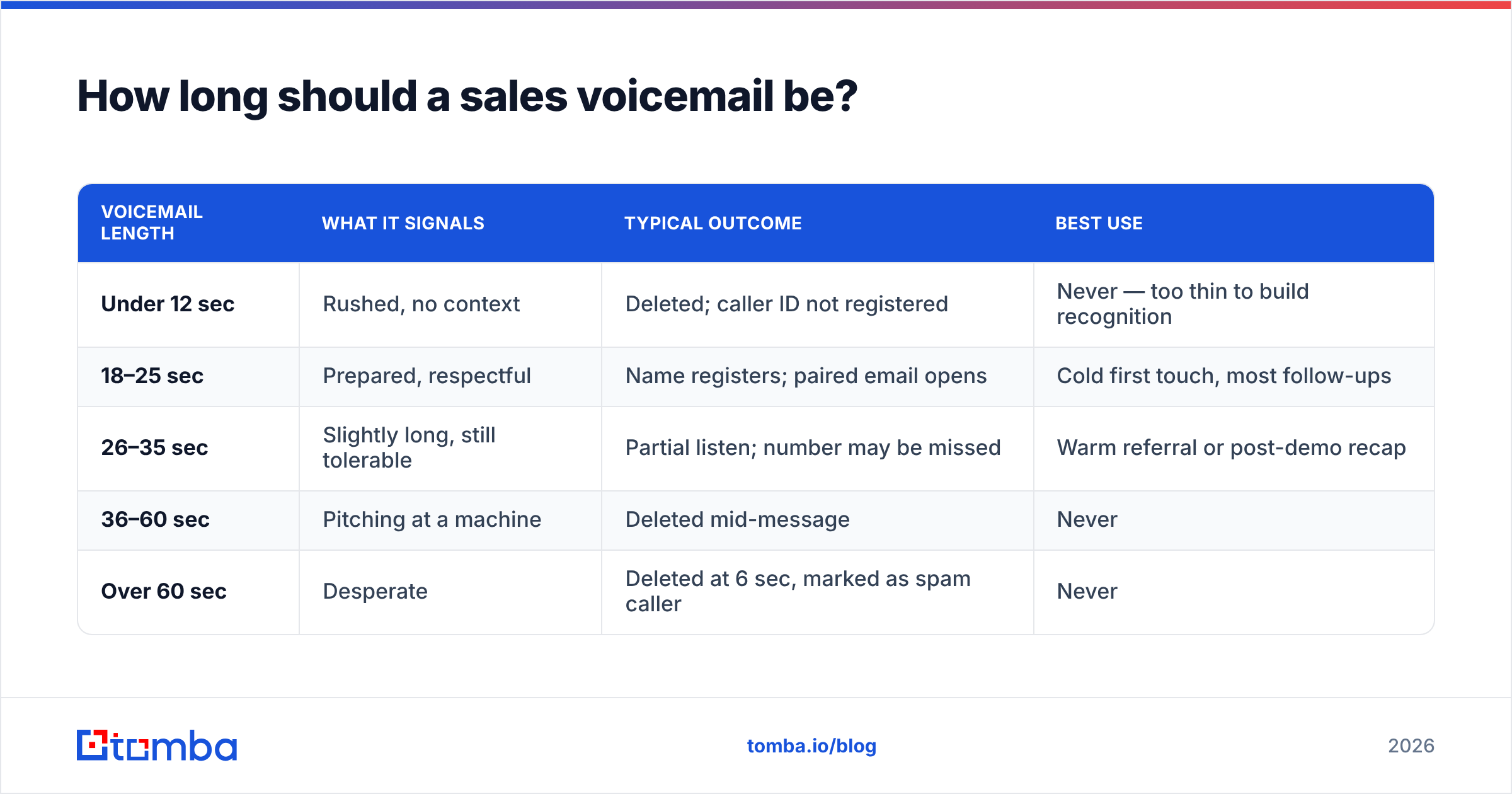
Between 18 and 25 seconds. That is roughly 55 to 75 spoken words at a normal pace.
Here is why the ceiling is real: a prospect listening to voicemail is deciding whether to delete within the first four to five seconds. If they get past that, they are giving you a short leash. Every second past 30 raises the odds they thumb the delete key mid-sentence — and the delete usually happens right before you say your phone number, because the number is always last.
| Voicemail length | What it signals | Typical outcome | Best use |
|---|---|---|---|
| Under 12 sec | Rushed, no context | Deleted; caller ID not registered | Never — too thin to build recognition |
| 18–25 sec | Prepared, respectful | Name registers; paired email opens | Cold first touch, most follow-ups |
| 26–35 sec | Slightly long, still tolerable | Partial listen; number may be missed | Warm referral or post-demo recap |
| 36–60 sec | Pitching at a machine | Deleted mid-message | Never |
| Over 60 sec | Desperate | Deleted at 6 sec, marked as spam caller | Never |
Time yourself on a stopwatch for a week. Almost every rep who thinks they leave 20-second voicemails is actually leaving 45-second ones — the pauses and self-corrections add up faster than you think.
What is the structure of a voicemail that gets returned?#
Four parts, in this order, every time. The order is not stylistic — it is triage. Each part answers the question the prospect is asking at that exact second.
- Identity (3–4 seconds). "Hi Dana, this is Marcus at Northwind." Say your first name clearly and your company once. Do not say your title. Nobody has ever returned a call because they were impressed by "Senior Enterprise Account Executive."
- Relevance hook (6–8 seconds). One sentence that could only apply to them. A trigger event, a mutual connection, a specific line from their job posting, a change on their site. "I saw you're hiring three SDRs in Austin this quarter" beats any value proposition you can write.
- The ask (5–6 seconds). One concrete, small request. Not "let's find time to explore synergies." Try: "I've got one question about how you're handling data hygiene for that team — worth two minutes?"
- Number, said twice, slowly (5–6 seconds). "You can reach me at 512-555-0142. That's 512-555-0142." Slow down by roughly 30% for the digits. This is the single most-skipped step and the most common reason a motivated prospect fails to call back.
Then stop talking. No "looking forward to connecting." No "have a great rest of your week." The message ends on your number.
A script you can steal#
"Hi Dana, Marcus at Northwind. I saw the three SDR roles you posted in Austin last week — congrats on the expansion. I've got one question about how the new reps will be sourcing contact data, and I think it's a two-minute conversation. 512-555-0142. Again, 512-555-0142."
That is 23 seconds spoken at a normal pace. Read it out loud and time it. The relevance hook is the only part you rewrite per prospect; everything else is a template.
What kills a sales voicemail?#
Every one of these is common, and every one is fixable in a single call block.
- Opening with a question. "Hi, is this Dana?" is jarring on a recording. It reads as either a bot or someone who did not know who they were calling.
- Front-loading your company story. "We're a leading provider of..." is delete-bait. The prospect has no reason to care yet.
- Saying your number at speaking pace. Prospects replay voicemails an average of zero times when the number is unintelligible. They just move on.
- Mentioning it's your third attempt. "Third time trying to reach you" makes you sound like collections. It signals persistence without value.
- Vague asks. "I'd love to connect and learn more about your business" is a request for free labor. Ask for something specific and small.
- Recording in a noisy room. Background chatter is a credibility tax you pay on every message. Grab a headset and a quiet corner.
There is one more, and it is the expensive one: leaving a great voicemail at a number that does not belong to your prospect. Direct-dial data decays fast, and desk lines that route to a switchboard eat your message entirely. Validate the line before the call block — a quick pass through a phone validator tells you whether the number is live, mobile, or a dead landline before you spend the 90 seconds dialing and talking.
Should you leave a voicemail at all?#
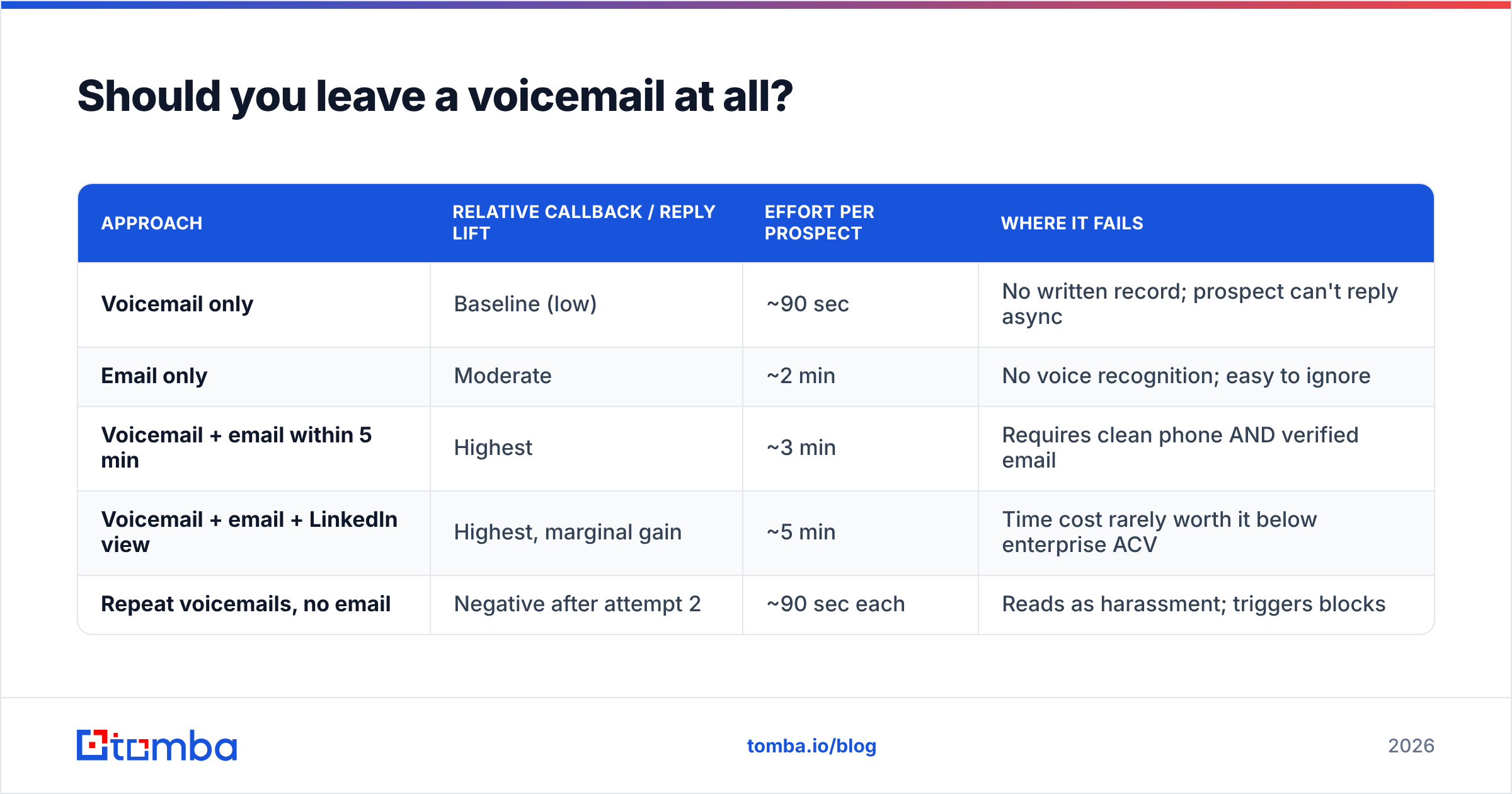
Yes, but only as half of a pair — and not on every attempt.
The data most sales orgs report internally is consistent: a voicemail alone converts poorly, an email alone converts moderately, and a voicemail followed within minutes by an email that references the voicemail converts materially better than either channel alone. HubSpot's sales research and most sequence tooling vendors point at the same pattern — channel stacking beats channel repetition.
| Approach | Relative callback / reply lift | Effort per prospect | Where it fails |
|---|---|---|---|
| Voicemail only | Baseline (low) | ~90 sec | No written record; prospect can't reply async |
| Email only | Moderate | ~2 min | No voice recognition; easy to ignore |
| Voicemail + email within 5 min | Highest | ~3 min | Requires clean phone AND verified email |
| Voicemail + email + LinkedIn view | Highest, marginal gain | ~5 min | Time cost rarely worth it below enterprise ACV |
| Repeat voicemails, no email | Negative after attempt 2 | ~90 sec each | Reads as harassment; triggers blocks |
The practical rule: leave a voicemail on attempts one, three, and five of a seven-touch sequence. On attempts two, four, six and seven, call and hang up without a message — the missed call itself is a soft touch — and let email and LinkedIn carry the load.

How do you pair the voicemail with an email?#
Send it within five minutes, while the voicemail notification is still on their lock screen. The email should do three things and nothing else.
- Subject line references the call, not your product. "Quick voicemail — the Austin SDR question" works. "Transform your sales pipeline" does not.
- First line closes the loop. "Just left you a voicemail — repeating the question here so you don't have to call back."
- Body is the same ask, in writing. Same relevance hook, same small question. Do not expand it into a pitch just because you have more room.
- One link maximum. A calendar link or nothing.
This only works if the email address is real. A bounced follow-up email does more damage than a skipped one, because bounces degrade your sender reputation and eventually cost you the inbox entirely. Run every address through an email verifier before the call block, not after — you want to know your pairing will land before you invest the phone time.
If you are building the call list from scratch, start from the company rather than the person: a domain search surfaces the email pattern and the people in the relevant department, and the email finder resolves a specific name to a verified address. Sequence it as list → verify → dial, never dial → hope.
How should voicemails change by call attempt?#
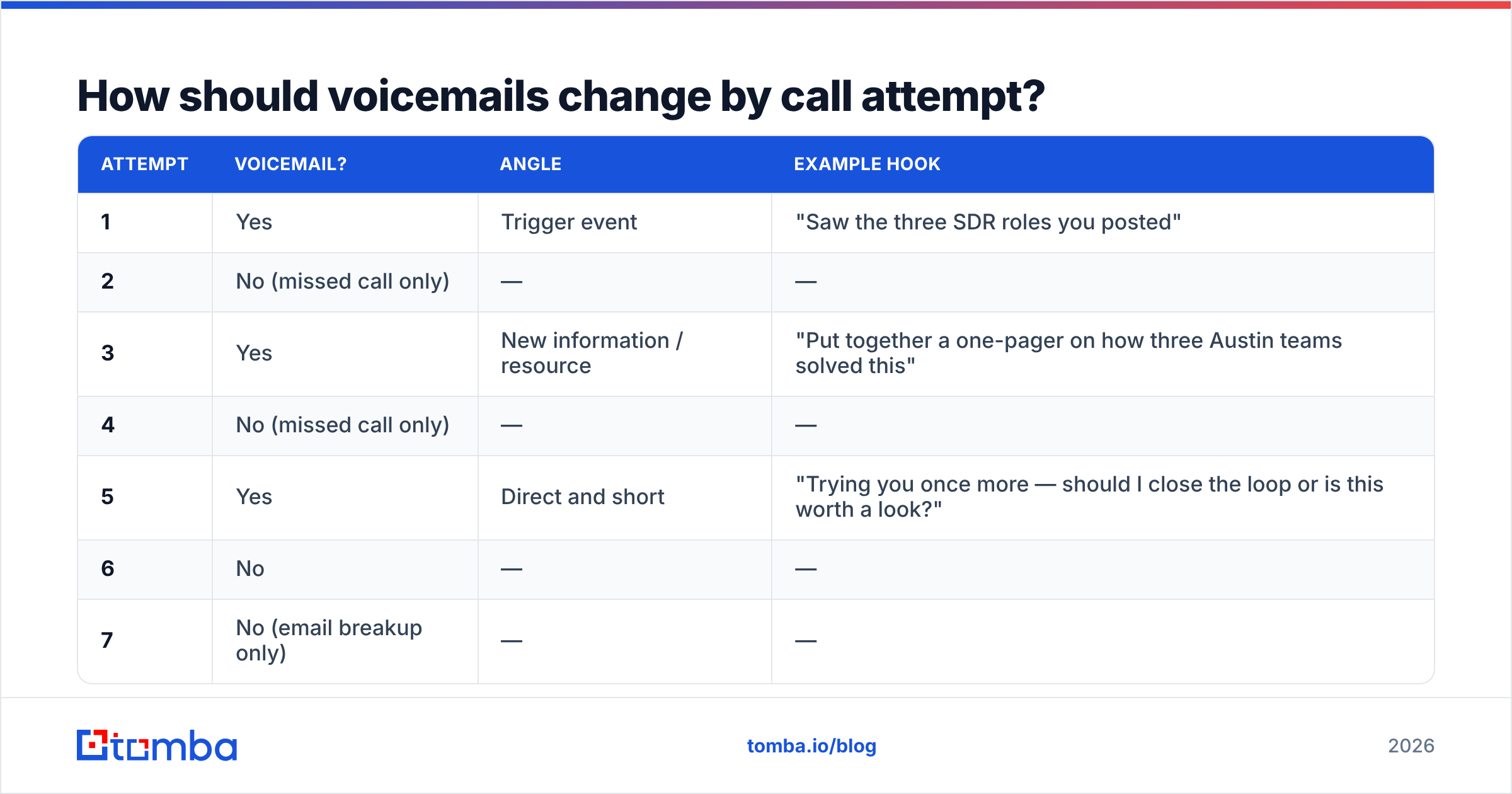
The message evolves across a sequence. Repeating the same voicemail three times is the fastest way to get your number blocked.
| Attempt | Voicemail? | Angle | Example hook |
|---|---|---|---|
| 1 | Yes | Trigger event | "Saw the three SDR roles you posted" |
| 2 | No (missed call only) | — | — |
| 3 | Yes | New information / resource | "Put together a one-pager on how three Austin teams solved this" |
| 4 | No (missed call only) | — | — |
| 5 | Yes | Direct and short | "Trying you once more — should I close the loop or is this worth a look?" |
| 6 | No | — | — |
| 7 | No (email breakup only) | — | — |
Attempt five is where most reps get squeamish and soften the language. Do the opposite. A clean "should I close this out?" gets more replies than any of the polite variants, because it gives the prospect an easy, low-guilt exit — and a meaningful share of people who were genuinely interested take that moment to say "no, wait."
What tools make voicemail sequences actually work?#
The voicemail itself needs no tooling. Everything around it does.
- Contact data. You need a direct dial and a verified email for the same person, sourced together. Splitting them across two vendors is where most reps lose the pairing.
- Voicemail drop. Most modern dialers let you record a message once and drop it after the beep, saving 20 seconds per call. Use one generic drop for the "attempt five" message; record attempts one and three live so the hook stays personal.
- A dialer with local presence. Answer rates rise measurably when the caller ID matches the prospect's area code, though check the rules in your jurisdiction before enabling it.
- CRM logging. If the voicemail is not logged, the paired email never gets sent. Wire the dialer to your CRM so the follow-up task auto-creates.
On the data side, the landscape splits into two camps. All-in-one platforms like Apollo or ZoomInfo bundle phone data with a dialer and sequencer, which is convenient but expensive at scale and often patchy on direct dials outside North America. Focused data providers — Tomba, Findymail, BookYourData — do the sourcing and verification well and let you bring your own dialer. BookYourData in particular is a solid fit if you want to buy a pre-built, verified list by title and geography rather than assemble one. Tomba's angle is search-and-verify on demand, with a free tier of 25 searches per month, Starter at $49/mo, Growth at $99/mo, and Pro at $249/mo — plus a Tomba API if you want the enrichment step inside your own call-prep script.
You can compare tools yourself on G2's sales intelligence category rather than taking any vendor's word for coverage. The number that matters for voicemail work is direct-dial fill rate in your specific geography — ask for it on a sample of 100 of your own accounts, not the vendor's demo list.
How do you practice this without burning prospects?#
Record yourself for a week. That is the whole method, and almost nobody does it.
Leave five voicemails on your own phone using your actual scripts. Play them back the next morning when you have forgotten what you said. You will hear the things prospects hear: the mumbled company name, the number recited at auction-caller speed, the three seconds of dead air where you looked at your notes, the upward inflection that makes your ask sound like an apology.
Fix one thing per week. Week one, just the phone number pacing. Week two, cut the message to 25 seconds. Week three, make every hook prospect-specific. Compounding small fixes beats memorizing a new script.
Then track two numbers in your CRM: voicemails left, and replies to the paired email within 48 hours. That second number is your real voicemail performance metric. If it does not move after three weeks of script work, the problem is not the voicemail — it is the list. Bad-fit prospects do not call back no matter how good the 23 seconds were.
The bottom line#
A sales voicemail is 23 seconds of recognition-building that makes your email work harder. Keep the structure fixed, personalize only the hook, say your number twice, and never leave one without a matching email five minutes behind it. Stop measuring callbacks and start measuring paired-email replies.
None of it matters if the number is dead or the email bounces. Before your next call block, build the list properly: use the Tomba Email Finder to resolve every name on your target account list to a verified, deliverable email address, so the follow-up that actually earns the meeting lands in the inbox instead of the void. Start on the free tier — 25 searches a month is enough to test the voicemail-plus-email pairing on a real account list before you commit to a plan.
Related guides#
// get started
Find, verify and enrich your first contacts today
Start on the free plan with 25 searches a month, then scale when your team is ready.
Free plan · No credit card required · GDPR & CCPA
Get the Tomba newsletter
Product and data updates
// about the author