How to Leave a Voicemail That Gets a Callback in 2026
Most B2B voicemails get deleted before the second sentence. Here is the 18-second structure, the exact scripts, and the follow-up sequence that turns an ignored ring-out into a returned call.
TL;DR
- A sales voicemail is not a pitch. It is a 15-25 second message whose only job is to make the next touch (your email, your second call) feel expected instead of cold.
- The structure that works is fixed: name, company, one specific reason you called this person, a single reference point, your number twice, done.
- Voicemail alone converts poorly. Voicemail paired with an email sent within five minutes is where the lift actually comes from — the message becomes a "call plus context" combo, not a stray ring-out.
- Speed, clarity of the callback number, and a reason tied to the prospect's world beat any clever hook. Reading a script word-for-word is what makes you sound like a robot, not having one.
- Before any of this matters, the number has to be right and the follow-up email has to land. Bad phone data and unverified emails kill more voicemail sequences than bad wording does.
Why do most sales voicemails never get returned?#
Because they are structurally identical to every other one your prospect deleted this week.
The typical B2B decision-maker gets a handful of unsolicited voicemails a week, and most of them open the same way: a slow "Hi, this is ___ calling from ___, I hope you're doing well." By the time the caller reaches an actual reason, the listener has already tapped delete. Voicemail systems make that trivially easy — most mobile carriers and unified-comms platforms let you skim visual transcripts, so your message competes as text before it competes as audio.
Three things are actually going wrong in the average message:
The first is length. Reps talk for 45-60 seconds because silence feels awkward, and they use that time to explain their product. Nobody returns a call to hear more about a product they did not ask about.
The second is the ask. Most voicemails end with "give me a call back when you get a chance" — a request that costs the listener effort and gives them nothing in return. It also puts the burden of scheduling on the busiest person in the exchange.
The third is that the voicemail travels alone. A voicemail with no matching email is a message from a stranger with no way to check who you are. A voicemail that is followed within minutes by an email referencing the same thing becomes a pattern the prospect recognizes.
If you have been leaving 60-second product summaries and wondering why the callback column in your CRM is empty, that is the whole answer. The fix is boring and mechanical.
What makes a voicemail worth returning?#
Five elements, and they are not interchangeable. Drop one and the message loses its reason to exist.
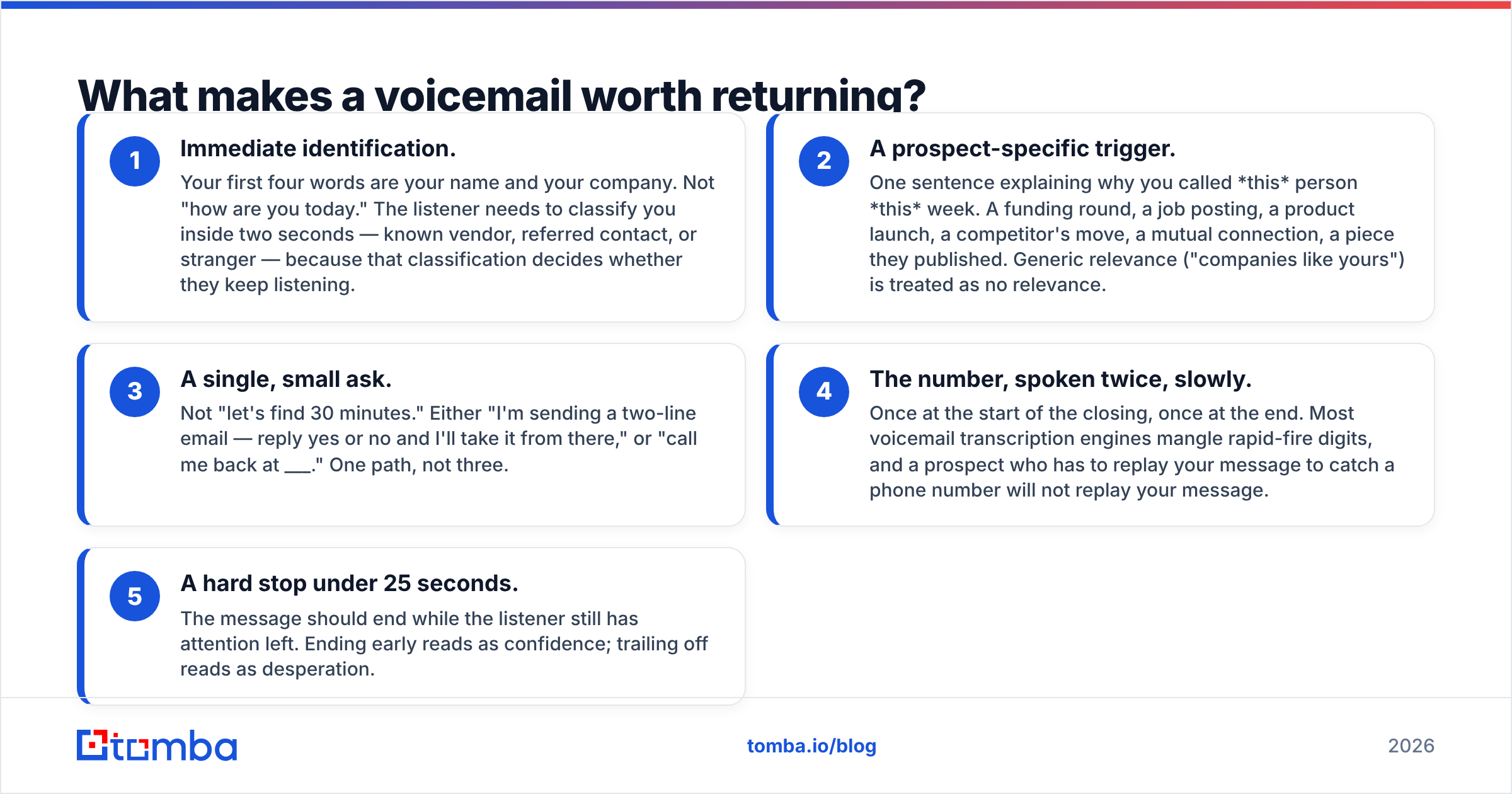
- Immediate identification. Your first four words are your name and your company. Not "how are you today." The listener needs to classify you inside two seconds — known vendor, referred contact, or stranger — because that classification decides whether they keep listening.
- A prospect-specific trigger. One sentence explaining why you called this person this week. A funding round, a job posting, a product launch, a competitor's move, a mutual connection, a piece they published. Generic relevance ("companies like yours") is treated as no relevance.
- A single, small ask. Not "let's find 30 minutes." Either "I'm sending a two-line email — reply yes or no and I'll take it from there," or "call me back at ___." One path, not three.
- The number, spoken twice, slowly. Once at the start of the closing, once at the end. Most voicemail transcription engines mangle rapid-fire digits, and a prospect who has to replay your message to catch a phone number will not replay your message.
- A hard stop under 25 seconds. The message should end while the listener still has attention left. Ending early reads as confidence; trailing off reads as desperation.
That is the entire skill. Everything else — tone, energy, time of day — is optimization on top of a structure that either exists or does not.
How long should a sales voicemail be?#
Between 15 and 25 seconds, and closer to 18 than 25.
The reasoning is mechanical rather than mystical. At a normal speaking pace of roughly 150 words per minute, 18 seconds gives you about 45 words. Forty-five words is enough for your name, your company, one specific reason, one ask, and your number twice. It is not enough for a value proposition, and that constraint is the point — it forces the pitch out of the message.
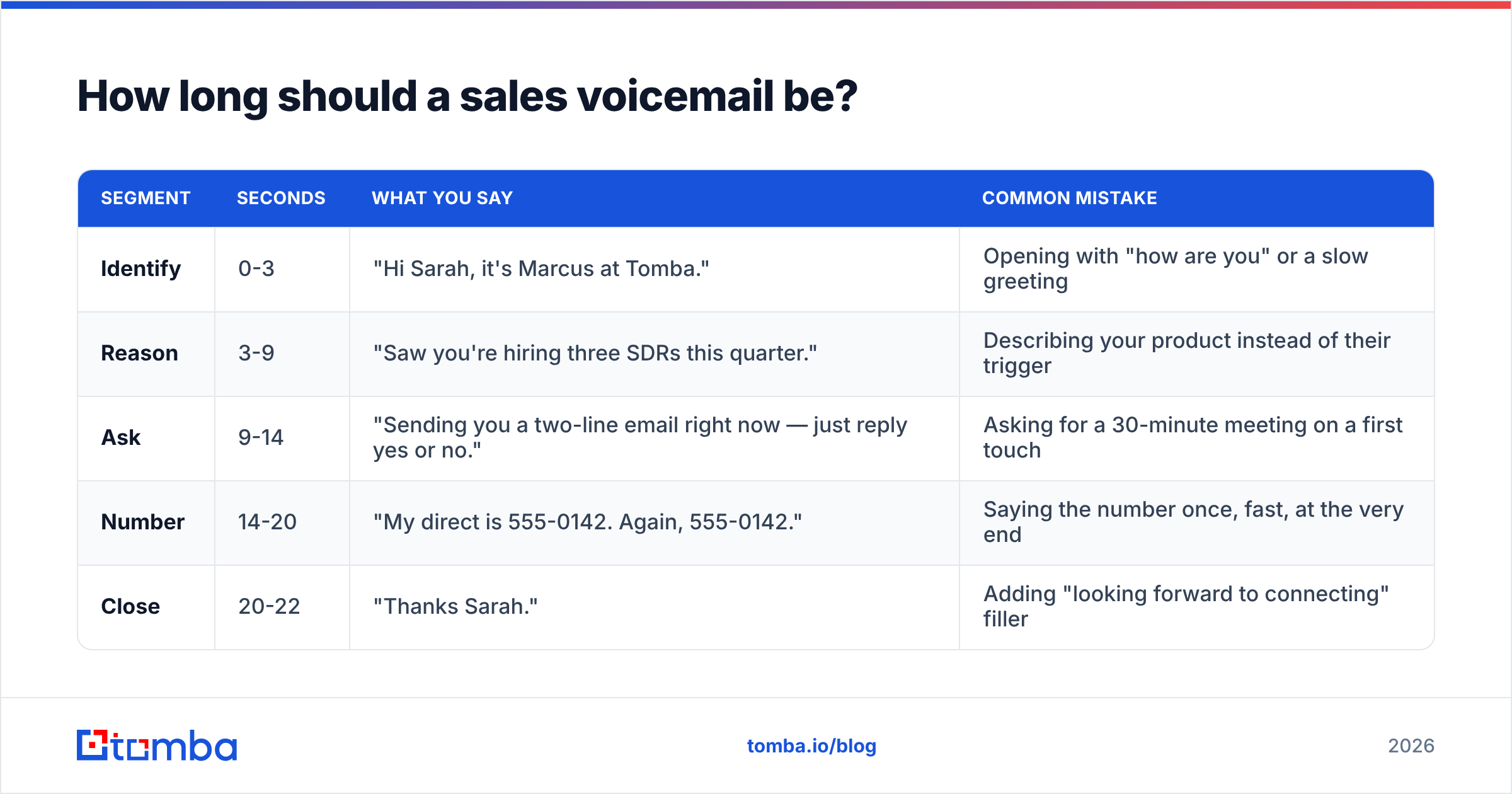
Here is what the seconds actually buy you:
| Segment | Seconds | What you say | Common mistake |
|---|---|---|---|
| Identify | 0-3 | "Hi Sarah, it's Marcus at Tomba." | Opening with "how are you" or a slow greeting |
| Reason | 3-9 | "Saw you're hiring three SDRs this quarter." | Describing your product instead of their trigger |
| Ask | 9-14 | "Sending you a two-line email right now — just reply yes or no." | Asking for a 30-minute meeting on a first touch |
| Number | 14-20 | "My direct is 555-0142. Again, 555-0142." | Saying the number once, fast, at the very end |
| Close | 20-22 | "Thanks Sarah." | Adding "looking forward to connecting" filler |
Every second past 25 is spent lowering the odds that anything before it gets heard. If your message consistently runs long, the problem is almost always that you are explaining the product in the Reason slot.
What is a voicemail script that actually works?#
Three scripts, mapped to three situations. Adapt the wording — do not read them verbatim, because scripted cadence is audible and it is the thing that makes prospects hang up on the follow-up call.
Script 1 — Trigger event (highest callback rate)
"Hi Sarah, Marcus at Tomba. Saw the three SDR roles you posted last week — the teams I talk to usually hit a data problem right around that hire. I'm sending a two-line email in the next minute; reply yes or no and I'll stop there. My direct is 555-0142. Again, 555-0142. Thanks Sarah."
Script 2 — Referral or mutual connection
"Hi Sarah, Marcus at Tomba. Dana Klein at Northbeam suggested I reach out — she mentioned you were rebuilding outbound this quarter. Email's on its way with what she and I discussed. Number's 555-0142, that's 555-0142. Talk soon."
Script 3 — Second or third attempt (no reply yet)
"Sarah, Marcus at Tomba again — last one from me. I sent over the two-line email on Tuesday about the SDR ramp. If it's not a fit, a one-word reply closes the loop and I'll leave you alone. 555-0142. Thanks."
Notice what is missing from all three: no feature list, no "quick question," no "I wanted to see if you'd be interested in," and no request for a meeting. The voicemail sells the email, not the product. That is a far smaller ask, and small asks get answered.
For the email that lands two minutes later, keep it to the same discipline — same trigger, same one-line ask. If you want a starting point, Tomba's cold email templates library covers the trigger-event and referral patterns that pair with these scripts.
Should you leave a voicemail at all, or just send an email?#
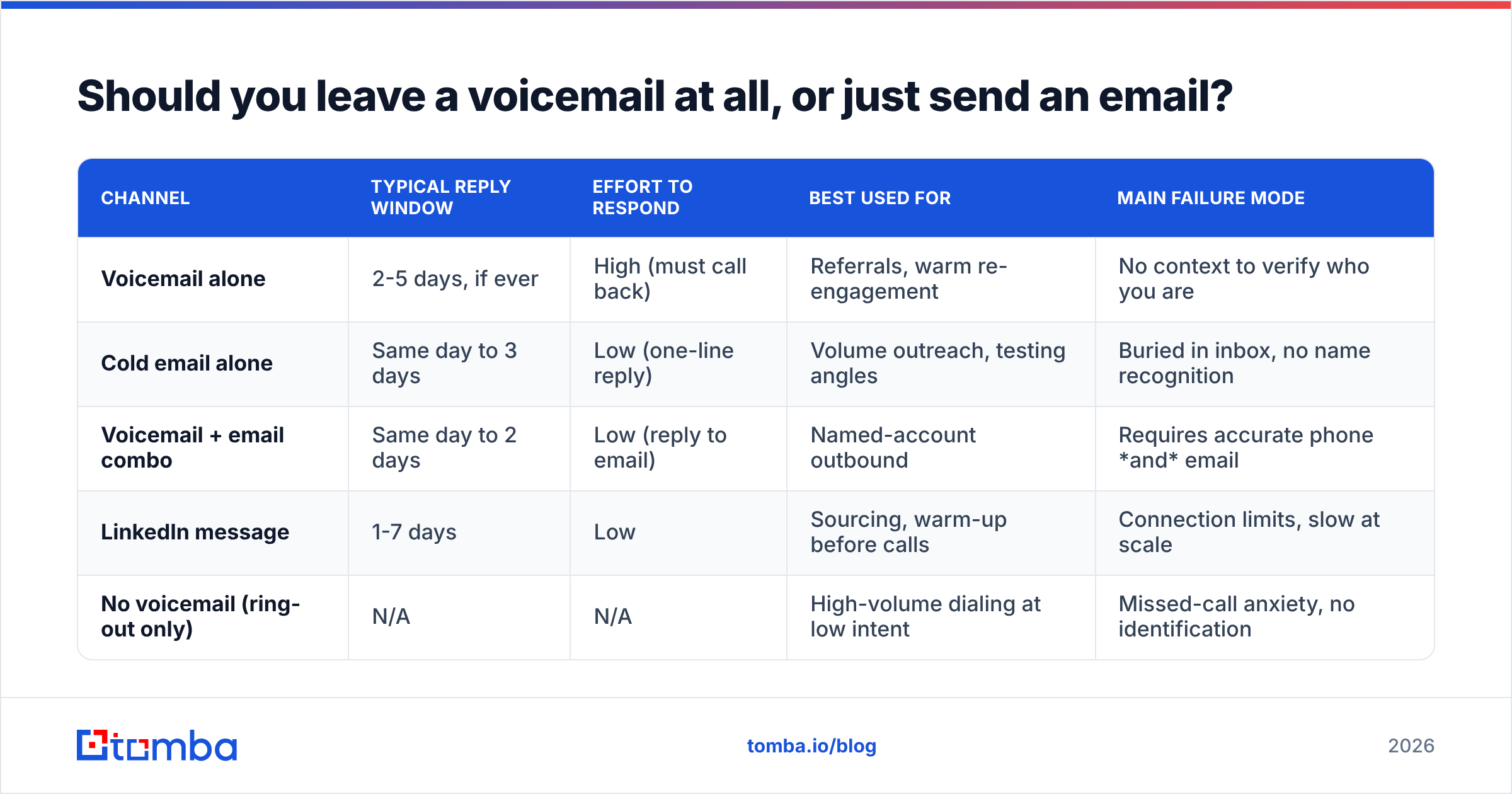
Both, in that order, within the same five-minute window. The comparison below is where most teams' assumptions break.
| Channel | Typical reply window | Effort to respond | Best used for | Main failure mode |
|---|---|---|---|---|
| Voicemail alone | 2-5 days, if ever | High (must call back) | Referrals, warm re-engagement | No context to verify who you are |
| Cold email alone | Same day to 3 days | Low (one-line reply) | Volume outreach, testing angles | Buried in inbox, no name recognition |
| Voicemail + email combo | Same day to 2 days | Low (reply to email) | Named-account outbound | Requires accurate phone and email |
| LinkedIn message | 1-7 days | Low | Sourcing, warm-up before calls | Connection limits, slow at scale |
| No voicemail (ring-out only) | N/A | N/A | High-volume dialing at low intent | Missed-call anxiety, no identification |
The combo wins because it splits the labor correctly. The voicemail creates name recognition and a reason. The email carries the low-effort reply path. Neither does both jobs well alone.
Some high-volume teams deliberately skip voicemail and rely on repeat dialing plus email. That is defensible when your list is enormous and your ACV is small. For named-account outbound where you have 200 targets and each one matters, skipping voicemail throws away your cheapest identification touch.

When is the best time to leave a voicemail?#
Early morning and late afternoon, on Tuesday through Thursday. The pattern is consistent across most B2B sales research — including the call-timing analyses HubSpot's sales blog has published repeatedly — and the mechanism is straightforward: before 9am and after 4pm, prospects are between meetings rather than in them, and they are more likely to be triaging their own phone rather than ignoring it.
Two practical adjustments:
- Match the time zone, not your calendar. A 4:30pm call from your desk is 7:30pm for a prospect two zones east. Segment your dial lists by zone before you build the day.
- Leave the voicemail on attempt one, not attempt four. Some teams hold the voicemail until several dials in. That wastes the identification value of the first touch and makes attempts two and three cold all over again.
Do not obsess over minute-level timing. The gap between a good message at a mediocre hour and a bad message at the perfect hour is not close.
How do you follow up after leaving a voicemail?#
Treat the voicemail as touch one of a five-touch sequence, not as an event that ends when you hang up.
- Minute 0 — Voicemail, 18 seconds, referencing the trigger.
- Minute 2 — Email with subject line matching the voicemail reference ("the three SDR roles"). Two lines. One yes/no ask.
- Day 3 — Second dial, different time of day. No voicemail this time.
- Day 5 — Second email, one new piece of information, same ask.
- Day 9 — Final voicemail using Script 3, explicitly closing the loop.
Log every attempt against the contact record so the sequence is visible to anyone who picks up the account later. If your dials, voicemails, and emails live in three separate tools with no shared record, your response rate numbers are guesses.
The single biggest lever in that sequence is the two-minute email, and it only works if the address is real. A bounced follow-up turns your voicemail into an orphan — the prospect heard a name, went looking for the email you promised, found nothing, and moved on. Running your list through an email verifier before the sequence starts costs a few cents per contact and prevents that failure entirely.
What kills callback rates fastest?#
- The wrong number. Main switchboards, disconnected direct lines, and numbers belonging to someone who left 18 months ago. If a third of your dials hit dead lines, no script fixes your results. Validate the list first — a phone validator check on line status and type takes seconds per record and tells you whether you are dialing a mobile, a landline, or nothing at all.
- Saying your number once. The most common single mistake. Say it twice, digit by digit, at conversational speed.
- Talking about yourself for the first ten seconds. "We're a platform that helps companies…" is an instant delete. Lead with their trigger.
- Asking for a meeting on touch one. Too big an ask from a stranger. Ask for a reply.
- Reading the script. Practice it until you can say it three different ways. The structure should be memorized; the wording should not.
- No email within five minutes. The voicemail's promise expires fast.
None of these are subtle. They are just easy to keep doing because nobody hears their own voicemails.
How do you get the direct dials in the first place?#
You cannot leave a good voicemail on a number you do not have, and switchboard numbers rarely convert into direct conversations.
Most teams assemble phone coverage from three sources: their CRM's existing records (often stale — Gartner's sales research consistently flags CRM data decay as a top pipeline risk), inbound form fills, and a B2B data provider. The provider layer is where quality varies most. Coverage rates for direct dials in B2B datasets are meaningfully lower than for work emails, which is why the strongest sequences use phone as the identification touch and email as the reply channel.
If you are building that layer, a phone finder that returns direct numbers alongside verified work emails keeps both halves of the combo in one record, and contact enrichment fills the trigger fields — headcount, role, tech stack — that make your 6-second Reason slot specific instead of generic.
If you want the mechanics of voicemail itself rather than the sales use case, the general background on voicemail systems explains why transcription accuracy varies so much by carrier — which is worth knowing before you decide how fast to say your number.
Start with data that dials#
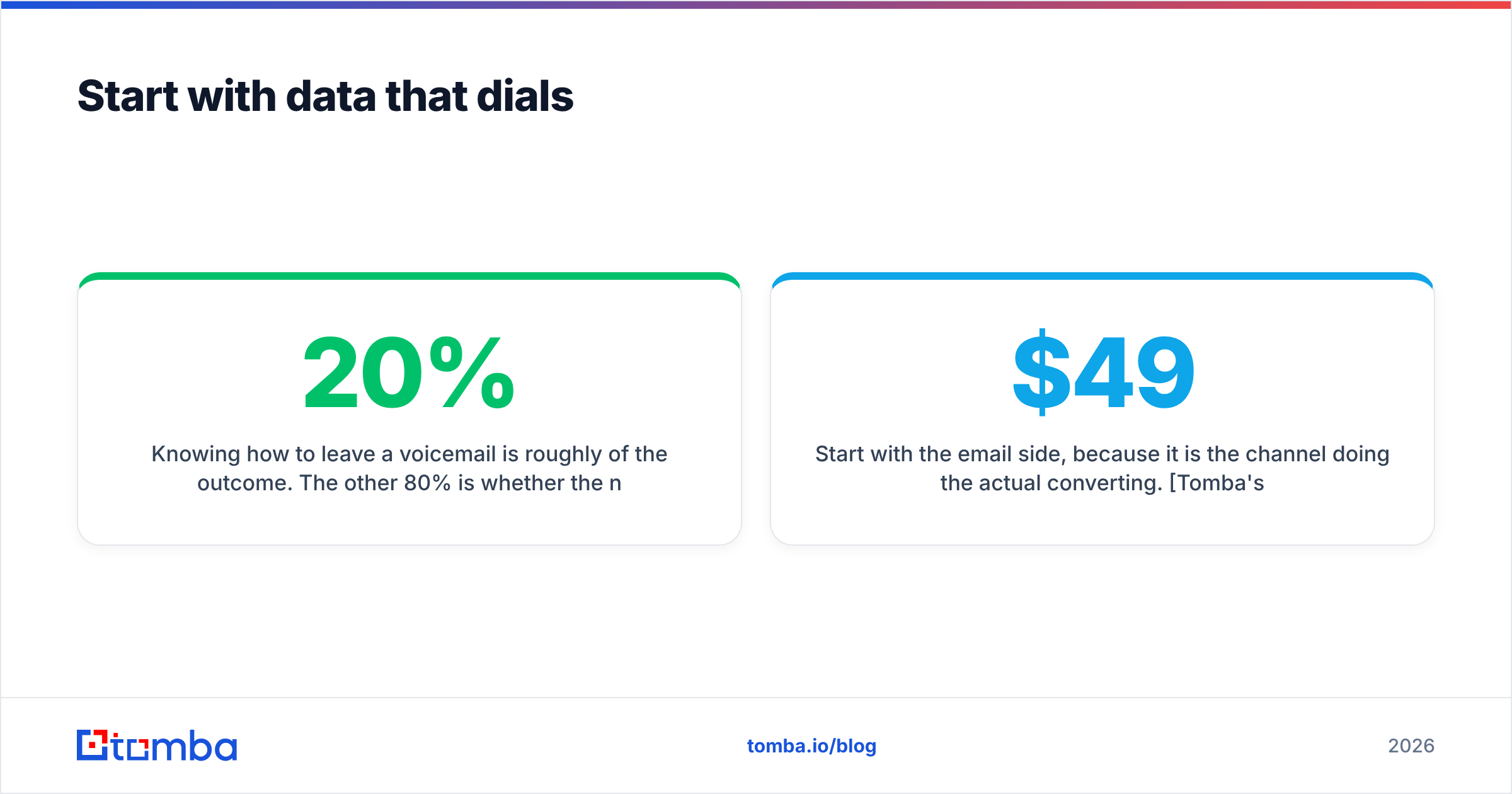
Knowing how to leave a voicemail is roughly 20% of the outcome. The other 80% is whether the number connects and whether the follow-up email lands in an inbox that exists.
Start with the email side, because it is the channel doing the actual converting. Tomba's Email Finder pulls verified work emails by name, domain, or company so the two-minute follow-up you promised on the voicemail actually arrives. The free tier gives you 25 searches a month to test the workflow on real accounts; paid plans start at $49/mo, with Growth at $99/mo and Pro at $249/mo — full Tomba pricing is public. Build the list, verify it, then go leave 18-second voicemails on numbers that ring.
Related guides#
// get started
Find, verify and enrich your first contacts today
Start on the free plan with 25 searches a month, then scale when your team is ready.
Free plan · No credit card required · GDPR & CCPA
// about the author