How to Leverage Intent Data for Sales: A 2026 Playbook
Intent data tells you who is researching your category right now. Here is how to source it, score it, route it, and turn a spike into a booked meeting in under 48 hours.
TL;DR
- Intent data is a probability signal, not a buying confirmation. Treat a surge as "worth a 20-minute research pass," not "send the demo link."
- Three sources matter: first-party (your site, docs, pricing page), second-party (review sites like G2), and third-party (publisher co-op networks). First-party converts best; third-party gives you reach.
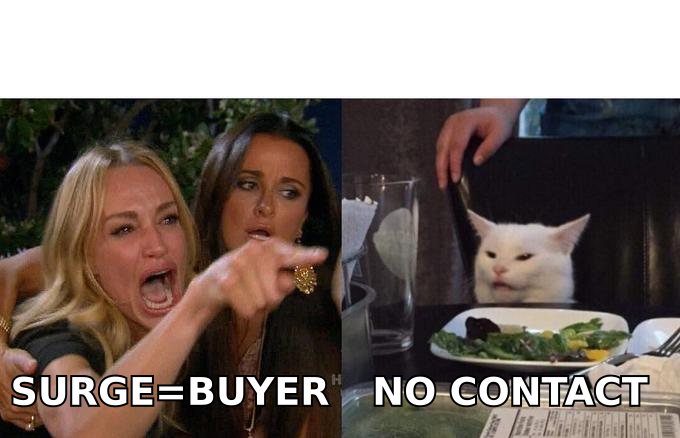
- The whole system dies at the contact layer. A surging account with no verified email or direct dial is a report, not a pipeline.
- Score accounts on recency + topic fit + ICP match + buying-committee breadth, not raw signal volume. Volume rewards big companies that browse everything.
- The 48-hour window is real. Response rates on intent-triggered outreach collapse once the research spike ends and a shortlist is formed.
What is intent data, and why does it break so often?#
Intent data is the digital breadcrumb trail buyers leave while researching a purchase before they ever talk to you. Someone reads three comparison posts about email verification, downloads a deliverability guide, checks pricing on two vendor sites, and asks a peer on LinkedIn. None of that reaches your CRM — but a lot of it is observable.
Here's the analogy that keeps teams honest: intent data is the security camera in a car dealership parking lot. It tells you a person circled the same SUV four times this week. It does not tell you their budget, whether they're buying for themselves, or whether they already signed elsewhere. Anyone who treats the footage as a signed contract will annoy a lot of browsers.
Technically, intent providers aggregate content consumption events across a publisher network, resolve the visitor's IP or cookie to a company, compare that company's topic consumption against its own historical baseline, and flag a "surge" when consumption exceeds that baseline by some threshold. The two words doing all the work are baseline and resolution. If the baseline is bad, everything looks like intent. If the IP-to-company resolution is bad, you're chasing the wrong logo entirely.
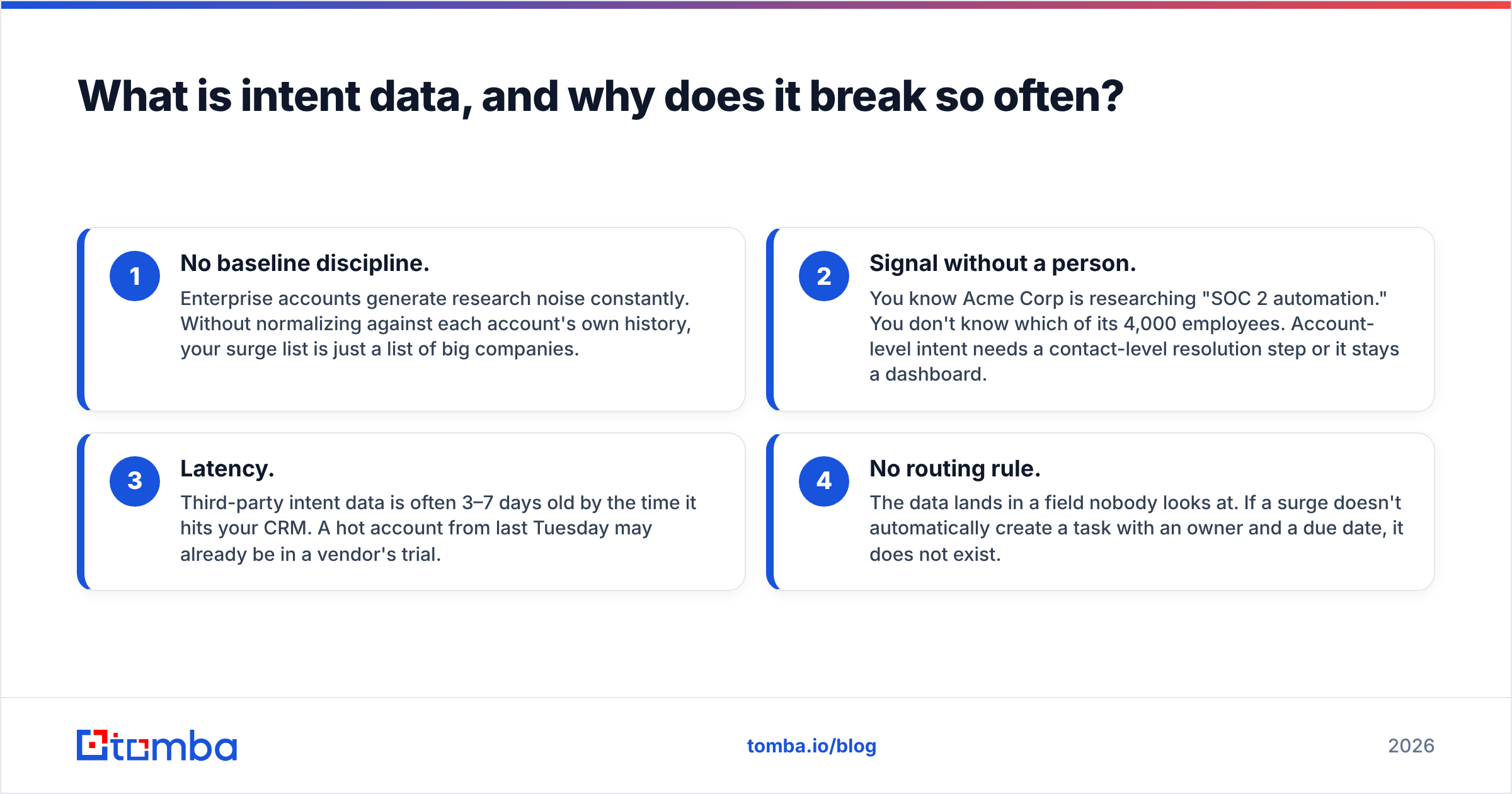
Most intent programs fail for one of four reasons:
- No baseline discipline. Enterprise accounts generate research noise constantly. Without normalizing against each account's own history, your surge list is just a list of big companies.
- Signal without a person. You know Acme Corp is researching "SOC 2 automation." You don't know which of its 4,000 employees. Account-level intent needs a contact-level resolution step or it stays a dashboard.
- Latency. Third-party intent data is often 3–7 days old by the time it hits your CRM. A hot account from last Tuesday may already be in a vendor's trial.
- No routing rule. The data lands in a field nobody looks at. If a surge doesn't automatically create a task with an owner and a due date, it does not exist.
What are the three types of intent data?#
The categories are not interchangeable. They differ in accuracy, volume, cost, and legal exposure.
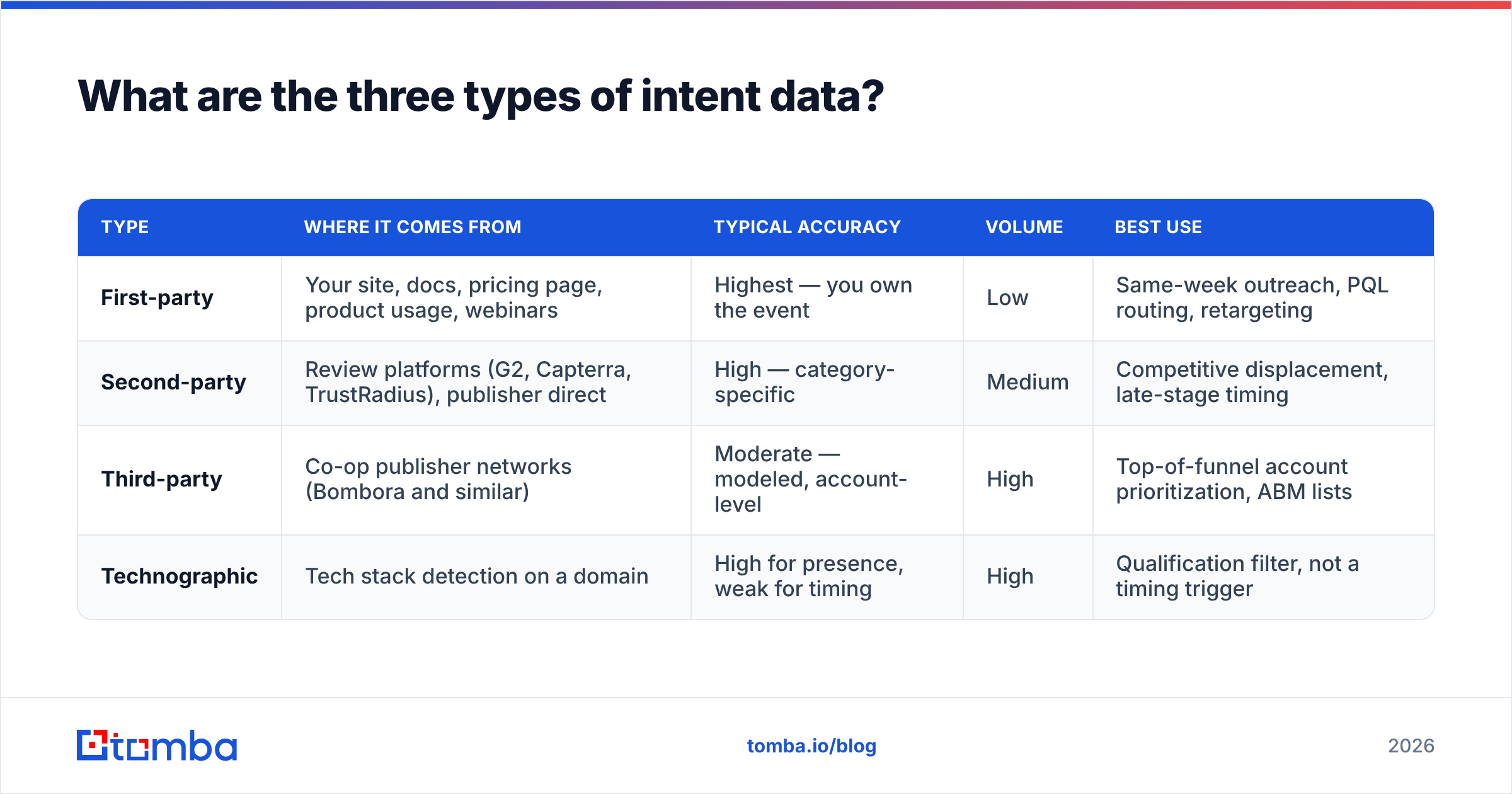
| Type | Where it comes from | Typical accuracy | Volume | Best use |
|---|---|---|---|---|
| First-party | Your site, docs, pricing page, product usage, webinars | Highest — you own the event | Low | Same-week outreach, PQL routing, retargeting |
| Second-party | Review platforms (G2, Capterra, TrustRadius), publisher direct | High — category-specific | Medium | Competitive displacement, late-stage timing |
| Third-party | Co-op publisher networks (Bombora and similar) | Moderate — modeled, account-level | High | Top-of-funnel account prioritization, ABM lists |
| Technographic | Tech stack detection on a domain | High for presence, weak for timing | High | Qualification filter, not a timing trigger |
First-party intent is the most underused asset in B2B. Your pricing page is the single highest-intent URL you own, and most teams do nothing with the anonymous 97% who visit it. Visitor identification closes that gap — a website visitor reveal layer resolves anonymous traffic to companies so a pricing-page visit becomes a named account rather than a Google Analytics number.
Second-party intent from review sites is the sharpest late-stage signal available. When someone compares you against two named competitors on G2, they are usually 60–80% through their evaluation. The downside is cost per account and thin volume outside big categories.
Third-party intent buys you reach. It's modeled data, resolved at the account level, and it will include false positives — a marketing intern doing a school project, a competitor doing research, a consultancy evaluating on behalf of a client you'll never see. Budget for a 30–50% noise rate and design your workflow so noise costs you a research minute rather than a burned sequence.

How do you score intent signals so the list is actually useful?#
Raw surge scores are vendor marketing. Build your own composite and you'll cut your working list by 80% without losing real opportunities.
Score each surging account across four dimensions:
- Recency weight — a signal from the last 72 hours is worth roughly 3x one from 14 days ago. Decay it explicitly; don't let a stale surge sit at full value.
- Topic proximity — "cold email deliverability" is adjacent to your product; "email marketing" is a category away. Maintain a tight topic whitelist of 8–15 terms rather than subscribing to 60.
- ICP match — headcount, industry, region, funding stage, tech stack. An out-of-ICP surge is not an opportunity, it's a distraction with good manners.
- Committee breadth — how many distinct people or job functions at the account are researching. One person reading is curiosity. Four people across security, ops, and finance is a project with a budget line.
A simple weighted formula that works in practice: score = (recency × 0.35) + (topic_fit × 0.30) + (icp_match × 0.25) + (breadth × 0.10). Anything above 70 goes to a human today. 40–70 goes to a nurture track. Below 40 gets ignored, permanently — and you should be comfortable ignoring most of your data.
One rule that saves teams from themselves: never let intent data override ICP. A surging account that can't afford you or can't legally buy from you is still a bad account. Intent changes timing, not fit.
Which intent data providers should you compare?#
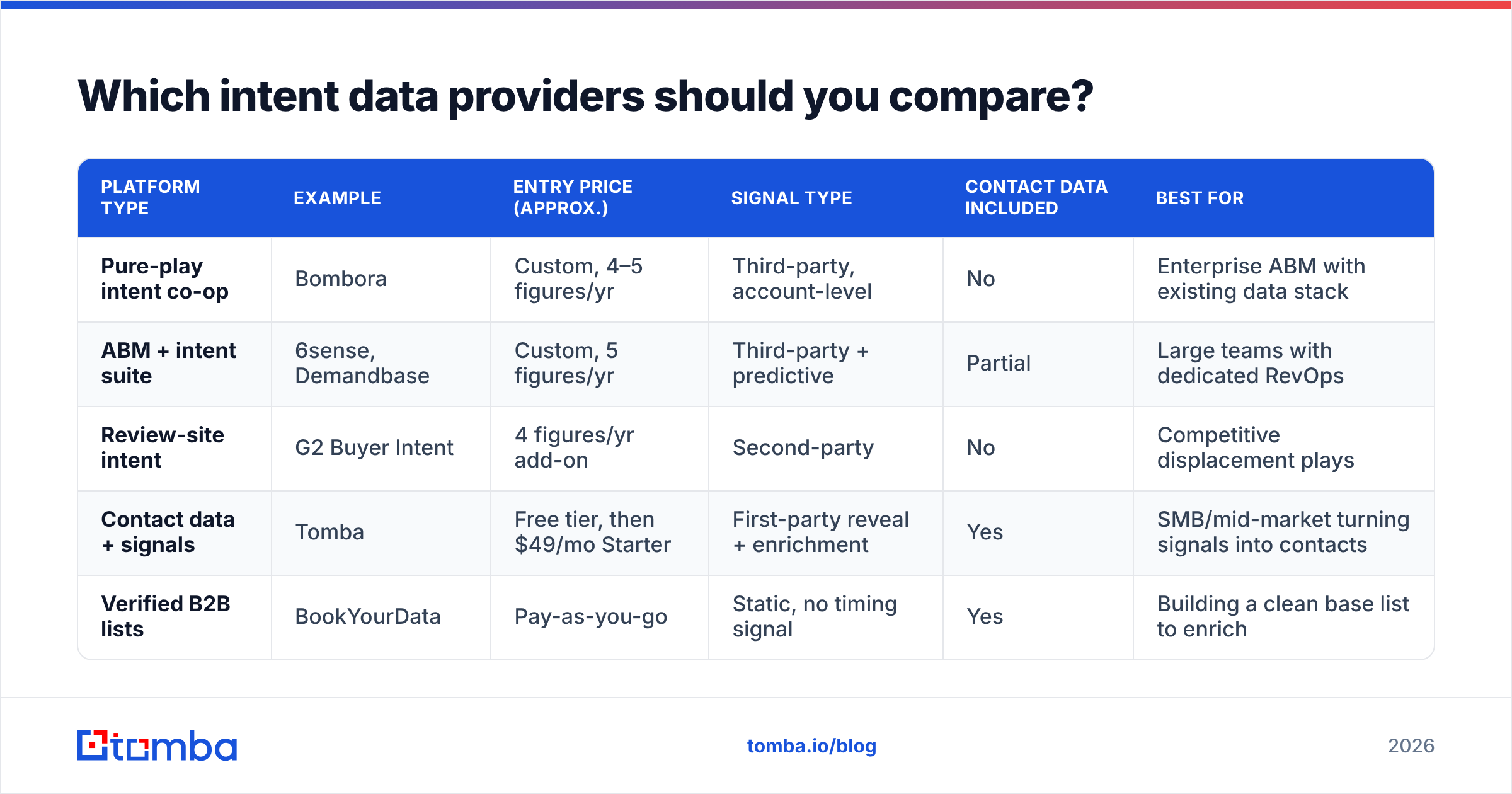
The market splits into pure-play intent networks, ABM platforms with intent bundled in, and contact-data platforms that layer signals on top. Here's how the categories actually stack up for a mid-market sales team.
| Platform type | Example | Entry price (approx.) | Signal type | Contact data included | Best for |
|---|---|---|---|---|---|
| Pure-play intent co-op | Bombora | Custom, 4–5 figures/yr | Third-party, account-level | No | Enterprise ABM with existing data stack |
| ABM + intent suite | 6sense, Demandbase | Custom, 5 figures/yr | Third-party + predictive | Partial | Large teams with dedicated RevOps |
| Review-site intent | G2 Buyer Intent | 4 figures/yr add-on | Second-party | No | Competitive displacement plays |
| Contact data + signals | Tomba | Free tier, then $49/mo Starter | First-party reveal + enrichment | Yes | SMB/mid-market turning signals into contacts |
| Verified B2B lists | BookYourData | Pay-as-you-go | Static, no timing signal | Yes | Building a clean base list to enrich |
Two honest notes. First, the enterprise ABM platforms are genuinely good and genuinely expensive; if you can't staff a RevOps person to tune them, you'll pay five figures for a dashboard. Second, none of the pure-play intent vendors solve your contact problem. BookYourData is a solid route to a clean, verified base list when you need coverage fast, and pairs naturally with a signal layer on top. Tomba sits at the resolution step — turning "Acme is surging" into "here are the four verified people at Acme who own this decision."
For a broader look at how enterprise platforms compare, see Tomba's 6sense alternative breakdown and Gartner's ABM platform research for analyst framing.
How do you turn an intent signal into a real contact?#
This is where most programs stall, and it's the least glamorous step. An account-level surge is a company name. A sales rep needs a person, a verified email, and ideally a phone number.
The resolution chain looks like this:
- Account → buying committee. Identify 3–6 relevant roles, not just the VP. For a deliverability purchase, that's the demand gen lead, the RevOps manager, the SDR manager, and sometimes IT.
- Committee → contact records. Run a domain search against the surging domain to pull the people and email pattern at that company in one pass.
- Contact → verified email. Never send to an unverified address on an intent play. You're deliberately emailing cold accounts at volume — bounce rate is your exposure. Run every address through an email verifier first, and use a catch-all verifier for domains that accept everything.
- Contact → phone. Intent-triggered calls outperform intent-triggered emails on high-score accounts. A phone finder step gives your callers a direct dial instead of a switchboard.
- Enrich and route. Push the record into your CRM with the signal metadata attached — topic, surge date, score — so the rep opens the task already knowing why.
The bounce risk deserves emphasis. Intent programs push reps to email accounts they have no relationship with, at speed. That combination is exactly how sender reputation gets destroyed. Verification isn't a nice-to-have here; it's the thing standing between an intent program and a blocked domain.
What does the 48-hour intent play look like?#
Speed is the entire edge. Here's a sequence that respects the signal without being creepy about it.
Hour 0–2 — Qualify. The signal fires. Check ICP fit, existing pipeline, and whether the account is already in a sequence. Kill it if any check fails. This takes 90 seconds per account when your CRM view is set up correctly.
Hour 2–6 — Resolve. Pull the buying committee, verify emails, grab direct dials. Batch this: resolving 30 accounts at once through a bulk email finder run beats doing it one at a time between calls.
Hour 6–24 — First touch. Lead with the topic, never the surveillance. Bad: "I saw your team was researching X." That reads as stalking and invites a privacy question you don't want. Good: a message about the specific problem the topic implies, sent to the person who owns it.
A working template shape:
Subject: the [specific process] problem at [Company]
[First name] — most [role] teams at [company size/stage] hit a wall when [specific symptom of the researched topic]. We fixed exactly that for [comparable company] by [one-sentence mechanism]. Worth 15 minutes, or is this already handled?
Hour 24–48 — Multi-thread. Call the primary contact. Email one adjacent role on the committee with a different angle. Engage on LinkedIn if there's a natural hook. Three channels, three distinct messages, no copy-paste across them.
Day 3–14 — Decay gracefully. If nothing lands, drop the account to a standard nurture cadence. Do not keep hammering a signal that has gone cold; you'll train the account to filter you.
For the messaging layer, HubSpot's sales research has solid benchmarks on cadence structure and response timing that are worth calibrating against.
What are the common mistakes and compliance traps?#
Mentioning the signal explicitly. Under GDPR and similar regimes, referencing observed browsing behavior in an outbound message can trigger a legitimate-interest challenge you have no good answer to. Use the signal to choose the topic and the timing. Never quote it back.
Buying too many topics. Teams subscribe to 40 topics because the price is the same, then drown. Eight tight topics beat 40 loose ones every time.
Treating intent as a lead source. It's a prioritization layer applied to accounts you already wanted. If intent data is generating your entire target list, your ICP definition is doing no work.
Skipping verification to move faster. The fastest way to make an intent program look like a failure is a 12% bounce rate in month two. Speed matters, but a bounced email is slower than no email.
No feedback loop. Track close rate by signal topic. Within a quarter you'll find that two or three topics drive nearly all your closed-won, and the rest are noise you're paying for. Cut them.
Ignoring first-party. Teams spend $30k on third-party intent while their own pricing page traffic goes unidentified. Fix the free signal before you buy the modeled one.
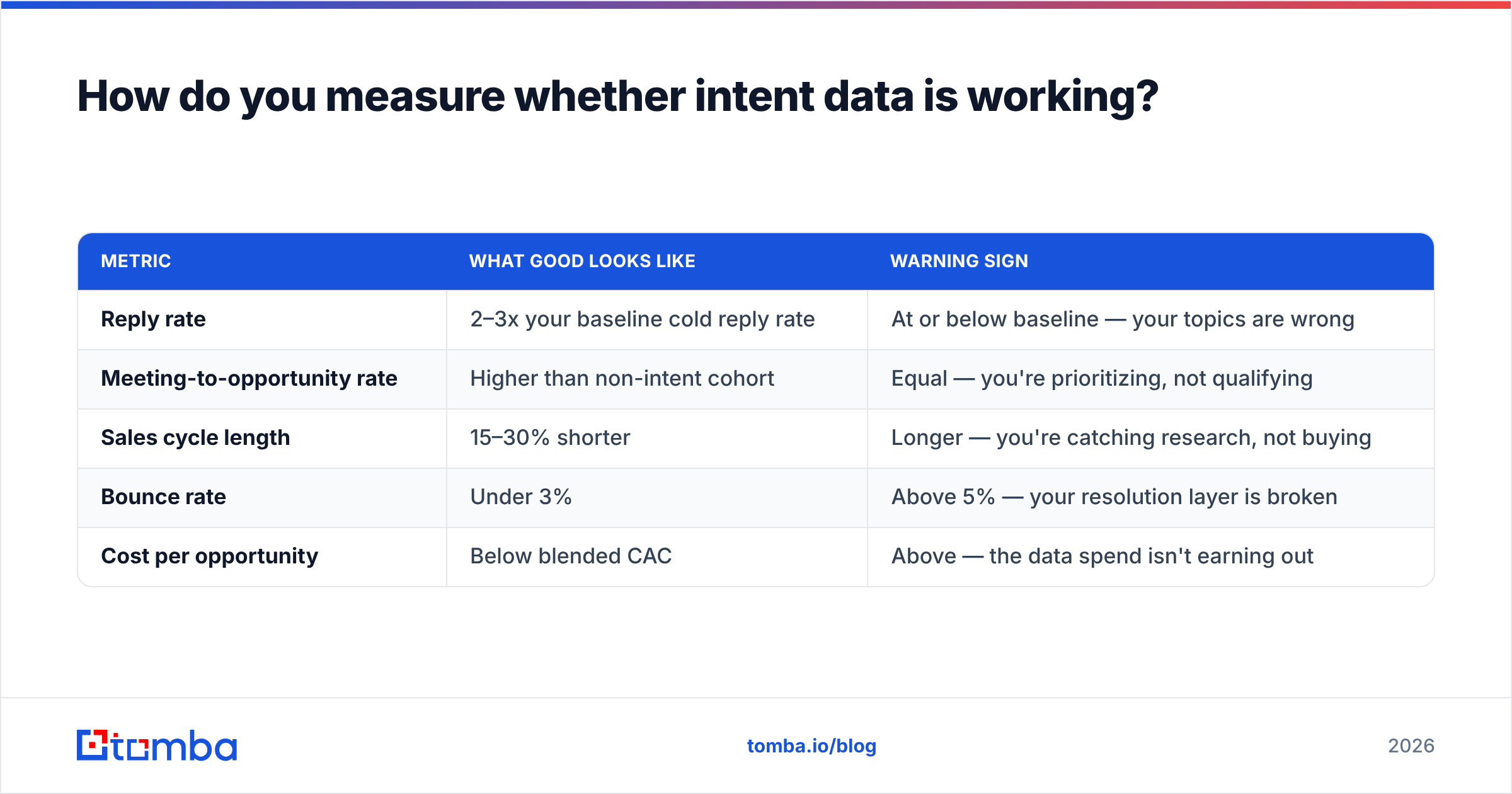
How do you measure whether intent data is working?#
Compare intent-sourced accounts against a control group of matched non-intent accounts on the same four metrics:
| Metric | What good looks like | Warning sign |
|---|---|---|
| Reply rate | 2–3x your baseline cold reply rate | At or below baseline — your topics are wrong |
| Meeting-to-opportunity rate | Higher than non-intent cohort | Equal — you're prioritizing, not qualifying |
| Sales cycle length | 15–30% shorter | Longer — you're catching research, not buying |
| Bounce rate | Under 3% | Above 5% — your resolution layer is broken |
| Cost per opportunity | Below blended CAC | Above — the data spend isn't earning out |
Run this comparison at 90 days, not 30. Intent programs need a full cycle before the numbers mean anything, and the first month is always contaminated by the backlog of accounts that were already warm.
If your response rate on intent-triggered outreach isn't meaningfully above your cold baseline, the problem is almost never the intent vendor. It's the resolution step, the message, or the delay between signal and send.
Where should you start if you have no intent budget?#
Start with first-party. It's free, it's yours, and it converts better than anything you can buy.
- Instrument your pricing, comparison, and docs pages as high-intent URLs.
- Add visitor identification so those sessions resolve to company names.
- Set a Slack alert for pricing-page visits from ICP-fit companies.
- Resolve each identified company to 3–4 verified contacts.
- Work the list within 24 hours.
That workflow costs a fraction of an enterprise intent contract and often outperforms it, because a pricing-page visit is a first-party fact rather than a modeled probability. Once it's producing pipeline consistently, layer third-party data on top to expand reach — not the other way around.
Ready to turn signals into conversations?#
Intent data without contact data is a very expensive report. The moment a surge fires, you need names, verified emails, and direct dials in minutes — not a ticket to an ops queue.
Tomba's Email Finder sits exactly at that step: point it at a surging domain and get verified, deliverable contacts for the people who actually own the decision. The free tier includes 25 searches a month so you can test the workflow on a handful of accounts before committing, and Tomba pricing starts at $49/mo on Starter when you're ready to run it at volume. Wire it into your intent alerts through the Tomba API and your surge-to-first-touch time drops from days to minutes — which, as every one of these programs eventually proves, is the only variable that really moves the number.
Related guides#
// get started
Find, verify and enrich your first contacts today
Start on the free plan with 25 searches a month, then scale when your team is ready.
Free plan · No credit card required · GDPR & CCPA
Get the Tomba newsletter
Product and data updates
// about the author