How to Maintain Ethics in Sales Without Losing Deals
Ethical selling is not a handicap. Here is a working framework for honest discovery, clean data sourcing, compliant outreach, and quota pressure that does not push reps into gray areas.
TL;DR — how to maintain ethics in sales
- Ethics fails when it is a poster on the wall. It works when it is a rule tied to a moment: discovery, data sourcing, price talk, the close.
- The three riskiest zones in B2B sales are overselling the product, using contact data you have no right to use, and faking urgency.
- Pay drives behavior more than any code of conduct. If your comp plan pays the same for a churned logo and a renewed one, you have already picked your ethics.
- The law (GDPR, CAN-SPAM, CCPA) is the floor, not the ceiling. Legal outreach can still be sleazy outreach.
- Clean, verified contact data cuts spam complaints and legal risk. Where the data came from matters as much as whether it is correct.
Ethics in sales is usually taught as a vibe. Be honest. Do right by the buyer. Nobody argues with that. And nobody changes on a Thursday afternoon when they are $18,000 short of quota and a buyer asks if the integration is live yet.
So this post treats ethics as a system instead. Plain rules, tied to set moments in the deal, with tests you can use in the room. That is how to maintain ethics in sales in practice: in discovery, in data sourcing, in outreach, in price talk, and in the comp plan that quietly drives all of it.
What does "ethical selling" actually mean in B2B?#
Ethical selling means one thing. The buyer, knowing all of it, would sign again. That is the whole test. The rest is detail.
The good part about that test is that you can measure it. Regret shows up fast. It looks like early churn, refund asks, a quiet onboarding, and low NPS in the first 90 days. If a fifth of new logos churn in 90 days, you have an ethics problem in a product-fit costume.
Three failure modes cause most of the damage:
Selling the roadmap. A rep calls a planned feature a shipped one, or a beta a GA. The rep rarely lies. They just use present tense about future code.
Fit blindness. You learn in discovery that the buyer is too small, too technical, or too regulated for you. You close anyway, because the quarter ends Friday.
Fake urgency. "This price expires Friday" when it does not. Or a made-up board story to force a yes.
None of this needs a bad person. It needs a quota, a forecast call, and no clear rules.

Which parts of the sales cycle carry the most ethical risk?#
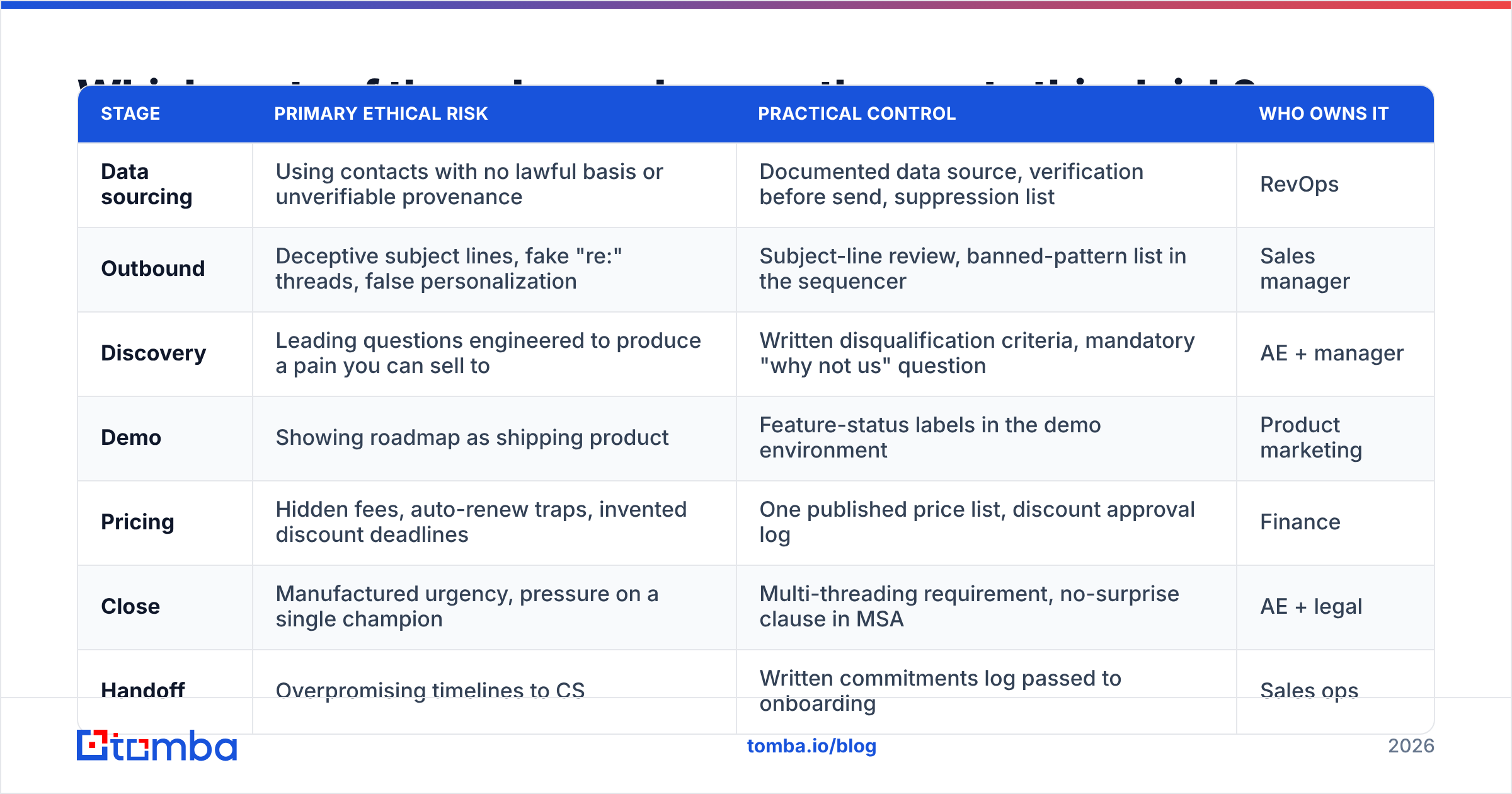
Risk is not spread evenly, so how to maintain ethics in sales changes by stage. Map it, and you can put controls where they matter. Skip the map, and you get a generic yearly training instead.
| Stage | Primary ethical risk | Practical control | Who owns it |
|---|---|---|---|
| Data sourcing | Using contacts with no lawful basis or unclear source | Documented data source, verified before send, suppression list | RevOps |
| Outbound | Deceptive subject lines, fake "re:" threads, false personalization | Subject-line review, banned-pattern list in the sequencer | Sales manager |
| Discovery | Leading questions built to produce a pain you can sell to | Written walk-away rules, a "why not us" question | AE + manager |
| Demo | Showing the roadmap as shipped product | Feature-status labels in the demo environment | Product marketing |
| Pricing | Hidden fees, auto-renew traps, invented discount deadlines | One published price list, discount approval log | Finance |
| Close | Fake urgency, pressure on a single champion | Multi-threading rule, no-surprise clause in the MSA | AE + legal |
| Handoff | Overpromising timelines to CS | Written commitments log passed to onboarding | Sales ops |
See the pattern. Every control is a document, a checklist item, or a system setting. None of them is a value statement. Values do not survive contact with a comp plan.
How do you source contact data ethically?#
Start with the source. For any contact in your CRM, you should be able to say where it came from and why you may use it. If you cannot say that for a list, the list is a risk, not an asset.
Under GDPR, cold B2B email in most of the EU rests on legitimate interest, not consent. But that basis has a price. You need a written balancing test, a real link between your product and the reader's job, and an opt-out that works. In the US, CAN-SPAM sets a lower bar: true headers, no fake subject lines, a postal address, and opt-outs honored within 10 business days.
Here is the short checklist for how to maintain ethics in sales data:
Prefer work data over personal data.
procurement@and other work addresses carry less privacy risk than a scraped personal account. Never use a private Gmail you dug up from a side project.Know your vendor's sources. Ask any data vendor to write down how they collect. Tomba publishes its data sources. Expect the same from every vendor you pay.
Verify before you send. Guessed addresses drive up bounces, hurt sender reputation, and mean you never checked who you are mailing. An email verifier pass costs pennies and strips out the worst of it.
Keep a real suppression list. Global, across every tool, honored within 24 hours. Not per sequence. Anything less turns an opt-out into a pause, which is the most common outbound breach there is.
Never buy "verified opt-in" B2B lists. They almost never are. If the vendor cannot show you the consent record, assume there is none.
Keep a delete path. If someone asks to be wiped from your database, you need a process that deletes rather than flags.
Good vendors make this easy, not hard. BookYourData and Tomba both publish how they source and verify. Demand that before you enter a card number. What splits a safe data stack from a risky one is rarely accuracy alone. It is whether you can show where each record came from.
Is aggressive selling the same as unethical selling?#
No. And mixing up the two breeds timid reps who lose winnable deals.
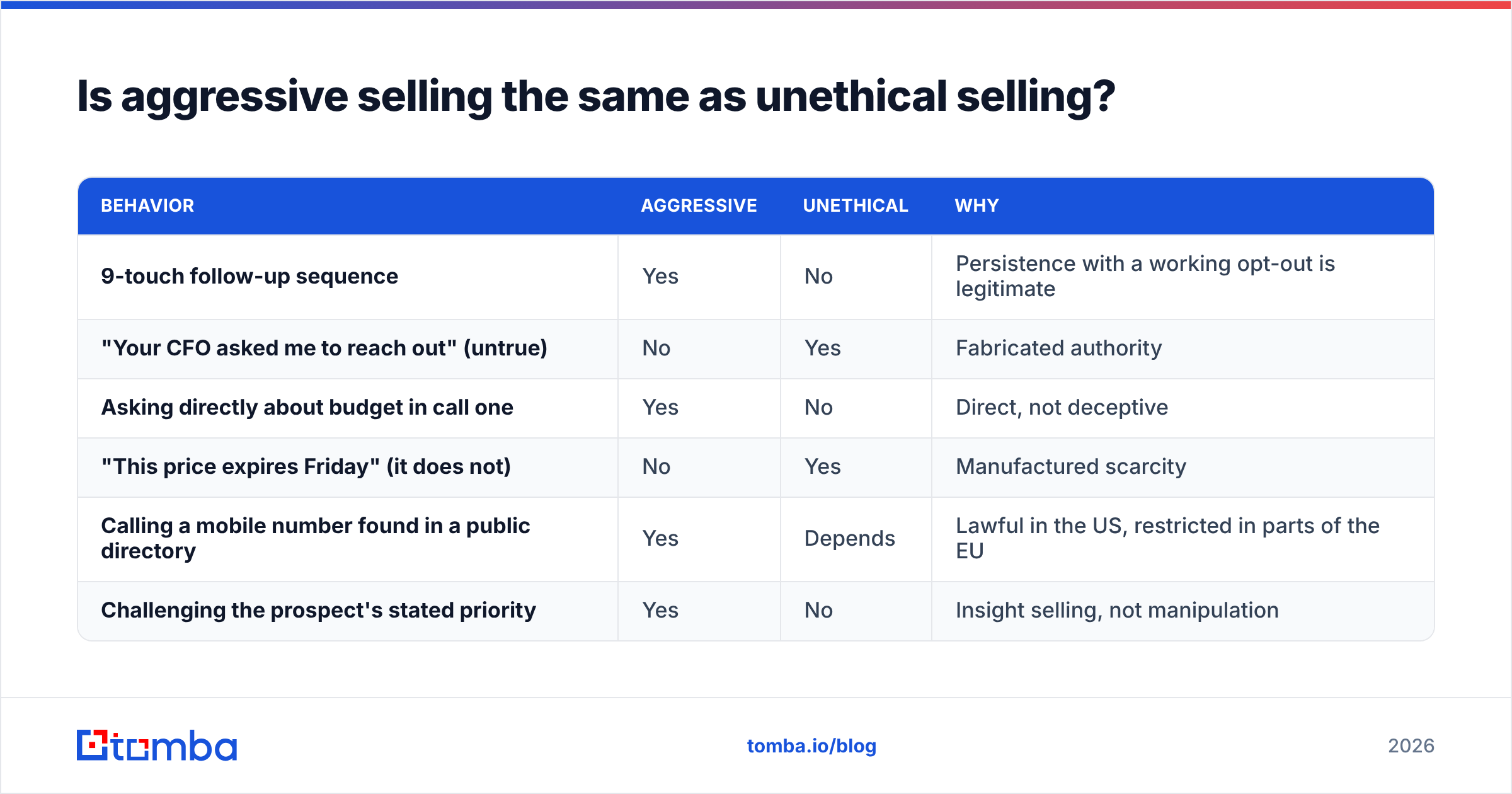
Aggressive selling means grit, plain talk, and hard questions. Nine follow-ups is aggressive. Telling a buyer your rival had a breach they never had is not. The line is not effort. The line is truth and consent.
| Behavior | Aggressive | Unethical | Why |
|---|---|---|---|
| 9-touch follow-up sequence | Yes | No | Persistence with a working opt-out is fair |
| "Your CFO asked me to reach out" (untrue) | No | Yes | Faked authority |
| Asking about budget on call one | Yes | No | Direct, not deceptive |
| "This price expires Friday" (it does not) | No | Yes | Faked scarcity |
| Calling a mobile found in a public directory | Yes | Depends | Fine in the US, limited in parts of the EU |
| Challenging the buyer's stated priority | Yes | No | Insight selling, not manipulation |
Gartner research on B2B buying keeps finding the same thing. Buyers rate sellers who help them sort through conflicting information above sellers who are merely pleasant. Pushing back on a bad guess is a service. Making up a fact is fraud. Reps who know the difference beat both the pushovers and the sharks. Holding that line is most of how to maintain ethics in sales.
How do you run honest discovery without losing the deal?#
Honest discovery means you are as ready to walk away as to qualify, and the buyer can tell. Four questions make that real.
"What would make this a bad fit for you?" This pulls the objection into call one, not into month four. If you cannot handle the answer, you were never going to keep the account.
"Who else are you looking at, and what do you like about them?" This forces you to win on merit. If a rival really does fit better, saying so buys you a referral and a later deal.
"What happens if you do nothing?" This surfaces real urgency. If nothing happens, there is no deal, and pretending there is wastes two calendars.
"Who has to be happy with this in six months?" This moves the talk from the signature to the outcome. That is where your interests and the buyer's line up.
Reps dodge question one. It feels like handing the buyer an exit. It does the opposite. It shows you are not reading a script. And it drags risk into the room, where you can deal with it, rather than into a Slack channel you will never see. This is how to maintain ethics in sales without paying for it in win rate.
Does compensation design determine sales ethics?#
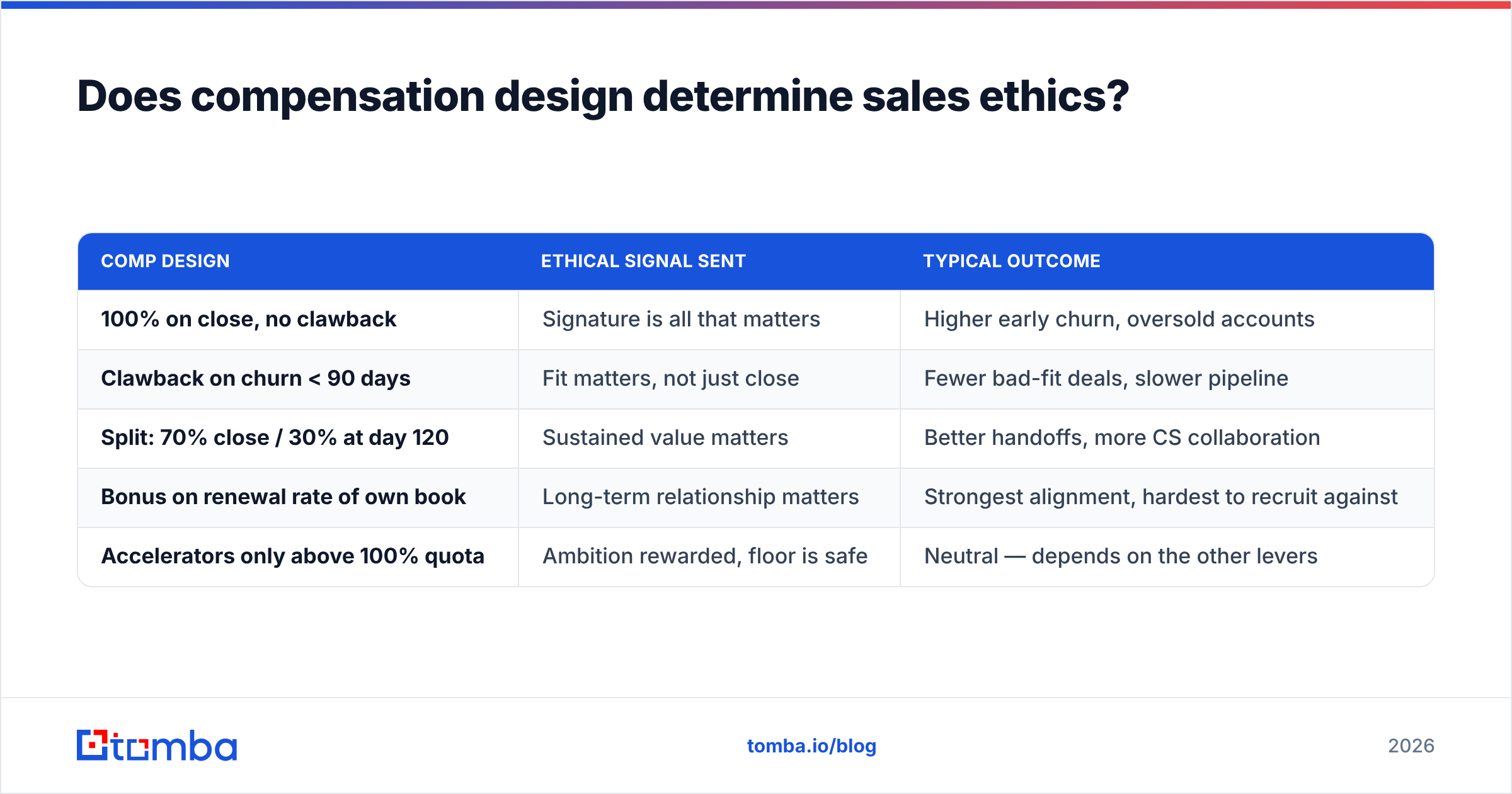
Yes. Comp design answers how to maintain ethics in sales at scale, long before training does. If you want to know what a company really values, read the comp plan, not the handbook.
A plan that pays in full at close, with no clawback and no retention piece, tells reps that life after the signature is not their problem. Reps then act on that. They are not being bad. They are reading the plan.
| Comp design | Ethical signal sent | Typical outcome |
|---|---|---|
| 100% on close, no clawback | Signature is all that matters | Higher early churn, oversold accounts |
| Clawback on churn < 90 days | Fit matters, not just the close | Fewer bad-fit deals, slower pipeline |
| Split: 70% close / 30% at day 120 | Value over time matters | Better handoffs, more CS teamwork |
| Bonus on renewal rate of own book | The long game matters | Best alignment, hardest to hire against |
| Accelerators only above 100% quota | Ambition paid, floor is safe | Neutral, depends on the other levers |
The trade-off is real. Pay tied to retention stretches the rep's cash cycle. It also makes hiring harder against rivals who pay it all up front. Most teams land on a partial clawback for churn inside 90 days. That is enough to shift behavior without making the job a hard sell.
The second lever is what you cheer. If Slack only ever posts closed-won, you run a close-at-all-costs floor, whatever the values page says. Posting "great walk-away" costs nothing and moves the needle.

What does an ethical outbound sequence look like?#
Here is how to maintain ethics in sales at the message level.
Real subject lines. No "Re:" on a first touch. No "Quick question about your invoice" when there is no invoice. Fake subject lines break CAN-SPAM, and they poison reply quality anyway.
Real personalization or none. A merge field with a company name is not personal, and every buyer knows it. Either cite something true and specific, or write a short, honest, clearly templated note. The second one converts better than fake warmth.
Honest identity. Your real name, your real company, a real address on a domain you own. Alias domains for deliverability are fine. Fake personas are not.
One-click opt-out on every touch. That includes plain-text notes that look one-to-one. "Reply STOP" only counts if a human works those replies.
Volume you can support. If a 5% reply rate would bury you, you are sending too much. That is an ethics problem dressed as a capacity problem.
Verified addresses only. Guessed addresses cause bounces, spam-trap hits, and an email deliverability collapse. A pass through a bulk email finder and a verify step is the cheapest control on this list.
Most teams fall into one trap here. They treat deliverability tooling as a stand-in for ethics. Warming a domain so spam lands in the inbox is not ethics. It is better-run spam. The real work happens upstream, in who you chose to contact and why.
How do you handle pricing and contract ethics?#
Pricing is where quiet bad practice hides, because it is boring and buyers rarely audit it. Four rules cover how to maintain ethics in sales once the money talk starts.
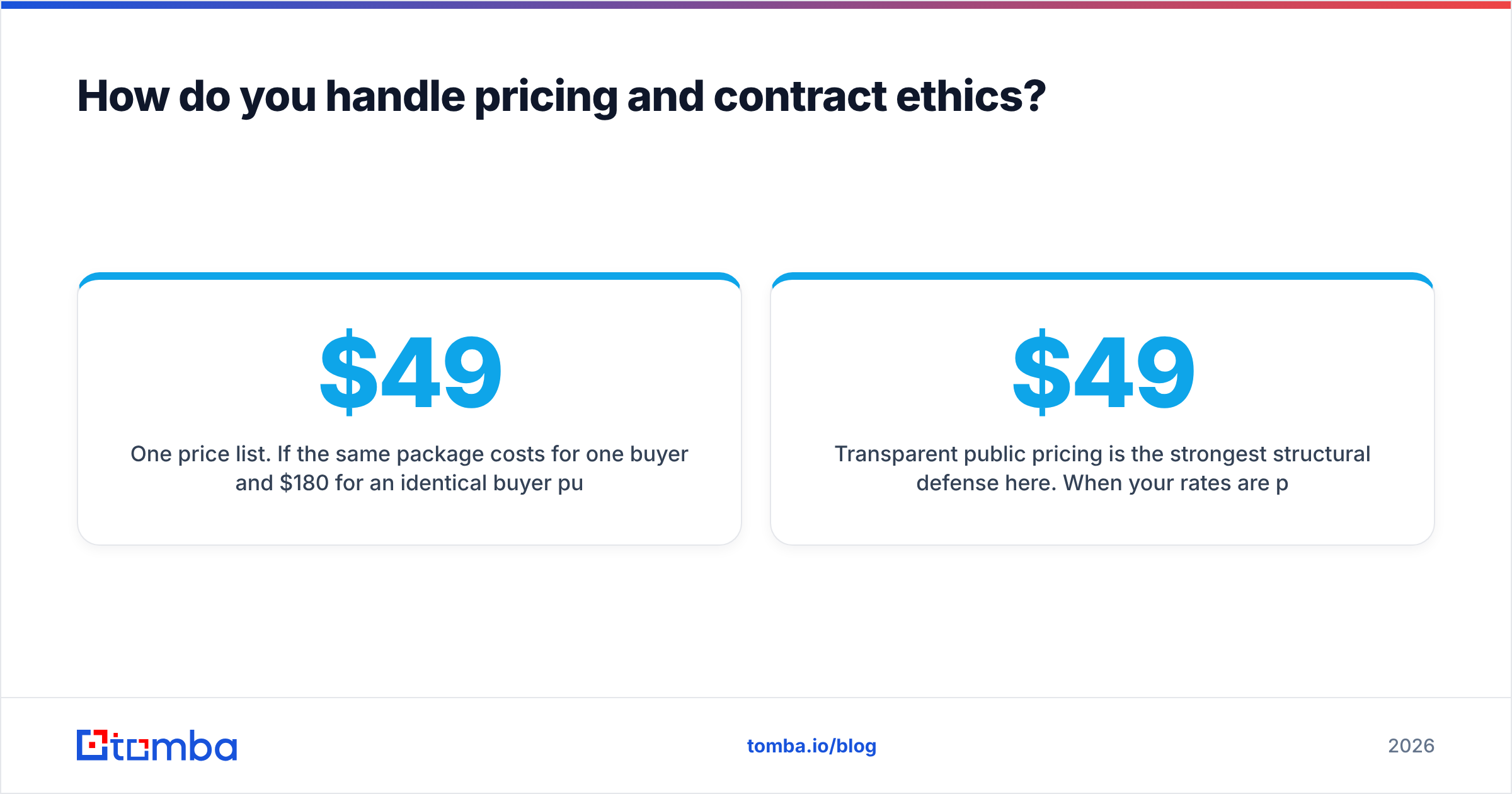
One price list. If the same package costs $49 for one buyer and $180 for a twin buyer, purely because one pushed harder, you have a fairness problem. It will surface in a customer Slack group sooner or later. Volume and term discounts are fine. Random ones are not.
Auto-renewal must be loud. Burying a 60-day cancel window in clause 14.3 is legal in many places and fatal to trust in all of them. Say it out loud on the call.
No fee surprises. Setup fees, overage rates, and API limits go in the proposal, not the invoice.
Discount deadlines must be real. If end-of-quarter pricing truly expires, say so and hold it. If you extend it every quarter, stop pretending.
Public pricing is the strongest defense here. When your rates are published, a rep cannot invent a number. See Tomba pricing: Free covers 25 searches a month, Starter is $49/mo, Growth $99/mo, and Pro $249/mo. Any vendor that hides its starting price is asking you to trust a talk you cannot benchmark.
How to maintain ethics in sales with a program that holds#
Four parts, in order of impact.
Written walk-away rules. A one-page list of who you do not sell to: size floors, industries you cannot serve, tech you need in place. Reps need that permission in writing, or they will not walk.
A deal-review question that is not about forecast. In pipeline review, ask once per deal: "what did you promise that we have not shipped?" It takes 20 seconds. It catches an oversold feature before it becomes a renewal fight.
A commitments log in the CRM. Every off-menu promise, whether a date, a feature, or an SLA, goes in a field and moves to CS at handoff. That one artifact kills most post-sale trust collapses. Wire it into your HubSpot integration so it is not a separate habit.
A quarterly data audit. Pull 50 CRM contacts. Trace each to a source and a lawful basis. If you cannot trace 10% of them, fix the intake, not the sample.
You do not need an ethics officer or a training vendor for this. You need four artifacts and one senior person who asks about them often. G2 reviews and public communities turned post-sale reputation into a compounding asset. Teams that treat honesty as a growth lever, not a tax, are the ones still winning renewals in year three.
Ethical prospecting starts with the data you use#
The fastest way to clean up outbound is not a better script. It is a smaller, cleaner, better-sourced list. Fewer people, contacted for a real reason, at verified addresses, with an opt-out that works.
That is what Tomba Email Finder is built for. Find work addresses by domain, name, or company, with sourcing and verification in the same flow. Start free at 25 searches a month, test the data on your own target accounts, then move to Starter at $49/mo once the process holds. Clean data alone will not teach a team how to maintain ethics in sales. But no ethics program survives a database nobody can vouch for.
Related guides#
// get started
Find, verify and enrich your first contacts today
Start on the free plan with 25 searches a month, then scale when your team is ready.
Free plan · No credit card required · GDPR & CCPA
Get the Tomba newsletter
Product and data updates
// about the author