How to Make a Sales Call Script That Actually Books Meetings
A sales call script is not a word-for-word monologue. Here is the 7-block framework top SDR teams use to build scripts reps actually stick to, plus the openers, objection blocks, and testing loop that separate a 2% connect-to-meeting rate from a 12% one.
TL;DR
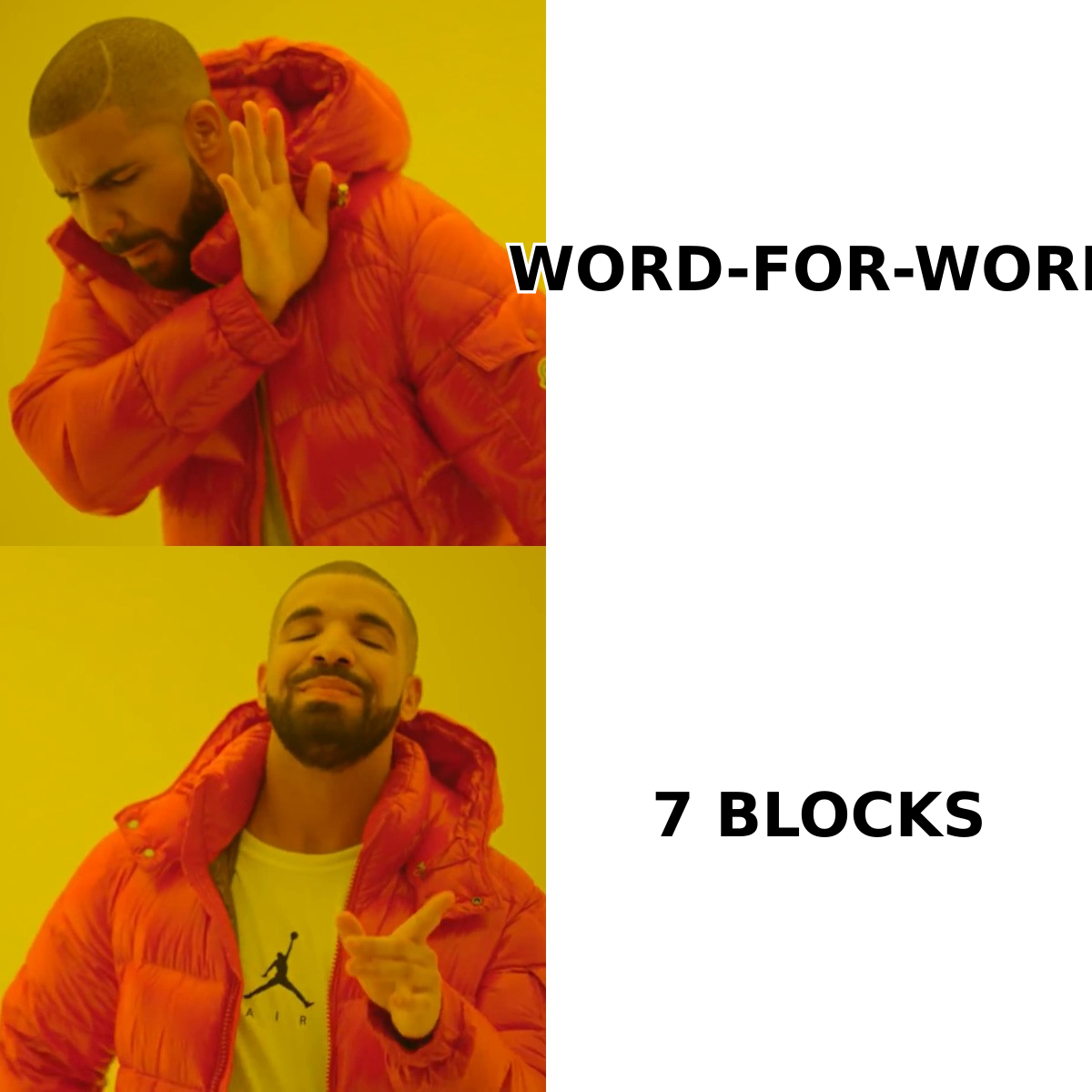
- A sales call script is a modular set of blocks — opener, permission line, value hypothesis, discovery, objection handling, close, voicemail — not a paragraph you read aloud.
- Write the opener last. Your value hypothesis determines everything upstream, and most reps get this backwards.
- Budget 30 seconds for the first block. Gong's cold-call research consistently shows the opener decides whether the rest of the call happens.
- Bad phone data kills good scripts. If 40% of your dials hit disconnected numbers, no wording change will save your connect rate.
- Test one block at a time across 100+ dials. Changing three variables at once teaches you nothing.
What is a sales call script, really?#
A sales call script is a repeatable structure for a conversation you have already had a hundred times. Think of it like a jazz chart, not a symphony score: the chord changes are fixed, the solo is yours. Reps who read a script literally sound like reps reading a script literally, and prospects hang up. Reps who improvise every call have no way to figure out why Tuesday worked and Wednesday did not.
The useful definition: a script is the set of decisions you make before the call so you are not making them during the call. What you say in the first eight seconds. What you do when they say "we already have a vendor." What question you ask when they go quiet. Those are pre-loaded. The rest is conversation.
This matters because cold calling is a volume game with a memory problem. You will make 60 dials today and remember four of them. A script is the mechanism that turns those 60 dials into data instead of anecdotes.
How to make a sales call script in 7 blocks?#
Build it as separate components you can swap independently. Here is the structure and how long each block should take on a well-run call.
- Opener (0-10 seconds) — State your name, your company, and one reason you called this specific person. No "how are you today." No permission-seeking apology.
- Permission line (10-30 seconds) — A short, honest ask for 30 seconds. This is where you earn the rest of the call, and it is the single highest-leverage sentence in the script.
- Value hypothesis (30-60 seconds) — One sentence about a problem people in their exact role tend to have, stated as a guess, not a fact. "Usually when I talk to RevOps leads at 200-person SaaS companies, routing rules are the thing eating their week. Is that off base for you?"
- Discovery (1-4 minutes) — Three to five questions max. Two about current state, one about impact, one about who else cares. Anything more and you are interrogating.
- Objection block (as needed) — Pre-written responses to your top five objections. Not rebuttals — acknowledgements plus a redirect.
- Close (final 30 seconds) — Ask for a specific time, not "some time next week." Offer two slots. Silence after the ask.
- Voicemail variant (20 seconds) — A compressed version for the 80% of dials nobody picks up. Different script, same value hypothesis.
Write blocks 3 through 7 first. Then write the opener, because the opener's only job is to buy you enough runway to deliver block 3.
Why do most sales call scripts fail?#
Three reasons, in order of frequency.
They are written by someone who does not dial. Marketing-authored scripts read beautifully and die on contact. They contain phrases like "leverage our best-in-class platform" that no human says out loud on a telephone. If your VP wrote the script, make them dial 50 numbers with it before it goes to the floor.
They front-load the pitch. The classic failure mode is spending 45 seconds on your company's origin story. The prospect's internal clock started the moment they said "hello," and you have burned it on information they did not request.
They assume the connect. A script optimized for live conversation is useless if you are reaching disconnected extensions and wrong departments. Data quality is upstream of copy quality. Before you rewrite a single line, pull 100 recent dials and check what percentage actually reached a human at the right company. If it is under 25%, your problem is the list, not the language. Running numbers through a phone validator before a calling block is cheaper than burning rep hours on dead lines.
What should your cold call opener actually say?#
The opener has one job: prevent the reflexive hang-up. Research published by Gong on recorded cold calls found that openers referencing a specific, personal reason for the call materially outperform generic introductions — and that the much-mocked "Did I catch you at a bad time?" performs worse than a straightforward "How've you been?" style open in their sample.
Three opener patterns that hold up:
The honest cold call. "Hi Sarah, it's Marcus from Tomba. I'll be upfront — this is a cold call. Want to give me 30 seconds and then decide if it's worth continuing?" Disarming works because it is unusual and it is true.
The trigger reference. "Hi Sarah, Marcus here. I saw you're hiring three more SDRs this quarter — that's why I'm calling." Requires real research, which means it does not scale past 30 calls a day without tooling.
The referral chain. "Hi Sarah, Marcus from Tomba. Dana in your ops team suggested you'd be the right person for this." Only use it if it is literally true. Fabricating a referral is a career-ending shortcut.
What none of these do: ask how the prospect's day is going, apologize for calling, or spend a clause on your company's funding round.
Which script framework fits your sales motion?#
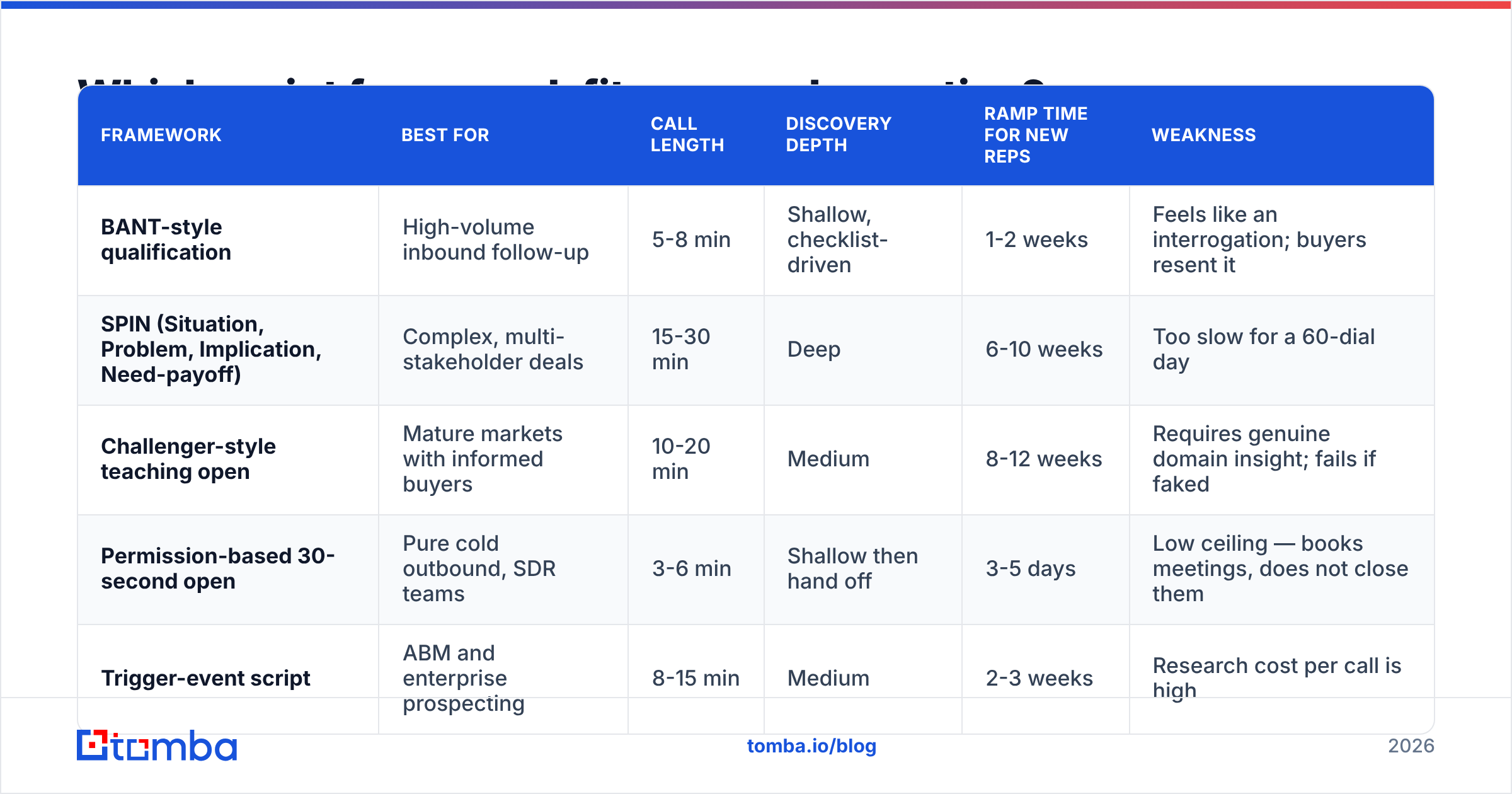
Not every team should use the same structure. Here is how the common frameworks compare on the dimensions that matter when you are choosing one.
| Framework | Best for | Call length | Discovery depth | Ramp time for new reps | Weakness |
|---|---|---|---|---|---|
| BANT-style qualification | High-volume inbound follow-up | 5-8 min | Shallow, checklist-driven | 1-2 weeks | Feels like an interrogation; buyers resent it |
| SPIN (Situation, Problem, Implication, Need-payoff) | Complex, multi-stakeholder deals | 15-30 min | Deep | 6-10 weeks | Too slow for a 60-dial day |
| Challenger-style teaching open | Mature markets with informed buyers | 10-20 min | Medium | 8-12 weeks | Requires genuine domain insight; fails if faked |
| Permission-based 30-second open | Pure cold outbound, SDR teams | 3-6 min | Shallow then hand off | 3-5 days | Low ceiling — books meetings, does not close them |
| Trigger-event script | ABM and enterprise prospecting | 8-15 min | Medium | 2-3 weeks | Research cost per call is high |
Most outbound SDR teams should start with the permission-based 30-second open and layer SPIN questions into the discovery block once reps are past their first month. Trying to teach Challenger to a rep in week two produces neither a challenge nor a sale.
How do you handle objections without sounding rehearsed?#
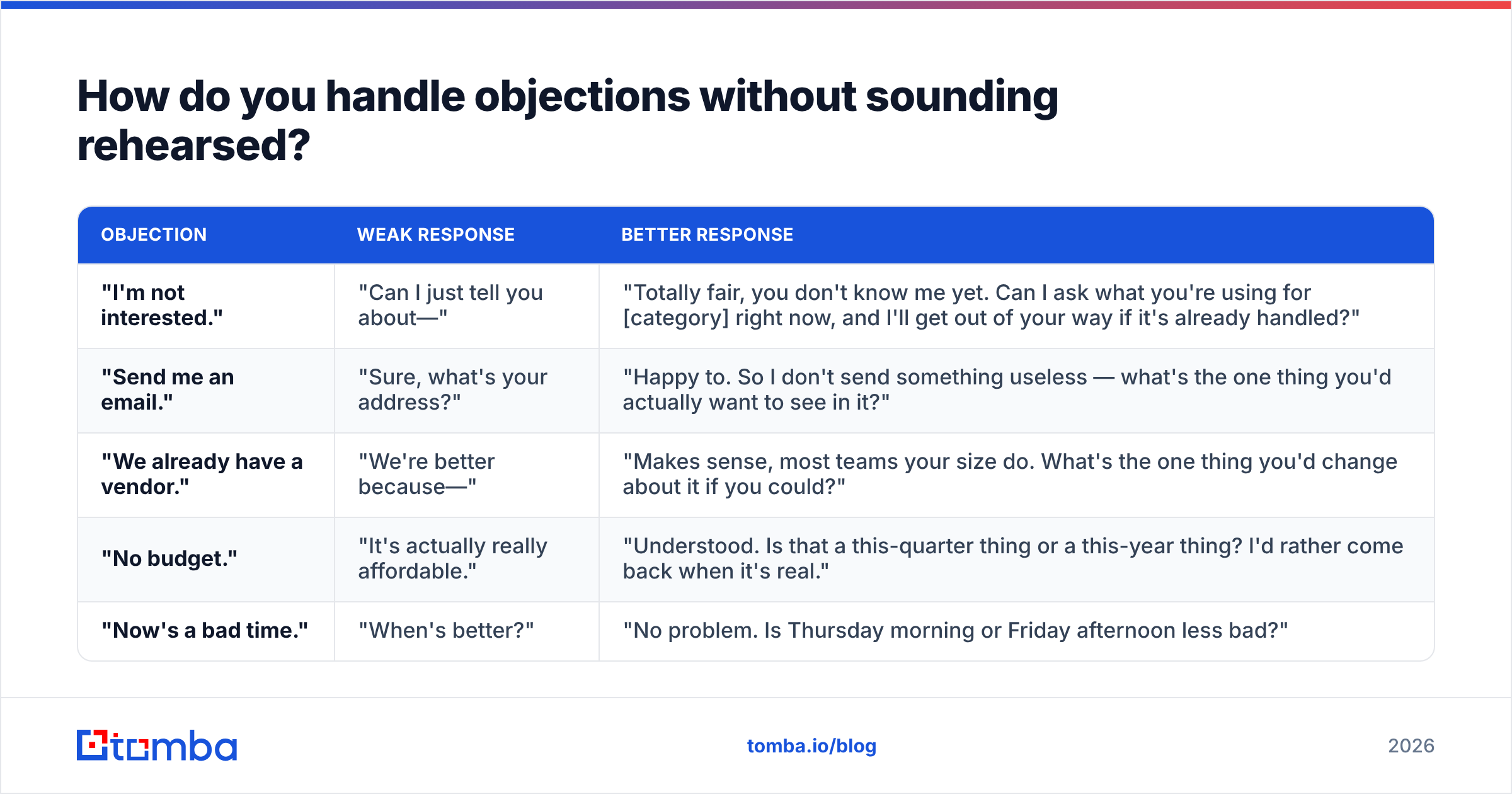
Pre-write your top five objections. Everyone's list is roughly the same, and the structure of a good response is always: acknowledge, reframe, ask.
| Objection | Weak response | Better response |
|---|---|---|
| "I'm not interested." | "Can I just tell you about—" | "Totally fair, you don't know me yet. Can I ask what you're using for [category] right now, and I'll get out of your way if it's already handled?" |
| "Send me an email." | "Sure, what's your address?" | "Happy to. So I don't send something useless — what's the one thing you'd actually want to see in it?" |
| "We already have a vendor." | "We're better because—" | "Makes sense, most teams your size do. What's the one thing you'd change about it if you could?" |
| "No budget." | "It's actually really affordable." | "Understood. Is that a this-quarter thing or a this-year thing? I'd rather come back when it's real." |
| "Now's a bad time." | "When's better?" | "No problem. Is Thursday morning or Friday afternoon less bad?" |
Notice every strong response ends in a question. An objection block that ends in a statement hands the prospect a clean exit.
The rehearsed-sounding problem is a delivery issue, not a content issue. Have reps read objection responses aloud 20 times until the words stop feeling like words. Actors call this "getting off book." It is the same skill.
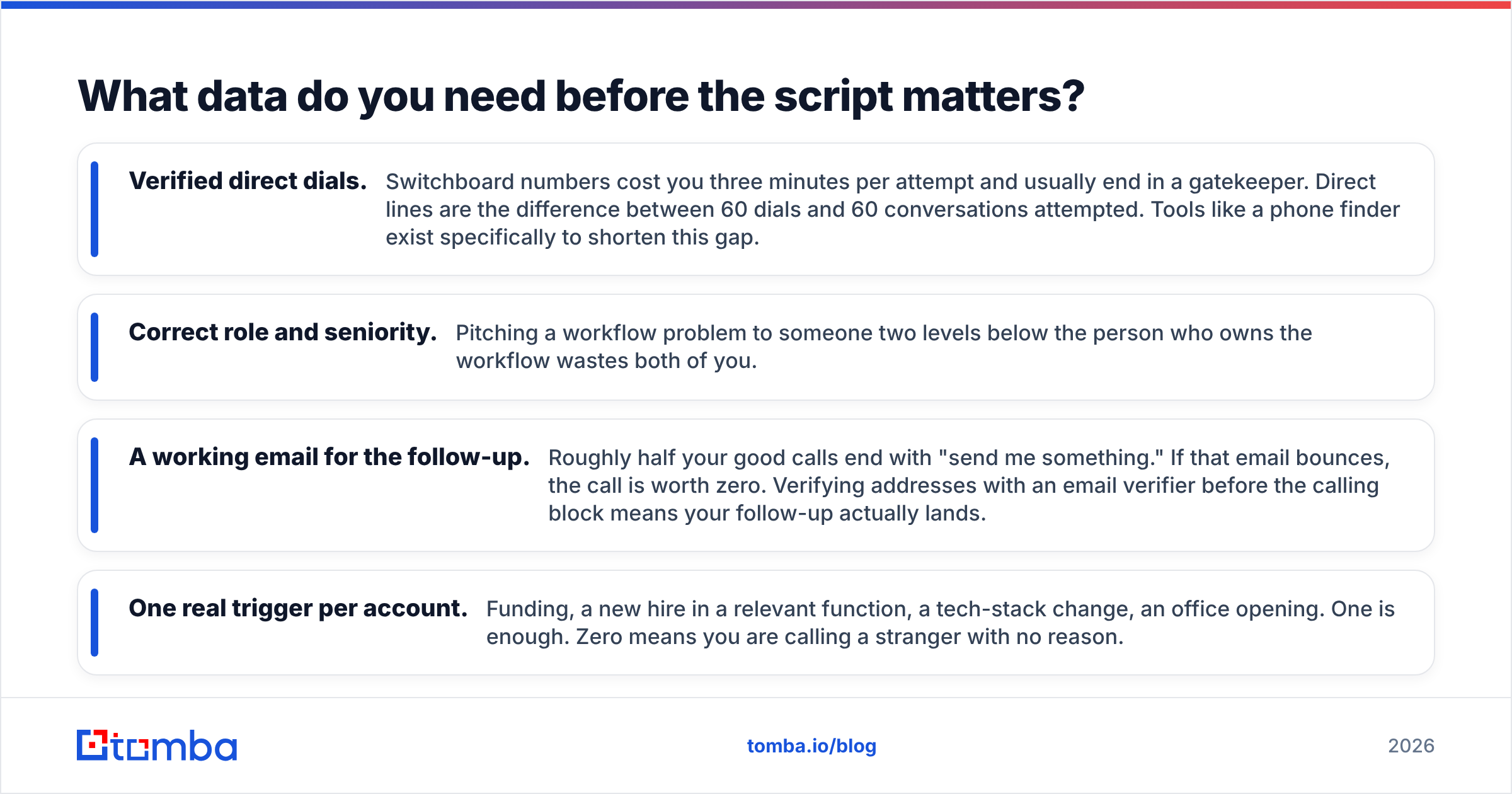
What data do you need before the script matters?#
A script converts conversations. It does not create them. The inputs that determine whether you get a conversation at all:
- Verified direct dials. Switchboard numbers cost you three minutes per attempt and usually end in a gatekeeper. Direct lines are the difference between 60 dials and 60 conversations attempted. Tools like a phone finder exist specifically to shorten this gap.
- Correct role and seniority. Pitching a workflow problem to someone two levels below the person who owns the workflow wastes both of you.
- A working email for the follow-up. Roughly half your good calls end with "send me something." If that email bounces, the call is worth zero. Verifying addresses with an email verifier before the calling block means your follow-up actually lands.
- One real trigger per account. Funding, a new hire in a relevant function, a tech-stack change, an office opening. One is enough. Zero means you are calling a stranger with no reason.
If your team is assembling call lists manually from LinkedIn, that research cost is the real constraint on dial volume — not script quality. Automating contact discovery through a B2B database or an enrichment step gives reps back the hours they are currently spending as researchers.
How do you test and improve a sales call script?#
Treat it like a landing page. One variable, enough sample, honest measurement.
Pick one block. Openers first, because they gate everything else. Write two versions.
Run 100 dials per version minimum. Fewer than that and you are reading noise. Split them across the same reps and the same time slots — if version A ran Tuesday morning and version B ran Friday at 4pm, you have measured the day of the week, not the script.
Measure the block's own metric, not the final one. For openers, the metric is "percentage of connects that lasted past 30 seconds." For the value hypothesis, it is "percentage that reached a discovery question." Attributing meeting bookings to the opener is too many steps removed.
Listen to five losses. Not five wins. Losses tell you where the script broke; wins mostly tell you the prospect was already interested.
Rewrite quarterly, not weekly. Constant churn means reps never get off book, and an under-rehearsed good script loses to a well-rehearsed mediocre one every time. Sites like G2 are useful for seeing which call-recording tools your peers use to run this loop, but the loop itself is process, not software.
One more thing worth tracking: your response rate on the post-call email. A call that ends in "send me something" is only half a win, and the follow-up email is doing work your script should get credit for.
What does a finished script look like?#
Compressed, for an SDR selling a data tool to RevOps leaders:
"Hi Sarah, it's Marcus at Tomba. I'll be honest, this is a cold call — give me 30 seconds and then tell me to go away if it's not relevant?
[pause, wait for yes]
Thanks. So I mostly talk to RevOps leads at companies around your size, and the thing that comes up over and over is that their reps are spending half their prospecting time just hunting down contact details instead of actually reaching out. Is that anywhere close to what's happening on your team, or have you got that solved?
[listen — this is the whole call]
Got it. Two quick things: how are your reps sourcing contacts today, and roughly how much of the week does that eat?
[listen]
That's exactly the pattern. I'd rather show you than describe it — I've got Tuesday at 10 or Thursday at 2. Which is easier?"
Under 90 seconds of rep talking. The prospect talks more than you do. That is the test of a good script: count your words versus theirs on a recording, and if you are above 40%, the script is a monologue wearing a costume.
Ready to stop guessing at phone numbers?#
The best script in the world converts nothing if the number rings dead or the follow-up email bounces. Before your next calling block, run your list through Tomba Email Finder to get verified contact details for the people you are actually trying to reach — so your reps spend their hours talking, not researching. The free tier covers 25 searches a month if you want to test the data quality on your own accounts first; paid plans start at $49/mo with full Tomba pricing laid out by volume. Fix the list, then fix the script. In that order.
Related guides#
Ready to find emails that actually work?
Join 150,000+ professionals who stopped guessing and started sending. Free credits on signup — no credit card required.
Get the Tomba newsletter
Practical outbound tactics and product updates — once every two weeks.
About the author