How to Make a Sales Pitch That Actually Closes in 2026
Most sales pitches fail before the second sentence. Here is a 7-step framework for building a pitch that survives a skeptical buyer, plus the structures, timings, and templates that actually convert.
TL;DR
- A sales pitch is not a monologue about your product. It is a 60-to-300-second argument that a specific problem is costing a specific buyer money, and that you have removed the risk of fixing it.
- The seven steps: research the account, name the problem, quantify the cost, state your claim, prove it, handle the obvious objection, ask for a small next step.
- Pitch length should match the channel: 30 seconds for a cold call opener, 90 seconds for a discovery recap, 5-8 minutes for a demo narrative. Longer is not better.
- The single biggest predictor of pitch success is pre-call research quality — and that starts with reaching the right person at all.
- Rehearse the first 15 seconds and the last 15 seconds. The middle can flex; the bookends cannot.
What is a sales pitch, really?#
A sales pitch is the compressed version of your argument for change. It exists because your buyer has limited attention and a default answer of "no, we'll keep doing what we're doing."
Think of it like a courtroom opening statement. The lawyer does not present every exhibit. They tell the jury what the case is about, why it matters, and what verdict they will ask for at the end. Everything after that is evidence supporting the frame they set in the first two minutes.
Most reps get this backwards. They open with company history, roll into a feature tour, and only reach the buyer's problem at minute eleven — by which point the buyer has mentally moved on to their next meeting.
Three practical implications:
- Your pitch is about the buyer's status quo, not your product. The competitor you are beating is usually "do nothing," not another vendor.
- Structure beats charisma. A well-structured pitch delivered flatly outperforms a charming ramble. Structure is learnable; charisma mostly is not.
- A pitch is a hypothesis. You are proposing that a problem exists. If the buyer disagrees, you learn something valuable in 30 seconds instead of wasting 30 minutes.
How do you make a sales pitch step by step?#
Here is the seven-step sequence. Work through it in order — skipping research is the most common failure and the hardest to recover from mid-call.
- Research the account and the person. Headcount changes, funding events, tech stack, recent job postings, and the specific person's remit. Ten minutes of research beats an hour of improvisation.
- Name the problem in their language. Not "inefficient workflows" but "your SDRs are spending 90 minutes a day building lists by hand."
- Quantify the cost. Put a number on it — hours, dollars, churned accounts, missed quota. Vague problems get vague urgency.
- State your claim in one sentence. "We cut list-building time to under 10 minutes a day." One sentence, no clauses, no adjectives.
- Prove it with one specific piece of evidence. A named customer, a benchmark number, a live 20-second demo of the exact thing you just claimed. One proof, not five.
- Pre-empt the obvious objection. Every category has one — price, switching cost, data accuracy, security review. Say it before they do and answer it plainly.
- Ask for a small, concrete next step. Not "does that sound interesting?" but "can I send you 25 verified contacts from your ICP so you can check the accuracy yourself?"
The whole sequence should take 90 seconds if you are recapping in discovery, and under 45 seconds if you are opening a cold call. Write it out. Time it with a stopwatch. Most reps discover their "two-minute pitch" runs four and a half minutes.
Which pitch structure should you use for each situation?#
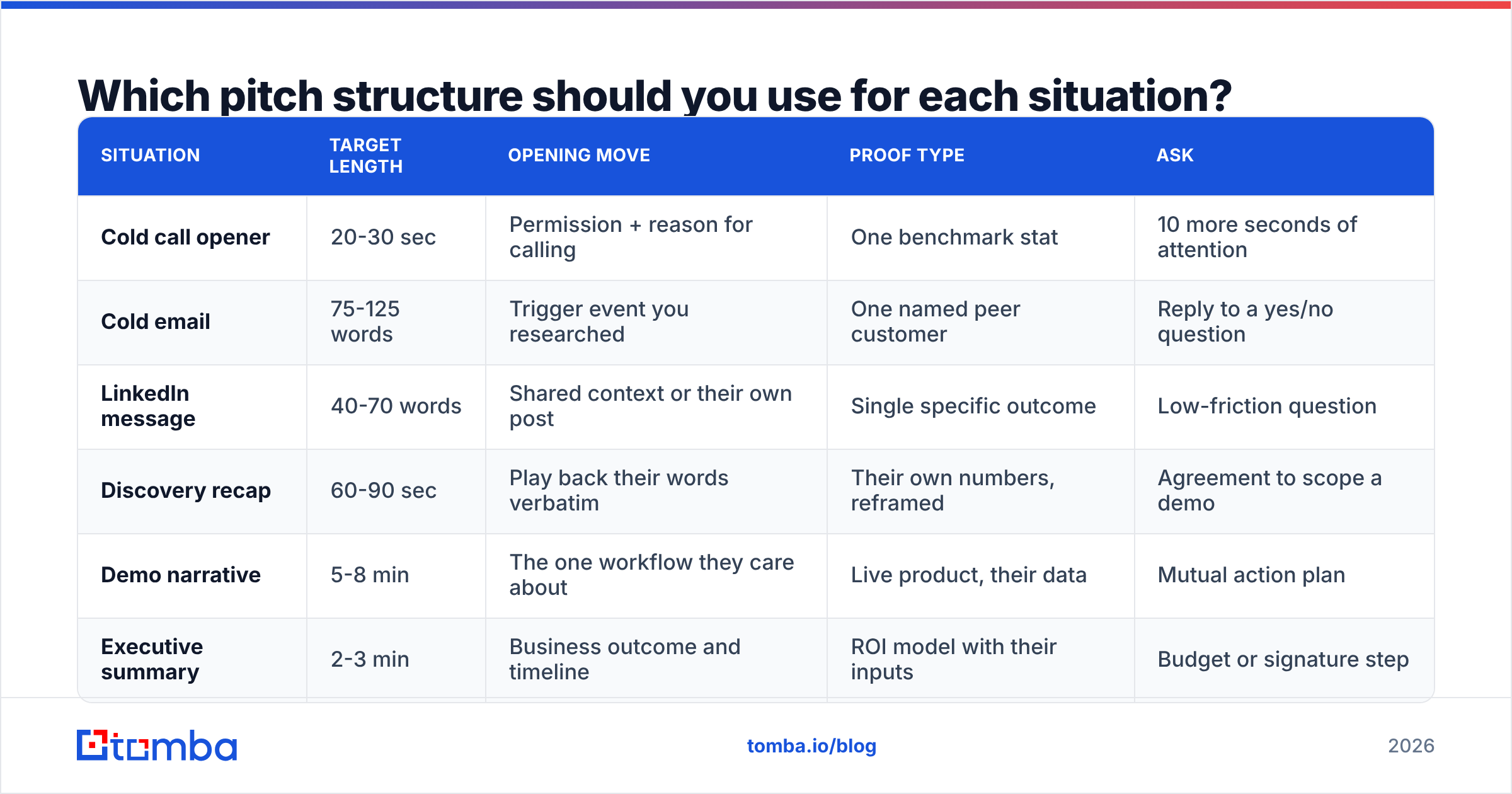
Different channels demand different shapes. Using a demo-length narrative on a cold call is why so many calls end at the 12-second mark.
| Situation | Target length | Opening move | Proof type | Ask |
|---|---|---|---|---|
| Cold call opener | 20-30 sec | Permission + reason for calling | One benchmark stat | 10 more seconds of attention |
| Cold email | 75-125 words | Trigger event you researched | One named peer customer | Reply to a yes/no question |
| LinkedIn message | 40-70 words | Shared context or their own post | Single specific outcome | Low-friction question |
| Discovery recap | 60-90 sec | Play back their words verbatim | Their own numbers, reframed | Agreement to scope a demo |
| Demo narrative | 5-8 min | The one workflow they care about | Live product, their data | Mutual action plan |
| Executive summary | 2-3 min | Business outcome and timeline | ROI model with their inputs | Budget or signature step |
The pattern across all six: the shorter the format, the more research has to do the work. A 30-second cold call opener has no room for storytelling. It survives entirely on whether you referenced something true and specific about their business in the first eight seconds.
Why does research matter more than delivery?#
Because specificity is the only credibility signal that survives compression.
Compare two openers:
"Hi Sarah, I'm calling from a sales intelligence platform that helps teams like yours improve pipeline efficiency."
"Hi Sarah — I saw you posted three SDR roles in Berlin last month. Most teams that scale outbound that fast hit a data quality wall around month two. Is that on your radar yet?"
Same product. Same rep. The second one earns another 30 seconds because it proves you did work before dialing. Gartner's B2B buying research has consistently found that buyers spend only a small fraction of their purchase journey with any single supplier's reps — which means the minutes you do get are expensive, and generic openers waste them outright.
Research has three layers worth budgeting time for:
- Company layer (3 min): funding, headcount trend, open roles, recent product launches, tech stack.
- Person layer (4 min): their role scope, tenure, what they post about, whether they were promoted recently, who they report to.
- Trigger layer (3 min): a specific event in the last 90 days that makes now a reasonable time to call.
The bottleneck for most teams is not analysis — it is contact data. You cannot research a prospect you cannot reach, and bounced sends burn sender reputation that takes weeks to rebuild. Building a clean list with an email finder and running it through an email verifier before any sequence goes out is the unglamorous prerequisite to every pitch that lands.
How do you open a sales pitch without getting hung up on?#
The first 8 to 15 seconds decide everything. Four openers that hold up in practice:
- The permission opener. "I know I'm interrupting — can I take 30 seconds to tell you why I called, and you can tell me if it's worth continuing?" Honest, disarming, and it converts a cold interruption into a small agreement.
- The trigger opener. "You just opened a second office in Austin. Usually that means territory reassignment chaos for the next quarter." Only works if the trigger is real.
- The peer opener. "Three heads of sales at Series-B fintechs told me the same thing last month — their reps can't get past the gatekeeper on enterprise accounts. Does that land for you?"
- The contrarian opener. "Most teams I talk to think their problem is more leads. Usually it's that half their existing list is undeliverable." Sharp, but only use it if you can back it immediately.
Avoid: "How are you today?", "Did I catch you at a bad time?", and any sentence that begins with your company's founding year. The first invites a brush-off, the second invites a "yes," and the third invites a hang-up.
What should go in the middle of the pitch?#
The middle is where you make the cost of inaction concrete. Three moves, in order.
Move 1 — Quantify. Convert the problem into a number the buyer recognizes. "Ten reps, 90 minutes a day on manual list building, at a loaded cost of $60 an hour, is roughly $234,000 a year in research time." Use their numbers where possible; use conservative industry numbers where not, and say you are being conservative.
Move 2 — Prove. One proof point, chosen to match the claim you just made. A named customer in their segment beats a logo wall. A specific number beats a testimonial adjective. If you can show it live in 20 seconds, show it live.
Move 3 — Pre-empt. Name the objection they are already forming. In data tooling it is almost always accuracy and price. Saying "you're probably wondering whether the emails actually deliver — here's our bounce rate and here's how you can test it on 25 contacts for free" is far stronger than waiting to be challenged.
A useful discipline: after each move, stop talking. Silence after a number invites the buyer to react, and their reaction tells you whether your hypothesis was right. Reps who monologue through all three moves learn nothing.
How should you close the pitch?#
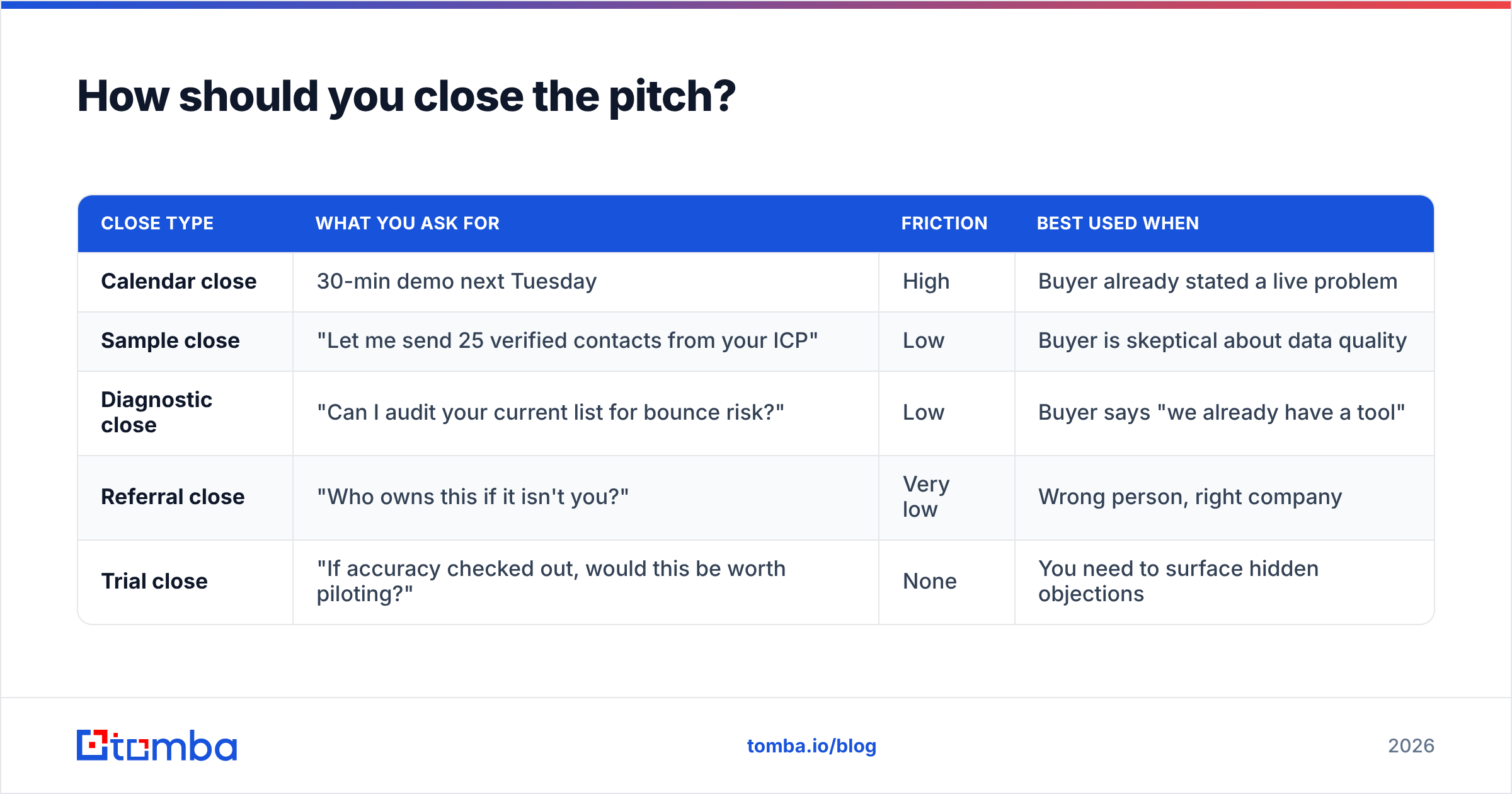
Ask for the smallest next step that still proves commitment.
The classic error is the "big ask" — pitching for a 60-minute demo with three stakeholders on a first call. The buyer has no reason to spend that yet. The alternative is a micro-commitment that generates evidence:
| Close type | What you ask for | Friction | Best used when |
|---|---|---|---|
| Calendar close | 30-min demo next Tuesday | High | Buyer already stated a live problem |
| Sample close | "Let me send 25 verified contacts from your ICP" | Low | Buyer is skeptical about data quality |
| Diagnostic close | "Can I audit your current list for bounce risk?" | Low | Buyer says "we already have a tool" |
| Referral close | "Who owns this if it isn't you?" | Very low | Wrong person, right company |
| Trial close | "If accuracy checked out, would this be worth piloting?" | None | You need to surface hidden objections |
Notice that three of the five closes do not ask for a meeting at all. They ask for permission to produce evidence. That is usually the faster path with skeptical technical buyers, and it also gives you a legitimate reason to follow up.
Whatever you choose, close with a statement, not a question that can be answered with "let me think about it." "I'll send those 25 contacts this afternoon — if three or more bounce, tell me and I'll stop calling" is a close. "Let me know if you're interested" is a wish.
What are the most common sales pitch mistakes?#
- Pitching features instead of the delta. Buyers do not care that you have an API. They care that the API removes four hours of manual CSV work each week. Always translate.
- Front-loading credentials. Your funding round, headcount, and award list belong at minute six, if anywhere. They are not a reason for a stranger to keep listening.
- Asking discovery questions you could have researched. "So tell me about your company" spends the buyer's goodwill on something a browser tab would have answered.
- Talking past the close. Once the buyer agrees, stop selling. Reps routinely re-open settled objections by continuing to talk.
- One pitch for every persona. The CFO, the VP of Sales, and the RevOps lead all care about different failure modes of the same problem. Same product, three different first sentences.
- Skipping the data layer. A brilliant pitch delivered to an invalid address is a rounding error. Clean, verified contacts and a checked email deliverability setup are the floor, not a nice-to-have.
Sales methodology sources like HubSpot's sales research and peer reviews on G2 repeat the same finding year after year: reps who personalize based on real account research consistently outperform reps who scale generic messaging. The gap is not talent. It is preparation.
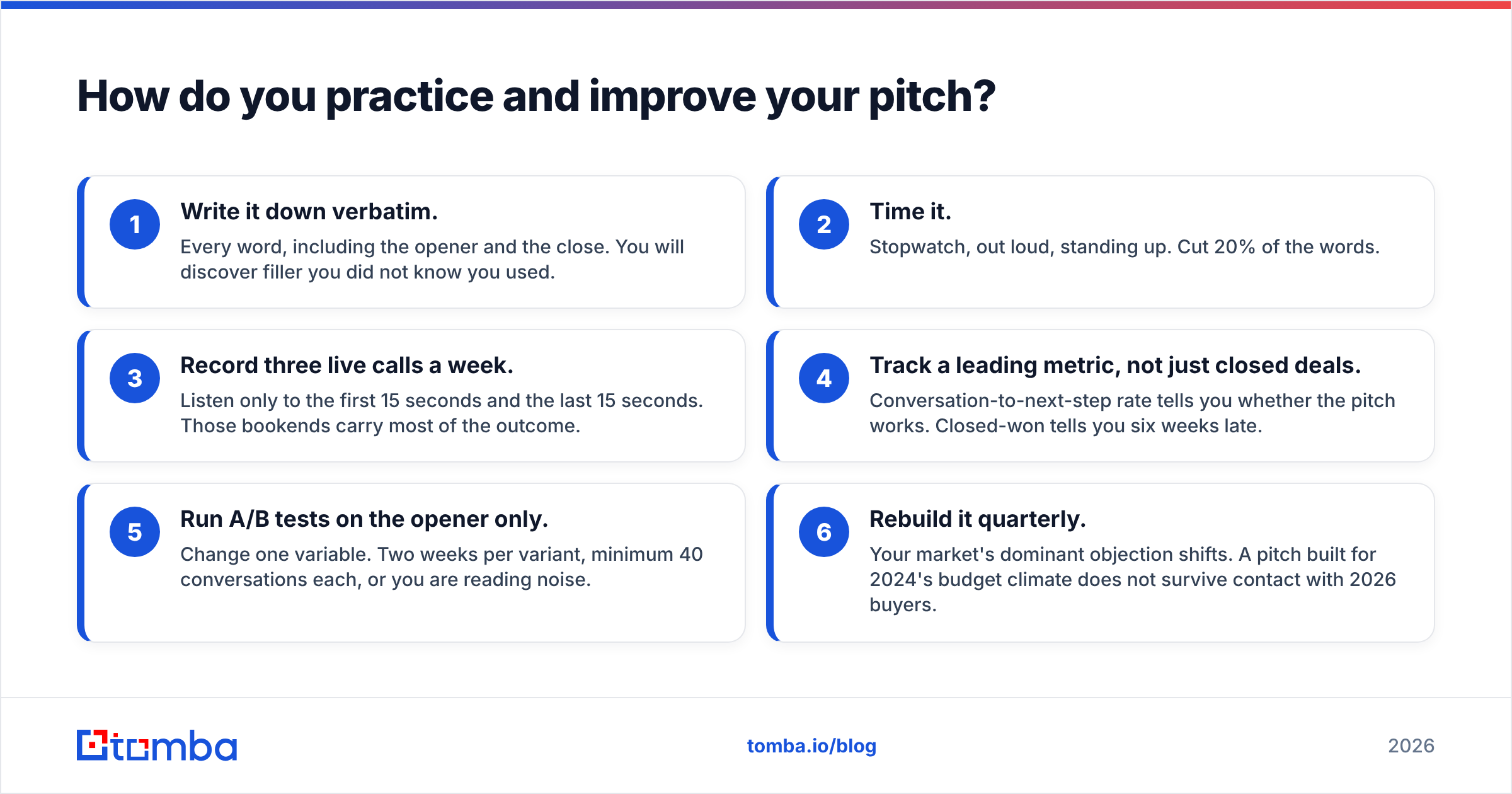
How do you practice and improve your pitch?#
Treat it like a repeatable asset, not a performance.
- Write it down verbatim. Every word, including the opener and the close. You will discover filler you did not know you used.
- Time it. Stopwatch, out loud, standing up. Cut 20% of the words.
- Record three live calls a week. Listen only to the first 15 seconds and the last 15 seconds. Those bookends carry most of the outcome.
- Track a leading metric, not just closed deals. Conversation-to-next-step rate tells you whether the pitch works. Closed-won tells you six weeks late.
- Run A/B tests on the opener only. Change one variable. Two weeks per variant, minimum 40 conversations each, or you are reading noise.
- Rebuild it quarterly. Your market's dominant objection shifts. A pitch built for 2024's budget climate does not survive contact with 2026 buyers.
For teams, standardize the skeleton and let reps personalize the proof point. A locked script produces robotic delivery; a locked structure with flexible evidence produces consistency without deadness. Feed the whole system with reliable contact data — pulling verified addresses through domain search or enriching existing records with data enrichment means your best pitch reaches the person it was written for.
Which tools support a research-led pitch?#
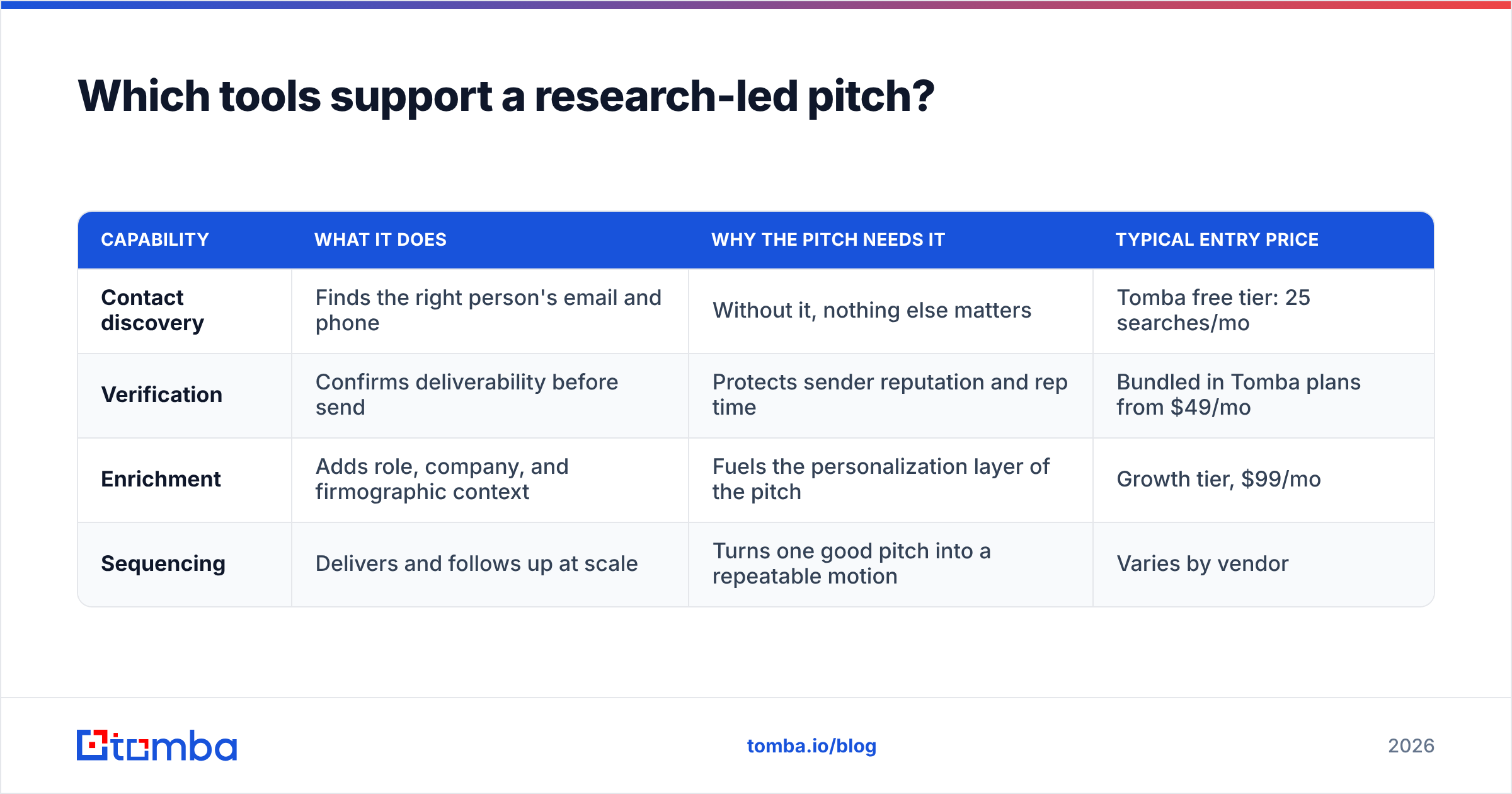
You need three capabilities, and they are often confused with one another.
| Capability | What it does | Why the pitch needs it | Typical entry price |
|---|---|---|---|
| Contact discovery | Finds the right person's email and phone | Without it, nothing else matters | Tomba free tier: 25 searches/mo |
| Verification | Confirms deliverability before send | Protects sender reputation and rep time | Bundled in Tomba plans from $49/mo |
| Enrichment | Adds role, company, and firmographic context | Fuels the personalization layer of the pitch | Growth tier, $99/mo |
| Sequencing | Delivers and follows up at scale | Turns one good pitch into a repeatable motion | Varies by vendor |
Tomba covers the first three. Tomba pricing runs from a free tier at 25 searches per month, through Starter at $49/mo and Growth at $99/mo, to Pro at $249/mo and custom enterprise plans. Peers in the discovery space such as BookYourData take a different approach — prepaid, download-first B2B lists rather than per-lookup search — which suits teams that want a bulk contact file up front rather than an API-driven workflow. Both models work; the choice depends on whether your motion is list-based or account-by-account.
For sequencing, that is a separate purchase. Discovery tools find and verify; sending platforms deliver. Buying one expecting the other is the most common mis-purchase in this category.
Start with contacts worth pitching#
The best pitch in your team's history is worthless if it lands in a spam folder or bounces off a stale address. Before you rewrite your script, fix the layer underneath it.
Use the Tomba Email Finder to build your next 100-account list from real, verified professional addresses — by domain, by name, or by company. Start on the free tier with 25 searches a month, test the accuracy against accounts you already know, and only scale once the data holds up. Then spend your prep time where it actually compounds: on the research that makes the first eight seconds of your pitch impossible to hang up on.
Related guides#
// get started
Find, verify and enrich your first contacts today
Start on the free plan with 25 searches a month, then scale when your team is ready.
Free plan · No credit card required · GDPR & CCPA
// about the author