How to Make a Sales Pitch Presentation That Closes Deals
Most B2B pitch decks lose the room by slide four. Here is a seven-step structure, a slide-by-slide timing table, and the prep work that makes the meeting worth booking in the first place.

TL;DR
- A sales pitch presentation is not a company overview. It is a structured argument that moves one specific buyer from "interesting" to "what happens next."
- Nine slides and 20 minutes of talk time is the working ceiling for a first meeting. Everything else belongs in the leave-behind.
- Open with the buyer's problem in their own words, not your logo wall. The founding-story slide is the single most common deck-killer.
- Every claim needs a proof asset attached: a number, a screenshot, a named customer, or a live demo step. Unproven claims train the room to discount the rest.
- The deck is only half the job. Getting in front of the right person, with a verified contact and accurate account data, is what decides whether the pitch ever happens.
What is a sales pitch presentation, and what is it not?#
A sales pitch presentation is a time-boxed argument built for one buyer, one problem, and one decision. It has a thesis ("your renewals leak because nobody owns the 60-day window"), evidence for that thesis, a mechanism for fixing it, and a specific next step.
What it is not: a company overview, a product tour, or a slide-shaped version of your website. Those are broadcast assets. A pitch is a conversation with slides attached, which is a different craft entirely. The closest cousin is the elevator pitch, just with 20 minutes instead of 30 seconds and a room full of people who each want something different.
That difference matters more than it used to. Gartner's research on the B2B buying journey has consistently shown that buying groups now involve six to ten stakeholders, and that buyers spend only a small fraction of the total buying cycle with any single vendor. Your presentation is not the whole education. It is the part the champion has to be able to re-tell internally, from memory, in about ninety seconds.
Build for that re-telling. If your champion cannot repeat your core claim after the call, the deck failed regardless of how good it looked.
What should a sales pitch presentation include?#
Six blocks, in this order. Each block earns the right to the next one.
- The problem, in the buyer's language. Pulled from discovery notes, their earnings call, their job posting, or their own words in the first meeting. No generic industry trends.
- The cost of the status quo. Quantify it or at least frame it. "Three reps spending six hours a week on manual list building" beats "inefficiency."
- The mechanism. How your product actually changes the outcome. Not features — the causal chain from what you do to what they get.
- The proof. One customer story that matches their shape: same size, same industry, same problem. One is enough if it fits; three unrelated logos are worse than one relevant story.
- The path. What implementation, onboarding, and the first 90 days look like. This is where enterprise deals are quietly won or stalled.
- The ask. One clear next step with a name, a date, and an owner. "Can we get 45 minutes with your RevOps lead next Thursday?" not "let us know your thoughts."
Notice what is missing: the founding story, the team slide, the funding announcement, the world map with dots on it. Those go in the appendix. If a buyer asks about your company's stability, you jump to the appendix slide and answer it — that is far stronger than pre-empting a question nobody asked.
How long should a sales pitch presentation be?#
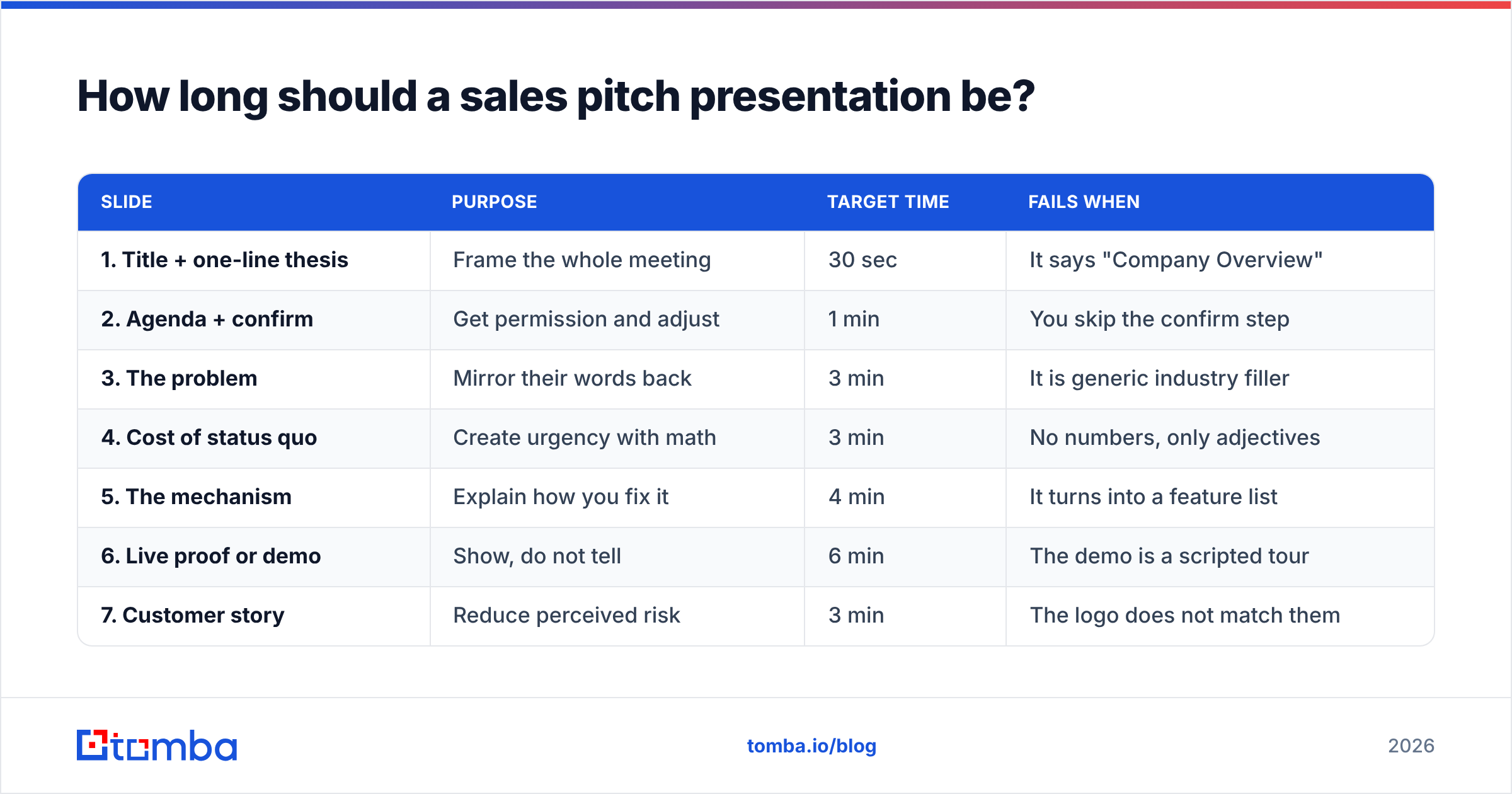
Shorter than you want it to be. Here is the working structure for a 30-minute first meeting, which is the most common slot you will get.
| Slide | Purpose | Target time | Fails when |
|---|---|---|---|
| 1. Title + one-line thesis | Frame the whole meeting | 30 sec | It says "Company Overview" |
| 2. Agenda + confirm | Get permission and adjust | 1 min | You skip the confirm step |
| 3. The problem | Mirror their words back | 3 min | It is generic industry filler |
| 4. Cost of status quo | Create urgency with math | 3 min | No numbers, only adjectives |
| 5. The mechanism | Explain how you fix it | 4 min | It turns into a feature list |
| 6. Live proof or demo | Show, do not tell | 6 min | The demo is a scripted tour |
| 7. Customer story | Reduce perceived risk | 3 min | The logo does not match them |
| 8. Path to value | De-risk implementation | 3 min | It ends at "go live" |
| 9. The ask | Book the next step | 2 min | It is "any questions?" |
That totals about 25 minutes of content, which in practice runs 30 because good meetings get interrupted. Interruptions are the goal. A pitch that runs start to finish without a single question is a pitch nobody was listening to.
Keep an appendix of 10 to 20 slides behind the ask: pricing detail, security and compliance, integrations, competitive positioning, ROI model. You will use two of them per meeting, and you will never know in advance which two.
How do you research before you build a single slide?#
Most bad decks are not design failures. They are research failures rendered in Figma.
Before you open a slide tool, you need four things: the specific problem this account has, who in the buying group owns it, what they have already tried, and what language they use internally. The first meeting's discovery call gets you most of this. Everything else comes from public signals and data work.
Practical sequence:
- Map the account. Pull the full contact set at the domain so you know who else sits in the buying group. A domain search gives you every findable email at a company plus titles and departments, which is how you spot the security reviewer or the finance approver who was never on the call.
- Enrich what you have. Job titles change, people move, and a champion who was a manager in Q1 may be a director now. Running your account list through data enrichment before a pitch stops you from addressing someone by a stale title in front of their team.
- Read their words. Earnings calls, G2 reviews of your competitors, their careers page, their engineering blog. Their job postings alone tell you what they are struggling to fix. G2 is an underused source here — reviews of the incumbent tool they are replacing are effectively free discovery notes.
- Check the timing. New leadership, a funding round, a compliance deadline, a migration. Every good pitch has an implicit "why now," and it should be their why-now, not your quarter-end.
This research is what makes slide three specific. Specificity is the whole ballgame. A problem slide that quotes a phrase the buyer used in discovery earns more trust in eight seconds than a design agency earns in eight weeks.
Which format wins: slide deck, live demo, or one-pager?#
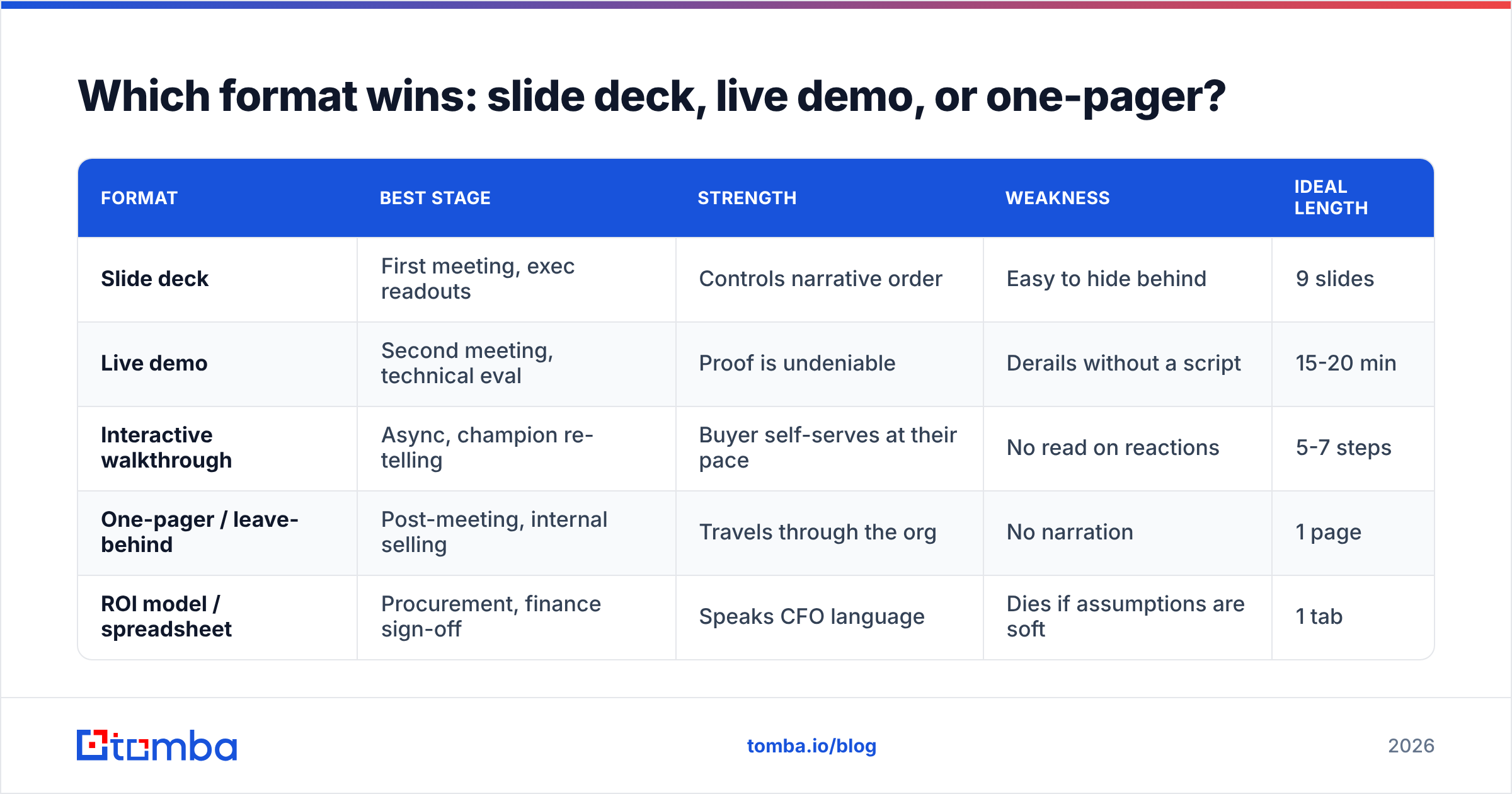
Depends on the stage and the audience. Most teams default to a deck for everything, which is why so many second meetings feel like a repeat of the first.
| Format | Best stage | Strength | Weakness | Ideal length |
|---|---|---|---|---|
| Slide deck | First meeting, exec readouts | Controls narrative order | Easy to hide behind | 9 slides |
| Live demo | Second meeting, technical eval | Proof is undeniable | Derails without a script | 15-20 min |
| Interactive walkthrough | Async, champion re-telling | Buyer self-serves at their pace | No read on reactions | 5-7 steps |
| One-pager / leave-behind | Post-meeting, internal selling | Travels through the org | No narration | 1 page |
| ROI model / spreadsheet | Procurement, finance sign-off | Speaks CFO language | Dies if assumptions are soft | 1 tab |
The strongest pattern for a mid-market B2B cycle: a nine-slide deck for the first meeting, a scripted demo built around the buyer's actual use case for the second, and a one-pager the champion can forward without you in the room. HubSpot's sales pitch guide makes a similar argument for brevity, and the underlying reason is structural — the more stakeholders in the buying group, the more your message gets compressed in transmission. Write for the compression.

How do you build the deck in seven steps?#
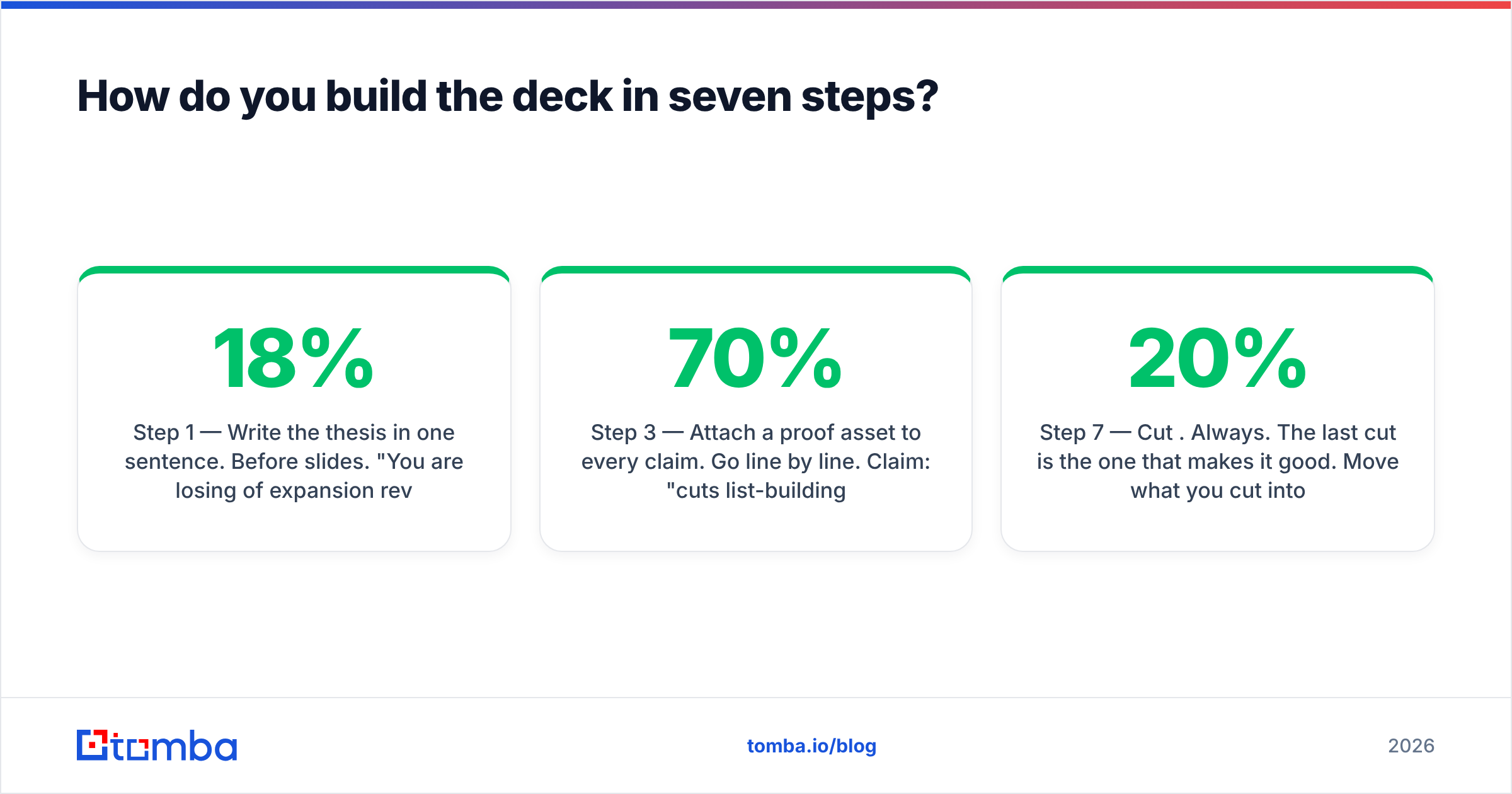
Step 1 — Write the thesis in one sentence. Before slides. "You are losing 18% of expansion revenue because renewals have no owner in the 60-day window, and here is how to fix that in a quarter." If you cannot write that sentence, you do not have a pitch yet, you have a product.
Step 2 — Outline in text, not slides. A bulleted doc, nine lines, one per slide. Order matters more than anything visual. Reorder in text where it is cheap.
Step 3 — Attach a proof asset to every claim. Go line by line. Claim: "cuts list-building time by 70%." Proof: a named customer, a screenshot, a before/after number. Any claim without an attached proof gets cut or softened. This single pass improves more decks than any redesign.
Step 4 — Build slides at one idea per slide. If a slide needs two sentences of explanation, it is two slides. Headlines should be full statements ("Renewals slip because nobody owns day 60"), not labels ("Renewals").
Step 5 — Design for the back of the room. 24pt minimum body text, high contrast, one chart per slide, no logos smaller than a thumbnail. Assume it will be viewed on a shared screen in a bright conference room, compressed by video conferencing.
Step 6 — Rehearse against interruption. Have a colleague interrupt you at slides three, five, and seven with a hostile question. If you cannot get back on track in ten seconds, your narrative depends too heavily on order.
Step 7 — Cut 20%. Always. The last cut is the one that makes it good. Move what you cut into the appendix so it is never truly lost.
What are the most common sales pitch presentation mistakes?#
- Opening with yourself. The company timeline slide is dead weight in a first meeting. Buyers do not care about your Series B until they care about your product.
- Feature dumps. Twelve features listed on one slide communicates nothing except that you have not decided what matters to this buyer.
- Unanchored numbers. "10x faster" with no baseline is noise. "From six hours to 35 minutes per list, measured across four reps over two months" is evidence.
- No named next step. Ending on "any questions?" hands control of the deal to the buyer's calendar. End on a specific ask with a specific person.
- Reading the slides. If the slide contains your script, the room reads faster than you talk and stops listening. Slides are the evidence; you are the narration.
- One deck for every account. Slides three, four, and seven should change every time. If they never change, the pitch is a broadcast and it will convert like one.
- Ignoring the silent stakeholder. The person who says nothing in the meeting is often the one who kills the deal in the internal review. Ask who else should see this and get their contact before you leave the call.
How do you make sure you are pitching the right person?#
The best deck in your category, delivered to someone with no budget authority and no pain, converts at zero. Targeting is upstream of everything in this article, and it is where most pipeline problems actually originate.
Three checks before you accept a pitch meeting:
- Is the problem real for them right now? Trigger events, hiring patterns, and tech-stack changes are stronger signals than firmographics alone.
- Is the person you are pitching close to the budget? If not, your entire deck needs a different job: equipping a champion rather than persuading a buyer. Those are structurally different presentations.
- Is the contact data accurate? Bounced invites, wrong-person meetings, and stale titles quietly eat a large share of booked-meeting rates. Running contacts through an email verifier before outreach is a two-minute step that prevents a category of failure you would otherwise blame on your messaging.
That last one is unglamorous and it moves the number. A pitch deck improvement might lift your close rate a few points. Fixing a list where a meaningful share of addresses bounce lifts everything downstream of it.
How do you know if the presentation actually worked?#
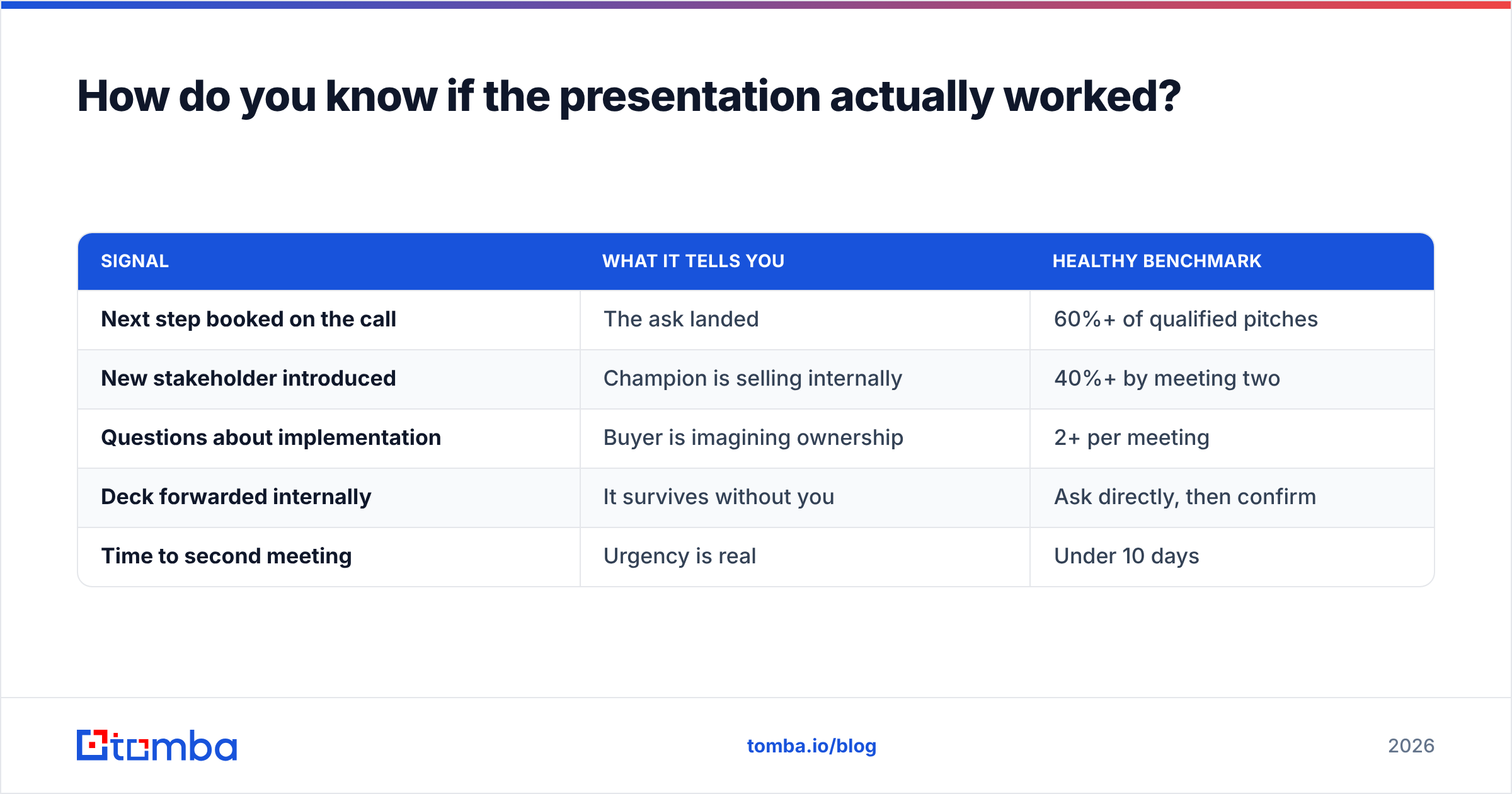
Track outcomes, not applause. "They loved it" is not a metric.
| Signal | What it tells you | Healthy benchmark |
|---|---|---|
| Next step booked on the call | The ask landed | 60%+ of qualified pitches |
| New stakeholder introduced | Champion is selling internally | 40%+ by meeting two |
| Questions about implementation | Buyer is imagining ownership | 2+ per meeting |
| Deck forwarded internally | It survives without you | Ask directly, then confirm |
| Time to second meeting | Urgency is real | Under 10 days |
Review your last ten pitches against that table. The pattern will tell you which slide is failing. If next steps are booked but no new stakeholders appear, your deck is not portable — fix the one-pager. If questions never reach implementation, your mechanism slide is not landing.
Run this review monthly. A pitch deck is a product, and products need release notes.
Where should you start?#
Start with the list, not the slides. Build the nine-slide structure once, then spend your prep time on the two things that change per account: the problem slide and the proof slide. Both come from research, and research comes from knowing exactly who you are talking to.
If your pitch calendar is thinner than it should be, the bottleneck is usually contact data rather than content. Tomba Email Finder locates verified professional email addresses by name, company, or domain, so the meetings you prepare for are with people who actually exist at the titles you think they hold. The free tier covers 25 searches a month, and Tomba pricing starts at $49/mo for Starter when you are ready to build lists at volume.
Get the right person in the room. Then nine slides is plenty.
Related guides#
// get started
Find, verify and enrich your first contacts today
Start on the free plan with 25 searches a month, then scale when your team is ready.
Free plan · No credit card required · GDPR & CCPA
// about the author