How to Make an Elevator Pitch That Actually Books Meetings
Most elevator pitches fail because they describe the seller, not the buyer's problem. Here is a 5-part framework, real examples, and the metrics that tell you when your pitch is working.
TL;DR
- A working elevator pitch is 5 parts: trigger, problem, mechanism, proof, ask. It runs 20–35 seconds — roughly 60–90 spoken words.
- Lead with the buyer's problem, not your company description. "We're an AI-powered platform that..." is the single most common failure mode.
- Write three versions — 10 seconds, 30 seconds, 90 seconds — and pick based on how much attention you actually have.
- Proof beats adjectives. One number a prospect can verify outperforms three claims they can't.
- A pitch only works if it reaches the right person. Getting the pitch right and getting the contact right are two separate problems — solve both.
What is an elevator pitch, really?#
An elevator pitch is a compressed argument for why a specific person should give you more of their time. That's it. It is not a company summary, not a mission statement, and not a feature list.
The name comes from the old scenario: you step into an elevator with the decision-maker and have until the doors open. The scenario is fiction, but the constraint is real. On a cold call you have about eight seconds before the prospect decides whether to hang up. In a LinkedIn message you have one line of preview text. At a conference booth you have the time it takes someone to walk past.
The useful reframe: your pitch is not trying to close a deal. It is trying to buy the next 90 seconds. Every word that doesn't earn that next 90 seconds is dead weight.
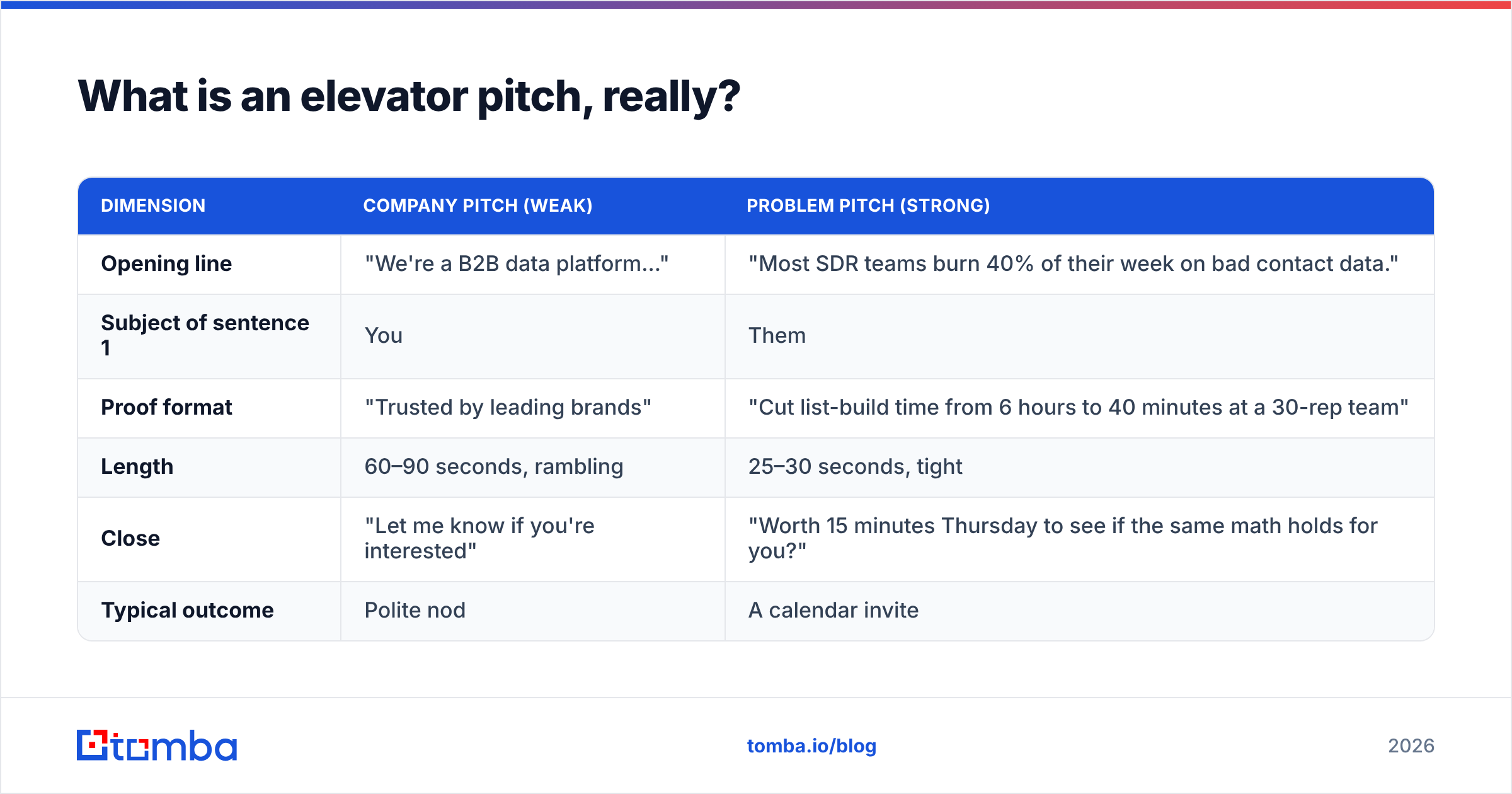
Here is the structural difference between the two pitch types most people confuse:
| Dimension | Company pitch (weak) | Problem pitch (strong) |
|---|---|---|
| Opening line | "We're a B2B data platform..." | "Most SDR teams burn 40% of their week on bad contact data." |
| Subject of sentence 1 | You | Them |
| Proof format | "Trusted by leading brands" | "Cut list-build time from 6 hours to 40 minutes at a 30-rep team" |
| Length | 60–90 seconds, rambling | 25–30 seconds, tight |
| Close | "Let me know if you're interested" | "Worth 15 minutes Thursday to see if the same math holds for you?" |
| Typical outcome | Polite nod | A calendar invite |
The right column isn't cleverer. It's just aimed at the listener instead of at the speaker.
How do you make an elevator pitch in 5 parts?#
Use this skeleton. Write each part as one sentence, then cut every sentence by a third.
The trigger (5 seconds) — a specific, observable fact about their world. Not "companies today face challenges." Try: "You just posted three SDR roles in two weeks." Specificity signals you did homework, which is the only credential you have in the first five seconds.
The problem (7 seconds) — name the cost, in their units. Money, hours, headcount, deals, or risk. "Every new rep spends their first month building lists instead of booking meetings" beats "onboarding is inefficient" because the second one has no price tag attached.
The mechanism (8 seconds) — how you solve it, in plain language, in one clause. Not the feature list. The how. "We pull verified work emails straight from the domain, so reps start dialing on day two, not day thirty." If you cannot explain the mechanism without jargon, you do not understand it well enough to pitch it.
The proof (7 seconds) — one number, one named-category customer, or one before/after. One. Three proof points read as insecurity. "A 30-rep team cut list-build from six hours a week to forty minutes" is a single sentence that does more work than a logo wall.
The ask (3 seconds) — small, specific, time-boxed. "Fifteen minutes Thursday?" not "would you be open to exploring a partnership?" The ask should be so small that saying yes costs nothing.
Read the whole thing aloud with a timer. If it runs past 35 seconds, you have an extra clause somewhere. Find it and delete it.

Why do most elevator pitches fail?#
Four failure modes account for nearly everything that goes wrong.
You describe yourself instead of their problem. The listener's brain is running one query: is this relevant to me? Every second you spend on your founding story is a second that query returns "no." Start with them.
You use category words that mean nothing. "Platform," "solution," "end-to-end," "AI-powered," "seamless." Research on B2B messaging consistently finds that undifferentiated category language makes vendors interchangeable in buyers' minds — Gartner's B2B buying research has documented how sameness across vendors stalls purchase decisions outright. If your competitor could say your sentence word-for-word, delete it.
You pitch a product to someone who has no problem. No pitch survives bad targeting. A perfect 30-second pitch to a person who does not own the problem converts at zero. This is a list quality issue, not a copy issue — and no amount of rewriting fixes it.
You ask for too much. "Can we set up a discovery call with your team next quarter?" is a large ask from a stranger. "Fifteen minutes Thursday?" is a small one. Small asks compound; large asks stall.
There's a fifth, quieter failure: the pitch never arrives. You wrote something sharp, sent it to firstname@company.com guessed from a pattern, and it bounced. Bounces above roughly 2–3% start damaging your sender reputation, which means your next pitch lands in spam regardless of quality. Verify before you send — a quick pass through an email verifier removes the addresses that would have bounced.
What does a good elevator pitch look like in practice?#
Three worked examples, same 5-part structure, different contexts.
B2B SaaS, cold call opener (28 seconds):
"Hi Dana — I saw you're hiring two more SDRs this quarter. Most teams that scale like that lose the first month of each new rep to list-building instead of dialing. We pull verified work emails directly from a company's domain, so new reps start conversations in week one. One 30-person team we work with went from six hours a week on list prep to about forty minutes. Worth fifteen minutes Thursday to see if the math is similar for you?"
Job seeker, conference hallway (22 seconds):
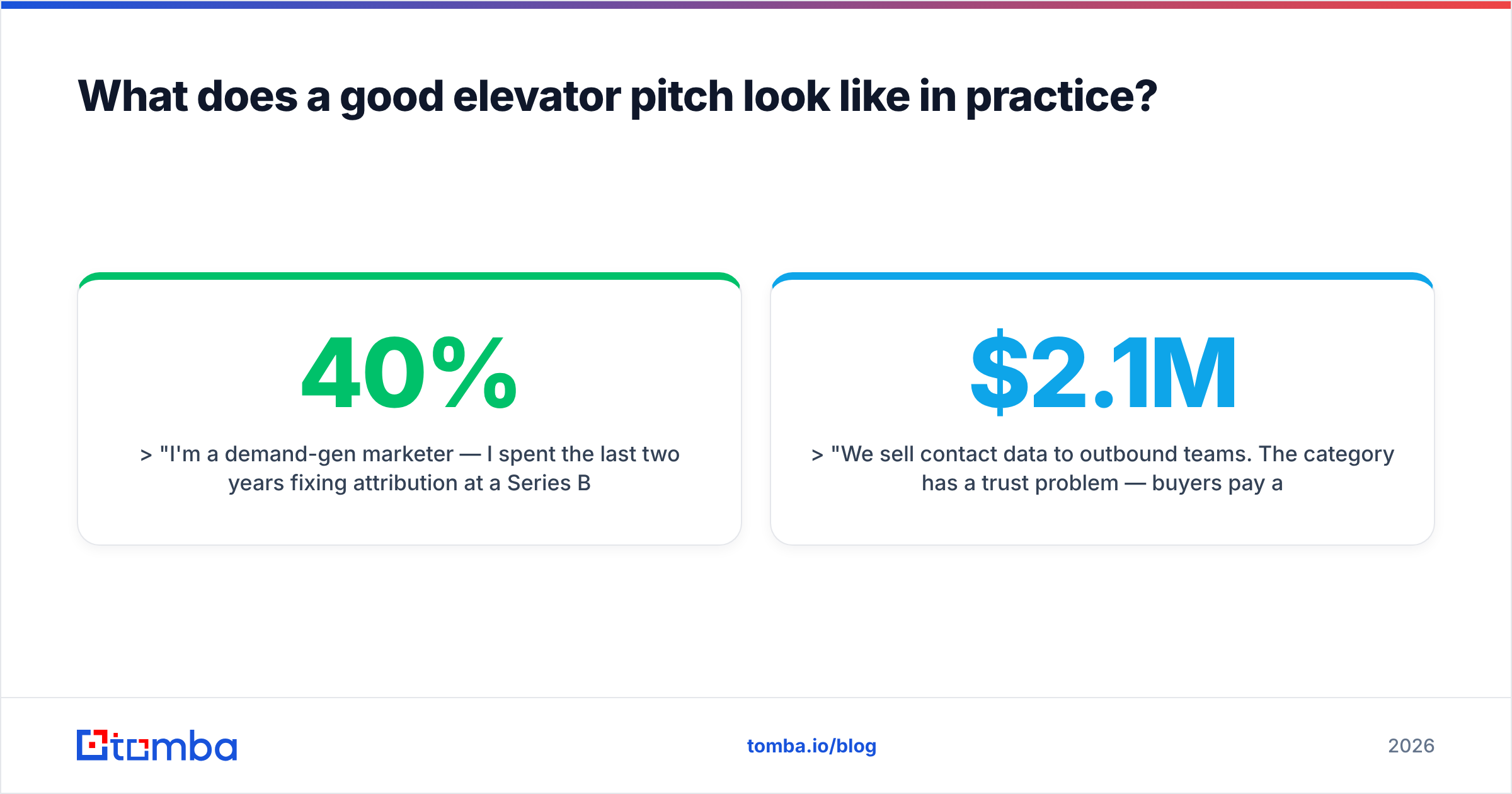
"I'm a demand-gen marketer — I spent the last two years fixing attribution at a Series B fintech. Their pipeline reporting was off by about 40%, so nobody trusted the numbers and budget kept going to the loudest channel. I rebuilt the model and we reallocated $600K into channels that were actually converting. I'm looking at Series B/C companies with the same problem. Are you hiring in that direction?"
Founder, investor intro (26 seconds):
"We sell contact data to outbound teams. The category has a trust problem — buyers pay per credit and roughly a third of the records are dead, so they're paying for waste. We charge for verified results only. We're at $2.1M ARR growing 12% month over month with 4% logo churn. Happy to send the deck if the space is interesting."
Notice what's absent in all three: adjectives about themselves, mission language, and the word "passionate."
What's the difference between a 10-second, 30-second, and 90-second pitch?#
Write all three. You will not know which one you need until you're in the room.
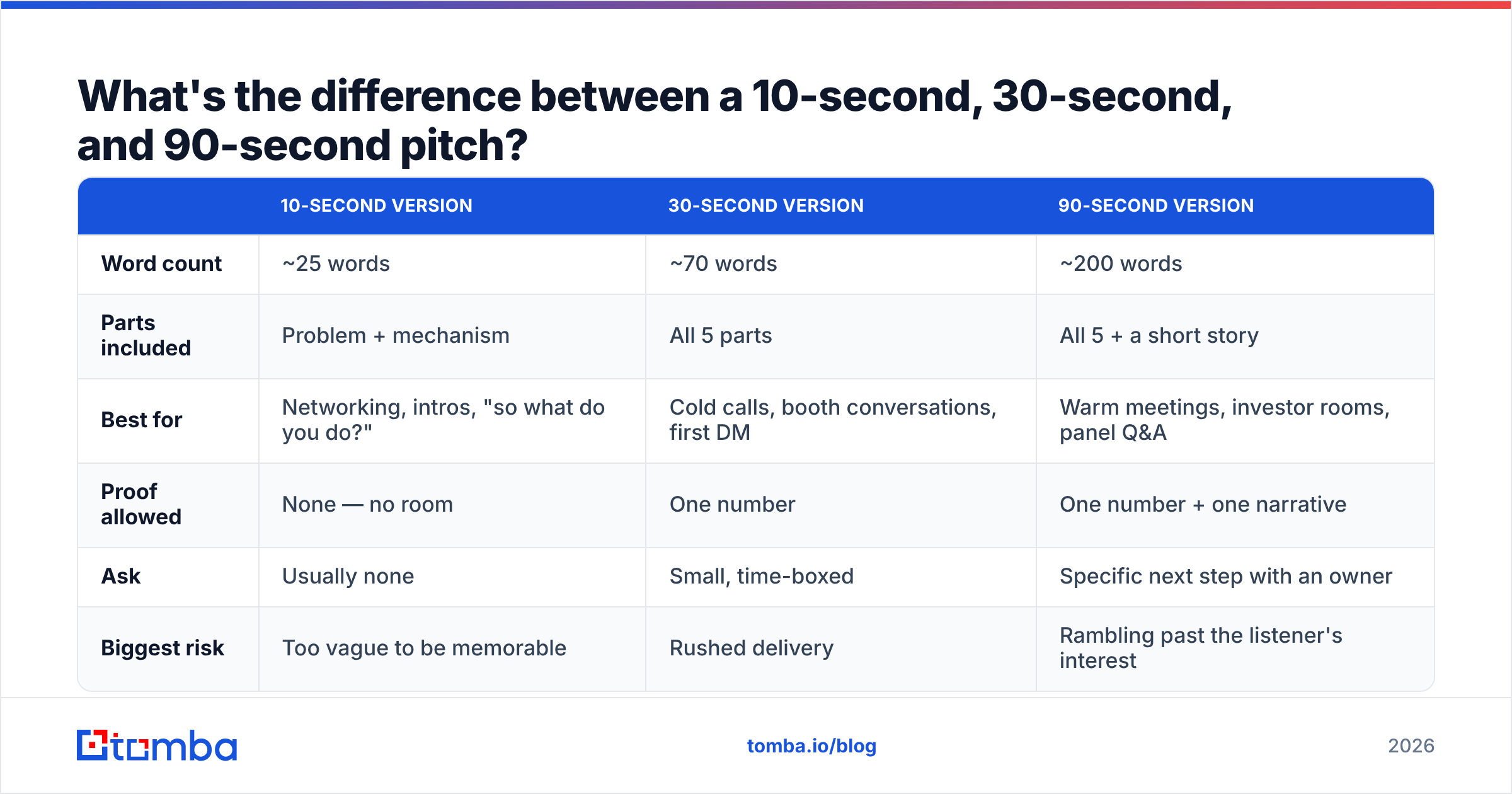
| 10-second version | 30-second version | 90-second version | |
|---|---|---|---|
| Word count | ~25 words | ~70 words | ~200 words |
| Parts included | Problem + mechanism | All 5 parts | All 5 + a short story |
| Best for | Networking, intros, "so what do you do?" | Cold calls, booth conversations, first DM | Warm meetings, investor rooms, panel Q&A |
| Proof allowed | None — no room | One number | One number + one narrative |
| Ask | Usually none | Small, time-boxed | Specific next step with an owner |
| Biggest risk | Too vague to be memorable | Rushed delivery | Rambling past the listener's interest |
The 10-second version is the hardest to write and the one you'll use most. Draft the 30-second version first, then compress. Compression is easier than expansion.
How do you test whether your pitch is working?#
Stop judging pitches by how they feel and start judging them by what happens next. Four measurable signals:
- Follow-up question rate. After you deliver the pitch, does the listener ask a question? A specific question ("how do you verify?") means the pitch landed. Silence or "cool, send me something" means it didn't. Track this manually across 20 conversations — it's the fastest diagnostic you have.
- Reply rate on written versions. For emailed pitches, measure response rate per variant, not open rate. Opens have been unreliable since Apple Mail Privacy Protection; replies are ground truth.
- Meeting-book rate. Pitches delivered divided by meetings booked. A cold pitch to a well-targeted list that converts at 3–5% into a meeting is doing real work. Below 1%, something in the targeting or the ask is broken.
- The recall test. A week later, ask a colleague who heard it once to repeat it back. If they can't reconstruct the problem you solve, no prospect will either.
Run A/B tests on one variable at a time. Change the trigger line for two weeks, hold everything else constant, compare reply rates. Changing three things at once teaches you nothing. HubSpot's sales research is a decent reference point for benchmark ranges, but your own baseline matters more than any published average.

Does the pitch matter more than the list?#
No — and this is where most teams misallocate effort.
A great pitch to the wrong 500 people loses to a mediocre pitch to the right 100. The pitch determines your conversion rate within a segment; the list determines whether the segment exists at all. Teams spend weeks wordsmithing and minutes on targeting, then blame the copy.
Concretely, four things need to be true before your pitch gets a fair test:
- Right person. The individual owns the problem and has budget authority or direct influence over it. A pitch about SDR productivity aimed at a CFO needs a different problem framing — cost per meeting, not hours saved.
- Right company. They have the trigger condition you named. If your pitch opens with "you're scaling your SDR team," and they're not, the first five seconds burn.
- Right contact data. The email exists and is deliverable. This is where a domain search that maps a company's actual email pattern beats guessing at
first.last@. - Right moment. Hiring posts, funding rounds, leadership changes, and tech-stack switches are all observable timing signals. Pitching a solved problem is the fastest way to sound irrelevant.
Fix those four and a decent pitch performs. Skip them and a brilliant pitch underperforms — which sends you back to rewriting copy that was never the bottleneck.
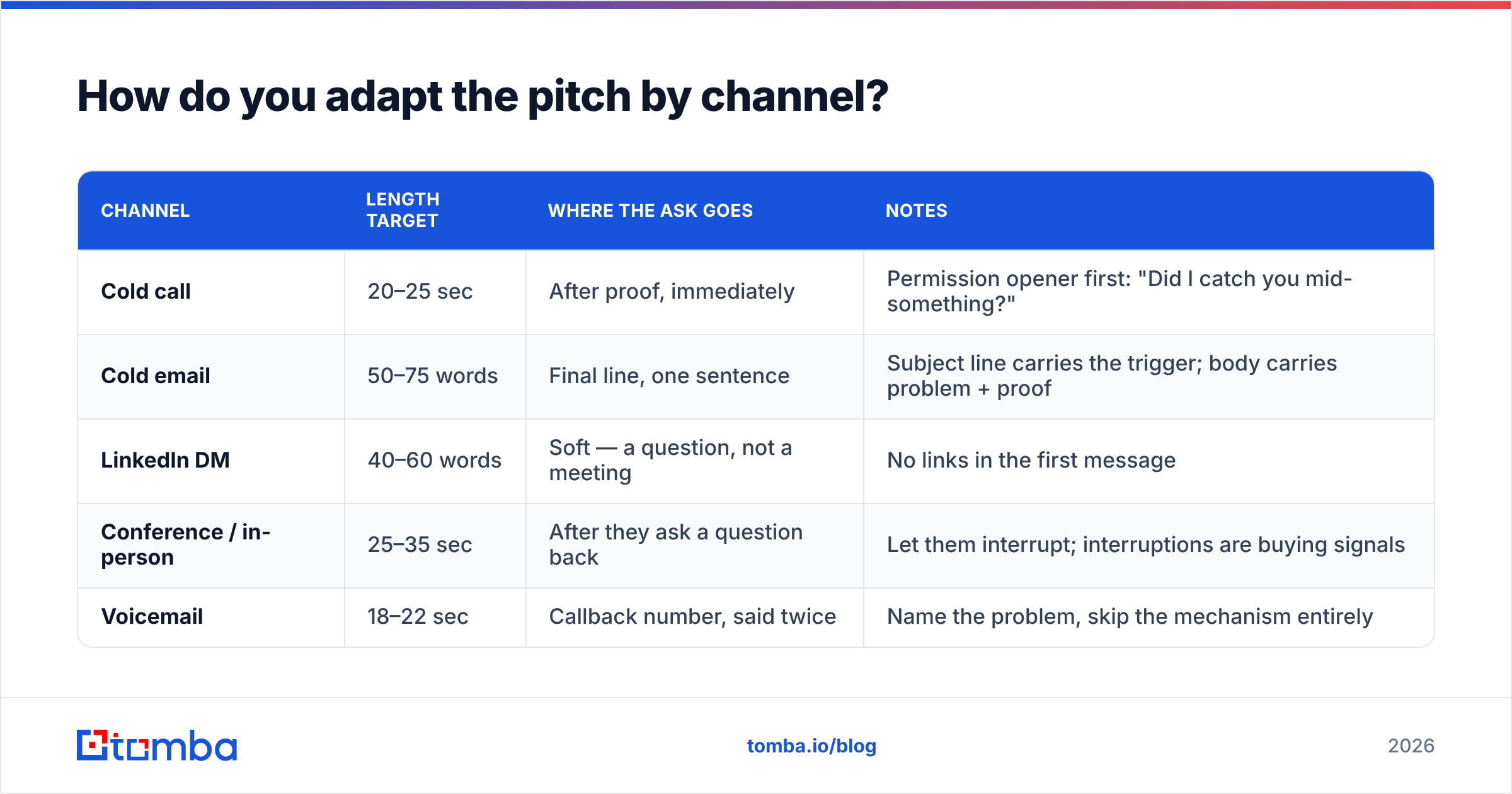
How do you adapt the pitch by channel?#
The 5-part skeleton holds. The delivery changes.
| Channel | Length target | Where the ask goes | Notes |
|---|---|---|---|
| Cold call | 20–25 sec | After proof, immediately | Permission opener first: "Did I catch you mid-something?" |
| Cold email | 50–75 words | Final line, one sentence | Subject line carries the trigger; body carries problem + proof |
| LinkedIn DM | 40–60 words | Soft — a question, not a meeting | No links in the first message |
| Conference / in-person | 25–35 sec | After they ask a question back | Let them interrupt; interruptions are buying signals |
| Voicemail | 18–22 sec | Callback number, said twice | Name the problem, skip the mechanism entirely |
Two channel-specific notes worth remembering. On cold email, the pitch competes with a subject line — if the subject fails, the pitch never gets read, so treat them as one unit. On voicemail, drop the mechanism entirely; there's no room, and curiosity does the work.
For written channels, deliverability sits underneath everything. Authentication records, sending volume, and list hygiene decide whether your carefully compressed 70 words reach an inbox at all. If you're ramping a new sending domain, check your SPF record before you scale volume — misconfigured authentication is a common and entirely avoidable reason good pitches disappear.
What should you do in the next hour?#
A practical sequence:
- Write the 30-second version. Five sentences, one per part. Do not edit while writing.
- Cut it by a third. Read aloud with a timer. Delete every adjective that describes you.
- Compress to 10 seconds. Keep problem + mechanism only.
- Replace one adjective with one number. "Fast" becomes "40 minutes instead of 6 hours." If you don't have the number, go find it before you pitch again.
- Test on five real conversations. Track follow-up questions. Revise one element.
- Audit your list. Confirm the trigger condition actually applies to the people you're about to pitch.
Do this in order. Step 6 is the one teams skip, and it's the one that determines whether steps 1–5 mattered.
Where does the contact data come from?#
Once your pitch is tight, the constraint moves to reach: getting it in front of enough of the right people to generate a signal you can learn from.
Tomba's Email Finder resolves verified work email addresses from a name and company domain, so the pitch you spent an hour compressing actually arrives in an inbox instead of bouncing. The free tier covers 25 searches a month, which is enough to test a pitch on a small, well-chosen list before committing budget. Paid plans start at $49/mo for Starter and $99/mo for Growth — full Tomba pricing is public, no sales call required.
Write the pitch. Verify the list. Then send it — in that order.
Related guides#
// get started
Find, verify and enrich your first contacts today
Start on the free plan with 25 searches a month, then scale when your team is ready.
Free plan · No credit card required · GDPR & CCPA
Get the Tomba newsletter
Product and data updates
// about the author