How to Make Cold Calling Fun: 9 Ways Reps Stay Sharp
Cold calling is only miserable when the setup is broken. Here are nine tested ways to make dials feel like a game instead of a punishment — plus the data and tooling that make the fun sustainable.
TL;DR
- Cold calling stops being fun when the feedback loop is broken: bad numbers, no scoreboard, no coaching, no visible progress. Fix the loop and the enjoyment follows.
- The single biggest morale killer is not rejection — it's dialing dead numbers. Reps who connect with a human on 25% of dials stay engaged; reps at 6% burn out in weeks.
- Gamification works when it rewards behavior you control (dials, conversations, follow-ups), not just closed deals.
- Small format changes — power hours, live call roulette, themed weeks, bet-based challenges — cost nothing and lift dial volume 20-40% in most teams that try them.
- Verified contact data is the cheapest fun-multiplier available: cleaner lists mean more conversations per hour, and conversations are what reps actually enjoy.
Why does cold calling feel so miserable in the first place?#
Because most reps are running an experiment with no visible result.
Think of a slot machine with the lights and sounds removed. You pull the lever, nothing happens, you pull again. Nobody would play that machine for eight hours. But that's exactly what a cold-calling shift feels like when 90% of dials hit voicemail, disconnected lines, or a gatekeeper who hangs up before you speak.
Three specific things break the loop:
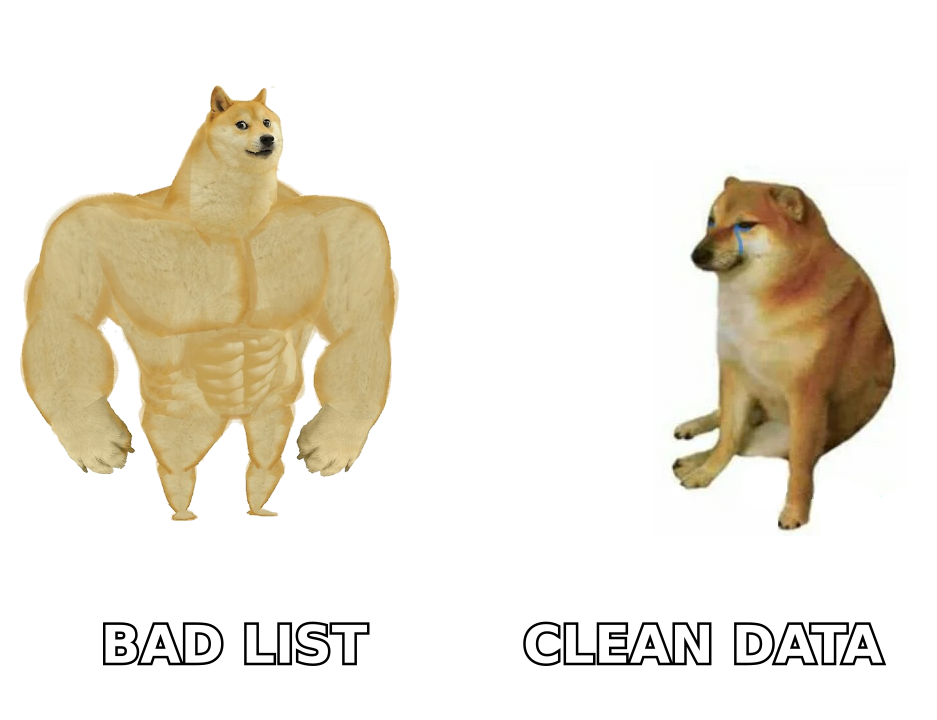
- Bad data. Wrong direct dials, main switchboards instead of mobiles, and people who left the company 14 months ago. Every one of those is a pull with no payoff.
- No scoreboard. If you can't see whether today was better than yesterday, there is no game — just repetition.
- Deal-only incentives. When the only celebrated outcome is a signed contract, a rep who made 80 excellent dials and booked zero meetings feels like a failure. That's a design flaw, not a performance problem.
Fixing enjoyment means fixing those three. Everything below is downstream of that.
What actually makes cold calling fun for reps?#
Fun in outbound comes from four ingredients. Miss any one and the shift drags.
- Fast feedback — you learn within seconds whether the approach worked. A live human answering is the feedback. Voicemail is not.
- Visible progress — a counter, a bar, a wall chart. Something that moves when you act.
- Social stakes — someone else is watching, competing, or celebrating with you. Solo dialing in a silent room is the least fun version of this job.
- Autonomy on the script — reps who can experiment with openers stay curious. Reps reading a locked script word-for-word are doing data entry with their voice.
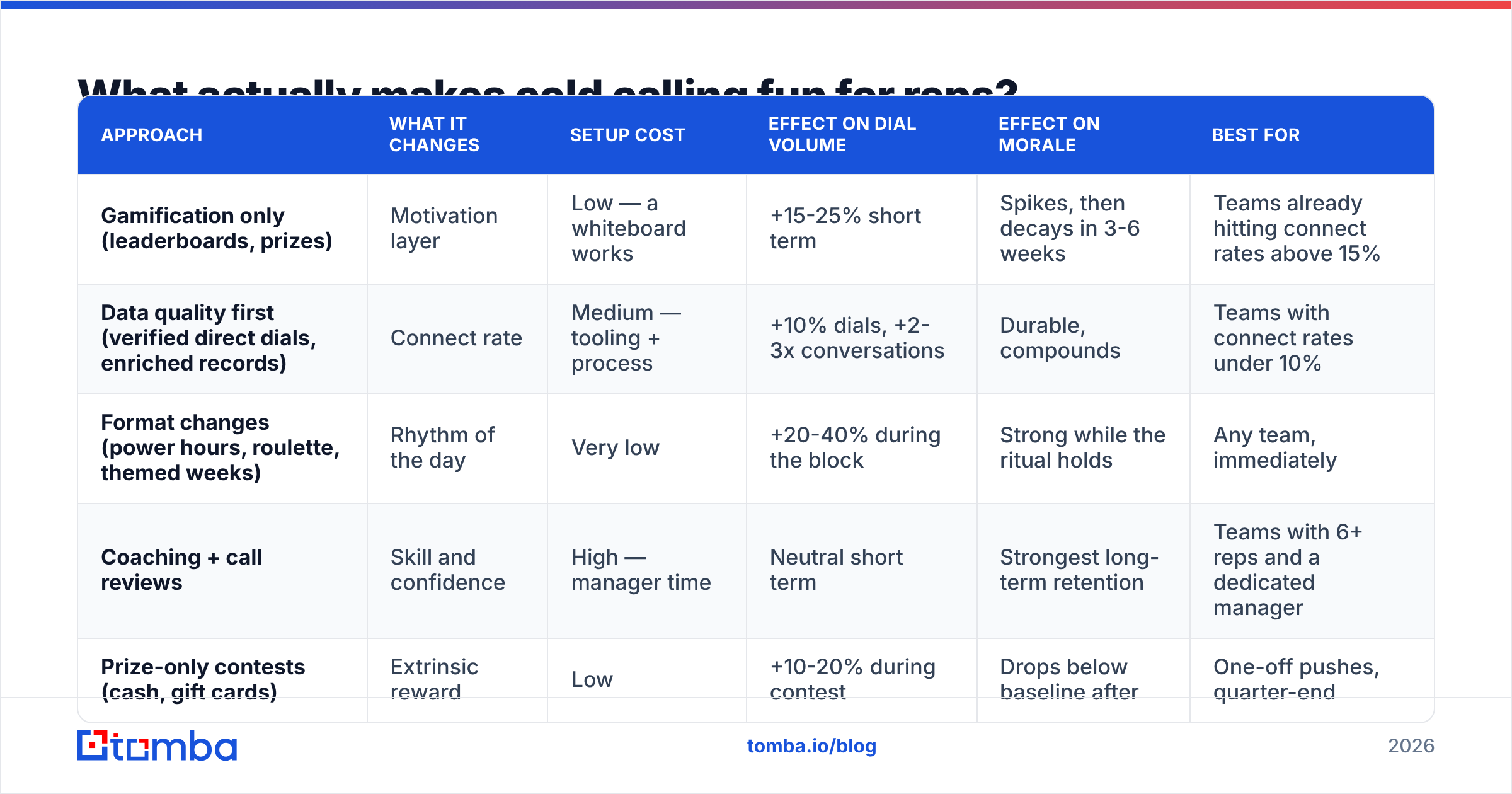
Here is how the two dominant approaches to "making calling fun" actually compare:
| Approach | What it changes | Setup cost | Effect on dial volume | Effect on morale | Best for |
|---|---|---|---|---|---|
| Gamification only (leaderboards, prizes) | Motivation layer | Low — a whiteboard works | +15-25% short term | Spikes, then decays in 3-6 weeks | Teams already hitting connect rates above 15% |
| Data quality first (verified direct dials, enriched records) | Connect rate | Medium — tooling + process | +10% dials, +2-3x conversations | Durable, compounds | Teams with connect rates under 10% |
| Format changes (power hours, roulette, themed weeks) | Rhythm of the day | Very low | +20-40% during the block | Strong while the ritual holds | Any team, immediately |
| Coaching + call reviews | Skill and confidence | High — manager time | Neutral short term | Strongest long-term retention | Teams with 6+ reps and a dedicated manager |
| Prize-only contests (cash, gift cards) | Extrinsic reward | Low | +10-20% during contest | Drops below baseline after | One-off pushes, quarter-end |
The pattern is consistent: format changes give you the fastest lift, data quality gives you the most durable one, and prize-only contests are the weakest lever despite being the most popular.
How do you gamify cold calling without it feeling forced?#
Gamify inputs, not outcomes. A rep controls how many dials they make and how many conversations they hold. They do not control whether a VP of Ops is having a bad day.
Concrete formats that hold up:
- Call roulette. Everyone spins for a random account tier — enterprise, mid-market, or a wildcard nobody wants. The wildcard is worth triple points. Reps stop cherry-picking and start enjoying the absurd ones.
- Bingo cards. A 5x5 grid of objections and phrases: "send me an email," "we already use a competitor," "how did you get this number." Free space is a dog barking. First to a line calls it out loud. It reframes objections as collectibles.
- The $2 bet. Two reps each put $2 on who books the first meeting before lunch. The stake is small enough to be silly and big enough to matter.
- Conversation streaks. Track consecutive days where a rep held five or more real conversations. Streaks are stickier than totals because they hurt to break.
- Team-wide connect goal. One shared number on a screen. Individual leaderboards create resentment in small teams; a shared bar creates a huddle.
Research from Gartner on sales engagement consistently points to the same thing: recognition frequency matters more than reward size. Five small acknowledgements a week beats one large bonus a quarter.
Whatever format you pick, rotate it. Any game gets boring in about six weeks. Put a calendar reminder to change the mechanic before people ask you to.
Does better data actually make calling more enjoyable?#
Yes, and it's the most underrated part of the answer.
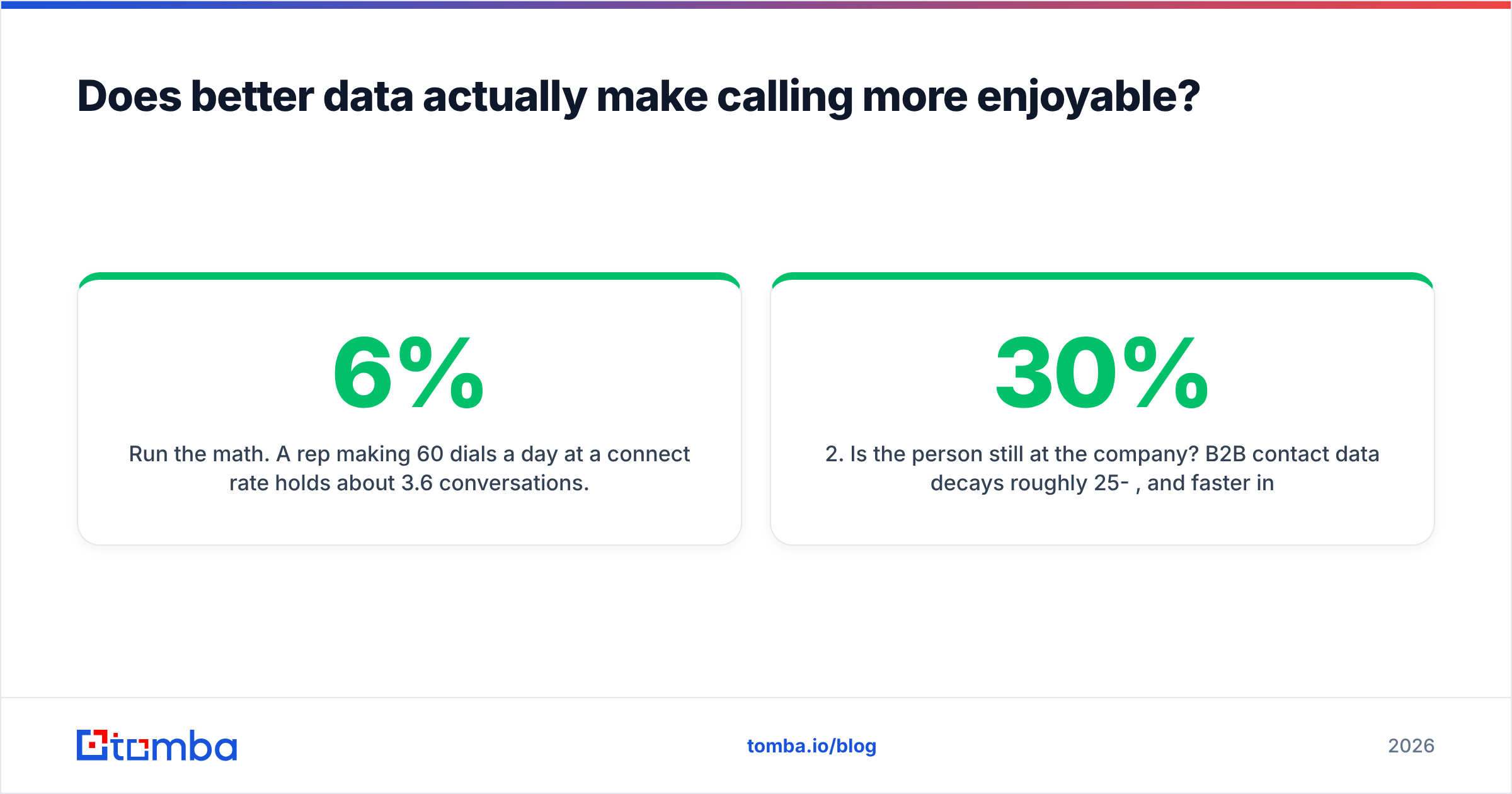
Run the math. A rep making 60 dials a day at a 6% connect rate holds about 3.6 conversations. The same rep at an 18% connect rate holds 10.8. That's not a 3x productivity gain — it's a completely different job. One version is eight hours of dead air. The other is a day of actual sales conversations, which is the part reps signed up for.
Connect rate is driven almost entirely by three things:
- Is the number a direct dial or a switchboard? Mobile and direct-dial numbers connect at multiples of main-line numbers.
- Is the person still at the company? B2B contact data decays roughly 25-30% per year, and faster in tech.
- Is the timing sane? Calling a European prospect at 4pm their time is not a data problem, but it is a list-building one.
This is where tooling earns its keep. A phone finder that returns verified direct dials removes the single largest source of dead pulls. Pair it with a phone validator run before the list goes to reps, and you strip out disconnected lines before anyone wastes a dial on them. Enrichment matters too — a record with a current title, company size, and recent trigger gives a rep something to open with instead of "so, what do you guys do over there?"
If your team also runs email sequences alongside calls, data enrichment keeps both channels pointing at the same, current person. Nothing kills momentum like calling someone whose email bounced two weeks ago.
What does a fun cold-calling day actually look like?#
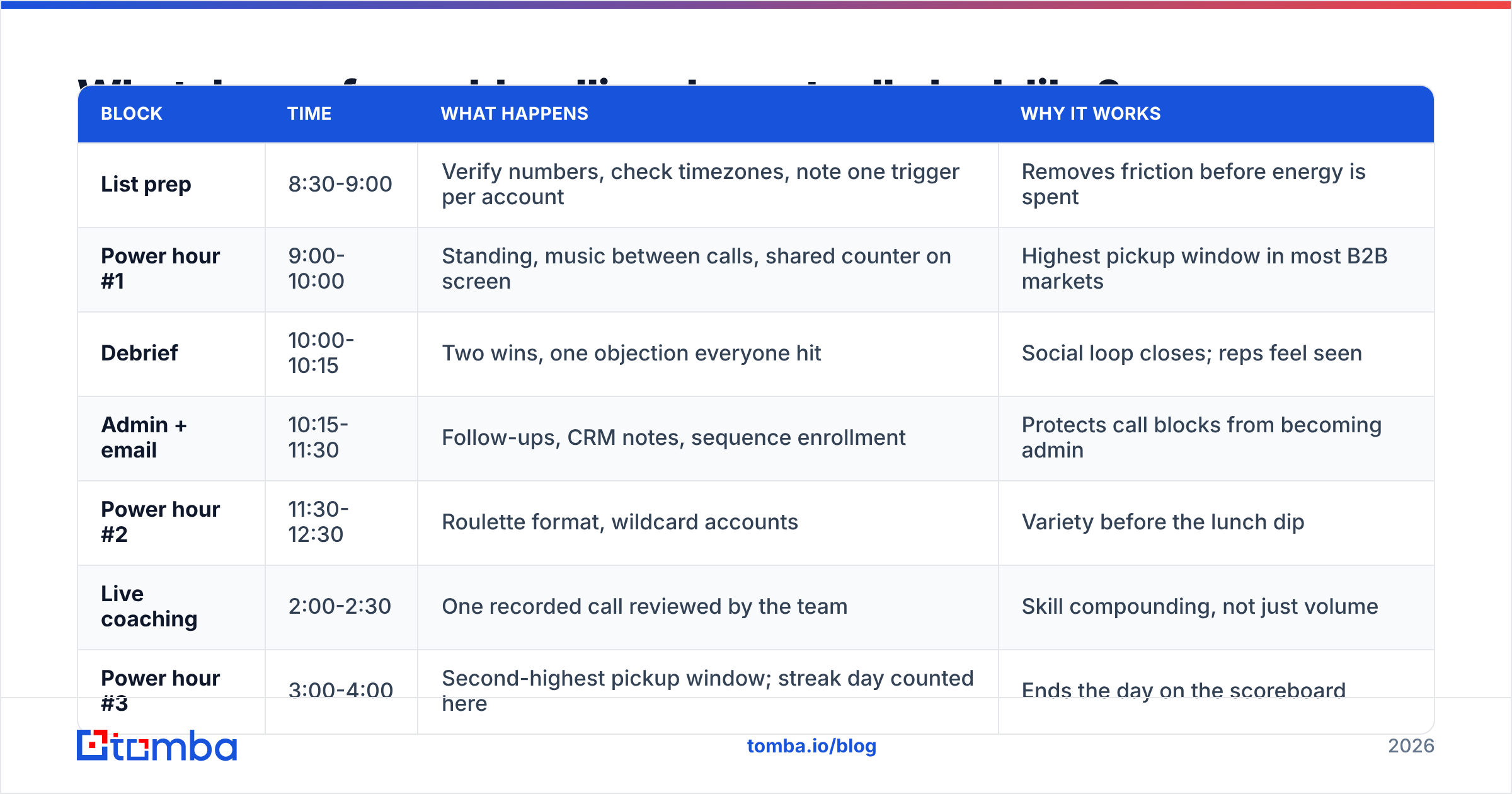
Structure beats willpower. Here's a schedule that teams consistently report as the least painful and highest-output version of the day.
| Block | Time | What happens | Why it works |
|---|---|---|---|
| List prep | 8:30-9:00 | Verify numbers, check timezones, note one trigger per account | Removes friction before energy is spent |
| Power hour #1 | 9:00-10:00 | Standing, music between calls, shared counter on screen | Highest pickup window in most B2B markets |
| Debrief | 10:00-10:15 | Two wins, one objection everyone hit | Social loop closes; reps feel seen |
| Admin + email | 10:15-11:30 | Follow-ups, CRM notes, sequence enrollment | Protects call blocks from becoming admin |
| Power hour #2 | 11:30-12:30 | Roulette format, wildcard accounts | Variety before the lunch dip |
| Live coaching | 2:00-2:30 | One recorded call reviewed by the team | Skill compounding, not just volume |
| Power hour #3 | 3:00-4:00 | Second-highest pickup window; streak day counted here | Ends the day on the scoreboard |
Three things make this work that aren't obvious from the table:
- Nobody dials alone. Even remote teams keep a video room open with mics muted between calls. The ambient presence of other people doing the same hard thing is most of the fun.
- The counter is public and only counts conversations. Dials are the price of admission; conversations are the score.
- The debrief is mandatory and short. Fifteen minutes, two wins, one shared objection. Skip it and the day flattens out by 11am.
How do you handle rejection without it draining the fun?#
Reframe the unit of success.
A meeting-booked metric produces a success rate around 2-5% for most B2B teams. That means 95%+ of your day is technically failure, which no human enjoys. Change what counts:
- A conversation held is a win. You got a human on the line and learned something.
- A clean disqualification is a win. You just saved yourself four follow-ups.
- A referral to the right person is a win, often bigger than the original target.
- A new objection you haven't heard before is a win. It goes in the team doc.
Under that scoring, a typical day contains 8-15 wins instead of zero. That's the difference between a rep who logs off energized and one who quietly updates their LinkedIn.
Two practical habits from teams that hold onto reps:
Name the rejection out loud. Some teams ring a bell for hangups. It sounds ridiculous, and it works — it converts a private sting into a shared joke.
Cap the streak damage. If a rep hits 20 dials with zero connects, they stop and switch to a warm list or an email block for 30 minutes. Grinding through a dead patch teaches the brain that calling equals pain.
For teams also working the social side, blending calls with LinkedIn outreach gives reps a second channel to make progress on when the phone is cold, which keeps the day from feeling like a wall.
What tools support a fun calling motion in 2026?#
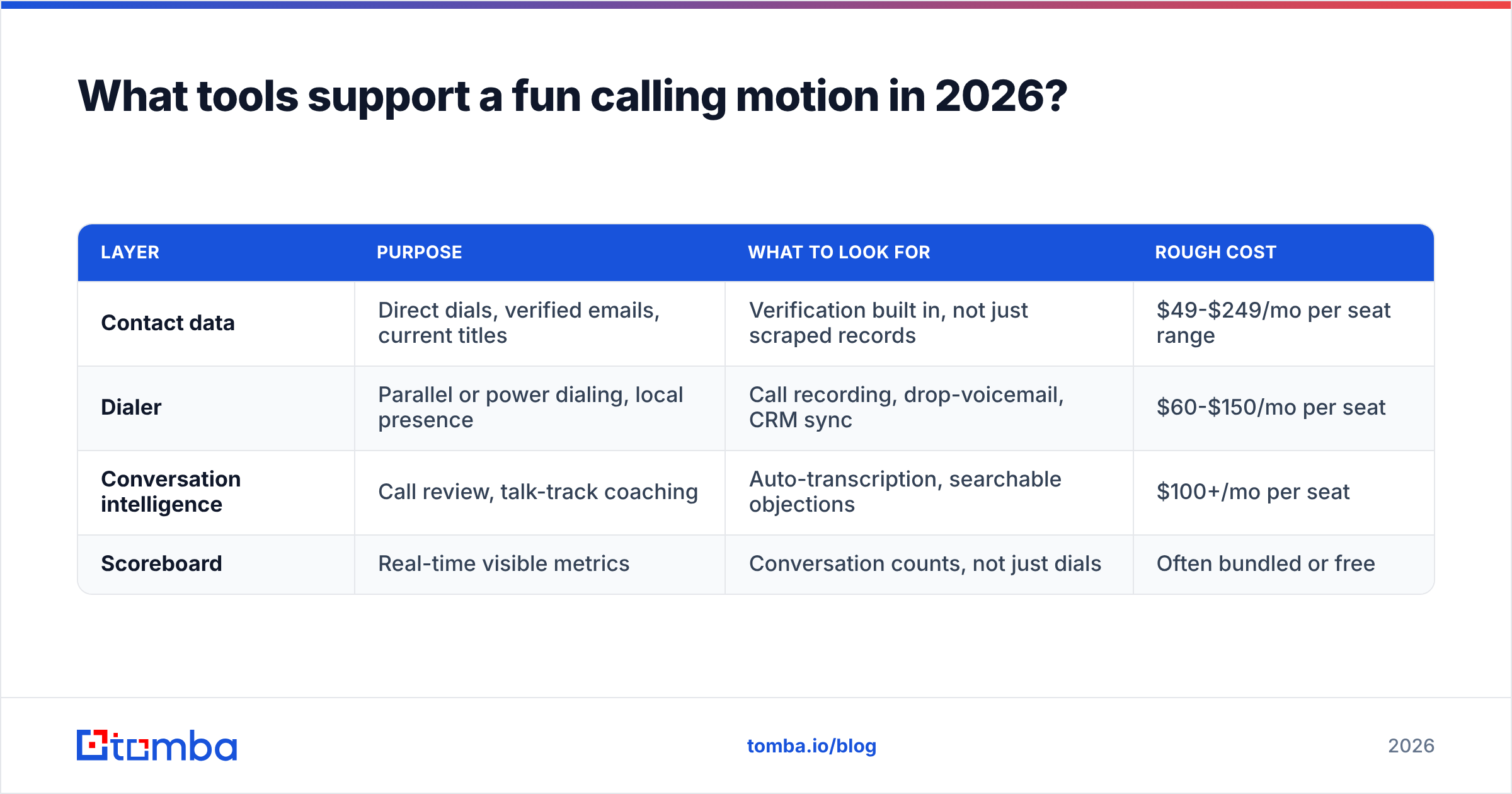
You need four categories covered. More than that and you've built admin work, not a stack.
| Layer | Purpose | What to look for | Rough cost |
|---|---|---|---|
| Contact data | Direct dials, verified emails, current titles | Verification built in, not just scraped records | $49-$249/mo per seat range |
| Dialer | Parallel or power dialing, local presence | Call recording, drop-voicemail, CRM sync | $60-$150/mo per seat |
| Conversation intelligence | Call review, talk-track coaching | Auto-transcription, searchable objections | $100+/mo per seat |
| Scoreboard | Real-time visible metrics | Conversation counts, not just dials | Often bundled or free |
On the data layer, Tomba pricing runs a free tier at 25 searches per month, Starter at $49/mo, Growth at $99/mo, and Pro at $249/mo — which puts verified direct dials and emails inside most SDR tool budgets. If you buy pre-built lists instead of building them, BookYourData is a solid pay-as-you-go option with strong coverage for teams that would rather purchase a vetted list than run their own enrichment workflow. Both approaches work; the choice is mostly about whether your motion is list-driven or account-driven.
For conversation intelligence, check current comparisons on G2 rather than trusting any single vendor's claims — this category moves fast and the leaders shift year to year. And if you're building the connective tissue yourself, HubSpot's sales hub documentation covers call logging and sequence syncing in enough detail to wire it up without a consultant.
How do you keep it fun after the novelty wears off?#
Assume every mechanic has a half-life of about six weeks. Plan for rotation instead of hoping for permanence.
A rotation that works:
- Weeks 1-4: streaks. Individual conversation streaks, publicly tracked.
- Weeks 5-8: team goal. One shared number, one shared reward, no individual ranking.
- Weeks 9-12: skill challenge. Everyone tests the same new opener and reports results. Competition shifts from volume to craft.
- Weeks 13-16: wildcard. Reps design the game. Whatever they invent will beat what you would have picked.
Two guardrails. First, never let a game punish honest reporting — if reps can win by mislogging calls, they will, and your pipeline data rots. Second, keep the underlying list quality high throughout. A brilliant game on a bad list is a party in a broken elevator. Run a bulk verify pass on any list before it goes into a contest week, so the score reflects effort rather than luck of the draw.
The teams that sustain this longest treat calling as a craft with a scoreboard, not a numbers grind with a prize attached. Those are different cultures, and reps can tell which one they're in within a week.
Start with the list, not the leaderboard#
Every tactic above depends on one thing: reps reaching real humans often enough that the feedback loop stays alive. Games layered on top of a 5% connect rate are decoration.
Fix the input first. Use the Tomba Email Finder to build accurate, verified contact records for your target accounts — then layer direct dials and enrichment on top so every dial your team makes has a real person behind it. Start on the free tier at 25 searches a month to test the lift on your own list, then scale up when the connect rate proves it. The scoreboard is a lot more fun when the numbers on it are real.
Related guides#
// get started
Find, verify and enrich your first contacts today
Start on the free plan with 25 searches a month, then scale when your team is ready.
Free plan · No credit card required · GDPR & CCPA
Get the Tomba newsletter
Product and data updates
// about the author