How to Manage a Sales Team in 2026: A Practical Playbook
Most sales managers inherit a team, a number, and a CRM full of stale records. Here is the operating cadence, metric set, and coaching system that actually moves quota attainment — plus what to stop doing.
TL;DR
- Managing a sales team is 70% operating cadence and coaching, 20% territory and data hygiene, 10% motivational theater. Most new managers invert that ratio.
- Run one weekly pipeline review, one weekly 1:1 per rep, and one monthly forecast call. Anything beyond that is usually a dashboard you should have read instead.
- Manage leading activity and conversion metrics you can change this week; report lagging metrics like closed revenue, don't coach on them.
- Underperformance needs a written 30/60/90 plan with a single diagnosis — skill, will, territory, or data — not a general "step it up" conversation.
- Your team's output is capped by the quality of the contact data they work with. Bad emails and dead phone numbers look exactly like low effort on a dashboard.
What does managing a sales team actually mean in 2026?#
It means owning a repeatable system that turns rep hours into pipeline, and pipeline into closed revenue — and being able to explain, on any given Tuesday, which part of that system is broken.
That is a different job from selling. The best individual contributor on your team spends their day moving specific deals forward. You spend your day moving the distribution forward: raising the floor of the bottom third, protecting the time of the top third, and removing the friction that costs everyone two hours a day.
Three shifts have changed the job over the last few years:
- Rep capacity is data-bound, not dial-bound. A rep can send 300 emails a day. If 22% bounce, you have burned domain reputation and management attention on a data problem you never diagnosed.
- Buyers arrive later. Most B2B buying groups do the majority of their research before they talk to sales, which means your reps get fewer, higher-stakes conversations. Coaching those conversations matters more than adding activity.
- Tooling consolidated. The average team now runs a CRM, a sequencer, a data/enrichment layer, and a conversation-intelligence tool. Four tools you must actually configure, not twelve you half-use.
If you want the macro picture, Gartner's sales research hub and Salesforce's State of Sales report are the two neutral sources worth reading each year. Everything below is the operational layer underneath them.
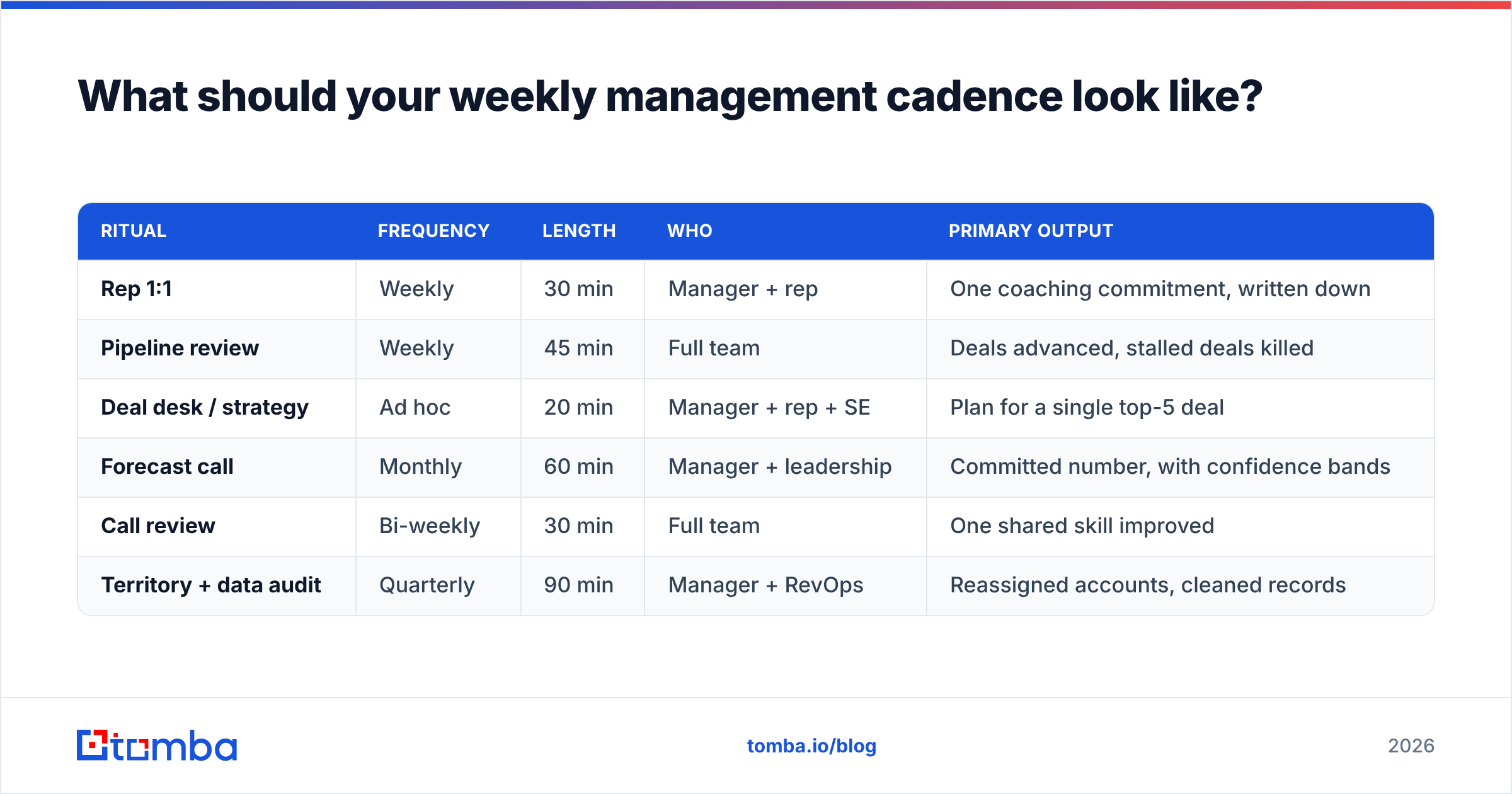
What should your weekly management cadence look like?#
Pick a cadence and defend it. An unpredictable manager creates a team that spends Monday guessing what you'll ask for.
Here is a cadence that works for a team of 5–10 reps and scales to about 15 before you need a second layer:
| Ritual | Frequency | Length | Who | Primary output |
|---|---|---|---|---|
| Rep 1:1 | Weekly | 30 min | Manager + rep | One coaching commitment, written down |
| Pipeline review | Weekly | 45 min | Full team | Deals advanced, stalled deals killed |
| Deal desk / strategy | Ad hoc | 20 min | Manager + rep + SE | Plan for a single top-5 deal |
| Forecast call | Monthly | 60 min | Manager + leadership | Committed number, with confidence bands |
| Call review | Bi-weekly | 30 min | Full team | One shared skill improved |
| Territory + data audit | Quarterly | 90 min | Manager + RevOps | Reassigned accounts, cleaned records |
Two rules make this work. First, the 1:1 belongs to the rep — they bring the agenda, you bring one piece of feedback. Second, the pipeline review is not a status update; if a deal has not moved in two weeks, the default action is to change something or close it lost.

Which metrics should you manage, and which should you ignore?#
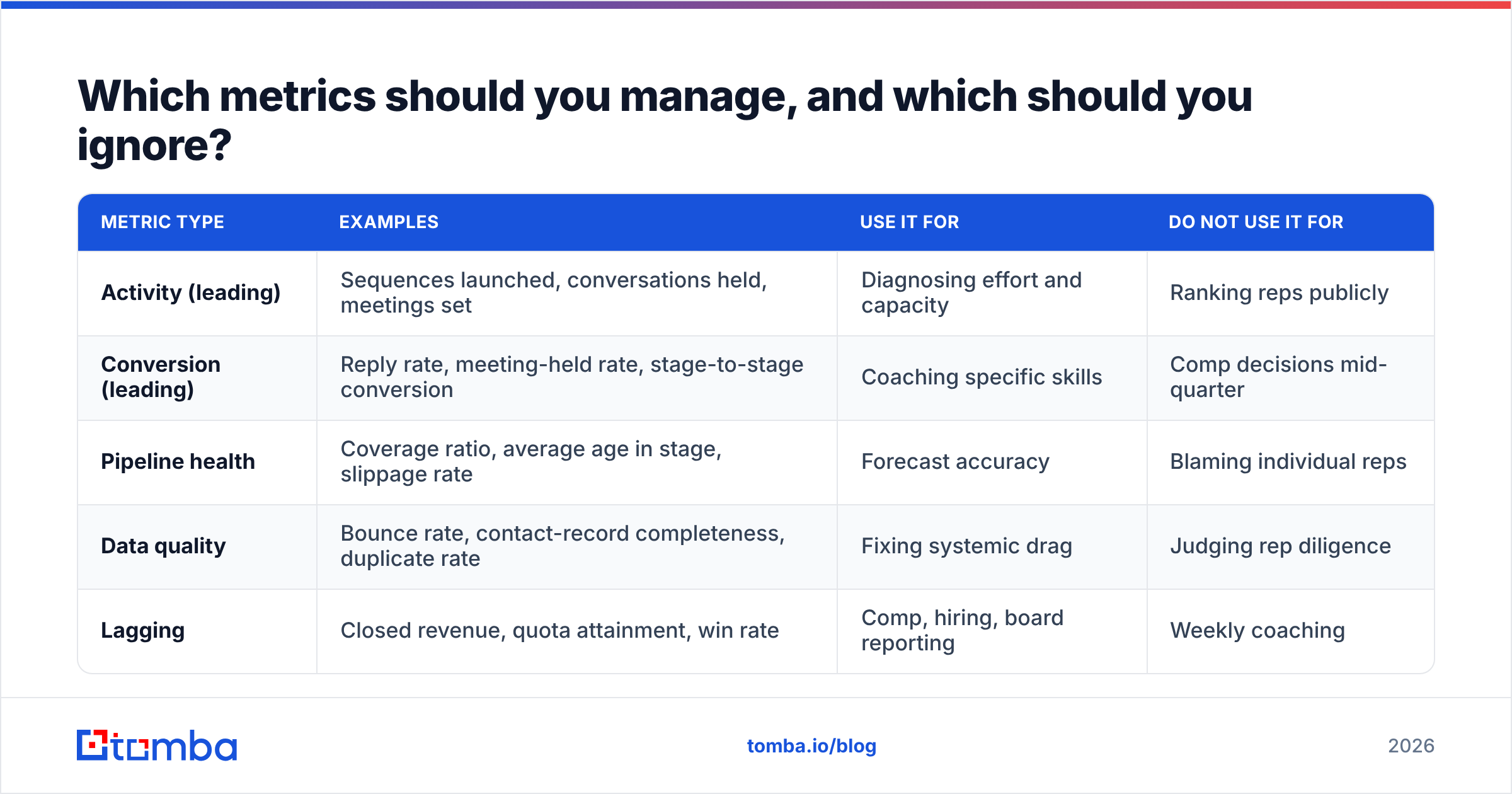
Manage the metrics a rep can change inside seven days. Report everything else.
The distinction matters because coaching a lagging metric is useless. Telling a rep "your closed-won is down" gives them nothing to do on Monday morning. Telling them "your discovery-to-demo conversion dropped from 48% to 29% — let's review three discovery calls" gives them a specific rep to run.
| Metric type | Examples | Use it for | Do not use it for |
|---|---|---|---|
| Activity (leading) | Sequences launched, conversations held, meetings set | Diagnosing effort and capacity | Ranking reps publicly |
| Conversion (leading) | Reply rate, meeting-held rate, stage-to-stage conversion | Coaching specific skills | Comp decisions mid-quarter |
| Pipeline health | Coverage ratio, average age in stage, slippage rate | Forecast accuracy | Blaming individual reps |
| Data quality | Bounce rate, contact-record completeness, duplicate rate | Fixing systemic drag | Judging rep diligence |
| Lagging | Closed revenue, quota attainment, win rate | Comp, hiring, board reporting | Weekly coaching |
A practical target set for most B2B teams: 3x pipeline coverage against quarterly quota, stage-to-stage conversion tracked over a rolling 90 days, bounce rate under 3%, and a median deal age per stage that you review monthly.
One caution on activity metrics. The moment you make dials or emails-sent a public leaderboard, you get dials and emails-sent — not conversations. Track activity privately as a diagnostic; celebrate outcomes publicly.
How do you coach reps without micromanaging?#
Micromanagement is not "asking about details." It is asking about details without a hypothesis. Coaching is the same conversation with a diagnosis attached.
Use these five moves in rotation:
- Diagnose before you prescribe. Every performance gap traces to one of four causes: skill (they don't know how), will (they don't want to), territory (there's nothing there), or data (they can't reach anyone). Name which one before you open your mouth in the 1:1.
- Coach one thing per cycle. Pick a single behavior — multi-threading, pricing conversations, discovery depth — and work it for four weeks. A rep given six pieces of feedback improves at zero of them.
- Review recordings, not recollections. A rep's memory of a call is a story about a call. Pull the recording, watch eight minutes together, and stop at the moment the deal actually turned.
- Make the commitment written and small. End every 1:1 with one sentence in a shared doc: "This week I will ask the pricing question before minute 20 on every discovery call." Review it next week. That single habit does more than any coaching framework.
- Ride along, then shut up. Join two live calls a month per rep. Do not rescue the deal. Note where you would have gone differently, and debrief within an hour while it's fresh.
- Protect deep-work blocks. Two uninterrupted prospecting hours beat six fragmented ones. If your own Slack habits are what fragment them, that's a manager problem, not a rep problem.
The HubSpot sales blog has a large library of coaching frameworks if you want structured worksheets; the frameworks matter less than the consistency of running one.
How do you handle an underperforming rep?#
Fast, in writing, and with a single named cause. Ambiguity here is the most expensive thing a sales manager does.
The sequence:
- Week 0 — Diagnose. Pull 90 days of data. Is it top-of-funnel volume, conversion, or deal size? Compare against the team median, not against your best rep.
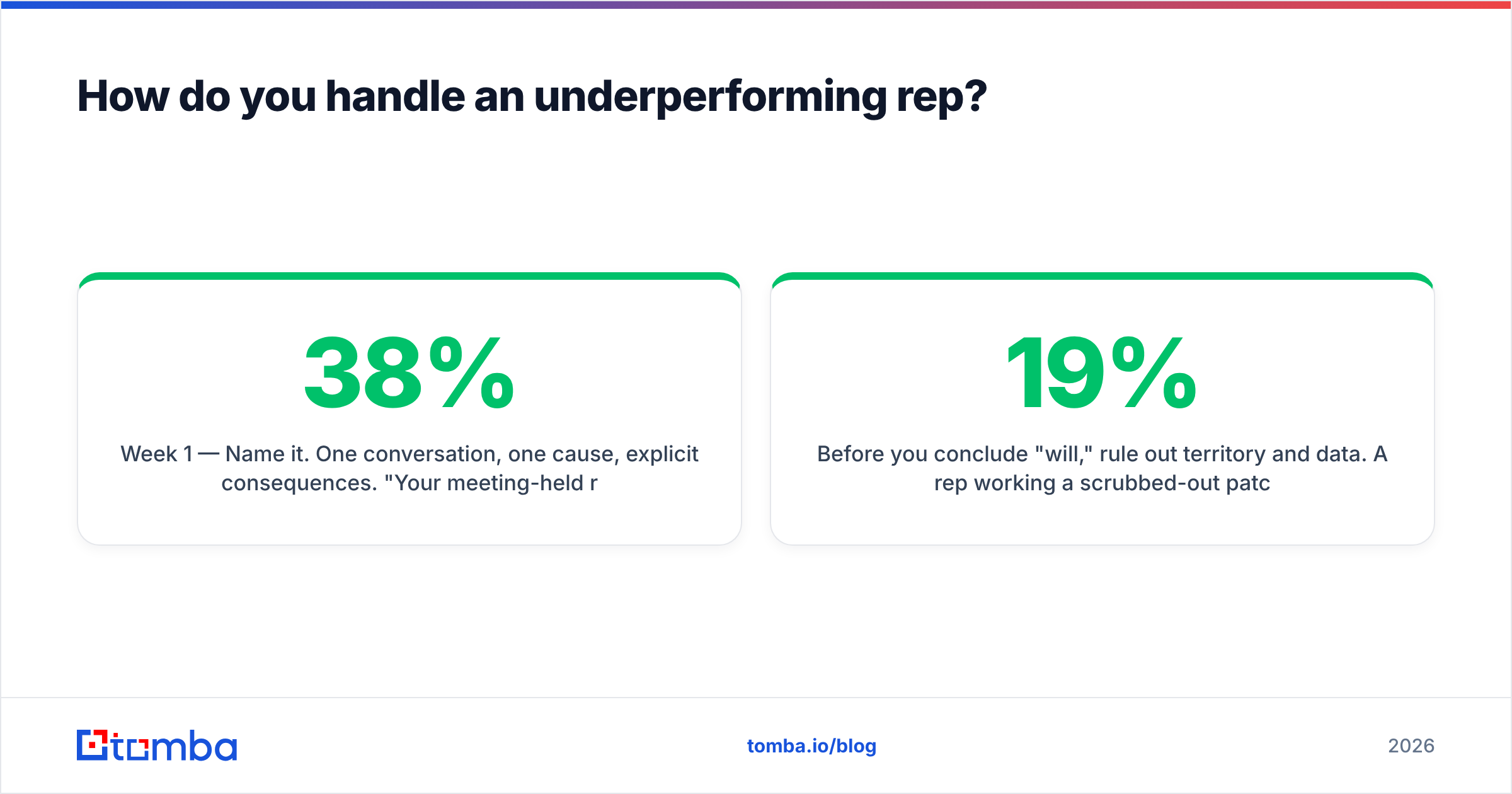
- Week 1 — Name it. One conversation, one cause, explicit consequences. "Your meeting-held rate is 38% against a team median of 61%. That is the gap. Here is what we'll do for 30 days."
- Weeks 2–5 — Support intensively. Twice-weekly 1:1s, two call reviews a week, one joint prospecting session. If you would not invest this for a rep you just hired, you have already decided to exit them — do it now instead.
- Week 6 — Decide. Improvement to trend, or a formal plan with HR. No third act.
Before you conclude "will," rule out territory and data. A rep working a scrubbed-out patch with a 19% bounce rate will produce numbers indistinguishable from a rep who has checked out. Check the account list and the email verification stats before you check the attitude.

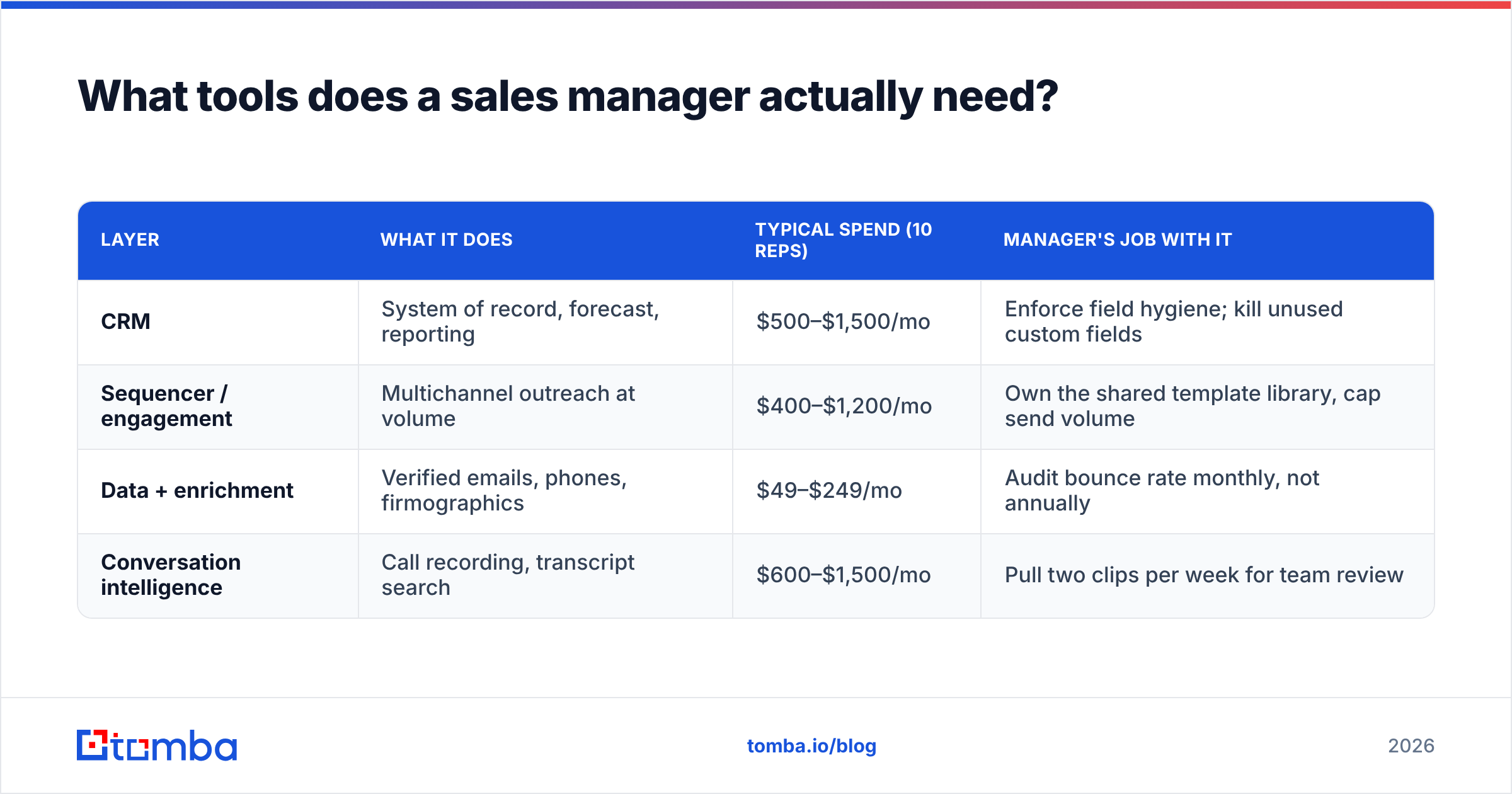
What tools does a sales manager actually need?#
Four layers, and you should be able to name the owner and the cost of each.
| Layer | What it does | Typical spend (10 reps) | Manager's job with it |
|---|---|---|---|
| CRM | System of record, forecast, reporting | $500–$1,500/mo | Enforce field hygiene; kill unused custom fields |
| Sequencer / engagement | Multichannel outreach at volume | $400–$1,200/mo | Own the shared template library, cap send volume |
| Data + enrichment | Verified emails, phones, firmographics | $49–$249/mo | Audit bounce rate monthly, not annually |
| Conversation intelligence | Call recording, transcript search | $600–$1,500/mo | Pull two clips per week for team review |
You do not need an ABM platform, an AI SDR, and a gamification layer in year one. You need the four above configured well. If you're evaluating options, G2's sales engagement category gives you filtered peer reviews by company size, which is more useful than any vendor comparison page.
For the data layer specifically, price transparency varies wildly. Tomba publishes a free tier at 25 searches per month, then Starter at $49/mo, Growth at $99/mo, and Pro at $249/mo — you can see the full breakdown on the Tomba pricing page. Peer tools like BookYourData take a different approach with prepaid, pay-as-you-go contact credits, which suits teams that buy list data in bursts rather than continuously. Match the pricing model to how your team actually consumes data.
How do you keep the data your team runs on clean?#
Treat contact data as inventory. It decays at roughly 2–3% per month as people change jobs, which means an untouched list is meaningfully worse in a quarter and mostly worthless in a year.
A quarterly data routine that takes one afternoon:
- Export the accounts nobody touched in 90 days. Reassign or archive them. Dead accounts inflate coverage ratios and hide real pipeline gaps.
- Re-verify every contact your team plans to sequence. Run the list through an email verifier before it enters the sequencer, not after the bounces come back.
- Fill the gaps rather than buying a new list. If you have company and name but no address, a domain search or targeted email finder lookup is cheaper than re-purchasing the account.
- Deduplicate before import. Duplicate records make the same buyer receive the same sequence twice, which is the fastest way to lose a logo you never even spoke to.
- Track bounce rate as a manager metric. Anything over 3% is a data problem, and it silently damages email deliverability for the whole domain — including the reps who did nothing wrong.
Assign this to one person, ideally RevOps. If you don't have RevOps, it's yours. It is not the reps' job, because the reps will always deprioritize it in favor of the deal in front of them, and they should.
How do you onboard and ramp a new rep?#
Set the ramp expectation before day one, in writing, and hold yourself to the milestones as tightly as you hold the rep.
A 90-day structure that works for mid-market B2B:
- Days 1–14: Product, ICP, and 20 recorded calls watched. No live prospecting. Output: a written ICP summary in their own words.
- Days 15–30: Shadowing plus supervised outbound. Output: first 50 sequenced contacts, reviewed by you before send.
- Days 31–60: Owns prospecting, co-runs discovery. Output: 3–5 self-sourced meetings, first opportunity created.
- Days 61–90: Full quota-carrying activity at 50% target. Output: at least one deal past the midpoint of the funnel.
The most common ramp failure is not training — it's giving a new rep a stale territory and a raw list. Hand them a clean, verified starter list on day 15. Their first two weeks of outbound sets their confidence baseline for the next year.
What separates the managers whose teams hit quota?#
Three things, consistently, across every team I've seen work:
They are boringly consistent. The 1:1 happens even in the last week of the quarter. Predictability is the whole product a manager sells to their team.
They fix systems, not people. When two reps have the same problem, it is not a people problem. Retitle the objection-handling doc, rewrite the sequence, re-scope the territory.
They protect selling time ruthlessly. Every meeting you add, every field you make mandatory in the CRM, every Slack ping — those come out of the same budget as prospecting hours. Audit your own calendar's cost to the team once a quarter.
None of this is glamorous. Managing a sales team well looks like the same six rituals repeated for four quarters, with the data underneath them kept clean enough that the rituals mean something.
Give your team something reliable to work with. The fastest fix most sales managers can make in their first month is replacing a decayed contact list with verified, current data — it removes the single biggest excuse from the board and makes every other coaching conversation honest. Start with the Tomba Email Finder on the free tier (25 searches/month, no card), run your next 50-account push through it, and compare your bounce rate before and after. If the difference is what it usually is, the $49/mo Starter plan pays for itself before your next forecast call.
Related guides#
// get started
Find, verify and enrich your first contacts today
Start on the free plan with 25 searches a month, then scale when your team is ready.
Free plan · No credit card required · GDPR & CCPA
// about the author