How to Market SaaS in 2026: A Practical Growth Playbook
Most SaaS marketing advice is recycled blog fluff. This playbook covers the seven channels that actually move ARR in 2026, what each one costs, and how to pick the right mix for your stage.
TL;DR
- SaaS marketing in 2026 is a portfolio problem, not a channel problem. Pick two acquisition channels you can win, one retention loop, and ignore the rest until you have $1M ARR.
- Paid search CPCs in competitive B2B categories now routinely clear $30-$80 per click. If your ACV is under $5,000, paid-first is a losing structure.
- Product-led growth is not "add a free tier." It's instrumenting activation and making the product the demo, the trial, and the upsell surface.
- Outbound still works, but only with clean data. Bounce rates above 3% kill your domain before your copy ever gets read.
- Your channel mix should change at $0-100K ARR, $100K-1M ARR, and $1M+ ARR. Copying a Series B playbook at seed stage is the single most common failure.
What does "marketing SaaS" actually mean in 2026?#
It means engineering repeatable demand for a product that customers rent monthly and can cancel any time. That last clause is what makes it different from marketing anything else. A furniture company sells once. You sell every single month, forever, and a churned customer erases the acquisition spend that won them.
So the job splits into three parts that most teams collapse into one:
- Acquisition — getting qualified attention from people with the problem you solve
- Activation — getting them to the moment where the product proves itself
- Expansion — growing revenue inside accounts you already own
Most SaaS "marketing" advice covers part one and stops. That's why so many teams have healthy top-of-funnel numbers and flat net revenue retention. If you're spending 80% of your marketing budget on acquisition and your NRR is under 100%, you're filling a bucket with a hole in it — and the hole is cheaper to patch than the tap is to open wider.
The practical implication: before you touch a single channel, know your payback period. Customer acquisition cost divided by monthly gross profit per customer. Under 12 months, you can be aggressive. Over 24 months, you have a positioning problem, not a marketing problem.
Which SaaS marketing channels actually work?#
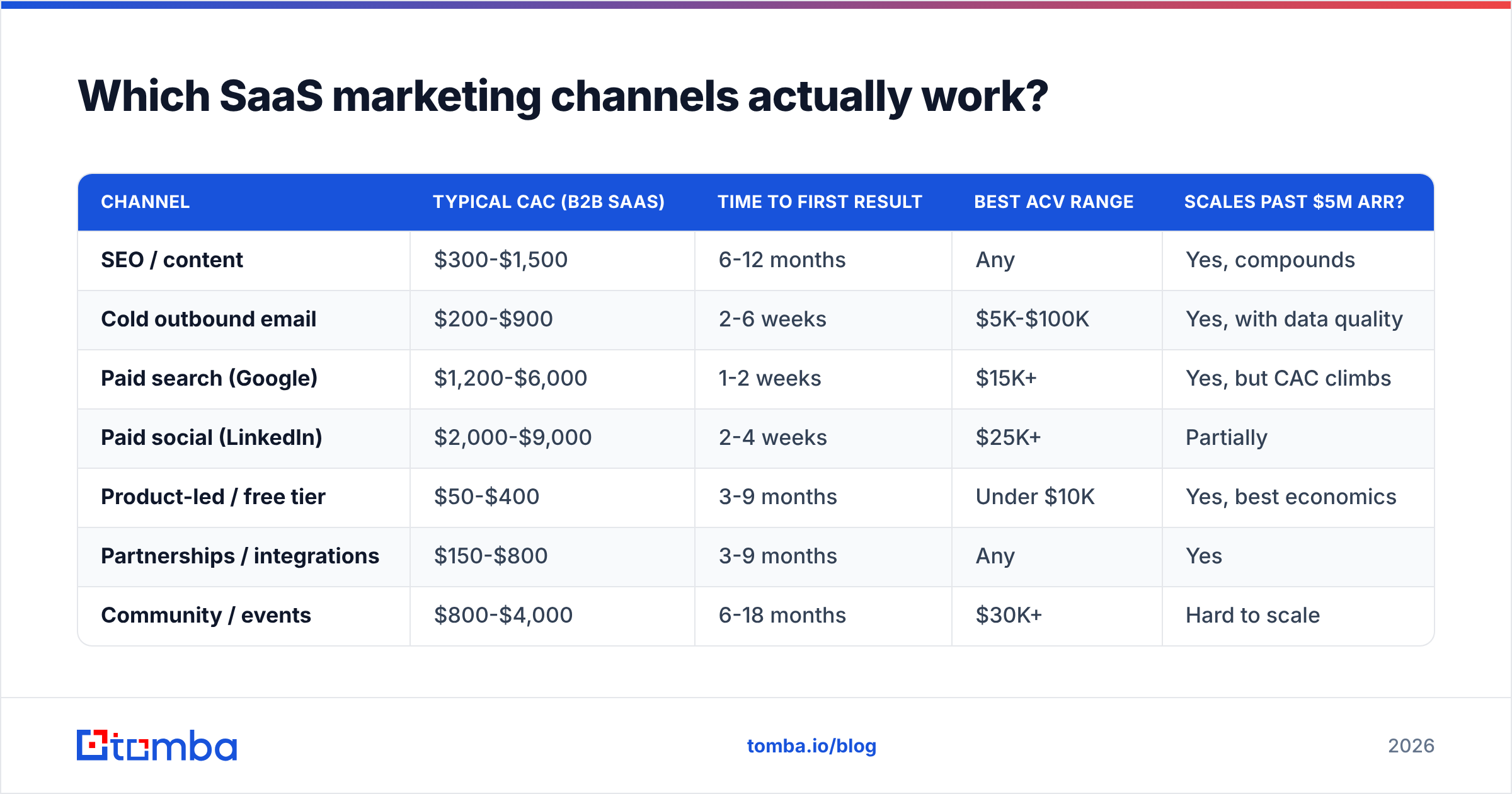
Here's the honest ranking, based on what most B2B SaaS teams report on G2 and in public benchmark data. Costs are directional — your category will shift them.
| Channel | Typical CAC (B2B SaaS) | Time to first result | Best ACV range | Scales past $5M ARR? |
|---|---|---|---|---|
| SEO / content | $300-$1,500 | 6-12 months | Any | Yes, compounds |
| Cold outbound email | $200-$900 | 2-6 weeks | $5K-$100K | Yes, with data quality |
| Paid search (Google) | $1,200-$6,000 | 1-2 weeks | $15K+ | Yes, but CAC climbs |
| Paid social (LinkedIn) | $2,000-$9,000 | 2-4 weeks | $25K+ | Partially |
| Product-led / free tier | $50-$400 | 3-9 months | Under $10K | Yes, best economics |
| Partnerships / integrations | $150-$800 | 3-9 months | Any | Yes |
| Community / events | $800-$4,000 | 6-18 months | $30K+ | Hard to scale |
Two patterns jump out. First, the cheapest channels (product-led, SEO, partnerships) are also the slowest. Second, the fastest channels (paid search, paid social) are the most expensive and get more expensive as you scale, because you exhaust the cheap intent first.
The mistake nearly everyone makes is starting with the fast expensive channels because they show a dashboard number in week two, then discovering at month nine that the unit economics never worked.
The channel-selection filter#
Run every candidate channel through these four questions before spending a dollar:
- Does your buyer search for this problem? If nobody types the query, SEO and paid search are dead on arrival. Check volume before you commit a content team.
- Is your ACV above $15,000? Below that, LinkedIn Ads and enterprise events almost never pay back within 18 months.
- Can a user get value alone in under 15 minutes? If not, product-led growth will produce signups that never activate.
- Do you know exactly who the buyer is by title and company size? If yes, outbound is your fastest path. If no, fix positioning first.
Two "yes" answers is enough to start. Four is rare and means you have unusual freedom.
How do you build a SaaS content engine that ranks?#
Stop writing "10 tips for X." That format lost to AI-generated volume two years ago. What ranks now is content with something a language model can't synthesize: proprietary data, real product screenshots, opinionated comparisons, and specific numbers.
Three content types carry almost all the pipeline for B2B SaaS:
- Bottom-of-funnel comparison pages — "X vs Y," "best X for Y," "X alternatives." These convert at 3-8% because the reader is already shopping. Build one per meaningful competitor.
- Job-to-be-done how-tos — content that walks through the exact task your product accelerates. The product appears as one step, not as the whole article.
- Original research — a survey, a benchmark study, an analysis of your own anonymized data. This is the only content type that reliably earns links in 2026.
For distribution, treat every post as having a second life. Turn the research into a LinkedIn carousel, the how-to into a short video, the comparison into a paid-search landing page. One asset, four surfaces.
One more thing that separates content that ranks from content that doesn't: internal linking discipline. Every new post should link to two or three existing posts, and one existing post should be updated to link to the new one. Search engines read that graph as topical authority.
Is outbound email still worth it for SaaS?#
Yes — but the failure mode has shifted. In 2020 the problem was copy. In 2026 the problem is data and infrastructure.
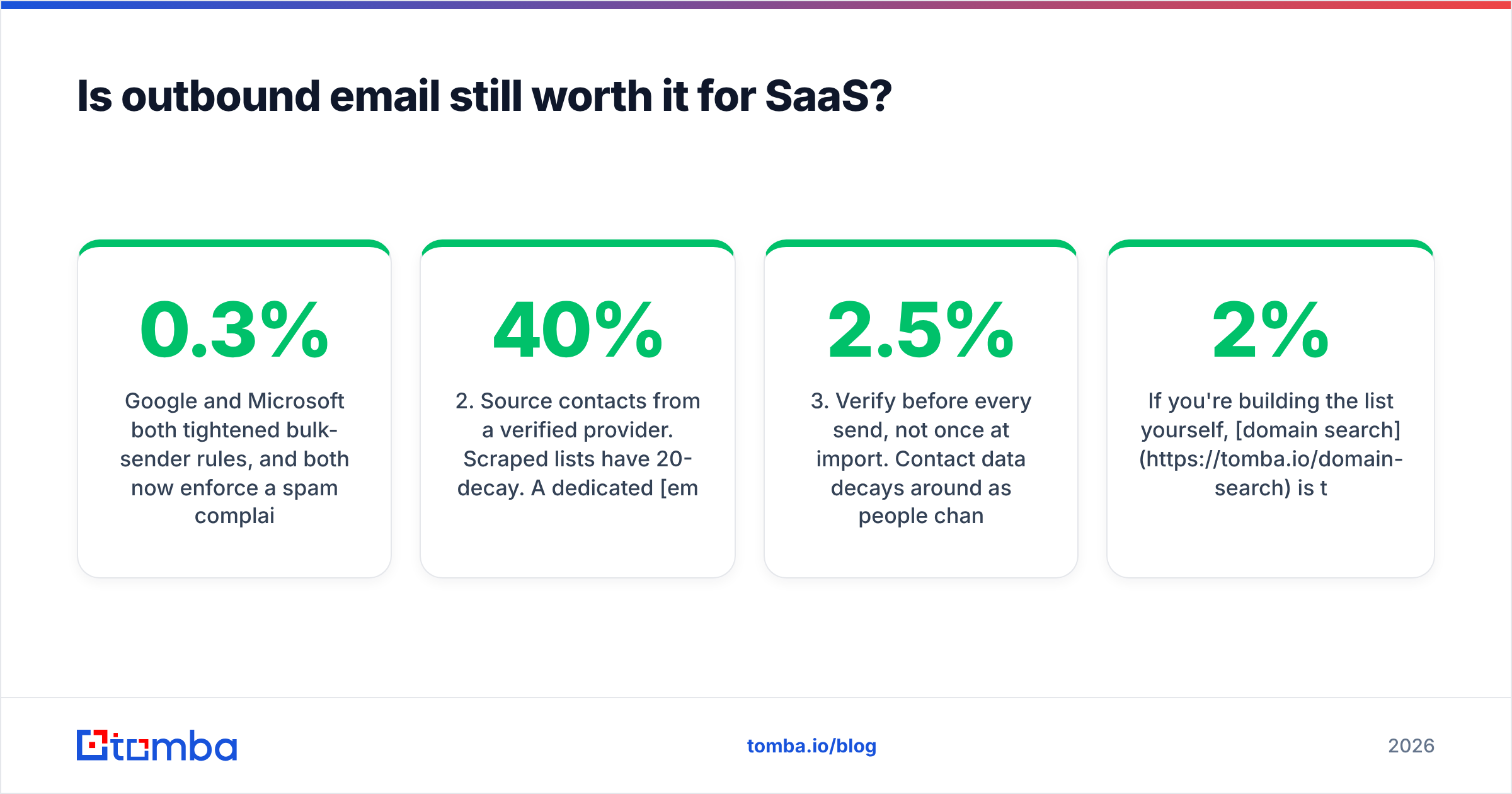
Google and Microsoft both tightened bulk-sender rules, and both now enforce a spam complaint threshold near 0.3%. Combine that with a bounce rate over 3% and your sending domain gets throttled within days. No amount of clever copywriting recovers a burned domain.
The sequence that works looks like this:
- Define the ICP tightly. Industry, headcount band, tech stack, trigger event. "B2B companies" is not an ICP.
- Source contacts from a verified provider. Scraped lists have 20-40% decay. A dedicated email finder with catch-all handling gets you into single-digit bounce territory.
- Verify before every send, not once at import. Contact data decays around 2.5% per month as people change jobs. Run the list through an email verifier before each campaign, not just at list build.
- Warm the domain for 3-4 weeks. Start at 10-15 sends per day per mailbox, ramp gradually. Use a separate sending domain from your primary.
- Write to one trigger. Funding round, new hire in a relevant role, a competitor's tool showing in their stack. Generic value props get generic ignore rates.
- Measure reply rate, not open rate. Open tracking has been unreliable since Apple Mail Privacy Protection. Positive reply rate is the only number that predicts pipeline.
If you're building the list yourself, domain search is the fastest way to map an entire company's contactable roster from a single URL. And when your target accounts run on catch-all domains — which is now a majority of mid-market — a catch-all verifier is the difference between a 2% and a 12% bounce rate.
Realistic benchmarks for cold outbound in 2026: 40-55% deliverability to primary inbox, 4-9% reply rate, 1-2% positive reply rate. If someone promises you 30% reply rates, they're either selling something or measuring a warm list.
How does product-led growth change the marketing job?#
It moves the conversion event inside the product. Your marketing site stops being the place where people decide to buy and becomes the place where people decide to try.
That sounds like less work. It's more, because now marketing owns activation metrics it can't directly control. You need to know:
- Time to first value — how many minutes until the user sees the thing they came for
- Activation rate — percent of signups that hit that moment within 7 days
- Signup-to-paid conversion — typically 2-5% for self-serve freemium, 8-25% for a reverse trial
- Expansion rate — how much of your growth comes from existing accounts
The teams that win at PLG obsess over the first session. They cut fields from signup forms, pre-populate demo data, and remove every step between account creation and the aha moment. HubSpot's own product-led growth research documents the pattern repeatedly: shortening time-to-value moves conversion more than any landing-page change.
A practical hybrid that works for most B2B SaaS: free tier for individual users, sales-assisted motion the moment a second seat from the same domain signs up. That domain signal is your highest-intent lead, and most companies never instrument it.
How should your channel mix change by stage?#
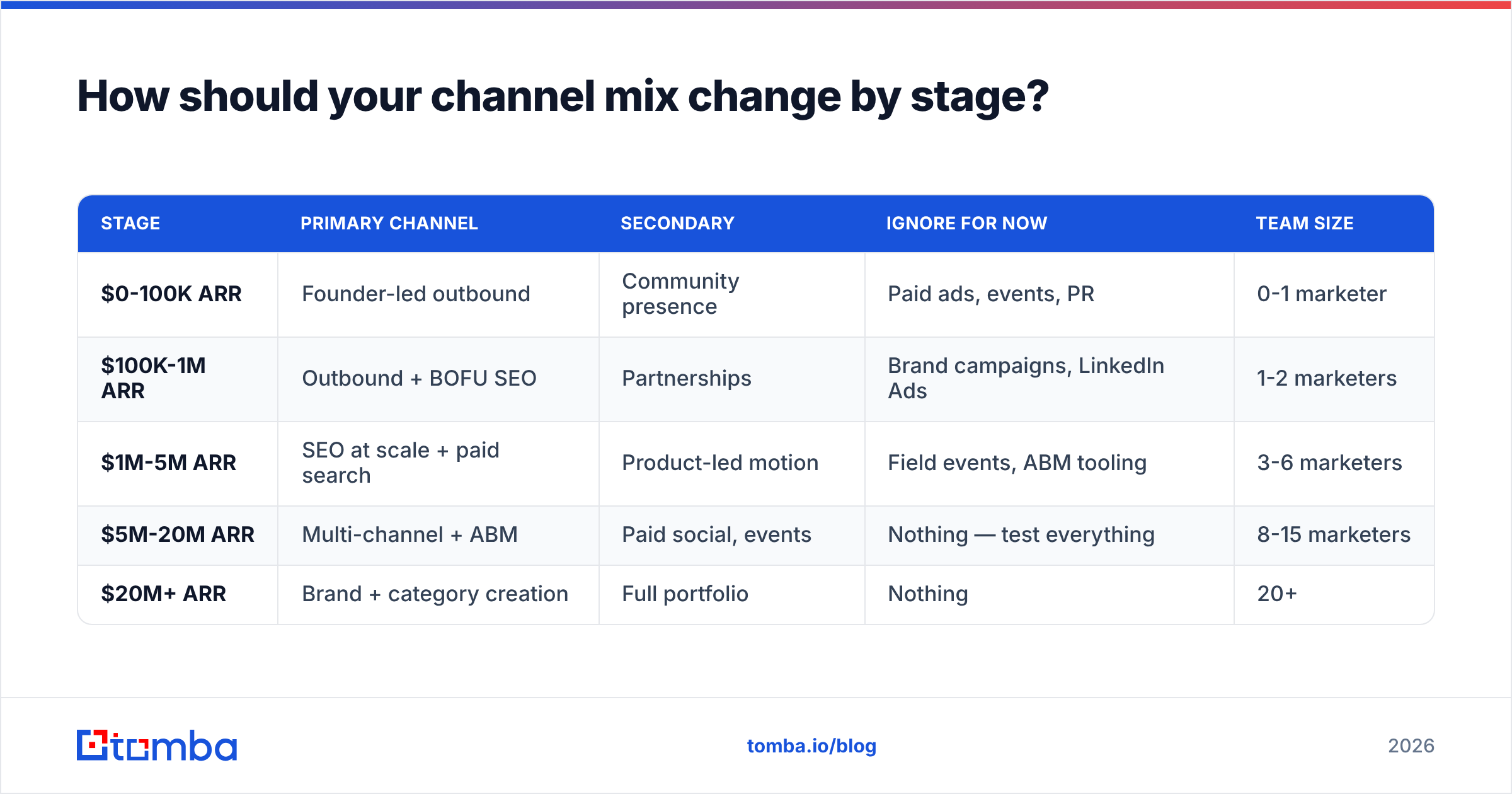
This is where most teams break. The playbook that works at $3M ARR actively hurts at $200K ARR because it assumes a team and a budget you don't have.
| Stage | Primary channel | Secondary | Ignore for now | Team size |
|---|---|---|---|---|
| $0-100K ARR | Founder-led outbound | Community presence | Paid ads, events, PR | 0-1 marketer |
| $100K-1M ARR | Outbound + BOFU SEO | Partnerships | Brand campaigns, LinkedIn Ads | 1-2 marketers |
| $1M-5M ARR | SEO at scale + paid search | Product-led motion | Field events, ABM tooling | 3-6 marketers |
| $5M-20M ARR | Multi-channel + ABM | Paid social, events | Nothing — test everything | 8-15 marketers |
| $20M+ ARR | Brand + category creation | Full portfolio | Nothing | 20+ |
At the earliest stage, the founder is the marketing channel. Nobody sells the product better, and the conversations produce positioning insight that no agency can generate. Automate that too early and you lose the learning.
The transition point people miss is $1M ARR. That's where founder-led outbound stops scaling — there aren't enough founder hours — and you need a system that runs without them. Building that system usually means a real B2B database feeding a documented sequence, not a spreadsheet of contacts one person maintains.
What SaaS marketing metrics should you actually track?#
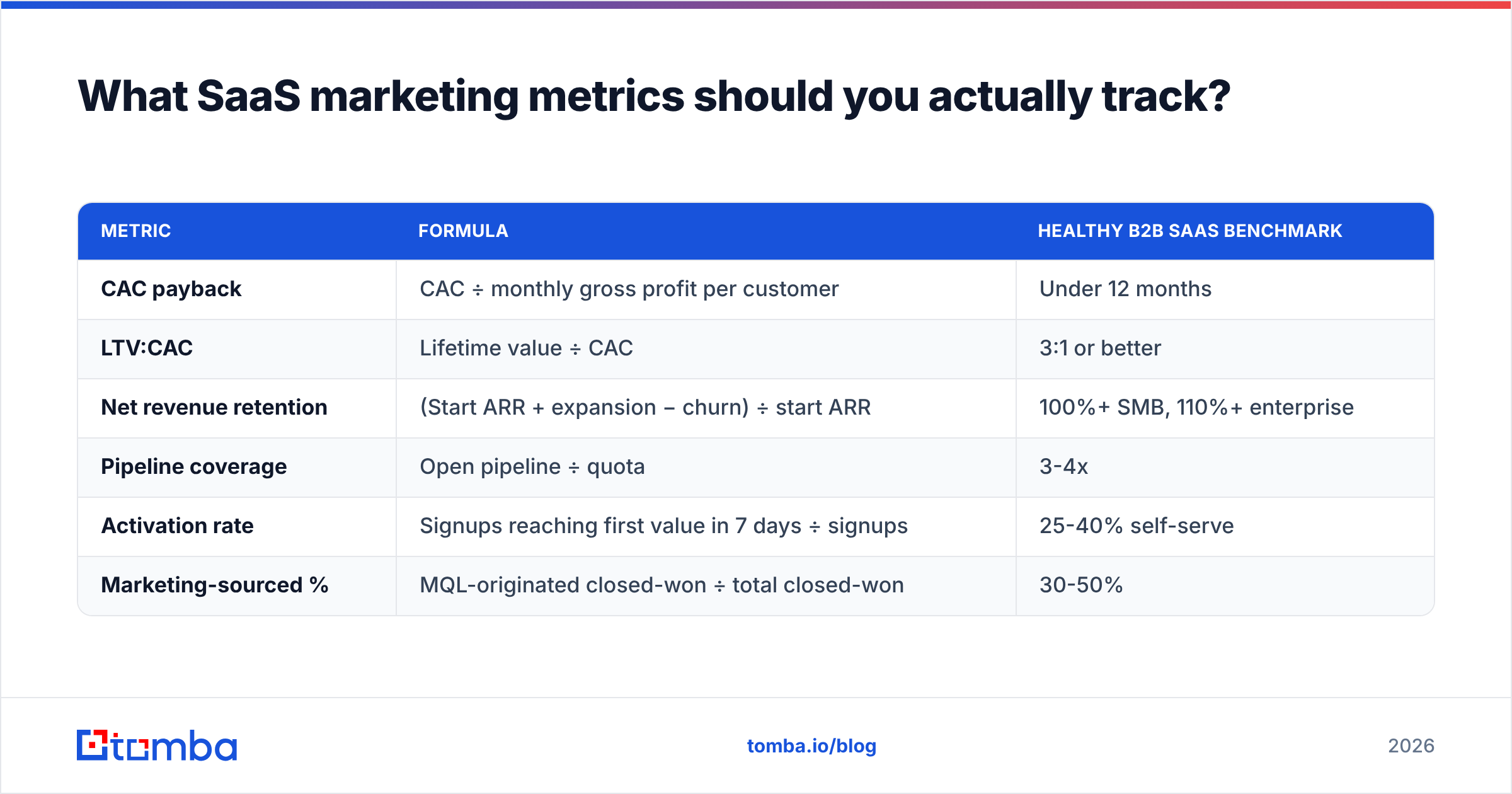
Track fewer things, more seriously. Here's the minimum viable set:
| Metric | Formula | Healthy B2B SaaS benchmark |
|---|---|---|
| CAC payback | CAC ÷ monthly gross profit per customer | Under 12 months |
| LTV:CAC | Lifetime value ÷ CAC | 3:1 or better |
| Net revenue retention | (Start ARR + expansion − churn) ÷ start ARR | 100%+ SMB, 110%+ enterprise |
| Pipeline coverage | Open pipeline ÷ quota | 3-4x |
| Activation rate | Signups reaching first value in 7 days ÷ signups | 25-40% self-serve |
| Marketing-sourced % | MQL-originated closed-won ÷ total closed-won | 30-50% |
The two that predict survival are CAC payback and NRR. Everything else is diagnostic. If you have to pick one dashboard number to show the board, make it CAC payback by channel — it forces the honest conversation about which channels are actually working.
Analyst firms like Gartner publish updated benchmark ranges annually; worth checking yours against the current cohort rather than a number you memorized in 2022.
What are the most common SaaS marketing mistakes?#
Buying leads instead of building an ICP. A purchased list of 50,000 "decision makers" converts worse than 500 contacts you researched. Providers like BookYourData do serious verification work and can be a legitimate shortcut when your ICP is clearly defined — but no data vendor fixes vague targeting.
Optimizing MQLs. MQL volume is the easiest metric to game and the least correlated with revenue. Measure qualified pipeline instead.
Rebranding instead of repositioning. New logo, same confused message. If prospects can't tell you in one sentence what you replace, that's positioning.
Hiring a "growth marketer" before finding one working channel. No individual contributor can discover product-market fit for you. Find the channel manually, then hire someone to scale it.
Neglecting data hygiene. Every stale contact costs you twice: once in wasted send volume, once in reputation damage. Running bulk verify before major campaigns is cheap insurance against expensive deliverability problems.
How do you put this into practice in the next 90 days?#
Days 1-14: write your ICP in one paragraph with specific firmographics. Interview five current customers about why they bought. Calculate your current CAC payback by channel — most teams have never done this and are surprised.
Days 15-45: pick exactly two channels using the filter above. Build the minimum infrastructure for each. For outbound, that's a verified list, a warmed domain, and a three-touch sequence. For content, that's five bottom-of-funnel comparison pages, not fifty blog posts.
Days 46-90: run, measure reply rate and qualified pipeline weekly, kill anything with no signal by day 75. Double the budget on whatever showed signal by day 60.
The discipline that matters is the killing. Most teams keep six half-funded channels running because stopping feels like failure. Two well-funded channels beat six starved ones every time.
Start with the data layer#
Every channel above depends on knowing who to reach. Bad contact data makes good copy irrelevant, tanks your deliverability, and corrupts every downstream metric you're trying to read.
The Tomba Email Finder gives you verified professional emails by domain, name, or company, with catch-all handling built in so your bounce rate stays where deliverability rules require. The free tier includes 25 searches a month if you want to test accuracy against your own known contacts first; paid plans start at $49/mo on Starter, with Growth at $99/mo and Pro at $249/mo — full Tomba pricing is public.
Build the list right, and the rest of the playbook has something to run on.
Related guides#
// get started
Find, verify and enrich your first contacts today
Start on the free plan with 25 searches a month, then scale when your team is ready.
Free plan · No credit card required · GDPR & CCPA
// about the author