How to Motivate a Remote Sales Team: A 2026 Playbook
Remote reps don't lose motivation because they're lazy — they lose it because the feedback loop broke. Here are seven systems that rebuild it, plus the metrics that tell you which one is failing.
TL;DR
- The short answer to how to motivate a remote sales team: fix the feedback loop, not the mood. Reps stop seeing the link between effort and outcome, and effort collapses.
- The single largest demotivator on distributed teams is not isolation. It is bad data: reps burning hours on bounced emails, wrong numbers, and dead accounts they cannot fix themselves.
- Seven systems fix it: activity-to-outcome visibility, async coaching cadence, a comp plan reps can calculate in their head, small-pod social structure, public micro-wins, autonomy over territory, and clean input data.
- Track four leading indicators — connect rate, reply rate, pipeline created per rep, and voluntary CRM hygiene — not "engagement survey scores."
- Fix the list quality first. Every other motivation lever multiplies against a rep's hit rate, so a 12% bounce rate quietly cancels your coaching program.
Why does remote sales motivation actually break?#
The conclusion first: how to motivate a remote sales team is a loop problem, not a mood problem. Reps go flat when the gap between what I did today and what happened because of it gets long, noisy, or invisible. Everything else is downstream.
In an office, that loop is fast and physical. A rep books a meeting and three people hear it. A rep gets crushed on a call and someone walks over. Feedback arrives in seconds and costs nothing to produce.
Remote, the loop stretches. A rep sends 60 emails on Tuesday, hears nothing, closes the laptop, and has no proof that Tuesday mattered. Do that for eleven days and you get what managers call "attitude." It is not attitude. It is an information problem wearing an attitude costume.
Think of it like practising free throws in a dark gym. You are shooting fine. You just cannot see whether the ball goes in, so after a while you stop caring how you shoot. Motivation is not the shot — it is the sound of the net.
Gallup's long-running research on engagement says the same thing in blunter terms. Two things drive extra effort more than anything else: clear expectations, and recognition that means something. Both fade fastest on remote teams. You can read their State of the Global Workplace findings for the underlying data.

How to motivate a remote sales team: the seven systems that work#
Skip the perks. Build these instead, in roughly this order.
- Make the loop visible daily. Every rep should be able to see, without asking, what their activity produced in the last 24 hours: opens, replies, connects, meetings, pipeline. Not a weekly roll-up. Daily.
- Run async coaching, not more meetings. Recorded call review with timestamped comments beats a 45-minute Zoom. In a Zoom, one rep talks and six wait.
- Ship a comp plan a rep can do in their head. If a rep cannot work out their commission on a napkin, the plan does not motivate — it confuses.
- Shrink the social unit to pods of 3–5. Twenty-person all-hands calls create spectators. Five-person pods create obligations.
The last three are the ones teams skip, and they are the ones that compound.
- Celebrate micro-wins, not just closed-won. A first meeting with a target logo is a win. A recovered dead account is a win. If only revenue gets celebrated, 95% of the week feels like failure.
- Give autonomy over territory and sequencing. Reps who choose their accounts defend their choices. Reps who receive a list defend nothing.
- Fix the input data. This is the boring one. It is also the one that decides whether the other six compound or cancel.
Which motivation levers move the needle most?#
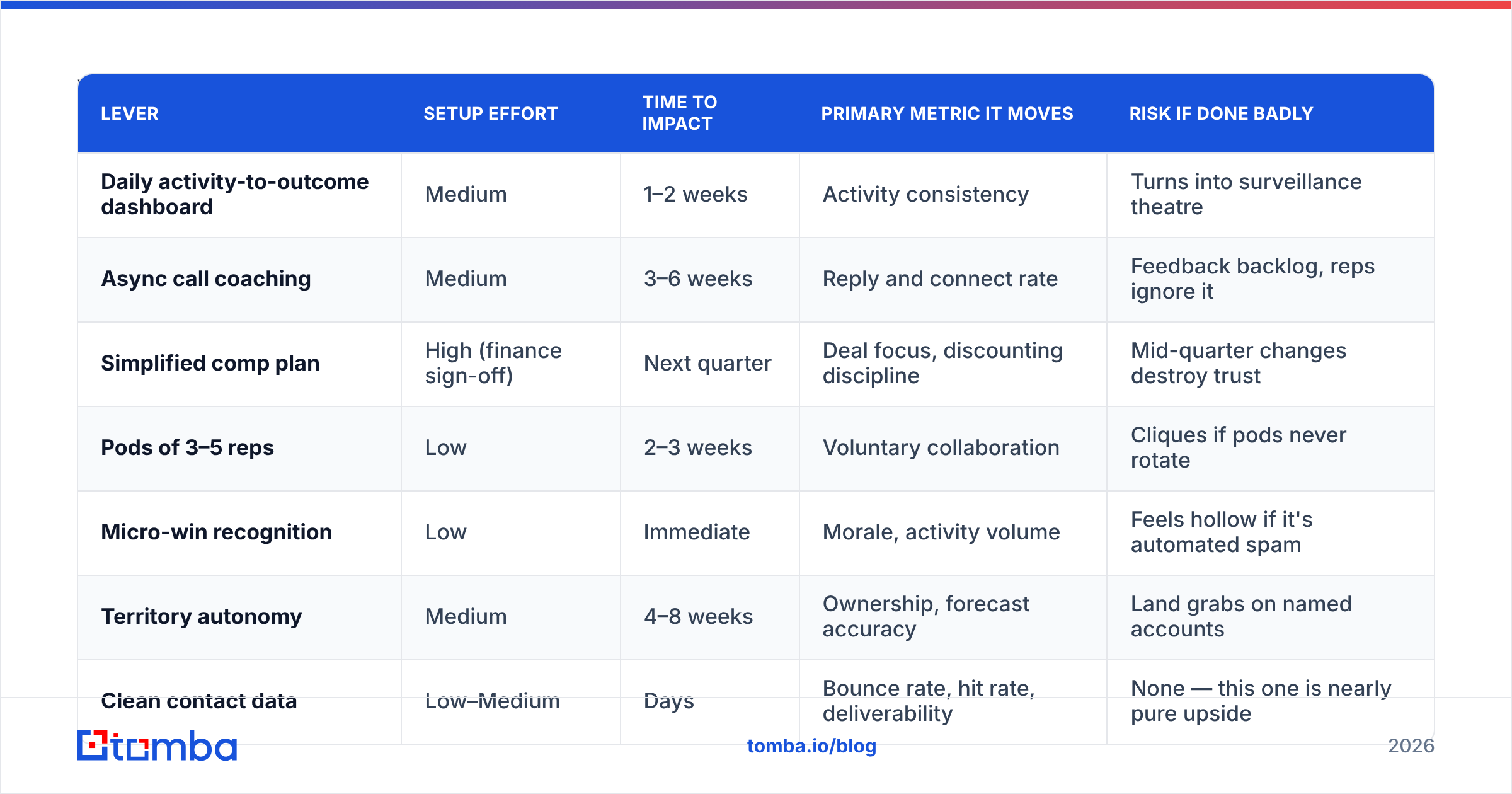
Not all of these cost the same or return the same. Here is the honest ranking based on effort, lag, and what it actually shifts.
| Lever | Setup effort | Time to impact | Primary metric it moves | Risk if done badly |
|---|---|---|---|---|
| Daily activity-to-outcome dashboard | Medium | 1–2 weeks | Activity consistency | Turns into surveillance theatre |
| Async call coaching | Medium | 3–6 weeks | Reply and connect rate | Feedback backlog, reps ignore it |
| Simplified comp plan | High (finance sign-off) | Next quarter | Deal focus, discounting discipline | Mid-quarter changes destroy trust |
| Pods of 3–5 reps | Low | 2–3 weeks | Voluntary collaboration | Cliques if pods never rotate |
| Micro-win recognition | Low | Immediate | Morale, activity volume | Feels hollow if it's automated spam |
| Territory autonomy | Medium | 4–8 weeks | Ownership, forecast accuracy | Land grabs on named accounts |
| Clean contact data | Low–Medium | Days | Bounce rate, hit rate, deliverability | None — this one is nearly pure upside |
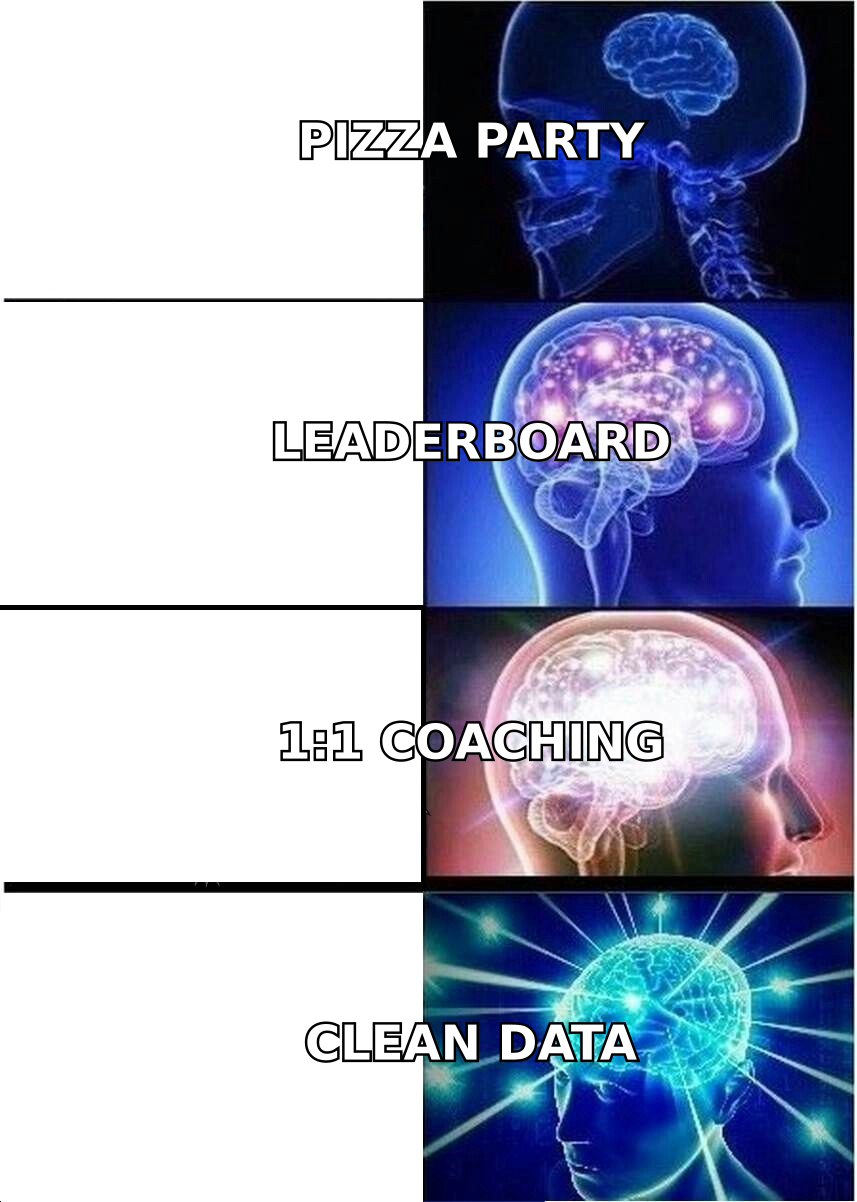
Read the last row again. It is the cheapest fix on the list and the fastest, and almost no sales manager treats it as a motivation lever. They treat it as an ops chore.
Is bad data really a motivation problem?#
Yes, and it is measurable. Here is the math that managers skip.
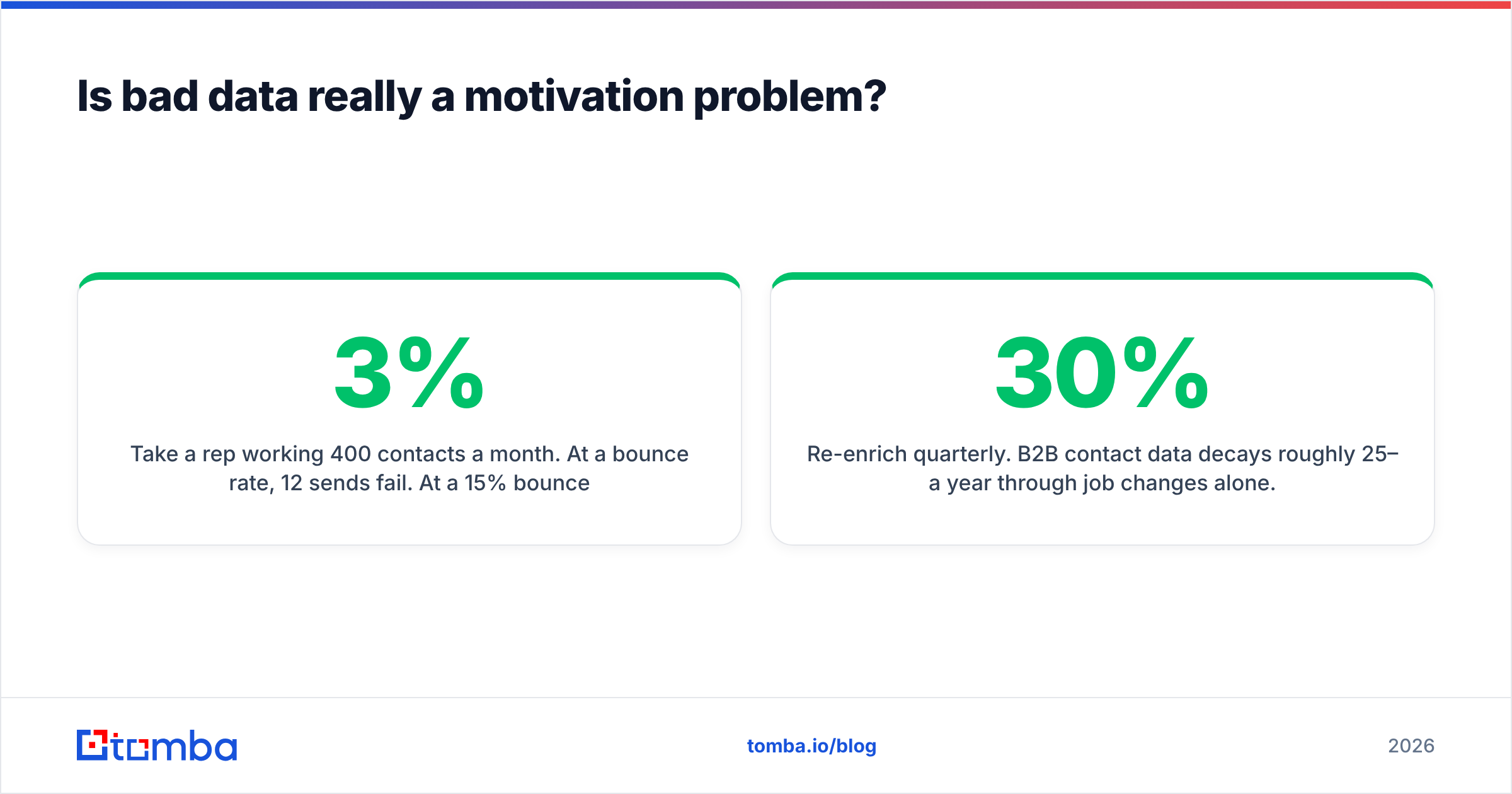
Take a rep working 400 contacts a month. At a 3% bounce rate, 12 sends fail. At a 15% bounce rate — normal for a scraped or aged list — 60 fail. The damage is not just those 60. Mailbox providers read hard bounces as proof that you do not know who you are writing to. Your sender reputation drops, and the other 340 emails land in spam at a higher rate. The rep did everything right and got punished for it.
Now put that in front of a person who is alone in an apartment, staring at a zero-reply week. They do not think "our data vendor is stale." They think "I am bad at this," or "this territory is dead." Both conclusions end in a resignation letter.
The fix is boring and quick:
- Verify before send, not after bounce. Running the list through an email verifier before a sequence starts turns an invisible failure into a pre-flight check.
- Kill catch-all guesswork. Catch-all domains accept everything at the gateway, then drop it later. That produces phantom "delivered" numbers. A catch-all verifier tells you which ones are actually safe.
- Re-enrich quarterly. B2B contact data decays roughly 25–30% a year through job changes alone. A contact you sourced in January is clearly worse in October.
- Give reps self-serve lookup. When a rep hits a wrong contact, they should find the right one in 20 seconds. No ticket to ops, no moving on.
That last point is the motivation multiplier. Autonomy over your own data means a dead end becomes a two-minute detour instead of a wall.
How do you coach remotely without micromanaging?#
The line between coaching and surveillance is whether the rep gets something back.
A dashboard that shows a manager how many calls a rep made is surveillance. Show that same data to the rep. Add that their 2pm–4pm block converts at twice the rate of their 9am block, and it is coaching. Same data, opposite effect.
Practical cadence that holds up across time zones:
- Weekly, async: each rep posts one recorded call and one thing they want feedback on. Manager comments with timestamps within 48 hours. Fifteen minutes of manager time per rep.
- Biweekly, live, 25 minutes: pipeline only. No status updates that could have been a Loom. Deals, blockers, next actions.
- Monthly, live, 45 minutes: career and skill, zero pipeline talk. This is the one managers cancel first and should never cancel.
- Quarterly: territory and comp review, with the rep bringing their own analysis of what to change.
Notice what is missing: the daily stand-up. On remote teams it is a tax on focus dressed up as alignment. If your reps need a daily meeting to know what to do, the dashboard is broken.
Want a deeper view of how coaching cadence ties to pipeline discipline? HubSpot's sales management research is a reasonable non-vendor place to start. G2's sales coaching software category shows what teams are actually buying to support it.
What should you measure instead of "engagement"?#
Engagement surveys are slow, easy to game, and quarterly. By the time the score drops, the rep has already updated their LinkedIn.
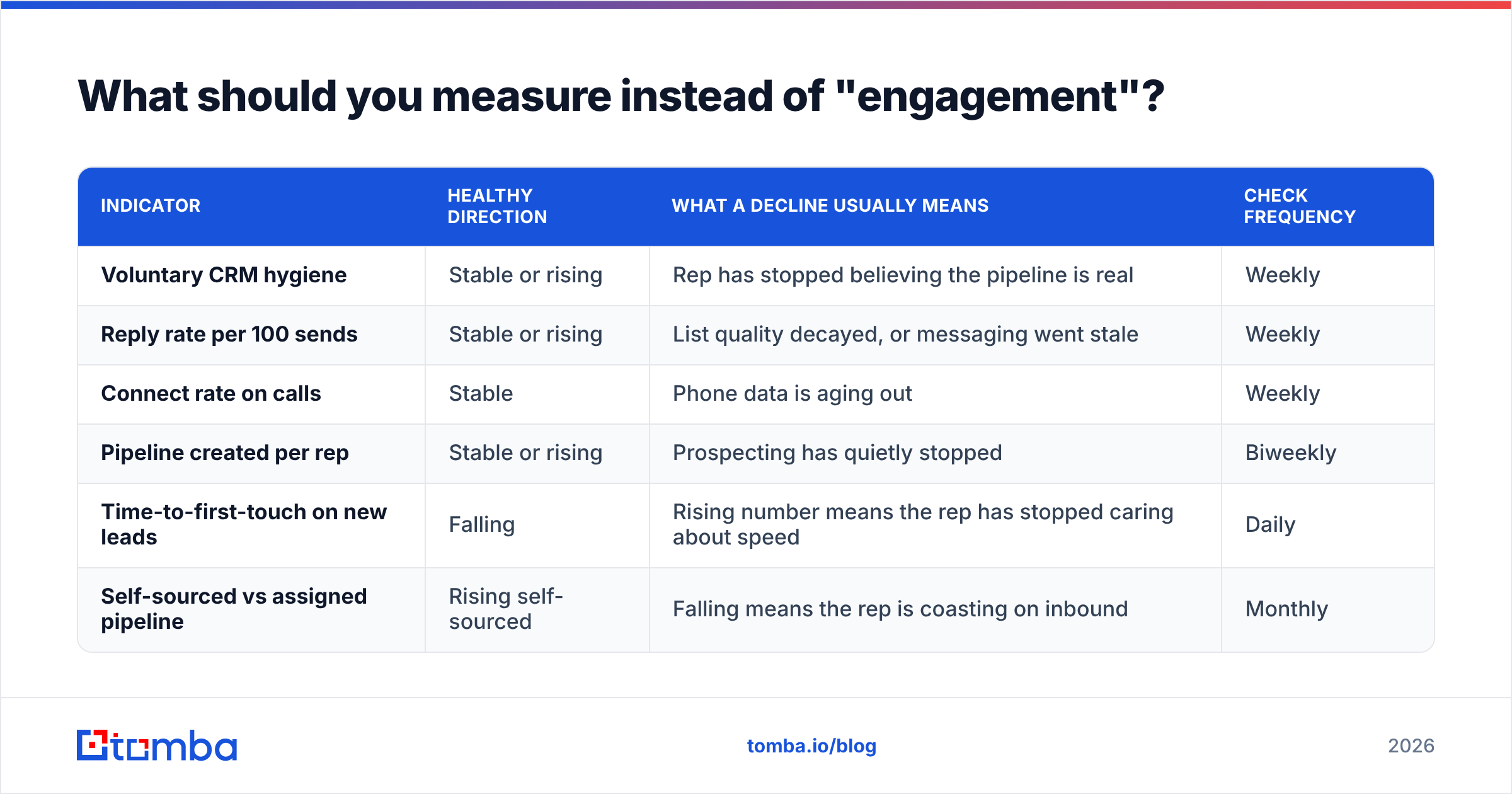
Track leading indicators that a demotivated rep changes before they disengage publicly:
| Indicator | Healthy direction | What a decline usually means | Check frequency |
|---|---|---|---|
| Voluntary CRM hygiene | Stable or rising | Rep has stopped believing the pipeline is real | Weekly |
| Reply rate per 100 sends | Stable or rising | List quality decayed, or messaging went stale | Weekly |
| Connect rate on calls | Stable | Phone data is aging out | Weekly |
| Pipeline created per rep | Stable or rising | Prospecting has quietly stopped | Biweekly |
| Time-to-first-touch on new leads | Falling | Rising number means the rep has stopped caring about speed | Daily |
| Self-sourced vs assigned pipeline | Rising self-sourced | Falling means the rep is coasting on inbound | Monthly |
The first row is the sleeper. Reps update the CRM when they believe the deals in it are real. When a rep quietly stops logging, they have stopped believing — usually weeks before they say anything out loud.
How do you rebuild recognition when nobody shares an office?#
Recognition has to be specific, fast, and public, in that order. "Great job team" is noise. "Sara pulled a meeting out of an account we marked dead in March, here's the exact email she sent" is signal, and it doubles as training.
Three formats that survive remote:
- The win channel with a template. Require three fields: what happened, what you tried, what you'd do differently. That turns bragging into a knowledge base.
- Peer nomination, not manager nomination. Manager praise reads as job description. Peer praise reads as real.
- Rotate the spotlight down the funnel. One week celebrate closed-won, the next celebrate best discovery call, the next best recovered account. Otherwise your two enterprise reps win every week. Everyone else stops looking.
One caution: leaderboards. They motivate the top three and demotivate everyone below sixth place. If you run one, rank on improvement, not raw number. A rep climbing from 40 to 70 meetings should beat a rep flat at 90.

Does compensation fix motivation on its own?#
No, and over-indexing on it is the most common expensive mistake.
Money sets the floor, not the ceiling. A comp plan that is below market or unclear will destroy motivation. But once it is fair and clear, extra accelerators buy surprisingly little extra effort. The constraint is rarely desire. It is usually hours in the day, quality of the list, or belief that the territory can produce.
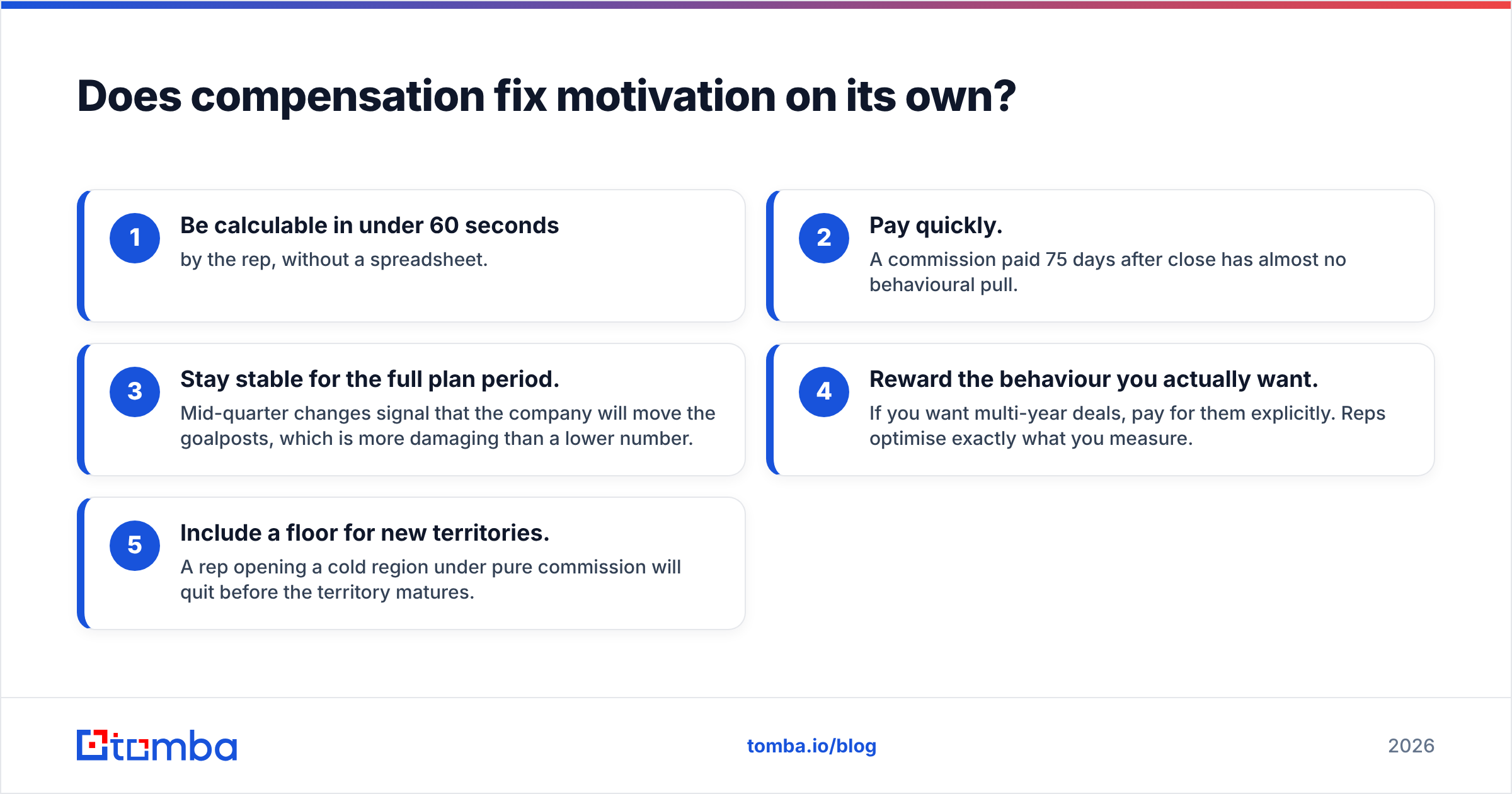
What comp must do:
- Be calculable in under 60 seconds by the rep, without a spreadsheet.
- Pay quickly. A commission paid 75 days after close has almost no pull on behaviour.
- Stay stable for the full plan period. Mid-quarter changes signal that the company will move the goalposts, which is more damaging than a lower number.
- Reward the behaviour you actually want. If you want multi-year deals, pay for them explicitly. Reps optimise exactly what you measure.
- Include a floor for new territories. A rep opening a cold region under pure commission will quit before the territory matures.
What does a 30-day fix plan look like?#
Here is how to motivate a remote sales team in 30 days, in the order that shows visible change fastest.
Week 1 — Audit the inputs. Pull a random sample of 200 contacts from each rep's active list and verify them. If more than 8% are invalid, your motivation problem is a data problem and you now have proof. Run the same check on phone data with a phone validator before you rebuild any calling cadence.
Week 2 — Give reps the loop. Stand up a daily view that shows activity and outcome side by side, visible to the rep first and the manager second. No new tooling required; a shared dashboard is enough.
Week 3 — Restructure the meetings. Kill the daily stand-up. Introduce async call review. Put the monthly career conversation on the calendar as a recurring event nobody is allowed to cancel.
Week 4 — Rebuild the list with clean sourcing. Give each rep 100 fresh, verified contacts in their own chosen segment rather than an assigned one. Autonomy plus clean data in the same week produces a real spike. More importantly, it produces proof that effort works again.
A note on that fourth week: the source matters. Vendors differ a lot in how they get data and how often they refresh it. You might use Tomba's B2B database, a peer like BookYourData for verified list purchase, or your own scraping pipeline. Ask every vendor the same two questions: how old is this record, and what did you do to confirm it this month? Tomba publishes its data sources for exactly that reason. Any vendor that will not answer is telling you the answer.
What if the problem is one rep, not the system?#
Diagnose before you intervene. Three patterns look identical from the outside and need opposite responses.
- Capability gap. Activity is high, outcomes are low. Fix: coaching and messaging, not pressure. Pressure on a capability gap produces churn.
- Belief gap. Activity has dropped but quality is still good when they do work. Fix: territory, data quality, and a visible early win. This is the easiest case to fix. It is also the one managers get wrong most often.
- Fit gap. Activity and quality both low, coaching does not stick over two full cycles. Fix: an honest conversation, quickly. Slow-rolling this is unfair to the rep. It also drags down everyone watching.
The tell that separates belief gap from fit gap: ask the rep to walk you through their top five accounts unprompted. A belief-gap rep still knows them cold and is frustrated. A fit-gap rep does not.
Where should you start this week?#
Start with the input data. It is the only lever on the list that costs almost nothing and pays this week.
Pull one rep's list, verify it, and count the invalid rows. If the number is over 8%, you have found the leak. You have also found the reason your last three motivation projects fell flat. Reps cannot stay motivated when the raw material is broken. No amount of praise, new comp plans, or new pods makes up for a list where one in seven contacts does not exist.
Give your reps contacts they can trust, plus the autonomy to fix a bad record in twenty seconds instead of twenty minutes. Tomba Email Finder does exactly that: verified professional emails by name, domain, or company. The free tier gives you 25 searches a month, so you can test a real territory first. Paid plans start at $49/mo. Check Tomba pricing to see which tier fits your team size. Then run the week-one audit above and let the numbers tell you where your motivation problem actually lives.
Related guides#
Ready to find emails that actually work?
Join 150,000+ professionals who stopped guessing and started sending. Free credits on signup — no credit card required.
Get the Tomba newsletter
Practical outbound tactics and product updates — once every two weeks.
About the author