How to Negotiate Over the Phone: A B2B Sales Playbook
Phone negotiation strips away body language and leaves you with voice, silence, and preparation. Here is the exact framework, script structure, and concession ladder B2B reps use to close on the call.
TL;DR
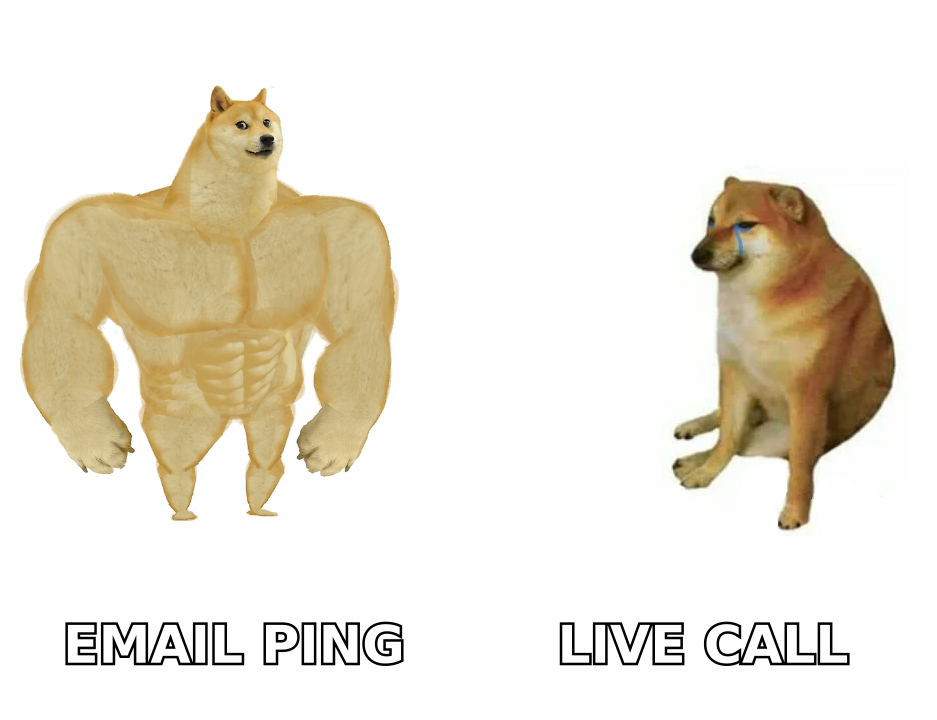
- Phone negotiation removes 70% of your read on the other side — you lose facial cues and posture, so you have to compensate with structured questions, deliberate silence, and tone control.
- Never negotiate on a call you did not schedule. An ambush call is the buyer's home turf; a booked call is yours.
- Build a concession ladder before you dial: three pre-approved trades, each one attached to something you get back (term length, case study, faster signature, upfront payment).
- Silence is the highest-ROI tactic on the phone. After you state a number, say nothing. The first person to talk loses roughly 3-8% of deal value in most rep-level negotiations.
- Log the call outcome the same hour. Deals die in the 72 hours after a "let me think about it" call, not during the call itself.
Why is negotiating over the phone harder than in person?#
Because you lose the feedback loop. In a room, you can see the CFO wince at the number before she says anything. On a call, that wince is invisible — you only get audio, and audio is a thin channel.
Think of it like driving with the windshield fogged over. The car still works. You still get there. But you drive slower, you check your mirrors more often, and you rely on instruments instead of intuition.
That means three practical changes to your approach:
- You must verbalize what you would normally read. "That number landed harder than I expected — what's the reaction on your side?" Ask the question you would otherwise have answered by looking at a face.
- Your pace has to slow down. Phone conversations feel faster than they are. Deliberately dropping your speaking rate by 10-15% reads as confidence, not hesitation.
- Silence becomes a tool, not an accident. In person, silence is awkward. On the phone, silence is pressure — and the person who is uncomfortable with it concedes first.
The upside: phone negotiation is asymmetric in your favor if you prepare and the buyer does not. You can have your pricing sheet, your concession ladder, your competitor comparison, and your past-deal notes open on screen. They usually have none of that.
What should you prepare before the call?#
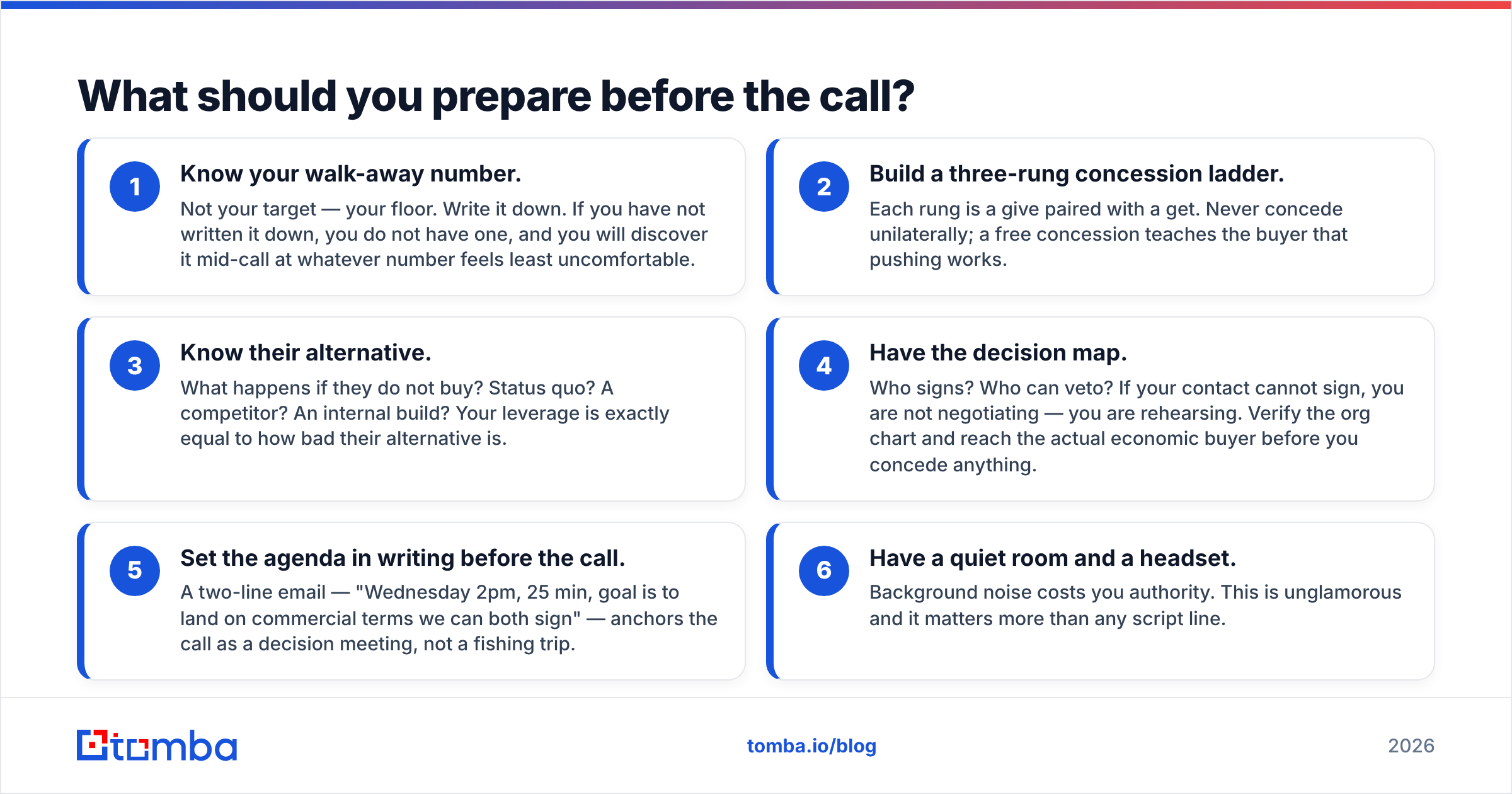
Preparation is 80% of the outcome. Here is the checklist that separates reps who hold price from reps who discount reflexively.
- Know your walk-away number. Not your target — your floor. Write it down. If you have not written it down, you do not have one, and you will discover it mid-call at whatever number feels least uncomfortable.
- Build a three-rung concession ladder. Each rung is a give paired with a get. Never concede unilaterally; a free concession teaches the buyer that pushing works.
- Know their alternative. What happens if they do not buy? Status quo? A competitor? An internal build? Your leverage is exactly equal to how bad their alternative is.
- Have the decision map. Who signs? Who can veto? If your contact cannot sign, you are not negotiating — you are rehearsing. Verify the org chart and reach the actual economic buyer before you concede anything.
- Set the agenda in writing before the call. A two-line email — "Wednesday 2pm, 25 min, goal is to land on commercial terms we can both sign" — anchors the call as a decision meeting, not a fishing trip.
- Have a quiet room and a headset. Background noise costs you authority. This is unglamorous and it matters more than any script line.
On point 4: if you are still stitching together who the decision-makers are, a domain search across the account surfaces the other stakeholders on the buying committee before you get blindsided by a name you have never heard of.
What does a concession ladder look like in practice?#
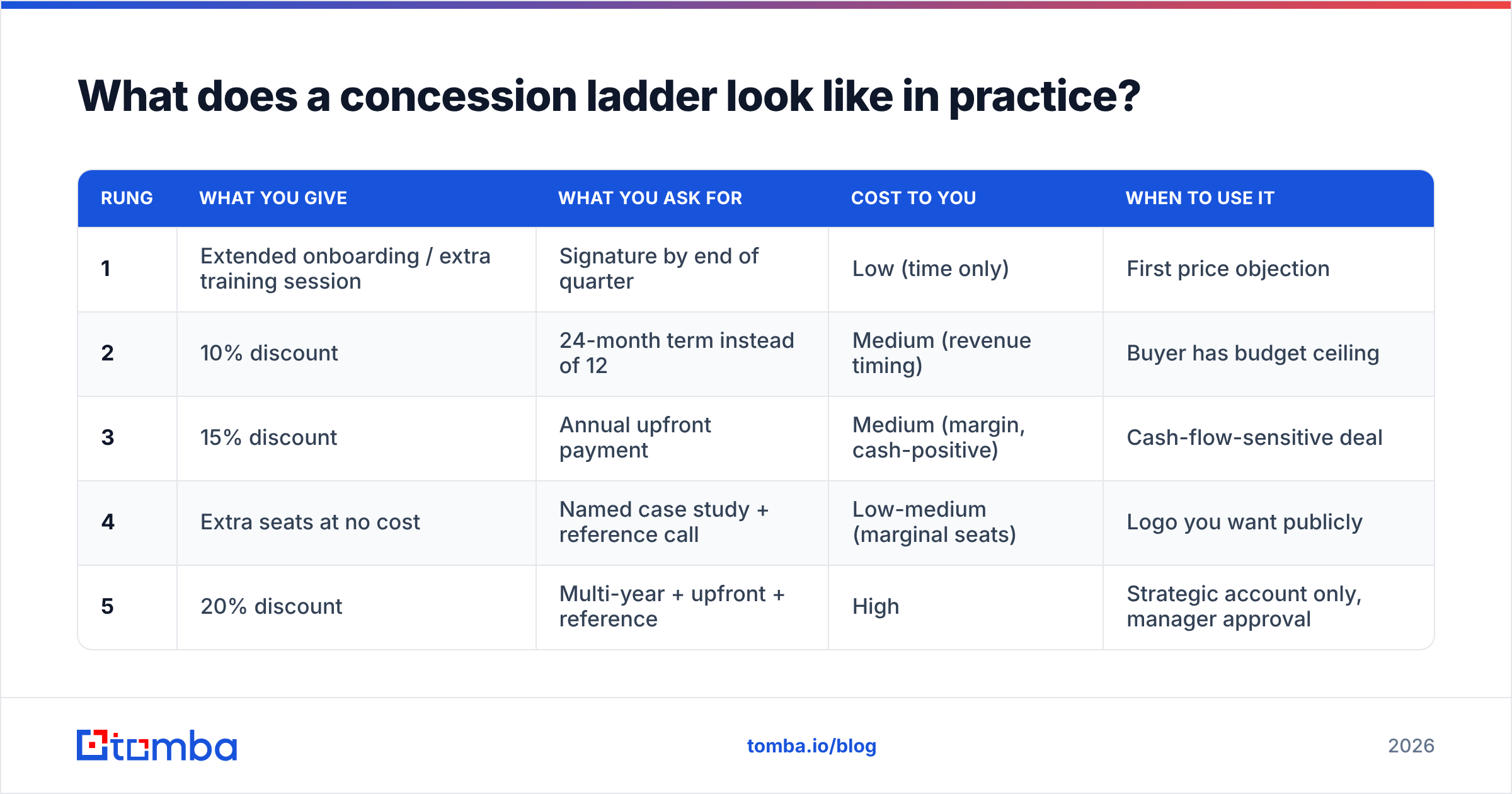
A concession ladder is your pre-authorized list of trades, ordered from cheapest-to-give to most expensive. You climb it slowly. You never skip rungs.
| Rung | What you give | What you ask for | Cost to you | When to use it |
|---|---|---|---|---|
| 1 | Extended onboarding / extra training session | Signature by end of quarter | Low (time only) | First price objection |
| 2 | 10% discount | 24-month term instead of 12 | Medium (revenue timing) | Buyer has budget ceiling |
| 3 | 15% discount | Annual upfront payment | Medium (margin, cash-positive) | Cash-flow-sensitive deal |
| 4 | Extra seats at no cost | Named case study + reference call | Low-medium (marginal seats) | Logo you want publicly |
| 5 | 20% discount | Multi-year + upfront + reference | High | Strategic account only, manager approval |
Notice what is absent: a rung that says "20% off because they asked twice." Every row has a get. That is the whole discipline.
When you offer a rung on the phone, phrase it as a conditional, never as an offer:
"If you can commit to a 24-month term, I can get you to $99 per month. Is that structure something you can sign off on?"
The conditional does two things. It keeps the discount contingent, so if they say no, the price snaps back to list. And it moves the conversation from "how much off" to "what structure" — a much better frame for you.
How do you handle the price objection on a live call?#
The price objection is not one objection. It is four, and they need different responses.
- "It's too expensive." — Vague. Almost always means "I have not connected the price to a return." Response: quantify. "Compared to what you're spending on X today, or compared to a budget number you have in mind?"
- "We don't have budget." — Timing, not value. Response: move the calendar or the payment structure, not the price. "If budget frees up in Q1, would you sign now with a January start?"
- "Competitor X quoted us less." — Real, and you should ask for specifics. "What's included in their number? Seats, support tier, data volume?" Half the time the quotes are not comparable.
- "I need to check with my boss." — Authority. You are talking to the wrong person, or they are using deferral as a soft no. Response: "Happy to join that conversation — what would they need to hear?"
The reflexive mistake is to answer all four with a discount. Discounting a timing objection does not solve timing; it just costs you margin and signals that your list price was fiction.
Which phone tactics actually change outcomes?#
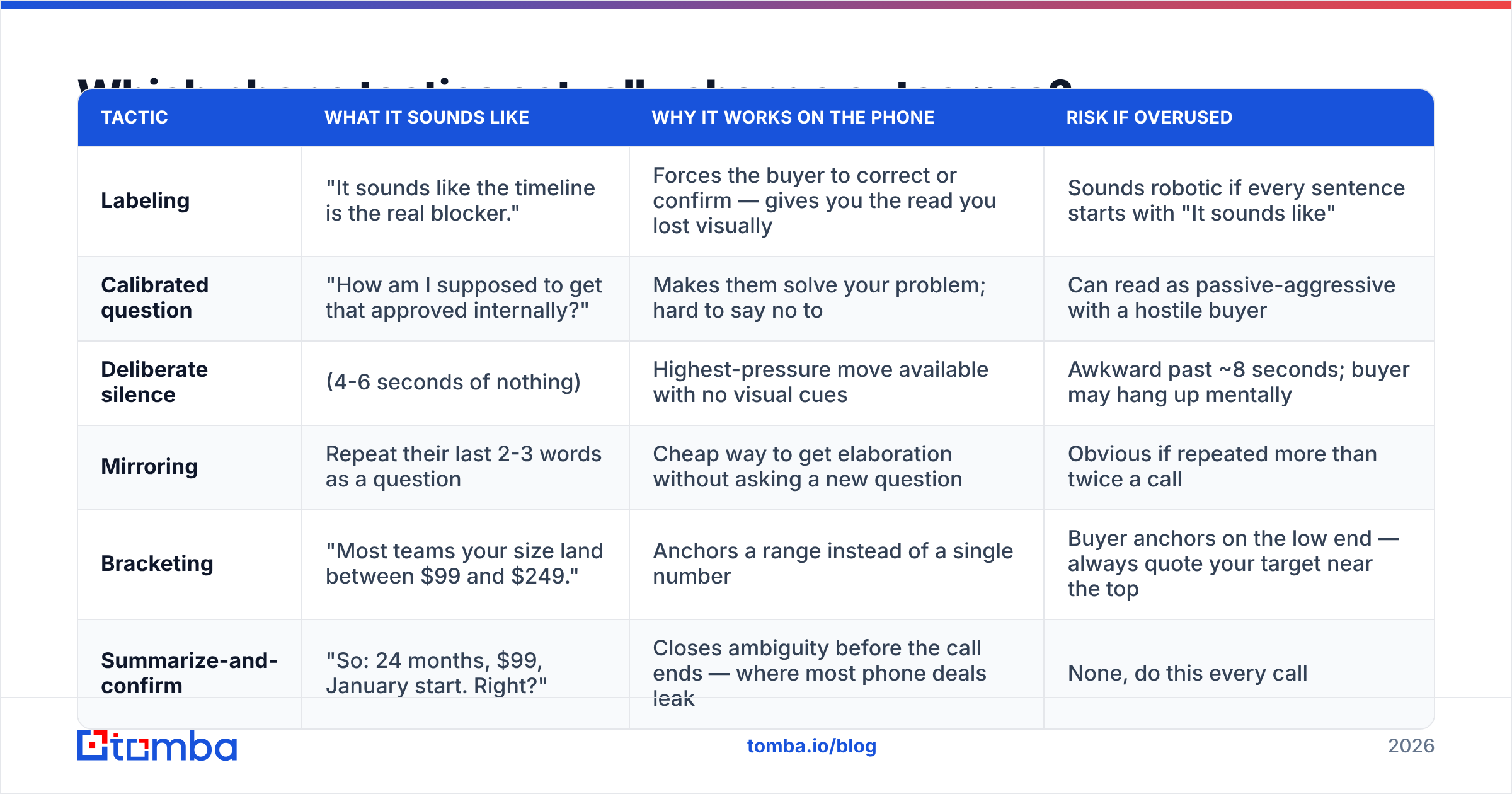
Chris Voss's negotiation work at the FBI — summarized well in HubSpot's sales negotiation guidance — translates unusually well to phone calls, because most of it is verbal by design.
| Tactic | What it sounds like | Why it works on the phone | Risk if overused |
|---|---|---|---|
| Labeling | "It sounds like the timeline is the real blocker." | Forces the buyer to correct or confirm — gives you the read you lost visually | Sounds robotic if every sentence starts with "It sounds like" |
| Calibrated question | "How am I supposed to get that approved internally?" | Makes them solve your problem; hard to say no to | Can read as passive-aggressive with a hostile buyer |
| Deliberate silence | (4-6 seconds of nothing) | Highest-pressure move available with no visual cues | Awkward past ~8 seconds; buyer may hang up mentally |
| Mirroring | Repeat their last 2-3 words as a question | Cheap way to get elaboration without asking a new question | Obvious if repeated more than twice a call |
| Bracketing | "Most teams your size land between $99 and $249." | Anchors a range instead of a single number | Buyer anchors on the low end — always quote your target near the top |
| Summarize-and-confirm | "So: 24 months, $99, January start. Right?" | Closes ambiguity before the call ends — where most phone deals leak | None, do this every call |
The last row is the one reps skip and then regret. A phone call has no artifact. If you do not summarize verbally and then in a follow-up email within the hour, you and the buyer will remember two different deals.
How should you structure the call itself?#
A 25-minute negotiation call has a shape. Deviating from it is how calls become rambling and end with "send me something in writing."
- Minutes 0-2 — Frame. "The goal today is to get to terms we can both sign. If we can't, that's fine, but let's find that out today." This is permission to close.
- Minutes 2-8 — Confirm value. Restate the problem, the impact, and what they told you it costs them. Never negotiate before value is re-anchored, or you are negotiating price in a vacuum.
- Minutes 8-15 — Surface all objections at once. "Besides price, is there anything else standing between us and a signature?" This is the single most valuable question on the call. It prevents the drip-feed of new objections after every concession.
- Minutes 15-22 — Trade. Climb the ladder, one rung at a time, each with a conditional.
- Minutes 22-25 — Summarize and set the next action with a date. "I'll have the paperwork to you by 4pm today, you'll have it signed by Thursday. Correct?"
Step 3 is where most reps lose money. If you concede on price and then hear about legal review, then security review, then a new stakeholder, you have paid full price for a partial close.
What comes after the call?#
Everything you agreed to evaporates unless it is written down within the hour. Send a short recap email with the agreed terms as bullets, the next step, and a date. No pleasantries, no re-selling — just the record.
Two things worth automating:
- Contact accuracy for the follow-up. If the summary email bounces because you had a stale address for the new stakeholder who joined on minute 12, the deal stalls for a week. Run the address through an email verifier before you send anything deal-critical.
- Direct-dial coverage for the follow-up call. Phone negotiations rarely finish in one call. If your only number is a switchboard, you have handed control of the next conversation to a receptionist. A phone finder that returns direct lines removes that dependency.
For teams building the calling list itself, the underlying question is data quality — where the data comes from determines whether your reps spend their day negotiating or dialing dead numbers. G2's category reviews are a reasonable neutral starting point for comparing sales intelligence sources, and Gartner's B2B buying research is worth reading on why buying committees have grown to 6-10 people — which is exactly why the "who else needs to approve this" question matters so much.
What mistakes kill phone negotiations most often?#
- Negotiating on an unscheduled call. If a buyer calls you out of the blue to "talk numbers," you are unprepared and they are not. Say: "I want to give this the attention it deserves — can we do 20 minutes tomorrow at 10?" Nothing is lost, and you regain the prep.
- Filling silence. After you name a price, the next voice should be theirs. Count to six in your head.
- Discounting before understanding. A discount offered before you know why they object is a discount you gave to nobody.
- Negotiating with a non-decision-maker. You will spend your concessions on a person who then has to re-negotiate upward with their boss. Always confirm authority in step 1.
- Letting the call end without a dated next step. "I'll follow up next week" is where deals go to die. Get a day and a time, in the call, on the record.
- Reading a script verbatim. Scripts are for structure, not for delivery. A buyer can hear reading. Use bullets, not sentences.
Is phone still the right channel for B2B negotiation in 2026?#
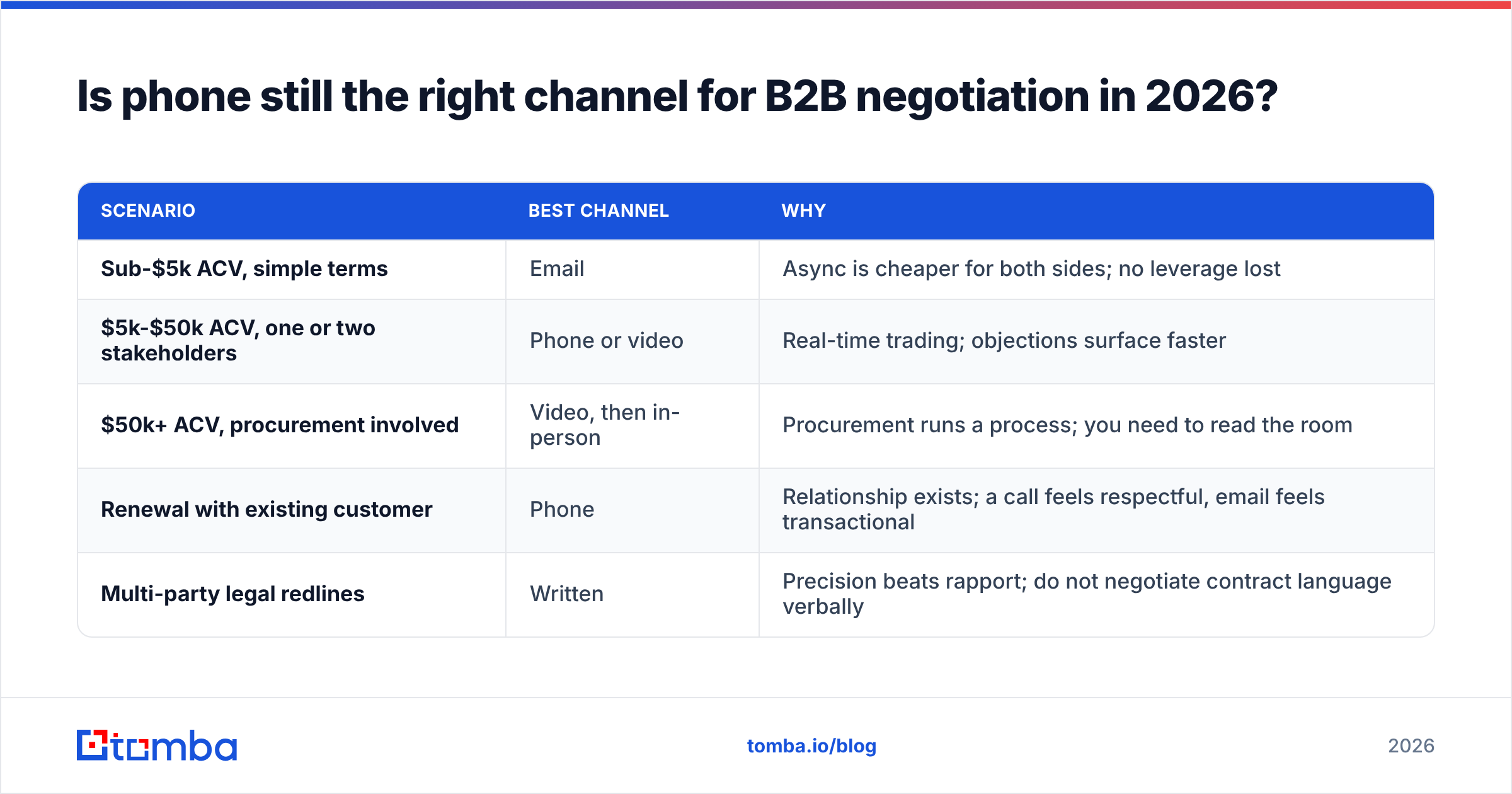
Mostly yes, with one caveat: it depends on deal size and complexity.
| Scenario | Best channel | Why |
|---|---|---|
| Sub-$5k ACV, simple terms | Async is cheaper for both sides; no leverage lost | |
| $5k-$50k ACV, one or two stakeholders | Phone or video | Real-time trading; objections surface faster |
| $50k+ ACV, procurement involved | Video, then in-person | Procurement runs a process; you need to read the room |
| Renewal with existing customer | Phone | Relationship exists; a call feels respectful, email feels transactional |
| Multi-party legal redlines | Written | Precision beats rapport; do not negotiate contract language verbally |
The failure mode is defaulting to email for everything because it feels safer. Email negotiation lets the buyer take unlimited time, consult unlimited people, and compare you to unlimited competitors between messages. A live call compresses all of that into 25 minutes where you control the frame.
The opposite failure mode is calling to negotiate contract clauses. Do not. Anything a lawyer will read should be written.
How do you practice this without burning real deals?#
Role-play with a colleague, but change the default. Most role-play is too easy because the "buyer" wants you to succeed. Instead:
- Give the buyer a written script with three objections they must raise, one of which is a hard budget ceiling you cannot meet.
- Record the call and listen back specifically for how long your silences actually are. They will be shorter than you think — usually 1-2 seconds when you believed they were five.
- Count your concessions. If you gave more than one, you climbed the ladder too fast.
- Have a third person score you on a single question: did you ask "besides price, what else?" before conceding? If not, the call failed regardless of the outcome.
Run this once a week for a month and phone negotiation stops feeling like improvisation. It becomes a checklist you execute while sounding relaxed — which is exactly what a good negotiator sounds like.
Where does the pipeline for these calls come from?#
None of this matters if you are not getting on calls with the right people in the first place. The best concession ladder in the world does not help you negotiate with someone who cannot sign.
That is a data problem before it is a sales-skills problem: you need the actual decision-maker's contact details, verified, before the negotiation starts — not a generic info@ address that routes to nobody. If you are building that list account by account, Tomba Email Finder resolves names and domains into verified professional addresses so your booked calls are with the people who own the budget. It starts free with 25 searches a month, and paid plans begin at $49/mo when you are ready to scale the list. Get the right person on the phone first — then run the playbook above.
Related guides#
// get started
Find, verify and enrich your first contacts today
Start on the free plan with 25 searches a month, then scale when your team is ready.
Free plan · No credit card required · GDPR & CCPA
// about the author