How to Nurture MQLs to SQLs: A 2026 Playbook That Works
Most MQLs die between the form fill and the first sales call. Here is the exact scoring, enrichment, and multi-touch nurture sequence that converts marketing leads into sales-qualified pipeline.
TL;DR
- Most MQL-to-SQL leakage is not a nurture-copy problem. It is a data problem: incomplete records, wrong contact, and a handoff that happens days too late.
- Score on fit and behavior separately. A CFO who downloaded one guide is not the same lead as an intern who downloaded five.
- Enrich every MQL the moment it converts — job title, company size, direct email, phone — so sales inherits a complete record instead of a form fill.
- Run a 21-day, three-track nurture (education, proof, offer) and route to sales the second an intent threshold trips, not at the end of the sequence.
- Benchmark: a healthy B2B MQL-to-SQL rate sits around 13-20%. If you are under 10%, fix qualification before you write another email.
What is an MQL and how is it different from an SQL?#
An MQL (marketing qualified lead) is someone who has shown enough interest — a demo request, a pricing page visit, a gated download — that marketing believes they are worth a follow-up. An SQL (sales qualified lead) is someone a rep has looked at and agreed is worth spending selling time on.
The gap between those two definitions is where most B2B pipeline dies. Marketing calls a webinar registrant an MQL. Sales opens the record, sees "gmail.com" and a blank job-title field, and never calls. Nobody is lying; the two teams just never agreed on what "qualified" means.
Think of it like a restaurant pass. Marketing plates the dish, sales carries it to the table. If the pass is chaotic — no tickets, no order of service — food goes cold no matter how good the kitchen is. Nurture is the pass.
A working definition looks like this:
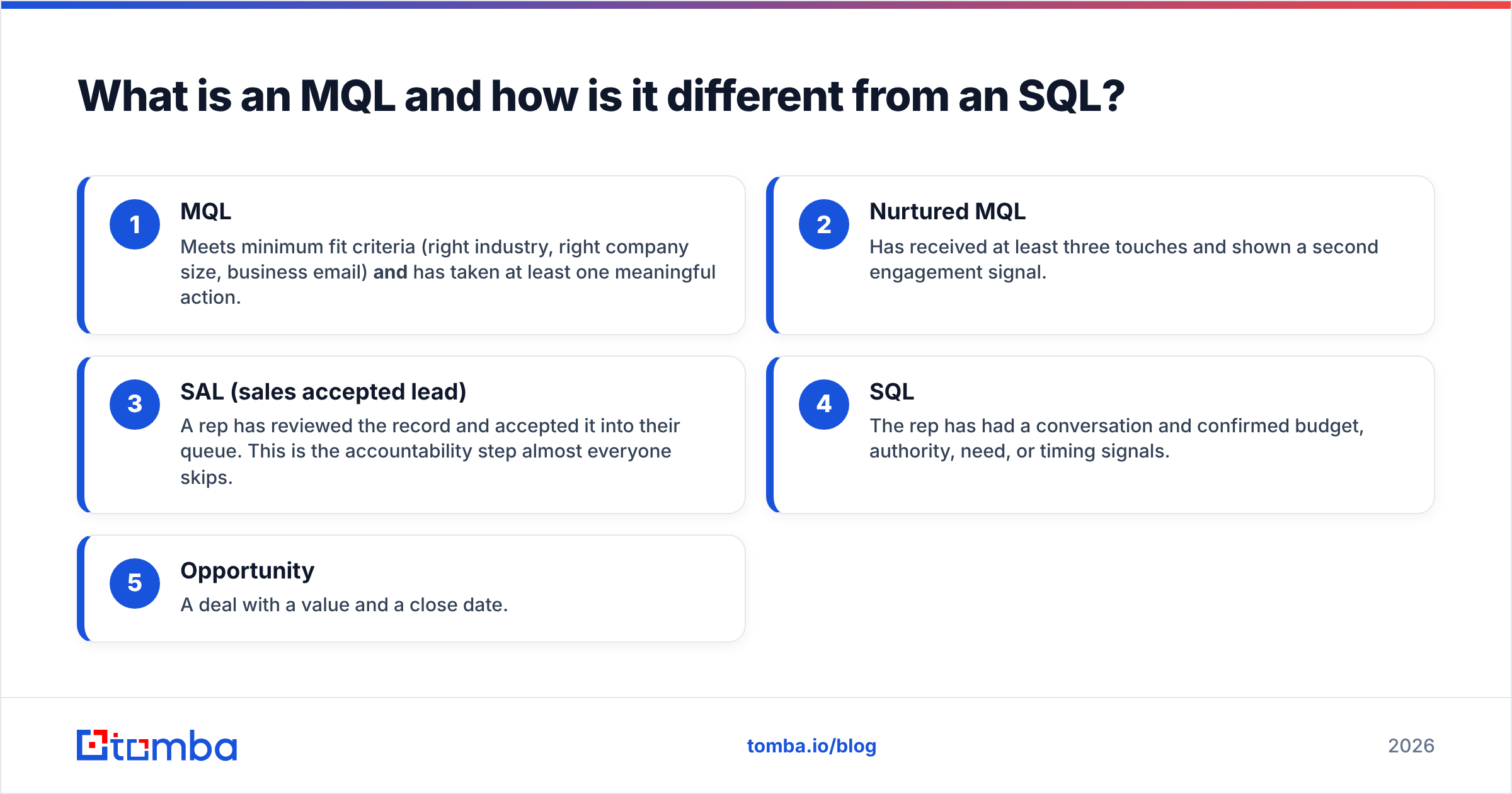
- MQL — Meets minimum fit criteria (right industry, right company size, business email) and has taken at least one meaningful action.
- Nurtured MQL — Has received at least three touches and shown a second engagement signal.
- SAL (sales accepted lead) — A rep has reviewed the record and accepted it into their queue. This is the accountability step almost everyone skips.
- SQL — The rep has had a conversation and confirmed budget, authority, need, or timing signals.
- Opportunity — A deal with a value and a close date.
Adding the SAL stage is the single cheapest fix available. It forces sales to reject leads explicitly with a reason code, which gives marketing a feedback loop instead of a rumor mill.
Why do most MQLs never become SQLs?#
Four causes, in rough order of damage:
Speed. Response time is the highest-leverage variable in the whole funnel. The classic Harvard Business Review study on lead response found firms that contacted a lead within an hour were roughly seven times more likely to have a meaningful conversation with a decision-maker than those who waited even two hours. Most nurture programs are built to wait.
Incomplete data. A form with three fields produces a record with three fields. The rep has to research the company, guess the seniority, and hunt for a phone number before they can even start. That research tax is why "the leads are bad" is the most common sales complaint in existence — half the time the leads are fine, they are just unusable in their raw state.
Wrong contact. The person who downloads your report is often not the person who signs. In a mid-market deal you are typically dealing with six to ten stakeholders. Nurturing only the downloader means nurturing the least powerful person in the room.
Undifferentiated sequences. One generic drip for every lead means the ready-to-buy prospect gets the same five-day-delayed "here's a blog post" email as the tire-kicker.

How do you score MQLs so only real ones reach sales?#
Use a two-axis model. Fit score answers "should we sell to this person?" Behavior score answers "do they want to talk right now?" Combine them into a grid, not a single number, because a single number lets a junior enthusiast outrank a perfect-fit executive.
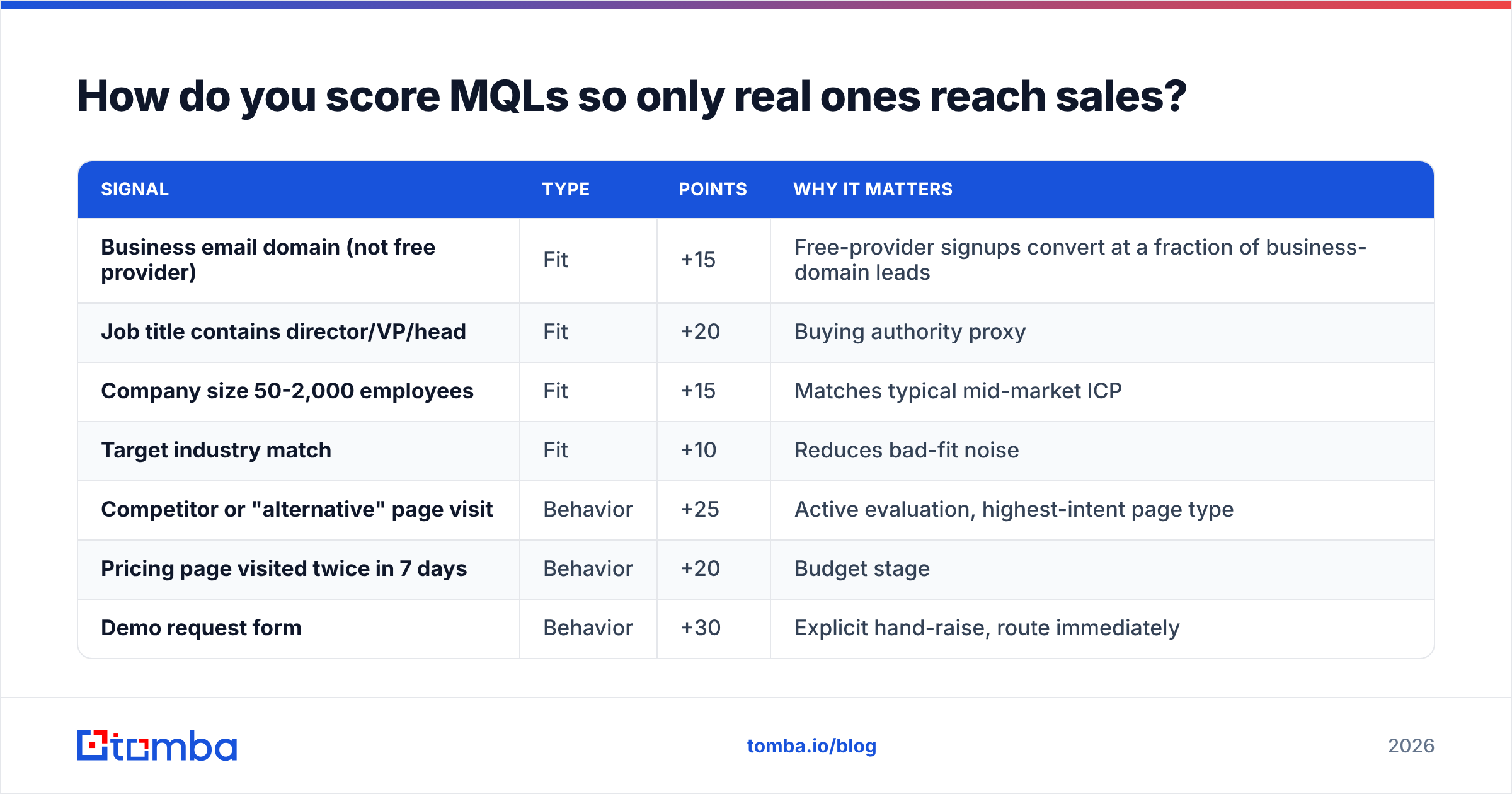
| Signal | Type | Points | Why it matters |
|---|---|---|---|
| Business email domain (not free provider) | Fit | +15 | Free-provider signups convert at a fraction of business-domain leads |
| Job title contains director/VP/head | Fit | +20 | Buying authority proxy |
| Company size 50-2,000 employees | Fit | +15 | Matches typical mid-market ICP |
| Target industry match | Fit | +10 | Reduces bad-fit noise |
| Competitor or "alternative" page visit | Behavior | +25 | Active evaluation, highest-intent page type |
| Pricing page visited twice in 7 days | Behavior | +20 | Budget stage |
| Demo request form | Behavior | +30 | Explicit hand-raise, route immediately |
| Opened 3+ emails, clicked 0 | Behavior | +3 | Weak signal, do not over-weight |
| Student, intern, or unemployed title | Fit | -25 | Suppress rather than delete — they change jobs |
Route on the combination:
- High fit + high behavior → straight to sales, same day, no nurture.
- High fit + low behavior → nurture track A (education and problem framing).
- Low fit + high behavior → nurture track B (self-serve, product-led, low sales cost).
- Low fit + low behavior → newsletter only.
Set your MQL threshold using actual conversion data, not intuition. Pull the last 200 closed-won deals, look at what their scores were at MQL stage, and set the bar at the tenth percentile. If you set it where nobody complains, it is too low.
How do you enrich leads before handing them to sales?#
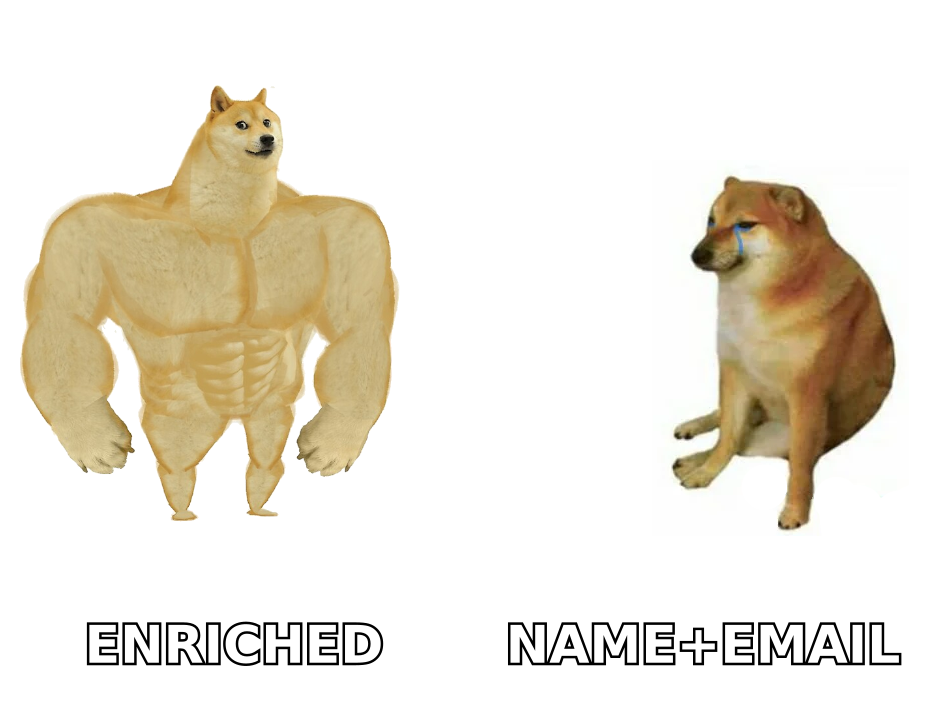
Enrichment is the step that turns a form fill into a workable record. The rule: a rep should never have to open a browser tab to figure out who a lead is.
Minimum viable enriched record before handoff:
- Verified work email — deliverable, not a role address like info@ or a dead alias. Run every address through an email verifier before it enters a sequence; bouncing on your own MQLs damages the domain you also use for outbound.
- Job title and seniority — normalized, so "Head of Growth" and "Growth Lead" land in the same bucket.
- Company firmographics — employee count, industry, revenue band, HQ country.
- Tech stack signals — do they run the CRM or ESP your product plugs into?
- Direct phone where available — a phone finder lookup turns a 3% email reply rate into a real conversation.
- Second and third stakeholder — use domain search to pull the other decision-makers at that company so the nurture can go multi-threaded.
That last point is underrated. If a marketing manager at a 400-person company downloads your buyer's guide, the actual purchase will involve their VP and probably a RevOps lead. Pulling those contacts at MQL stage — rather than after the deal stalls — is the difference between a single-threaded deal that dies on a reorg and one that survives it.
Automate this. Trigger enrichment on form submission via the Tomba API or a HubSpot integration workflow so the record is complete before the lead-assignment rule fires. Manual enrichment does not survive contact with volume.
What does a 21-day MQL nurture sequence actually look like?#
Three tracks, one calendar. Every touch has a job; nothing is there to "stay top of mind."
Days 1-7 — Frame the problem.
- Day 0 (within 5 minutes): deliver what they asked for, plus one line about the most common mistake in that area. No pitch.
- Day 2: a short, specific case story — company like theirs, the metric that moved, the timeframe. 150 words maximum.
- Day 5: a genuinely useful asset that requires no form. A calculator, a checklist, a teardown.
- Day 7: a plain-text email from a human rep, one question, no links. This is the highest-reply touch in the whole sequence.
Days 8-14 — Prove it.
- Day 9: comparison content. How your category is typically evaluated, honestly including where you are not the right fit.
- Day 11: LinkedIn connection request from the assigned rep, referencing the original download. Layering channels lifts overall response rate more than adding a sixth email.
- Day 13: a customer proof point matched to their industry.
Days 15-21 — Make it easy to raise a hand.
- Day 16: a low-friction offer. Not "book a 45-minute demo" — try a 12-minute recorded walkthrough or a free audit.
- Day 19: a phone attempt if you have a direct number, followed by a voicemail-to-email pair.
- Day 21: the breakup email. Explicit, warm, one sentence, easy to reply to. These consistently pull outsized reply rates.
Two hard rules. First, any intent trigger interrupts the sequence and routes to sales immediately — pricing page, competitor comparison page, second demo-video view. Second, if a lead does not engage by day 21, they go back to the newsletter, not into a second drip. Recycling is not nurturing.
For copy, keep every email under 120 words and one call to action. Our cold email templates library has starting points you can adapt rather than writing from a blank page.
Which tools should you use to nurture MQLs to SQLs?#
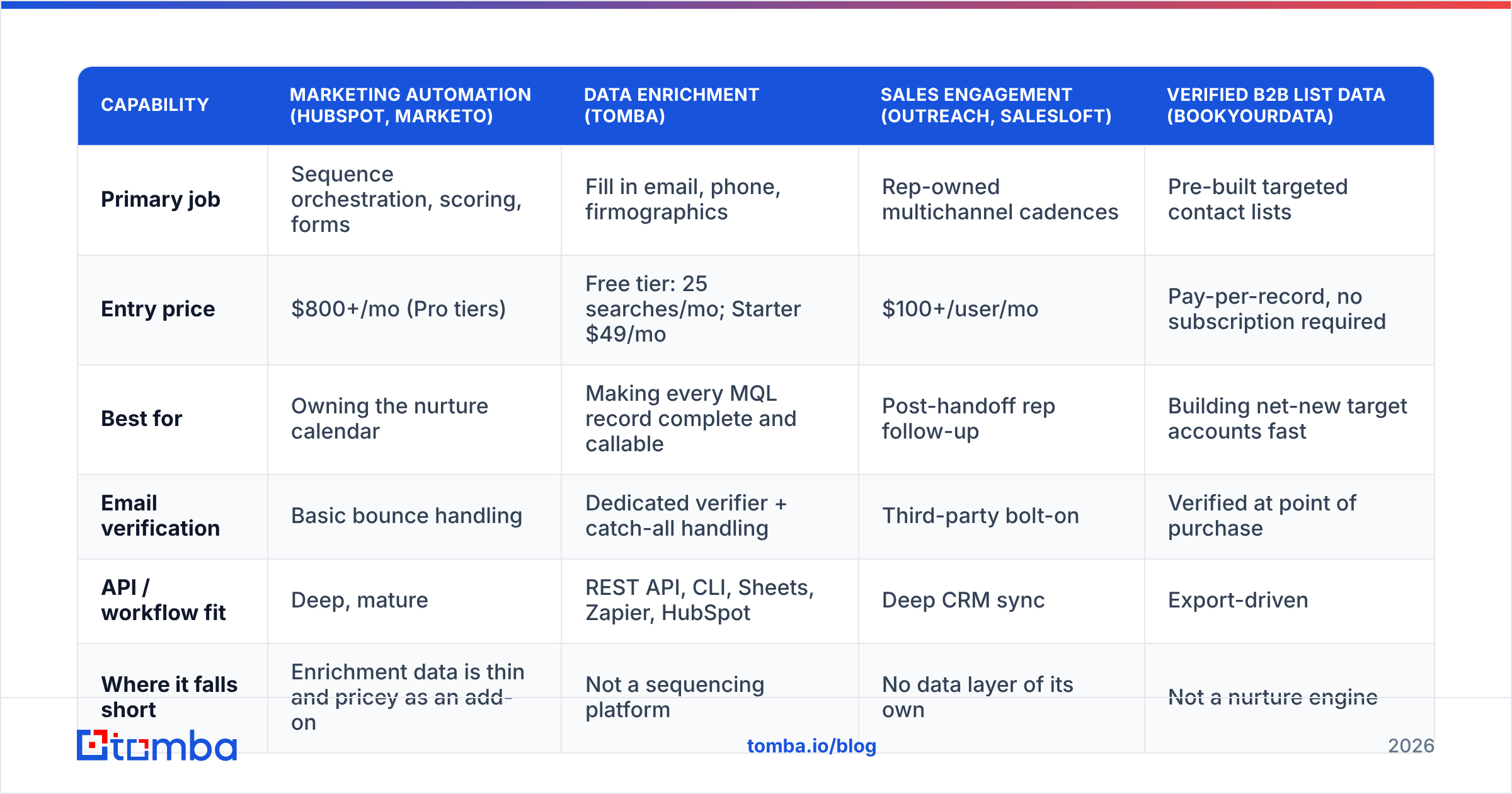
Your stack needs four jobs covered: capture, enrich, orchestrate, and route. Some platforms bundle several; most teams assemble three or four.
| Capability | Marketing automation (HubSpot, Marketo) | Data enrichment (Tomba) | Sales engagement (Outreach, Salesloft) | Verified B2B list data (BookYourData) |
|---|---|---|---|---|
| Primary job | Sequence orchestration, scoring, forms | Fill in email, phone, firmographics | Rep-owned multichannel cadences | Pre-built targeted contact lists |
| Entry price | $800+/mo (Pro tiers) | Free tier: 25 searches/mo; Starter $49/mo | $100+/user/mo | Pay-per-record, no subscription required |
| Best for | Owning the nurture calendar | Making every MQL record complete and callable | Post-handoff rep follow-up | Building net-new target accounts fast |
| Email verification | Basic bounce handling | Dedicated verifier + catch-all handling | Third-party bolt-on | Verified at point of purchase |
| API / workflow fit | Deep, mature | REST API, CLI, Sheets, Zapier, HubSpot | Deep CRM sync | Export-driven |
| Where it falls short | Enrichment data is thin and pricey as an add-on | Not a sequencing platform | No data layer of its own | Not a nurture engine |
The honest read: no single vendor does all four well. Marketing automation platforms are excellent orchestrators and mediocre data providers — their enrichment add-ons cost more than a dedicated tool and cover fewer records. Sales engagement platforms assume the data is already correct. BookYourData is a strong fit when you need verified contacts in a specific segment immediately rather than waiting for inbound to trickle in. A dedicated enrichment layer sits underneath all of them and keeps the records usable.
Check G2's marketing automation category for current peer reviews before committing to an annual contract — the mid-market tier moves fast.
Pricing detail matters here. If you are enriching a few thousand MQLs a month, the Tomba pricing ladder — Free at 25 searches, Starter at $49/mo, Growth at $99/mo, Pro at $249/mo — is a rounding error against the cost of a rep spending ten minutes per lead on manual research.
How do you measure whether your nurture is working?#
Track five numbers, weekly, in a single view:
- MQL-to-SAL rate. What percentage of MQLs does sales accept? Below 60% means your MQL definition is broken, not your emails.
- MQL-to-SQL rate. The headline metric. Healthy B2B benchmarks land in the 13-20% range depending on motion; product-led companies run higher, enterprise ABM runs lower.
- Time to first touch. Measure in minutes, not days. Anything over an hour on a high-fit lead is a leak.
- Stage velocity. Median days from MQL to SQL. If this is climbing, your sequence is too long or your routing rules are stale.
- Rejection reason codes. The most useful data you are probably not collecting. "Wrong title," "no budget," "already a customer," "unreachable." If "unreachable" dominates, your problem is contact data quality, not nurture copy.
Review reason codes with sales monthly and change one scoring rule per review. Changing five at once means you learn nothing.
One caution on attribution: do not judge nurture on last-touch. The day-7 human email that got a reply often gets zero credit because the demo request came through a branded search two weeks later. Use a simple multi-touch view or, at minimum, look at cohort conversion rates rather than per-email attribution. Forrester's B2B research is a reasonable grounding on how buying groups actually move.
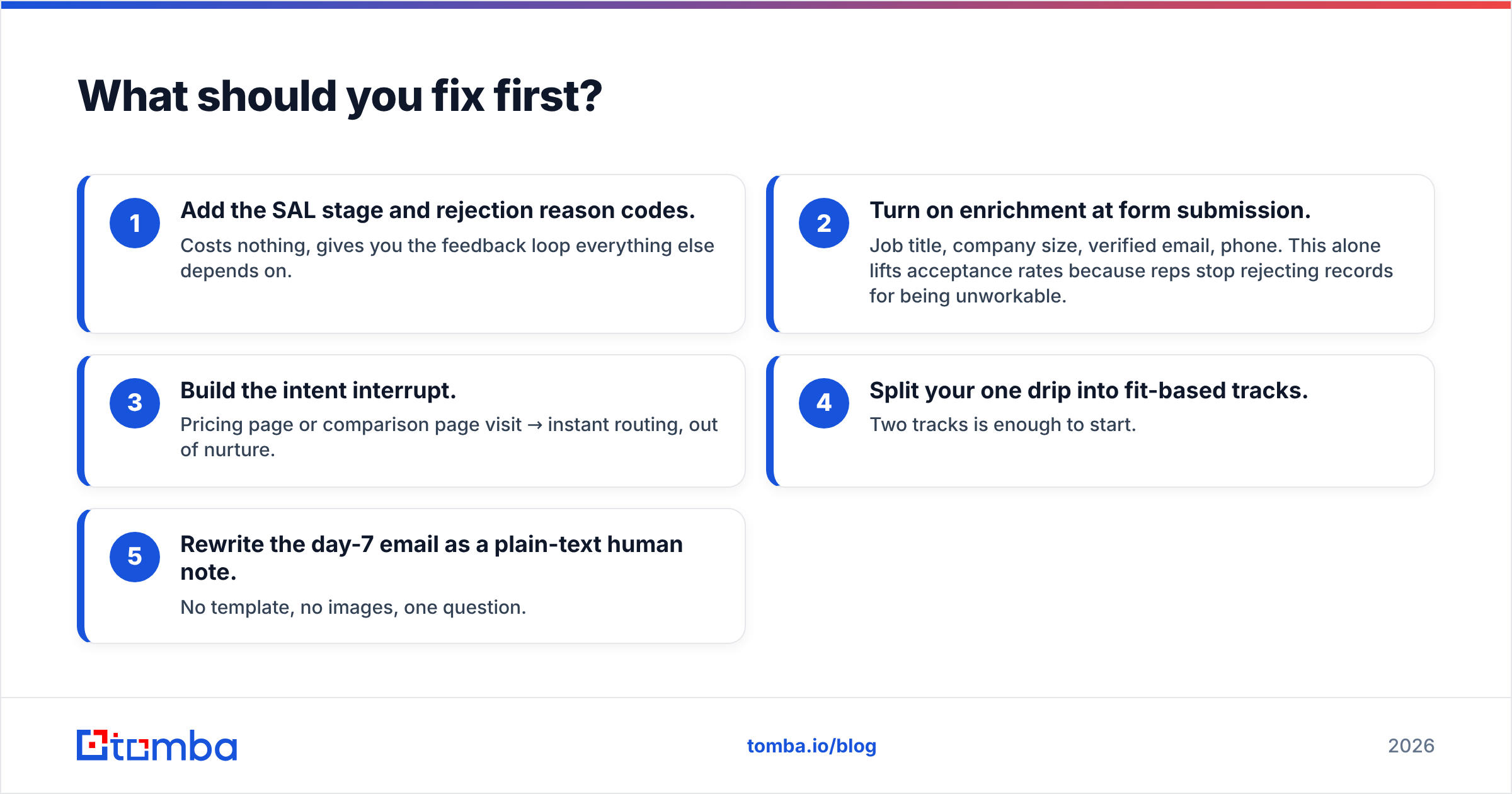
What should you fix first?#
If you only have a week, do these in order:
- Add the SAL stage and rejection reason codes. Costs nothing, gives you the feedback loop everything else depends on.
- Turn on enrichment at form submission. Job title, company size, verified email, phone. This alone lifts acceptance rates because reps stop rejecting records for being unworkable.
- Build the intent interrupt. Pricing page or comparison page visit → instant routing, out of nurture.
- Split your one drip into fit-based tracks. Two tracks is enough to start.
- Rewrite the day-7 email as a plain-text human note. No template, no images, one question.
Everything else — lifecycle scoring models, predictive AI scoring, buying-group orchestration — is a refinement on top of these five. Teams that skip to the sophisticated stuff while their records are still half-empty get sophisticated dashboards showing a broken funnel.
Get complete MQL records before sales ever sees them#
The nurture sequence you write matters less than the record it runs against. A perfect five-email cadence sent to an unverified address at a company you know nothing about converts at zero.
Tomba Email Finder closes that gap: verified professional emails by domain, name, or company, plus the surrounding decision-makers you need for multi-threading. Start free with 25 searches a month to enrich a sample of your existing MQL backlog and measure the lift in sales acceptance. If the reason codes stop saying "unreachable," you found your leak.
Related guides#
// get started
Find, verify and enrich your first contacts today
Start on the free plan with 25 searches a month, then scale when your team is ready.
Free plan · No credit card required · GDPR & CCPA
// about the author