How to Overcome Cold Calling Fear: A Rep's Field Guide
Call reluctance is not a personality flaw, it's a process gap. Here's the exposure ladder, scripts, and data prep that turn dialing dread into a repeatable daily habit.
TL;DR
- Cold calling fear is mostly a process problem, not a courage problem. Bad lists, no script, and no warm-up produce the rejection rate that trains your brain to avoid the phone.
- The fastest fix is an exposure ladder: start with low-stakes calls (existing customers, inbound leads, referrals) and climb toward true cold dials over 10 working days.
- Verified data cuts the pain in half. Wrong-number dials and gatekeeper dead ends account for a large slice of the "rejection" reps feel — and they're avoidable.
- Track dials and conversations, never outcomes, for the first 30 days. Outcome-based goals feed anxiety; activity goals defuse it.
- Two scripts do most of the work: a 9-second permission opener and a 3-sentence voicemail. Memorize both, improvise nothing early on.
Call reluctance has a name in sales research — and it affects a huge share of reps at some point in their career, including people who close six-figure deals over Zoom without blinking. The phone is different. There's no delete key, no draft folder, and no way to soften a "no" before it lands. This guide breaks down what's actually happening in your head and gives you a concrete 30-day plan to fix it.
What is cold calling fear, actually?#
Cold calling fear is anticipatory anxiety about social rejection, amplified by three specific conditions: uncertainty about who's on the other end, no ability to control the timing of the response, and a public record of your failure (a manager watching the dial count).
It shows up in predictable ways:
- Pre-call ritual creep — you "research" a prospect for 20 minutes before a call that needs 90 seconds of prep. Research feels productive. It's avoidance in a costume.
- List grooming — you reorganize the CRM, clean up fields, and re-sort by company size instead of dialing. Also avoidance.
- Email substitution — every prospect who "prefers email" magically ends up in a sequence instead of a call queue.
- Physical symptoms — dry mouth, elevated heart rate, the hand hovering over the dial button. Real, measurable, and mostly gone by call five of any given session.
- Post-rejection spiral — one bad call ends the block. You go make coffee. The block never restarts.
The important reframe: none of that is a character defect. Every one of those behaviors is a rational response to a system that produces too many negative outcomes per unit of effort. Fix the system and the fear shrinks with it.
Why does bad data make cold calling fear worse?#
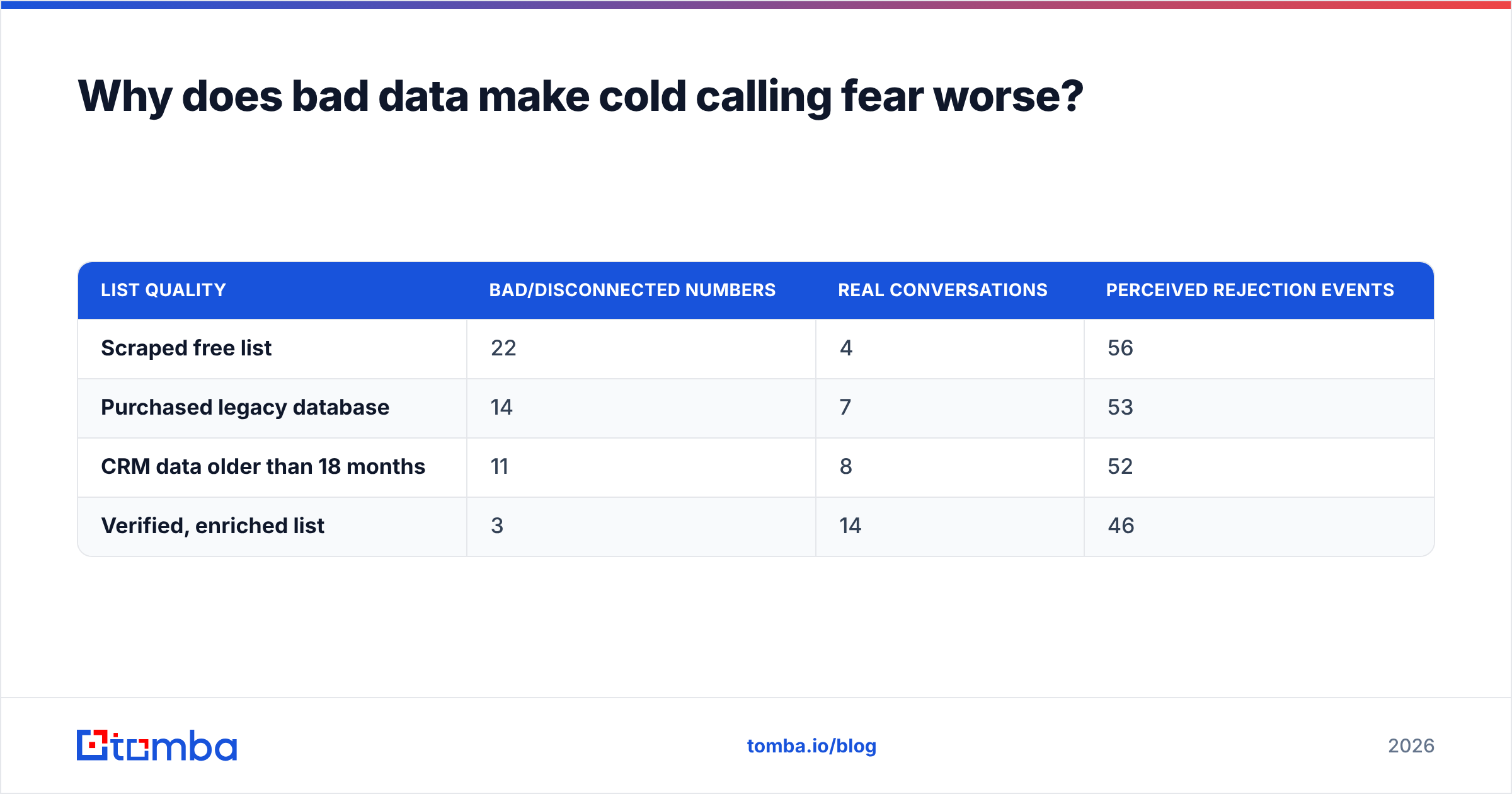
Because your brain doesn't distinguish between "this number is disconnected" and "this person rejected me." Both register as failure. If a third of your list is stale, you're manufacturing rejection that has nothing to do with your pitch.
Run the math on a typical 60-dial block:
| List quality | Bad/disconnected numbers | Real conversations | Perceived rejection events |
|---|---|---|---|
| Scraped free list | 22 | 4 | 56 |
| Purchased legacy database | 14 | 7 | 53 |
| CRM data older than 18 months | 11 | 8 | 52 |
| Verified, enriched list | 3 | 14 | 46 |
The last row doesn't just produce more conversations — it produces a fundamentally different emotional experience of the same hour. You dial, someone picks up, you have a human exchange. That's the loop that builds confidence. Dead air does the opposite.
This is the least glamorous fix in the guide and the highest leverage. Before you touch a script, make sure the contacts are real. Use a phone validator to strip disconnected and non-mobile lines from your queue, and pair each dial record with a verified email so a no-answer can convert into a same-day follow-up instead of a dead end. If you're building lists from scratch, domain search plus a phone finder pass gives you a queue you can trust.
How do you build an exposure ladder for cold calls?#
Exposure therapy is the evidence-backed treatment for phobic avoidance, and it maps cleanly onto sales calling. The rule: never start at the top of the ladder. Start at a rung where your anxiety is a 3/10, and only climb when the current rung is boring.
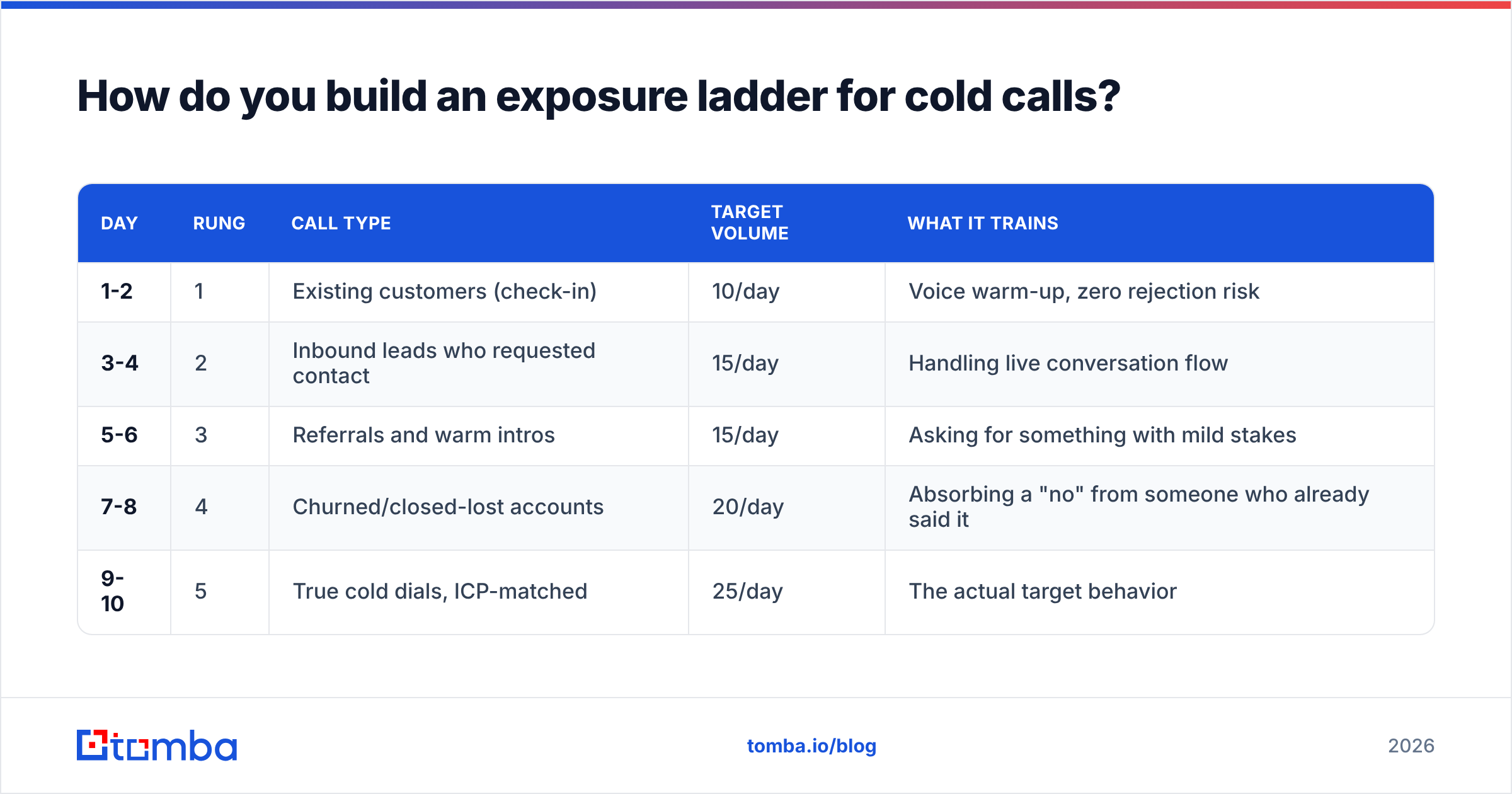
Here's a 10-day ladder that works for most reps:
| Day | Rung | Call type | Target volume | What it trains |
|---|---|---|---|---|
| 1-2 | 1 | Existing customers (check-in) | 10/day | Voice warm-up, zero rejection risk |
| 3-4 | 2 | Inbound leads who requested contact | 15/day | Handling live conversation flow |
| 5-6 | 3 | Referrals and warm intros | 15/day | Asking for something with mild stakes |
| 7-8 | 4 | Churned/closed-lost accounts | 20/day | Absorbing a "no" from someone who already said it |
| 9-10 | 5 | True cold dials, ICP-matched | 25/day | The actual target behavior |
Two rules make or break this:
- Do not skip rungs because you feel fine on a Tuesday. Confidence built on a good day evaporates on a bad one. Finish the rung.
- Do not measure outcomes on rungs 1-4. No meetings booked, no pipeline created. Only dials completed and conversations held.
By day 9 the physiological response is dramatically smaller, because your nervous system has 100+ data points showing that picking up the phone does not, in fact, result in catastrophe.
What should you say in the first nine seconds?#
Use a permission-based opener. It short-circuits the reflexive brush-off and — critically for anxious reps — gives the prospect an explicit exit, which lowers your stakes too.
The structure:
- Name + company, slowly. "Hi Sarah, it's Marcus from Tomba."
- Honest frame. "I'll be upfront — this is a cold call."
- Permission ask. "Can I have 30 seconds to tell you why I called, and then you can tell me to get lost?"
- Single-sentence reason. Tied to their role, not your product.
- Question, then shut up. Silence is your friend here; let them fill it.
The honesty line does disproportionate work. Prospects relax when you stop pretending you're returning their call, and reps relax because they're no longer maintaining a fiction. Most people who study high-performing outbound teams — including the practitioner research published by HubSpot and peer reviews aggregated on G2 — land on some version of the same principle: transparency beats manufactured familiarity.
For voicemail, three sentences, under 20 seconds:
"Sarah, Marcus at Tomba, 555-0142. I'm calling about how your SDR team is sourcing mobile numbers — we found something that might save your team a few hours a week. 555-0142, I'll try you again Thursday."
Name, reason, number twice, next step. No pitch. No "just circling back."
Is cold calling still worth the anxiety in 2026?#
Yes, for one measurable reason: fewer people are doing it, so the channel is less saturated than email. Inbox volume has exploded while dial volume per rep has fallen in many organizations. A conversation on the phone still carries more information per minute than any other outbound channel — you hear hesitation, priority, and budget signals that never make it into an email reply.
That said, the phone is not a standalone channel anymore. The teams with the best numbers run it as one leg of a sequence:
- Call first, email same day. The email references the call attempt, which lifts reply rates because the name is now familiar.
- LinkedIn view before the dial. A profile view an hour before the call creates weak familiarity that measurably improves pickup-to-conversation conversion.
- Voicemail + email pairing. Never leave a voicemail without a matching email inside 10 minutes. Same subject, same ask.
- Three touches, then park. Cycling a prospect indefinitely burns your morale more than theirs.
If you want to reduce the number of cold dials required for the same pipeline, improve targeting rather than volume. A tight ICP list of 200 verified contacts outperforms 2,000 loosely-matched ones on every metric that matters — including how you feel at 5pm.
How do you handle the rejection itself?#
Separate the person from the event. This sounds like a motivational-poster line, but there's a mechanical version of it that works.
The 30-second reset protocol:
- Write the outcome, not the feeling. In your CRM: "Not now — budget frozen until Q3." Not "brutal call."
- Stand up. Physically break the posture you were in during the call.
- Dial within 30 seconds. The single strongest predictor of continuing a call block is how fast the next dial happens after a bad one. Momentum is preserved in seconds, not minutes.
- Debrief at the end of the block, never during. Mid-block analysis is rumination with a spreadsheet.
Reframe the actual math. If your connect rate is 15% and your meeting rate off connects is 20%, you need roughly 33 dials per meeting. That means 32 non-meetings are not failures — they are the required inputs. A rep who books 3 meetings from 100 dials had a good day and heard "no" 97 times. Both statements are true.
Rejection is rarely about you. The person picking up is mid-task, mid-meeting, or mid-lunch. Their tone is about their calendar, not your worth. The response rate on any cold channel is a function of timing far more than persuasion.
What does a low-anxiety calling routine look like?#
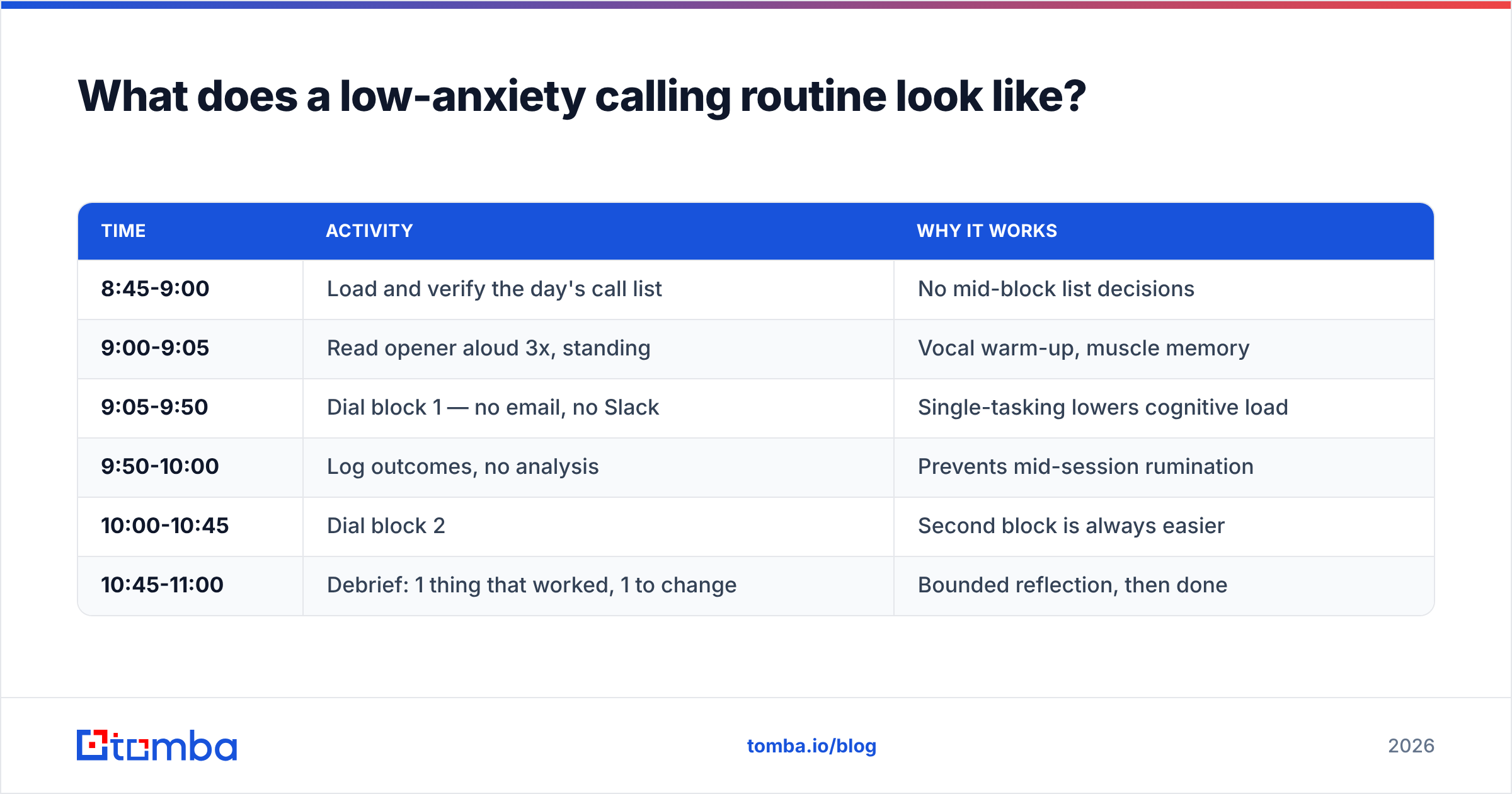
Structure removes decisions, and decisions are where avoidance lives. Here's a daily block that reps report as the least dreadful version of the activity:
| Time | Activity | Why it works |
|---|---|---|
| 8:45-9:00 | Load and verify the day's call list | No mid-block list decisions |
| 9:00-9:05 | Read opener aloud 3x, standing | Vocal warm-up, muscle memory |
| 9:05-9:50 | Dial block 1 — no email, no Slack | Single-tasking lowers cognitive load |
| 9:50-10:00 | Log outcomes, no analysis | Prevents mid-session rumination |
| 10:00-10:45 | Dial block 2 | Second block is always easier |
| 10:45-11:00 | Debrief: 1 thing that worked, 1 to change | Bounded reflection, then done |
Notes on execution:
- Stand while dialing. Voice projection and perceived confidence both improve; it's the cheapest intervention available.
- Call from a script you can see. Printed, not on the same screen as the dialer.
- Batch by persona, not by account size. Saying the same thing 25 times in a row builds fluency; switching personas every call resets you to beginner mode each time.
- Set a floor, not a ceiling. "25 dials minimum" beats "book 2 meetings" every time for anxiety management.
For the list-loading step, an email finder run against your target accounts the night before means you arrive at 8:45 with a queue instead of a research project. If you're working from a spreadsheet, the bulk email finder handles a few hundred contacts in one pass.
Which tools actually reduce call anxiety?#
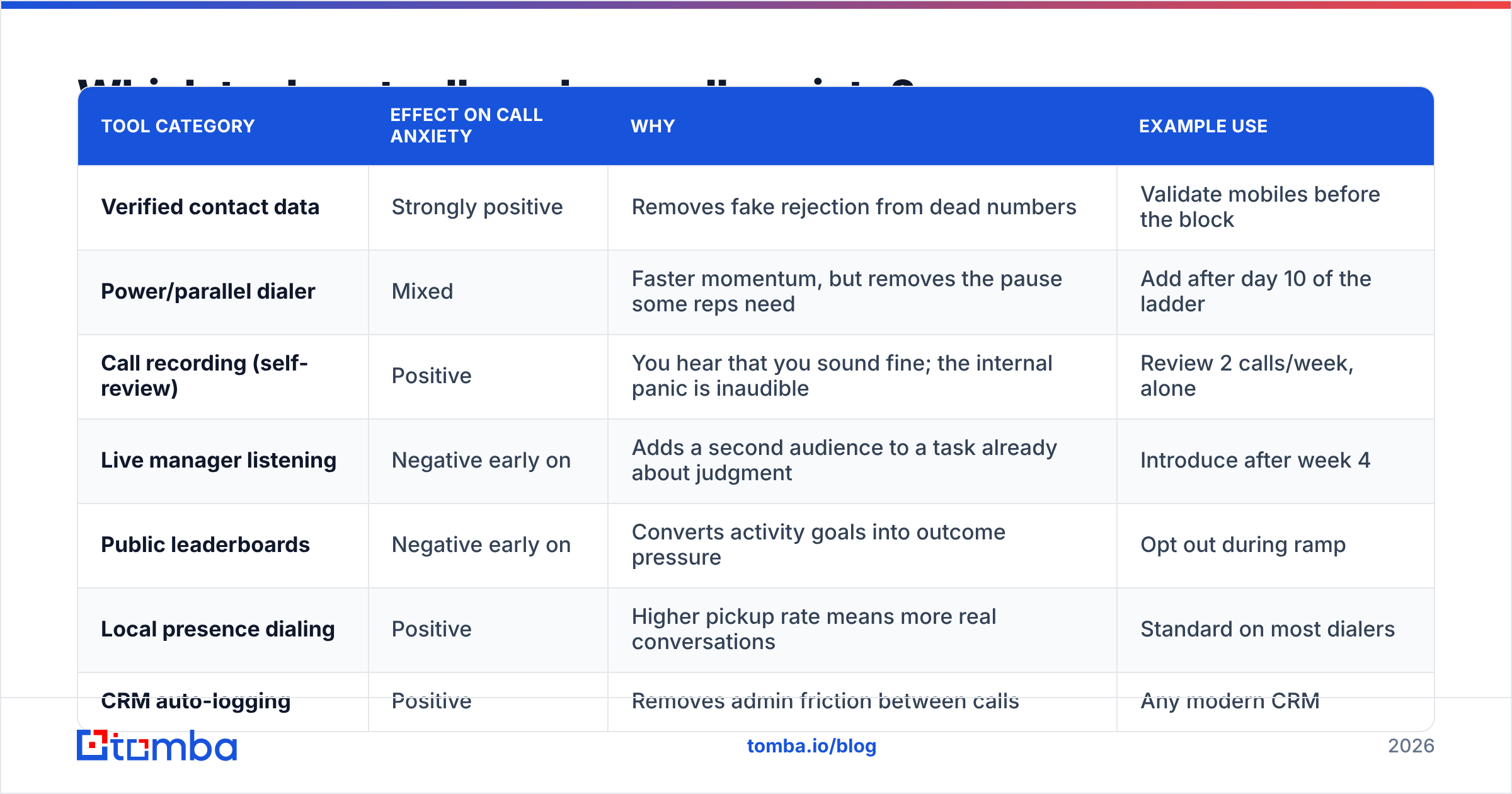
Not all sales tooling helps here. Tools that add pressure (public leaderboards, real-time manager listening) tend to worsen call reluctance in the early stages. Tools that remove friction and uncertainty help. Here's the honest breakdown:
| Tool category | Effect on call anxiety | Why | Example use |
|---|---|---|---|
| Verified contact data | Strongly positive | Removes fake rejection from dead numbers | Validate mobiles before the block |
| Power/parallel dialer | Mixed | Faster momentum, but removes the pause some reps need | Add after day 10 of the ladder |
| Call recording (self-review) | Positive | You hear that you sound fine; the internal panic is inaudible | Review 2 calls/week, alone |
| Live manager listening | Negative early on | Adds a second audience to a task already about judgment | Introduce after week 4 |
| Public leaderboards | Negative early on | Converts activity goals into outcome pressure | Opt out during ramp |
| Local presence dialing | Positive | Higher pickup rate means more real conversations | Standard on most dialers |
| CRM auto-logging | Positive | Removes admin friction between calls | Any modern CRM |
The self-review point deserves emphasis. Reps consistently rate their own recorded calls higher than they rated the live experience. What felt like a stammering disaster reads as normal conversational hesitation on playback. Two recordings a week is usually enough to recalibrate.
Peer research on sales tooling from analysts like Gartner consistently finds the same pattern: adoption improves when tools reduce rep effort per task, and stalls when tools primarily serve manager visibility. Choose accordingly during ramp.
How long until cold calling stops feeling awful?#
Roughly 300 dials for most reps — about three weeks at 25 dials a day. That's not a promise of enjoyment; it's the point where the anticipatory dread drops below the threshold that triggers avoidance.
Markers along the way:
- Dial 50: Physical symptoms (heart rate, dry mouth) noticeably reduced at the start of a block.
- Dial 150: You stop rehearsing the opener in your head. It's automatic.
- Dial 300: A hostile call no longer ends your block. You dial the next one within 30 seconds without thinking about it.
- Dial 500: You start improvising off-script correctly, because you have enough pattern recognition to know what a given objection actually means.
If you're past 300 dials and the dread hasn't moved, the problem is almost certainly upstream: your list isn't ICP-matched, your offer isn't landing with the persona you're calling, or your quota structure is punishing activity rather than rewarding it. Fix the input, not your willpower.
One last note on comparison. It's tempting to benchmark yourself against the loudest rep on the floor. Don't. Connect rates vary enormously by industry, seniority of target, and region — a rep calling SMB owners and a rep calling enterprise CISOs are doing different jobs with the same job title. Compare your week-4 numbers to your own week-1 numbers.
Start with a list you can trust#
The single change that makes the biggest dent in call reluctance is dialing numbers that actually connect to the person you meant to reach. Everything else — scripts, ladders, resets — works better on top of clean data.
Start free with the Tomba Email Finder at 25 searches a month, or move to the Starter plan at $49/mo when you're building lists at volume. Growth is $99/mo and Pro is $249/mo, with enterprise pricing available for larger teams; full Tomba pricing is on the site. Pair the finder with the phone finder so every account in your call block has both a verified email and a working direct line — and you spend your call time talking to people instead of listening to disconnect tones.
Related guides#
// get started
Find, verify and enrich your first contacts today
Start on the free plan with 25 searches a month, then scale when your team is ready.
Free plan · No credit card required · GDPR & CCPA
// about the author