How To Overcome Objections In Sales: A 2026 Playbook
Most objections are not rejections — they are missing information, bad timing, or the wrong person on the call. Here is a repeatable framework, scripts, and a comparison of the four objection types that kill B2B deals.
TL;DR
- Most "objections" are not objections. They are reflexes ("send me info"), missing information ("what does this cost?"), or a signal you reached the wrong person entirely.
- Use a five-step loop on every one: pause, clarify, isolate, reframe with evidence, confirm. Skipping the clarify step is the single most common rep error.
- The four objection families — price, timing, authority, and status quo — each need a different response. Treating them all as "price" loses deals.
- Roughly a third of "not interested" replies in cold outbound are data problems, not messaging problems. Verify your list before you rebuild your pitch.
- Practice with recorded calls and a written objection bank. Improvisation on the fifth objection of the day is how discounts get given away.
What is a sales objection, really?#
A sales objection is a stated reason not to move forward. That is the textbook definition, and it is misleading, because the stated reason and the real reason match maybe half the time.
Think of it like a check-engine light. The light says "engine." The actual problem might be a loose gas cap. If you respond to the light instead of diagnosing the cause, you replace parts that were never broken — which is exactly what a rep does when they answer "it's too expensive" with a discount, when the real issue was that the buyer never understood what they were paying for.
So the working definition is better: an objection is the buyer telling you where your case is incomplete. It is information. Reps who treat it as conflict get defensive, talk faster, and lose. Reps who treat it as a request for evidence slow down and win more.
There is also a distinction worth drawing early:
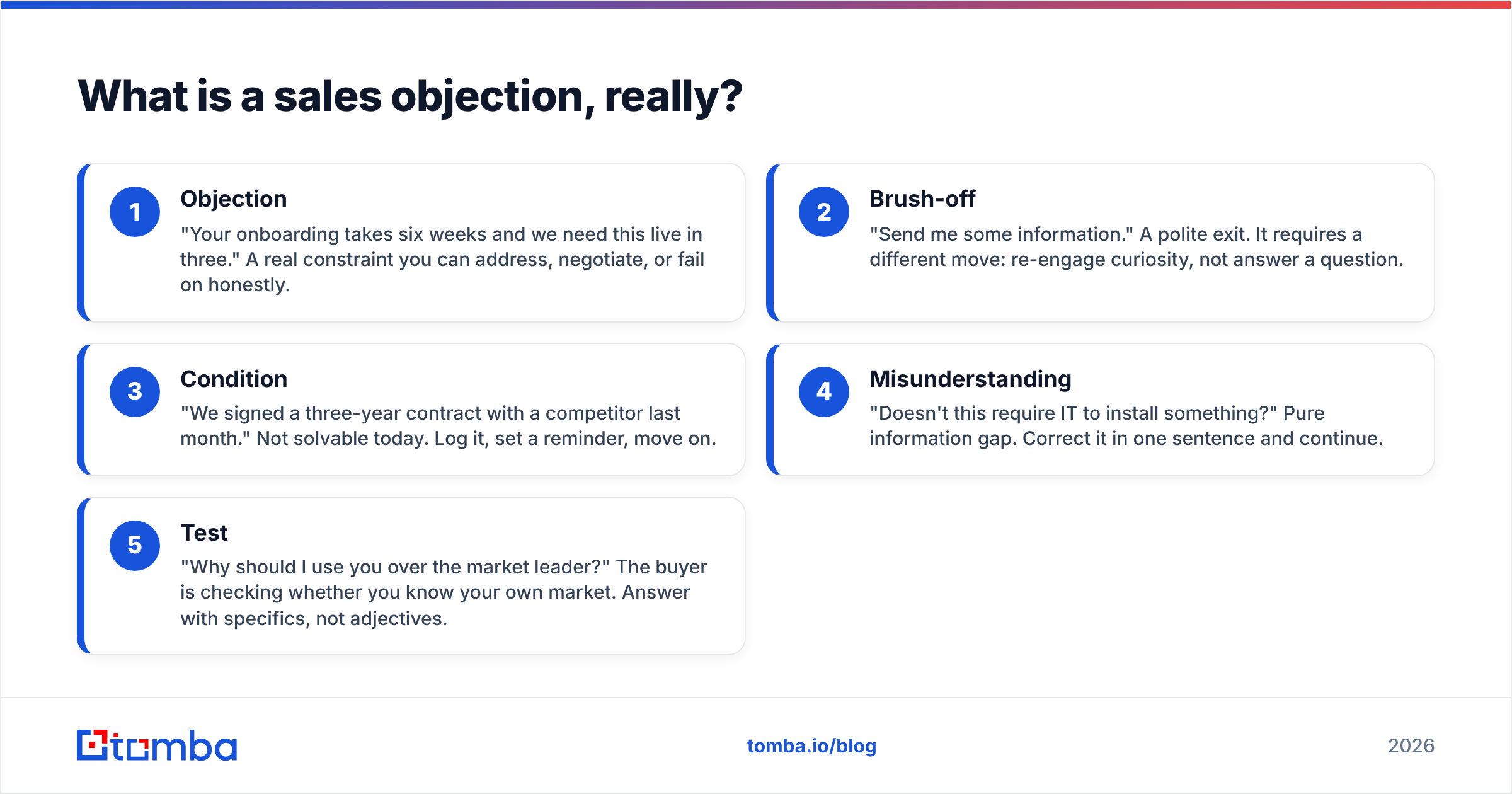
- Objection — "Your onboarding takes six weeks and we need this live in three." A real constraint you can address, negotiate, or fail on honestly.
- Brush-off — "Send me some information." A polite exit. It requires a different move: re-engage curiosity, not answer a question.
- Condition — "We signed a three-year contract with a competitor last month." Not solvable today. Log it, set a reminder, move on.
- Misunderstanding — "Doesn't this require IT to install something?" Pure information gap. Correct it in one sentence and continue.
- Test — "Why should I use you over the market leader?" The buyer is checking whether you know your own market. Answer with specifics, not adjectives.
Misclassifying a condition as an objection wastes the back half of your quarter. Misclassifying a brush-off as genuine interest fills your pipeline with ghosts.
Why do most objection-handling scripts fail?#
Because they optimize for the rebuttal and ignore the diagnosis.
Open any sales-training PDF and you will find a table: objection on the left, canned response on the right. "Too expensive" → "Compared to what?" That line works occasionally. It fails often, because it assumes you already know why the buyer said the word "expensive."
There are at least four distinct meanings behind that one sentence:
- I don't have the budget at all this year.
- I have budget, but not authority to spend it without a business case.
- I have budget and authority, but I don't believe the ROI number you just quoted.
- I have all three, and I'm negotiating because you sounded eager.
Each meaning has a different correct response. Discounting is the right answer to exactly zero of them.
The second reason scripts fail is emotional. Under pressure, most reps do one of two things — they either concede immediately or they argue. Research on buyer-seller interaction from Gartner has consistently found that buyers who feel pushed toward a specific outcome report lower purchase confidence, and low purchase confidence correlates strongly with deals that stall rather than deals that are lost outright. A stalled deal is worse than a lost one; it eats forecast accuracy for two quarters.
How do you overcome objections in sales, step by step?#
Here is the loop. Five steps, in order, every time. It takes 45 to 90 seconds when done well.
Step 1 — Pause. Two full seconds of silence after the objection lands. This does more work than any phrase in this article. It signals you are not running a script, and buyers frequently fill the silence with the real reason.
Step 2 — Clarify. One question, and it must be open. "When you say the timing isn't right, what's driving that?" Not "Is it because of budget?" — closed questions let the buyer take the easy exit.
Step 3 — Isolate. Confirm this is the only thing standing between you and a next step. "If we solved the integration piece, is there anything else that would stop this from moving forward?" This is the highest-leverage sentence in B2B sales. It converts a vague fog of hesitation into a finite list you can work.
Step 4 — Reframe with evidence. Now you respond — with a customer example, a number, a doc link, a trial. Not with an opinion. "Three other companies your size were worried about the same thing; here's what their first 30 days looked like."
Step 5 — Confirm and advance. "Does that address it?" Then propose the specific next step with a date on it. An objection handled without a scheduled next step is a conversation, not progress.
The order matters. Reps who jump from step 1 to step 4 — pause, then rebut — answer the wrong question about 40% of the time by their own call-review admission.
Which objection types matter most, and how do they differ?#
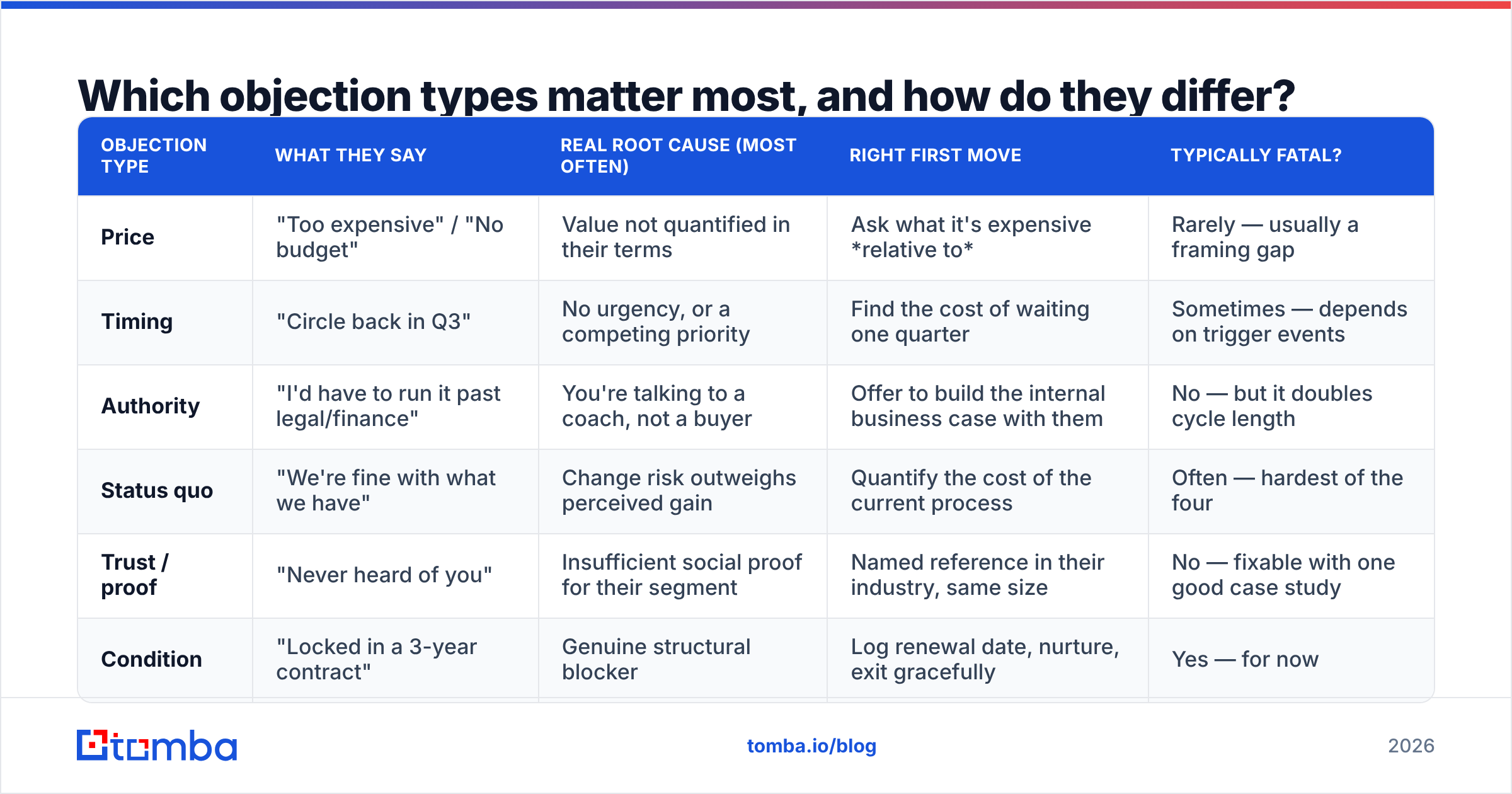
Four families cover the overwhelming majority of B2B pushback. Here is how they differ in root cause, correct response, and how often they are genuinely fatal.
| Objection type | What they say | Real root cause (most often) | Right first move | Typically fatal? |
|---|---|---|---|---|
| Price | "Too expensive" / "No budget" | Value not quantified in their terms | Ask what it's expensive relative to | Rarely — usually a framing gap |
| Timing | "Circle back in Q3" | No urgency, or a competing priority | Find the cost of waiting one quarter | Sometimes — depends on trigger events |
| Authority | "I'd have to run it past legal/finance" | You're talking to a coach, not a buyer | Offer to build the internal business case with them | No — but it doubles cycle length |
| Status quo | "We're fine with what we have" | Change risk outweighs perceived gain | Quantify the cost of the current process | Often — hardest of the four |
| Trust / proof | "Never heard of you" | Insufficient social proof for their segment | Named reference in their industry, same size | No — fixable with one good case study |
| Condition | "Locked in a 3-year contract" | Genuine structural blocker | Log renewal date, nurture, exit gracefully | Yes — for now |
Notice that status quo is the dangerous one, not price. Reps obsess over price because it is loud and concrete. Status quo bias is quiet — it shows up as "we'll revisit next year" and never as a hard no. Your CRM records it as an open opportunity for eleven months.
The scripts that hold up#
For price: "Help me understand — expensive compared to another vendor, or compared to doing nothing? Those are two different conversations and I want to have the right one."
For timing: "Totally fair. Just so I plan around it — what happens between now and Q3 that changes things? If the answer is 'nothing specific,' it might be worth looking at what waiting a quarter actually costs."
For authority: "Makes sense. Most people in your seat need finance to sign off. Rather than throwing a PDF over the wall, want me to put together the numbers in the format your finance team usually asks for?"
For status quo: "I'm not going to argue that what you have is broken. I'd rather ask — what's the one thing your current setup makes harder than it should be?"
None of these are clever. They are all just questions that buy you the actual information. Clever loses; specific wins.
Is your objection problem actually a data problem?#
This is the section most objection-handling articles skip, and it is the one that moves numbers fastest.
If you are running outbound and hearing "I'm not the right person," "we don't do that here," or "how did you get this address?" — those are not objections. Those are symptoms of a bad list. No script fixes a wrong contact.
Run the diagnostic before you invest in training:
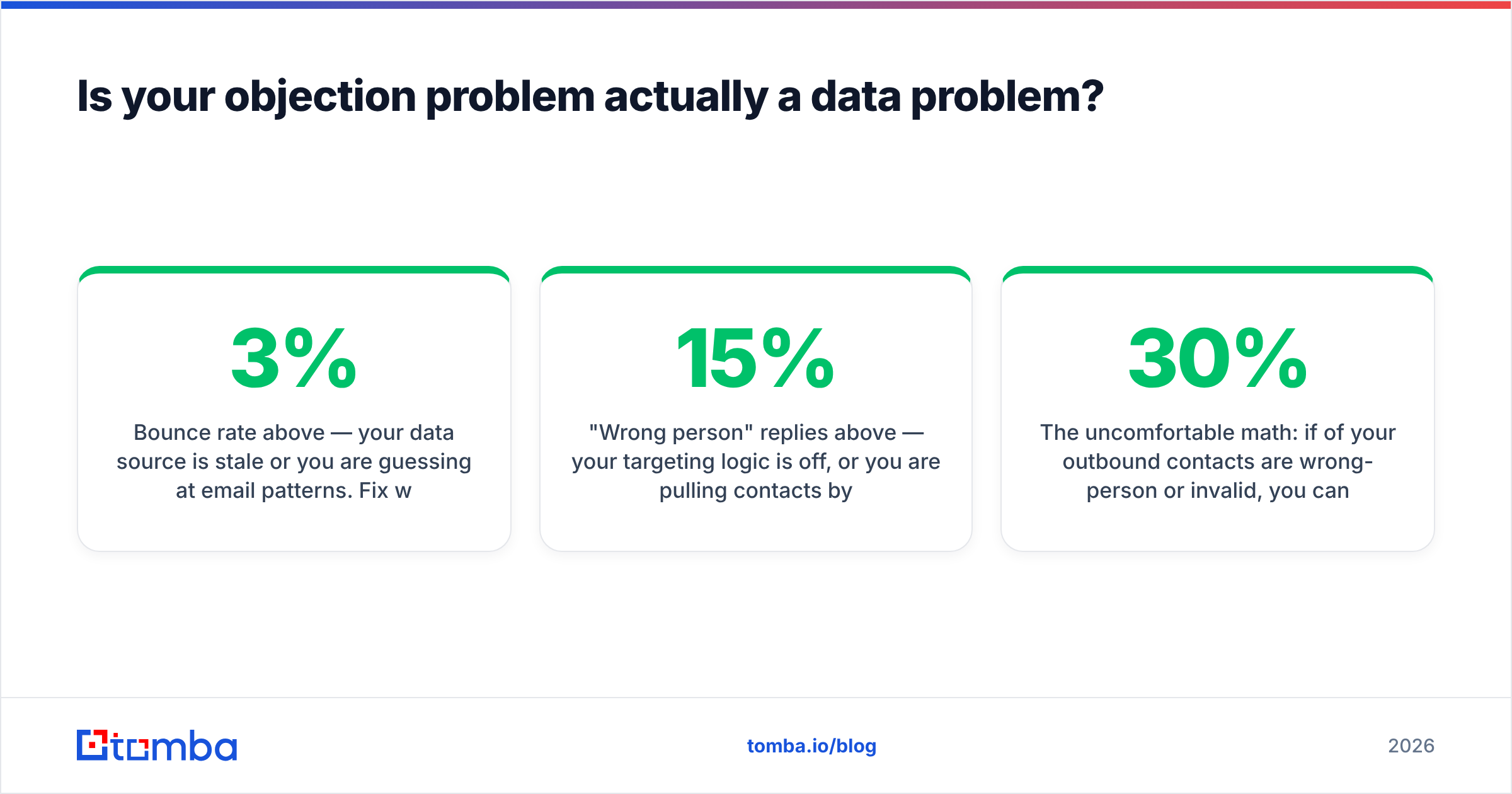
- Bounce rate above 3% — your data source is stale or you are guessing at email patterns. Fix with an email verifier pass before every send.
- "Wrong person" replies above 15% — your targeting logic is off, or you are pulling contacts by company without filtering by role.
- Silence, not objections — if nobody replies at all, you don't have an objection-handling problem. You have a deliverability or relevance problem. Check your email deliverability fundamentals first.
- Objections that contradict your research — "we already use a tool for that" when your notes said otherwise means your enrichment data is out of date. A data enrichment refresh on the account fixes more of these than any rebuttal.
The uncomfortable math: if 30% of your outbound contacts are wrong-person or invalid, you can improve your objection handling by 20% and still see flat results. Clean the input first. It is cheaper and faster than retraining a team.
This is also where the "authority" objection often originates. You reached a manager because the manager's email was easy to guess, not because the manager owns the budget. Building your list role-first — VP of RevOps, not "anyone at Acme" — removes the objection before it is spoken. A domain search that returns roles and departments alongside addresses lets you target the actual decision-maker rather than whoever surfaces first.
How do you practice objection handling without burning real deals?#
Live calls are a terrible place to learn. Here is the cheaper loop.
Build a written objection bank. Every rep contributes the exact wording of every objection they heard this week. Real phrasing, not paraphrase. After a month you will have 30 to 50 entries, and you will notice that 8 of them account for 80% of the volume. Those 8 get scripted responses. The rest get judgment.
Record and review. Pick one call per rep per week. Listen only to the 90 seconds after each objection. Three questions: Did they pause? Did they ask a clarifying question before responding? Did they isolate? Most teams score under 30% on the second question when they first measure it.
Run reverse role-play. The manager plays the rep and deliberately handles it badly. The rep's job is to identify what went wrong. This teaches diagnosis faster than making reps perform under observation, which mostly teaches performance anxiety.
Score the outcome, not the delivery. The metric is not "did that sound smooth." It is "did the next step get scheduled with a date." Everything else is theater. Tracking this alongside your win rate by objection type tells you which family your team is actually losing to.
For structured frameworks on discovery questioning — which feeds directly into fewer objections downstream — HubSpot's sales research library and peer reviews on G2 are both reasonable free starting points before you buy a training program.
What does an objection-free pipeline actually look like?#
It does not exist, and chasing it is a mistake. A pipeline with zero objections means one of two things: your reps are only talking to people who were going to buy anyway, or your buyers are too disengaged to push back. Both are worse than friction.
What good looks like:
- Objections arrive early — in discovery, not at contract stage. Late objections mean your qualification is weak.
- The same eight objections recur, and your team has evidence-backed responses for all eight.
- Status quo objections are surfaced explicitly and either resolved or disqualified within two calls, instead of parked as "nurture."
- Price conversations happen after value has been quantified, not before.
- Zero objections trace back to bad contact data — because the list was verified before the sequence started.
That last bullet is the only one you can fix this week without changing how anyone sells.
Where should you start?#
Pick the cheapest fix with the largest surface area. For most B2B teams in 2026, that is not a training vendor — it is the input list.
Start by pulling a random sample of 200 contacts from your current outbound queue and checking three things: does the address resolve, does the title match your ICP, and is the company still in your target segment. If more than a fifth fail, your objection problem is a sourcing problem wearing a costume.
Then fix the loop: pause, clarify, isolate, reframe, confirm. Drill it in role-play until the pause stops feeling awkward. It will take about two weeks.
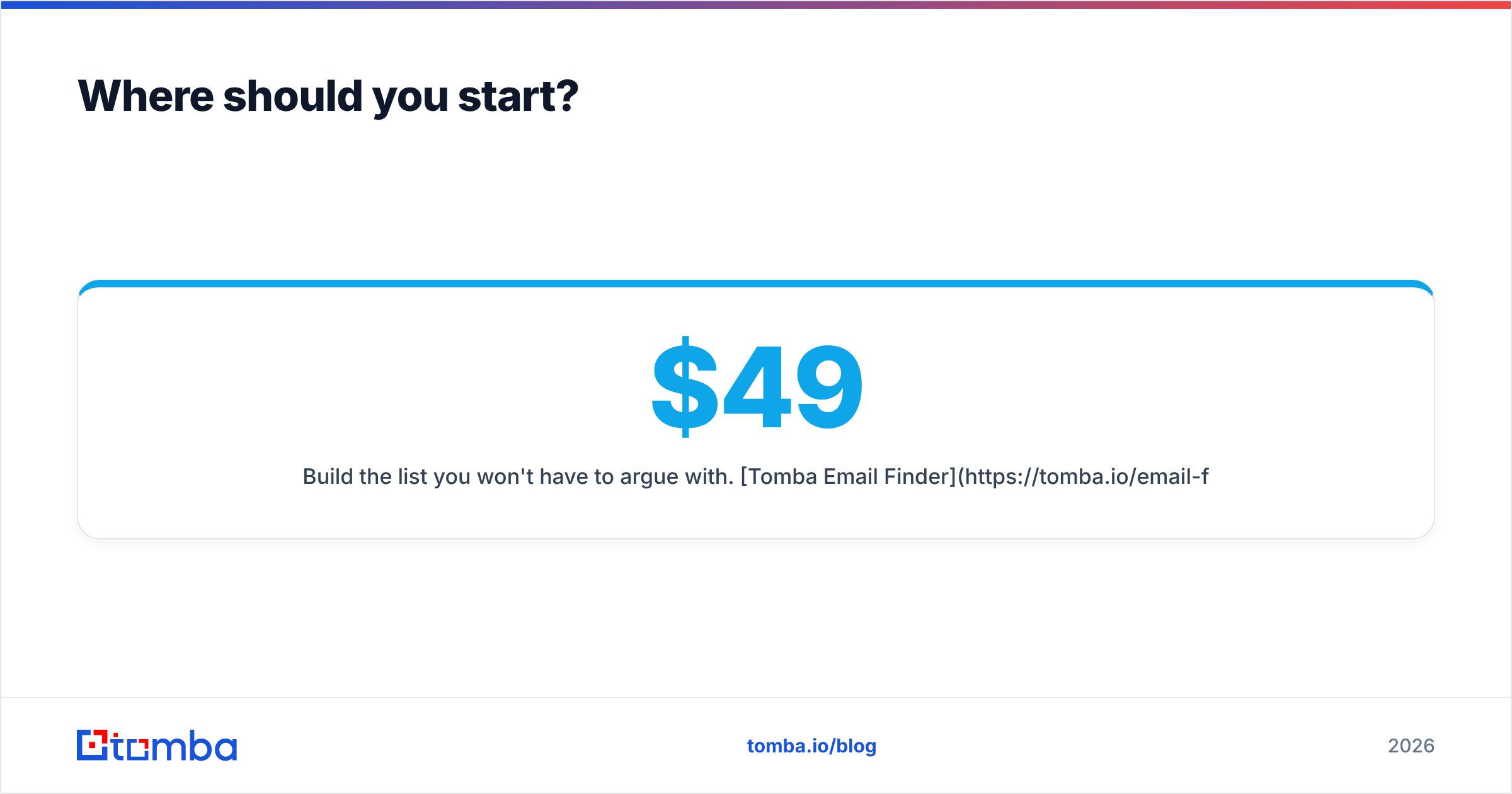
Build the list you won't have to argue with. Tomba Email Finder finds verified professional addresses by domain, name, or company, so your reps spend their objection-handling energy on real decision-makers instead of bounced sends and wrong-department replies. Start free with 25 searches a month, or check Tomba pricing — Starter runs $49/mo, Growth $99/mo, and Pro $249/mo with bulk and API access for teams running outbound at volume.
Related guides#
Ready to find emails that actually work?
Join 150,000+ professionals who stopped guessing and started sending. Free credits on signup — no credit card required.
Get the Tomba newsletter
Practical outbound tactics and product updates — once every two weeks.
About the author