How to Overcome Price Objections in B2B Sales (2026 Guide)
Most price objections are not about price. Here are the seven objections buyers actually raise, the scripts that work on each, and the discovery habits that stop them from showing up at all.
TL;DR
- "It's too expensive" is almost never a price problem. It's a value, budget, timing, authority, or trust problem wearing a price costume — and each one needs a different response.
- Never negotiate against an objection you haven't diagnosed. Ask one clarifying question before you defend a number. Reps who do this close materially more deals than reps who jump straight to a discount.
- Discounting to save a deal trains the buyer to expect discounts forever and drags your average contract value down across the whole pipeline.
- The strongest defense against price objections happens in discovery, before pricing is ever mentioned: quantify the cost of the status quo in the buyer's own numbers.
- Bad contact data inflates your objection rate. If you're pitching the wrong person at the wrong company, "too expensive" is often just a polite exit.
Why do buyers say "it's too expensive"?#
Because it's the safest sentence in B2B buying.
Think of it like a guest declining a dinner invitation with "I'm busy that night." Sometimes it's true. Usually it's a socially acceptable wrapper around something more awkward: they don't want to go, they don't like the other guests, or they aren't sure they can commit. Price works the same way. It's the one objection a buyer can raise without insulting you, admitting they lack authority, or confessing they don't fully understand what you sell.
So when you hear it, you're not hearing a data point. You're hearing a door that's been left slightly ajar.
The mechanical version: price is a ratio, not a number. Buyers compare cost against perceived value, and they compare that ratio against alternatives — including the alternative of doing nothing. A $99/month tool is "expensive" when the buyer sees $50/month of value. A $50,000 platform is "cheap" when it visibly recovers $400,000 in lost pipeline. Nobody in your pipeline has an objection to your price in isolation. They have an objection to your price relative to something, and your job is to find out what that something is.
What are the 7 types of price objections?#
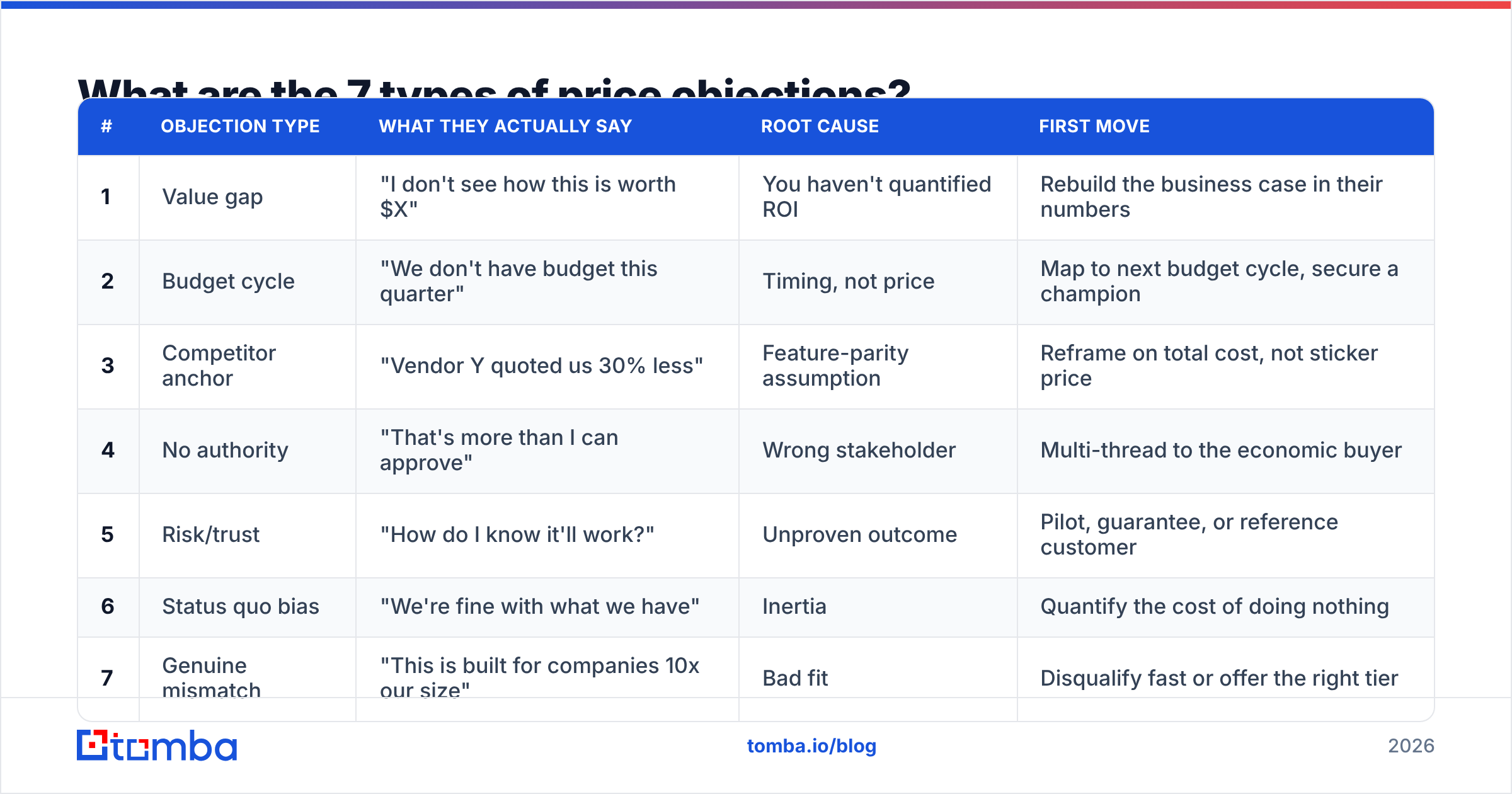
Diagnose before you prescribe. These seven cover nearly every "too expensive" you will hear, and each has a distinct tell and a distinct fix.
| # | Objection type | What they actually say | Root cause | First move |
|---|---|---|---|---|
| 1 | Value gap | "I don't see how this is worth $X" | You haven't quantified ROI | Rebuild the business case in their numbers |
| 2 | Budget cycle | "We don't have budget this quarter" | Timing, not price | Map to next budget cycle, secure a champion |
| 3 | Competitor anchor | "Vendor Y quoted us 30% less" | Feature-parity assumption | Reframe on total cost, not sticker price |
| 4 | No authority | "That's more than I can approve" | Wrong stakeholder | Multi-thread to the economic buyer |
| 5 | Risk/trust | "How do I know it'll work?" | Unproven outcome | Pilot, guarantee, or reference customer |
| 6 | Status quo bias | "We're fine with what we have" | Inertia | Quantify the cost of doing nothing |
| 7 | Genuine mismatch | "This is built for companies 10x our size" | Bad fit | Disqualify fast or offer the right tier |
Notice how few of these are solved by lowering the price. Exactly one — number seven — and even there the answer is a different package, not a discount on the wrong one.
Most reps treat all seven identically. They hear "expensive," reach for the discount lever, and hand over margin to fix a problem that wasn't about money. That's how a healthy sales pipeline quietly turns into a discount pipeline.
How do you diagnose the real objection in under 60 seconds?#
Ask, then shut up.
The single highest-leverage habit in objection handling is inserting one question between the objection and your response. Not a rebuttal. A question. Here are five that work, ranked by how much they reveal:
- "Too expensive compared to what?" — Flushes out whether they're comparing you to a competitor, an internal build, or nothing at all. If the answer is "compared to nothing," you have a value gap, not a pricing problem.
- "Is it the total number, or how it's structured?" — Separates a real budget ceiling from a cash-flow or procurement issue. Payment terms fix the second one for free.
- "If price weren't a factor, would you move forward this quarter?" — The cleanest disqualifier in sales. A "no" means price was never the blocker and you just saved yourself three weeks.
- "What number were you expecting?" — Reveals their anchor. If they're 10% off, you have a deal. If they're 70% off, you have a fit problem.
- "Who else needs to sign off on a number like this?" — Turns a price objection into a stakeholder map. Often the "objection" is just a person relaying a limit they didn't set.
Then stay silent. The pause after a diagnostic question is where the actual objection surfaces. Reps who fill that silence with justification talk themselves into a discount before the buyer has even asked for one.
What do you actually say? Seven scripts#
Scripts aren't for reciting. They're for having a shape in your head when your pulse is up.
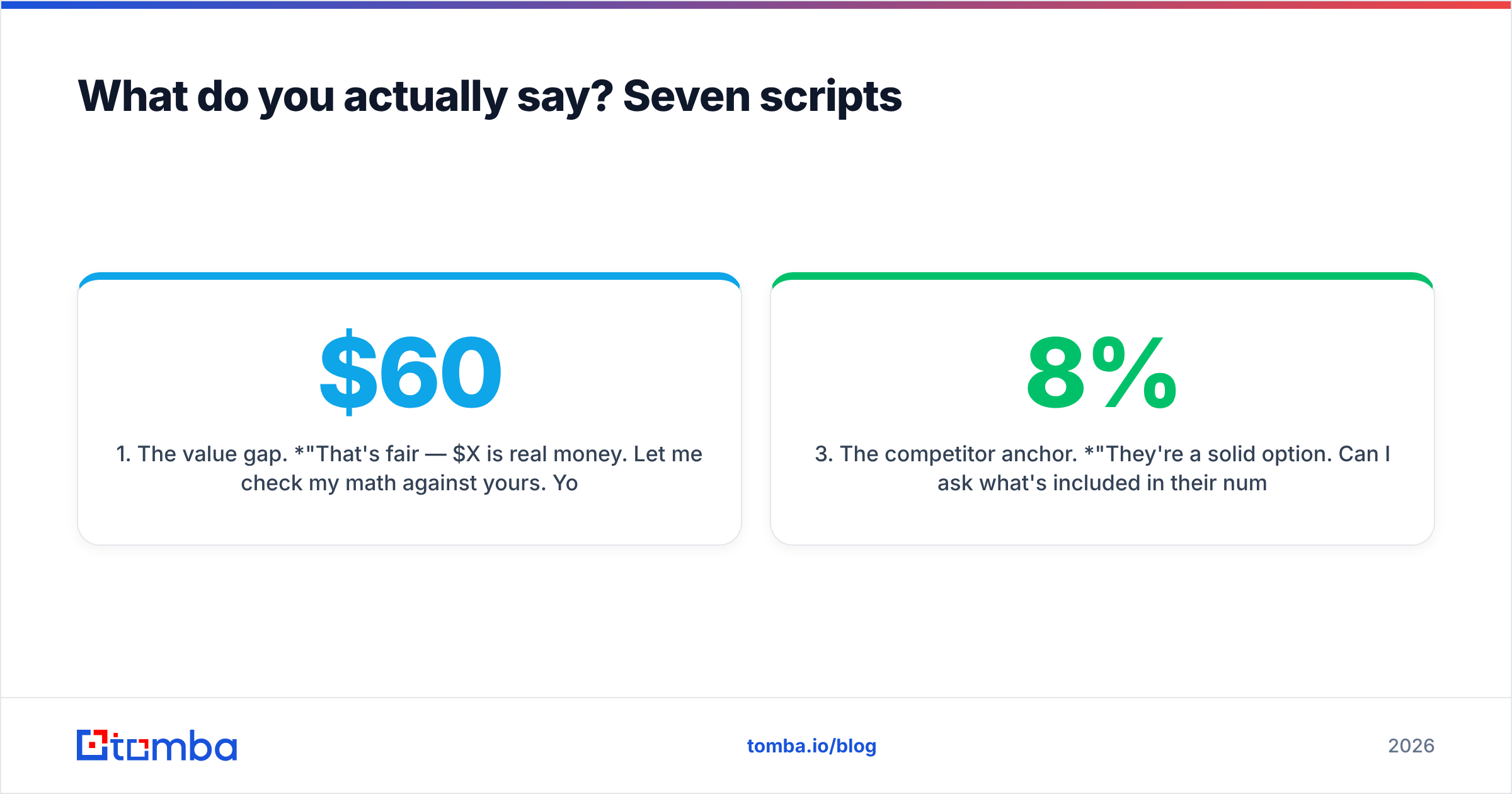
1. The value gap. "That's fair — $X is real money. Let me check my math against yours. You said you're losing about 12 hours a week to manual list building. At a loaded rate of $60 an hour, that's $37,000 a year. Does that number look right to you?" Make them correct your arithmetic. The moment they say "actually it's closer to 15 hours," they've started building your business case for you.
2. The budget cycle. "Understood — sounds like this is a timing question rather than a value question. When does the next budget cycle open? And what would need to be true for this to be in it?" Then get a calendar commitment, not a "check back in Q3."
3. The competitor anchor. "They're a solid option. Can I ask what's included in their number? Most of the quotes I see there exclude onboarding and cap API calls — which usually means the year-one total lands within about 8% of ours. Want me to build both out side by side?" Never disparage the competitor. Just widen the frame from price to total cost of ownership.
4. No authority. "That makes sense — a number like this usually needs a second signature. Who owns that budget? I'd rather build the case with you than have you carry my pitch into a room I'm not in." This reframes multi-threading as helping them, not going over their head.
5. Risk and trust. "So the question isn't really price, it's whether it works. What would you need to see in 30 days to know this was a good decision?" Then design a paid pilot with an explicit success metric. Free trials attract tourists; paid pilots attract buyers.
6. Status quo bias. "Totally reasonable. What's the current process costing you — not in dollars, in missed follow-ups and stale records?" Inertia only breaks when doing nothing gets a price tag.
7. Genuine mismatch. "Honestly? I don't think our Pro tier is right for a team of four. Our Starter plan covers what you described. If you outgrow it, we'll talk." Losing a deal you shouldn't have won is a win. It protects your win rate, your churn numbers, and your reputation.
Should you ever discount?#
Yes — but never for free, and never as a reflex.
Every discount you grant without a trade is a permanent reset of what that account believes your product is worth. Renewals get benchmarked against the discounted number, not the list price. Research from firms like Gartner has consistently shown that B2B buying groups now include six to ten stakeholders, which means your discounted number gets circulated internally and becomes the reference price for every future conversation with that company.
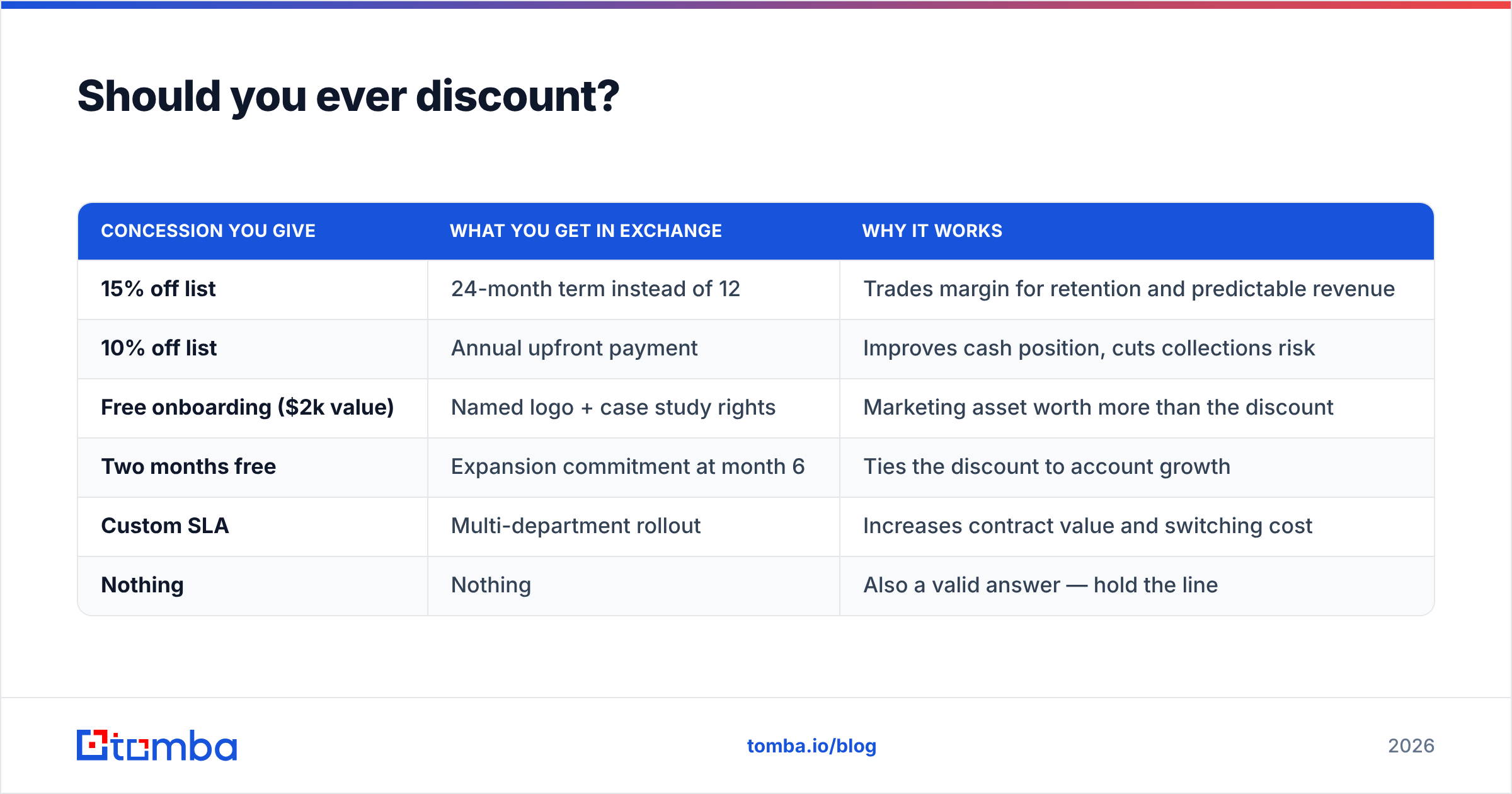
If you're going to move on price, extract something structural in return:
| Concession you give | What you get in exchange | Why it works |
|---|---|---|
| 15% off list | 24-month term instead of 12 | Trades margin for retention and predictable revenue |
| 10% off list | Annual upfront payment | Improves cash position, cuts collections risk |
| Free onboarding ($2k value) | Named logo + case study rights | Marketing asset worth more than the discount |
| Two months free | Expansion commitment at month 6 | Ties the discount to account growth |
| Custom SLA | Multi-department rollout | Increases contract value and switching cost |
| Nothing | Nothing | Also a valid answer — hold the line |
The last row matters most. "Our pricing reflects what the product delivers, and I'd rather show you that than discount it" is a complete sentence. Buyers respect it more often than reps expect.
How do you prevent price objections before they happen?#
Front-load the value conversation so the price lands on a foundation instead of in a vacuum.
- Quantify the problem in discovery, not in the pitch. Get the buyer to state a dollar figure for their current pain before you state one for your solution. Whoever names a number first sets the frame — make it them.
- Price late, but never surprise late. Give a range early ("teams like yours typically land between $X and $Y") so the final quote confirms an expectation rather than creating a shock.
- Sell to the economic buyer from call one. Most price objections are really authority objections. If your champion can't approve the number, you're rehearsing a pitch that someone else has to deliver badly.
- Tie the price to a metric they already report on. Cost per qualified meeting, pipeline coverage ratio, response rate — anchoring to a metric on their dashboard makes the spend feel operational rather than discretionary.
- Qualify harder at the top. Every unqualified prospect who reaches your pricing slide is a future "too expensive."
That last point is where data quality quietly determines your objection rate. If your outbound list is stuffed with wrong-fit companies, junior titles, and stale contacts, you'll spend your week getting price objections that are really fit objections. Clean firmographics and verified decision-maker contacts mean the people hearing your number are people the number was designed for. Tools that combine data enrichment with verified contact discovery — Tomba, BookYourData, and similar providers all play in this space — cut the volume of conversations that were never going to close on any price.
How do sales methodologies handle price objections differently?#
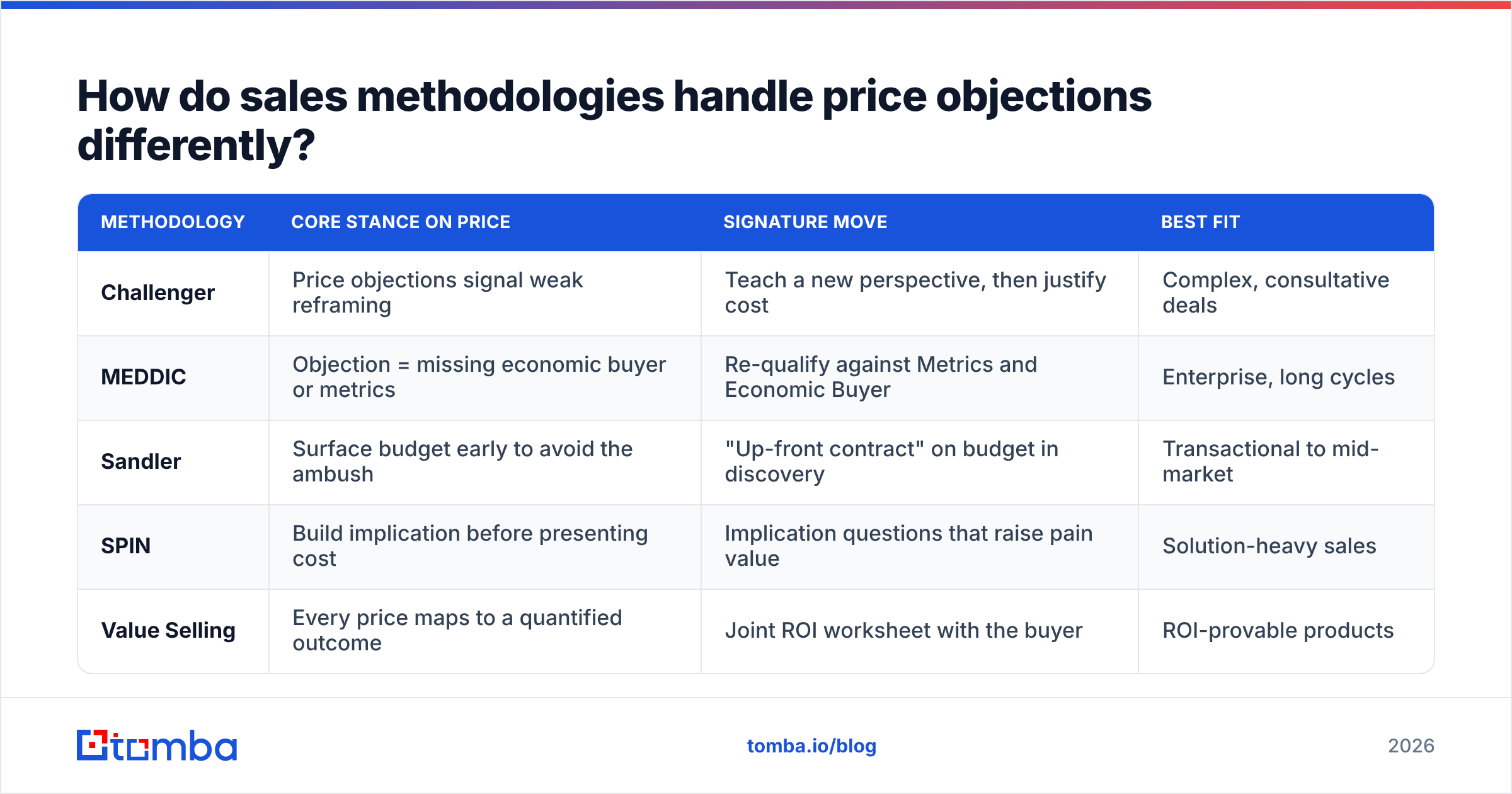
Every major framework has a position on this, and they mostly agree on the diagnosis while differing on the choreography.
| Methodology | Core stance on price | Signature move | Best fit |
|---|---|---|---|
| Challenger | Price objections signal weak reframing | Teach a new perspective, then justify cost | Complex, consultative deals |
| MEDDIC | Objection = missing economic buyer or metrics | Re-qualify against Metrics and Economic Buyer | Enterprise, long cycles |
| Sandler | Surface budget early to avoid the ambush | "Up-front contract" on budget in discovery | Transactional to mid-market |
| SPIN | Build implication before presenting cost | Implication questions that raise pain value | Solution-heavy sales |
| Value Selling | Every price maps to a quantified outcome | Joint ROI worksheet with the buyer | ROI-provable products |
The through-line: not one of them recommends discounting as a first response. All five treat "too expensive" as a diagnostic signal that something upstream — qualification, discovery, or stakeholder mapping — was incomplete. HubSpot's sales research reaches a similar conclusion, and reviews aggregated on G2 show the same pattern in how buyers describe vendor conversations that went well versus badly.
What does a strong objection-handling process look like on a team?#
Individual scripts don't scale. Process does.
Build a shared objection library. Every rep logs the exact wording of price objections they hear, the response they gave, and whether the deal advanced. After 90 days you'll have a ranked list of what actually works in your market, in your buyers' language — worth more than any generic playbook.
Run objection drills in pipeline reviews. Not a discussion of the deal, a live role-play of the next call. Ten minutes a week. Reps who have said the words out loud before the call don't freeze on the call.
Track your discount rate as a leading indicator. If average discount depth is climbing quarter over quarter, the problem isn't your reps' negotiation skill — it's that unqualified deals are reaching late stages. Fix that at the top of the funnel, where a good email finder and disciplined email verification keep your outreach pointed at accounts that can actually buy. Compare the total cost of that hygiene against one lost deal and it stops looking like a line item.
Finally, separate "lost on price" from "lost on value" in your CRM. Most teams log both as price. When you split them, you usually find that genuine price losses are a small minority — and that the rest were losses you could have prevented three weeks earlier with a better discovery call.
Start with better prospects, not better discounts#
The cheapest way to overcome price objections is to have fewer of them, and that starts with who you're talking to. When your outreach lands with the right decision-maker at a company that has the budget and the pain, "too expensive" gets rare fast.
Tomba's Email Finder gets you verified, decision-maker-level contacts by domain, name, or company, so your pitch reaches people the price was built for. The free tier includes 25 searches a month, and paid plans start at $49/mo with Growth at $99/mo — check the Tomba pricing page for full details. Start with the free tier, clean up one target account list, and see how many "too expensive" replies disappear when you're talking to the right person.
Related guides#
// get started
Find, verify and enrich your first contacts today
Start on the free plan with 25 searches a month, then scale when your team is ready.
Free plan · No credit card required · GDPR & CCPA
Get the Tomba newsletter
Product and data updates
// about the author