How to Overcome Sales Objections: A 2026 Playbook
Most objections are not rejections — they are missing information, missing trust, or the wrong person on the call. Here is a repeatable framework, scripts, and the data checks that stop objections before they start.
TL;DR
- Most "objections" are not refusals. They are missing information, missing trust, or a missing decision-maker. Treat them as diagnostics, not attacks.
- Use a four-step loop on every objection: Pause → Clarify → Reframe → Confirm. Skipping the clarify step is the single most common rep error.
- The five objections that account for the bulk of lost deals are price, timing, authority, status quo, and competitor incumbency. Each has a different root cause and a different response.
- Roughly a third of what reps call "objections" are really data problems — wrong contact, wrong company size, wrong trigger. Fix targeting and the objection never fires.
- Scripts help, but only if you rehearse them out loud. Record calls, tag objections, and review the tags weekly.
What is a sales objection, really?#
An objection is a request for more information delivered in the grammar of refusal.
Think of it like a customer at a restaurant asking, "Is this dish spicy?" They are not rejecting the meal. They are managing a risk they cannot see from the menu. Your job is not to argue that the dish is delicious. Your job is to answer the actual risk question so they can order with confidence.
That reframe matters because it changes your physical response. Reps who hear "too expensive" as rejection get defensive, talk faster, and start discounting. Reps who hear it as a risk question slow down and ask what the buyer is comparing the price against.
There is a hard line worth drawing early:
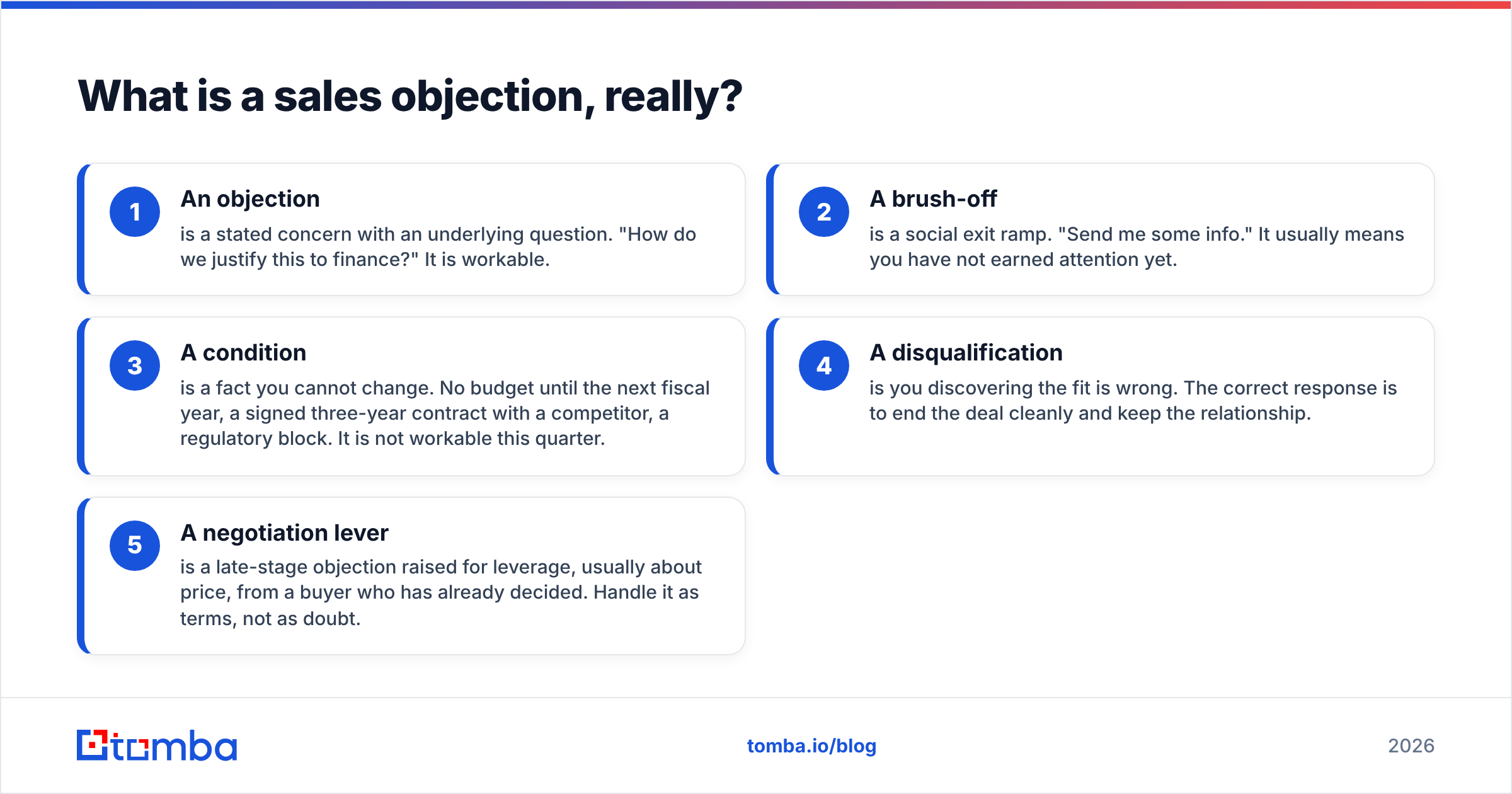
- An objection is a stated concern with an underlying question. "How do we justify this to finance?" It is workable.
- A brush-off is a social exit ramp. "Send me some info." It usually means you have not earned attention yet.
- A condition is a fact you cannot change. No budget until the next fiscal year, a signed three-year contract with a competitor, a regulatory block. It is not workable this quarter.
- A disqualification is you discovering the fit is wrong. The correct response is to end the deal cleanly and keep the relationship.
- A negotiation lever is a late-stage objection raised for leverage, usually about price, from a buyer who has already decided. Handle it as terms, not as doubt.
Miscategorising these is expensive. Reps who treat conditions as objections burn hours on deals that were never live. Reps who treat objections as conditions walk away from deals that a single clarifying question would have saved.
Actually, embed it properly:
How do you overcome sales objections in four steps?#
The framework below works on cold calls, discovery, demos, and procurement. It is deliberately short because you have to run it in real time.
Step 1 — Pause. Count one full second before you respond. Silence signals you took the concern seriously. It also stops the reflex to defend. On recorded calls, the reps with the highest close rates consistently have a longer gap between the buyer's objection and their first word.
Step 2 — Clarify. Ask one question that surfaces the real driver. "When you say it's expensive, what are you comparing it to?" "When you say timing, what has to happen first?" This step is skipped constantly, and it is where deals are lost. You cannot answer a question you have not heard.
Step 3 — Reframe. Restate the concern in terms of the outcome the buyer already told you they wanted, then bridge to evidence. Evidence means a customer story with a number in it, a benchmark, or a trial structure — not an adjective.
Step 4 — Confirm. Close the loop explicitly. "Does that address the concern, or is there another piece of it?" If you do not confirm, the objection goes underground and reappears in the procurement stage when you have less leverage.
A short worked example on the classic price objection:
Buyer: "This is more than we planned to spend."
Rep: (pause) "Fair. What number did you have in your head, and where did it come from?"
Buyer: "We benchmarked against what we pay for our current tool."
Rep: "That helps. Your current tool covers list building. You told me the bigger cost was the eleven hours a week your SDRs spend cleaning bad records. If we cut that in half, the delta pays for itself in about six weeks. Want me to build that math on your actual headcount?"
Buyer: "Do that."
Rep: "I will. Is cost the last open item, or is there something else you'd need before a decision?"
Note what did not happen: no discount, no defensiveness, no feature dump.
Which sales objections come up most, and what do they actually mean?#
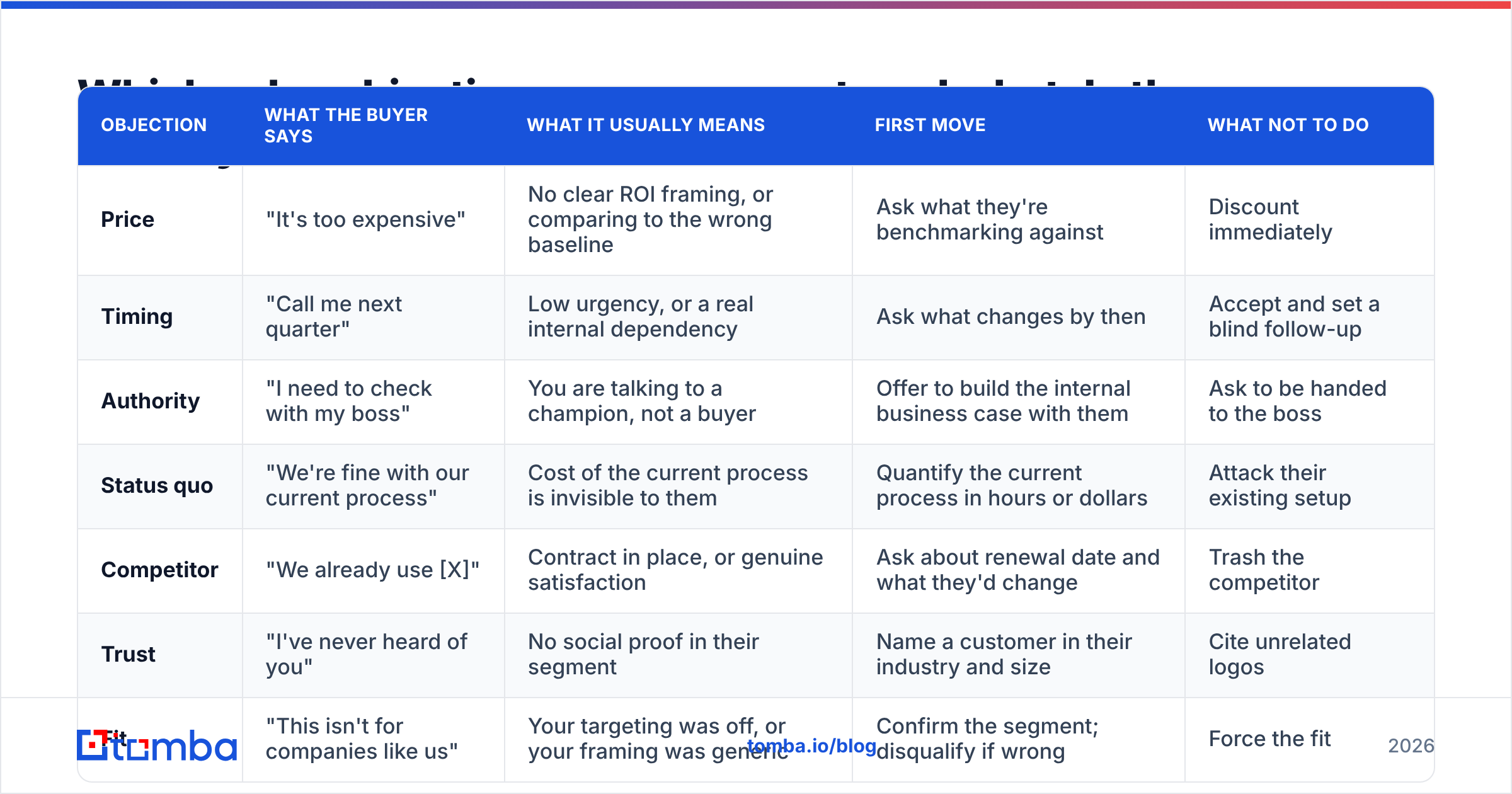
| Objection | What the buyer says | What it usually means | First move | What NOT to do |
|---|---|---|---|---|
| Price | "It's too expensive" | No clear ROI framing, or comparing to the wrong baseline | Ask what they're benchmarking against | Discount immediately |
| Timing | "Call me next quarter" | Low urgency, or a real internal dependency | Ask what changes by then | Accept and set a blind follow-up |
| Authority | "I need to check with my boss" | You are talking to a champion, not a buyer | Offer to build the internal business case with them | Ask to be handed to the boss |
| Status quo | "We're fine with our current process" | Cost of the current process is invisible to them | Quantify the current process in hours or dollars | Attack their existing setup |
| Competitor | "We already use [X]" | Contract in place, or genuine satisfaction | Ask about renewal date and what they'd change | Trash the competitor |
| Trust | "I've never heard of you" | No social proof in their segment | Name a customer in their industry and size | Cite unrelated logos |
| Fit | "This isn't for companies like us" | Your targeting was off, or your framing was generic | Confirm the segment; disqualify if wrong | Force the fit |
The pattern across every row: the first move is a question, never a rebuttal. And in three of the seven rows — competitor, trust, and fit — the objection is partly a targeting failure that happened long before the call.
Why do half your objections start before the call?#
Because you called the wrong person, at the wrong company, with the wrong assumption.
A rep who calls a 40-person startup and pitches an enterprise-tier workflow will hear "too expensive" every time. That is not an objection-handling problem; it is a list problem. A rep who emails a contact who left the company eight months ago will hear nothing at all — and will log the silence as "no interest."
Data decay is the quiet killer here. B2B contact data degrades meaningfully every year as people change roles, companies rebrand, and domains consolidate. If your list was built eighteen months ago, a substantial share of it is now wrong. Every wrong record generates a fake objection that your team will spend real hours trying to overcome.
Three pre-call checks that remove objections before they exist:
- Verify the contact is still there. Run addresses through an email verifier before the sequence goes out. A bounced email is an objection you never got to hear.
- Confirm you have the right seniority. The "I need to check with my boss" objection is largely a symptom of prospecting one level too low. Use data enrichment to pull title, seniority, and department before you write the first line.
- Check the trigger is real. Funding, hiring, tech-stack changes, and leadership moves make "why now" answerable. Without a trigger, "call me next quarter" is the rational buyer response.
For a deeper reference on the mechanics behind bounce rates and inbox placement, email deliverability is worth understanding before you blame reply rates on your messaging.
How do you handle the price objection without discounting?#
Discounting is the fastest way to teach a buyer that your price was never real.
The alternative is to change what the price is being compared to. Buyers rarely evaluate cost in the abstract; they compare against something. Your job in the clarify step is to find out what.
There are four comparison baselines, and each needs a different response:
- Against a competitor's price. Move the conversation to total cost — implementation time, seats required, overage fees, credit rollover. Two tools with the same sticker price often differ by 40% once usage is real.
- Against their existing budget line. Reframe as reallocation, not new spend. What line item does this replace or shrink?
- Against doing nothing. Quantify the status quo. Hours per week times loaded hourly cost times 52. Buyers underestimate this consistently because the cost is distributed across people rather than showing up on an invoice.
- Against an imagined "fair" number. This is the weakest baseline and the easiest to move. Ask how they arrived at it. Often they cannot, and the objection dissolves.
Structural moves that beat a discount:
- Shorten the term. A quarterly commitment instead of annual lowers perceived risk without lowering price.
- Narrow the scope. Start with one team, one use case, one region. Land small, expand on evidence.
- Tie payment to a milestone. Deferred start dates or a paid pilot both preserve list price.
- Trade, never give. If you concede on price, get something: a case study, a longer term, a faster signature, a reference call.
Research on B2B buying behaviour from Gartner has consistently found that buyers spend only a small fraction of their process with any single supplier. That is why the ROI math has to be something they can carry into a room you are not in.
How do you handle "I need to talk to my boss"?#
Treat it as a coaching opportunity, not a redirect.
The instinct is to ask for an introduction to the decision-maker. This usually fails because it signals to your contact that they are not important. The better move is to make your contact good at selling your product internally.
Ask three questions:
- "Who else will be in the room when this gets discussed?"
- "What will they push back on first?"
- "What format do decisions like this usually get presented in?"
Then build that artifact for them. A one-page summary with the problem, the numbers, the alternatives considered, and the risk of inaction. Your champion presents it. You have now sold to a room you were never in.
If the deal is worth it, offer a low-pressure joint call: "Happy to join for fifteen minutes purely to answer technical questions — you run the recommendation." That framing keeps your champion in control and gets you in the room.
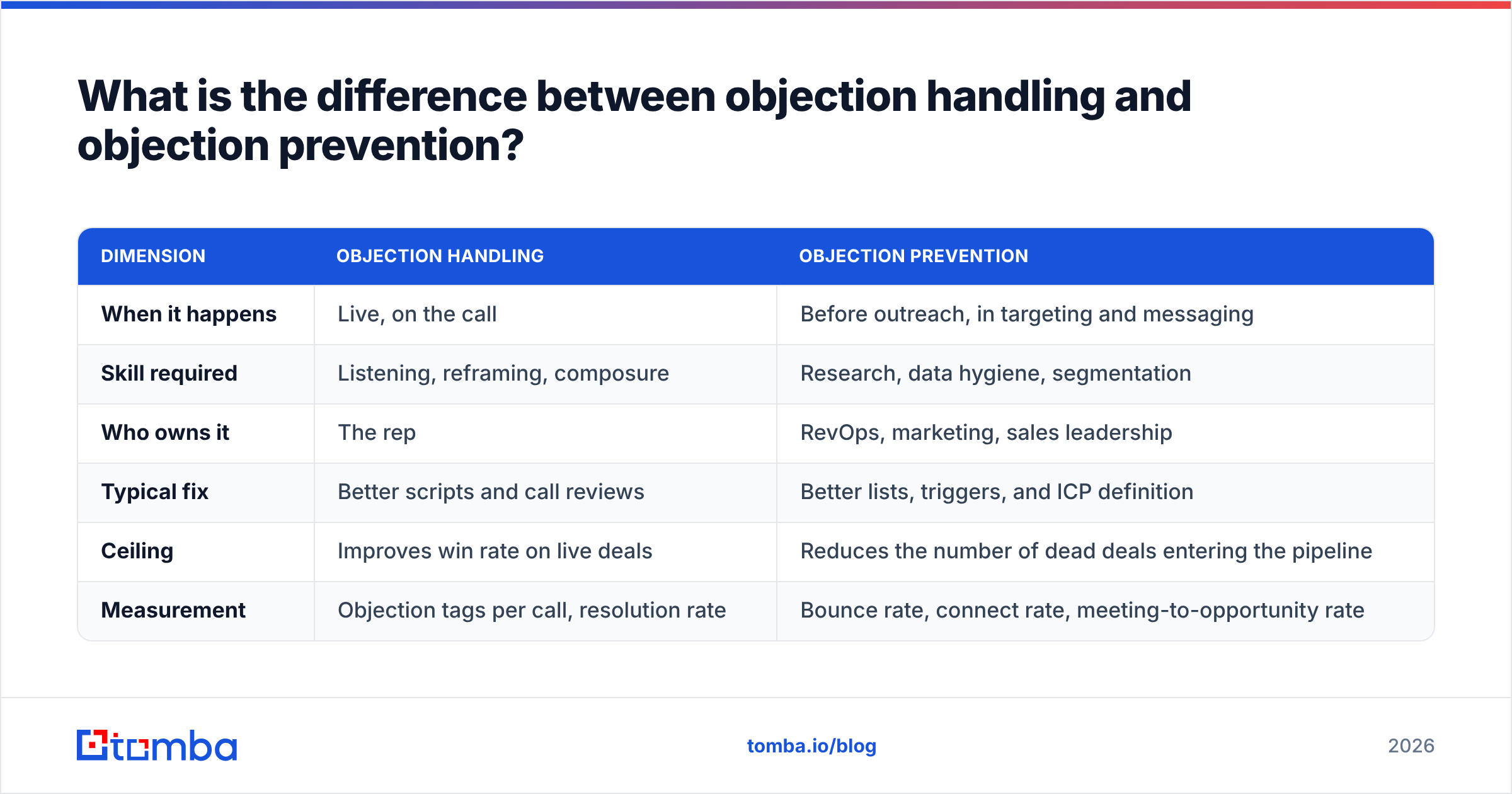
What is the difference between objection handling and objection prevention?#
| Dimension | Objection handling | Objection prevention |
|---|---|---|
| When it happens | Live, on the call | Before outreach, in targeting and messaging |
| Skill required | Listening, reframing, composure | Research, data hygiene, segmentation |
| Who owns it | The rep | RevOps, marketing, sales leadership |
| Typical fix | Better scripts and call reviews | Better lists, triggers, and ICP definition |
| Ceiling | Improves win rate on live deals | Reduces the number of dead deals entering the pipeline |
| Measurement | Objection tags per call, resolution rate | Bounce rate, connect rate, meeting-to-opportunity rate |
Both matter, but teams over-invest in the first column and under-invest in the second. Handling objections is visible, coachable, and satisfying. Preventing them is invisible work that shows up as an unexplained lift in conversion rate.
A practical split: if the same objection appears in more than 30% of your calls, it is not a rep skill issue. It is a positioning or targeting issue, and no amount of script training will fix it. Change the list or change the message.
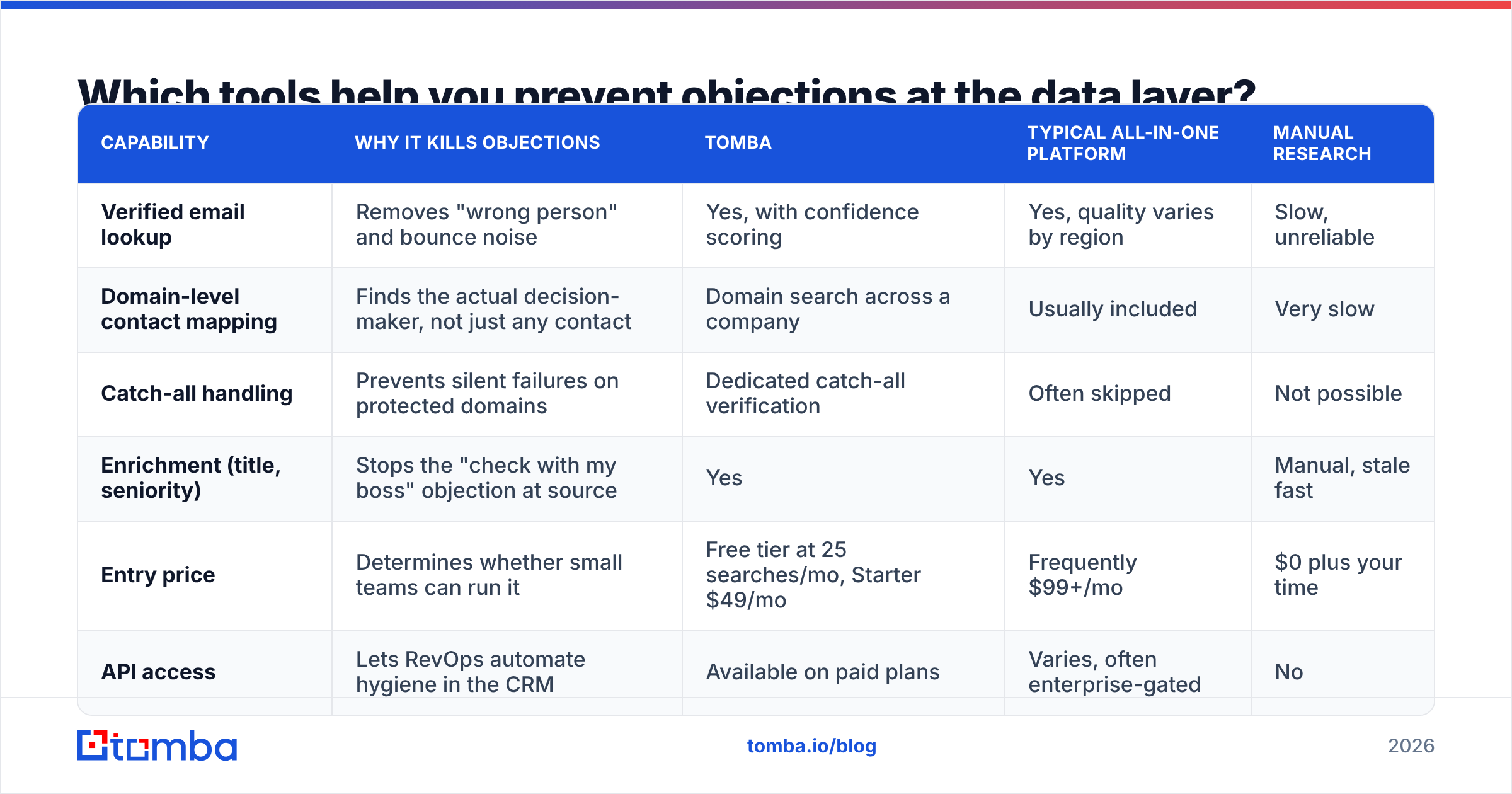
Which tools help you prevent objections at the data layer?#
Not every objection is solvable with software, but the targeting ones are. Here is how a few common categories compare for the specific job of getting the right person into your sequence with accurate details.
| Capability | Why it kills objections | Tomba | Typical all-in-one platform | Manual research |
|---|---|---|---|---|
| Verified email lookup | Removes "wrong person" and bounce noise | Yes, with confidence scoring | Yes, quality varies by region | Slow, unreliable |
| Domain-level contact mapping | Finds the actual decision-maker, not just any contact | Domain search across a company | Usually included | Very slow |
| Catch-all handling | Prevents silent failures on protected domains | Dedicated catch-all verification | Often skipped | Not possible |
| Enrichment (title, seniority) | Stops the "check with my boss" objection at source | Yes | Yes | Manual, stale fast |
| Entry price | Determines whether small teams can run it | Free tier at 25 searches/mo, Starter $49/mo | Frequently $99+/mo | $0 plus your time |
| API access | Lets RevOps automate hygiene in the CRM | Available on paid plans | Varies, often enterprise-gated | No |
Independent review sites like G2 are useful for sanity-checking vendor claims across this category — read the reviews from companies your size rather than the aggregate score. And note that credible peers exist here: platforms such as BookYourData take a different route with pay-as-you-go verified B2B lists, which suits teams that buy in bursts rather than run continuous enrichment.
Full Tomba pricing runs Free, Starter $49/mo, Growth $99/mo, Pro $249/mo, and Enterprise custom, so the ladder scales with volume rather than forcing an annual enterprise commitment on a five-person team.
How do you train a team to get better at this?#
Scripts on a wiki do nothing. Three practices actually move the number.
- Tag objections on every call. One field, seven options, matching the table above. After a month you will see which objection dominates, and that tells you whether the problem is skill, message, or list.
- Run 15-minute weekly role-plays. Not full call simulations — just one objection, three reps, three attempts each. Reps improve at objection handling the way musicians improve at a difficult bar: repetition of the hard part, not the whole piece.
- Review the losses, not the wins. Pull five closed-lost deals a month and find the exact moment the objection surfaced. In most cases it appeared early, was acknowledged, and was never resolved. That gap is your coaching content.
One more habit worth building: write down the objection verbatim. Not "price objection" but the buyer's actual words. The phrasing carries the diagnosis. "We can't justify this" is a business-case problem. "That seems like a lot" is an anchoring problem. Same category, different fix.
For teams building repeatable sequences, HubSpot's sales resources are a reasonable free starting point for call frameworks, and worth adapting rather than adopting wholesale.
What should you do this week?#
Pick one objection that shows up in most of your calls. Write the clarify question you will ask before responding — one sentence. Rehearse it out loud ten times. Use it on every call this week and log what the buyer says next.
Then audit your list. Pull 100 records from your active sequence and check how many bounce, how many have the wrong title, and how many point at someone who no longer works there. If that number is above 10%, your objection problem is at least partly a data problem, and no script will fix it.
That second half is where a targeting layer earns its keep. The Tomba Email Finder gets you verified, current contacts for the specific people who can actually say yes — which removes the "wrong person," "not my department," and "I need to check with my boss" objections before your rep ever picks up the phone. Start on the free tier at 25 searches a month, verify a slice of your existing list, and see how much of your objection volume was never really an objection at all.
Related guides#
Ready to find emails that actually work?
Join 150,000+ professionals who stopped guessing and started sending. Free credits on signup — no credit card required.
Get the Tomba newsletter
Practical outbound tactics and product updates — once every two weeks.
About the author