How to Pitch a Product in 2026: A 7-Step Sales Framework
Most product pitches fail before the second slide. Here is the 7-step framework top B2B reps use to research, structure, and deliver a pitch that gets a next meeting booked.
TL;DR
- A product pitch is not a demo and not a deck. It is a 3-part argument: this problem costs you X, here is the mechanism that removes it, here is proof it worked for someone like you.
- Research beats charisma. Reps who spend 10-15 minutes on account research before a pitch consistently book more second meetings than reps who wing it with a polished script.
- Lead with the buyer's problem, not your feature list. Features belong in the last third of the conversation, mapped one-to-one against problems the buyer already named out loud.
- Structure every pitch around a single measurable outcome. "Cut SDR research time from 12 minutes to 90 seconds per account" beats "boost productivity."
- The pitch fails or succeeds before you open your mouth — if you pitched the wrong person at the wrong company, no framework saves it. Contact accuracy is a pitch input, not an afterthought.
What is a product pitch, and how is it different from a demo?#
A product pitch is a short, structured argument that a specific buyer has a specific problem worth paying to solve, and that your product is the most credible way to solve it. That's it. It usually runs 3 to 12 minutes depending on format — cold call, discovery call, conference booth, investor room, or the first 90 seconds of a scheduled meeting.
A demo is different. A demo shows how the product works. A pitch establishes why anyone should care that it works. Reps who confuse the two open a screen share in minute two and spend twenty minutes clicking through settings menus while the buyer quietly checks Slack.
Think of it like a doctor's appointment. A pitch is the diagnosis conversation: symptoms, cause, proposed treatment, expected outcome. A demo is the pharmacist explaining how to take the pills. Nobody wants dosing instructions before they've been told what's wrong with them.
The three components every product pitch needs:
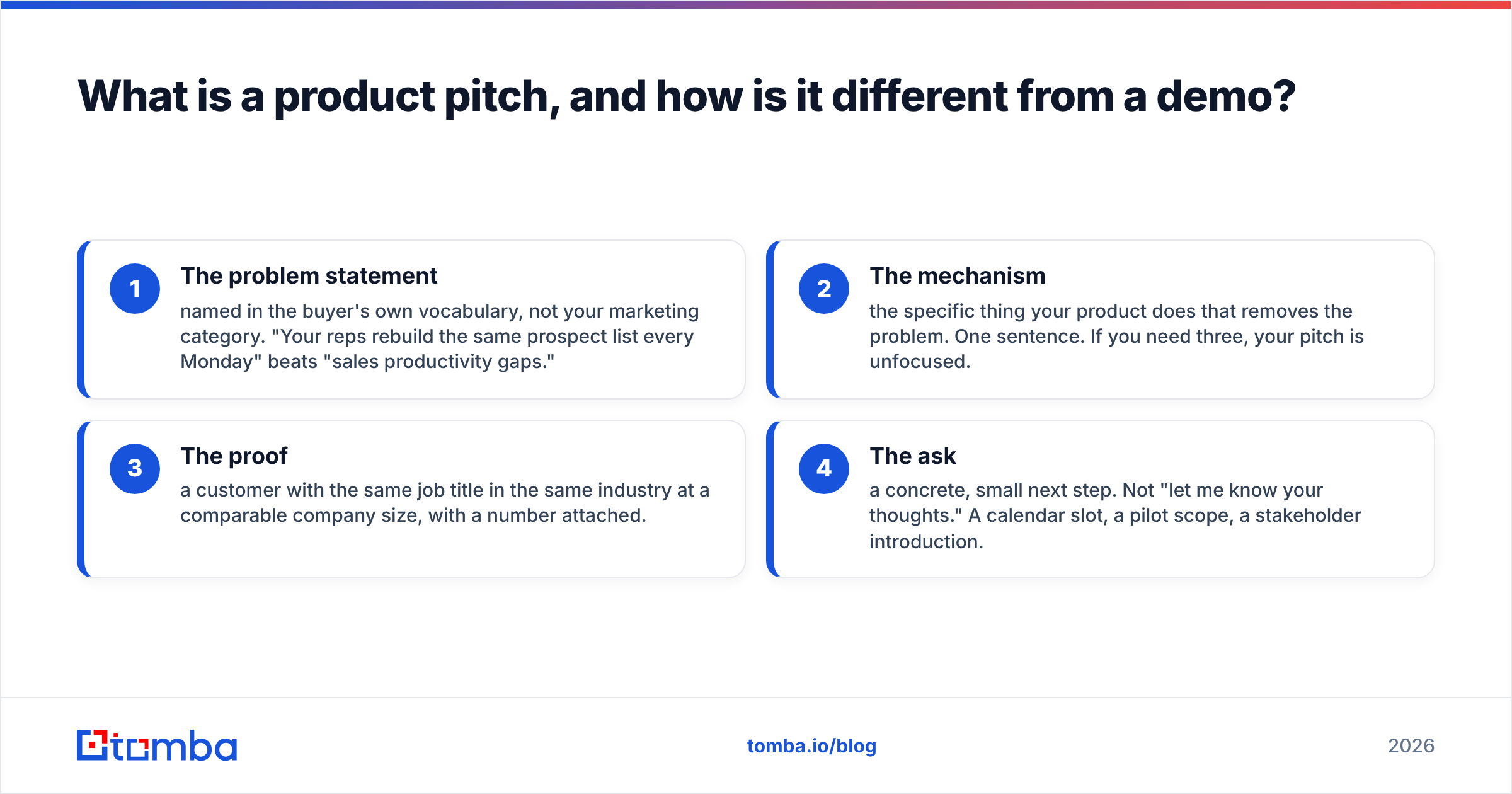
- The problem statement — named in the buyer's own vocabulary, not your marketing category. "Your reps rebuild the same prospect list every Monday" beats "sales productivity gaps."
- The mechanism — the specific thing your product does that removes the problem. One sentence. If you need three, your pitch is unfocused.
- The proof — a customer with the same job title in the same industry at a comparable company size, with a number attached.
- The ask — a concrete, small next step. Not "let me know your thoughts." A calendar slot, a pilot scope, a stakeholder introduction.
Why do most product pitches fail?#
They fail because the rep is pitching to a persona instead of a person. Generic pitches are optimized to be safe across every possible listener, which makes them relevant to none of them.
Here's the pattern that shows up in call recordings again and again:
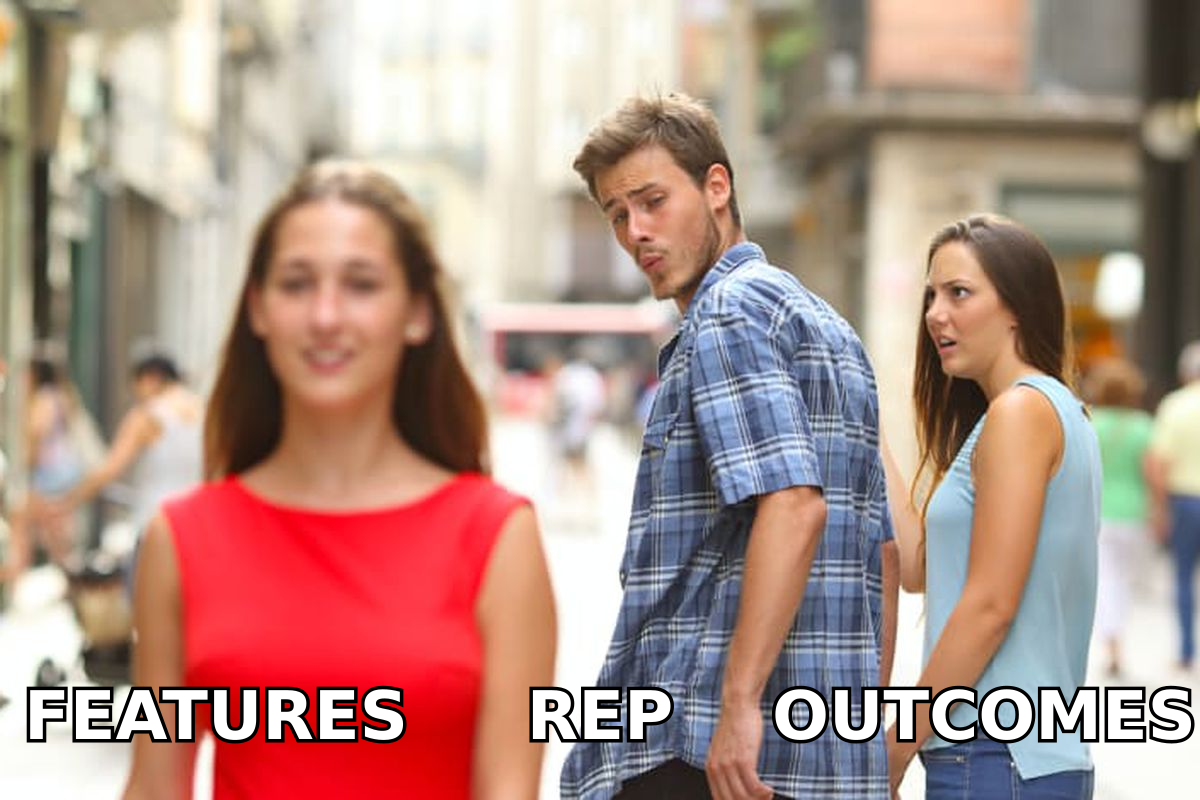
- Feature dumping. The rep lists 11 capabilities hoping one lands. The buyer remembers zero. Research from HubSpot's sales data consistently shows buyers value reps who understand their needs over reps who explain their product well.
- No qualifying question in the first two minutes. If you haven't asked the buyer to describe their current process, you're guessing what to emphasize.
- Talking too much. Top performers talk roughly 45% of a discovery call. Underperformers push past 70%. If you're monologuing, you're not pitching — you're presenting.
- Wrong contact entirely. You pitched the marketing ops manager on a product that only the VP of Sales can buy. No framework fixes bad targeting.
- No proof point. Claims without customer evidence sound like brochure copy. One named customer with a real number outperforms three adjectives.
The fifth failure is the sneaky one. You can execute a technically perfect pitch and still lose because the person on the other end of the line has no budget authority and no pain. That's a data problem, not a delivery problem — which is why the research step below comes first, not last.
How do you research before a pitch?#
Spend 10 to 15 minutes per account. Not 45 — you'll never scale that — and not two, which produces the generic pitch that fails.
Pull these five things:
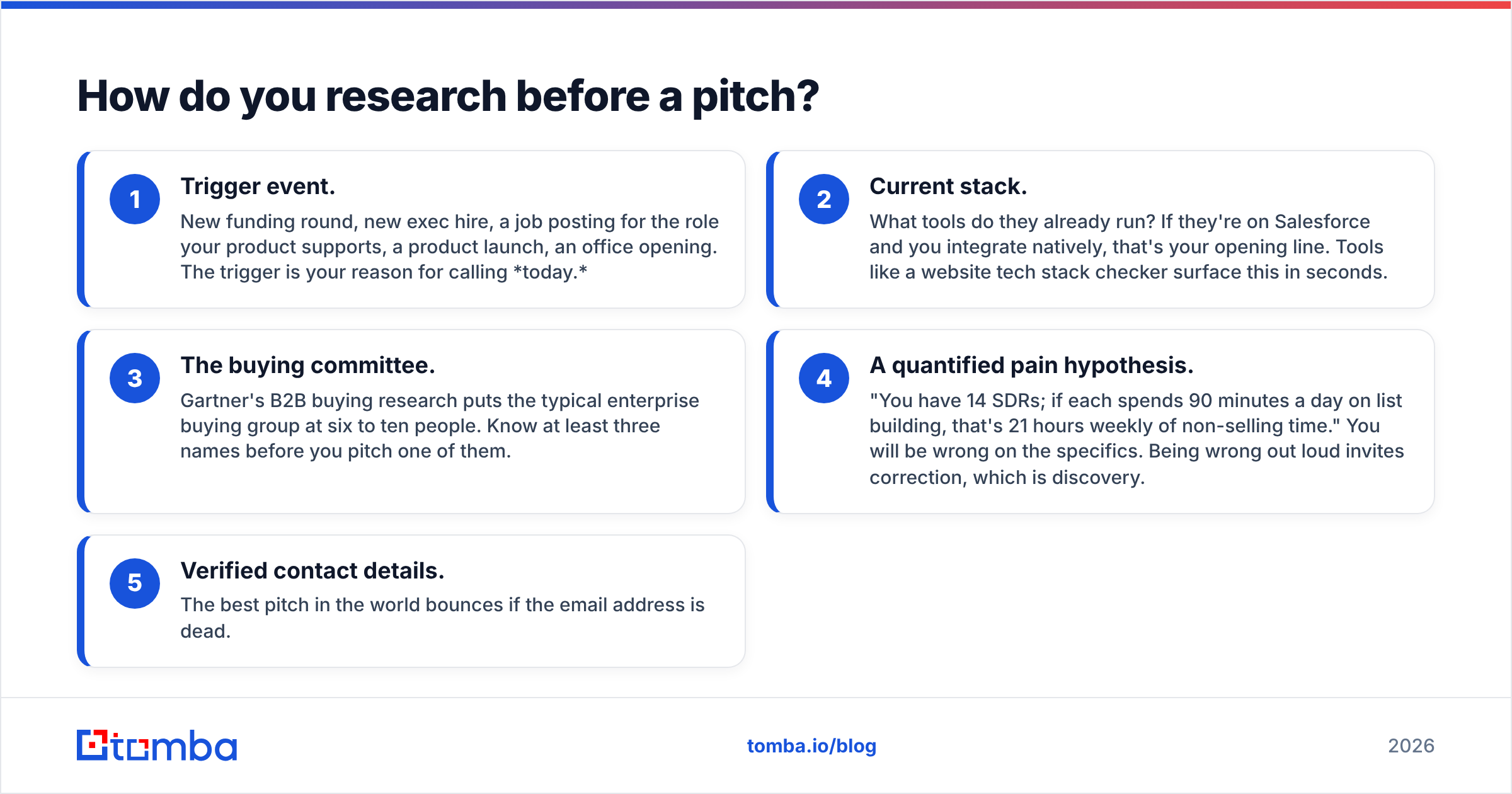
- Trigger event. New funding round, new exec hire, a job posting for the role your product supports, a product launch, an office opening. The trigger is your reason for calling today.
- Current stack. What tools do they already run? If they're on Salesforce and you integrate natively, that's your opening line. Tools like a website tech stack checker surface this in seconds.
- The buying committee. Gartner's B2B buying research puts the typical enterprise buying group at six to ten people. Know at least three names before you pitch one of them.
- A quantified pain hypothesis. "You have 14 SDRs; if each spends 90 minutes a day on list building, that's 21 hours weekly of non-selling time." You will be wrong on the specifics. Being wrong out loud invites correction, which is discovery.
- Verified contact details. The best pitch in the world bounces if the email address is dead.
That last point deserves more weight than it usually gets. If 25% of your outbound pitches never reach a human inbox, your pitch conversion math is broken before your words matter. Run every target through an email verifier before the sequence goes out, and use a domain search to map the full buying committee at an account rather than pitching whichever single name you found on LinkedIn.
What is the 7-step product pitch framework?#
Here's the sequence. It works for a 3-minute cold call and a 30-minute scheduled meeting — you just change how long you spend on each step.
Step 1 — Permission and frame (15 seconds). "I've got a specific reason for the call and it'll take two minutes. Fair to keep going?" Asking permission raises completion rates because it converts an interruption into a small agreement.
Step 2 — The trigger-based opener (20 seconds). Reference the specific thing you found in research. "I saw you posted three SDR roles last month." This is the single highest-leverage sentence in the whole pitch.
Step 3 — The problem hypothesis (30 seconds). State the pain you believe they have, framed as a guess, not a fact. "Usually when a team scales SDRs that fast, list quality is the first thing to break. Is that landing anywhere close?"
Step 4 — Shut up and listen (2-8 minutes). The buyer either corrects you or confirms you. Both outcomes are wins. Take notes on their exact words — you'll reuse their vocabulary in step 6.
Step 5 — The mechanism (45 seconds). One sentence on how your product removes the pain they just described. Not what your product does generally. What it does about the thing they said.
Step 6 — Proof with a number (30 seconds). "A 20-person team in fintech cut research time from 12 minutes to under 2 per account and doubled meetings booked in the first quarter." Name the segment, name the metric, name the delta.
Step 7 — The specific ask (15 seconds). "Can I get 25 minutes Thursday to show you what that looks like on your actual account list?" Specific day, specific length, specific content.
How does a pitch change by channel?#
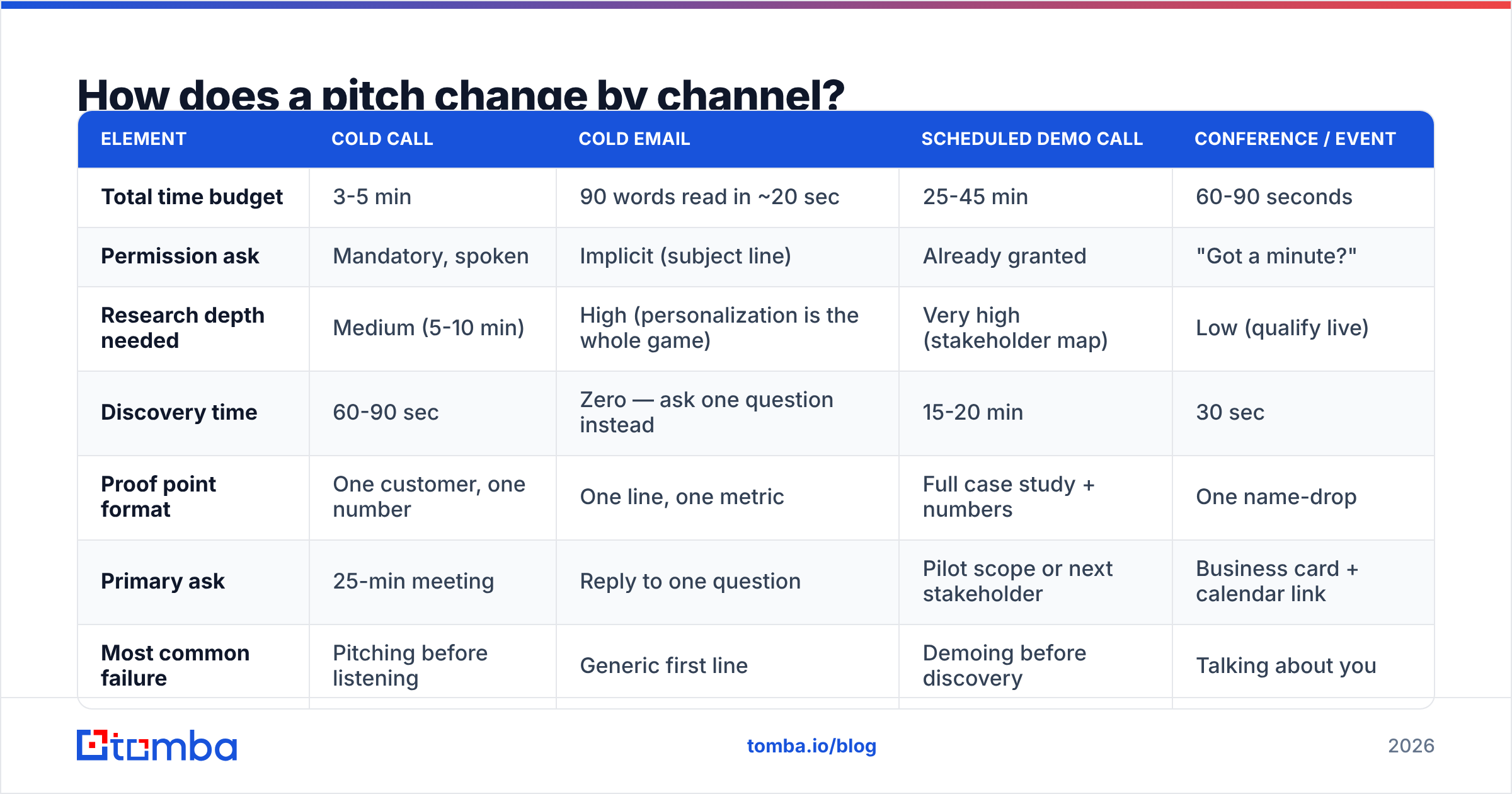
The framework holds, but the compression ratio changes drastically. Here's how the same seven steps play out across the four channels B2B reps actually use:
| Element | Cold call | Cold email | Scheduled demo call | Conference / event |
|---|---|---|---|---|
| Total time budget | 3-5 min | 90 words read in ~20 sec | 25-45 min | 60-90 seconds |
| Permission ask | Mandatory, spoken | Implicit (subject line) | Already granted | "Got a minute?" |
| Research depth needed | Medium (5-10 min) | High (personalization is the whole game) | Very high (stakeholder map) | Low (qualify live) |
| Discovery time | 60-90 sec | Zero — ask one question instead | 15-20 min | 30 sec |
| Proof point format | One customer, one number | One line, one metric | Full case study + numbers | One name-drop |
| Primary ask | 25-min meeting | Reply to one question | Pilot scope or next stakeholder | Business card + calendar link |
| Most common failure | Pitching before listening | Generic first line | Demoing before discovery | Talking about you |
| Success metric | Meeting booked rate | Reply rate | Multi-threading achieved | Qualified follow-ups |
Cold email is the harshest constraint. You get roughly 20 seconds of attention and no chance to adapt mid-pitch. That's why email pitches live or die on the first line and the specificity of the ask — and why response rate is the only metric that tells you whether your written pitch is working. If you're building the written version, a set of cold email templates is a faster starting point than a blank page.
What should your pitch actually say? (Scripts)#
Cold call opener, trigger-based:
"Hi [Name], it's [You] from [Company]. I'll be straight — I saw you're hiring three SDRs this quarter. Usually when teams scale that fast, the bottleneck moves from headcount to list quality inside about 60 days. Is that something you're already thinking about, or am I off?"
Cold email, 4-line structure:
Subject: three SDR roles
[Name] — saw the three SDR openings.
Most teams that add reps that fast find list building eats 90 minutes per rep per day by month two. [Similar Company] hit that wall and cut it to 15 minutes.
Worth 20 minutes Thursday to compare notes on how you're sourcing lists today?
Objection response — "we already use [Competitor]":
"Makes sense, they're solid. Most teams I talk to who run [Competitor] keep it for [thing it's good at] and add us for [narrow, specific gap]. Is [specific gap] something you're hitting, or is that not a problem for you right now?"
Notice what that objection response does: it validates the incumbent, narrows the claim, and ends with a question that lets the buyer say no cleanly. Aggressive competitive teardowns lose deals — buyers hear them as an insult to a decision they already made.
How do you measure whether your pitch is working?#
Track pitch performance at the stage level, not just at the closed-won level. By the time a deal closes, too many variables have moved to learn anything about your pitch specifically.
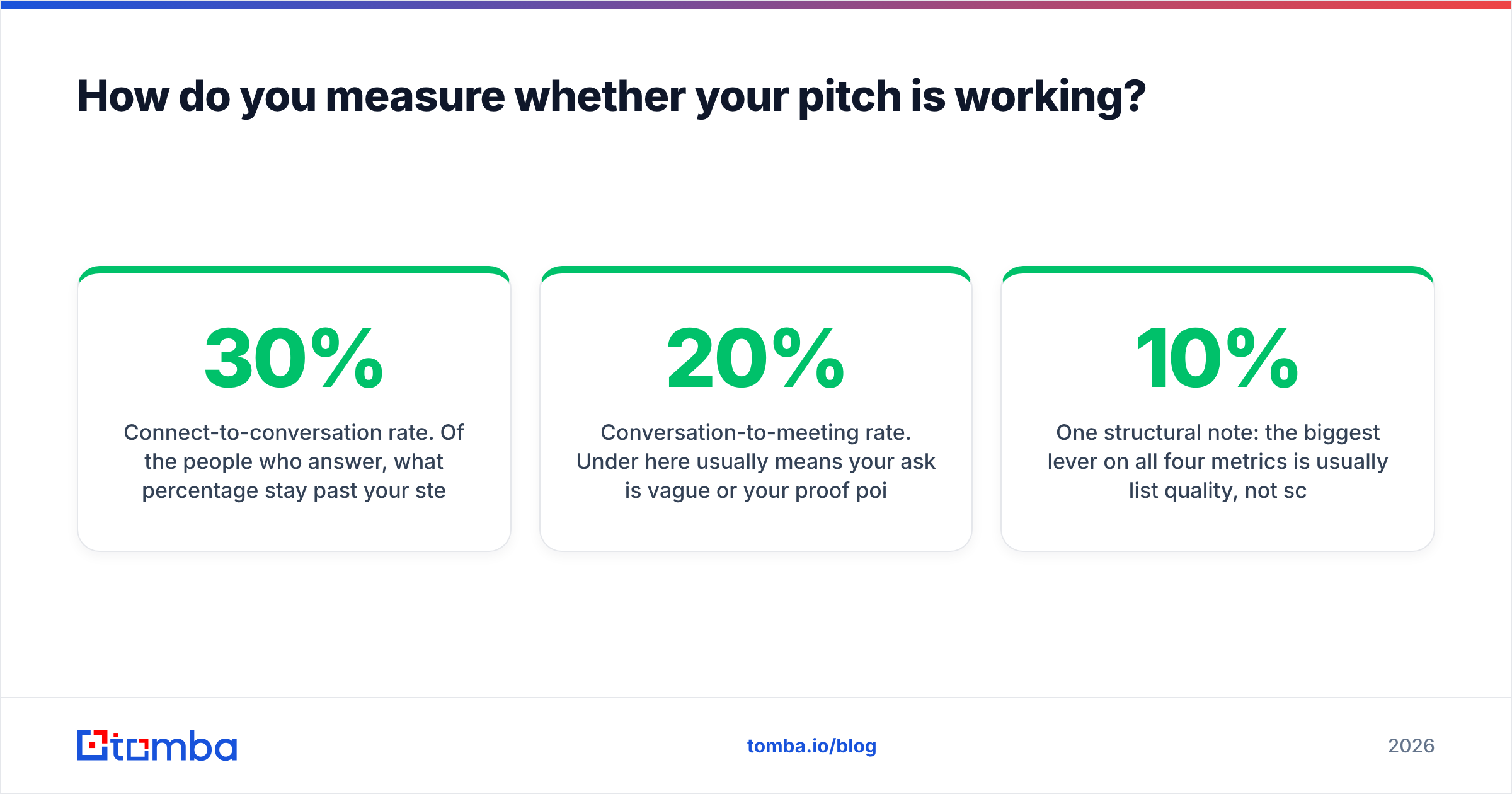
The four numbers worth watching weekly:
- Connect-to-conversation rate. Of the people who answer, what percentage stay past your step 3? If this is under 30%, your opener is the problem.
- Conversation-to-meeting rate. Under 20% here usually means your ask is vague or your proof point is missing.
- Meeting-to-multithread rate. Did a second stakeholder join by meeting two? If not, you pitched a champion who can't buy.
- Pitch-to-close cycle time. Getting shorter means your pitch is qualifying harder up front, which is good even if raw meeting volume dips.
Peer review sites like G2's sales enablement category are also a free source of the actual language your buyers use to describe their pain — read your competitors' reviews and steal the complaint vocabulary verbatim.
One structural note: the biggest lever on all four metrics is usually list quality, not script quality. Doubling your connect rate by pitching the right titles at the right companies beats a 10% script improvement every time. Building that list from a reliable B2B database and enriching it with verified contact data does more for pitch performance than another round of script edits.
What are the biggest mistakes to avoid?#
- Pitching the product before you've earned the problem. If the buyer hasn't agreed they have a problem, every feature you name is noise.
- Using your internal category language. "Revenue intelligence platform" means nothing to a VP of Sales who thinks in terms of "my reps can't find the right contacts."
- Skipping the number. Every proof point needs a metric. Vague success stories read as fiction.
- Making the ask too big. "Let's get your whole team on a call next week" is a bigger commitment than a first pitch has earned. Ask for one small yes.
- Ignoring the second and third stakeholder. Single-threaded deals stall. Ask "who else would need to weigh in on this?" before the call ends, then go find their contact details.
- Reusing the same pitch across segments. A 40-person startup and a 4,000-person enterprise have different problems even when they buy the same product. Segment your proof points at minimum.
- Emailing unverified addresses. Bounces damage sender reputation, which quietly reduces deliverability for every future pitch you send from that domain.
How do you build a repeatable pitch process?#
Turn the seven steps into an asset your whole team can run, not a talent you happen to have.
Make three artifacts:
- A one-page pitch doc per segment. Problem statement, mechanism, proof point with number, ask. Four boxes. If it doesn't fit on one page, it's not a pitch.
- A research checklist. The five items from the research section, with the tool or link next to each so a new rep can complete it in 10 minutes without asking anyone.
- A call-recording review cadence. Two calls per rep per week, reviewed against the seven steps. Score which step broke, not "how the call felt."
Then attach the data layer underneath. Your reps should never be the bottleneck on finding a verified email or a direct dial for a stakeholder they identified mid-call. That work belongs in a tool, running in the background, so the human time goes into the conversation.
Where should you start?#
Pick one segment. Write the four-box pitch doc for it. Build a list of 50 accounts that fit, verify every contact, and run the seven-step framework on all 50 without changing the script. Then review what broke.
That's a two-week experiment with a real answer at the end, which beats another quarter of tweaking slides.
If the constraint is getting in front of the right person at all, start there. Tomba's Email Finder locates verified professional email addresses by name, company, or domain, so the pitch you spent an hour sharpening actually reaches the buyer who can act on it. The free tier gives you 25 searches a month to test it against your current list, and paid plans start at $49/mo on Starter with Growth at $99/mo — full Tomba pricing is public if you want to run the math against your team size. A great pitch delivered to a dead inbox converts at exactly zero.
Related guides#
// get started
Find, verify and enrich your first contacts today
Start on the free plan with 25 searches a month, then scale when your team is ready.
Free plan · No credit card required · GDPR & CCPA
// about the author