How to Pitch in Sales: A 2026 Framework That Books Meetings
Most sales pitches fail in the first 15 seconds. Here is a repeatable pitch framework, a channel-by-channel comparison, and the data prep that makes it land.
TL;DR
- A sales pitch is not a presentation. It is a 60-to-90-second hypothesis about the buyer's problem that invites correction — the shorter it is, the more you learn.
- The six-step structure that works in 2026: trigger, problem hypothesis, proof, differentiator, ask, silence. Everything else is decoration.
- Channel matters more than script. The same message needs three different lengths for cold email, cold call, and a live discovery meeting.
- Personalization only beats volume when the underlying contact data is accurate. A perfect pitch to a bounced address is worth zero.
- Practice objection handling before you practice delivery. Buyers interrupt; scripted monologues collapse the moment they do.
What is a sales pitch, exactly?#
A sales pitch is a short, testable claim about the buyer's world that earns you the right to ask a question.
That is the whole definition. It is not your company origin story, not a feature tour, and not the deck your marketing team built for a conference booth. Think of it like a doctor's opening line. A bad doctor lists every treatment they offer. A good one says, "Based on your chart, I think the pain is coming from here — does that match what you're feeling?" You are doing the same thing with a revenue problem.
The practical consequence: a pitch should be falsifiable. If your buyer cannot disagree with it, you have said nothing. "We help companies grow faster" is unfalsifiable filler. "Most RevOps teams your size are re-verifying lists twice because the CRM and the enrichment tool disagree — is that happening here?" is a claim they can confirm or reject. Either answer moves the deal.
Length discipline follows from that. Research summarized by Gartner has consistently shown B2B buyers spend only a fraction of their purchase journey with any single vendor rep, and that buying groups now routinely include 6–10 stakeholders. You are not the main character in their week. Say the thing, then stop.
How do you structure a pitch in six steps?#
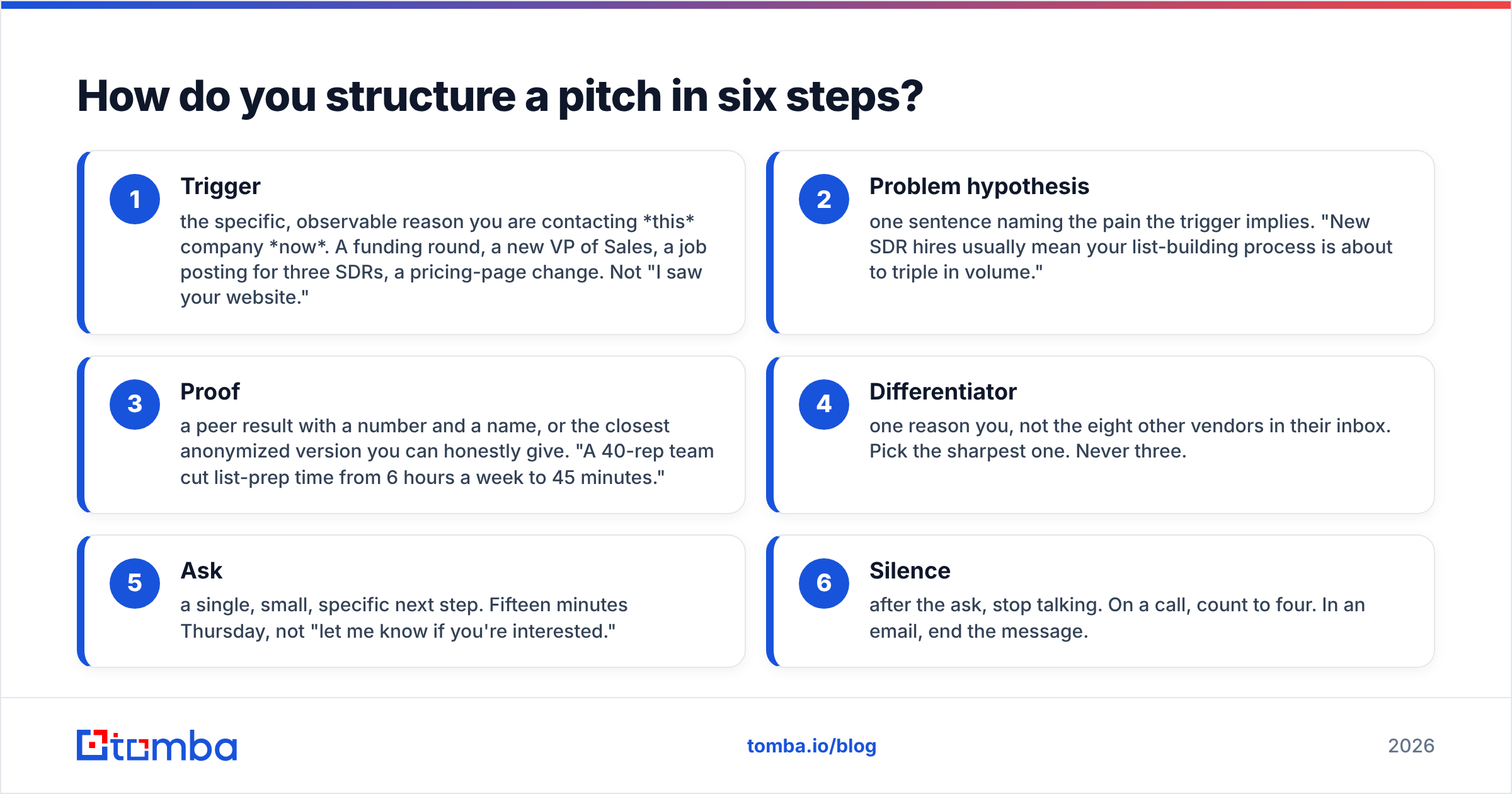
Here is the skeleton. Fill it in for every account before you dial or send.
- Trigger — the specific, observable reason you are contacting this company now. A funding round, a new VP of Sales, a job posting for three SDRs, a pricing-page change. Not "I saw your website."
- Problem hypothesis — one sentence naming the pain the trigger implies. "New SDR hires usually mean your list-building process is about to triple in volume."
- Proof — a peer result with a number and a name, or the closest anonymized version you can honestly give. "A 40-rep team cut list-prep time from 6 hours a week to 45 minutes."
- Differentiator — one reason you, not the eight other vendors in their inbox. Pick the sharpest one. Never three.
- Ask — a single, small, specific next step. Fifteen minutes Thursday, not "let me know if you're interested."
- Silence — after the ask, stop talking. On a call, count to four. In an email, end the message.
That order is deliberate. Trigger earns attention, hypothesis earns relevance, proof earns credibility, differentiator earns preference, ask converts, silence lets the buyer own the decision. Skip a step and the next one lands weaker.
The most common failure I see in call reviews is collapsing steps 2 and 3 into a feature list. The rep says "we do email finding, verification, enrichment, and phone lookup" and the buyer's brain files it under "vendor noise." Name the pain first. A feature only means something once it has a problem attached to it.
Is a cold email pitch different from a cold call pitch?#
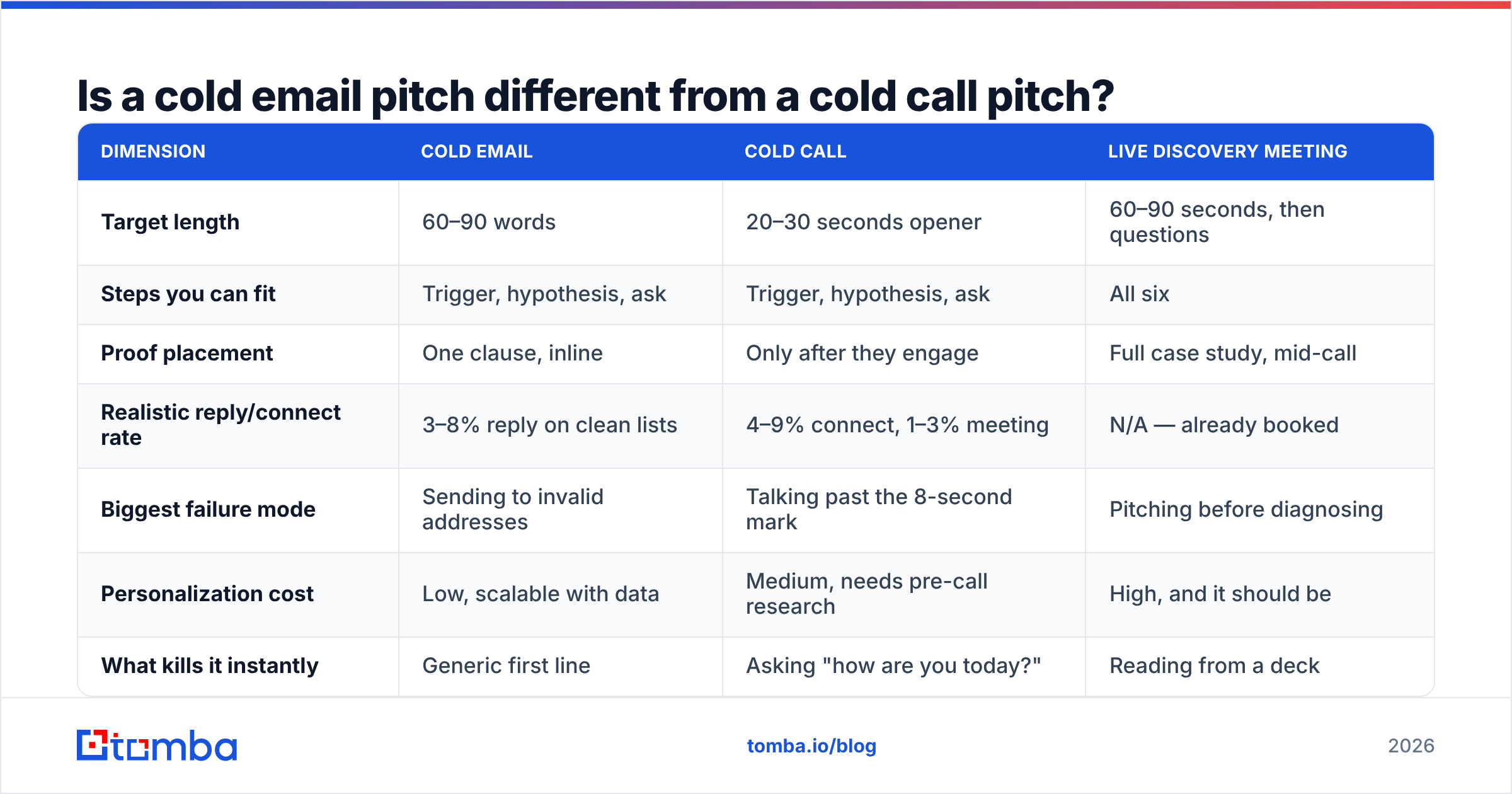
Yes — the structure is the same, but the compression ratio and the burden of proof change completely.
| Dimension | Cold email | Cold call | Live discovery meeting |
|---|---|---|---|
| Target length | 60–90 words | 20–30 seconds opener | 60–90 seconds, then questions |
| Steps you can fit | Trigger, hypothesis, ask | Trigger, hypothesis, ask | All six |
| Proof placement | One clause, inline | Only after they engage | Full case study, mid-call |
| Realistic reply/connect rate | 3–8% reply on clean lists | 4–9% connect, 1–3% meeting | N/A — already booked |
| Biggest failure mode | Sending to invalid addresses | Talking past the 8-second mark | Pitching before diagnosing |
| Personalization cost | Low, scalable with data | Medium, needs pre-call research | High, and it should be |
| What kills it instantly | Generic first line | Asking "how are you today?" | Reading from a deck |
Three things fall out of that table.
First, email is the only channel where your data quality is the bottleneck. On a call, a wrong number just means no answer. In email, a bad address damages your sending domain. If your bounce rate creeps past 2–3%, mailbox providers start deprioritizing you, and even your good pitches stop landing. Run every list through an email verifier before the first send — this is not optional hygiene, it is a prerequisite for the pitch mattering at all. If you want the deeper mechanics, email deliverability explains how bounce rate feeds sender reputation.
Second, the phone rewards brevity even harder than email. You have roughly eight seconds before the prospect decides whether to hang up. Which means on a call your pitch is really just steps 1, 2, and 5 — trigger, hypothesis, ask — with proof held in reserve for when they say "tell me more."
Third, the discovery meeting is the only place a full pitch belongs, and even there it should come after you have asked questions. Pitching at minute two of a discovery call is the single most expensive mistake in B2B sales. You are guessing at the problem when the buyer was about to tell you.
What does a good pitch actually sound like?#
Concrete beats abstract, so here are three versions of the same pitch for the same fictional prospect: a Series B SaaS company that just posted four SDR roles.
Cold email (72 words):
Subject: four SDR reqs
Hi Dana — saw the four SDR openings on the careers page.
Most teams scaling from 3 to 7 reps hit the same wall: list-building time grows faster than headcount, and reps end up spending Mondays in spreadsheets instead of on the phone.
One team your size cut prep from six hours a week to about 45 minutes by moving verification upstream of the sequencer.
Worth 15 minutes Thursday to compare notes?
Cold call opener (24 seconds):
"Dana, this is Sam from Tomba — I'll be direct, you didn't expect the call. I noticed you're hiring four SDRs. Usually when a team doubles like that, the list-building process breaks before the headcount does. Is that already showing up, or are you ahead of it?"
Discovery meeting (after 10 minutes of questions):
"So based on what you've described — two tools disagreeing on the same contact, reps manually reconciling — here's how I'd frame it. The problem isn't the sequencer, it's that verification happens after the list is built instead of before. Here's what that changed for a 40-rep team..."
Notice the email and the call carry the same hypothesis in different clothes. That is the point of building the six-step skeleton once per account: it ports across channels without a rewrite.
Notice also what none of them contain: no "I hope this finds you well," no company boilerplate, no three-feature list. If you want a starting library to adapt rather than write from scratch, the cold email templates collection is a reasonable base — but rewrite the hypothesis line for every account or you are back to spam.
How do you handle the objections that break a pitch?#
Assume you will be interrupted. Plan for it instead of hoping it does not happen.
- "We already use [competitor]." Do not attack the incumbent. Ask what they would change about it. You are looking for the gap, not the win. "Makes sense — most teams on that stack are happy with the finding side. Where does it fall down for you, if anywhere?"
- "Send me some information." This is usually a polite exit. Convert it into a micro-commitment: "Happy to. So I send the relevant part and not a brochure — is the bigger issue the data volume or the accuracy?"
- "We don't have budget." Budget objections at the pitch stage are almost never about money; they are about priority. "Fair — is it a budget freeze, or is this just not in the top three problems this quarter?"
- "Now's not a good time." Take it at face value once. "No problem — is the timing about this quarter, or should I check back after the SDR class ramps?" That second clause proves you were listening.
- "How did you get my email?" Answer honestly and briefly. Vagueness here destroys trust faster than anything else in the call. Explain that you use public professional data sources, and move on.
The pattern across all five: answer in one sentence, then ask a question. Never let an objection turn into a monologue where you defend yourself. Defending is losing.
Does personalization actually beat volume in 2026?#
Only when the data underneath it is right. This is the part most "personalization" advice skips.
A hyper-personalized pitch sent to dana.smith@company.com when the real address is dsmith@company.com produces exactly one outcome: a bounce, plus a small hit to your sending domain. Do that at scale and your deliverable, well-researched pitches stop reaching inboxes at all. Volume without data quality is spam; personalization without data quality is expensive spam.
The practical sequence that works:
- Build the account list from a trigger, not from a filter. "Companies hiring SDRs" beats "companies with 50–200 employees."
- Find the contact. A domain search pulls the addresses and patterns for a company in one pass, which is faster than guessing formats one name at a time.
- Verify before you sequence. Catch-all domains especially — they accept everything at the SMTP layer and tell you nothing, which is why a dedicated catch-all check matters.
- Enrich for the hypothesis. Role, tenure, tech stack, headcount trend. This is what turns step 2 of the pitch from a guess into a claim.
- Then write. Not before. The pitch is downstream of the research, always.
Peer-review platforms like G2 are useful for sanity-checking vendor claims here, since accuracy numbers published by vendors themselves are rarely comparable. In this space, tools like Tomba, BookYourData, Apollo, and Hunter all solve overlapping slices of the problem — the right pick depends on whether you need breadth of database, verification depth, or API throughput. If you are pulling contacts programmatically as part of a sequence build, the Tomba API handles find-and-verify in a single call, which removes an entire reconciliation step from the workflow. Pricing for volume planning is on the Tomba pricing page: a free tier at 25 searches/month, Starter at $49/mo, Growth at $99/mo, and Pro at $249/mo.
How do you practice and measure a pitch?#
Treat the pitch as a testable artifact, not a personality trait.
Practice loop, weekly:
- Record five real calls. Not roleplays — roleplays flatter you.
- Time your opener. If it exceeds 30 seconds before the first question, cut it.
- Count how many sentences you spoke before the buyer spoke. Target under four.
- Have a peer listen for the hypothesis. If they cannot restate it in one sentence, it was not clear.
Metrics that tell you the pitch is working:
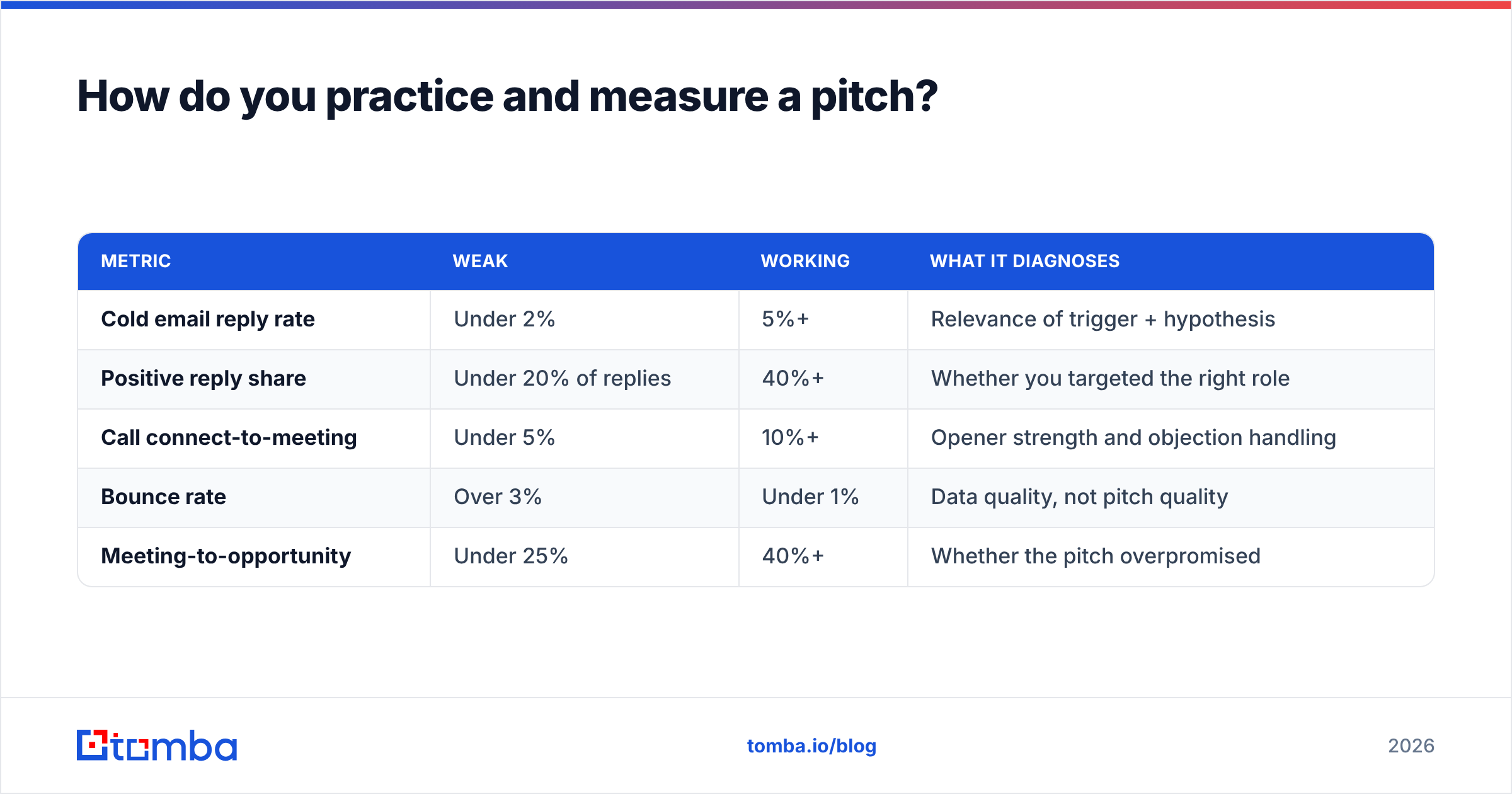
| Metric | Weak | Working | What it diagnoses |
|---|---|---|---|
| Cold email reply rate | Under 2% | 5%+ | Relevance of trigger + hypothesis |
| Positive reply share | Under 20% of replies | 40%+ | Whether you targeted the right role |
| Call connect-to-meeting | Under 5% | 10%+ | Opener strength and objection handling |
| Bounce rate | Over 3% | Under 1% | Data quality, not pitch quality |
| Meeting-to-opportunity | Under 25% | 40%+ | Whether the pitch overpromised |
That last row is the one teams ignore. If your meeting rate is climbing but opportunities are not, your pitch is writing checks discovery cannot cash. That is worse than a low reply rate, because you are burning calendar time and reputation simultaneously.
Also track your response rate by segment rather than in aggregate. An 4% blended rate might be 9% in your best vertical and 0.5% in three others you should stop pitching entirely. Aggregates hide the decision.
For structuring the broader motion around the pitch — sequencing, cadence, follow-up counts — HubSpot's sales resources remain a solid free reference, and their data on follow-up persistence is worth reading before you decide two touches is enough. It isn't.
What should you stop doing immediately?#
Short list, all of them common, all of them costly:
- Opening with your company name and title. Nobody has ever bought because of a title. Lead with the trigger.
- Asking "did I catch you at a bad time?" You are handing them a scripted exit.
- Sending the same pitch to five people at one account on the same day. They talk. It reads as automation, because it is.
- Pitching features before pain. Covered above, but it bears repeating because it is the default failure mode under pressure.
- Skipping verification to hit send faster. You are trading a permanent asset (domain reputation) for an hour of speed.
- Writing a new pitch every week. Change one variable at a time or you will never know what worked.
The through-line: a pitch is a system, not a performance. Systems get measured, versioned, and improved. Performances just get rated.
Where should you start this week?#
Pick your ten best-fit accounts. Write the six-step skeleton for each — trigger, hypothesis, proof, differentiator, ask, silence. Then check whether you can actually reach the right person at each one before you write a single word of copy.
That last check is where most pitch improvements die quietly. If the address is wrong or the contact left the company eight months ago, the best hypothesis in your pipeline never gets read.
Start with the Tomba Email Finder. Give it a name and a domain, and it returns the verified professional address with a confidence score, so the pitch you spent twenty minutes sharpening actually lands in a human inbox. The free tier covers 25 searches a month — enough to build your first trigger-based list, prove the framework on real accounts, and decide whether volume justifies a paid plan afterward.
Related guides#
// get started
Find, verify and enrich your first contacts today
Start on the free plan with 25 searches a month, then scale when your team is ready.
Free plan · No credit card required · GDPR & CCPA
// about the author