How to Pitch to Decision Makers: A 2026 Field Guide
Executives kill 70% of deals that champions love. Here is the research-backed framework for reaching, framing, and closing a pitch to the person who actually signs.
TL;DR
- Decision makers do not buy products. They buy a defensible answer to "why now, why this, why you" that they can repeat to their own boss in 30 seconds.
- The average B2B buying group is 6–10 people. Your champion is rarely the signer — plan the pitch for the person with budget authority, not the person who replies fastest.
- Lead with a quantified business problem, not a feature list. Anchor on a metric the exec already reports on (CAC, churn, pipeline coverage, headcount efficiency).
- Get the meeting first: verified contact data beats clever copy. A perfect pitch to a bounced address converts at zero percent.
- Run the pitch in four beats — Context, Cost of Inaction, Mechanism, Decision Ask — and end with a specific next step, never "let me know your thoughts."
You have probably had this happen. Your champion loves the product. They ran the trial, they built the internal slide, they told you it was "basically a formality." Then the VP joined the call, asked two questions you did not expect, and the deal went dark for a quarter.
That is not a pitch problem in the way most sellers think. It is a translation problem. What excites an end user — time saved, a nicer UI, fewer manual steps — is not what a decision maker is scored on. This guide covers how to pitch to decision makers in a way that survives the gap between those two audiences.
Who is actually the decision maker in a B2B deal?#
Start by dropping the singular. Gartner's research on B2B buying has consistently found that the typical purchase involves six to ten stakeholders, each arriving with independently gathered information. There is rarely one person who decides; there is one person who can stop the deal and one who can sign it, and they are not always the same human.
Map the group before you build the pitch:
- The economic buyer — controls the budget line, cares about payback period and risk. Usually a VP or C-level. This is who your pitch is ultimately aimed at, even when they are not in the room.
- The champion — feels the pain daily, will sell internally on your behalf, but has no signing authority. Your job is to arm them, not to convince them twice.
- The technical evaluator — security, IT, or data ops. Cannot say yes, can absolutely say no. Handle with documentation, not enthusiasm.
- The blocker — owns a competing initiative or the incumbent tool. Often invisible until late. Surface them early by asking "who else would have an opinion on this?"
- The end users — the people who will live in the product. Their adoption risk is a line item in the exec's mental model.
Most stalled deals trace back to pitching beat #2 (the champion's pain) to an audience that only rewards beat #1 (the economic case).
What do decision makers care about that end users don't?#
Executives filter every incoming pitch through three questions: does this move a number I am accountable for, what happens if I do nothing, and how likely is this to blow up on me. Everything else is noise.
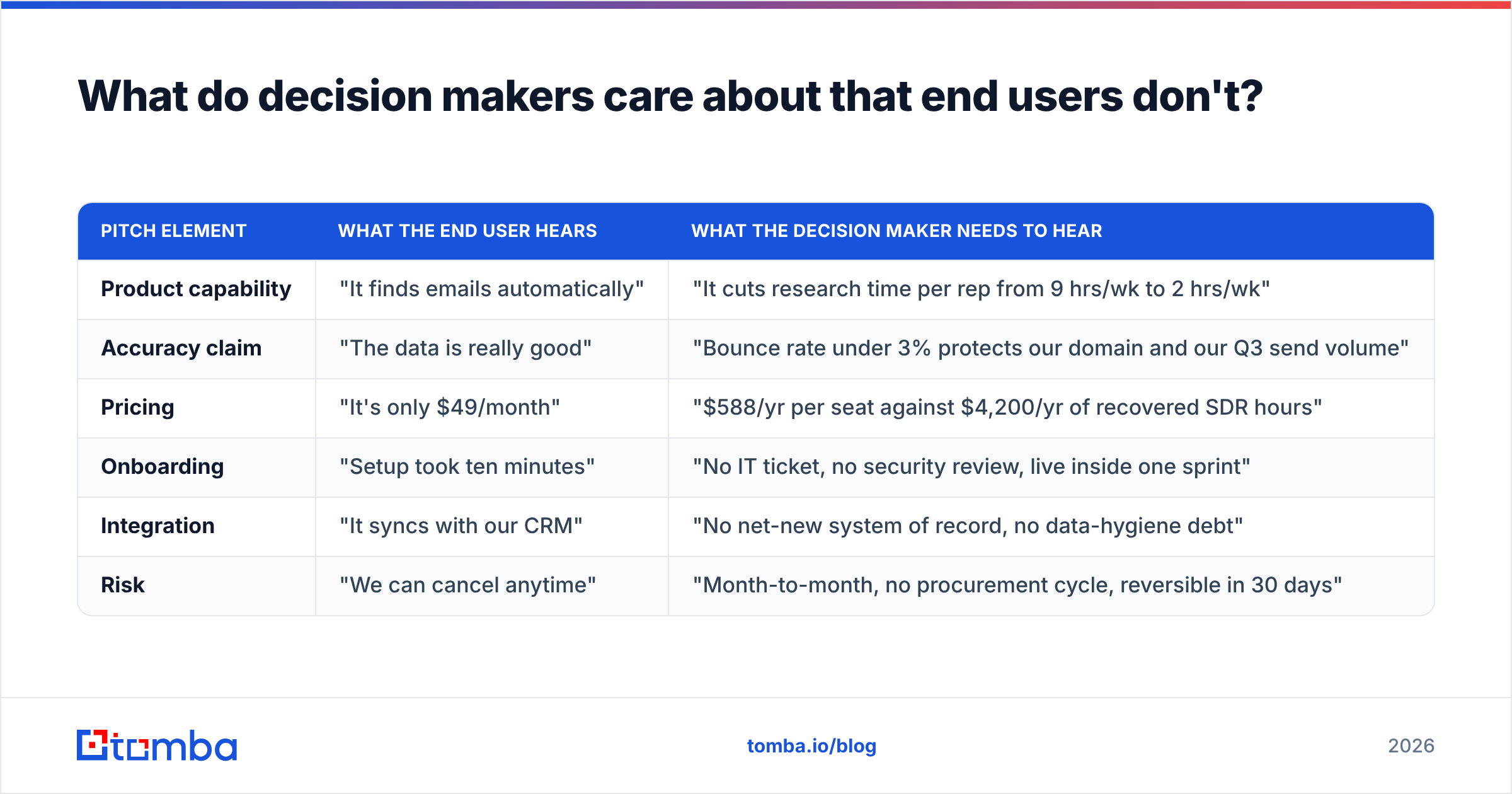
The table below is the translation layer. Take whatever you currently say to a champion and move it one column right.
| Pitch element | What the end user hears | What the decision maker needs to hear |
|---|---|---|
| Product capability | "It finds emails automatically" | "It cuts research time per rep from 9 hrs/wk to 2 hrs/wk" |
| Accuracy claim | "The data is really good" | "Bounce rate under 3% protects our domain and our Q3 send volume" |
| Pricing | "It's only $49/month" | "$588/yr per seat against $4,200/yr of recovered SDR hours" |
| Onboarding | "Setup took ten minutes" | "No IT ticket, no security review, live inside one sprint" |
| Integration | "It syncs with our CRM" | "No net-new system of record, no data-hygiene debt" |
| Risk | "We can cancel anytime" | "Month-to-month, no procurement cycle, reversible in 30 days" |
Notice that nothing in the right-hand column is a feature. Every line is a number, a timeframe, or a risk boundary. That is the register decision makers operate in, and it is the register your champion needs to be handed pre-written, because they will not construct it themselves.
How do you get the meeting in the first place?#
A pitch framework is worthless if it never gets in front of the person with budget. This is where most outbound programs quietly fail — not on messaging, but on reach.
Three things need to be true before your message lands:
- You have the right person. Titles drift. The "VP Marketing" who owned this budget 18 months ago may now sit under a CRO who owns it instead. Verify current role, not scraped-in-2023 role.
- You have a deliverable address. Sending to stale or guessed addresses drives bounces, and bounces damage sender reputation across your whole domain. One bad list can suppress the deliverability of every other sequence you run.
- You have a second channel. Executives ignore email at higher rates than any other persona. A verified mobile number or an active LinkedIn presence gives you a follow-up path that is not another unopened thread.
Practically, this means building the exec list deliberately rather than exporting whatever a database hands you. Use a domain search to see the actual email pattern and current staff at the target company, then run each address through an email verifier before it enters a sequence. For accounts where email is saturated, a phone finder gives you the parallel path. The mechanics matter more than the copy at this stage: an outstanding pitch to first.last@ at a company that uses flast@ is a pitch nobody read.
One useful shortcut for warming the approach: check whether the exec has published anything — a conference talk, a byline, a podcast appearance. An author finder surfaces bylined contacts directly, and referencing something they actually wrote outperforms any personalization token you can merge into a template.
What is the four-beat structure for an executive pitch?#
Once you are in the room — 20 minutes, maybe 30, with someone who will check their phone — run this sequence. It works on a call, in a deck, or compressed into a six-sentence email.
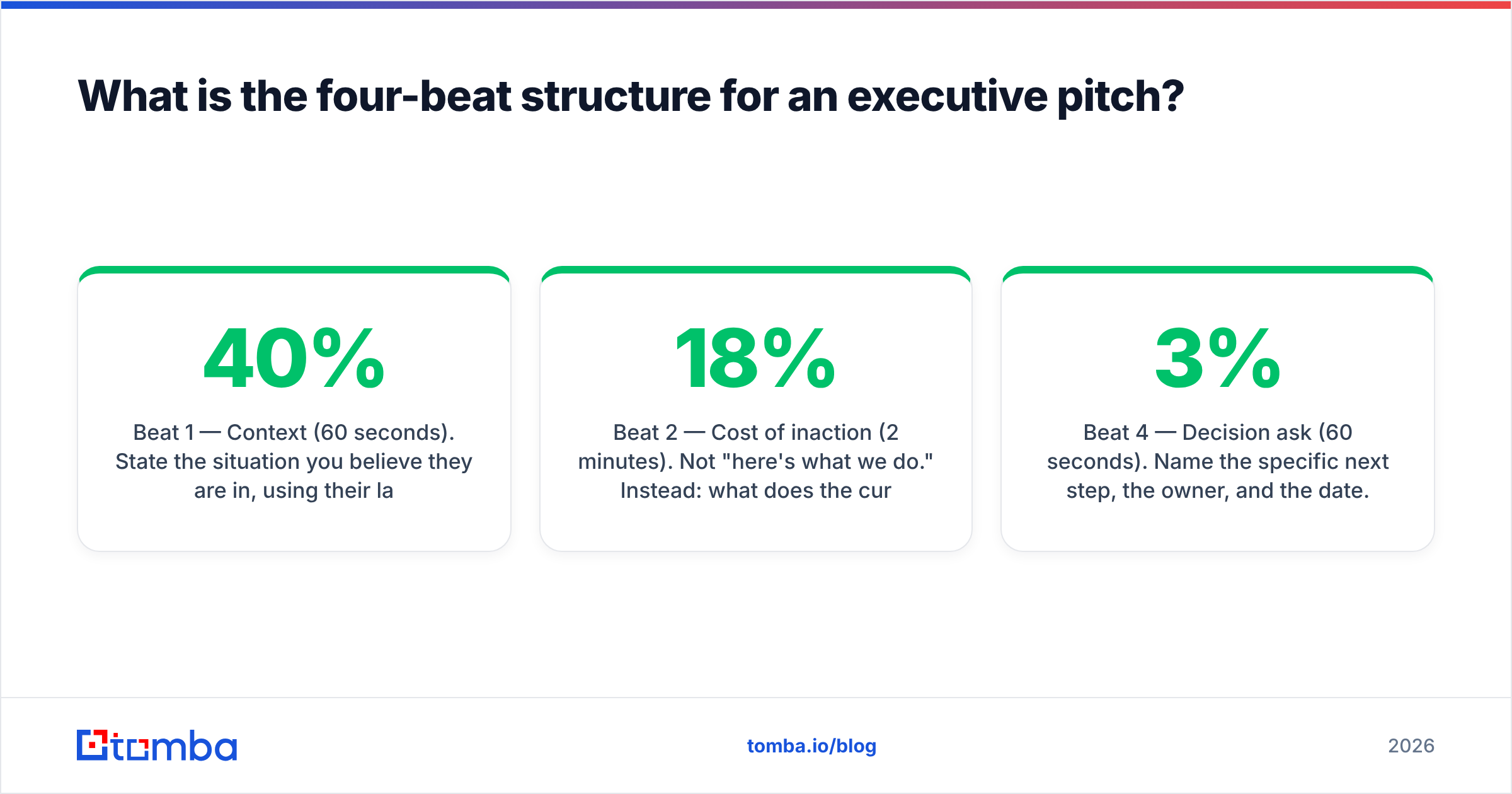
Beat 1 — Context (60 seconds). State the situation you believe they are in, using their language and their numbers. "You've grown the SDR team from 4 to 11 in a year, and outbound-sourced pipeline is up 40% while cost per meeting is up 65%." If you are wrong, they will correct you, and the correction is worth more than the pitch. If you are right, you have earned the next four minutes.
Beat 2 — Cost of inaction (2 minutes). Not "here's what we do." Instead: what does the current path cost over the next four quarters? Quantify it. Executives are far more responsive to a defensible loss than a speculative gain — a bias that holds up consistently in behavioural economics research and shows up in every enterprise procurement cycle. "At your current bounce rate, roughly 18% of the list your team builds each month is unreachable. That's 1.8 of every 10 SDR hours spent on contacts that don't exist."
Beat 3 — Mechanism (3 minutes). Now the product, but framed as how the number changes, not what the software does. One or two capabilities, maximum. Show the workflow with their data if you can. This is the only beat where a demo belongs, and it should be short enough that they ask for more rather than checking out.
Beat 4 — Decision ask (60 seconds). Name the specific next step, the owner, and the date. "I'd like to run 500 of your target accounts through verification this week and send you the bounce-rate delta by Friday. If it's under 3%, does that justify a pilot with two reps?" Never end on "let me know your thoughts." That phrase converts a decision into a to-do item, and to-do items expire.

How should the pitch change by seniority?#
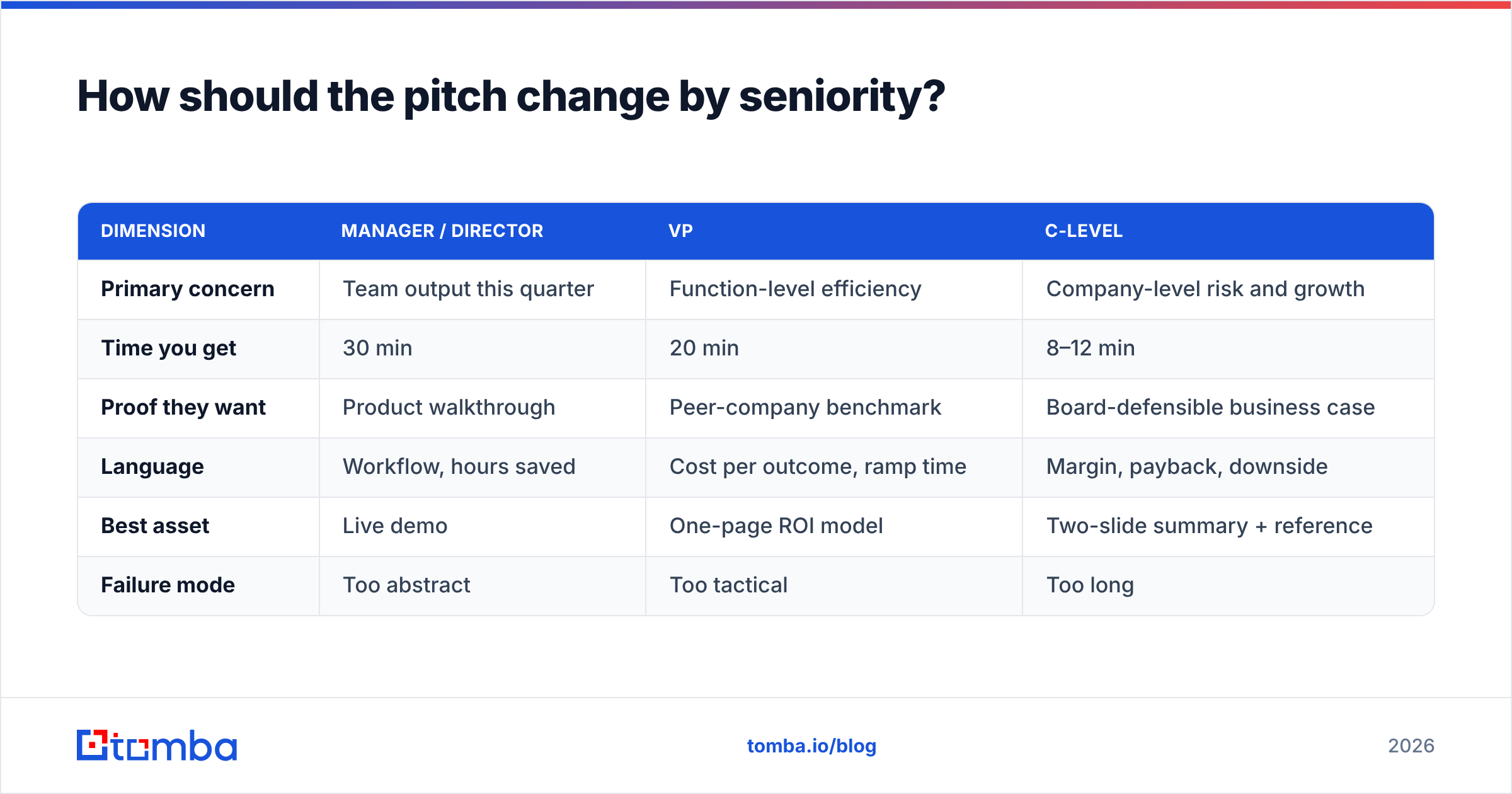
The same product deserves a different pitch depending on who is across the table. Here is how the emphasis shifts:
| Dimension | Manager / Director | VP | C-level |
|---|---|---|---|
| Primary concern | Team output this quarter | Function-level efficiency | Company-level risk and growth |
| Time you get | 30 min | 20 min | 8–12 min |
| Proof they want | Product walkthrough | Peer-company benchmark | Board-defensible business case |
| Language | Workflow, hours saved | Cost per outcome, ramp time | Margin, payback, downside |
| Best asset | Live demo | One-page ROI model | Two-slide summary + reference |
| Failure mode | Too abstract | Too tactical | Too long |
The most common mistake is running the director-level pitch upward. A CRO does not want your demo. They want to know the payback period and whether anyone comparable has already done this successfully. Conversely, running the C-level pitch downward feels evasive to a manager who genuinely wants to see the tool work.
What are the mistakes that kill executive pitches?#
Pitching the champion's pain to the budget holder. "Your reps hate manual research" is a complaint, not a business case. Convert it: manual research consumes X hours at Y fully-loaded cost.
Leading with your company. Nobody senior cares that you were founded in 2019 or that you have 40,000 users. Cut the company slide entirely or move it to the appendix.
Over-indexing on features. Every additional capability you mention dilutes the one that matters. Pick the single mechanism that moves their number and defend it.
Ignoring the status quo as a competitor. Your real competition is usually "do nothing" or "we already have a spreadsheet." HubSpot's sales research repeatedly finds that inertia, not a rival vendor, is the most common reason deals are lost. Address it directly: what does year two of the spreadsheet look like?
No written follow-up the champion can forward. After the meeting, send a short, forwardable summary — problem, quantified cost, proposed step, timeline. Assume it will be pasted into Slack without your name on it. Write it so it survives that.
Guessing at contact data. Worth repeating because it silently caps everything else. If your enrichment is stale, your best-crafted pitch reaches an inbox that no longer exists. Run data enrichment on the account before the exec outreach, not after the champion goes quiet.
How do you follow up without being annoying?#
Executive follow-up is a different discipline from SDR cadence. Volume does not work; relevance does.
- Anchor every touch to something new. A competitor announcement, a hiring signal, a published benchmark. "Following up on my last email" is not a reason to write.
- Shorten each message. Touch one: five sentences. Touch three: two sentences. If they are not reading, adding words does not help.
- Go multi-threaded, not louder. If the VP goes dark, the answer is usually a second stakeholder, not a fourth email. Find the peer or the direct report who feels the same pain.
- Set an explicit expiry. "If the timing is wrong, I'll circle back in Q1 — just say the word." This gets replies at a strikingly high rate because it hands them an easy out, and an easy out is still a response.
- Track deliverability, not just opens. If your follow-ups are landing in spam, your "no response" data is fiction. Check your domain's SPF record and monitor bounce rates as a leading indicator.
For teams comparing outreach and data platforms at this stage, G2's sales intelligence category is a reasonable neutral starting point — vendor claims about accuracy vary wildly and peer reviews at least normalise the comparison.
What does a good pitch look like in writing?#
Compress the four beats into six sentences. Here is the shape, not a template to copy verbatim:
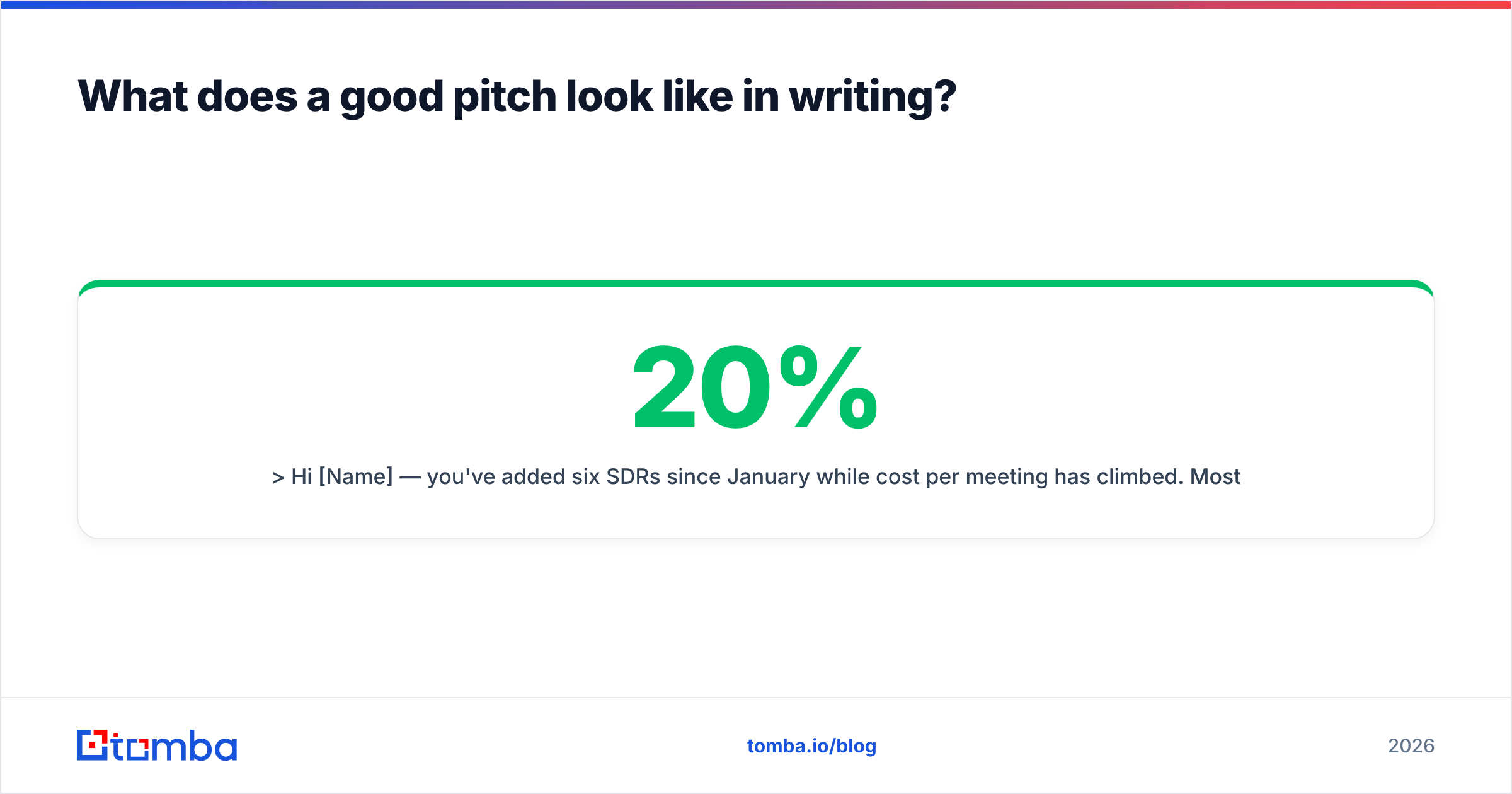
Hi [Name] — you've added six SDRs since January while cost per meeting has climbed. Most teams at that stage lose 15–20% of outbound capacity to contact data that's stale or unverified, which shows up as bounce rate and wasted research hours rather than as a line item. We verify contact data before it enters your sequences, so reps work lists that are actually reachable. Two teams your size cut bounce rate from 14% to under 3% within a month. I can run 500 of your target accounts through verification this week and send you the delta — no cost, no commitment. Worth 15 minutes if the number surprises you?
Context. Quantified cost. Mechanism. Proof. Specific ask. Under 120 words. That email gets forwarded; a 400-word feature description does not.
Where should you start this week?#
Pick one target account tier — say, your 50 highest-ACV open opportunities where the champion is engaged but no exec has been reached. For each, identify the economic buyer by name, verify their contact details, and write the six-sentence version of your pitch aimed at them rather than at your champion. That is one afternoon of work and it typically surfaces two or three deals that were stalled purely because nobody with budget had ever seen the business case.
If contact accuracy is the bottleneck — and for most teams running executive outreach it is — start with the Tomba Email Finder. Find and verify the decision maker's address by name and domain before you spend an hour writing the pitch, so your best message reaches the person who can actually approve it. The free tier covers 25 searches a month, and paid plans start at $49/mo; full Tomba pricing is on the site if you need to size it for a team.
Related guides#
// get started
Find, verify and enrich your first contacts today
Start on the free plan with 25 searches a month, then scale when your team is ready.
Free plan · No credit card required · GDPR & CCPA
Get the Tomba newsletter
Product and data updates
// about the author