How to Plan a Sales Kickoff That Actually Changes Behavior
Most sales kickoffs are expensive theater. Here's a working timeline, an agenda that survives contact with quota, a real budget breakdown, and the 30-day follow-through that decides whether any of it sticks.
TL;DR
- A sales kickoff (SKO) is not a party with slides. It is a behavior-change event with a budget, and it should be planned backwards from one measurable outcome you name before you book anything.
- Start 12–16 weeks out for in-person, 6–8 weeks for virtual. Anything shorter and you get a status-update meeting with catering.
- Cap executive presentations at 25% of agenda time. Put the other 75% into practice: live call reviews, pitch certification, territory planning with real data.
- Budget realistically: $1,200–$2,500 per rep in-person, $150–$400 per rep virtual. The line item people forget is post-event reinforcement.
- The SKO does not end on the last day. Without a 30/60/90 reinforcement plan, roughly everything you taught decays within a month.
What is a sales kickoff, and what is it actually for?#
A sales kickoff is the annual (sometimes semi-annual) event where a revenue org resets targets, retrains the team, and launches the new year's messaging. That is the textbook answer. The useful answer is narrower.
Think of an SKO like a pit stop in motorsport. The car is already fast. You are not rebuilding the engine — you have seconds to change the tires, refuel, and send it back out with a new race plan. Teams that treat the SKO as a rebuild (new methodology, new CRM, new comp plan, new ICP, all at once) send reps back onto the track with four half-installed tires.
So the framing question is: what one behavior do you want different on the Monday after?
Common valid answers:
- Reps stop leading discovery with product and start leading with a diagnostic question set.
- Reps run multithreaded deals — three contacts minimum per open opportunity.
- Reps prospect into a newly defined ICP segment instead of recycling last year's accounts.
- Reps use the new pricing structure without discounting to the floor in week one.
Pick one. Maybe two. The agenda, the breakouts, the exercises, and the post-event scorecard all descend from that choice. If you cannot state the target behavior in a sentence, you are planning a conference, not a kickoff.
When should you start planning a sales kickoff?#
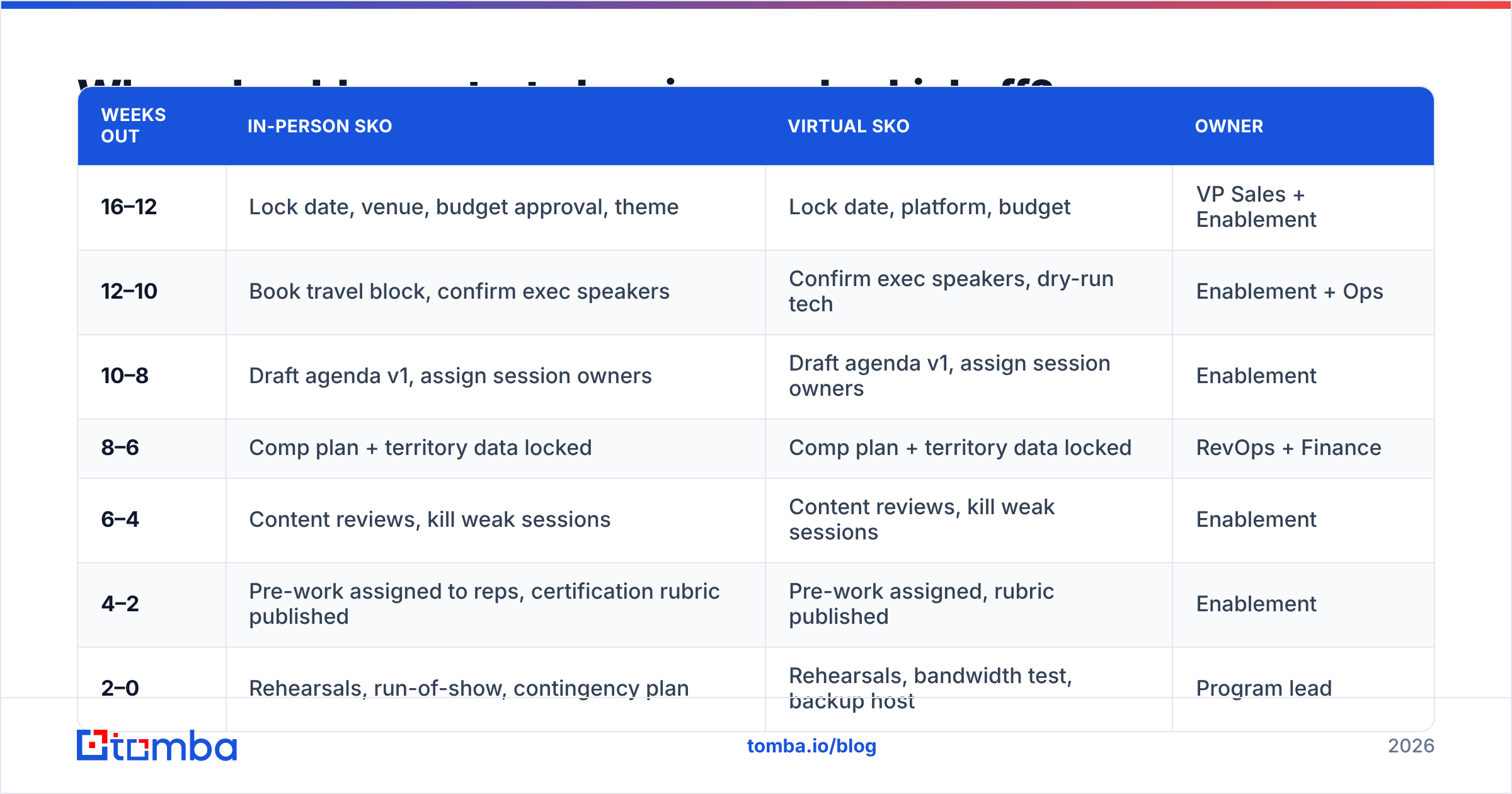
Backwards from the event date. Here is a working timeline that assumes a January or February kickoff for a 40–150 person revenue org.
| Weeks out | In-person SKO | Virtual SKO | Owner |
|---|---|---|---|
| 16–12 | Lock date, venue, budget approval, theme | Lock date, platform, budget | VP Sales + Enablement |
| 12–10 | Book travel block, confirm exec speakers | Confirm exec speakers, dry-run tech | Enablement + Ops |
| 10–8 | Draft agenda v1, assign session owners | Draft agenda v1, assign session owners | Enablement |
| 8–6 | Comp plan + territory data locked | Comp plan + territory data locked | RevOps + Finance |
| 6–4 | Content reviews, kill weak sessions | Content reviews, kill weak sessions | Enablement |
| 4–2 | Pre-work assigned to reps, certification rubric published | Pre-work assigned, rubric published | Enablement |
| 2–0 | Rehearsals, run-of-show, contingency plan | Rehearsals, bandwidth test, backup host | Program lead |
| +1 to +12 | Reinforcement cadence, manager coaching, scorecard | Same | Frontline managers |
Two rows in that table get skipped constantly and cause the most damage.
The first is weeks 8–6: comp plan and territory data locked. If reps arrive and their territories are still "being finalized," they will spend the entire event whispering about accounts instead of listening. Nothing you present competes with a rep's anxiety about their book. Lock it or postpone.
The second is weeks +1 to +12. It is on the timeline because it is part of the event, not an afterthought. More on that below.

What should a sales kickoff agenda look like?#
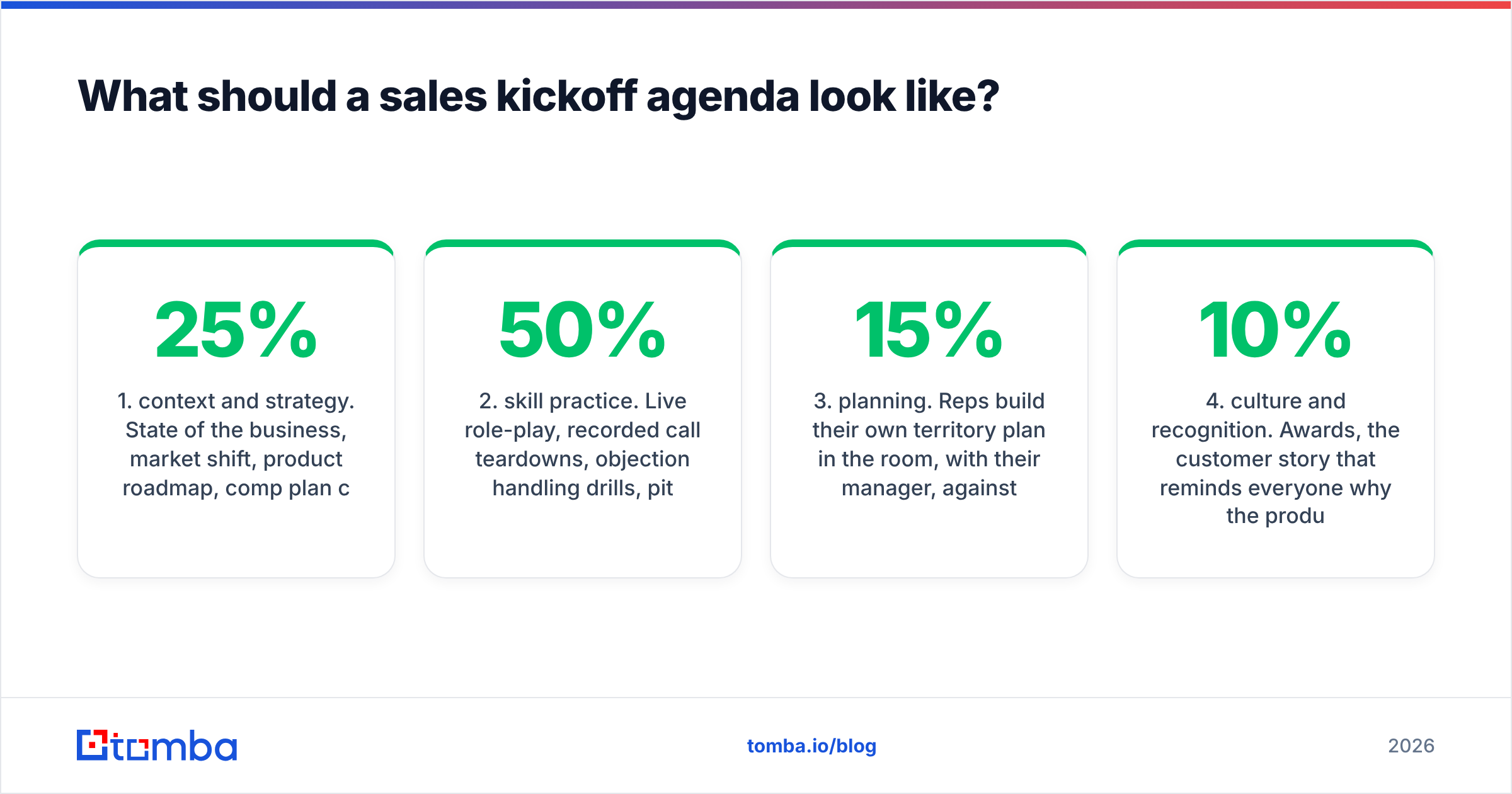
Use a fixed ratio rather than filling time. The 25/50/25 split holds up across org sizes:
- 25% context and strategy. State of the business, market shift, product roadmap, comp plan changes. Delivered by executives, time-boxed hard. If your CEO needs 90 minutes, the answer is 30 minutes plus a recorded deep dive.
- 50% skill practice. Live role-play, recorded call teardowns, objection handling drills, pitch certification with a pass/fail rubric. This is the part that changes Monday behavior and it is the first thing cut when the agenda runs long. Protect it.
- 15% planning. Reps build their own territory plan in the room, with their manager, against real account data. They should leave with a named list of accounts and a first-touch sequence, not a vague intention.
- 10% culture and recognition. Awards, the customer story that reminds everyone why the product matters, the dinner. Real value, but it is seasoning, not the meal.
Two structural rules make the 50% actually work:
- Small rooms beat big rooms. Breakouts of 8–12 reps with one manager facilitating. In a 200-person ballroom, four people participate and everyone else checks Slack.
- Every practice session ends in a score. A pitch certification where nobody can fail is not a certification. Publish the rubric two weeks early so reps prepare, and let managers re-certify stragglers in week two rather than embarrassing anyone on stage.
For structuring the strategy portion, HubSpot's sales enablement resources and Salesforce's sales leadership library both publish agenda frameworks worth stealing selectively — take the session formats, ignore the vendor-specific tooling advice.
How much does a sales kickoff cost?#
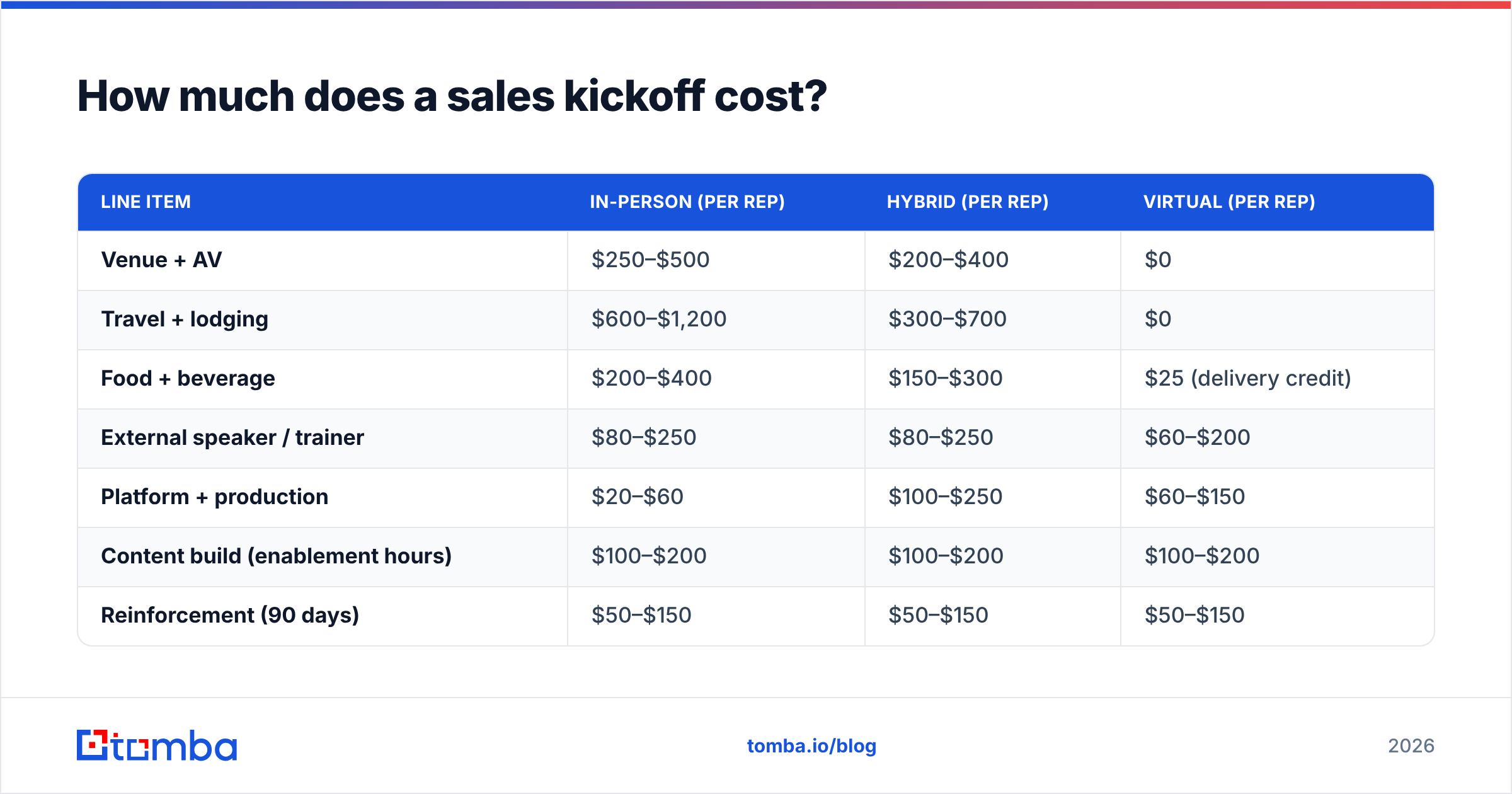
Budget per rep, not per event. Costs scale almost linearly with headcount, which makes per-rep the only number a CFO can benchmark.
| Line item | In-person (per rep) | Hybrid (per rep) | Virtual (per rep) |
|---|---|---|---|
| Venue + AV | $250–$500 | $200–$400 | $0 |
| Travel + lodging | $600–$1,200 | $300–$700 | $0 |
| Food + beverage | $200–$400 | $150–$300 | $25 (delivery credit) |
| External speaker / trainer | $80–$250 | $80–$250 | $60–$200 |
| Platform + production | $20–$60 | $100–$250 | $60–$150 |
| Content build (enablement hours) | $100–$200 | $100–$200 | $100–$200 |
| Reinforcement (90 days) | $50–$150 | $50–$150 | $50–$150 |
| Realistic total | $1,300–$2,760 | $980–$2,250 | $295–$685 |
Three notes on reading that table honestly.
Hybrid is not the cheap option. It is the expensive option that satisfies nobody, because you pay for production quality on top of partial travel. Hybrid works when you have a genuine two-tier structure — a leadership summit in person, a broader all-hands virtual — not when you are splitting one audience.
Enablement hours are a real cost. Building a pitch certification rubric, three role-play scenarios, and a call teardown library is 60–120 hours of skilled work. Teams that leave this line at zero end up with executives improvising slides the night before.
Reinforcement is the highest-ROI line item and the smallest. $50–$150 per rep for 90 days of manager coaching guides, scorecard tracking, and refresher content is the difference between an event and a program.
What content actually changes rep behavior?#
Filter every proposed session through one test: can a rep do something differently because of this?
Sessions that pass:
- Recorded call teardowns from your own team. Not a vendor's demo reel. Pull three calls — one that closed, one that stalled, one that died — and dissect them line by line. Reps recognize their own patterns immediately.
- Objection drills against the objection you actually lose to. Pull the real reason codes from your CRM. If 40% of losses cite "no budget this quarter," build the whole drill around that.
- Pitch certification with a rubric. Five minutes, live, scored against criteria you published in advance.
- Territory planning with live data in the room. Reps open a working list of target accounts and build the first sequence while managers walk the floor.
Sessions that fail the test:
- Product roadmap presented as a feature list with no "here is the sentence you say to a customer."
- A motivational keynote with no follow-up artifact.
- Any session where the deliverable is "awareness."
If you use a formal framework, tie it to something reps already trust. G2's category pages for sales enablement software are useful for benchmarking what your peers actually deploy, rather than what a conference stage says they should.
How do you prep the data so reps can sell on day one?#
This is the operational half of kickoff planning that enablement teams under-own, and it is where the "changes behavior on Monday" promise usually breaks.
A territory planning session with stale account data is worse than no session, because reps leave with a plan built on contacts who left the company eight months ago. Before the event:
- Freeze territories 6 weeks out. Reps need time to object, escalate, and accept before they can plan.
- Refresh contact data on every named account. Titles change, people leave, domains get acquired. Run your target account list through data enrichment so the names in the room are the names who exist.
- Verify before the event, not after. A bulk email verifier pass on the target list means reps' first sequences don't bounce into a spam-folder spiral in week one — which is exactly when leadership is watching activity dashboards.
- Fill the gaps in the ICP segment you just launched. If the SKO announces a new vertical push, reps need contacts in that vertical before they leave the room. A domain search across the new target account list turns a strategy slide into a working prospect list.
- Set the accuracy expectation. Tell reps what "good" data looks like and where it comes from. Understanding where the data comes from makes them likelier to trust it and less likely to fall back on their personal spreadsheet from 2024.
Do this and the territory planning block produces artifacts — named accounts, verified contacts, drafted first touches. Skip it and the block produces a document nobody opens again.

How do you measure sales kickoff ROI?#
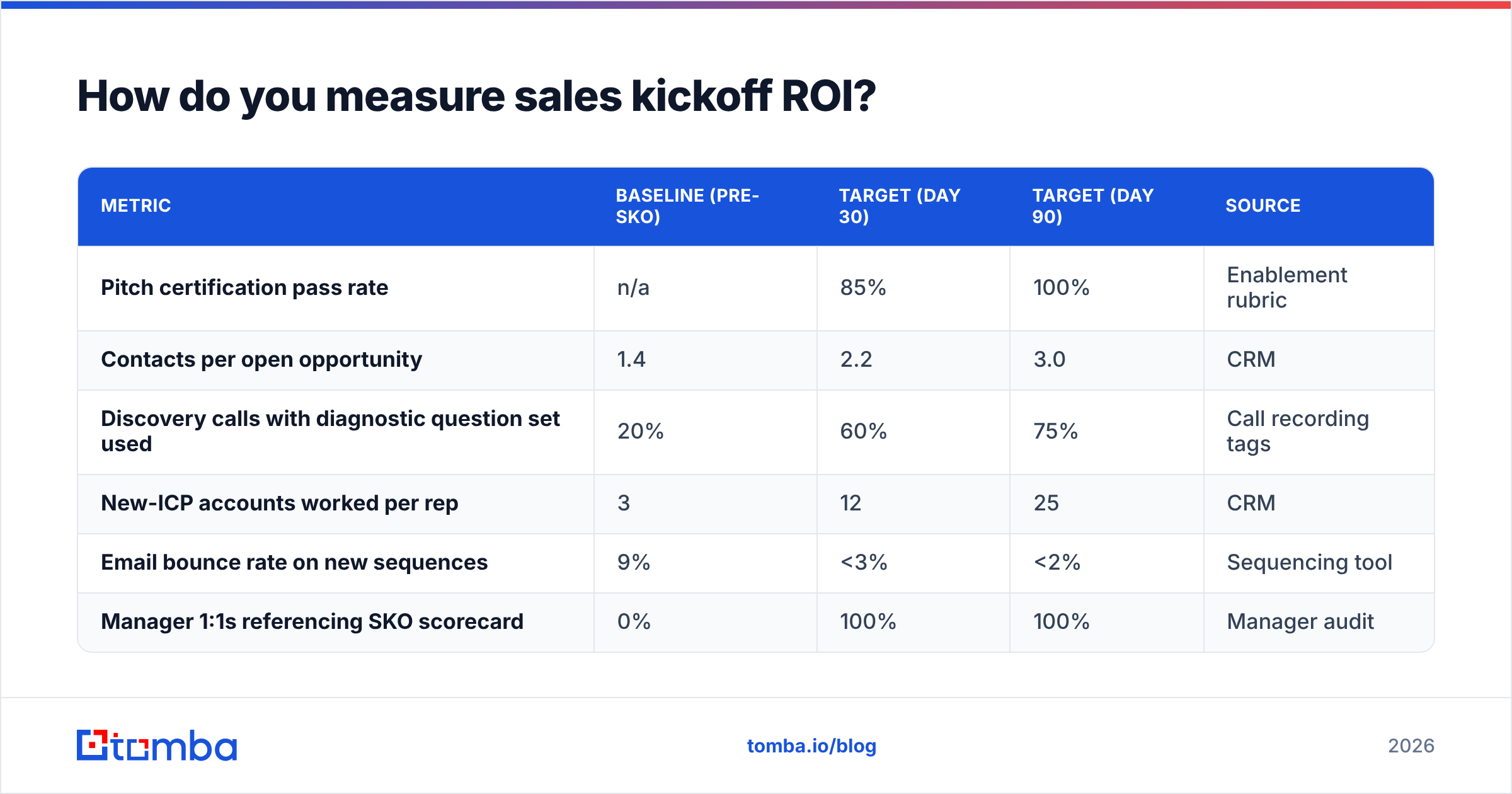
You cannot attribute pipeline to an event cleanly, and pretending otherwise damages your credibility with finance. What you can do is measure leading indicators of the specific behavior you targeted, on a fixed cadence.
| Metric | Baseline (pre-SKO) | Target (Day 30) | Target (Day 90) | Source |
|---|---|---|---|---|
| Pitch certification pass rate | n/a | 85% | 100% | Enablement rubric |
| Contacts per open opportunity | 1.4 | 2.2 | 3.0 | CRM |
| Discovery calls with diagnostic question set used | 20% | 60% | 75% | Call recording tags |
| New-ICP accounts worked per rep | 3 | 12 | 25 | CRM |
| Email bounce rate on new sequences | 9% | <3% | <2% | Sequencing tool |
| Manager 1:1s referencing SKO scorecard | 0% | 100% | 100% | Manager audit |
Notice that none of those are revenue. Revenue arrives two to four sales cycles later and is confounded by a dozen variables. The honest pitch to your CFO is: "Here are six behaviors we changed and the cost per rep to change them. Here is the win rate trend we expect those behaviors to move by Q3." That earns more credibility than a fabricated attribution model.
What are the most common sales kickoff mistakes?#
- Announcing the comp plan as a surprise. Reps stop listening the moment they suspect their earnings changed. Communicate comp before the event, in writing, one-to-one with managers.
- Cramming three initiatives into one event. New methodology, new segment, and new pricing in the same 48 hours means none of them land. Sequence them across quarters.
- No manager enablement track. Frontline managers are the delivery mechanism for everything you taught. If they get the same content as reps and no coaching guide, reinforcement dies on day two.
- Filming nothing. Every session should be recorded and clipped. New hires joining in March deserve the same launch content.
- Scheduling zero unstructured time. Reps swap more tactical knowledge in hallways than in half your breakouts. Build in real gaps.
- Ending without a scorecard. If nobody is tracking the six metrics above by Day 30, the event was entertainment. Expensive, occasionally excellent entertainment — but not enablement.
What does a good post-kickoff week one look like?#
Concrete and boring, by design:
- Day 1: Recording library published, scorecard live in the CRM dashboard, certification results sent to managers.
- Day 3: Every manager runs a 1:1 referencing the rep's individual territory plan from the event.
- Day 5: First cohort of re-certifications for anyone who did not pass live.
- Day 10: Enablement publishes a two-page recap with the three behaviors, the metric for each, and where to find the drill.
- Day 30: Leadership reviews the scorecard table. Sessions that produced no metric movement get cut from next year's agenda.
That last line is the flywheel. An SKO that audits itself gets better every year. An SKO that only gets a satisfaction survey gets longer every year.
Ready to make the territory planning block actually work? The fastest way to turn a strategy slide into a working prospect list is to arrive with verified contacts already in hand. Tomba's Email Finder lets your enablement team build and validate target-account contact lists before reps ever sit down — start free with 25 searches a month, or check Tomba pricing for team plans starting at $49/mo. Prep the data, and your kickoff ends with reps sending real emails instead of filing another plan.
Related guides#
// get started
Find, verify and enrich your first contacts today
Start on the free plan with 25 searches a month, then scale when your team is ready.
Free plan · No credit card required · GDPR & CCPA
// about the author