How To Prepare For A Discovery Call: A 2026 Playbook
Most discovery calls fail before the dial tone. Here is the 30-minute research routine, the question framework, and the data checks that turn a first call into a qualified pipeline.
TL;DR
- A discovery call is won in the 30 minutes before it starts, not in the 30 minutes it runs. Research the account, the person, and the trigger event — in that order.
- Build a written pre-call brief: company snapshot, likely pain hypothesis, 3 must-ask questions, 2 disqualifiers, and one clear next step you will propose.
- Talk-to-listen ratio should sit near 30:70. Prepare questions, not a pitch deck.
- Verify the contact data before the call. Wrong title, wrong company, or a bounced calendar invite kills the meeting before it begins.
- Close every discovery call with a scheduled next step and a written recap sent the same day. No recap, no deal.
What Is A Discovery Call, Exactly?#
A discovery call is a structured conversation whose only job is to find out whether a real problem exists, who owns it, what it costs, and whether your product is a plausible fix. It is not a demo. It is not a pitch. It is a diagnosis.
Think of it like a doctor's first appointment. A bad doctor walks in and prescribes antibiotics before you finish the sentence. A good one asks where it hurts, when it started, what you have already tried, and what happens if nothing changes. Same fifteen minutes, wildly different outcome.
The technical framing: discovery is the qualification stage between a booked meeting and an evaluation. You are collecting inputs for a decision — yours and theirs. If you leave the call unable to write down the prospect's problem in their own words, you did not run discovery. You ran a conversation.
Most reps skip preparation because the meeting is already booked and it feels like the hard part is over. It is not. A booked meeting is a 30-minute credit line; preparation decides whether you spend it or waste it.
Why Does Preparation Decide The Outcome?#
Because attention is the scarcest thing in the call. Your buyer gives you roughly five minutes of genuine attention before they decide whether this is worth the rest of the slot. Everything you do in preparation buys you those five minutes.
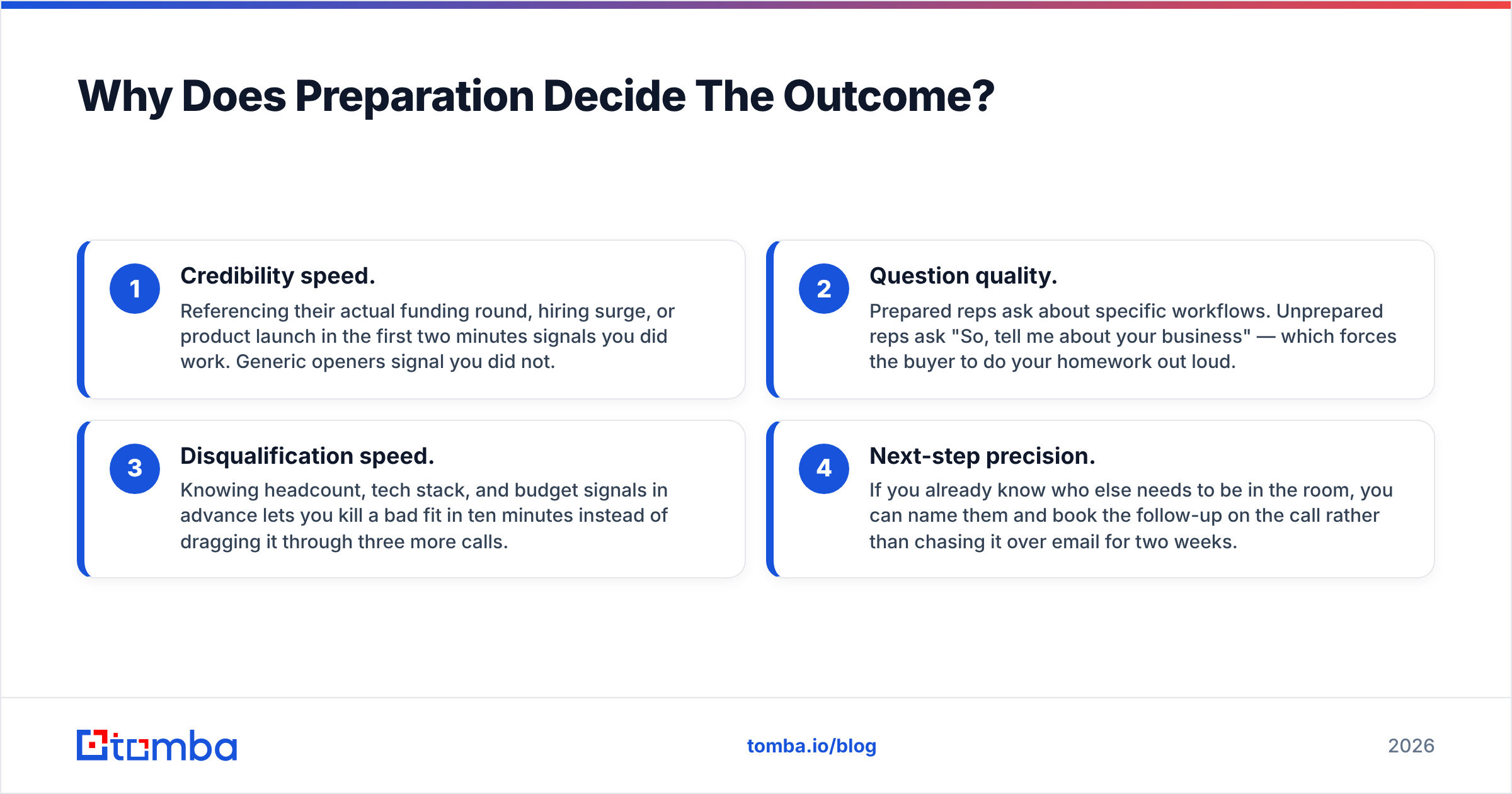
Concretely, preparation moves four things:
- Credibility speed. Referencing their actual funding round, hiring surge, or product launch in the first two minutes signals you did work. Generic openers signal you did not.
- Question quality. Prepared reps ask about specific workflows. Unprepared reps ask "So, tell me about your business" — which forces the buyer to do your homework out loud.
- Disqualification speed. Knowing headcount, tech stack, and budget signals in advance lets you kill a bad fit in ten minutes instead of dragging it through three more calls.
- Next-step precision. If you already know who else needs to be in the room, you can name them and book the follow-up on the call rather than chasing it over email for two weeks.
Research from HubSpot's sales data consistently shows that buyers rate "understood my needs" as a top differentiator between the rep they buy from and the ones they ignore. That understanding is manufactured before the call, not improvised during it.

How Do You Research An Account In 30 Minutes?#
Timebox it. Thirty minutes is enough for a first call; anything longer is procrastination dressed as diligence. Here is the split that works.
Minutes 0–8: The company. Pull the About page, the latest press release, and the careers page. Job postings are the single most underrated signal in B2B — a company hiring three RevOps analysts is telling you exactly where its pain is. Check G2 reviews of their current vendors in your category if they list any.
Minutes 8–15: The person. LinkedIn profile, tenure in role, previous employers, recent posts or comments. Someone eleven months into a VP role is usually still building their stack; someone six years in is defending one. Those are different conversations.
Minutes 15–22: The trigger. Why is this meeting happening now? Inbound demo request, cold outbound reply, referral, conference badge scan — each implies a different level of intent and a different opening. Read the original form fill or email thread verbatim. The words they used are the words you should reflect back.
Minutes 22–30: The brief. Write it down. A pre-call brief that lives only in your head is not a brief. One page, five sections, in your CRM so the rest of the team can see it.
Data quality is the invisible half of this. If your contact record has a stale title or a role that changed six months ago, your carefully researched opener lands wrong. Running the contact through an email verifier before the invite goes out, and using data enrichment to refresh title and company size, removes an entire class of avoidable embarrassment.
What Goes Into A Pre-Call Brief?#
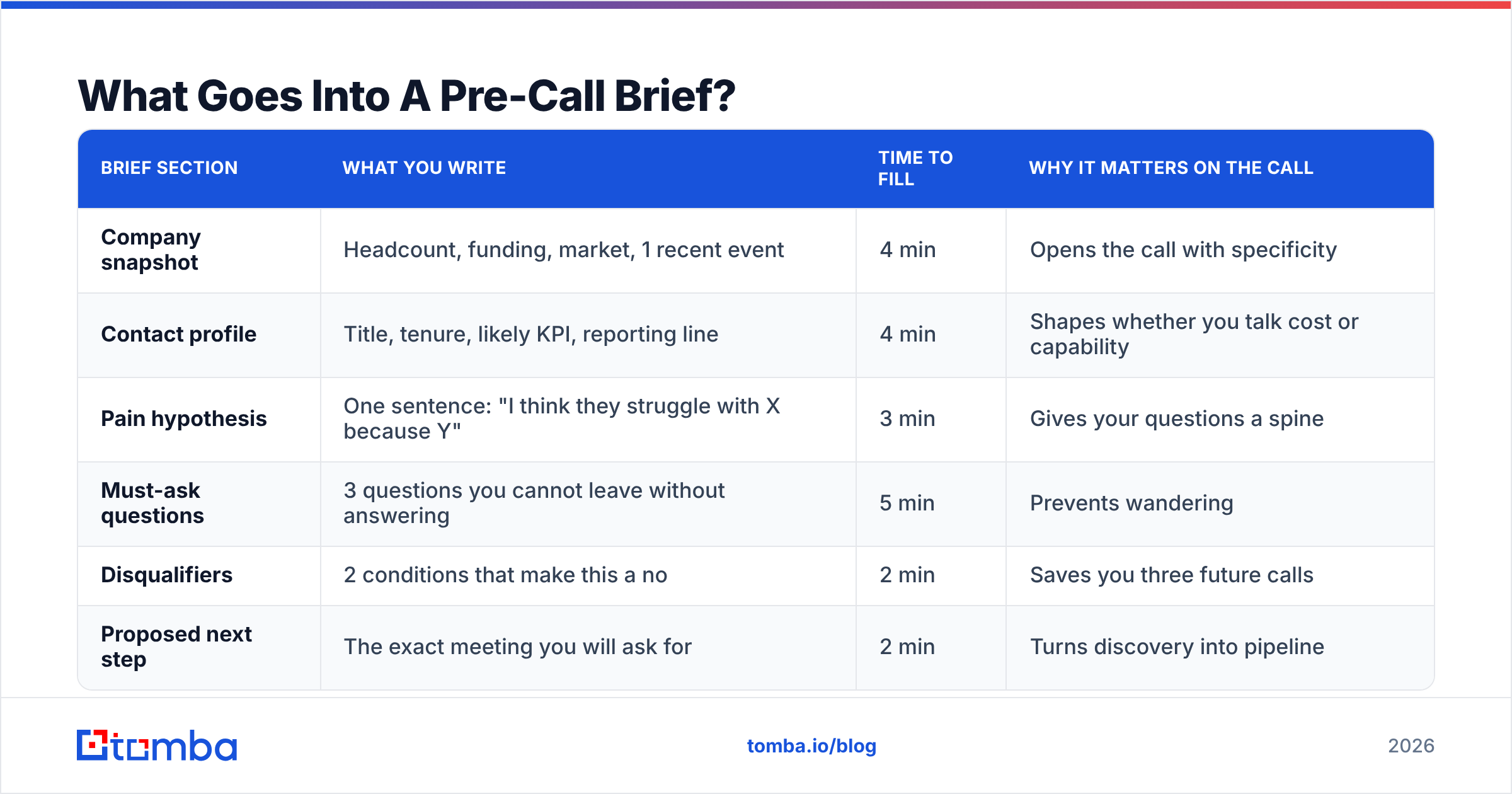
| Brief section | What you write | Time to fill | Why it matters on the call |
|---|---|---|---|
| Company snapshot | Headcount, funding, market, 1 recent event | 4 min | Opens the call with specificity |
| Contact profile | Title, tenure, likely KPI, reporting line | 4 min | Shapes whether you talk cost or capability |
| Pain hypothesis | One sentence: "I think they struggle with X because Y" | 3 min | Gives your questions a spine |
| Must-ask questions | 3 questions you cannot leave without answering | 5 min | Prevents wandering |
| Disqualifiers | 2 conditions that make this a no | 2 min | Saves you three future calls |
| Proposed next step | The exact meeting you will ask for | 2 min | Turns discovery into pipeline |
The pain hypothesis is the piece most reps skip and the piece that does the most work. It forces you to commit to a theory before the call, which makes the call a test rather than a fishing expedition. You are allowed to be wrong. You are not allowed to have no theory.
Which Questions Should You Actually Ask?#
Prepare more questions than you will use, and rank them. Order matters more than volume — you earn the right to ask about budget by first understanding the problem.
- Situation questions — "Walk me through how your team handles [process] today." Cheap to answer, warms the conversation, gives you vocabulary.
- Problem questions — "Where does that break down?" and "How often does that happen?" This is where you validate or kill your hypothesis.
- Impact questions — "What does that cost you in hours or revenue per month?" Quantification is what makes the deal survive procurement later.
- Consequence questions — "What happens if you do nothing for another two quarters?" This separates a genuine priority from an interesting annoyance.
- Process questions — "Who else weighs in on a decision like this?" and "What did the last tool evaluation look like here?" Maps the buying committee before you need it.
- Commitment questions — "If this looks right, what would the next step be on your side?" Ends the call with a path, not a vague "send me something."
Two rules govern delivery. First, ask one question at a time; stacked questions get the easiest one answered and the important one dropped. Second, count to three after they finish speaking. The second thing a buyer says is almost always more honest than the first.
How Do You Prepare The Logistics So Nothing Breaks?#
Boring, and responsible for a large share of no-shows.
- Confirm the invite actually landed. A calendar invite sent to a guessed or outdated address silently fails. If the meeting came from outbound, confirm the address resolves — a quick pass through a free email checker takes seconds and prevents a ghost meeting.
- Send an agenda 24 hours ahead. Three bullets: what you want to learn, what they will get, how long it runs. Response to that email is also an attendance signal.
- Check the timezone twice. Especially across DST boundaries, where calendar tools disagree.
- Test the link, camera, and screen share. Not on the call. Before.
- Have a fallback number. If video fails, you dial. Meetings that reschedule due to tech rarely reschedule at all.
- Pull up the CRM record. Open before the call starts, not fumbled for during it.
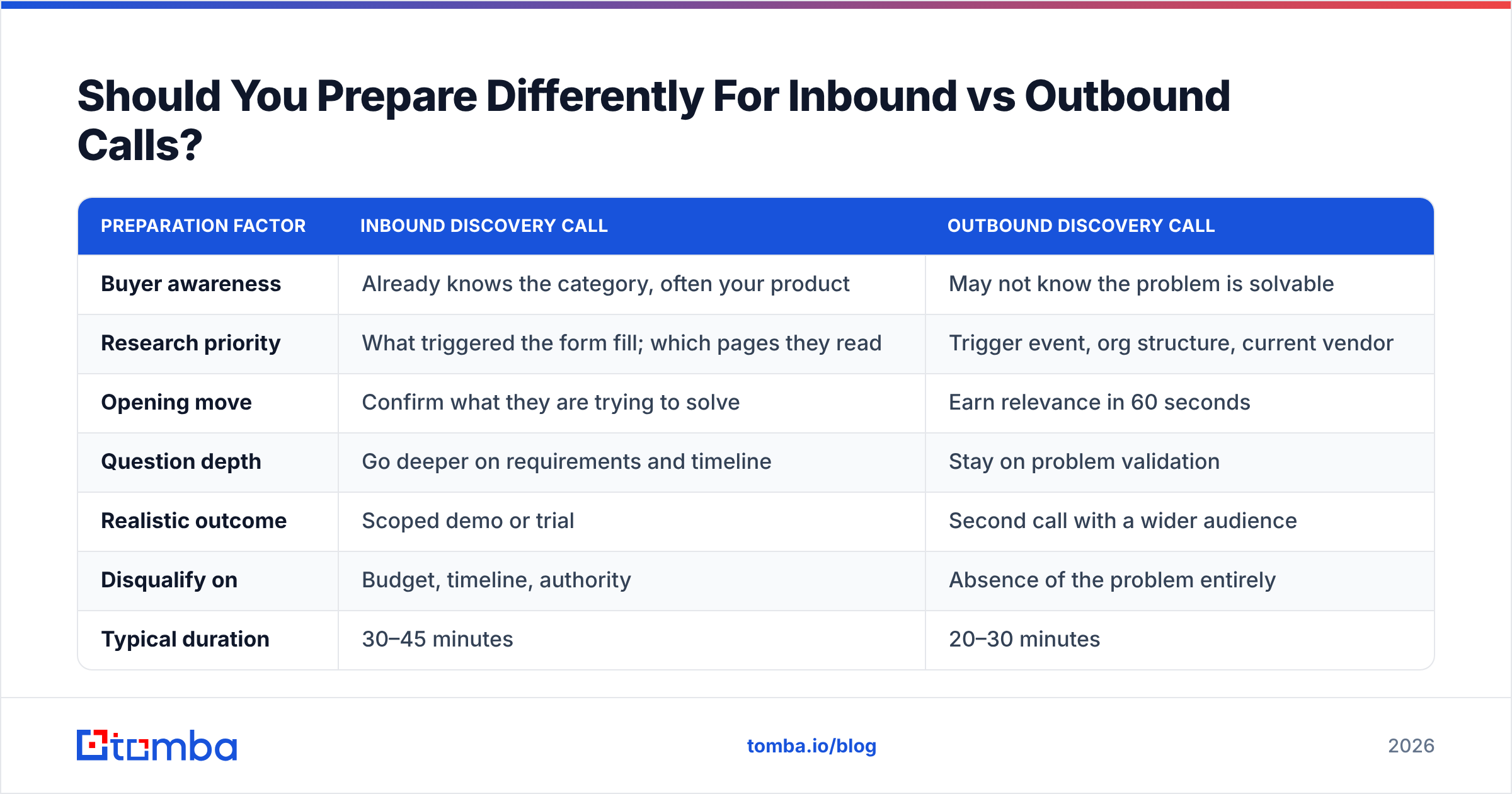
Should You Prepare Differently For Inbound vs Outbound Calls?#
Yes, and treating them identically is a common mistake. The buyer's starting position is not the same, so your preparation should not be either.
| Preparation factor | Inbound discovery call | Outbound discovery call |
|---|---|---|
| Buyer awareness | Already knows the category, often your product | May not know the problem is solvable |
| Research priority | What triggered the form fill; which pages they read | Trigger event, org structure, current vendor |
| Opening move | Confirm what they are trying to solve | Earn relevance in 60 seconds |
| Question depth | Go deeper on requirements and timeline | Stay on problem validation |
| Realistic outcome | Scoped demo or trial | Second call with a wider audience |
| Disqualify on | Budget, timeline, authority | Absence of the problem entirely |
| Typical duration | 30–45 minutes | 20–30 minutes |
| Follow-up asset | Tailored demo agenda | Short proof point, one case study |
Inbound calls fail when reps under-prepare because "they came to us." Outbound calls fail when reps over-pitch because they feel they must justify the interruption. Both failures are preparation failures.
For outbound specifically, the list quality upstream determines how much preparation is even worth doing. A well-built list from domain search with verified role data means every booked call is with someone who plausibly owns the problem. A scraped list means you will spend your preparation time researching people who were never buyers.
What Should You Do In The First And Last Five Minutes?#
The first five minutes set the frame. Open with a specific, earned observation — the funding round, the new office, the job posting. Then state the agenda and ask permission to run it: "I want to spend most of this asking questions about how you handle X today, then if it makes sense, talk about what a next step could look like. Does that work?" That single sentence buys you permission to ask hard questions for the next twenty minutes.
Avoid the two classic openers. Do not ask "How's your week going?" to someone with a 30-minute slot. Do not launch into your company history — nobody booked a call to hear when you were founded.
The last five minutes decide whether this becomes pipeline. Summarize what you heard in their language: "So the core issue is that your team spends eight hours a week manually cleaning lists, and that's blocking the outbound push you want to run in Q2 — did I get that right?" Getting a "yes, exactly" is worth more than any close.
Then propose a specific next step with a date, a time, and named attendees. "I'd like to show your ops lead how this works — does Thursday at 2pm work, and should we include Sarah?" Vague next steps ("I'll send some info") are the most common cause of stalled deals, and they are entirely self-inflicted.
Send the recap within four hours. Bullet the problem as they described it, the impact number they gave you, the agreed next step, and nothing else. No attachments unless they asked. That email becomes the shared record you both refer back to, and it quietly tests whether they were serious.
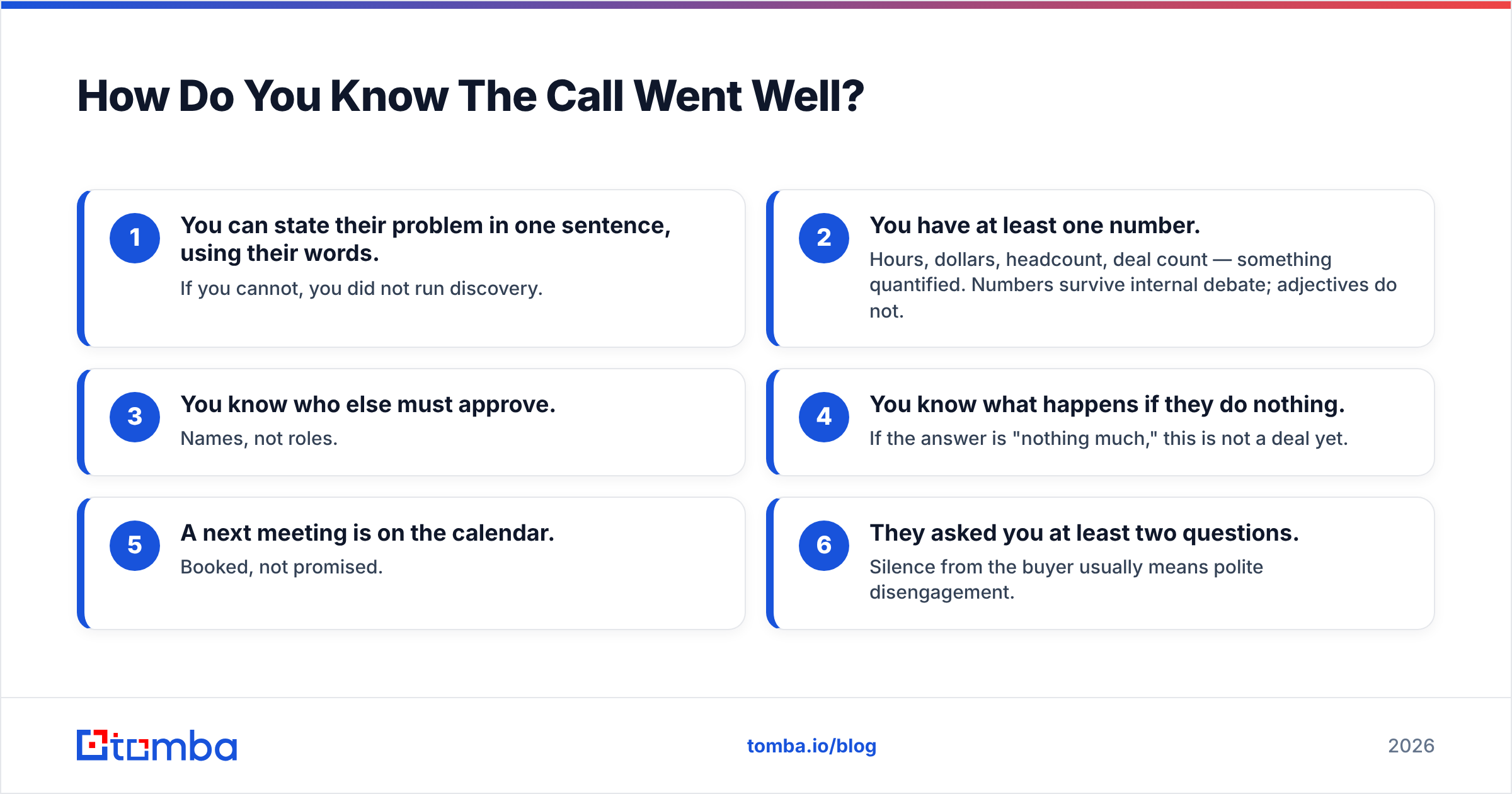
How Do You Know The Call Went Well?#
Not by how much they liked you. Use hard signals.
- You can state their problem in one sentence, using their words. If you cannot, you did not run discovery.
- You have at least one number. Hours, dollars, headcount, deal count — something quantified. Numbers survive internal debate; adjectives do not.
- You know who else must approve. Names, not roles.
- You know what happens if they do nothing. If the answer is "nothing much," this is not a deal yet.
- A next meeting is on the calendar. Booked, not promised.
- They asked you at least two questions. Silence from the buyer usually means polite disengagement.
Hit four or more and the deal is real. Hit two or fewer and the honest move is to log it, keep it in nurture, and move on. Reviewing these against your win rate by stage over a quarter will tell you fast which of the six actually predicts closed-won in your market — the answer differs by segment more than most playbooks admit.
One more habit worth building: record the call (with consent) and review your talk ratio. Most reps believe they listen more than they do. The recording is unkind and useful. Aim to speak for under a third of the time, and check that your questions got shorter as the call went on — long questions late in a call usually mean you are pitching with a question mark on the end.
Where Should You Store What You Learn?#
In the CRM, in structured fields, on the same day. A discovery call whose findings live in a rep's notebook is a call the company paid for and did not receive.
Log at minimum: the problem statement in the buyer's words, the quantified impact, the current solution or workaround, the buying committee names, the objection you heard, and the agreed next step with a date. Six fields. Two minutes. That record is what lets a manager coach the deal, what lets marketing hear real language, and what stops the deal from dying when the rep leaves.
Good discovery data compounds. After forty calls in one segment you will have a written map of how that market describes its pain — which becomes better outbound copy, better subject lines, and better targeting on the next list you build.
Ready To Book Calls Worth Preparing For?#
Preparation only pays off if the person on the other end is the right person. Build your target list from verified, current contact data with the Tomba Email Finder — find decision-makers by domain, name, or company, and confirm the address is live before the invite goes out. Start on the free tier with 25 searches a month, or move to the Starter plan at $49/mo when you are running volume; full Tomba pricing is on the site. Better contacts in, better discovery calls out.
Related guides#
// get started
Find, verify and enrich your first contacts today
Start on the free plan with 25 searches a month, then scale when your team is ready.
Free plan · No credit card required · GDPR & CCPA
// about the author