How to Prospect in B2B Sales in 2026: A 7-Step Playbook
Most B2B prospecting fails before the first email goes out — bad list, bad data, bad timing. Here is the 7-step system reps actually use to book meetings in 2026, with the tables, cadences, and metrics that make it repeatable.
TL;DR
- Prospecting is a filtering problem, not a volume problem. Every hour you spend tightening your ICP saves five hours of sending into the void.
- The sequence that works in 2026: define ICP → build an account list → find the right people → get verified contact data → pick a trigger → run a multi-channel cadence → measure reply rate, not send rate.
- Bounce rate above 3% is the single fastest way to kill a sending domain. Verify before you send, every time.
- One good trigger (funding, hiring, tech change, new exec) beats ten personalization tokens pulled from a LinkedIn headline.
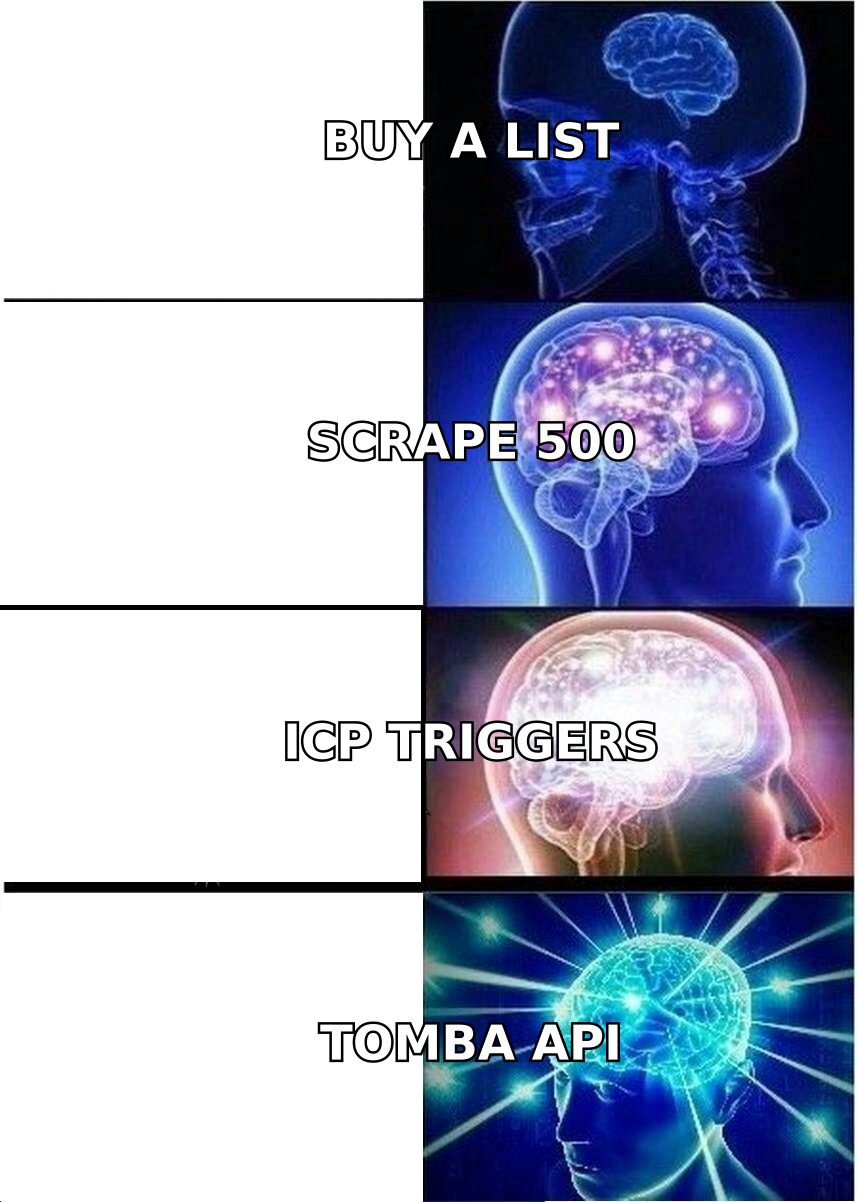
- Target 25–40 net-new, fully-researched accounts per rep per week — not 500 scraped rows.
What is B2B prospecting, exactly?#
B2B prospecting is the work of identifying companies that fit your ideal customer profile, finding the specific humans inside them who own the problem you solve, and starting a relevant conversation with those humans before they raise their hand.
Three things are packed into that sentence, and most teams only do one of them well:
- Account selection — which companies deserve your time this quarter.
- Contact discovery — which person at that company owns the pain, and how to reach them.
- Outreach execution — the messages, channels, and cadence that earn a reply.
Lead generation is the broader category — inbound forms, content, paid ads, events. Prospecting is the outbound half: you go find them. The distinction matters because the skills are different. Lead gen optimizes for volume of hand-raisers. Prospecting optimizes for precision against a named list.
Think of it like fishing versus spearfishing. Lead gen casts a net and sorts whatever comes up. Prospecting picks the fish, walks to where it lives, and takes one shot. If your list is wrong, no amount of copywriting rescues you.
Why do most B2B prospecting efforts fail?#
They fail on inputs, not effort. Reps who miss quota are usually working just as hard as reps who hit it — they are working against a worse list with worse data.
The five failure modes, in the order they cost you the most money:
- The list is too wide. "Any SaaS company with 50–5,000 employees" is not an ICP. It's a category. You will send 2,000 emails and get 11 replies, nine of which are "not a fit."
- The data is stale or guessed. Pattern-guessed emails (
first.last@domain.com) hit real inboxes maybe 60–70% of the time. The rest bounce, and bounces compound into deliverability damage. - There's no reason for the email to exist today. Without a trigger, your message competes with 40 other cold emails on relevance alone.
- One channel only. Email-only sequences leave a lot on the table; email plus LinkedIn plus a phone touch typically lifts connect rates meaningfully because you catch people where they actually are.
- No measurement past "sent." If your dashboard's headline number is emails sent, you're optimizing the wrong variable.
HubSpot's ongoing sales statistics research has tracked the same pattern for years: the top performers do less outreach against tighter lists with better data. That's the whole game.
How do you build an ICP that actually filters?#
Your ICP needs to be narrow enough that a new rep could look at a company and say yes or no in under 30 seconds. Build it from closed-won data, not from a whiteboard session.
- Pull your last 20 closed-won deals. Ignore losses for now. Look for what the winners share — not what your marketing deck claims.
- Extract hard firmographics. Employee count band, revenue band, industry, geography, funding stage. Write ranges, not adjectives.
- Add technographics. What's in their stack? If your product replaces or plugs into a specific tool, that tool's presence is a qualifier. A website tech stack checker turns this into a filterable field instead of a guess.
- Name the trigger events. What was happening at the account when they bought? New VP of Sales, a funding round, a compliance deadline, headcount growth in a specific team.
- Name the persona and the anti-persona. Who signs, who champions, who blocks. Also: which job title looks right but never converts (usually a title with "Operations" bolted on).
- Write the disqualifiers. Fewer than X employees. No in-house sales team. Already using a competitor on a three-year contract. Disqualifiers save more time than qualifiers.
Run that filter over your current pipeline. If more than 40% of your open opportunities fail it, your ICP is fiction or your pipeline is junk. Both are worth knowing.
Where should you source prospects in 2026?#
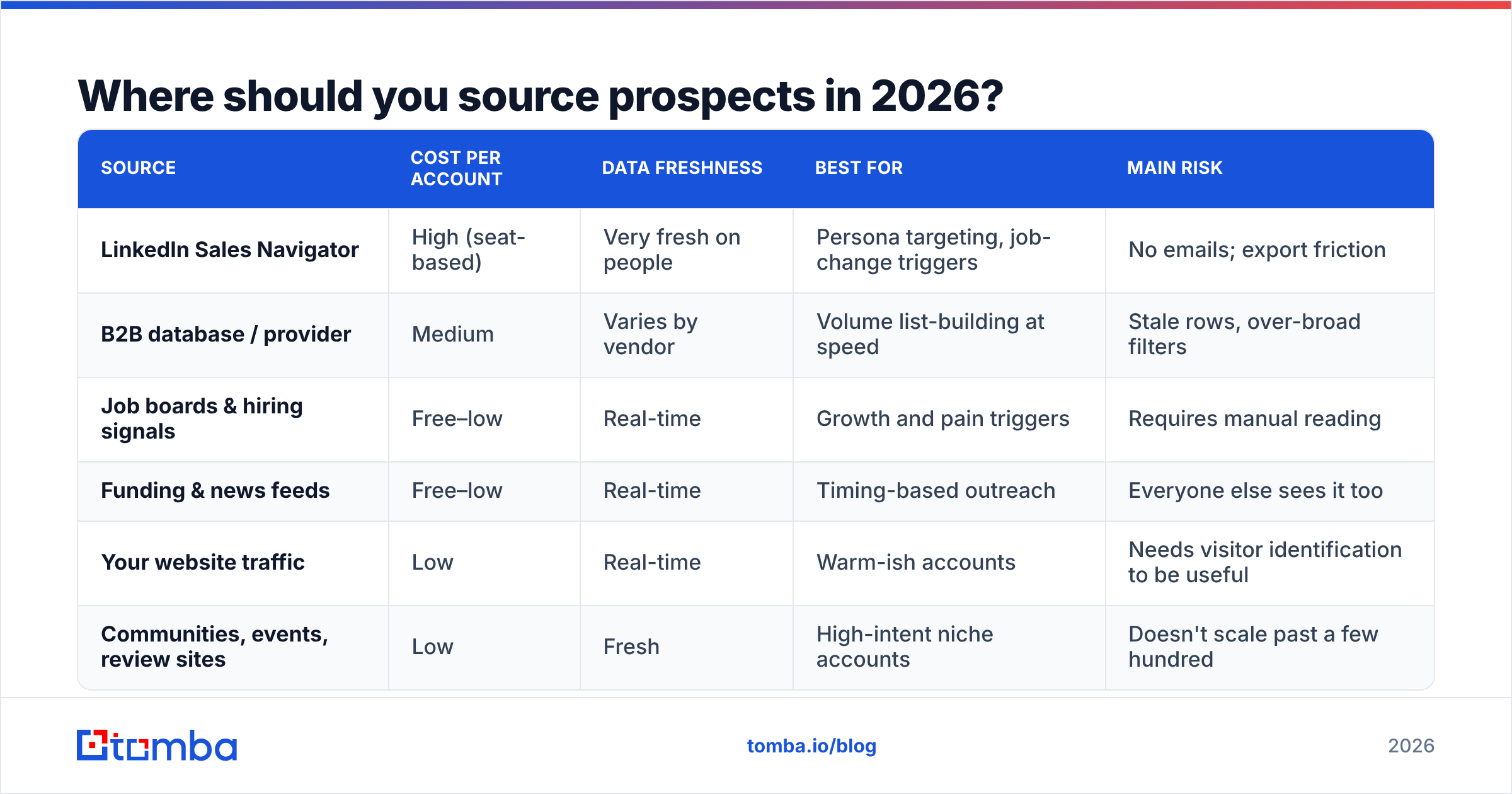
Sourcing is where teams waste the most time, usually by defaulting to whatever tool the last rep left behind. Each source has a different cost/quality shape:
| Source | Cost per account | Data freshness | Best for | Main risk |
|---|---|---|---|---|
| LinkedIn Sales Navigator | High (seat-based) | Very fresh on people | Persona targeting, job-change triggers | No emails; export friction |
| B2B database / provider | Medium | Varies by vendor | Volume list-building at speed | Stale rows, over-broad filters |
| Job boards & hiring signals | Free–low | Real-time | Growth and pain triggers | Requires manual reading |
| Funding & news feeds | Free–low | Real-time | Timing-based outreach | Everyone else sees it too |
| Your website traffic | Low | Real-time | Warm-ish accounts | Needs visitor identification to be useful |
| Communities, events, review sites | Low | Fresh | High-intent niche accounts | Doesn't scale past a few hundred |
The practical answer is layering, not choosing. Use Sales Navigator or a B2B database to build the account universe, then apply a trigger source on top to decide who gets worked this week. An account that fits your ICP and just posted three SDR job openings is worth ten accounts that only fit the ICP.
For evaluating vendors, G2's sales intelligence category is the least biased public comparison — filter reviews by company size close to yours, since enterprise reviewers and 10-person-team reviewers describe completely different products.
How do you find and verify contact data without burning your domain?#
Here's where prospecting gets technical, and where most damage happens.
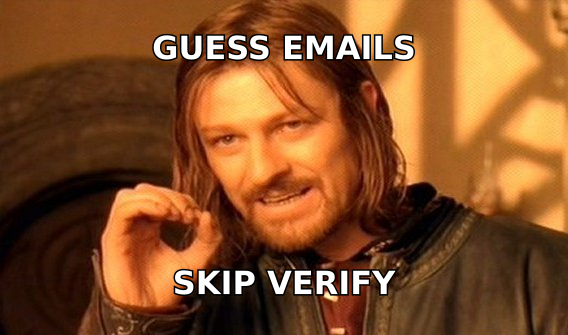
Guessing email formats is not a strategy. Yes, first.last@company.com covers a lot of mid-market companies. It also silently fails on companies using flast@, first@, or a legacy pattern from an acquisition. Every guess that misses is a hard bounce, and hard bounces are what mailbox providers use to decide whether you're a sender or a spammer.
The working sequence:
- Find by domain. Start with a domain search to see the company's real email pattern and the people already indexed against it. This tells you the format before you guess anything.
- Find by name. For a specific person, run an email finder with first name, last name, and domain. You get an address plus a confidence score and the sources it was found in.
- Verify before sending. Run every address through an email verifier. SMTP-level checks catch dead mailboxes, role accounts (
info@,sales@), and disposable domains before they cost you anything. - Handle catch-alls deliberately. Catch-all domains accept everything at the server level, so standard verification returns "unknown." A catch-all verifier uses additional signals to separate real mailboxes from black holes. Don't just delete catch-alls — a big share of enterprise domains are catch-all, and you'd be deleting your best accounts.
- Enrich the row. Title, seniority, department, company size, LinkedIn URL. Data enrichment is what makes a message specific instead of generic.
Keep hard bounce rate under 3%, and ideally under 2%. Above that, Google and Microsoft start throttling. Free tools like a free email checker are fine for spot checks, but at list scale you want bulk verification wired into the workflow.
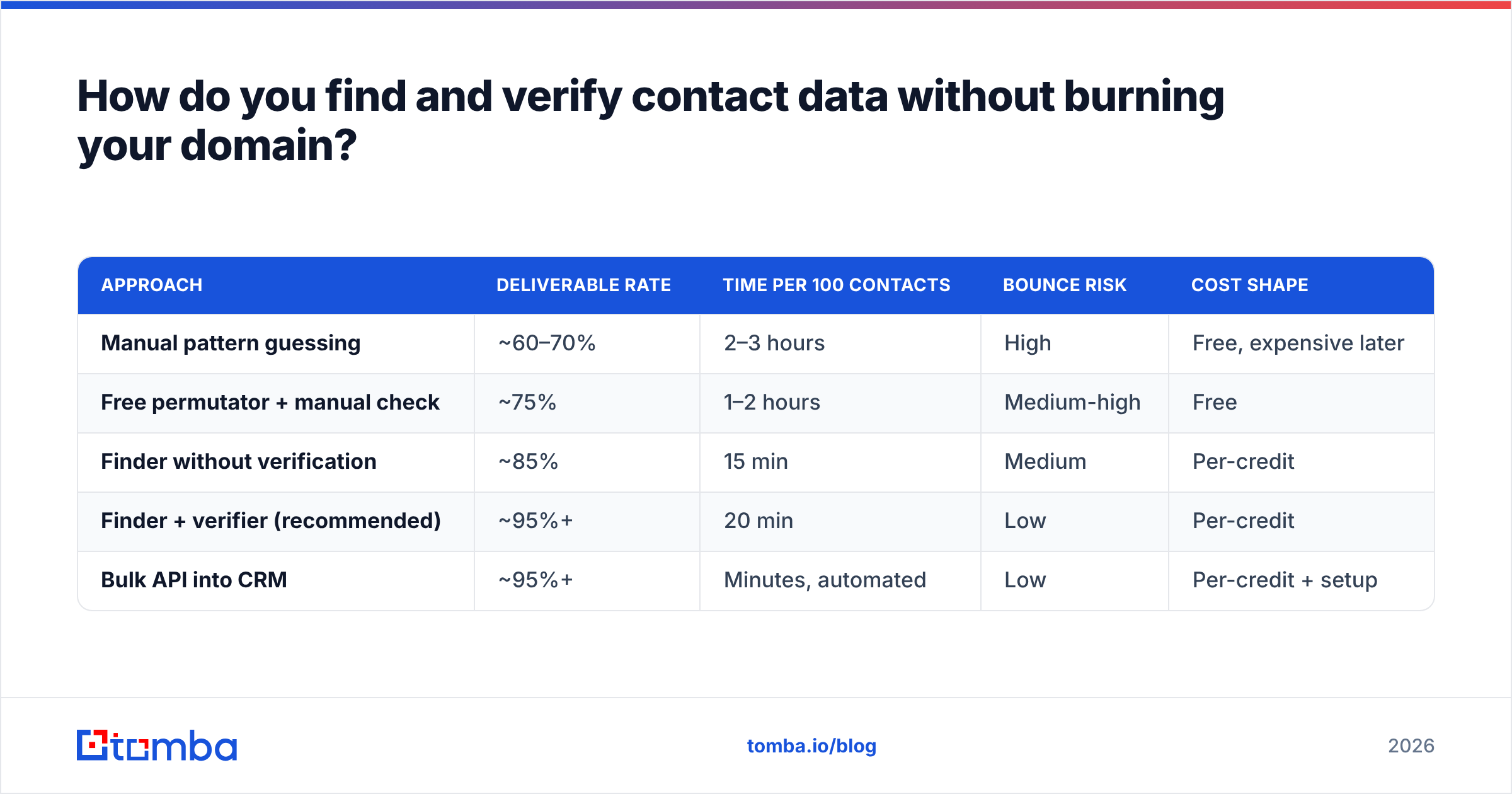
| Approach | Deliverable rate | Time per 100 contacts | Bounce risk | Cost shape |
|---|---|---|---|---|
| Manual pattern guessing | ~60–70% | 2–3 hours | High | Free, expensive later |
| Free permutator + manual check | ~75% | 1–2 hours | Medium-high | Free |
| Finder without verification | ~85% | 15 min | Medium | Per-credit |
| Finder + verifier (recommended) | ~95%+ | 20 min | Low | Per-credit |
| Bulk API into CRM | ~95%+ | Minutes, automated | Low | Per-credit + setup |
For teams running this at volume, the Tomba API or a bulk email finder run removes the copy-paste step entirely. Pricing starts at a free tier with 25 searches per month, then $49/mo for Starter, $99/mo for Growth, and $249/mo for Pro — see Tomba pricing for the credit breakdown per tier.
What does a good prospecting cadence look like?#
A cadence is a schedule, not a script. The mistake is treating it as five copies of the same email with different subject lines.
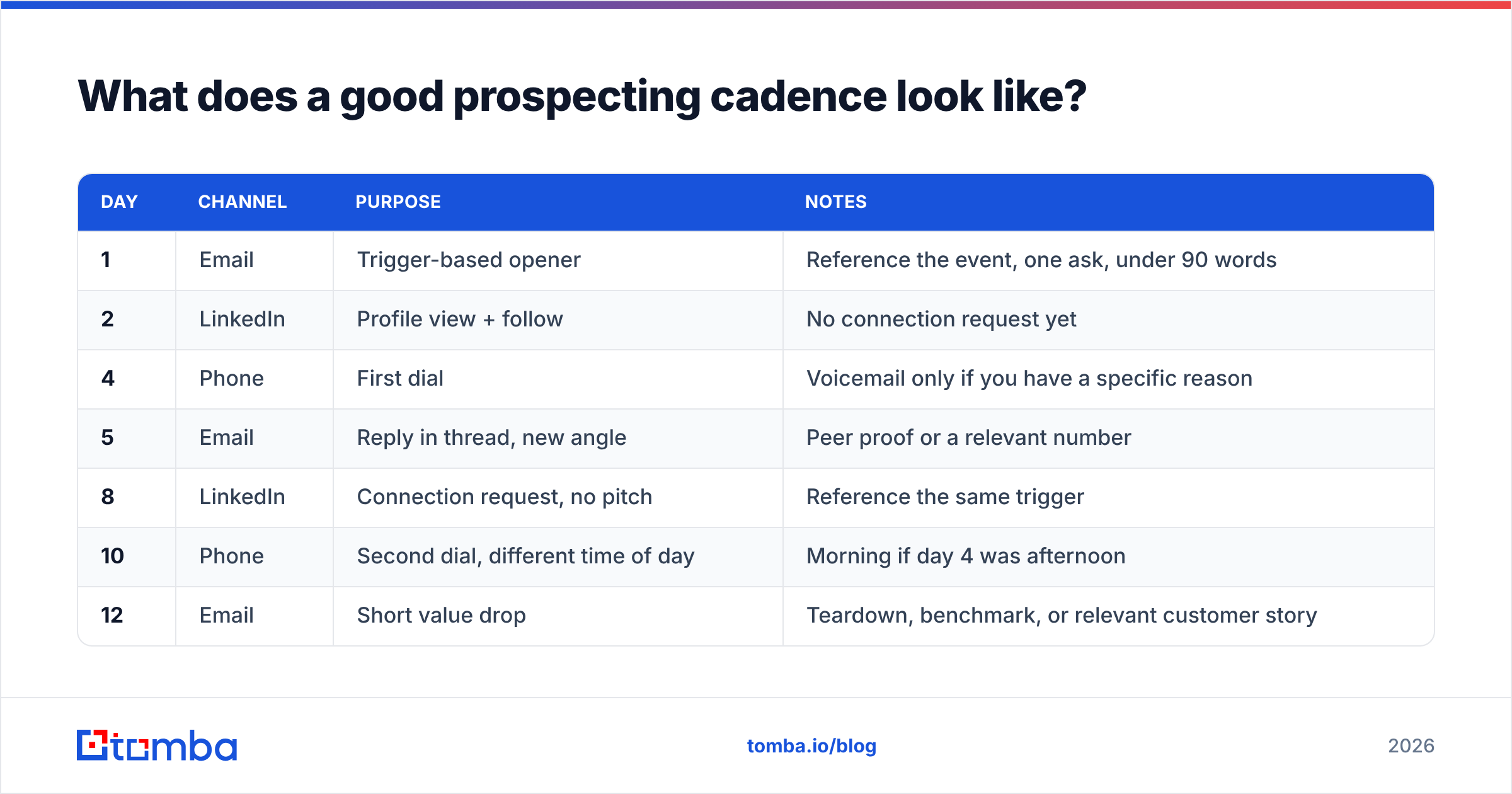
A 14-business-day, multi-channel structure that holds up:
| Day | Channel | Purpose | Notes |
|---|---|---|---|
| 1 | Trigger-based opener | Reference the event, one ask, under 90 words | |
| 2 | Profile view + follow | No connection request yet | |
| 4 | Phone | First dial | Voicemail only if you have a specific reason |
| 5 | Reply in thread, new angle | Peer proof or a relevant number | |
| 8 | Connection request, no pitch | Reference the same trigger | |
| 10 | Phone | Second dial, different time of day | Morning if day 4 was afternoon |
| 12 | Short value drop | Teardown, benchmark, or relevant customer story | |
| 14 | Breakup, low pressure | "Should I close the loop?" |
Three rules that matter more than the schedule:
- One idea per message. If a prospect has to decide between two asks, they decide neither.
- Vary the angle, not just the wording. Message two should make a different argument than message one, not restate it politely.
- Stop at the breakup and recycle. Move the account to a nurture list with a 90-day timer. Trigger-based re-entry beats brute-force follow-up.
If you want a starting library, our cold email templates cover the trigger-opener and breakup patterns specifically. Rewrite them — templates are scaffolding, not finished messages.
How many prospects should each rep work per week?#
Set the target in researched accounts, not touches. A realistic full-cycle benchmark for a mid-market SDR:
- 25–40 net-new accounts researched per week (roughly 6–8 per day)
- 2–3 contacts per account, so 60–120 net-new people entering sequences
- 250–400 total touches per week across email, LinkedIn, and phone, including follow-ups on accounts from prior weeks
- 8–12 meaningful conversations, meaning a real reply or a connected call over 60 seconds
- 4–8 booked meetings, depending on ACV and market maturity
If your numbers are wildly above these on touches and below on meetings, you have a list problem, not an activity problem. Gartner's sales research has been consistent on this point: buyers spend a small fraction of their journey with any single vendor's sellers, so precision beats presence.
How do you measure prospecting so it improves?#
Track five numbers weekly. Not fifteen.
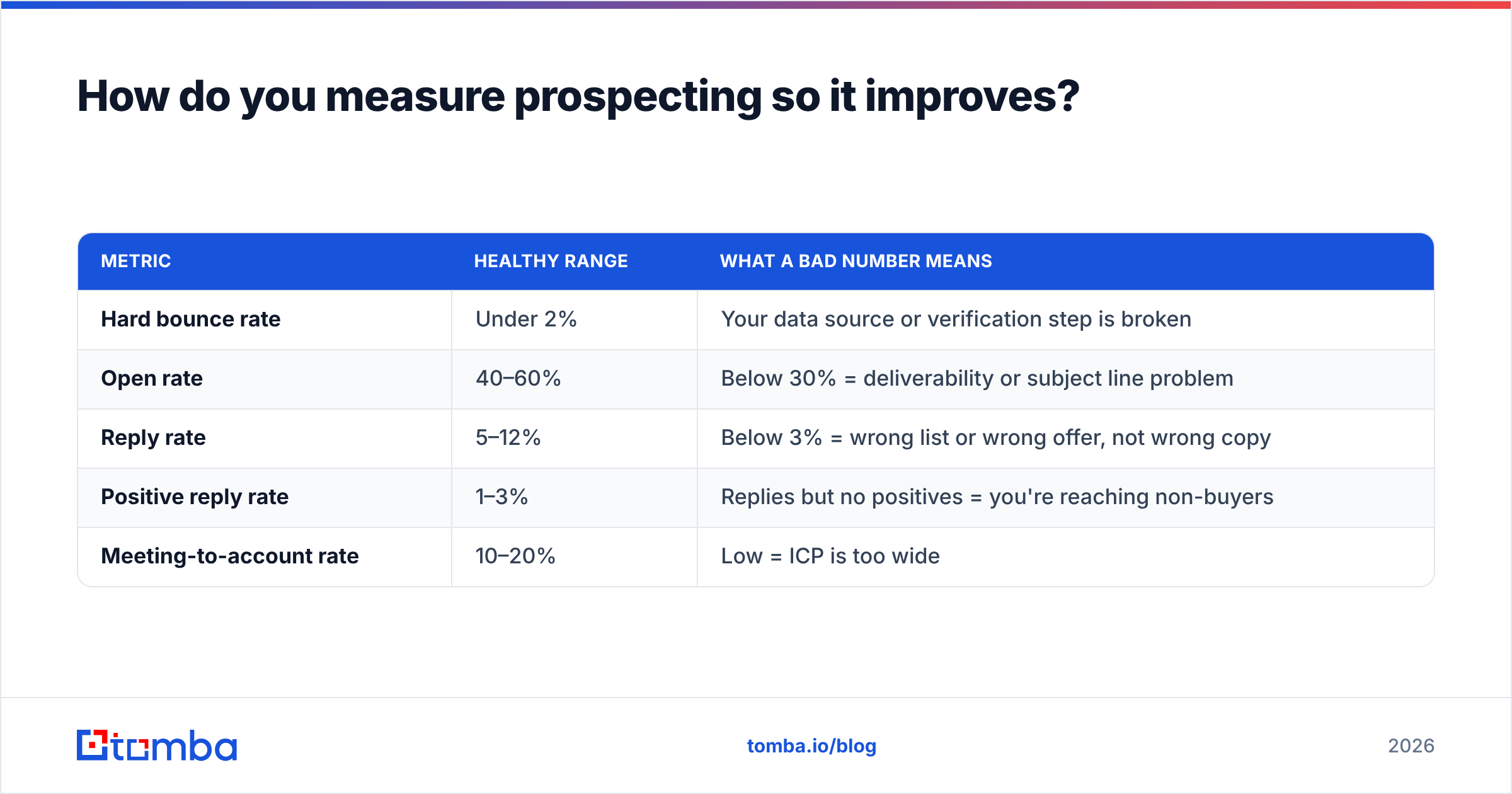
| Metric | Healthy range | What a bad number means |
|---|---|---|
| Hard bounce rate | Under 2% | Your data source or verification step is broken |
| Open rate | 40–60% | Below 30% = deliverability or subject line problem |
| Reply rate | 5–12% | Below 3% = wrong list or wrong offer, not wrong copy |
| Positive reply rate | 1–3% | Replies but no positives = you're reaching non-buyers |
| Meeting-to-account rate | 10–20% | Low = ICP is too wide |
Diagnose in that order, top to bottom. There is no point rewriting subject lines if 8% of your sends are bouncing — fix the data layer first, then deliverability, then targeting, then copy. Most teams do it backwards and spend three weeks A/B testing openers on a list that was never going to convert.
What are the most common prospecting mistakes to avoid?#
- Personalizing the wrong thing. "I saw you went to Michigan" is not relevance. "You're hiring three RevOps analysts" is.
- Sending from your primary domain. Use a separate sending domain for cold outreach so a bad month doesn't take down company email.
- Ignoring role accounts.
info@andsupport@addresses inflate your list and tank your reply rate. - Working accounts nobody owns. Territory conflicts kill more sequences than bad copy. Sort ownership before the first send.
- Treating no-reply as no-interest. Roughly half of positive replies land after the third touch. Quitting at touch two throws away paid work.
- Never refreshing the list. B2B contact data decays roughly 2–3% per month as people change jobs. A list you built in January is meaningfully wrong by June.
Start with data you can actually send to#
The pattern across every high-performing outbound team is the same: a narrow ICP, a real trigger, and contact data that's verified before it enters a sequence. The first two are strategy work you own. The third is tooling — and it's the one place where guessing costs you the most.
Tomba's Email Finder gives you the company email pattern, the individual address, a confidence score, and the sources behind it — then hands off to verification so nothing unverified reaches your sequence. Start on the free tier at 25 searches per month, and move to Starter at $49/mo when your list-building outgrows it. Build the list once, verify it properly, and spend your remaining hours on the part machines can't do: writing something a real buyer wants to answer.
Related guides#
// get started
Find, verify and enrich your first contacts today
Start on the free plan with 25 searches a month, then scale when your team is ready.
Free plan · No credit card required · GDPR & CCPA
// about the author