How to Qualify Sales Prospects: A 2026 Framework That Works
Most reps qualify on gut feel and lose the quarter to deals that were never real. Here is a concrete, five-layer process for qualifying sales prospects before you burn a single hour on them.
TL;DR
- Qualification is not one conversation. It is five layers: data validity, account fit, person fit, problem fit, and process fit. Skip a layer and you inherit a stalled deal three weeks later.
- Legacy BANT still works for transactional deals under $10k. For committee-driven B2B, MEDDPICC or a hybrid scorecard beats it because it forces you to name a champion and an economic buyer.
- Layer zero is the cheapest and most skipped: if the contact data is wrong, every downstream qualification score is fiction. Verify before you research.
- Disqualify loudly and early. A rep who kills 60% of new leads in week one closes more than a rep who nurtures everything.
- Build a written scorecard with weights, not vibes. If two reps score the same account differently by more than 20 points, your criteria are too vague.
Your pipeline is probably a lie. Not because your reps are dishonest, but because "qualified" is the most abused word in B2B sales. Someone downloaded a PDF, so they're an MQL. They took a call, so they're an SQL. They said "interesting, send me pricing," so now there's a $40,000 line item with a close date at the end of the quarter that everyone quietly knows will slip.
This post is a working process for how to qualify sales prospects: what to check, in what order, and when to walk away.
What does it actually mean to qualify a sales prospect?#
Qualifying a prospect means proving, with evidence, that a specific person at a specific company has a problem you solve, the authority or influence to act on it, and a reason to act now rather than next year.
Three words matter there: specific, evidence, and now.
Most qualification failures are failures of specificity. "Mid-market SaaS companies" is not a qualified account. "A 340-person Series B SaaS company whose VP of Sales just posted three SDR roles and whose outbound tooling is Apollo plus a spreadsheet" is. The second version tells you what to say in the first sentence of your email.
Evidence means observable facts, not inference. "They seem like a fit" is inference. "They installed HubSpot in Q3 and their careers page lists a RevOps hire" is evidence.
And "now" is the criterion reps most often skip. Plenty of prospects have your problem and your budget and will still do nothing for eighteen months because nothing is on fire. Timing is a qualifier, not a nice-to-have.

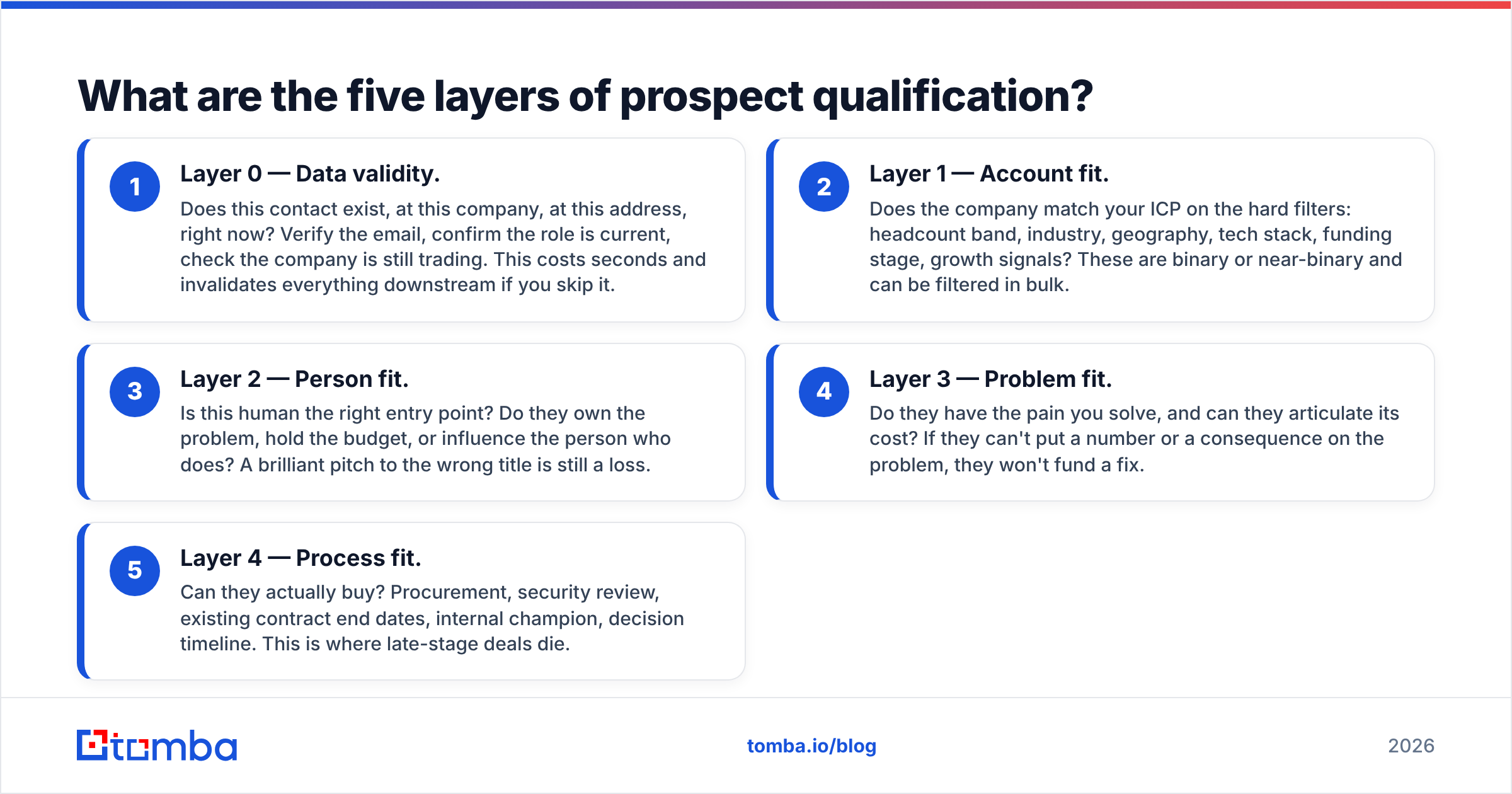
What are the five layers of prospect qualification?#
Run them in this order. Each layer is cheaper than the one after it, so failing fast at layer one saves you the cost of layers two through five.
- Layer 0 — Data validity. Does this contact exist, at this company, at this address, right now? Verify the email, confirm the role is current, check the company is still trading. This costs seconds and invalidates everything downstream if you skip it.
- Layer 1 — Account fit. Does the company match your ICP on the hard filters: headcount band, industry, geography, tech stack, funding stage, growth signals? These are binary or near-binary and can be filtered in bulk.
- Layer 2 — Person fit. Is this human the right entry point? Do they own the problem, hold the budget, or influence the person who does? A brilliant pitch to the wrong title is still a loss.
- Layer 3 — Problem fit. Do they have the pain you solve, and can they articulate its cost? If they can't put a number or a consequence on the problem, they won't fund a fix.
- Layer 4 — Process fit. Can they actually buy? Procurement, security review, existing contract end dates, internal champion, decision timeline. This is where late-stage deals die.
Reps love layers 3 and 4 because they involve conversation. They neglect 0, 1, and 2 because those feel like admin. That's backwards. Layers 0 through 2 are where you buy back your time.
Which qualification framework should you use in 2026?#
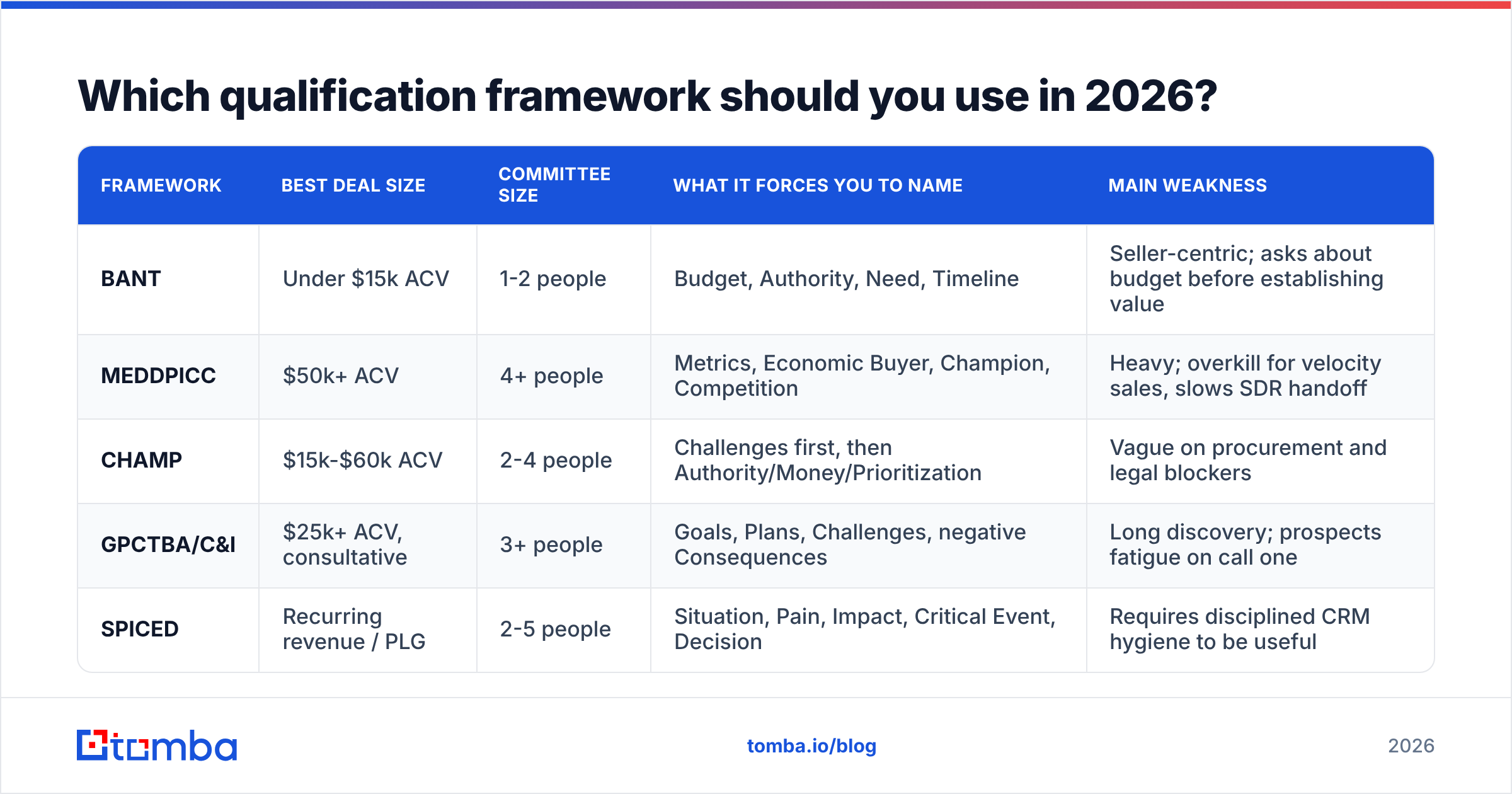
There is no universally correct framework — there is a correct framework for your deal size and buying committee. Here's how the main ones compare on the dimensions that matter operationally.
| Framework | Best deal size | Committee size | What it forces you to name | Main weakness |
|---|---|---|---|---|
| BANT | Under $15k ACV | 1-2 people | Budget, Authority, Need, Timeline | Seller-centric; asks about budget before establishing value |
| MEDDPICC | $50k+ ACV | 4+ people | Metrics, Economic Buyer, Champion, Competition | Heavy; overkill for velocity sales, slows SDR handoff |
| CHAMP | $15k-$60k ACV | 2-4 people | Challenges first, then Authority/Money/Prioritization | Vague on procurement and legal blockers |
| GPCTBA/C&I | $25k+ ACV, consultative | 3+ people | Goals, Plans, Challenges, negative Consequences | Long discovery; prospects fatigue on call one |
| SPICED | Recurring revenue / PLG | 2-5 people | Situation, Pain, Impact, Critical Event, Decision | Requires disciplined CRM hygiene to be useful |
The pattern: as deal size grows, frameworks shift from asking the prospect qualifying questions to documenting what you learned about their organization. BANT interrogates. MEDDPICC maps. If your average contract value crossed $50,000 in the last two years and you're still running BANT, that mismatch is showing up as late-stage slippage.
A practical hybrid most teams land on: BANT-style hard filters at the SDR stage (is there a plausible budget band and a plausible timeline?), MEDDPICC discipline from first AE call onward. HubSpot's sales qualification guide walks through the question-level mechanics of several of these if you want scripts rather than structure.
How do you qualify prospects before you ever talk to them?#
Pre-call qualification is where the leverage is. Every hour of research you avoid on a bad-fit account is an hour spent on a good-fit one.
Start with data validity, because it's the fastest disqualifier. A contact whose email hard-bounces is not a low-priority lead — it's not a lead. Run your list through an email verifier before enrichment, not after. The cost ordering matters: verification is cheap per record, enrichment is expensive, and human research time is the most expensive thing you own. Filter in that order.
Then build the account layer from observable signals:
- Headcount trajectory. Not just current size. A company that went from 90 to 140 people in twelve months is buying tooling. A company that went from 140 to 90 is cancelling it.
- Hiring signals. Open roles are the cleanest public statement of internal priority. Three SDR reqs means outbound is funded. A first RevOps hire means the CRM is about to be rebuilt.
- Tech stack. What they already run tells you whether you're a rip-and-replace (hard) or a layer-on (easy). It also tells you your competition before the call.
- Funding and leadership changes. A new VP within 90 days is the single highest-converting timing signal in B2B. New leaders buy; incumbent leaders defend.
- Domain-level contactability. If you can't reach anyone at the account, ICP fit is academic. A quick domain search tells you whether the org has reachable, verifiable contacts at the titles you need before you commit research hours.
Score these into a simple weighted model. You don't need a data science team — a spreadsheet with five criteria, weights summing to 100, and a threshold at 60 will outperform intuition immediately. What matters is that it's written down, so two reps looking at the same account arrive at roughly the same number.
What questions actually qualify a prospect on the call?#
Bad qualifying questions ask the prospect to do your job. "What's your budget?" asks them to price your solution before they understand it. "Are you the decision maker?" invites a face-saving yes.
Better questions produce evidence:
- Instead of "what's your budget?" — "When you solved something like this last time, what did that cost you, roughly?" You learn their spending reality without triggering defensiveness.
- Instead of "are you the decision maker?" — "Walk me through how a purchase like this got approved the last time." You get the actual org chart, including the people they'd never have named.
- Instead of "what's your timeline?" — "What happens if this is still unsolved in six months?" If the answer is "nothing much," you've found a no-decision deal early, which is a win.
- Instead of "do you have this problem?" — "How are you handling this today?" Every prospect has a current solution, even if it's a spreadsheet and a prayer. Understanding it tells you what you're actually replacing.
- Instead of "what are your goals?" — "What is your team measured on this quarter?" Corporate goals are aspirational. Compensation-linked metrics are real.
Ask about the last purchase, not the next one. People describe past behavior accurately and predict future behavior terribly.
When should you disqualify, and how fast?#
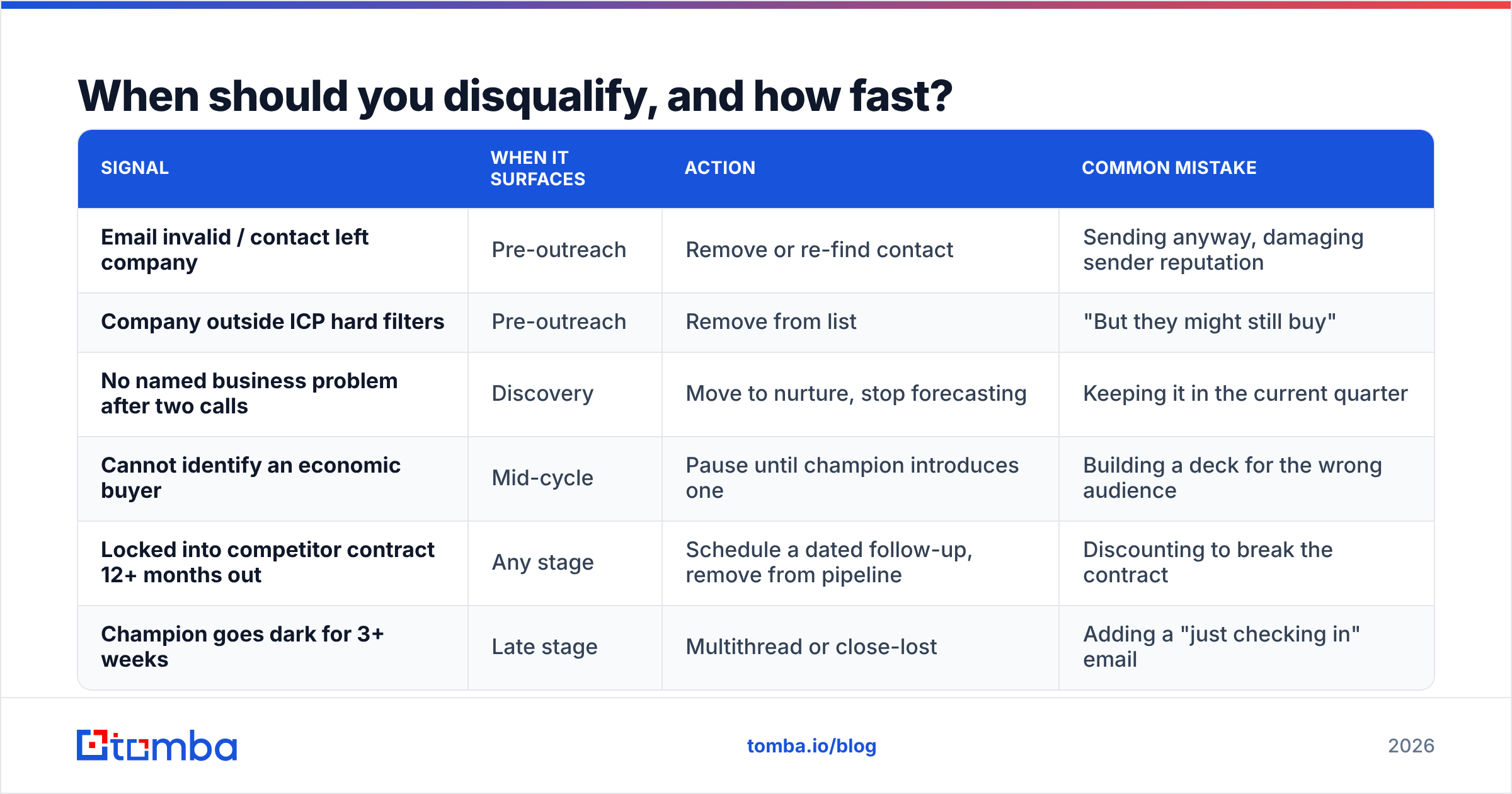
Disqualify the moment you have evidence a required condition is absent — not when you run out of hope.
Hard disqualifiers, in rough order of how quickly they should trigger:
| Signal | When it surfaces | Action | Common mistake |
|---|---|---|---|
| Email invalid / contact left company | Pre-outreach | Remove or re-find contact | Sending anyway, damaging sender reputation |
| Company outside ICP hard filters | Pre-outreach | Remove from list | "But they might still buy" |
| No named business problem after two calls | Discovery | Move to nurture, stop forecasting | Keeping it in the current quarter |
| Cannot identify an economic buyer | Mid-cycle | Pause until champion introduces one | Building a deck for the wrong audience |
| Locked into competitor contract 12+ months out | Any stage | Schedule a dated follow-up, remove from pipeline | Discounting to break the contract |
| Champion goes dark for 3+ weeks | Late stage | Multithread or close-lost | Adding a "just checking in" email |
Notice that four of six are recoverable — they mean not now, not never. The discipline is removing them from your active forecast, not from your CRM. A dated, specific follow-up ("their Salesloft renewal is in March 2027") is worth ten generic nurture sequences.
Reps resist disqualifying because pipeline coverage targets punish it. If your manager measures pipeline volume rather than pipeline quality, you'll be structurally incentivized to keep dead deals alive. That's a management problem masquerading as a rep problem — Gartner's sales research has covered the pattern extensively, and the fix is measuring stage-conversion rates rather than raw pipeline dollars.
How do you keep qualification data accurate over time?#
Qualification decays. B2B contact data degrades roughly 25-30% a year through job changes alone, and the accounts you qualified in January are a different shape by September.
Three habits keep it honest:
Re-verify before every campaign, not every quarter. A list that was clean in March will bounce in September. Running a bulk verify pass immediately before send is cheaper than repairing a damaged sending domain afterward.
Re-check the person, not just the address. An email that still resolves doesn't mean the person still holds the role. Title changes are the silent killer of qualification — your champion got promoted, or left, and your deal has no advocate. Pull fresh contact enrichment on open opportunities monthly.
Write the disqualification reason. Every closed-lost and every disqualified lead should carry a structured reason code. After ninety days you'll be able to see which disqualification reason is most common, and that tells you whether your ICP definition or your messaging is the actual problem. Teams that skip this argue about ICP forever with no data.
One more: separate "bad fit" from "bad timing" in your CRM. They demand opposite behavior. Bad fit means fix the targeting. Bad timing means set a calendar reminder and do nothing else.
What does a working qualification scorecard look like?#
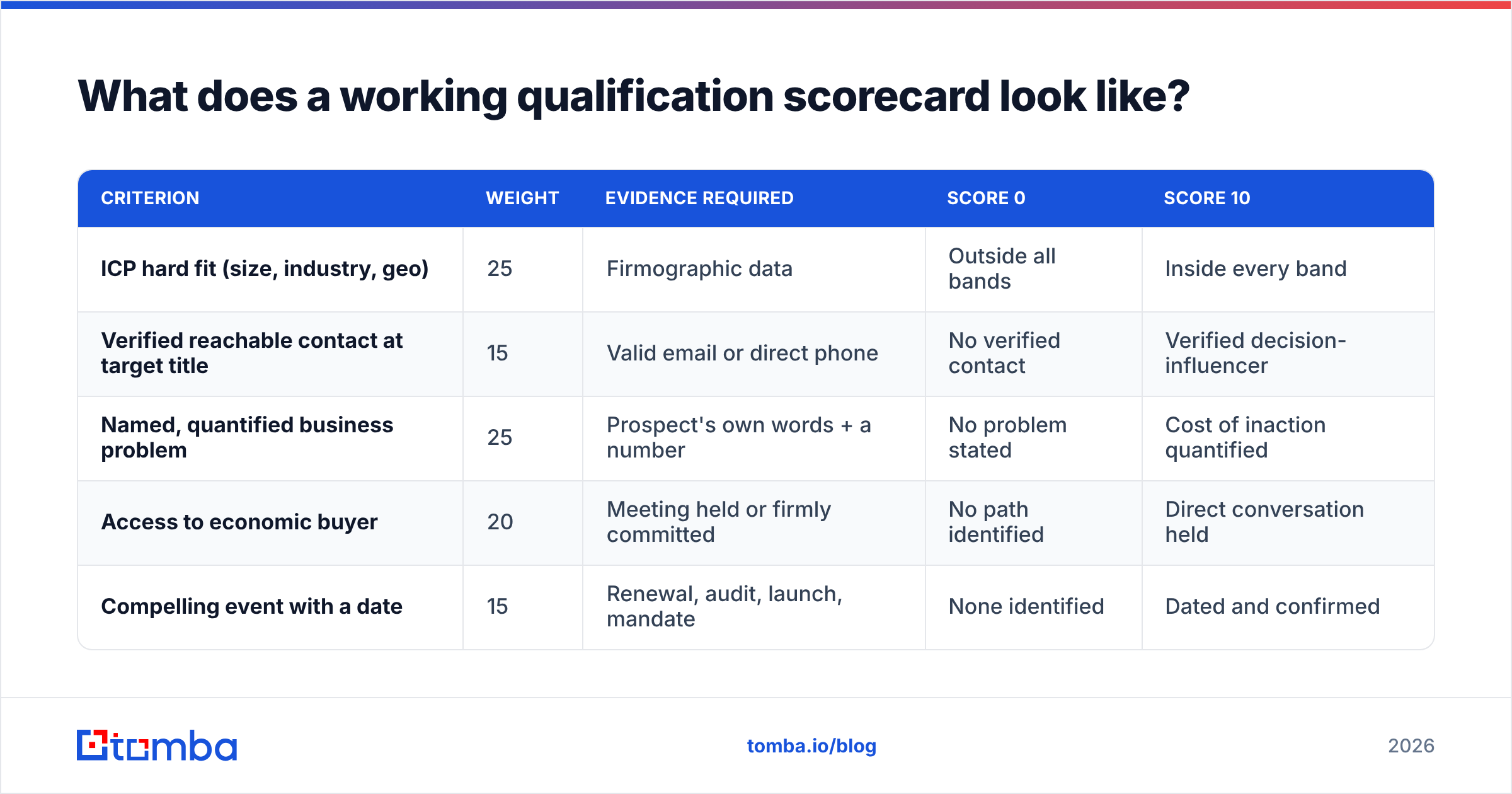
Keep it to five to seven criteria. More than that and reps stop filling it in.
| Criterion | Weight | Evidence required | Score 0 | Score 10 |
|---|---|---|---|---|
| ICP hard fit (size, industry, geo) | 25 | Firmographic data | Outside all bands | Inside every band |
| Verified reachable contact at target title | 15 | Valid email or direct phone | No verified contact | Verified decision-influencer |
| Named, quantified business problem | 25 | Prospect's own words + a number | No problem stated | Cost of inaction quantified |
| Access to economic buyer | 20 | Meeting held or firmly committed | No path identified | Direct conversation held |
| Compelling event with a date | 15 | Renewal, audit, launch, mandate | None identified | Dated and confirmed |
Total under 50: disqualify or nurture. 50-70: keep working, but don't forecast. Above 70: forecast with a date.
The weights are yours to tune, but resist the urge to make everything equal. If access to the economic buyer is the thing that most predicts your closed-won deals, weight it accordingly — and check that against your last fifty closed deals rather than against your instincts. G2's sales intelligence category is a reasonable place to sanity-check which data points comparable teams weight most heavily.
Where do most teams get qualification wrong?#
Four failure modes, in order of frequency:
Qualifying the lead instead of the account. One person's interest is not organizational intent. A curious analyst is not a buying signal. Qualify at the account level, then find the right person inside it.
Confusing engagement with qualification. Opens, clicks, and replies measure your copy, not their intent. A prospect who replies "not right now, thanks" is more engaged than one who ignores you and equally unqualified.
Treating qualification as a stage gate rather than a continuous process. Deals get requalified at every stage, because facts change. The champion who was enthusiastic in March may have lost her budget in May.
Starting from bad data. This is the one that quietly poisons everything else. If 30% of your list has wrong emails and 20% has stale titles, half your qualification work is scoring fiction. Fixing the data layer is unglamorous and it's the highest-ROI change most teams can make this quarter — worth reviewing where your data comes from and how often it's refreshed.
Vendors like BookYourData and other verified-database providers have built their whole positioning around this point, and they're right about it: qualification quality is bounded by data quality. You cannot out-process a bad list.
Start with the layer everyone skips#
Everything in this post depends on layer zero. Account fit scoring, discovery questions, MEDDPICC maps — all of it assumes you're evaluating a real person with a real address at a real company.
Get that part right first. Use Tomba's Email Finder to confirm that the contacts on your target accounts exist and are reachable before you spend research hours qualifying them, then verify in bulk before every send. The free tier gives you 25 searches a month to test your assumptions against your actual ICP list; paid plans start at $49/mo on Starter and $99/mo on Growth if you're running volume — see Tomba pricing for the full breakdown.
Qualify the data, then qualify the deal. In that order.
Related guides#
// get started
Find, verify and enrich your first contacts today
Start on the free plan with 25 searches a month, then scale when your team is ready.
Free plan · No credit card required · GDPR & CCPA
// about the author