How To Refuse a Discount Request Politely (Without Losing the Deal)
Discounting is the fastest way to shrink your margin and your authority. Here are the exact scripts, frameworks, and trade-offs for saying no to a discount request while keeping the deal alive.
TL;DR
- A discount request is almost never about price. It's about perceived risk, budget timing, or a procurement ritual. Answer the real question and the discount request usually dissolves.
- Never say a flat "no." Say "not for free" — every concession must buy something back (longer term, prepayment, case study, reduced scope).
- The three-sentence structure that works: acknowledge the ask, restate the value in their numbers, offer a trade instead of a cut.
- Roughly one in five buyers asks for a discount reflexively. Holding firm on a $30k ACV deal at a 15% ask saves $4,500 — repeated across a quarter, that's a headcount.
- The cheapest way to stop discounting is to stop talking to people who can't afford you. Better targeting upstream beats better scripts downstream.
Why do buyers ask for a discount in the first place?#
Start here, because the script you use depends entirely on the motive behind the ask.
There are five reasons a buyer asks you to come down on price, and only one of them is actually about money:
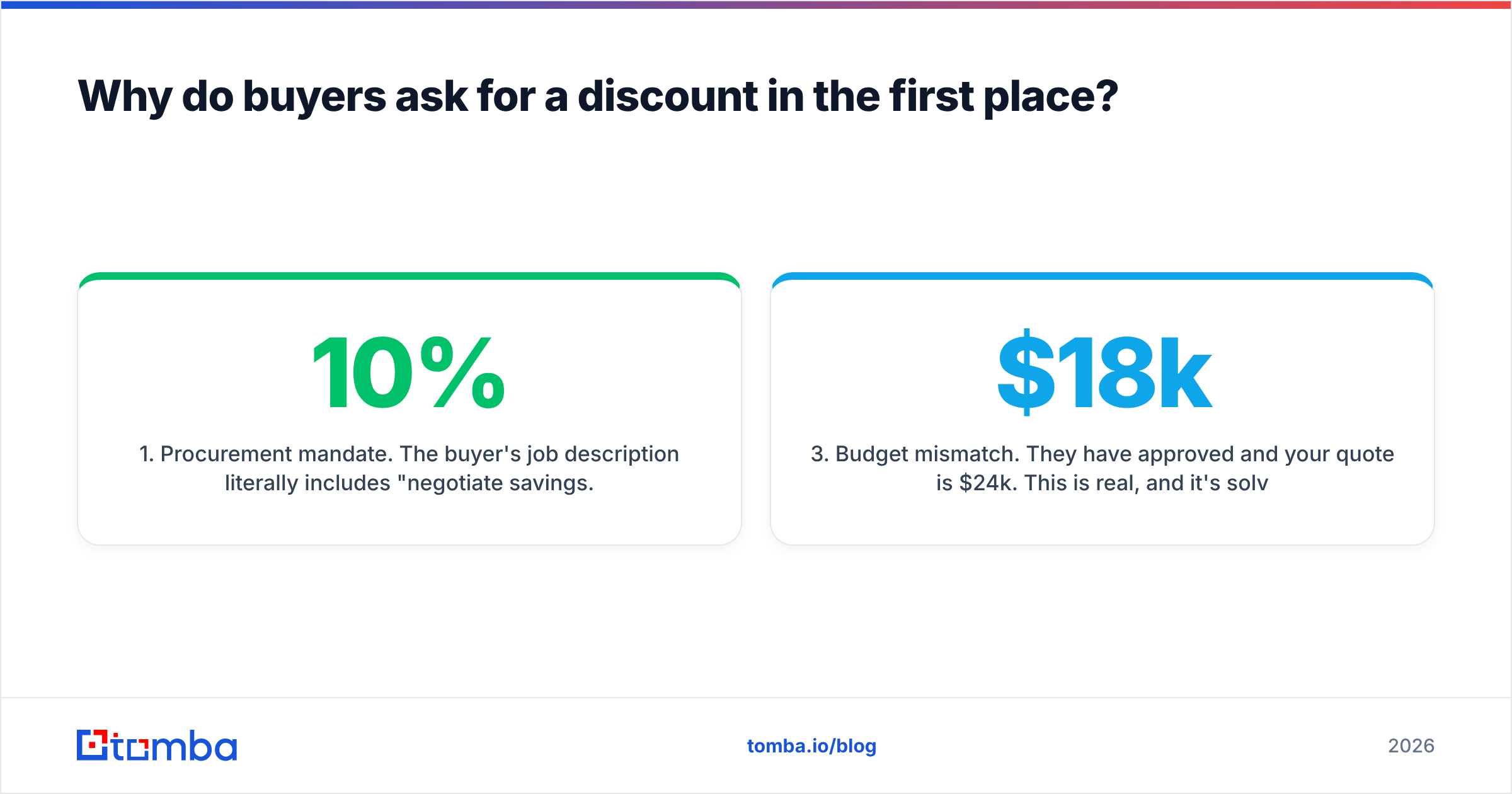
- Procurement mandate. The buyer's job description literally includes "negotiate savings." They'd ask a monastery for 10% off. This ask is performative and you can hold firm with near-zero relationship damage.
- Risk hedging. They aren't sure your product works. A discount is their way of buying insurance. Price isn't the lever — proof is.
- Budget mismatch. They have $18k approved and your quote is $24k. This is real, and it's solvable with scope or timing, not a cut.
- Anchoring test. They want to see whether your price is real. If you fold in 40 seconds, every future renewal starts from your discounted number.
- Competitive leverage. A rival quoted lower. This is a positioning conversation, not a pricing one.
Misdiagnose the motive and you'll discount a deal that never needed it. HubSpot's sales research has consistently found that buyers who get an immediate discount trust the original price less, not more — you teach them your list price was fiction. Their sales negotiation guidance makes the same point: concessions given without a request attached to them destroy the anchor you spent the whole cycle building.

What is the polite refusal framework that actually holds?#
Three sentences. Acknowledge, reframe, trade. That's the whole thing.
Sentence one — acknowledge without apologizing. "I appreciate you asking directly — that saves us both time." You are not sorry. Do not write "Unfortunately" or "I'm afraid." Those words signal that you know your price is unfair.
Sentence two — reframe in their numbers. Not your features. Their math. "At 40 hours a month of manual list-building recovered, the $99/mo plan pays for itself in the first nine days."
Sentence three — trade, don't cut. "I can't move on the monthly rate, but I can do 12 months prepaid at the equivalent of two free months, or start you on a 60-day pilot at Starter scope."
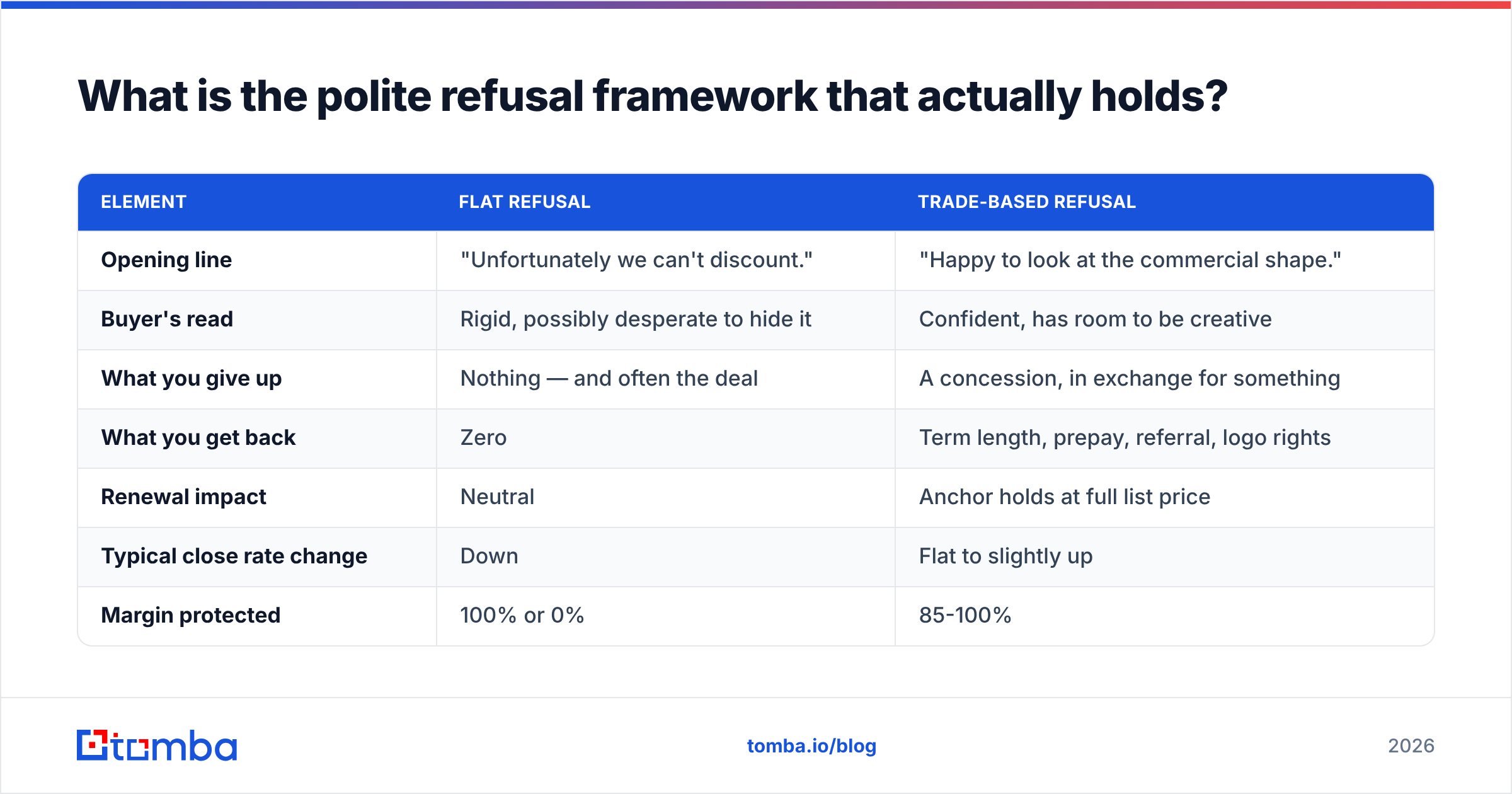
Here's what separates the two approaches in practice:
| Element | Flat refusal | Trade-based refusal |
|---|---|---|
| Opening line | "Unfortunately we can't discount." | "Happy to look at the commercial shape." |
| Buyer's read | Rigid, possibly desperate to hide it | Confident, has room to be creative |
| What you give up | Nothing — and often the deal | A concession, in exchange for something |
| What you get back | Zero | Term length, prepay, referral, logo rights |
| Renewal impact | Neutral | Anchor holds at full list price |
| Typical close rate change | Down | Flat to slightly up |
| Margin protected | 100% or 0% | 85-100% |
The trade-based approach is not a soft no. It's a firmer no wrapped in a yes-shaped sentence. You're still not cutting price — you're changing what's on both sides of the table.
How do you word the refusal in an email?#
Seven scripts, mapped to the five motives above. Copy them, then rewrite them in your voice — a script that sounds like a script reads worse than an awkward original.
1. The procurement ritual
Thanks for pushing on price — I'd do the same in your seat. Our pricing is published and applied uniformly, so there isn't a rep-level discount lever to pull. What I can do is structure the term: annual prepay lands you at the equivalent of $X/month. Want me to send that version of the quote?
2. The risk hedge
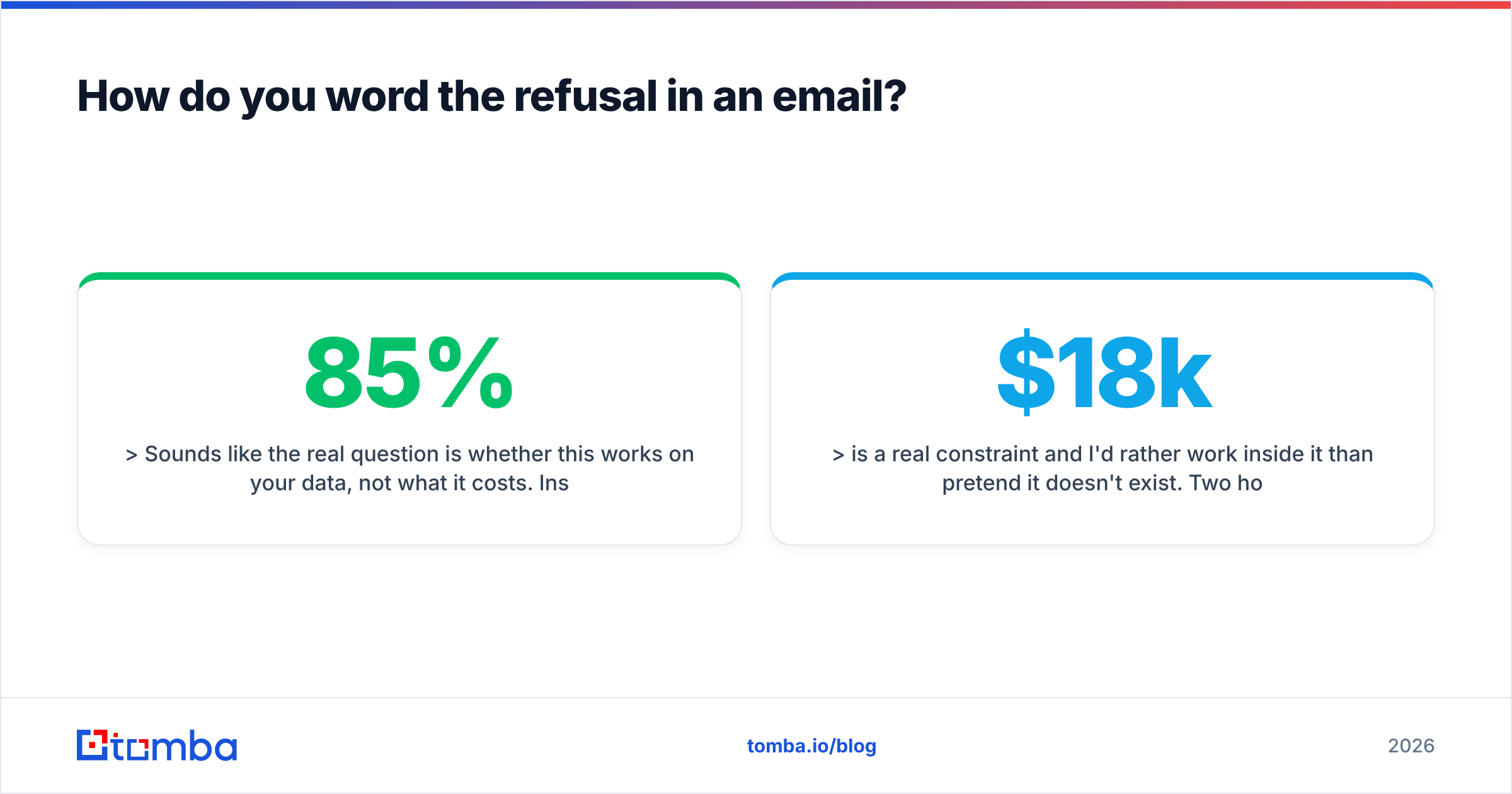
Sounds like the real question is whether this works on your data, not what it costs. Instead of discounting, let's de-risk it: 30 days on your actual domain list, and if match rates come in under 85%, you walk with no invoice. Fair?
3. The budget mismatch
$18k is a real constraint and I'd rather work inside it than pretend it doesn't exist. Two honest options: (a) drop the enrichment module and land at $17,400 on the same terms, or (b) start Q3 at half seats and expand at renewal. I'd rather scope down than discount down — that keeps your renewal price honest.
4. The anchoring test
The price is the price. I know that's a boring answer, but the reason is that everyone on your plan pays it, including the accounts that signed last week. If I moved for you, I'd be moving for them, and the product roadmap is funded by that number.
5. The competitive quote
They may well be cheaper. Before we talk price, can I ask what their verified-match rate was on a sample of your list? We can run 100 of your target domains through both and compare bounce rates. If they win, take their deal with my blessing.
6. The renewal squeeze
You've been with us 14 months and the usage data shows 4x the volume of year one. A discount at renewal would mean paying less for more. What I can offer is locking the current rate for 24 months instead of 12 — that's real money against next year's increase.
7. The "just this once"
There's no version of this where it's just once. Whatever we agree now becomes the baseline for renewal, expansion, and every conversation your CFO has about us. I'd rather protect a price you can defend internally than win this quarter and lose the account in eighteen months.
Notice what's absent from all seven: apology, hedging, and any hint that the number was inflated to begin with.
What should you offer instead of a price cut?#
Concessions that cost you less than margin. Rank them by what you give up versus what you get back.
- Extended payment terms — Net-60 instead of Net-30 costs you working capital, not revenue. Buyers with cash-flow pressure often value this more than 10% off.
- Longer commitment at the same rate — A rate lock across 24 months feels like a win to a buyer bracing for annual increases, and it doubles your contracted revenue.
- Scope reduction — Remove seats, modules, or credit volume. The unit price stays intact, which is the whole point. This is the single most underused move in B2B sales.
- Onboarding or migration credit — A one-time services concession is far cheaper than a permanent ARR haircut, and it lands as a bigger favor.
- Prepayment discount with a floor — If you must discount, tie it to cash up front and cap it at a published number (10-15%), so it's policy rather than a personal favor.
- Non-cash value — A case study, a logo on the site, a reference call, a beta seat on a new module. These have real marketing cost and buyers understand you're trading, not caving.
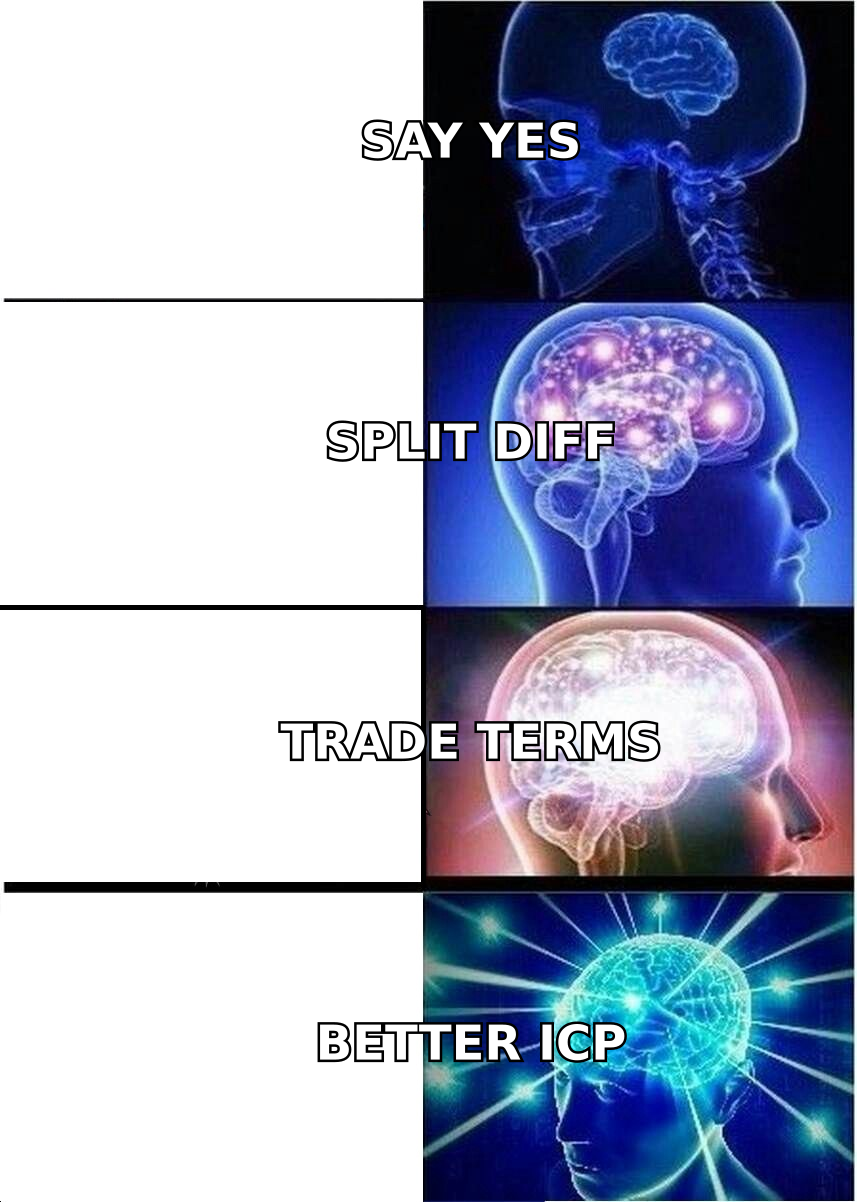
Salesforce's research into deal desk practices lands on the same conclusion: teams that publish a concession ladder — a fixed list of what can be traded and at what price — discount less than teams that leave it to rep judgment. The ladder removes the emotional part of the conversation. You're not saying no; the policy is.
When should you actually say yes to a discount?#
Three situations, and they're narrower than most reps believe.
Strategic logo in a new segment. If closing this account gives you a reference in a vertical you're trying to enter, a discount is a marketing expense. Price it that way, book it against marketing, and put a written expiry on it — a two-year term with a step-up to list at renewal.
Multi-year prepaid cash. Cash today at a discount is genuinely worth more than invoiced revenue over three years. This is a finance decision, not a sales one. Get the threshold from your CFO once and apply it mechanically.
Genuine volume. If they're buying 200 seats and your list price was built for 20, holding list is not integrity, it's laziness. Publish volume tiers so the discount is a schedule, not a negotiation.
Everything else is you flinching. And the hidden cost is compounding: a 15% cut on a $30k ACV deal isn't $4,500 — it's $4,500 every year the account renews, plus the same 15% applied to every expansion, plus whatever the buyer tells their peer group about how easy you were to move.
How do you stop getting discount requests at all?#
Fix the top of the funnel. This is the part most "handle objections" advice skips entirely.
Most discount pressure comes from talking to companies that were never going to pay your price — wrong size, wrong budget maturity, wrong buying stage. If your outbound list is scraped indiscriminately, you'll spend your quarter defending price against startups running on a founder's credit card.
The controllable inputs:
- Tighten firmographic qualification before the first email. Headcount bands, funding stage, and existing tech stack predict willingness-to-pay better than intent signals do.
- Verify contact data so you're reaching the economic buyer, not a junior researcher. A junior contact escalates on price because that's the only dimension they're empowered to discuss. Running your list through an email verifier before send also protects deliverability, which keeps you in front of the seniors who actually have budget.
- Lead with the outcome number in your first touch. If your opener quantifies value, the price conversation starts anchored against a benefit rather than against a competitor's sticker.
- Publish pricing. Buyers who self-select through a public pricing page arrive pre-qualified. The ones who'd have haggled never book the call.
- Track your discount rate as a metric. Discount percentage by rep, by segment, by deal size. What gets measured stops quietly leaking. Pair it with win rate — if a rep's discounting is up and their win rate isn't, the discounts aren't buying anything.
Building that tighter list is a data problem before it's a skills problem. Pulling verified contacts by company with domain search and enriching them with seniority and role signals via data enrichment means your reps spend their negotiation energy on accounts that can actually sign at list.
For benchmarking what "normal" discounting looks like in your category, G2's software buyer behavior reports are a reasonable public reference point — they consistently show that buyers rank vendor responsiveness and proof of outcomes above price when ranking selection criteria, even while asking for discounts.
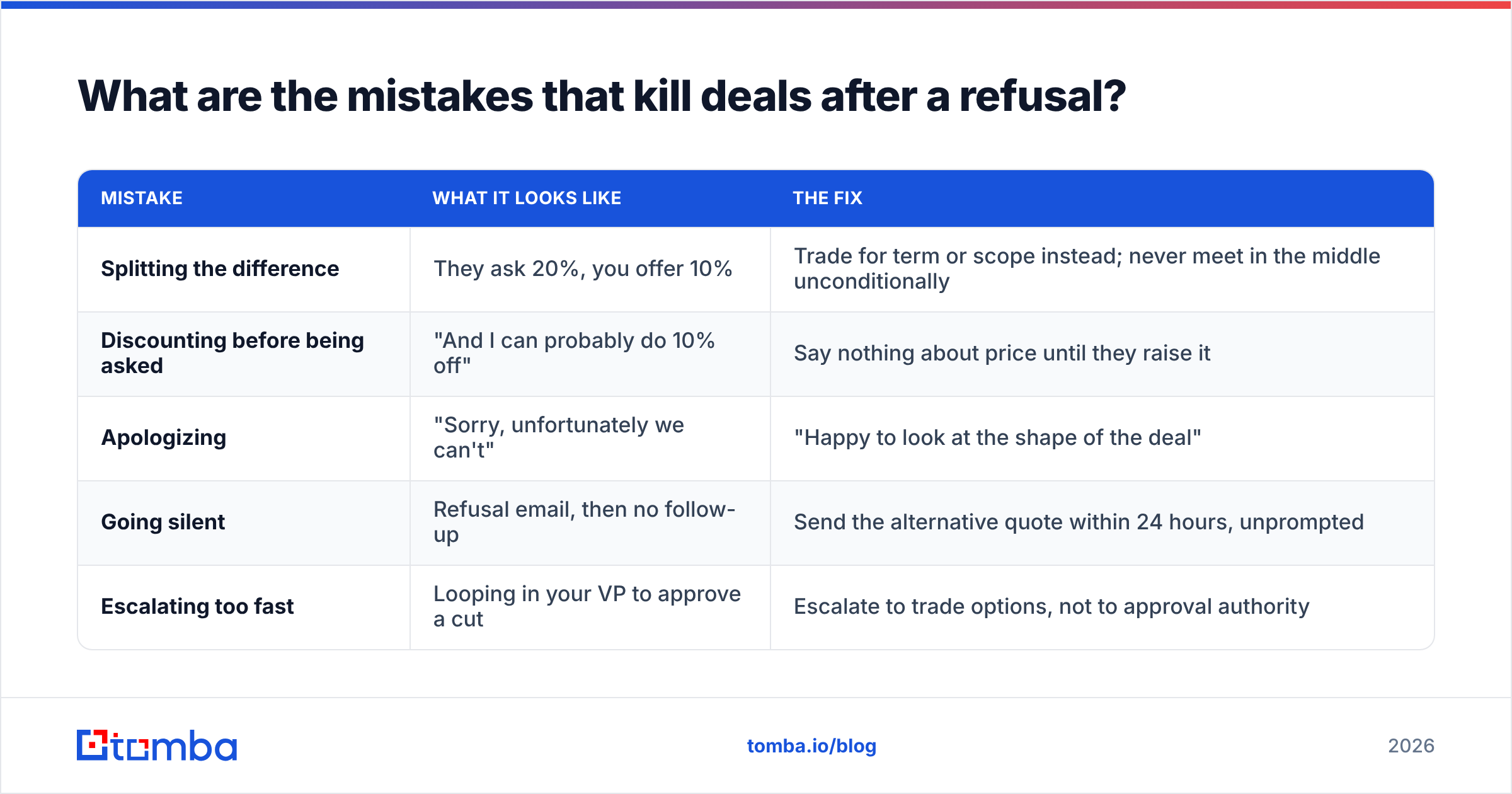
What are the mistakes that kill deals after a refusal?#
Four failure modes, in order of how often they show up in lost-deal reviews.
| Mistake | What it looks like | The fix |
|---|---|---|
| Splitting the difference | They ask 20%, you offer 10% | Trade for term or scope instead; never meet in the middle unconditionally |
| Discounting before being asked | "And I can probably do 10% off" | Say nothing about price until they raise it |
| Apologizing | "Sorry, unfortunately we can't" | "Happy to look at the shape of the deal" |
| Going silent | Refusal email, then no follow-up | Send the alternative quote within 24 hours, unprompted |
| Escalating too fast | Looping in your VP to approve a cut | Escalate to trade options, not to approval authority |
The silence failure is the most expensive and the easiest to fix. A refusal that arrives without an alternative reads as a door closing. A refusal that arrives with two restructured options reads as collaboration. Same margin, opposite outcome.
One more: never refuse a discount in a channel the buyer didn't choose. If they asked on a call, answer on the call. Deferring a price answer to email reads as stalling, and stalling reads as weakness.
Where does this leave your pricing conversations?#
Holding price is a downstream symptom of upstream targeting. The reps who rarely discount aren't better negotiators — they're talking to better-fit accounts, with verified contact data, reaching people who own the budget line rather than people who only own the objection.
If your discount rate is creeping up, audit your prospecting data before you rewrite your scripts. Wrong-fit pipeline manufactures price objections at a rate no amount of wording can absorb.
Start by building a list you can defend your price to. Tomba's Email Finder gets you verified, role-accurate contacts at the companies that match your ICP — decision-makers, not gatekeepers — so your negotiations start from fit rather than from friction. The free tier covers 25 searches a month if you want to test the match quality on your own target list; Tomba pricing starts at $49/mo for Starter and $99/mo for Growth when you're ready to scale the list-building alongside the discipline.
Related guides#
// get started
Find, verify and enrich your first contacts today
Start on the free plan with 25 searches a month, then scale when your team is ready.
Free plan · No credit card required · GDPR & CCPA
// about the author