How to Remind Someone Who You Are in an Email (Without Cringe)
You met at a conference six months ago. Now you need something. Here are the exact reconnection lines, templates, and timing rules that get replies instead of silence.
TL;DR
- Never open with "You probably don't remember me." It hands the reader an excuse to stop reading and frames you as forgettable before they've decided anything.
- The strongest reminder is a specific, verifiable anchor: an event name, a date, a mutual contact, or a sentence they actually said.
- Put the reminder in the first 12 words of the body, and repeat a compressed version in the subject line. Most recipients decide from the preview pane.
- Reconnection emails perform best when the ask is smaller than the relationship — ask for a reply, not a 45-minute call.
- If you're not sure the address still works, verify it before sending. A bounce on a warm contact costs you both the reply and your sender reputation.
You met someone at SaaStr. You swapped LinkedIn connections after a webinar. A former colleague moved to a company you now want to sell into. In every case you face the same problem: they knew you once, and now you're a name in a crowded inbox with no context attached.
Getting this wrong is expensive. A cold email to a stranger that fails costs you nothing but a credit. A reconnection email that lands awkwardly burns an actual relationship — and those are finite.
This guide covers what to say, where to say it, and the timing rules that decide whether a reminder reads as gracious or desperate.
Why do people forget you in the first place?#
Because they meet a lot of people and your interaction was not the memorable part of their week. This is not an insult, it's arithmetic.
A typical B2B conference attendee has 40 to 90 conversations across two days. A webinar host sees hundreds of names in a chat panel. A hiring manager reviews a stack of profiles. Your 6-minute chat by the coffee station was real and it mattered — it just doesn't have a dedicated slot in their long-term memory.
Three things determine whether a recall attempt works:
- Recency — Under 30 days, a light nudge is usually enough. Past 90 days, you need hard specifics.
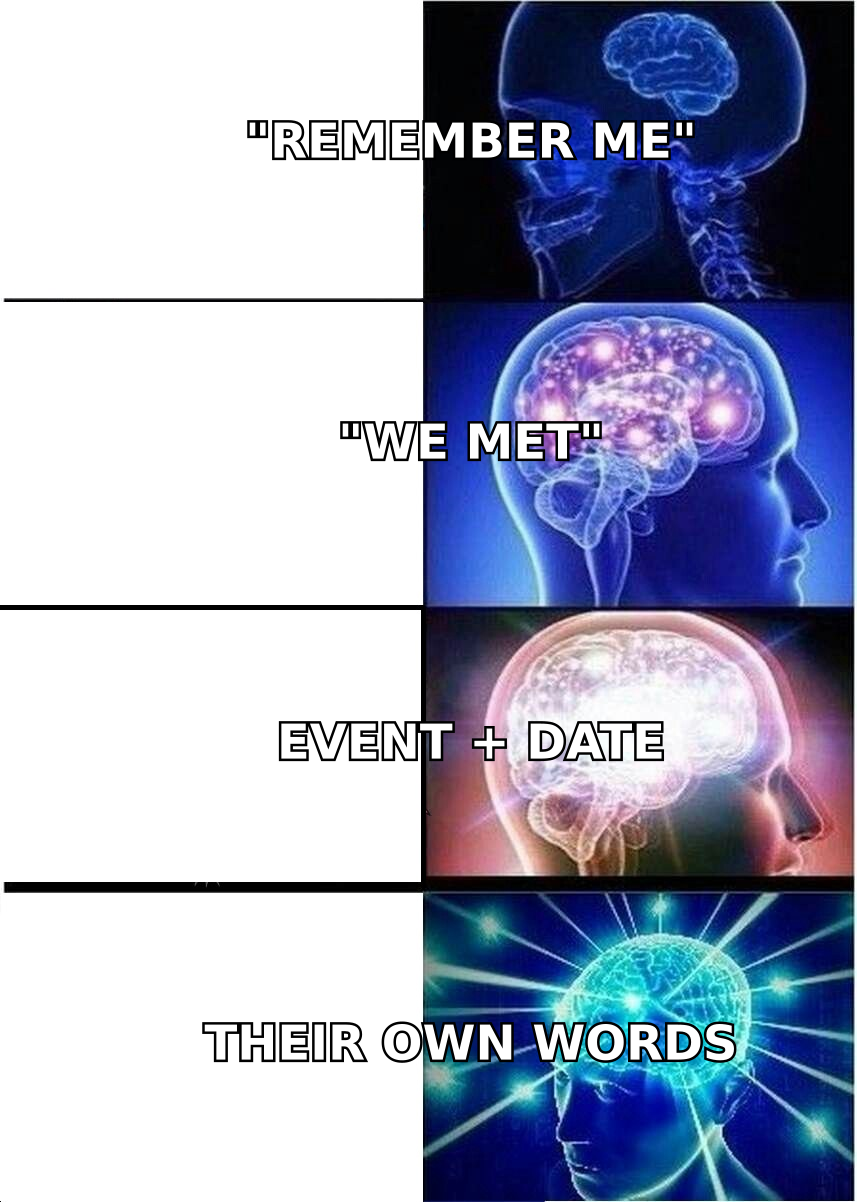
- Distinctiveness — "We chatted at the conference" fails. "You told me your team was ripping out Salesforce for HubSpot" works, because it's a memory only you two share.
- Their motivation to remember — If reconnecting benefits them, they'll do the recall work for you. If it only benefits you, you must do all of it.
Design your email around the assumption that they remember nothing, but write it so it doesn't insult them if they remember everything.

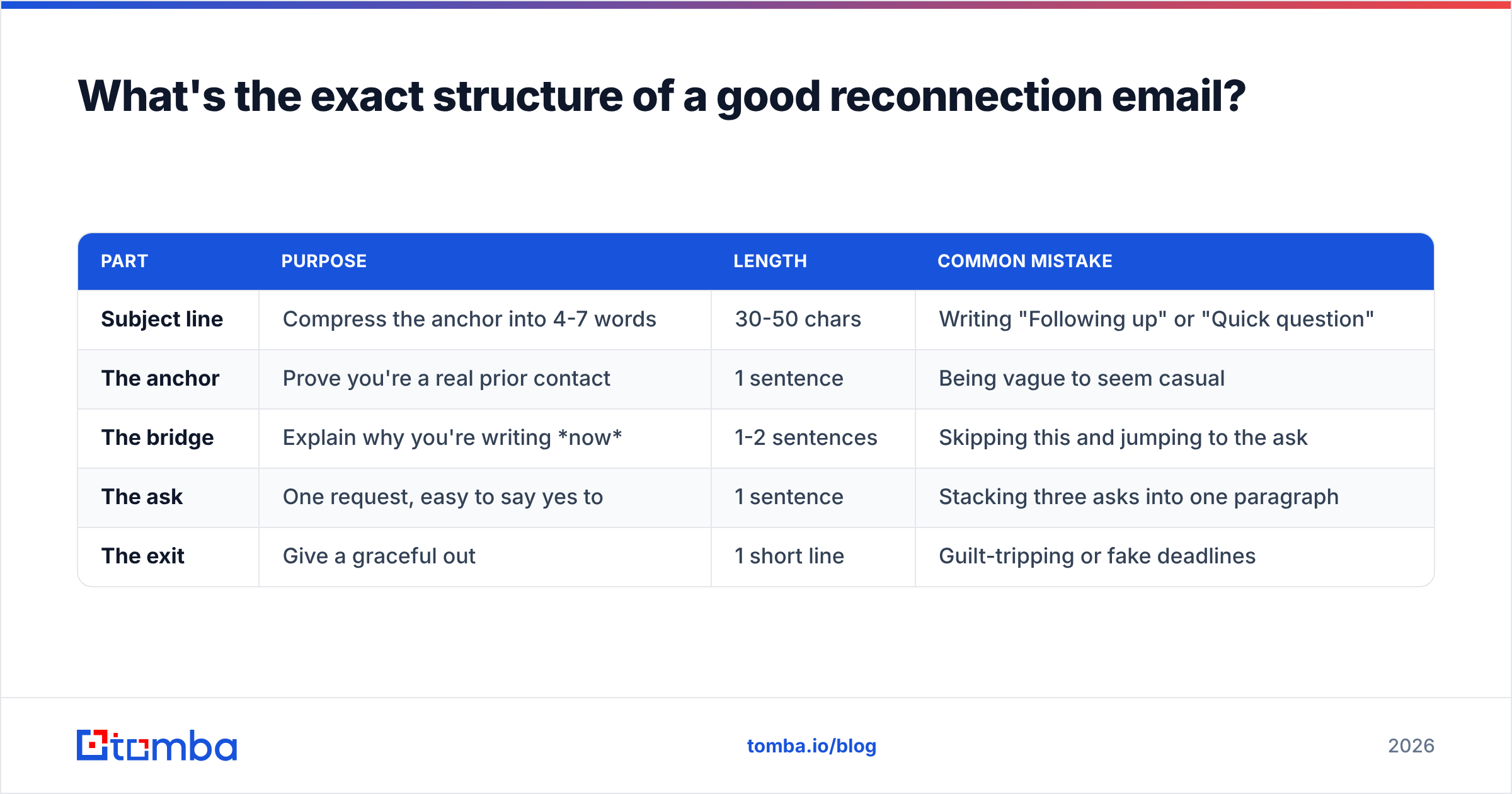
What's the exact structure of a good reconnection email?#
Five parts, in this order. Total length: 90 to 140 words.
| Part | Purpose | Length | Common mistake |
|---|---|---|---|
| Subject line | Compress the anchor into 4-7 words | 30-50 chars | Writing "Following up" or "Quick question" |
| The anchor | Prove you're a real prior contact | 1 sentence | Being vague to seem casual |
| The bridge | Explain why you're writing now | 1-2 sentences | Skipping this and jumping to the ask |
| The ask | One request, easy to say yes to | 1 sentence | Stacking three asks into one paragraph |
| The exit | Give a graceful out | 1 short line | Guilt-tripping or fake deadlines |
The anchor does the heavy lifting. Everything else is standard email hygiene.
A worked example:
Subject: Your Salesforce migration — SaaStr coffee line
Hi Dana — we talked in the coffee line at SaaStr last October, right after the pricing panel. You mentioned your team was six weeks into moving off Salesforce and the data mapping was the painful part.
I've since spent a lot of time on exactly that problem and put together a mapping checklist that saved a similar team about two weeks.
Want me to send it over? No pitch attached — just curious whether the migration ever finished.
— Marcus
Note what's happening: the anchor is verifiable (event, month, specific panel, specific detail), the bridge explains the timing, the ask is a yes/no question, and the exit removes pressure. Dana can reply in four words.
Which opening lines actually work — and which kill the email?#
Below are seven openers that work, ranked by strength of anchor.
- The direct quote — "You told me your biggest hiring bottleneck was technical screening." Strongest possible anchor. Nobody can fake a quote from a conversation that didn't happen.
- The event + specific moment — "We sat at the same table during the RevOps roundtable at Pavilion Summit in March." Better than naming the event alone, because it narrows to a moment.
- The mutual person — "Priya Raman suggested I reach out — she and I worked together at Datadog." Borrowed credibility does the recall work.
- The prior thread — "We traded emails in January about your API docs; here's the thread below." Attach or quote the original. Instant proof.
- The shared artifact — "You commented on my post about outbound attribution back in spring." Verifiable and flattering.
- The role-based reintroduction — "I'm the one who ran the demo for your ops team in Q2." Works when the interaction was formal rather than personal.
- The honest short version — "Marcus here — we met briefly at SaaStr. Long enough ago that I'll assume you don't have it top of mind." This is the only acceptable form of admitting they may not remember, because it's confident rather than apologetic.
Now the lines to delete on sight:
- "You probably don't remember me, but..." — Pre-emptively lowers your status and gives permission to skip.
- "I know you're incredibly busy..." — Everyone is. It's filler.
- "Just circling back / touching base / following up" — Says nothing and reads as automated.
- "Not sure if you saw my last email" — Passive-aggressive, and they did see it.
- "It's been a while!" — True, and useless as an anchor.
- "Hope this finds you well" — Harmless but wastes the highest-value line in the email.
The pattern: every deleted line is about you and your uncertainty. Every good line is about a specific shared moment.
How should the reminder change based on how long it's been?#
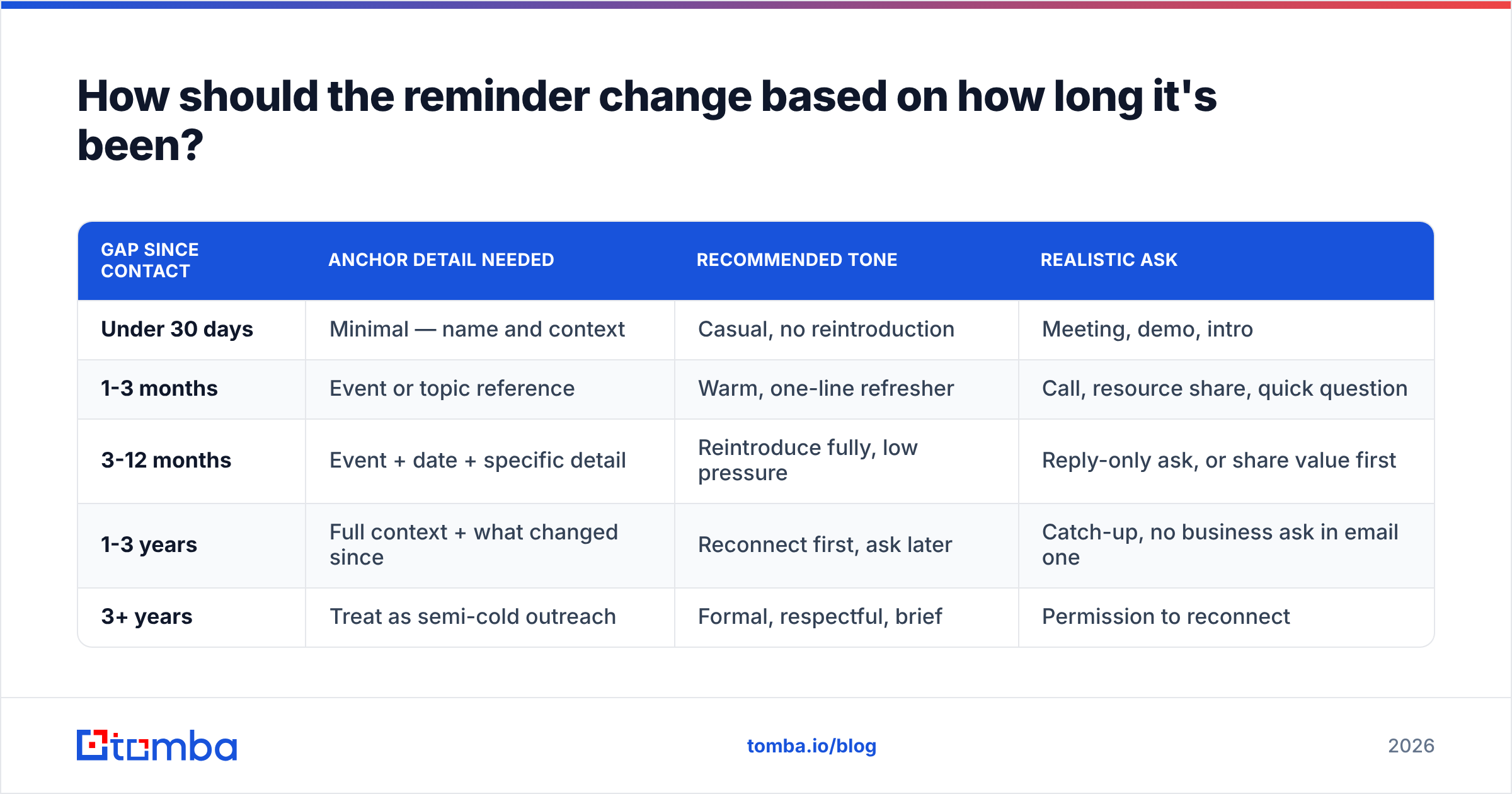
Timing changes tone more than it changes structure. Use this as a decision table:
| Gap since contact | Anchor detail needed | Recommended tone | Realistic ask |
|---|---|---|---|
| Under 30 days | Minimal — name and context | Casual, no reintroduction | Meeting, demo, intro |
| 1-3 months | Event or topic reference | Warm, one-line refresher | Call, resource share, quick question |
| 3-12 months | Event + date + specific detail | Reintroduce fully, low pressure | Reply-only ask, or share value first |
| 1-3 years | Full context + what changed since | Reconnect first, ask later | Catch-up, no business ask in email one |
| 3+ years | Treat as semi-cold outreach | Formal, respectful, brief | Permission to reconnect |
The rule most people break: they use a 30-day tone on an 18-month gap. That mismatch is what makes reconnection emails feel presumptuous. If eighteen months have passed and your first email asks for a 45-minute discovery call, you're spending relationship capital you no longer have.
For anything past the one-year mark, consider splitting into two emails. Email one reconnects and asks nothing. Email two, sent a week later after a reply, makes the ask. Your response rate on the second email will be dramatically higher than a combined single send.
What are the templates for the four most common scenarios?#
Scenario 1: Met at an event, 4-6 months ago#
Subject: The API pricing debate — Web Summit
Hi Sam — Marcus here. We ended up in a long argument about usage-based API pricing at the Web Summit afterparty in November. You were firmly pro-seat-based and I think you won.
Reason I'm writing: we just shipped the hybrid model we were sketching on a napkin. Thought you'd find the numbers interesting.
Want me to send the breakdown? Two paragraphs, no deck.
Scenario 2: Former colleague, 2+ years#
Subject: From the Datadog days — congrats on the VP role
Hi Priya — Marcus Webb, we overlapped on the platform team at Datadog through 2023. Saw the VP announcement and wanted to say congratulations, genuinely deserved.
No agenda here. I've moved into RevOps at a Series B and have been half-following your posts on data governance. If you're ever up for a 20-minute catch-up call I'd enjoy it.
Either way — good to see it going well.
Scenario 3: Prospect who went quiet mid-deal#
Subject: Reviving the Q1 evaluation (or closing it out)
Hi Dana — we were three calls into an evaluation back in February and then things went quiet on both sides, which I assume means priorities moved.
Two things changed since: the SSO gap you flagged shipped in June, and pricing for your seat count dropped a tier.
Worth another look, or should I close the file? A one-word reply is completely fine.
Scenario 4: LinkedIn connection, never actually talked#
Subject: We connected here after your churn post
Hi Alex — we connected on LinkedIn last spring after your post on net revenue retention, though we've never actually spoken.
I'm working on a similar problem at a Series A and your framework for separating expansion from contraction has been the most useful thing I've read on it.
Any chance you'd be open to a 15-minute call? Happy to send questions in advance so it's not a waste of your time.
Each template does the same three things: anchors in something verifiable, explains the timing, and makes the ask smaller than the relationship. Adapt the details, keep the skeleton. If you'd rather start from a pre-built library, Tomba's free cold email templates cover reconnection, follow-up, and re-engagement patterns.
What breaks a reconnection email before anyone reads it?#
Content is only half the battle. The other half is whether the message reaches the inbox at all.
Three failure modes, in order of frequency:
- The address is stale. People change jobs every 2-4 years. The email you collected 18 months ago has a meaningful chance of bouncing, and bounces on old lists are the fastest way to damage sender reputation. Run any address older than a year through an email verifier before you send. If it's dead, find the new one at their current company with a domain search.
- The formatting screams template. Merge-tag artifacts, tracking pixels on a one-off personal email, a signature block with four social icons and a banner. Reconnection emails should look like they came from a person's regular mail client, because they should have.
- The subject line is generic. "Following up" and "Quick question" are the two most-used subject lines in B2B outbound, which means they carry zero information and are pattern-matched as sales mail. Put the anchor in the subject. "SaaStr coffee line" beats "Reconnecting" every time.
There's also the question of whether to send at all. Both HubSpot's research on email engagement and buyer-behavior data collected by Gartner point the same direction: relevance beats volume. If you have no genuine reason to write beyond needing something, the email will read that way. Wait until you have a real trigger — a funding round, a role change, a relevant piece of work you finished, a piece of news in their market.
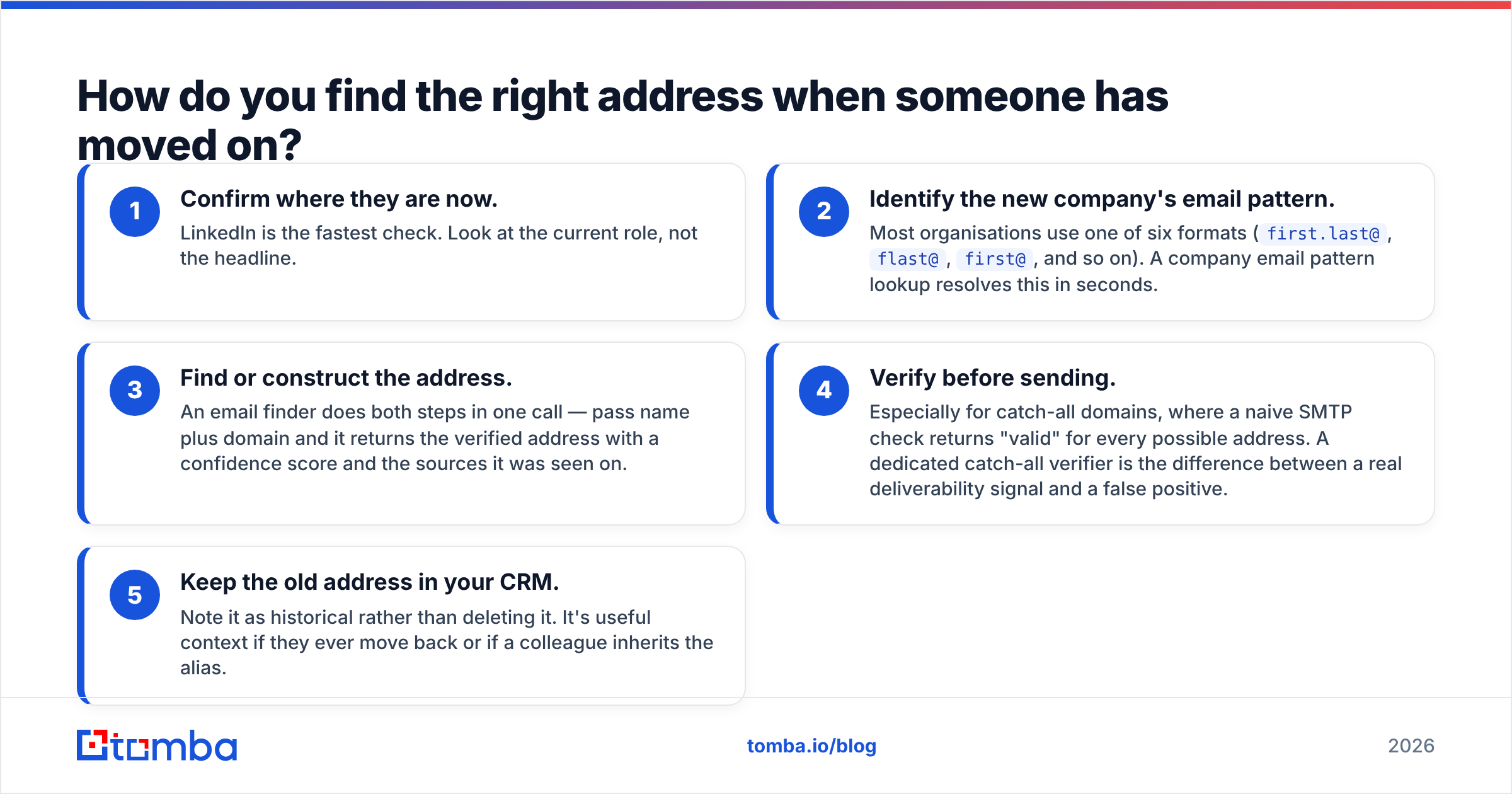
How do you find the right address when someone has moved on?#
Half of all reconnection failures happen before writing. You have a name and an old company, and the contact has since moved twice.
The workflow that works:
- Confirm where they are now. LinkedIn is the fastest check. Look at the current role, not the headline.
- Identify the new company's email pattern. Most organisations use one of six formats (
first.last@,flast@,first@, and so on). A company email pattern lookup resolves this in seconds. - Find or construct the address. An email finder does both steps in one call — pass name plus domain and it returns the verified address with a confidence score and the sources it was seen on.
- Verify before sending. Especially for catch-all domains, where a naive SMTP check returns "valid" for every possible address. A dedicated catch-all verifier is the difference between a real deliverability signal and a false positive.
- Keep the old address in your CRM. Note it as historical rather than deleting it. It's useful context if they ever move back or if a colleague inherits the alias.
For anything beyond a handful of contacts, run the list through a bulk email finder rather than doing it one at a time. If you're reviving a list of a few hundred dormant contacts from an old event, batching is the only sane approach — and you'll want the bounce rate under 2% before that list touches your primary sending domain.
Should you use AI to write reconnection emails?#
Partly. AI is good at structure and bad at anchors.
The anchor — the specific detail that proves you were there — has to come from your own memory, your notes, or the original thread. No model can invent "you were firmly pro-seat-based and I think you won." That's the one sentence that makes the email work, and it's the one sentence AI cannot supply.
What AI does well here: tightening a 220-word draft to 120, generating three subject-line variants from your anchor, and catching the apologetic phrasing you didn't notice you wrote. Use a subject line generator for variants, then pick the one that carries the most concrete information.
What to never do: run a reconnection sequence through an automated multi-step cadence. These emails are one-offs by definition. If your "personal reconnection" arrives with a follow-up on day 3 and a breakup email on day 7, the recipient learns exactly what it was.
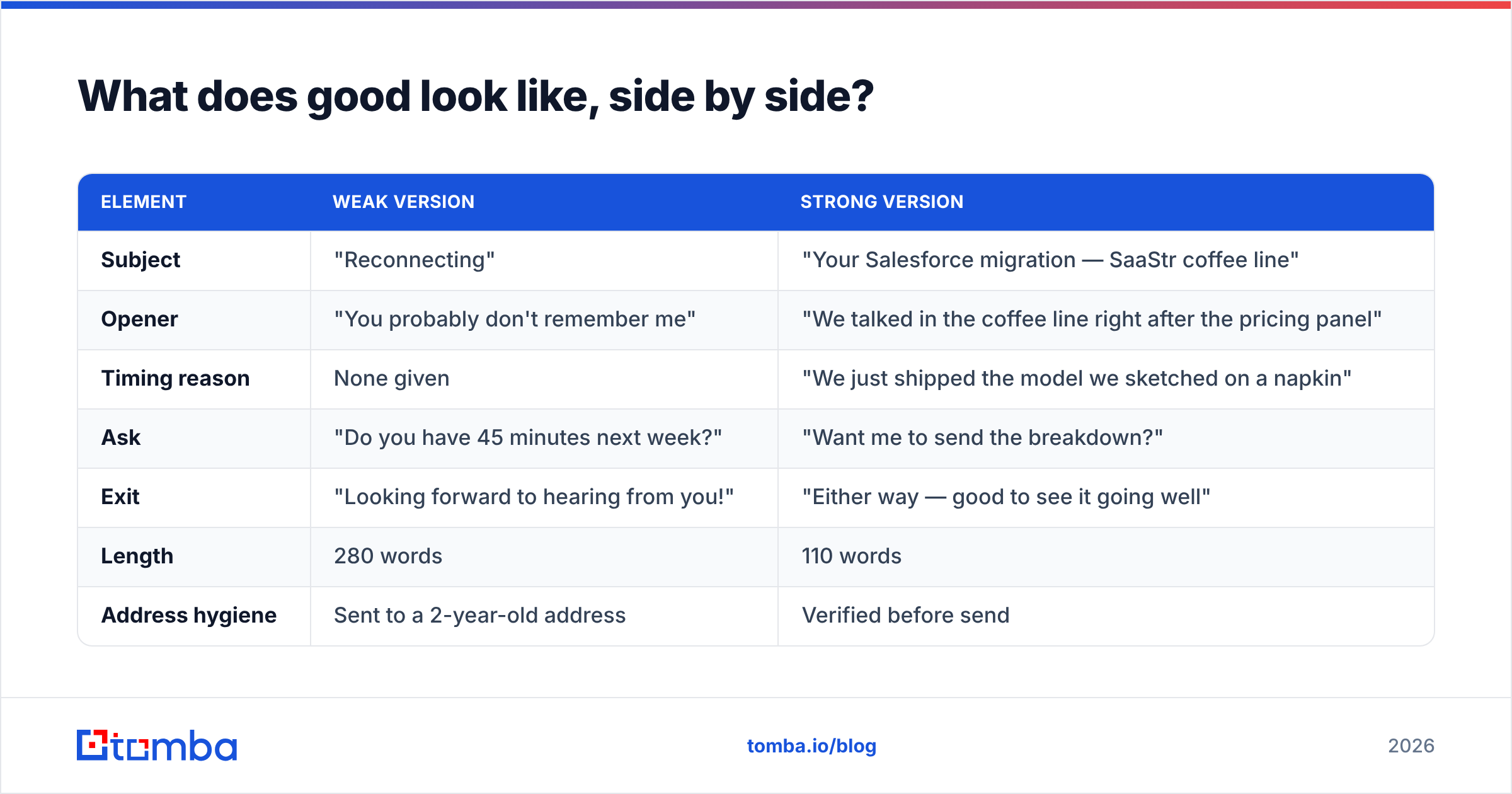
What does good look like, side by side?#
| Element | Weak version | Strong version |
|---|---|---|
| Subject | "Reconnecting" | "Your Salesforce migration — SaaStr coffee line" |
| Opener | "You probably don't remember me" | "We talked in the coffee line right after the pricing panel" |
| Timing reason | None given | "We just shipped the model we sketched on a napkin" |
| Ask | "Do you have 45 minutes next week?" | "Want me to send the breakdown?" |
| Exit | "Looking forward to hearing from you!" | "Either way — good to see it going well" |
| Length | 280 words | 110 words |
| Address hygiene | Sent to a 2-year-old address | Verified before send |
Every row on the right does the same thing: it removes work from the recipient. They don't have to recall, they don't have to interpret your motive, and they don't have to schedule anything to respond.
Get the address right before you worry about the words#
The best-written reconnection email in the world fails if it lands on an address the person abandoned when they changed jobs. Before you spend twenty minutes crafting the perfect anchor sentence, spend twenty seconds confirming the contact is reachable.
Tomba's Email Finder resolves a name and company domain into a verified, current business email with a confidence score and source list — so your reconnection lands in a monitored inbox instead of a defunct alias. The free tier gives you 25 searches a month to test it on your own dormant contacts; paid plans start at $49/mo on Starter, with Growth at $99/mo for teams reviving larger lists. Full Tomba pricing is public, and the Tomba API covers it if you'd rather wire verification into your CRM directly.
Write the anchor yourself. Let the tooling handle everything else.
Related guides#
// get started
Find, verify and enrich your first contacts today
Start on the free plan with 25 searches a month, then scale when your team is ready.
Free plan · No credit card required · GDPR & CCPA
// about the author