How To Respond To A Lost Deal Email Template That Wins Later
You lost the deal. What you send in the next 48 hours decides whether you get a second shot in six months. Here are 7 lost-deal email templates, the exact structure behind them, and the follow-up cadence that reopens closed-lost pipeline.
TL;DR
- Reply within 48 hours. A gracious, specific response to a loss keeps you in the buyer's mental shortlist; silence or a passive-aggressive sign-off removes you permanently.
- The winning structure is five lines: thank, accept cleanly, ask one diagnostic question, leave one piece of value, set a specific re-check date.
- Never ask "can I ask what went wrong?" as an open question. Ask a forced-choice question — price, timing, features, or internal politics — and you'll actually get an answer.
- Roughly a fifth to a third of closed-lost deals become winnable again within 12-18 months, mostly through churn at the winning vendor or a champion changing jobs. Your loss email is what buys you the ticket back.
- Track the champion, not just the account. When they move companies, your lost deal becomes a warm inbound at a brand-new logo — which is where a tool like the email finder earns its keep.
Why does the email you send after losing matter so much?#
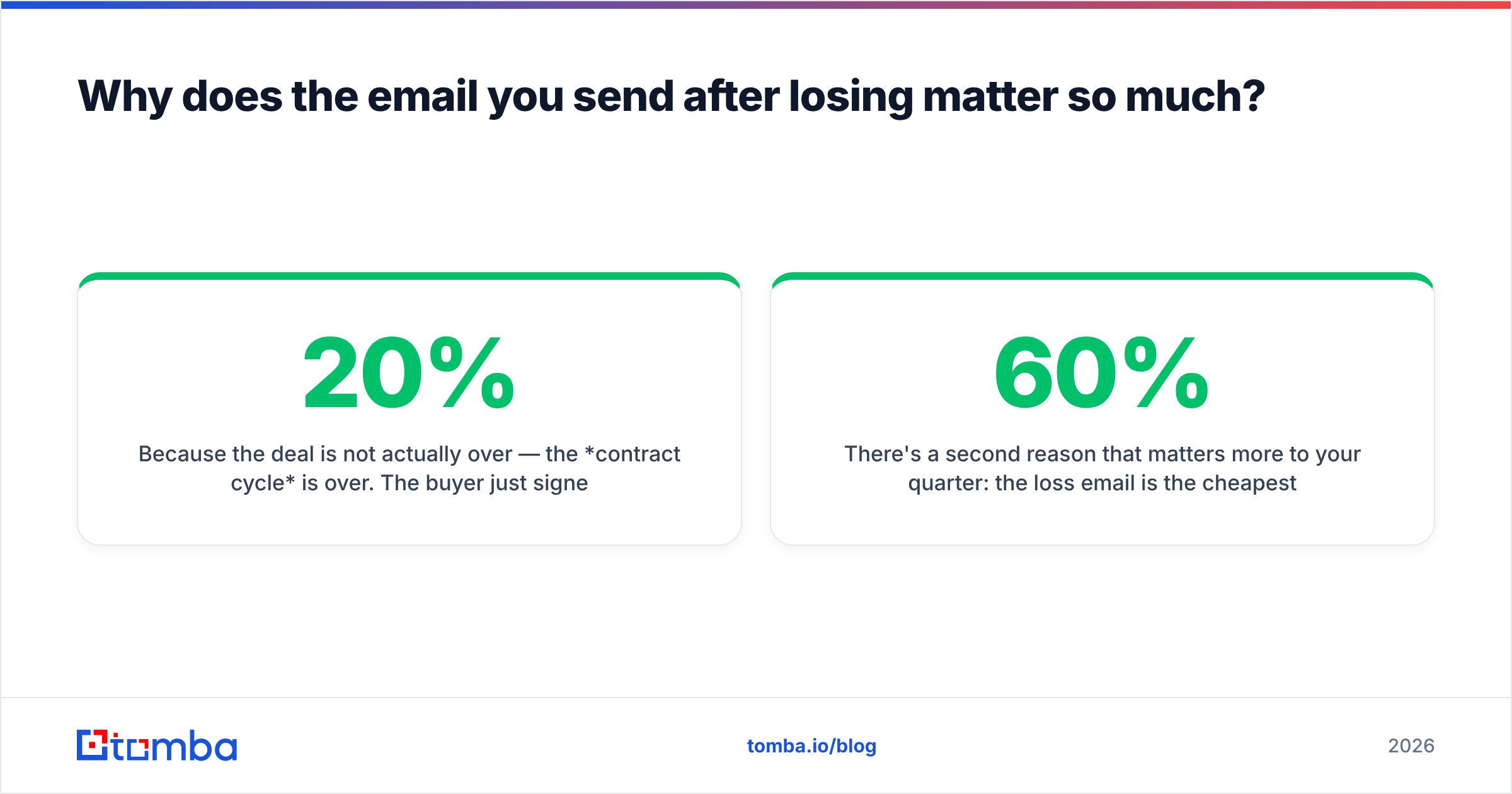
Because the deal is not actually over — the contract cycle is over. The buyer just signed a 12- or 24-month agreement with someone else. Somewhere between 20% and 40% of those relationships underperform, get re-evaluated, or fall apart at renewal. When that happens, the buyer does not run a fresh RFP from scratch. They pull up the shortlist from last time and email the two vendors they remember liking.
Your job in the loss email is to be one of those two.
Think of it like being turned down for a job. The candidate who replies "understood, that's disappointing but I get it — if the role reopens or the new hire doesn't work out, I'd still love a conversation" is the one the hiring manager calls in four months. The candidate who ghosts, or who writes three paragraphs arguing the decision was wrong, is never contacted again.
There's a second reason that matters more to your quarter: the loss email is the cheapest source of honest win/loss data you will ever get. Formal win/loss interview programs (the kind Gartner and Forrester research keeps recommending) cost real money and take weeks. A well-written two-line question in your loss reply gets you 40-60% of the same signal for free, in a day.
What is the correct structure for a lost deal email?#
Five components, in this order. Deviating from the order is what makes most loss emails read as bitter.
- Thank them specifically. Not "thanks for your time." Name a moment — the security review, the workshop with their ops team, the fact that they looped in finance early. Specificity proves you were paying attention.
- Accept the decision without a single word of pushback. No "I do want to flag one thing about their pricing." The moment you relitigate, you become the vendor who couldn't take a no, and you're out of the mental shortlist forever.
- Ask exactly one forced-choice question. Open questions get ignored; multiple-choice questions get answered. "Was it primarily price, timeline, or a missing capability?" gets a reply roughly three times as often as "any feedback on why we lost?"
- Leave one piece of genuinely useful value. An implementation checklist, a benchmark doc, a "here's what to watch for in your first 90 days with any vendor in this category" note. This should help them even though they chose someone else. That's the whole point.
- Name a specific re-check date. Not "let's stay in touch." Say "I'll check back the week of March 9, about 60 days before your renewal." Then actually do it. A named date creates a permission structure for the follow-up.
Which lost deal email template should you use?#
Pick by loss reason, not by mood. Here are seven working templates.
Template 1 — Lost on price#
Subject: Congrats on the decision — one thing before I go quiet
Hi [Name],
Thanks for running such a clear process — you gave us a real shot and your team asked sharper questions than most.
Fully understand the budget call. No pitch here.
One quick thing: was it the absolute number, or the shape of the contract (annual prepay, seat minimums)? Asking because we've reworked terms twice this year based on exactly that feedback, and it helps me know which.
Attaching the rollout checklist we built for you — it works with any vendor in this category, so use it regardless.
I'll check back the week of [date, ~60 days pre-renewal]. Good luck with the launch.
Template 2 — Lost on a missing feature#
Subject: Understood — and thank you for the specifics
Hi [Name],
Appreciate you being direct about the [feature] gap instead of letting it drag. That's rarer than it should be.
That item is on our roadmap for [quarter]. I'm not going to ask you to wait for it — you have a problem now.
When it ships I'll send you a two-minute walkthrough, no meeting required. If it's still relevant then, we talk. If not, no harm done.
Genuinely hope [competitor] works out well for you.
Template 3 — Lost to a status-quo / "no decision"#
Subject: Parking this properly
Hi [Name],
Sounds like the project is on hold rather than dead. Let's park it cleanly instead of me chasing you every three weeks.
Quick check: is the blocker budget cycle, headcount to run it, or that [problem] just isn't hurting enough yet?
I'll go quiet and come back the week of [date]. If something changes before then, my line is open.
Template 4 — Lost to an incumbent renewal#
Subject: Renewal makes sense — see you at the next one
Hi [Name],
Renewing the incumbent is usually the right call when switching costs are real. No argument from me.
One favour: when does the next renewal window open? I'd rather show up eight weeks early with something useful than three days late with a pitch.
Meanwhile, here's the benchmark data we pulled on [category metric] during our eval. Use it as leverage in your QBRs with them.
Template 5 — Lost because your champion left mid-cycle#
Subject: Following [Champion] — and closing the loop with you
Hi [Name],
Now that [Champion] has moved on, I understand the eval reset. That's fair.
Two things: first, here's a one-page summary of everything we covered with them, so nothing is lost if you revisit this later. Second, if a fresh eval happens under you, I'd like to earn the seat rather than assume it.
Who's the right person to check in with in [quarter]?
Template 6 — Lost after a trial that underperformed#
Subject: The trial didn't land — here's my honest read
Hi [Name],
The trial underdelivered and I own part of that. We onboarded you into [module] when your actual use case was [use case], and that cost you two weeks.
Not asking for a second trial today. If you ever want a properly scoped 10-day pilot, I'll set it up personally.
Either way, thanks for the candour in the debrief — it changed how we onboard this segment.
Template 7 — Lost and you never got a reason#
Subject: One question, one line to answer
Hi [Name],
Looks like you've gone another direction — no problem at all.
Would you reply with a single letter? A = price, B = features, C = timing, D = something else. That's it. It genuinely helps us stop wasting buyers' time.
Thanks either way, and good luck.
Template 7 has the highest reply rate of the seven, for an obvious reason: the cost of replying is one keystroke.
How do the main loss reasons compare?#
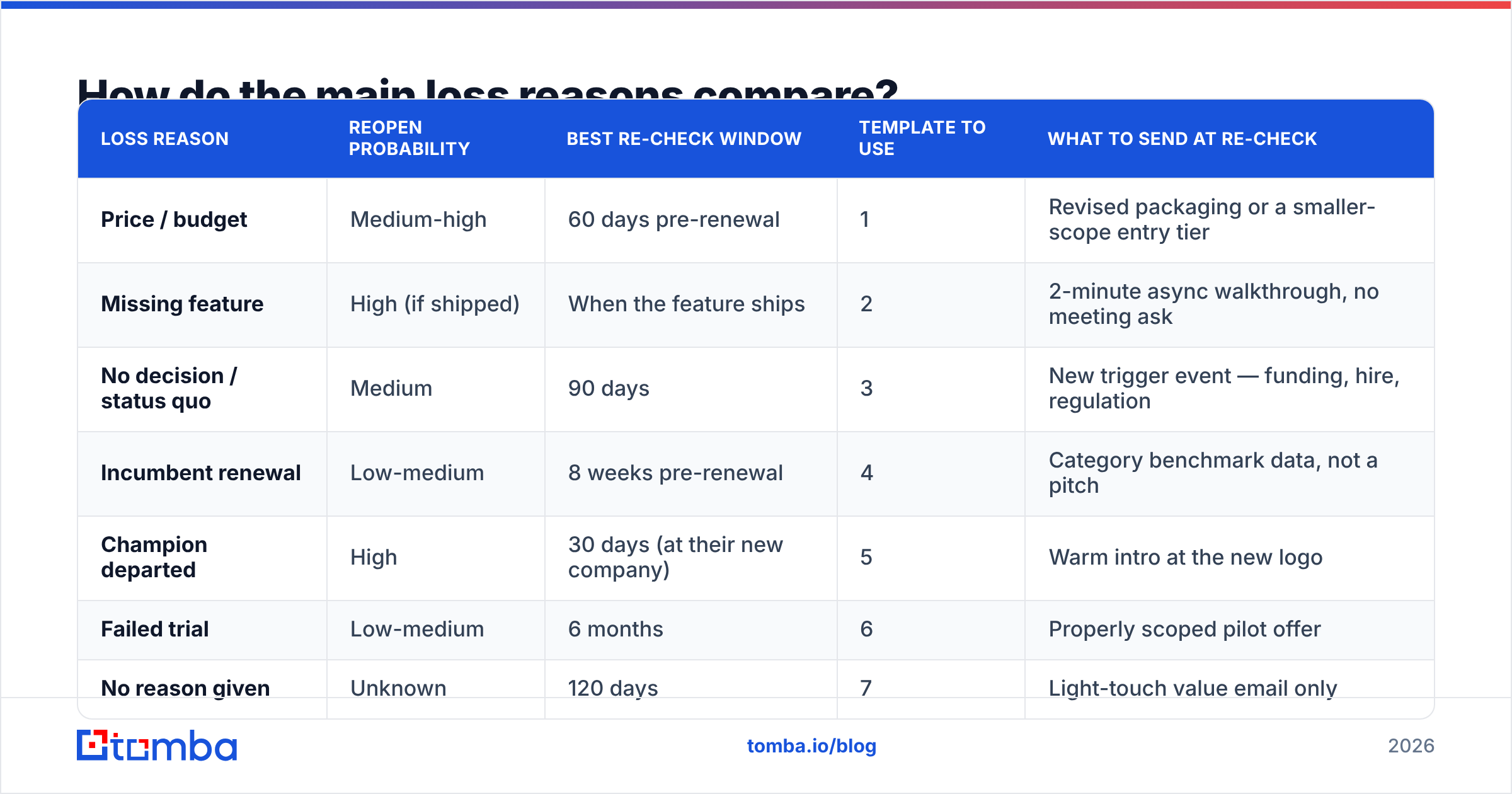
Not all losses deserve the same follow-up cadence. Match your effort to the probability the deal actually reopens.
| Loss reason | Reopen probability | Best re-check window | Template to use | What to send at re-check |
|---|---|---|---|---|
| Price / budget | Medium-high | 60 days pre-renewal | 1 | Revised packaging or a smaller-scope entry tier |
| Missing feature | High (if shipped) | When the feature ships | 2 | 2-minute async walkthrough, no meeting ask |
| No decision / status quo | Medium | 90 days | 3 | New trigger event — funding, hire, regulation |
| Incumbent renewal | Low-medium | 8 weeks pre-renewal | 4 | Category benchmark data, not a pitch |
| Champion departed | High | 30 days (at their new company) | 5 | Warm intro at the new logo |
| Failed trial | Low-medium | 6 months | 6 | Properly scoped pilot offer |
| No reason given | Unknown | 120 days | 7 | Light-touch value email only |
Two rows deserve extra attention. Champion departed is the highest-ROI row on the table and the one most teams ignore — your champion liked you enough to fight for you internally, and now they're at a company with a fresh budget and no incumbent. Incumbent renewal is the lowest-effort row: one calendar reminder, one useful email, no cadence.
What should you never write in a lost deal email?#
Five things kill the relationship instantly:
- Any comparison to the winner. "Just so you know, [competitor] charges for onboarding" reads as sour grapes, even when it's factually true and helpful. Save it.
- A request for a call to "understand the decision." You lost; you don't get to book 30 more minutes of their time. Ask in writing, in one line.
- Passive-aggressive language. "Sorry we couldn't be the right fit this time" with the italics energy. Buyers read tone accurately.
- A CC to their boss. This is an escalation attempt wearing a courtesy costume, and everyone knows it.
- An automated sequence. If your loss email is a step in a 7-touch automated cadence, delete it. This is the one email in the cycle that must be hand-written, and it takes four minutes.
Also worth noting: keep the loss email plain text and off your bulk-sending domain. A "sorry we lost" note landing in promotions is a bad look, and post-loss emails to disengaged contacts can drag your sender reputation if you batch them. Send from your primary inbox, one at a time.
When should you follow up after a lost deal?#
Use a fixed cadence tied to the loss reason, not to your quarter-end panic. The pattern that works across most B2B cycles:
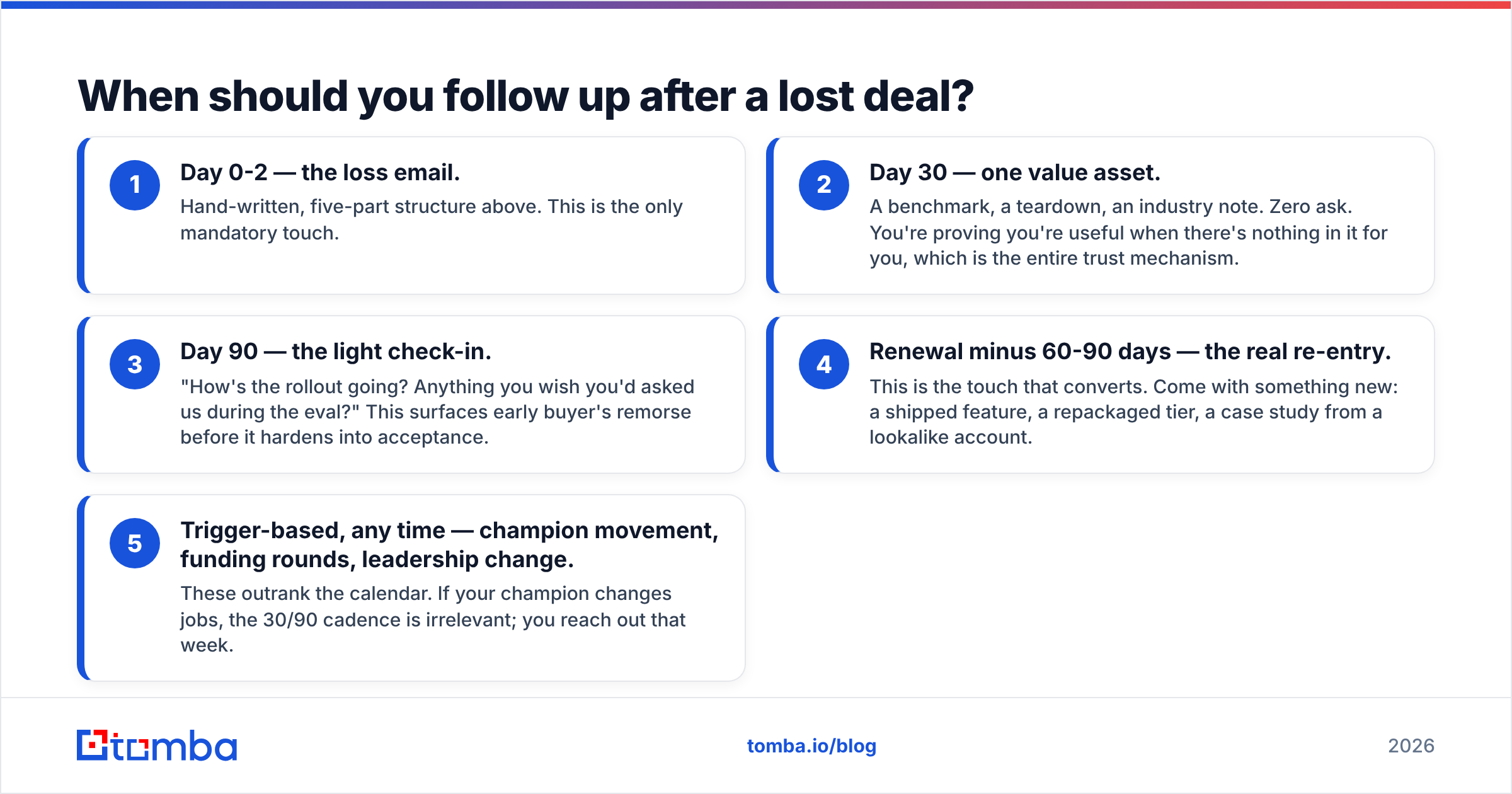
- Day 0-2 — the loss email. Hand-written, five-part structure above. This is the only mandatory touch.
- Day 30 — one value asset. A benchmark, a teardown, an industry note. Zero ask. You're proving you're useful when there's nothing in it for you, which is the entire trust mechanism.
- Day 90 — the light check-in. "How's the rollout going? Anything you wish you'd asked us during the eval?" This surfaces early buyer's remorse before it hardens into acceptance.
- Renewal minus 60-90 days — the real re-entry. This is the touch that converts. Come with something new: a shipped feature, a repackaged tier, a case study from a lookalike account.
- Trigger-based, any time — champion movement, funding rounds, leadership change. These outrank the calendar. If your champion changes jobs, the 30/90 cadence is irrelevant; you reach out that week.
The trigger-based touch is where most reopened pipeline actually comes from, and it's the one that depends on data hygiene rather than writing skill. If your CRM has your champion's old work address and nothing else, the trigger fires into a bounce. Running lost-deal contacts through an email verifier every quarter, and re-finding addresses for people who moved, is what turns the cadence from theoretical into functional. A quarterly bulk verify pass over your closed-lost list takes minutes and prevents the most common failure mode: a perfect re-entry email sent to a dead mailbox.
How do you turn loss data into a better win rate?#
Log the answer to your forced-choice question in a structured field, not in a notes blob. Four values — price, features, timing, other — is enough. After 40-50 losses you'll have a pattern that's more actionable than any deck.
What teams typically find:
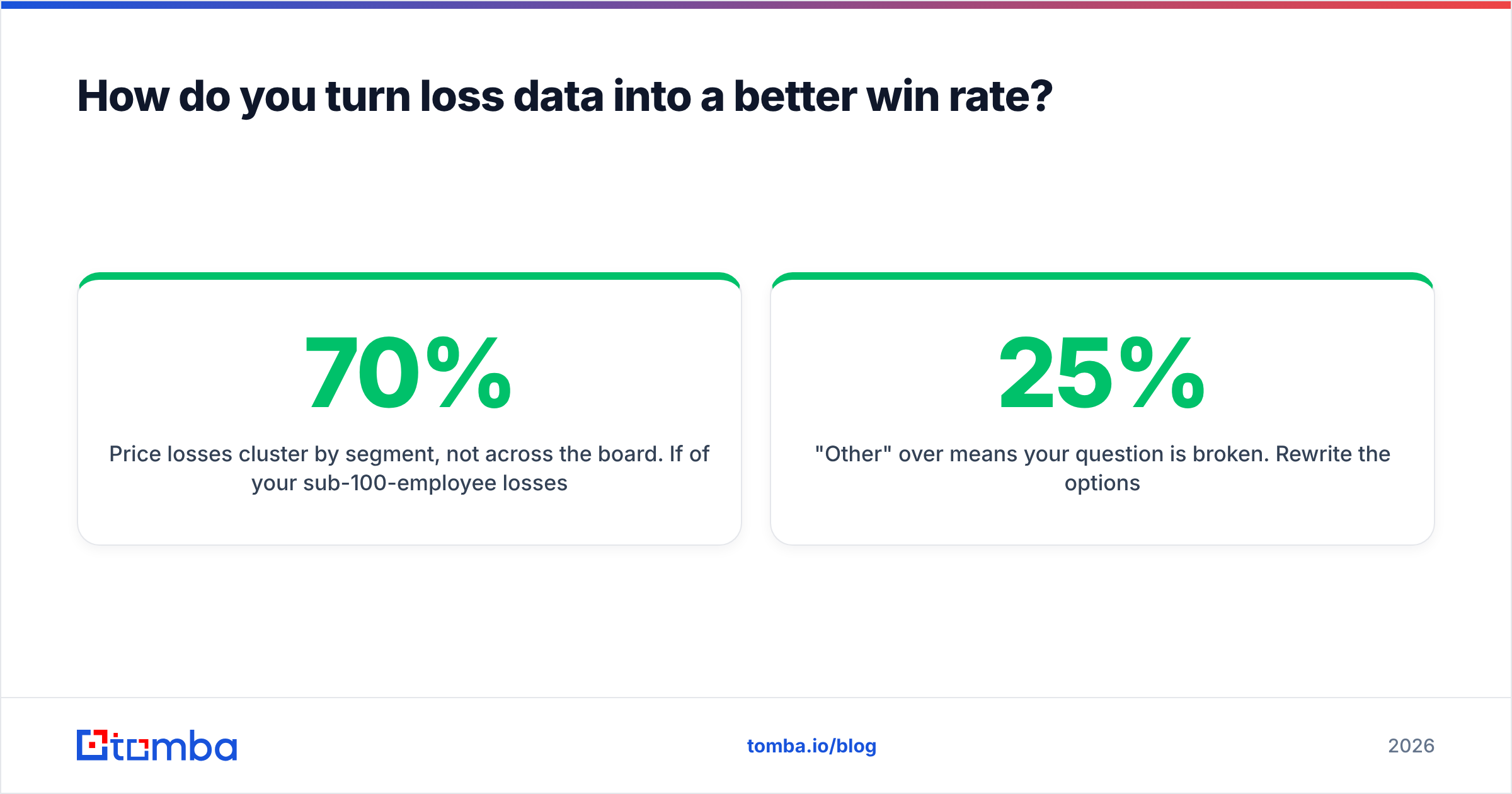
- Price losses cluster by segment, not across the board. If 70% of your sub-100-employee losses are price and only 15% of enterprise losses are, you have a packaging problem, not a pricing problem.
- Feature losses cluster by one or two items. If the same gap appears in 12 of 50 losses, that's a roadmap argument with a number attached.
- Timing losses are usually qualification failures. A high "no decision" rate means you're advancing deals that never had a trigger event, and your discovery needs work, not your closing.
- "Other" over 25% means your question is broken. Rewrite the options.
Feed that back into how you build lists. If enterprise deals close at triple the rate of SMB, the fix upstream is targeting, and that starts with better account data — a domain search across your ideal-customer-profile accounts, enriched with role and seniority, beats buying another 10,000 unqualified contacts. Peers in the space like BookYourData take a similar data-first view of list quality, and the underlying logic holds regardless of vendor: better inputs, fewer avoidable losses. Buyer reviews on G2 consistently show data accuracy as the top complaint category across prospecting tools, which is exactly the variable you control.
One last habit worth building: run a monthly review of closed-lost deals from 9-15 months ago. That cohort is entering renewal windows right now. Most reps never look at it, which means the field is empty.
Ready to reopen the deals you already lost?#
Your closed-lost list is the warmest cold list you own. Those people know your product, sat through your demo, and in many cases liked you — they just had a reason not to buy that quarter. The only thing standing between you and that pipeline is contact data that went stale the moment someone changed jobs.
Use the Tomba Email Finder to re-find your former champions at their new companies, verify the addresses on your closed-lost list before you send, and turn a spreadsheet of losses into a re-entry cadence that actually lands. The free tier gives you 25 searches a month to test it on your top lost accounts, and paid plans start at $49/mo — see full Tomba pricing for team volumes.
Write the loss email. Set the re-check date. Then make sure the address still works.
Related guides#
// get started
Find, verify and enrich your first contacts today
Start on the free plan with 25 searches a month, then scale when your team is ready.
Free plan · No credit card required · GDPR & CCPA
Get the Tomba newsletter
Product and data updates
// about the author