How to Respond to an Intro Email: Templates That Work
A warm intro is the highest-converting lead you will ever get, and most reps waste it with a slow, bloated reply. Here is the timing, the BCC etiquette, and four copy-paste templates that turn an introduction into a booked call.
TL;DR
- Reply within 24 hours. Warm intros decay faster than any other lead type — the referrer's social capital is spent the moment they hit send, and it stops earning interest immediately.
- Move the person who made the introduction to BCC in your first reply, thank them in one line, and never make them read the rest of the thread.
- Your reply has one job: propose a specific, low-friction next step. Not a pitch, not a deck, not a calendar link with no context.
- Keep it under 120 words. Longer replies to intros correlate with slower responses because they hand the recipient homework.
- Build the follow-up path before you need it — if the thread goes quiet, you should already have a verified direct address and a second channel.
What Is an Intro Email, and Why Does the Reply Matter So Much?#
An intro email is a message where a mutual contact connects two parties who have not spoken before. In B2B sales it usually looks like one of three things: a customer introducing you to a peer at another company, an investor connecting you with a portfolio operator, or an internal champion looping in the actual decision maker.
The reply matters because an intro is borrowed trust. Someone put their name on you. That trust has a half-life measured in hours, not weeks. When you reply within a day, you inherit the referrer's credibility. When you reply on day four, the recipient has already forgotten the context and reads your message the same way they read a cold email — except now it also arrives with a whiff of "this person is not organised."
There is also a second, quieter cost. Every slow or sloppy intro reply teaches the referrer not to introduce you again. Referral flow dries up not because people stop liking you but because they stop trusting that you will handle the handoff well.
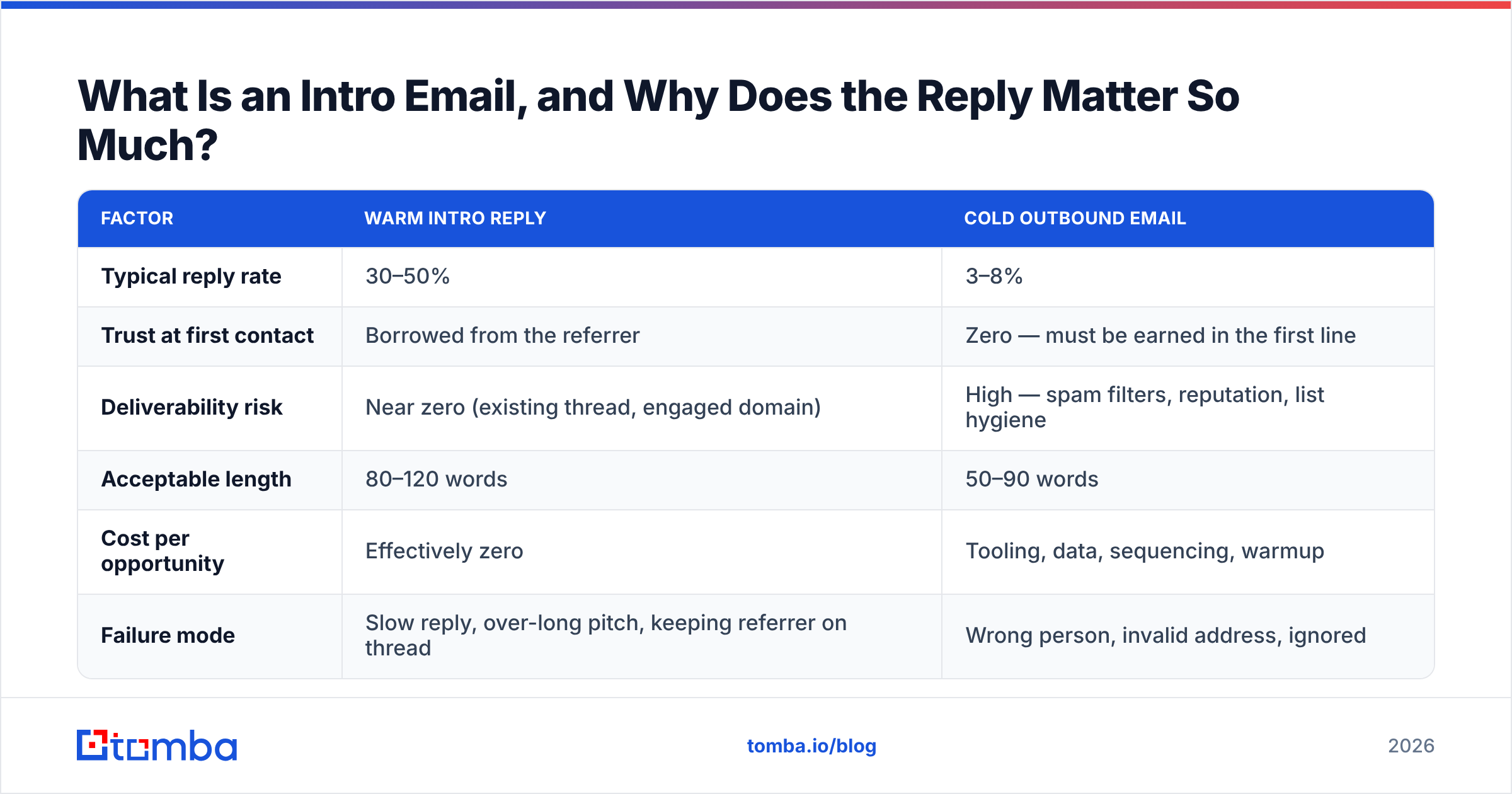
Compare the two starting positions honestly:
| Factor | Warm intro reply | Cold outbound email |
|---|---|---|
| Typical reply rate | 30–50% | 3–8% |
| Trust at first contact | Borrowed from the referrer | Zero — must be earned in the first line |
| Deliverability risk | Near zero (existing thread, engaged domain) | High — spam filters, reputation, list hygiene |
| Acceptable length | 80–120 words | 50–90 words |
| Cost per opportunity | Effectively zero | Tooling, data, sequencing, warmup |
| Failure mode | Slow reply, over-long pitch, keeping referrer on thread | Wrong person, invalid address, ignored |
The numbers vary by industry, but the shape holds everywhere: the intro is the cheapest opportunity in your pipeline and the easiest one to fumble. Which is why it is worth having a repeatable structure instead of improvising each time.
What Are the Six Parts of a Strong Intro Email Reply?#
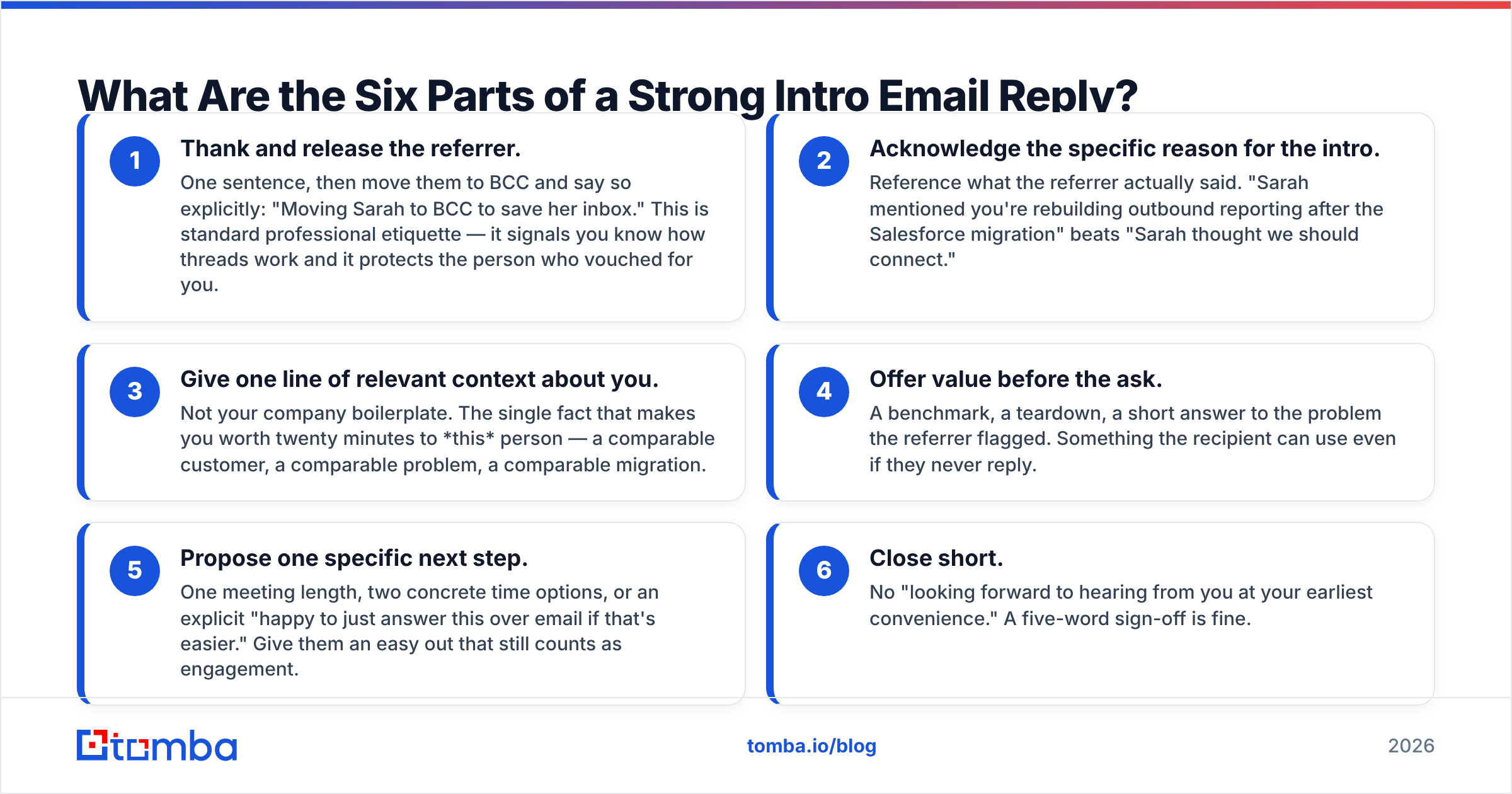
Every good reply to an introduction contains the same six moves, in the same order. Once you internalise them you can write one in ninety seconds.
- Thank and release the referrer. One sentence, then move them to BCC and say so explicitly: "Moving Sarah to BCC to save her inbox." This is standard professional etiquette — it signals you know how threads work and it protects the person who vouched for you.
- Acknowledge the specific reason for the intro. Reference what the referrer actually said. "Sarah mentioned you're rebuilding outbound reporting after the Salesforce migration" beats "Sarah thought we should connect."
- Give one line of relevant context about you. Not your company boilerplate. The single fact that makes you worth twenty minutes to this person — a comparable customer, a comparable problem, a comparable migration.
- Offer value before the ask. A benchmark, a teardown, a short answer to the problem the referrer flagged. Something the recipient can use even if they never reply.
- Propose one specific next step. One meeting length, two concrete time options, or an explicit "happy to just answer this over email if that's easier." Give them an easy out that still counts as engagement.
- Close short. No "looking forward to hearing from you at your earliest convenience." A five-word sign-off is fine.
The order matters. Gratitude first buys you the right to make an ask; the ask before the value read as extraction, and people can feel it even when they cannot name it.
How Fast Should You Reply to an Intro Email?#
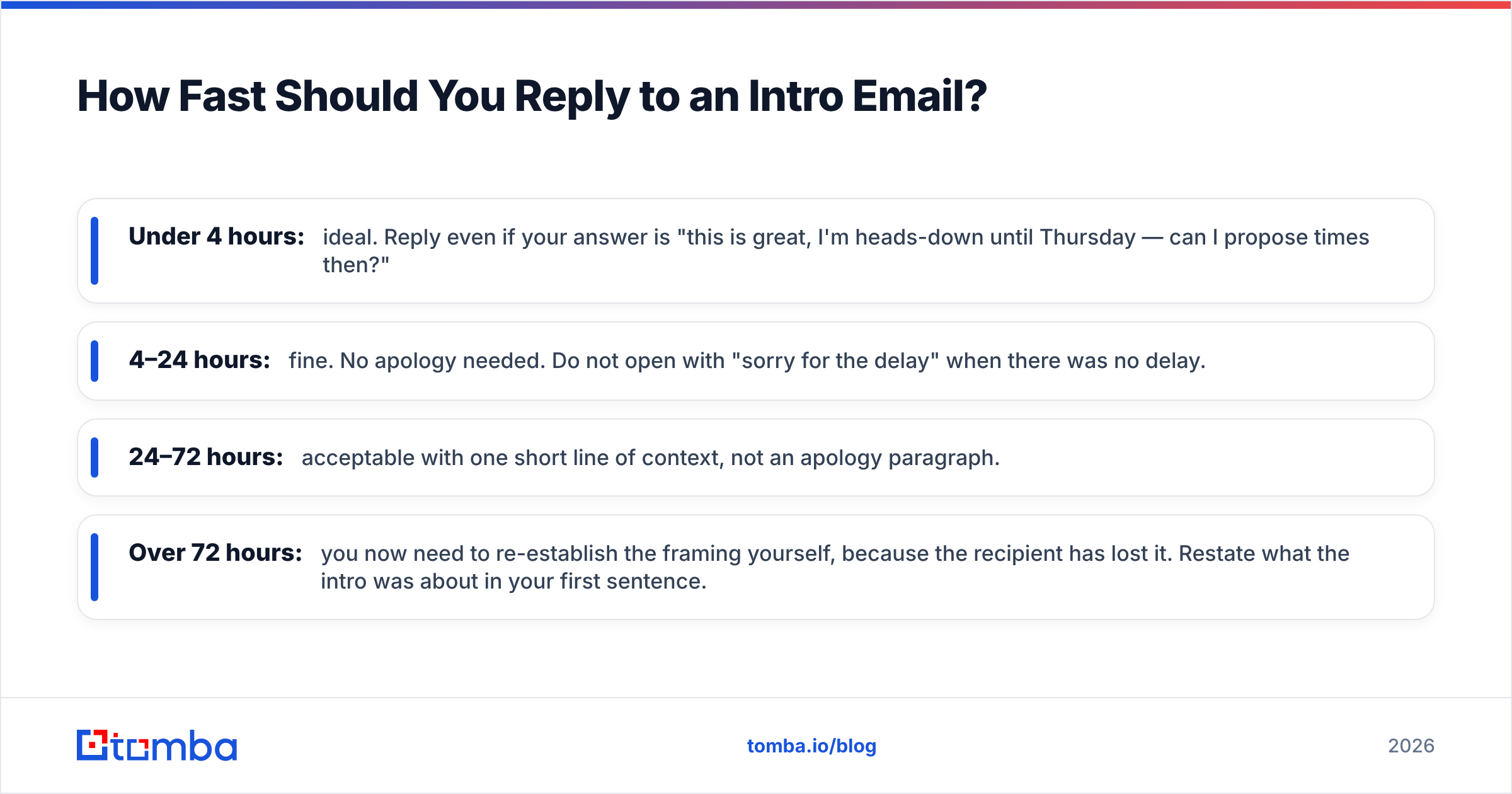
Within 24 hours, and inside four business hours if you can manage it.
Here is the practical reasoning. When the intro lands, all three people in the thread have the context loaded in working memory. The referrer just wrote the framing sentence. The recipient just read it. You just read it. Reply now and nobody has to reconstruct anything.
Wait three days and the recipient has to re-open the thread, re-read the framing, and decide whether they still care. That is three separate opportunities to archive you. HubSpot's sales research team has published repeatedly on the collapse in conversion as response lag grows — the curve is brutal for inbound leads, and warm intros behave the same way. You can browse their ongoing coverage at HubSpot's sales blog.
Some timing rules worth keeping:
- Under 4 hours: ideal. Reply even if your answer is "this is great, I'm heads-down until Thursday — can I propose times then?"
- 4–24 hours: fine. No apology needed. Do not open with "sorry for the delay" when there was no delay.
- 24–72 hours: acceptable with one short line of context, not an apology paragraph.
- Over 72 hours: you now need to re-establish the framing yourself, because the recipient has lost it. Restate what the intro was about in your first sentence.
One exception: if the intro arrives at 11pm on a Friday, do not reply at 11:04pm on a Friday. Schedule it for Monday morning. Availability is attractive; being permanently online is not.
Should You Reply All, Move the Referrer to BCC, or Start a New Thread?#
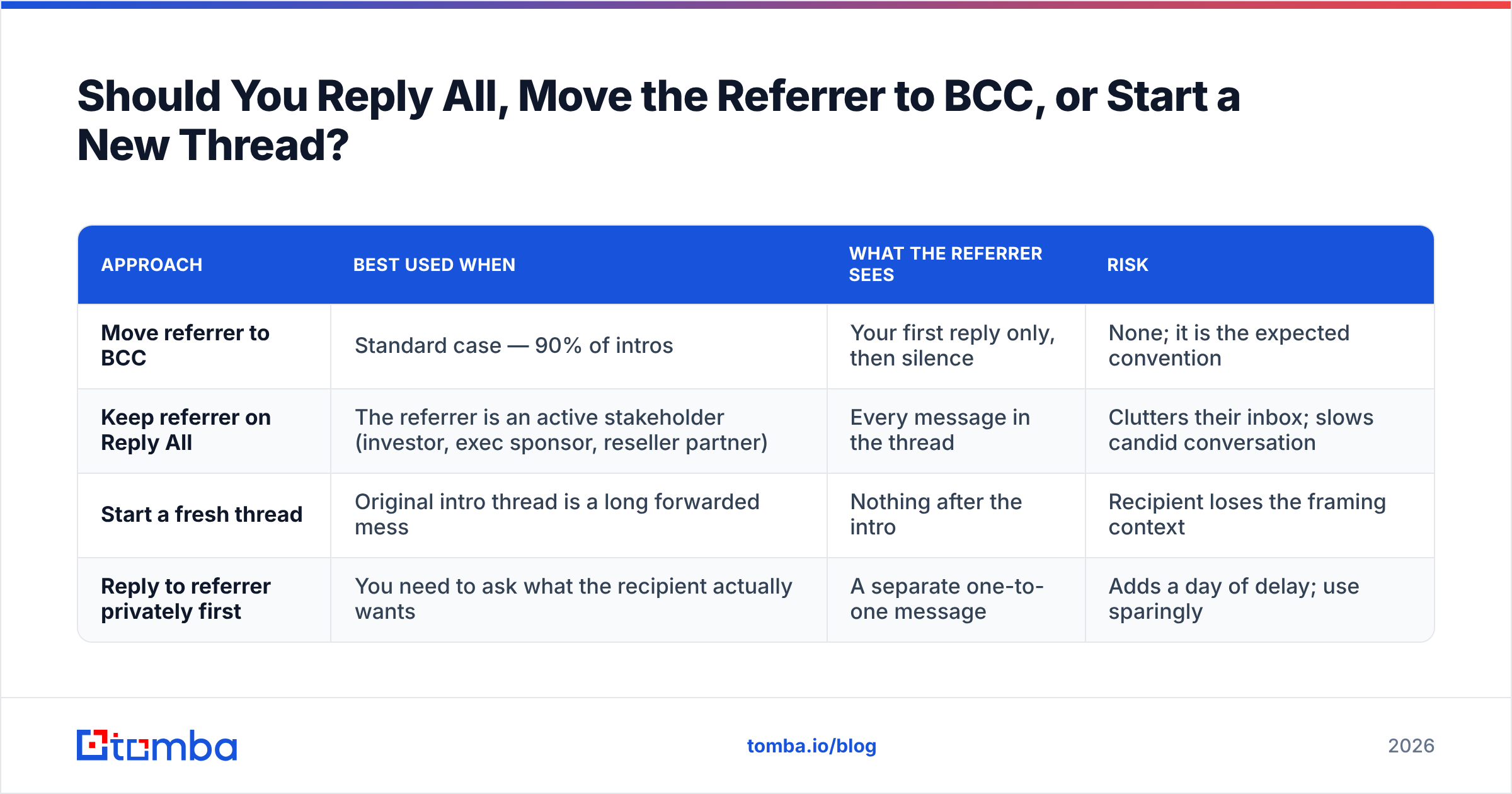
Move to BCC. Almost always. But the alternatives have narrow, legitimate uses, so know when each applies.
| Approach | Best used when | What the referrer sees | Risk |
|---|---|---|---|
| Move referrer to BCC | Standard case — 90% of intros | Your first reply only, then silence | None; it is the expected convention |
| Keep referrer on Reply All | The referrer is an active stakeholder (investor, exec sponsor, reseller partner) | Every message in the thread | Clutters their inbox; slows candid conversation |
| Start a fresh thread | Original intro thread is a long forwarded mess | Nothing after the intro | Recipient loses the framing context |
| Reply to referrer privately first | You need to ask what the recipient actually wants | A separate one-to-one message | Adds a day of delay; use sparingly |
The BCC move (blind carbon copy in the technical sense) is a courtesy signal. It tells the referrer "your job is done, thank you," and it tells the recipient "we can now talk normally." Both people notice when you do it, and both people notice when you do not.
One caveat: if the referrer explicitly says "keep me in the loop" or is the budget holder, keep them on the thread until the meeting is booked, then move them to BCC in the confirmation message.
What Do Good Intro Email Replies Actually Look Like?#
Four templates covering the situations you will hit most often. Adapt the specifics; keep the structure.
Template 1 — Standard warm intro to a prospect
Subject: Re: Intro — Ben @ Tomba <> Priya @ Northline
Thanks for making this happen, Sarah — moving you to BCC.
Priya, good to meet you. Sarah mentioned Northline is rebuilding outbound reporting after the CRM migration, which is roughly the problem we solved for two other logistics teams last quarter — the fix was less about tooling and more about how leads got deduplicated on the way in.
Happy to walk you through what those teams did, or just send the two-page summary if that's more useful. Would 20 minutes Thursday or Friday morning work?
Ben
Template 2 — Intro to a peer, no sales intent
Thanks, Marco — BCC'ing you.
Elena, nice to meet you. Marco said you're running the same RevOps stack we are and have already solved the attribution mess we're currently in. I'd love to trade notes rather than pitch anything — I have a working setup for multi-touch that might save you a week, and I'd be selfishly grateful for how you handled the reporting layer.
25 minutes in the next two weeks, whenever suits?
Template 3 — Intro to a decision maker by an internal champion
Thanks for the intro, Dan.
Alex, Dan and I have been mapping how your team is handling lead routing across the two new regions. Rather than repeating that conversation, I've put the current-state and proposed-state on one page — happy to send it ahead so the call is a decision rather than a demo.
Does 30 minutes next week work, with Dan on the call?
Note that Dan stays on this one. He is a stakeholder, not just a connector.
Template 4 — Polite decline (the intro is not a fit)
Thanks for thinking of me, Sarah.
Priya, good to meet you. Being straight with you: what we do is a poor match for a team at your stage — you'd be paying for capability you won't use for another year. Two tools that would fit better are X and Y.
If the picture changes after your Series A, I'm easy to find.
That last one costs you nothing and buys enormous referrer goodwill. People remember the vendors who told them no.
What Mistakes Kill Intro Email Replies?#
- The wall of text. Anything over 150 words in a first reply is homework. Cut the second paragraph; it is almost always the weakest one.
- Naked calendar links. "Here's my Calendly" with no proposed times reads as "my time is worth more than yours." Offer two slots and the link.
- Copy-pasted boilerplate. If the recipient can tell your paragraph would work for any company, it works for none.
- Keeping the referrer captive. Every subsequent message they receive is a small tax on the relationship that just helped you.
- No follow-up plan. Roughly a third of intro threads go quiet, not because of disinterest but because of inbox volume. One follow-up at day five, one at day twelve, then stop.
- Wrong assumption about the address. Intros often come to a personal or forwarded address that the person does not actually monitor. If two follow-ups vanish, the address is the suspect, not the message.
How Do You Turn One Intro Into a Repeatable Pipeline?#
The reply is tactics. The system is what compounds. Three things separate teams who get one intro from teams who get thirty.
1. Enrich before you reply. Two minutes of research changes the quality of your second sentence. Who else sits on the recipient's team, what stack are they running, who else at that company touches this problem? Running the domain through a domain search shows you the org shape before the first call, so you know whether you are talking to the decision maker or the researcher.
2. Own the direct address. An intro that lands on a forwarded alias is fragile. Once you have a name and a company, confirm the deliverable, direct address so your follow-ups do not silently die in a forwarding rule. An email verifier takes seconds and removes an entire category of "they ghosted me" that was never ghosting at all.
3. Ask for the next intro at the right moment. The best time to request a referral is immediately after you have delivered something useful — not at the end of the deal. When someone says "that was genuinely helpful," that is the cue. Two names, specific asks, and a forwardable paragraph they can send with one click.
Track this the same way you track anything else. If your intro-to-meeting rate is below 50%, the problem is the reply. If it is above 70% but volume is low, the problem is that you are not asking. For benchmarking how peers rate the tools in this workflow, G2's category listings are a reasonable neutral starting point, and it is worth understanding what a healthy response rate looks like for your segment before you decide anything is broken.
The uncomfortable truth is that most teams treat warm intros as luck. They are not luck. They are the output of doing the boring parts well — replying fast, protecting the referrer, proposing one clear step, and following up on an address you know actually works.
Ready to Stop Losing Warm Intros to Bad Addresses?#
The fastest fix in this entire workflow is also the least glamorous: make sure your follow-ups reach a real, monitored inbox. When an intro lands on an alias, a shared mailbox, or an address someone left behind two jobs ago, no template saves you.
Tomba Email Finder gives you the verified professional address behind a name and a domain, so your day-five follow-up lands where the person actually reads. The free tier includes 25 searches a month, Starter is $49/mo, and Growth is $99/mo — full Tomba pricing is public, with no per-seat surprises. Start with the free tier, run it against the last ten intros that went quiet, and see how many of them were an address problem rather than an interest problem.
Related guides#
// get started
Find, verify and enrich your first contacts today
Start on the free plan with 25 searches a month, then scale when your team is ready.
Free plan · No credit card required · GDPR & CCPA
Get the Tomba newsletter
Product and data updates
// about the author