How to Respond to "I Don't Have Time" in Sales Calls
"I don't have time" is rarely about time. Here are 12 field-tested responses, a decision table for picking the right one, and the follow-up cadence that turns a brush-off into a booked meeting.
TL;DR
- "I don't have time" is almost never about the calendar. It is a low-cost exit from a conversation that has not yet earned attention. Treat it as a priority objection, not a scheduling one.
- The highest-converting reply pattern is: acknowledge in under five words, compress your ask to a concrete unit of time, then attach one specific outcome relevant to their role.
- Never respond with "when is a better time?" as your opening move. It hands the prospect a second, easier way to say no.
- Channel matters more than script. The phone reply, the email reply, and the LinkedIn reply are three different moves with different success rates.
- If you hear this objection on more than 40% of your calls, the problem is upstream: bad list, wrong persona, or a vague opener — not your rebuttal.
Why do prospects say "I don't have time"?#
Because it works. It is the cheapest sentence in a buyer's vocabulary — socially acceptable, impossible to argue with, and it ends the conversation without either party losing face.
Think of it like a doorman at a club. The doorman does not actually care about the length of the line; the line is just the reason he gives. He is filtering on something else entirely — whether you belong inside. Your job is not to argue about the line.
There are four distinct things a prospect means when they say it:
- "I genuinely have 90 seconds." They are walking into a meeting. Real, literal, temporary. This is the easiest version and the rarest.
- "I don't know who you are yet." Time is the polite version of "you have not earned the right to my attention." Most common on cold calls.
- "This isn't a priority this quarter." They understand the offer. It ranks eleventh on a list where budget covers three. This is a value objection wearing a time costume.
- "I'm never going to buy and want you gone." A brush-off. Pushing here burns goodwill and your own hours.
Your response only works if you diagnose which one you're facing. The same script that wins version 2 will actively damage version 4.
How should you respond to "I don't have time" on a cold call?#
Conclusion first: acknowledge, compress, and offer a concrete micro-outcome — all inside 12 seconds.
The structural mistake most reps make is treating the objection as a negotiation over calendar space. It isn't. The prospect is telling you your pitch has an unclear payoff. Asking for a different slot does not fix an unclear payoff; it just relocates it.
Here are the responses that hold up in real call recordings:
The compression play.
"Totally fair — I called out of the blue. Give me 30 seconds, and if it's not relevant you hang up on me. Deal?"
Why it works: it names the intrusion, shrinks the ask below the threshold where refusing feels worth the effort, and hands them explicit permission to end it. Permission-to-refuse language reliably outperforms pressure language.
The relevance test.
"No problem. One question and I'll let you go — are you still handling vendor renewals for the ops stack, or has that moved?"
Why it works: it converts a pitch into a qualification question. Answering costs three seconds, and their answer tells you whether to invest another minute.
The specific-outcome reply.
"Understood. The only reason I'd take your time: three ops leads at companies your size cut onboarding from 14 days to 4. If that number isn't interesting, I'll close the file."
Why it works: it replaces "I'd love to show you our platform" with a number and a peer group. Vague value propositions produce time objections. Specific ones produce questions.
The straight redirect (for version 4).
"Sounds like this isn't the right time or the right fit. Which one is it? Either answer is fine."
Why it works: it gives you a clean disqualification instead of six months of ghost-follow-up. Protecting your pipeline hygiene is worth more than a soft maybe.
Wait — that placeholder needs to render as an image:

What should you never say when you hear this objection?#
Four responses that consistently underperform, and what to use instead:
- "When would be a better time?" — You have converted one rejection into a second, easier rejection ("I'll let you know"). Use the compression play first; ask for a slot only after you have earned interest.
- "This will only take a minute." — Everyone says this and nobody believes it. It signals a script. "30 seconds and you can hang up on me" is believable because it is unusually small and includes an escape hatch.
- "I understand you're busy, but…" — The word "but" deletes everything before it. Replace with "totally fair" and a period.
- "What if I told you we could save you 40%?" — A hypothetical framing on an unqualified claim reads as a pitch. Lead with an outcome you can attribute to a named peer group instead.
Which response fits which channel?#
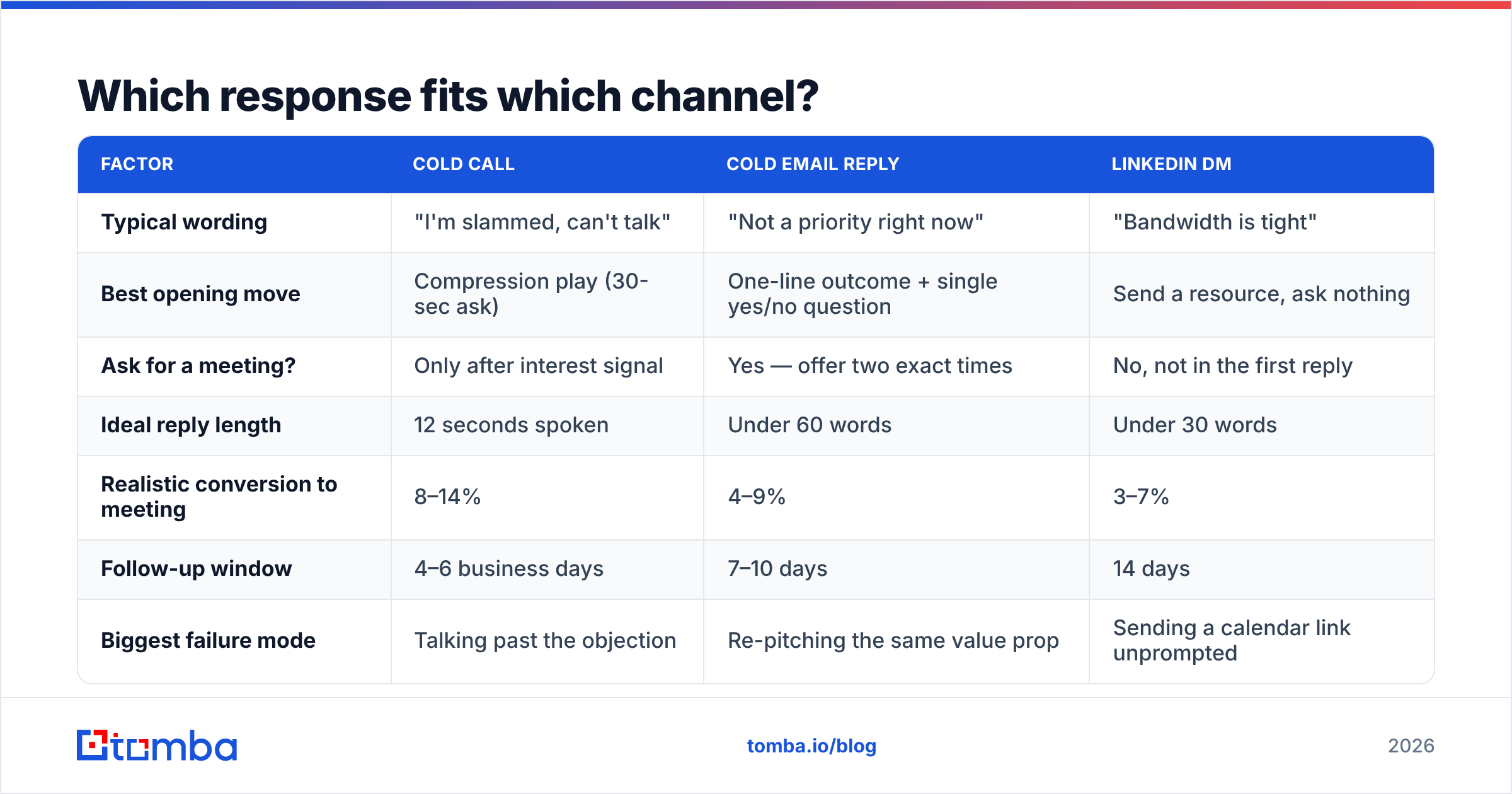
The same objection arrives through three doors, and the winning move differs at each. Here is the comparison:
| Factor | Cold call | Cold email reply | LinkedIn DM |
|---|---|---|---|
| Typical wording | "I'm slammed, can't talk" | "Not a priority right now" | "Bandwidth is tight" |
| Best opening move | Compression play (30-sec ask) | One-line outcome + single yes/no question | Send a resource, ask nothing |
| Ask for a meeting? | Only after interest signal | Yes — offer two exact times | No, not in the first reply |
| Ideal reply length | 12 seconds spoken | Under 60 words | Under 30 words |
| Realistic conversion to meeting | 8–14% | 4–9% | 3–7% |
| Follow-up window | 4–6 business days | 7–10 days | 14 days |
| Biggest failure mode | Talking past the objection | Re-pitching the same value prop | Sending a calendar link unprompted |
| When to disqualify | Second identical brush-off | Third unanswered reply | No engagement in 30 days |
Two things fall out of this table. First, the phone is still the highest-converting channel for this specific objection, because you get to hear tone — and tone tells you which of the four meanings you are dealing with. Second, LinkedIn is the worst place to push. The medium is asynchronous and low-stakes; pressure reads as desperation.
What does a good email reply to "not a priority right now" look like?#
Short, and it must contain new information. A reply that re-states your original pitch is asking the prospect to re-decide with identical inputs, which is why most get ignored.
The structure that works:
- Line 1 — Accept without friction. "Makes sense, I'll get out of your inbox."
- Line 2 — One new, concrete data point. A peer result, a benchmark, a change in their market. Something they did not have when they said no.
- Line 3 — A single binary question. "Worth a look in Q1, or should I close this out?"
- No calendar link. Adding one at this stage converts a low-friction reply into a commitment request.
Total: under 60 words. The binary close is the important part — "worth a look, or should I close this out?" gets replies precisely because "close it out" is an easy, honest answer that costs the prospect nothing. You will get more nos, faster, and a meaningfully higher rate of yeses.
A worked example:
Makes sense — I'll get out of your inbox.
One thing before I do: two other RevOps leads at Series B companies told me the same thing in March, then moved on it after their renewal date slipped. Yours is in November, if I read the filing right.
Worth 15 minutes in October, or should I close this out?
That reply works because of the third sentence. It proves research. Generic follow-ups fail; researched follow-ups get answered. This is also where your data layer starts to matter — if you cannot reliably reach the right person with the right context, no script saves you. Getting verified contact data through a proper email finder and running the list through an email verifier before you send means your replies land with the decision-maker rather than a stale alias.
How do you stop hearing this objection in the first place?#
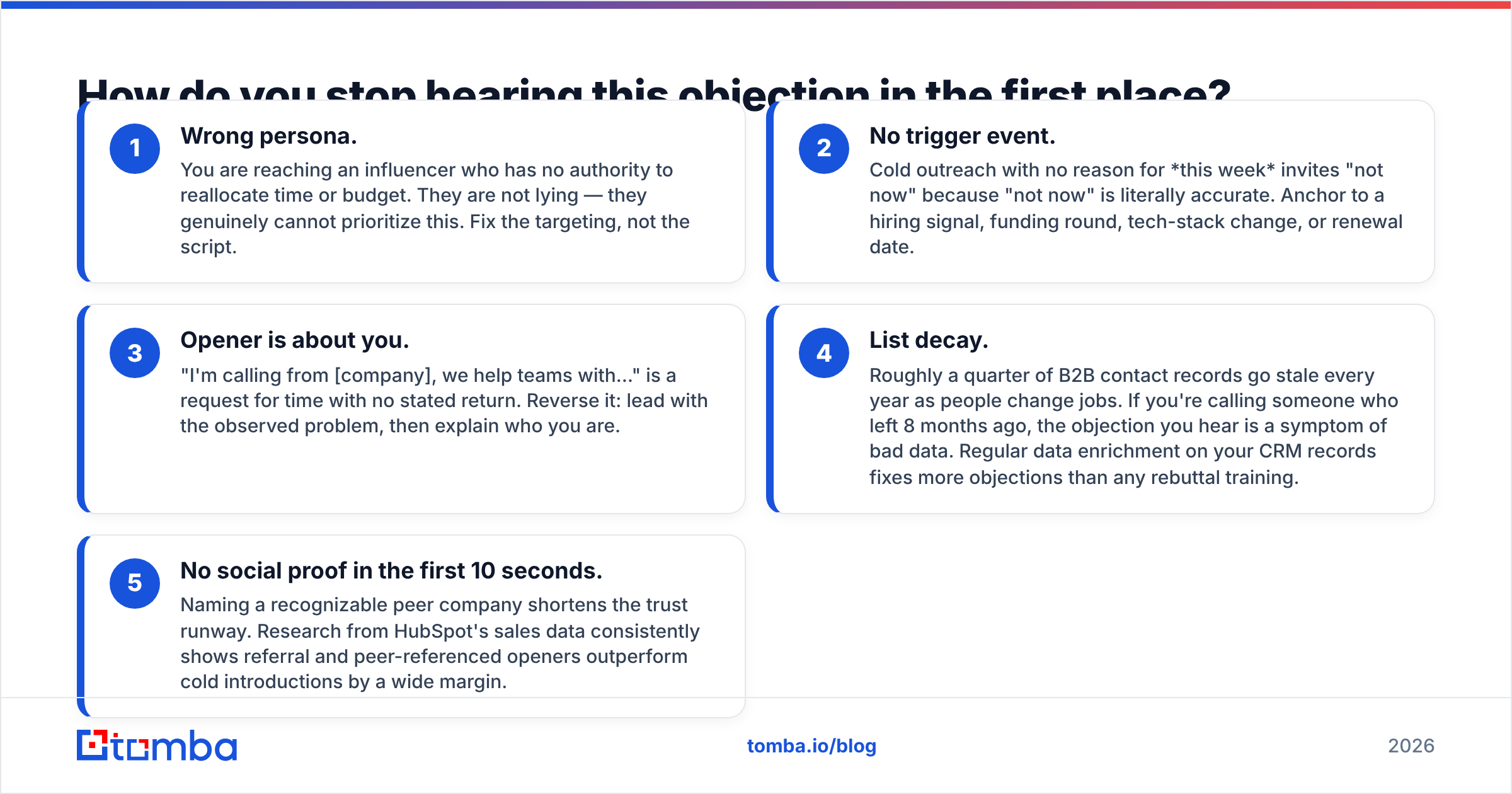
If more than four in ten conversations end in a time objection, stop rewriting rebuttals and fix the inputs. Three upstream causes, ranked by how often they're the culprit:
- Wrong persona. You are reaching an influencer who has no authority to reallocate time or budget. They are not lying — they genuinely cannot prioritize this. Fix the targeting, not the script.
- No trigger event. Cold outreach with no reason for this week invites "not now" because "not now" is literally accurate. Anchor to a hiring signal, funding round, tech-stack change, or renewal date.
- Opener is about you. "I'm calling from [company], we help teams with…" is a request for time with no stated return. Reverse it: lead with the observed problem, then explain who you are.
- List decay. Roughly a quarter of B2B contact records go stale every year as people change jobs. If you're calling someone who left 8 months ago, the objection you hear is a symptom of bad data. Regular data enrichment on your CRM records fixes more objections than any rebuttal training.
- No social proof in the first 10 seconds. Naming a recognizable peer company shortens the trust runway. Research from HubSpot's sales data consistently shows referral and peer-referenced openers outperform cold introductions by a wide margin.
How should you follow up after a time objection?#
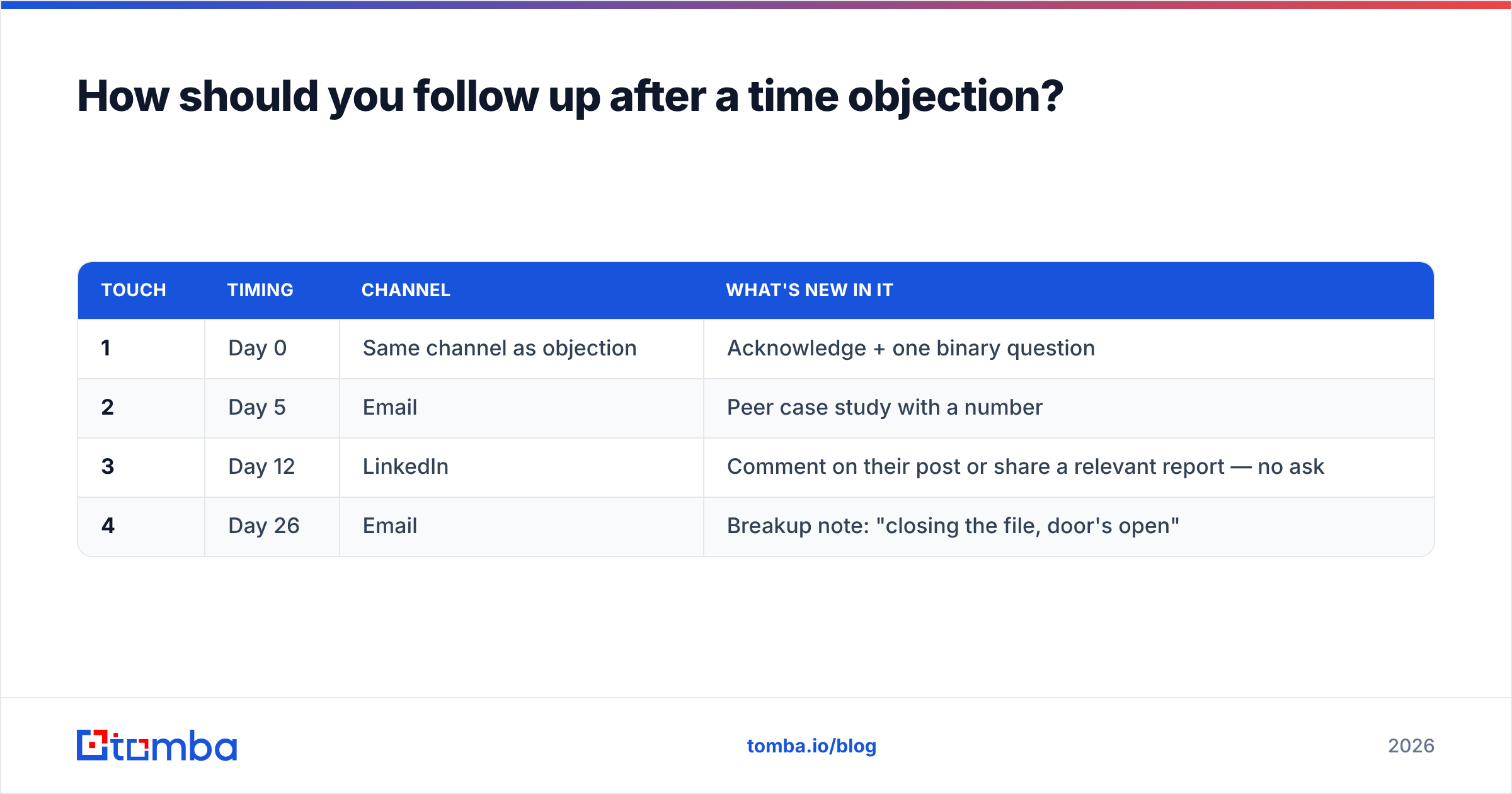
Conclusion first: change the angle every time, and cap it at four touches.
Repeating yourself with increasing politeness is the default behavior and it does not work. Each follow-up must carry something the prospect did not have before. Here is a cadence that respects that rule:
| Touch | Timing | Channel | What's new in it |
|---|---|---|---|
| 1 | Day 0 | Same channel as objection | Acknowledge + one binary question |
| 2 | Day 5 | Peer case study with a number | |
| 3 | Day 12 | Comment on their post or share a relevant report — no ask | |
| 4 | Day 26 | Breakup note: "closing the file, door's open" |
The breakup note has an outsized reply rate for a reason: it removes the obligation to engage, which is the exact thing the original objection was trying to remove. People respond to the release of pressure.
Two rules on top of the cadence:
- Never send touch 2 within 48 hours of touch 1. Fast follow-up after a brush-off reads as not listening.
- If the trigger event changes, the clock resets. New funding round, new VP, a competitor announcement — that is a legitimately new conversation, not a follow-up.
For teams running this at volume, timing beats persistence. G2's buyer behavior research shows B2B buyers do most of their evaluation before ever talking to a vendor, which means your job in follow-up is to be present and useful at the moment their internal priority shifts — not to convince them the priority should shift today.
How do you handle it from a gatekeeper versus a decision-maker?#
These require opposite postures.
From a gatekeeper, "she doesn't have time" is a screening statement, not a decision. The move is to be transparent and brief:
"Completely understand. I'm not trying to get around you — can you tell me whether vendor evaluations for the reporting stack go through her, or through someone in ops? If it's someone else, I'd rather bother them than her."
You are asking for routing, not access. Gatekeepers give routing information readily because it reduces their workload.
From a decision-maker, the same objection is an actual judgment about priority. Do not ask for routing — ask for a threshold:
"Fair. What would have to be true for this to be worth 20 minutes in the next quarter?"
The answer is your qualification criteria, delivered by the buyer. Either they tell you what to come back with, or they tell you nothing will change it — and both answers are useful. Either way you have replaced an ambiguous "no time" with something actionable for your sales process and your CRM notes.
What metrics tell you your responses are working?#
Track four numbers, not just meetings booked:
- Objection-to-conversation rate. Of the calls where you heard "no time," what percentage continued past 60 seconds? Below 20% means your compression play needs work.
- Time-to-disqualification. Faster is better. A rep who gets to a clean no in two touches beats a rep who gets to a soft maybe in nine.
- Reply rate on touch 4 (breakup). If your breakup note has the highest reply rate in the sequence, touches 2 and 3 aren't carrying new information.
- Objection frequency by list source. If one source produces a time objection twice as often as another, that is a data quality signal, not a skill signal. Comparing this across list sources — your own scraping, a purchased list, an enrichment provider — often surfaces the real problem in an afternoon.
Vendors like BookYourData and Tomba both publish accuracy standards worth checking against your own observed connect rates; running your existing list through a verification pass before you attribute low conversion to your script is the cheapest diagnostic available.
Put the scripts where the data is good#
The best objection handling in the world cannot rescue a list of people who left the company, never owned the problem, or never existed. Reps who rarely hear "I don't have time" are not better talkers — they are calling better-qualified people at better moments, which is a data problem solved before the phone rings.
If your time objections cluster around specific segments or list sources, start there. Build your target list from verified, current contact data, confirm the person still holds the role, and reach them with a trigger event you can name in the first sentence.
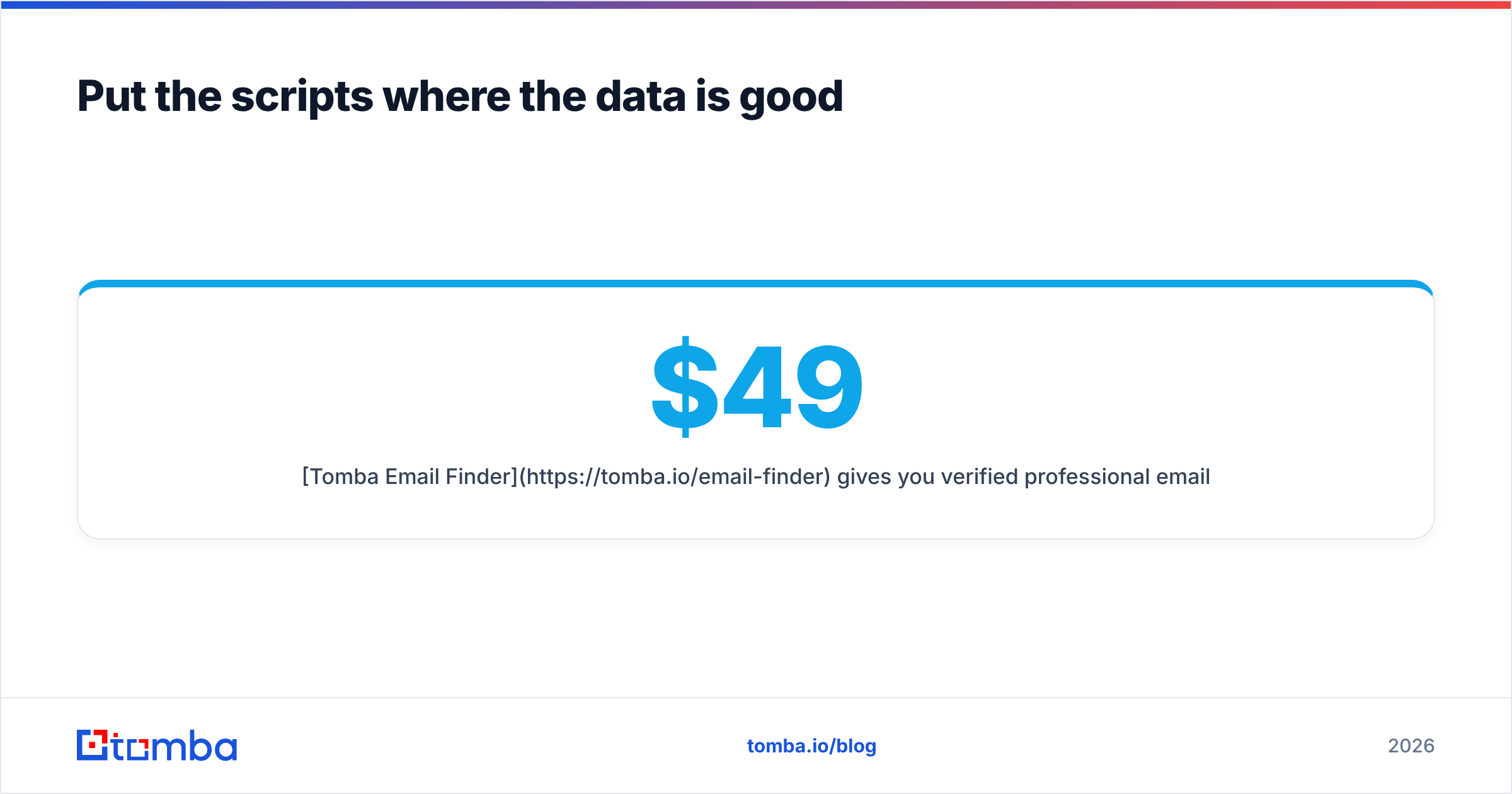
Tomba Email Finder gives you verified professional email addresses by name, domain, or company, with a free tier at 25 searches per month to test against your own list before committing. Paid plans start at $49/mo (Starter), $99/mo (Growth), and $249/mo (Pro) — see full Tomba pricing for volume and API limits. Find the right person first; the script gets a lot easier after that.
Related guides#
// get started
Find, verify and enrich your first contacts today
Start on the free plan with 25 searches a month, then scale when your team is ready.
Free plan · No credit card required · GDPR & CCPA
// about the author