How to Respond When a Prospect Says No: 9 Proven Replies
Most reps hear "no" and quietly disappear. That single habit kills more pipeline than bad targeting ever will. Here are nine scripted responses, a rejection-type decision table, and the follow-up cadence that turns a soft no into a later yes.
TL;DR
- Most "no" replies are not rejections of your product — they are rejections of your timing, your framing, or your relevance. Diagnose which one before you write back.
- Never argue. The highest-converting response to a no is a short, low-pressure reply that asks one clarifying question and gives the prospect an easy exit.
- Map the type of no (no budget, no time, no authority, no need, no trust) to a specific reply. Generic "just circling back" emails are why 90% of dead deals stay dead.
- Set a re-engagement window: 30 days for timing objections, 90 days for budget, next fiscal quarter for priority, immediate close-out for a hard no.
- Half of the "no" replies you get are from the wrong person. Verify you reached the actual decision-maker before you accept the answer as final.
Why does "no" almost never mean no?#
Because "no" is the cheapest sentence in B2B. It costs the prospect nothing, ends an unwanted conversation instantly, and requires zero explanation. That makes it the default response to any unsolicited outreach — regardless of whether the person actually has the problem you solve.
Look at what's underneath it. When a VP of Marketing replies "not interested," she is rarely saying "your category is worthless." She's saying one of these:
- "I don't have budget this quarter." — A timing signal, not a value judgment. Your reply should schedule a future conversation, not defend your price.
- "I already use a competitor." — The most useful no you can get. It confirms budget, category awareness, and an active use case. Ask what they'd change about their current tool.
- "This isn't my decision." — You reached the wrong contact. The answer isn't persuasion, it's routing. Ask for a name.
- "I don't believe your claim." — A trust gap. Proof beats argument here: a customer in their vertical, a benchmark, a specific number.
- "I genuinely don't have this problem." — The one real no. Thank them, close the loop cleanly, and remove them from the sequence.
- "You caught me at a terrible moment." — Pure noise. A short, friendly reply 30 days later frequently converts.
Only one of those six is a permanent no. The other five are routing problems disguised as rejection. Treating all six the same way is the single most expensive habit in outbound.
How should you respond when a prospect says no over email?#
Reply within 24 hours, keep it under 60 words, and ask exactly one question. That's the whole formula. Long rebuttal emails read as desperation and get archived faster than the original pitch.
Here are the nine replies that work, matched to the specific no you received.
1. The clean acknowledgment (use when the no is vague)
"Understood — appreciate you closing the loop. Out of curiosity, was it timing or is this just not a problem you're solving right now? Either answer is genuinely useful and I won't follow up after this."
The "I won't follow up after this" line is what makes it work. It removes pressure, and reply rates on this pattern routinely beat generic follow-ups because you've made answering free.
2. The competitor swap (use when they already have a vendor)
"Makes sense — [Competitor] is solid. Curious: if you could change one thing about how it handles [specific workflow], what would it be? Not pitching, just building a picture of where the category falls short."
You're not selling. You're doing research, and prospects answer research questions they'd never answer to a pitch.
3. The referral pivot (use when you hit the wrong person)
"Got it — sounds like this sits outside your remit. Who owns [specific function] these days? Happy to take it off your plate entirely."
4. The budget deferral (use for "no budget")
"Fair enough. When does planning for next quarter's budget start on your side? I'd rather show up at the right time than pester you now."
5. The proof drop (use when they doubt the claim)
"That's a reasonable pushback. [Similar company] had the same objection — here's what actually changed for them in 60 days: [one specific metric]. If that's not compelling, I'll stop here."
6. The status quo challenge (use for "we're fine as is")
"Understood. Rough question: what would have to break for [problem area] to become worth 30 minutes? If the answer is 'nothing,' I'll close this out."
7. The soft archive (use for a hard no)
"Appreciate the direct answer — I'll close the file. If anything changes on [specific trigger], I'm here."
8. The trigger watch (use when a future event may change things)
"Makes sense today. I'll check back after [funding round / new hire / product launch], since that usually changes the math on this."
9. The single-question breakup (use as the last email in a sequence)
"Last note from me. Should I close this out, or is there a version of this worth revisiting in Q1?"
What's the difference between a soft no and a hard no?#
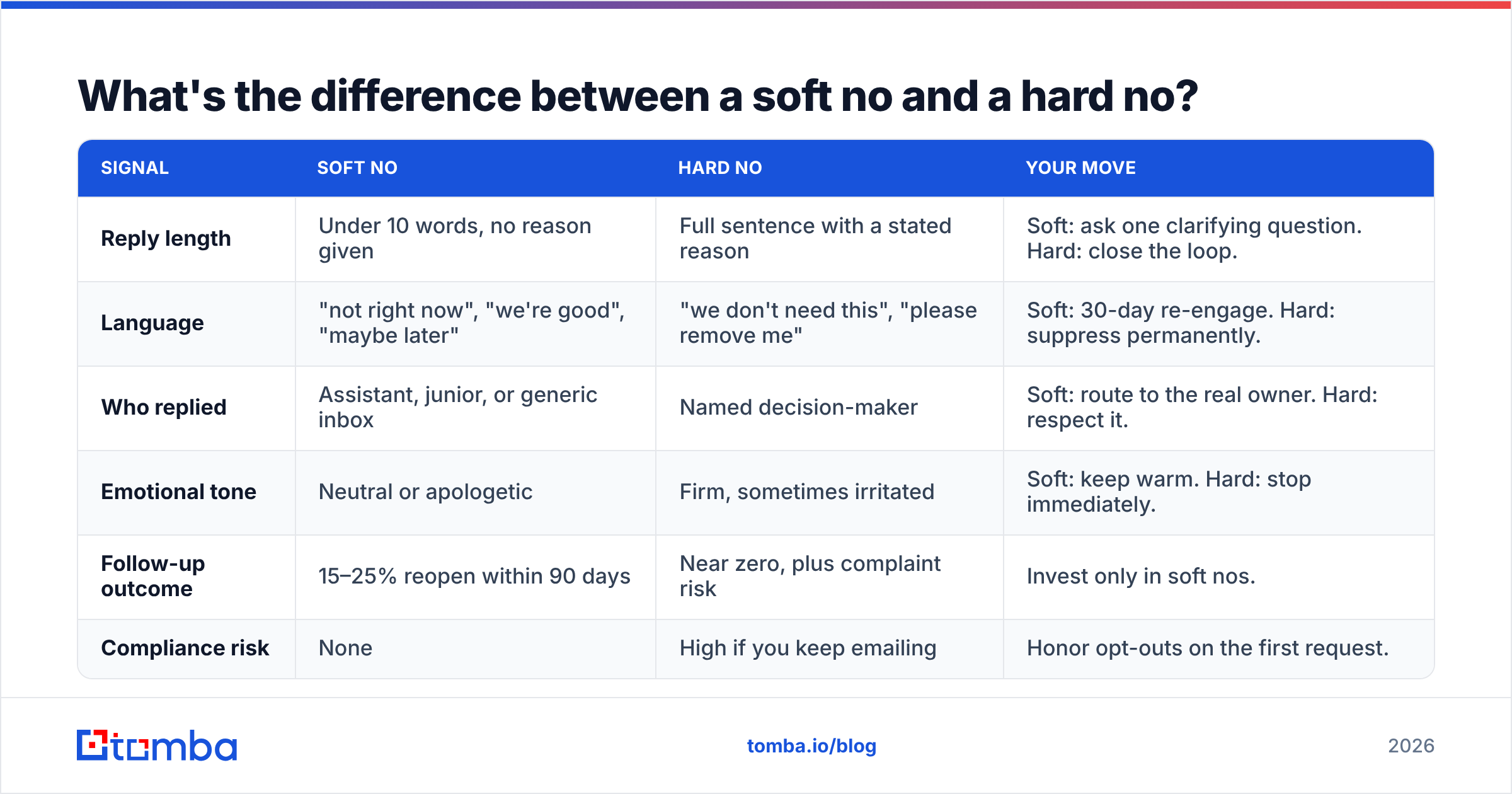
A hard no names a reason and closes the door. A soft no is a deflection — short, non-specific, and often sent from a phone. Learn to tell them apart or you'll waste months chasing the wrong deals and abandoning the right ones.
| Signal | Soft No | Hard No | Your move |
|---|---|---|---|
| Reply length | Under 10 words, no reason given | Full sentence with a stated reason | Soft: ask one clarifying question. Hard: close the loop. |
| Language | "not right now", "we're good", "maybe later" | "we don't need this", "please remove me" | Soft: 30-day re-engage. Hard: suppress permanently. |
| Who replied | Assistant, junior, or generic inbox | Named decision-maker | Soft: route to the real owner. Hard: respect it. |
| Emotional tone | Neutral or apologetic | Firm, sometimes irritated | Soft: keep warm. Hard: stop immediately. |
| Follow-up outcome | 15–25% reopen within 90 days | Near zero, plus complaint risk | Invest only in soft nos. |
| Compliance risk | None | High if you keep emailing | Honor opt-outs on the first request. |
The compliance line matters more than reps think. Ignoring an explicit removal request damages your email deliverability across the whole domain, not just that one thread. One angry recipient marking you as spam costs you inbox placement with everyone else you email that week.
How long should you wait before following up on a no?#
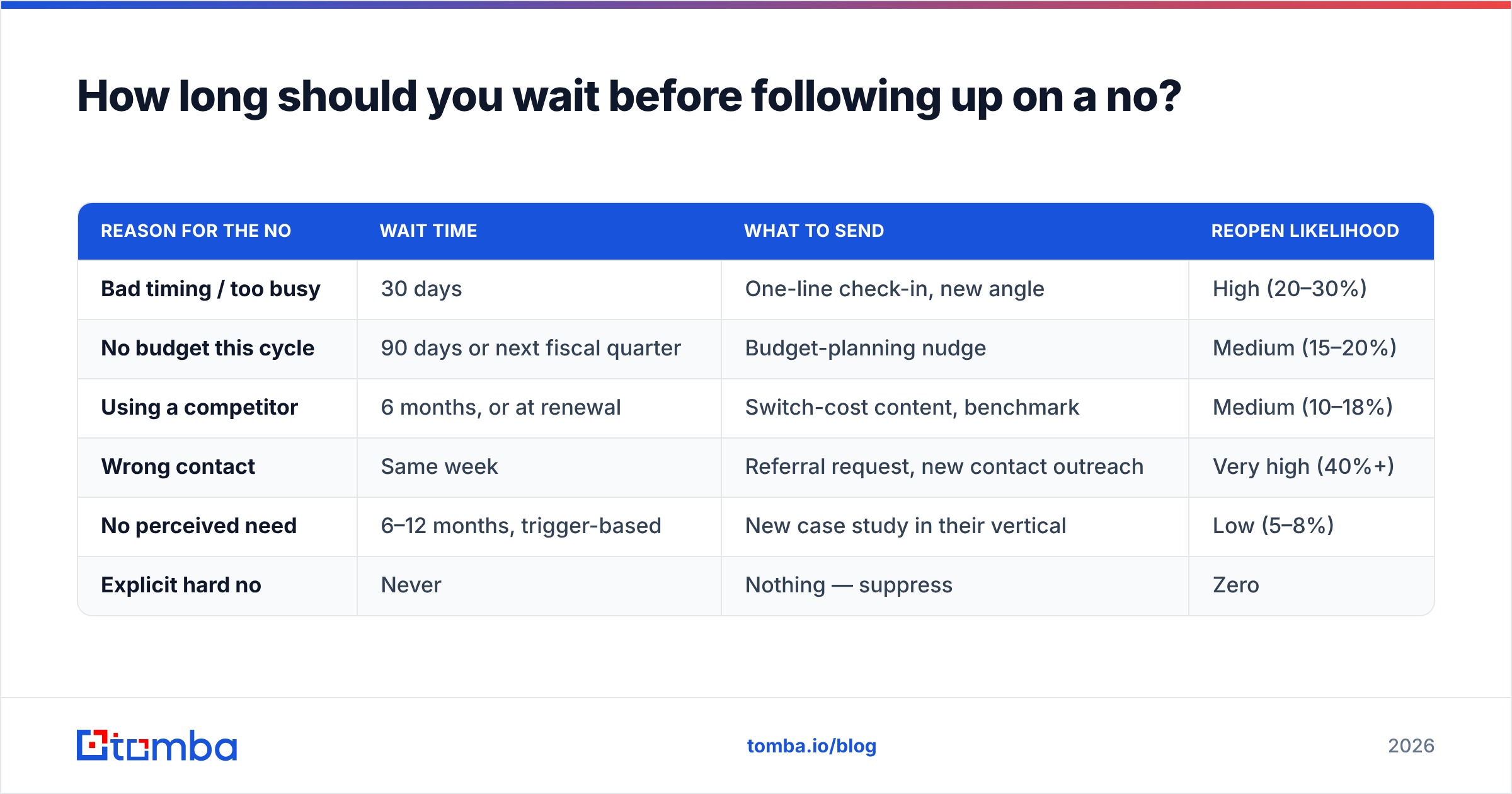
Match the wait to the reason. A prospect who said "no budget" in January is a different lead in April; a prospect who said "wrong person" is a same-week action.
| Reason for the no | Wait time | What to send | Reopen likelihood |
|---|---|---|---|
| Bad timing / too busy | 30 days | One-line check-in, new angle | High (20–30%) |
| No budget this cycle | 90 days or next fiscal quarter | Budget-planning nudge | Medium (15–20%) |
| Using a competitor | 6 months, or at renewal | Switch-cost content, benchmark | Medium (10–18%) |
| Wrong contact | Same week | Referral request, new contact outreach | Very high (40%+) |
| No perceived need | 6–12 months, trigger-based | New case study in their vertical | Low (5–8%) |
| Explicit hard no | Never | Nothing — suppress | Zero |
Two rules govern the whole table. First, never re-engage with the same message that failed. If the first angle was cost savings and it got a no, come back with a compliance or speed angle. Second, tie re-engagement to a trigger event where you can — a funding round, a leadership hire, a product launch, a job posting for the role that owns your problem. Trigger-based follow-ups outperform calendar-based ones because they carry a built-in reason for the email to exist.
How do you handle "no" on a live sales call?#
Slow down instead of speeding up. The instinct on a call is to talk faster and stack more benefits — which is exactly what makes the prospect end the call. Do the opposite.
The four-beat sequence that works:
- Acknowledge, verbatim. "Got it — sounds like the timing's wrong." Repeating their words back proves you listened and lowers their defenses.
- Pause. Three full seconds. Prospects fill silence with the real objection more often than not, and the real objection is the one you can actually solve.
- Ask one diagnostic question. "Is that a this-quarter thing, or is the whole category off the table?" One question. Not three.
- Offer the exit. "If it's the second one, I'll close it out — no hard feelings." Giving a genuine exit is what earns you the honest answer.
What never works: "But have you considered…", stacking a discount immediately, or asking to speak to their manager. Discounting on the first no teaches the prospect that your price is fiction, and it trains your entire pipeline to wait for the markdown.
Research on objection handling from sales orgs published by HubSpot consistently points the same direction — the reps who ask more questions after an objection close more than the reps who present more. Talking less after "no" is a skill, not a personality trait.
Are you sure the "no" came from the right person?#
This is the question almost nobody asks, and it invalidates a disturbing share of the nos in your CRM. If your email went to a stale address, a shared inbox, or a person who left the company eight months ago, the "not interested" you got back tells you nothing about the account.
Before you mark an account as rejected, confirm three things:
- The contact is current. Role changes are constant in B2B. A reverse email lookup tells you who actually sits behind an address today.
- The address is deliverable. A no that came from an autoresponder or a catch-all domain isn't a no at all. Run the list through an email verifier before you draw conclusions from silence or bounces.
- The person owns the budget. If you pitched an individual contributor, the answer was always going to be no — not because your product is wrong, but because saying yes wasn't in their power.
The fix for accounts stuck at step three is lateral, not vertical. Use domain search to pull the other named contacts at the company, identify the function that actually owns your problem, and open a second thread with a completely different angle. Referencing the first conversation is fine and honest: "Spoke with [name] on your team — sounds like this sits with you instead."
One caution: a second thread is not permission to email five people at the same company in the same week. That reads as a spray campaign and gets your domain flagged. One new contact, one new angle, spaced at least a week apart.
What should you track so nos become data instead of dead ends?#
Log the reason, not just the outcome. A CRM full of "Closed — Not Interested" is a CRM you can't learn anything from. A CRM that separates "no budget," "wrong contact," "competitor incumbent," and "no need" tells you exactly which part of your motion is broken.
Four fields, minimum, on every rejected opportunity:
- Rejection type — pick from a fixed list of five or six, never free text.
- Re-engage date — auto-calculated from the type using the table above.
- Angle used — so the next touch doesn't repeat a losing message.
- Trigger to watch — funding, hiring, renewal, leadership change.
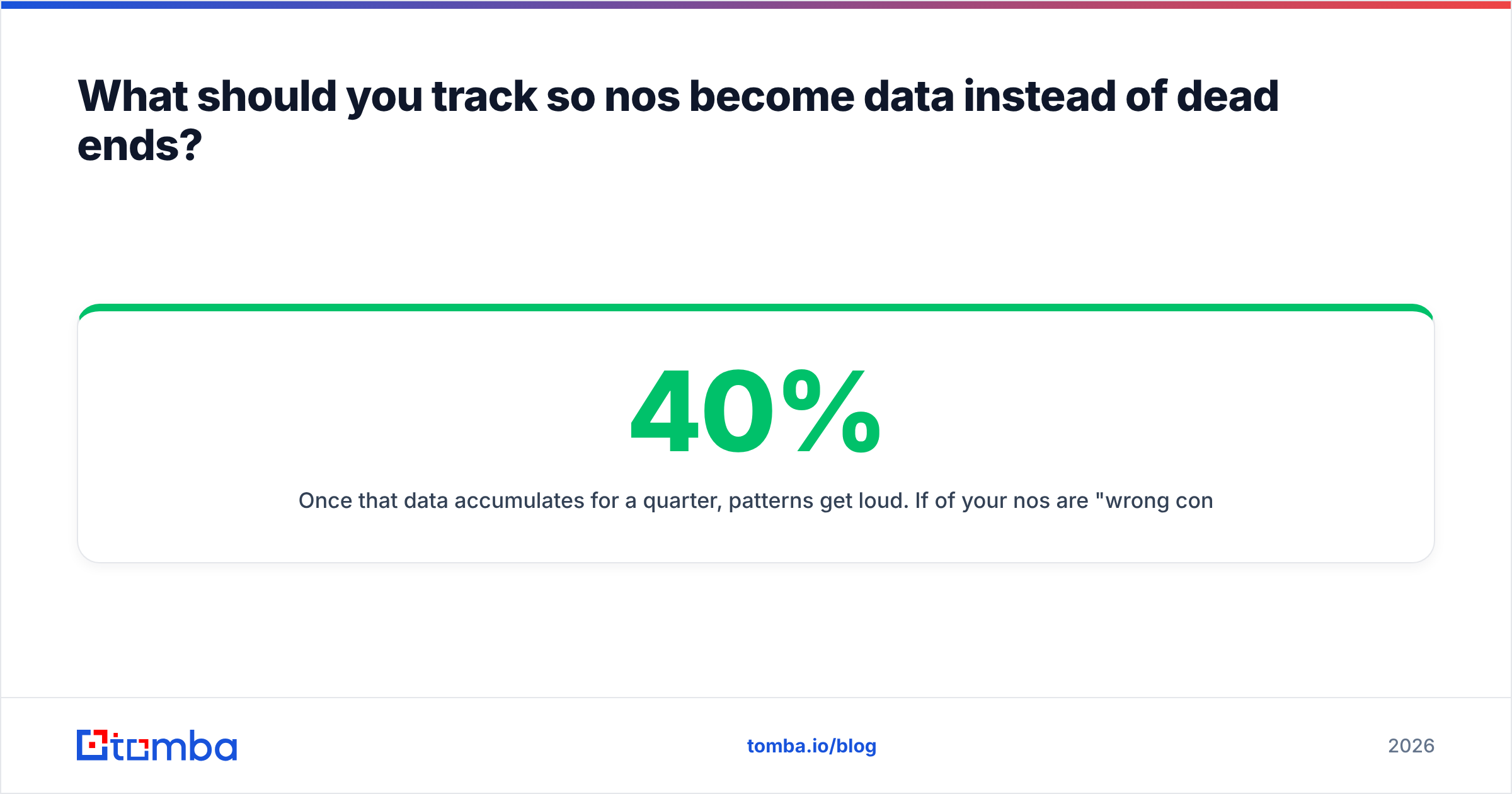
Once that data accumulates for a quarter, patterns get loud. If 40% of your nos are "wrong contact," you have a data problem, not a messaging problem — and no amount of copywriting will fix it. If 40% are "no need," your targeting is off. If 40% are "competitor incumbent," you need switch-cost material and a renewal-timing play. Peer reviews on G2 are a fast way to find out what the incumbent's users actually complain about, which is the raw material for that material.
Teams that enrich accounts with firmographic and technographic signals before outreach see fewer "no need" replies in the first place, simply because the list was better. Running data enrichment on your target accounts to confirm headcount, tech stack, and department structure eliminates a meaningful chunk of rejections before you ever send the first email — the cheapest rejection is the one you never provoke.
What's the honest expectation for reopening a "no"?#
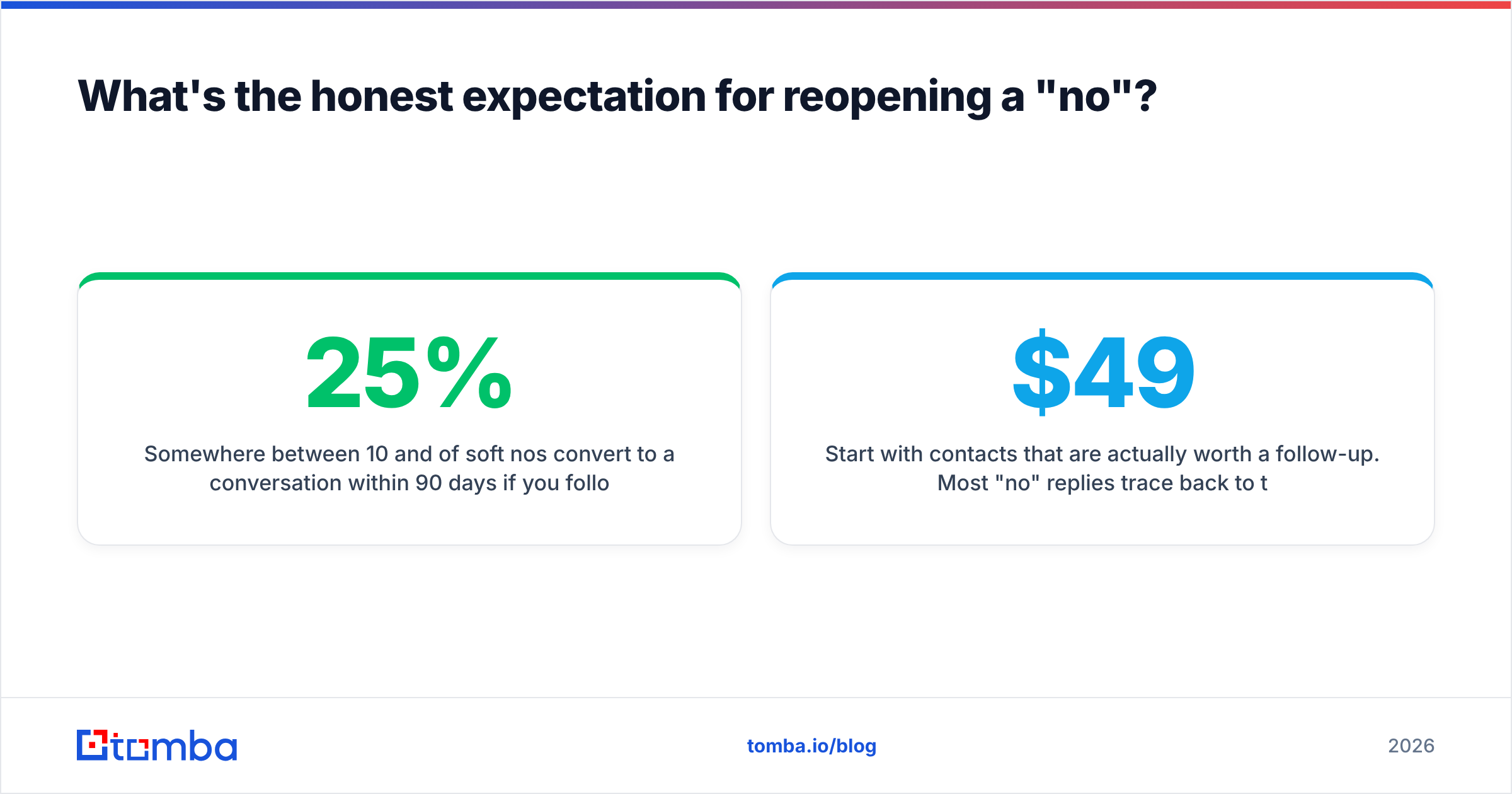
Somewhere between 10 and 25% of soft nos convert to a conversation within 90 days if you follow up with a new angle. Not 80%. Not "persistence always wins." Most nos stay no, and the discipline is in spending your follow-up effort on the third of the list that's actually reachable.
That means the real leverage isn't in your objection-handling script at all. It's upstream: better targeting, verified contacts, the right decision-maker on the first attempt. A rep working a clean, well-researched list of 200 accounts will outperform a rep grinding objection scripts against 2,000 unverified ones, every quarter, without exception.
Handle the no well when it comes. But build the list so it comes less often.
Start with contacts that are actually worth a follow-up. Most "no" replies trace back to the wrong person, a stale address, or an account that never fit. The Tomba Email Finder gets you verified, current decision-maker emails by name or domain, so the nos you do collect are real signal instead of bad data. Free tier includes 25 searches a month; paid plans start at $49/mo — see full Tomba pricing for team volumes and API access.
Related guides#
// get started
Find, verify and enrich your first contacts today
Start on the free plan with 25 searches a month, then scale when your team is ready.
Free plan · No credit card required · GDPR & CCPA
// about the author