How to Rush Someone Politely by Email: 7 Scripts That Work
Chasing a reply without sounding pushy is a skill. Here are the exact lines, timing rules, and follow-up cadence that move a stalled thread forward while keeping the relationship intact.
TL;DR
- Politeness is not softness. The most polite rush email is the one that gives the other person a specific deadline, a specific ask, and an easy way out.
- "ASAP," "just checking in," and "gentle reminder" all read as pressure without information. Replace them with a date, a reason, and a one-click response option.
- Structure beats wording: context → concrete deadline → why the deadline exists → smallest possible ask → escape hatch.
- Cadence matters more than phrasing. Two well-timed nudges outperform five apologetic ones.
- If an external contact never replies at all, the problem may be the address, not the tone — verify before you escalate.
What does "rushing someone politely" actually mean in email?#
It means transferring urgency without transferring blame.
Most people write rush emails backwards. They lead with their own anxiety ("just following up again…"), apologize for existing, then bury the actual deadline in the last sentence. The recipient reads pressure but no information, so they file it under "deal with later" — which is exactly the outcome you were trying to avoid.
A polite rush email does the opposite. It front-loads the concrete detail (what you need, by when, and why that date is real) and back-loads the relationship maintenance (an out, an offer to help, a fallback option). The reader gets everything they need to make a decision in under ten seconds, and nothing that makes them feel scolded.
Linguists call this negative politeness — reducing the imposition on someone's autonomy while still making a request. Politeness theory describes it as giving the other person a face-saving route to say yes, no, or "not this week." In practice that means: never make them guess what happens if they miss the date, and never make them feel cornered into a single acceptable answer.
Why do most urgency emails backfire?#
Because they use urgency words instead of urgency facts.
Compare these two lines:
"Following up on my last email — could you please review ASAP? This is quite urgent."
"The design team locks the sprint Thursday at 5pm ET. If your copy edits land before then, they ship this release; after that, next release is March 14."
The first is louder. The second is more urgent, because it contains a consequence the reader can verify. Loud is not urgent. Specific is urgent.
Three other common failure patterns:
The serial bump — sending "any update?" every 48 hours until someone replies out of irritation. It trains the recipient to associate your name with noise, and it damages your standing on every future thread.
The fake deadline — inventing a date that quietly passes with no consequence. Do this twice and every future deadline you set is discounted to zero. Sales teams burn credibility this way constantly, which is why Gartner's sales research keeps landing on trust as the differentiator in stalled B2B deals rather than persistence.
The guilt sandwich — "I know you're really busy, I hate to bother you again, but…" This reads as passive aggression, not courtesy. Apologizing for your request implies the request wasn't worth making.
What are the 5 building blocks of a polite rush email?#
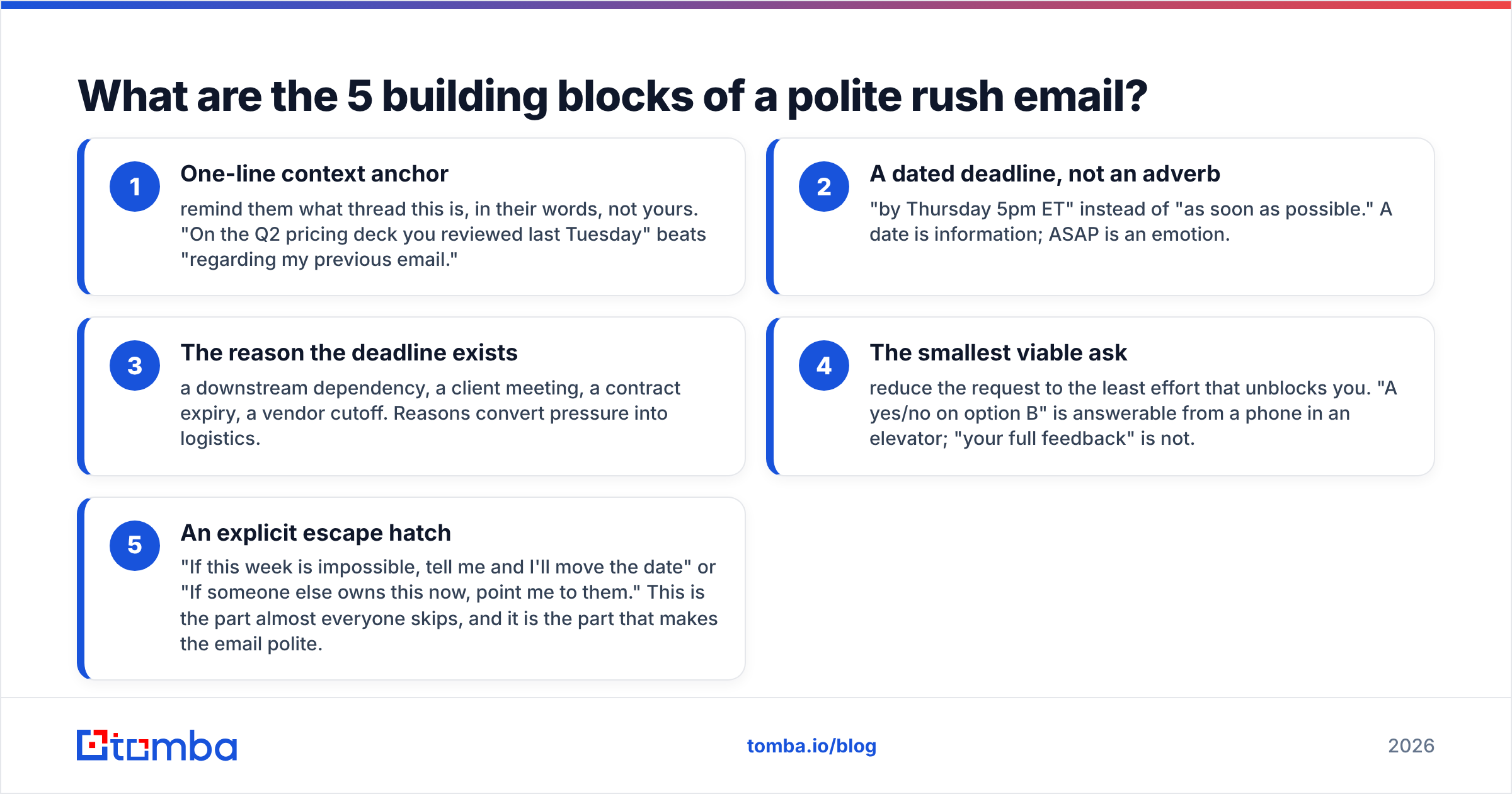
Every effective version of this email contains the same five parts, in roughly this order:
- One-line context anchor — remind them what thread this is, in their words, not yours. "On the Q2 pricing deck you reviewed last Tuesday" beats "regarding my previous email."
- A dated deadline, not an adverb — "by Thursday 5pm ET" instead of "as soon as possible." A date is information; ASAP is an emotion.
- The reason the deadline exists — a downstream dependency, a client meeting, a contract expiry, a vendor cutoff. Reasons convert pressure into logistics.
- The smallest viable ask — reduce the request to the least effort that unblocks you. "A yes/no on option B" is answerable from a phone in an elevator; "your full feedback" is not.
- An explicit escape hatch — "If this week is impossible, tell me and I'll move the date" or "If someone else owns this now, point me to them." This is the part almost everyone skips, and it is the part that makes the email polite.
Miss block 5 and you have written a demand. Miss blocks 2 and 3 and you have written a nag. All five together read as a competent colleague solving a scheduling problem — which is the tone you actually want.
What should you actually write? 7 scripts you can copy#
Adapt the details; keep the skeleton. These work on colleagues, clients, vendors, and prospects alike.
1. The dependency nudge (internal, first chase)
Subject: Copy edits — Thursday 5pm locks the sprint
Hi Dana — quick one on the pricing page copy. Engineering locks the sprint Thursday at 5pm ET, so edits landing before then ship this release; anything after goes to March 14. Even a "looks fine" is enough to unblock me. If Thursday is unrealistic, say the word and I'll flag the slip to Marco now rather than Friday.
2. The single-question close (client, waiting on a decision)
Subject: One question to close out the SOW
Hi Priya — everything on the SOW is agreed except the start date. Option A is March 2, Option B is March 16. A one-word reply is all I need and I'll send the final for signature same day.
3. The deadline-with-consequence (vendor or external partner)
Subject: Freight quote — our carrier holds the slot until Friday
Hi Tom, our carrier holds the March 9 slot until Friday noon. If the quote arrives before then we book it; after that we go to the spot market and the cost changes materially for both of us. Anything you can send today, even a rough range?
4. The reassignment prompt (silence, no answer twice)
Subject: Should I be asking someone else?
Hi Alex — no reply on the security review, which usually means it's not yours anymore. Totally fine either way: point me at the right person and I'll take it off your plate entirely.
5. The two-option escalation (a real date is slipping)
Subject: Two paths on the launch date
Hi Sam — we're four days from the copy freeze with the legal review outstanding. Two options: (a) legal signs by Wednesday and we hold the March 4 launch, or (b) we move the launch to March 18 now, before the ad spend commits. I'd rather choose than drift. Which one?
6. The friendly last call (before you close the loop)
Subject: Closing this out unless I hear back
Hi Jordan — I'll assume this isn't a priority right now and stop chasing after Friday. No hard feelings at all. If it's just bad timing, tell me a month and I'll come back then.
7. The cold-outreach rush (prospect, use sparingly)
Subject: Pricing changes on the 1st — worth 10 minutes?
Hi Nina — our current tier pricing is grandfathered for accounts opened before the 1st. If that's irrelevant to you, ignore this and I won't follow up. If it isn't, I have Thursday 10am or Friday 2pm.
For subject lines, keep the deadline visible in the preview pane. A subject line generator helps if you're stuck, but the rule is simpler than any tool: put the date in the subject and the ask in the first sentence.
Which phrasing works best — and what does the reader actually hear?#
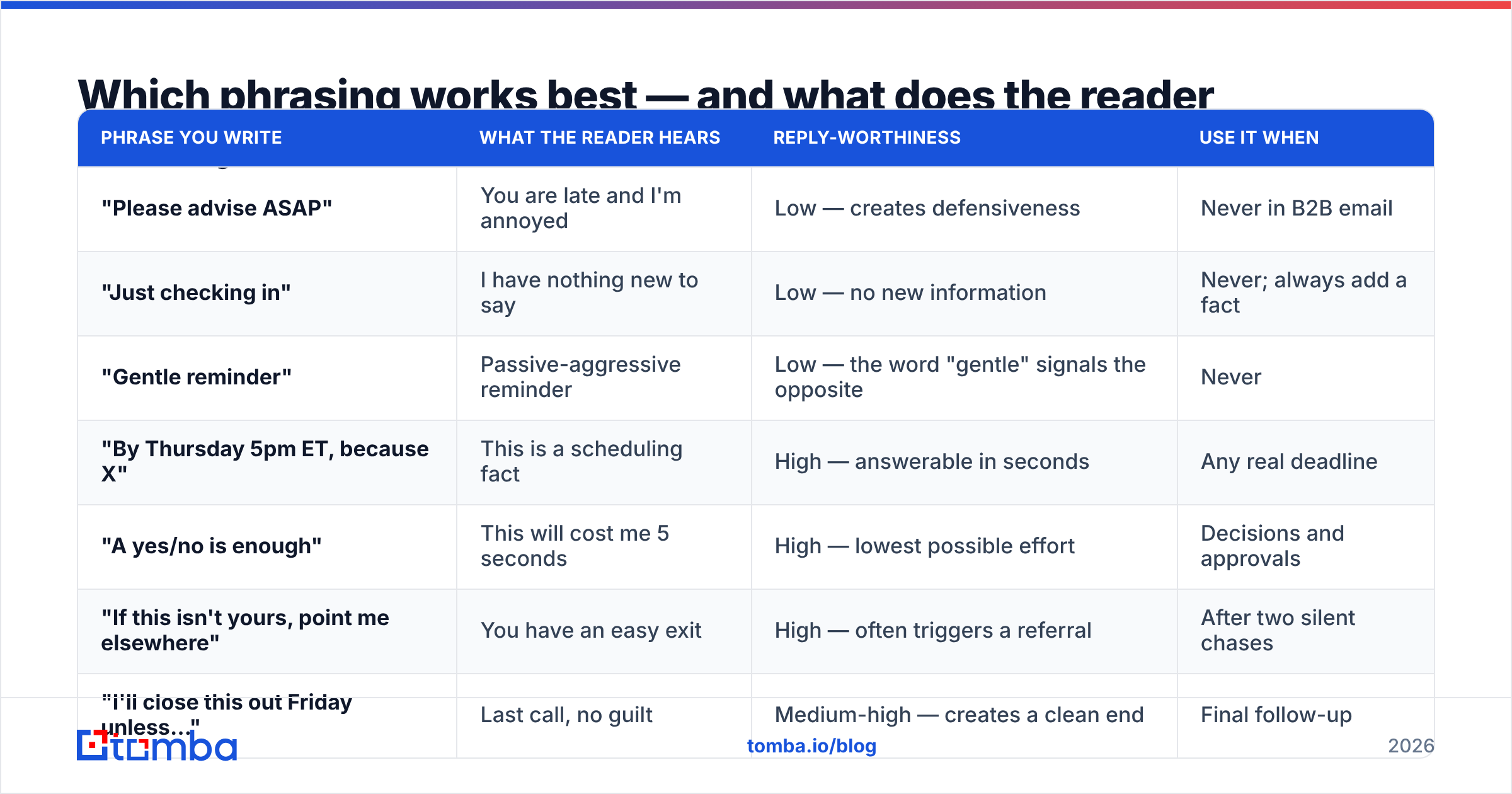
Wording is a smaller lever than structure, but it isn't nothing. Here's how the common phrases land:
| Phrase you write | What the reader hears | Reply-worthiness | Use it when |
|---|---|---|---|
| "Please advise ASAP" | You are late and I'm annoyed | Low — creates defensiveness | Never in B2B email |
| "Just checking in" | I have nothing new to say | Low — no new information | Never; always add a fact |
| "Gentle reminder" | Passive-aggressive reminder | Low — the word "gentle" signals the opposite | Never |
| "By Thursday 5pm ET, because X" | This is a scheduling fact | High — answerable in seconds | Any real deadline |
| "A yes/no is enough" | This will cost me 5 seconds | High — lowest possible effort | Decisions and approvals |
| "If this isn't yours, point me elsewhere" | You have an easy exit | High — often triggers a referral | After two silent chases |
| "I'll close this out Friday unless…" | Last call, no guilt | Medium-high — creates a clean end | Final follow-up |
Notice the pattern: every high-performing phrase contains either a date, a consequence, or an exit. Every low-performing phrase contains only feelings.

How fast should you follow up without becoming annoying?#
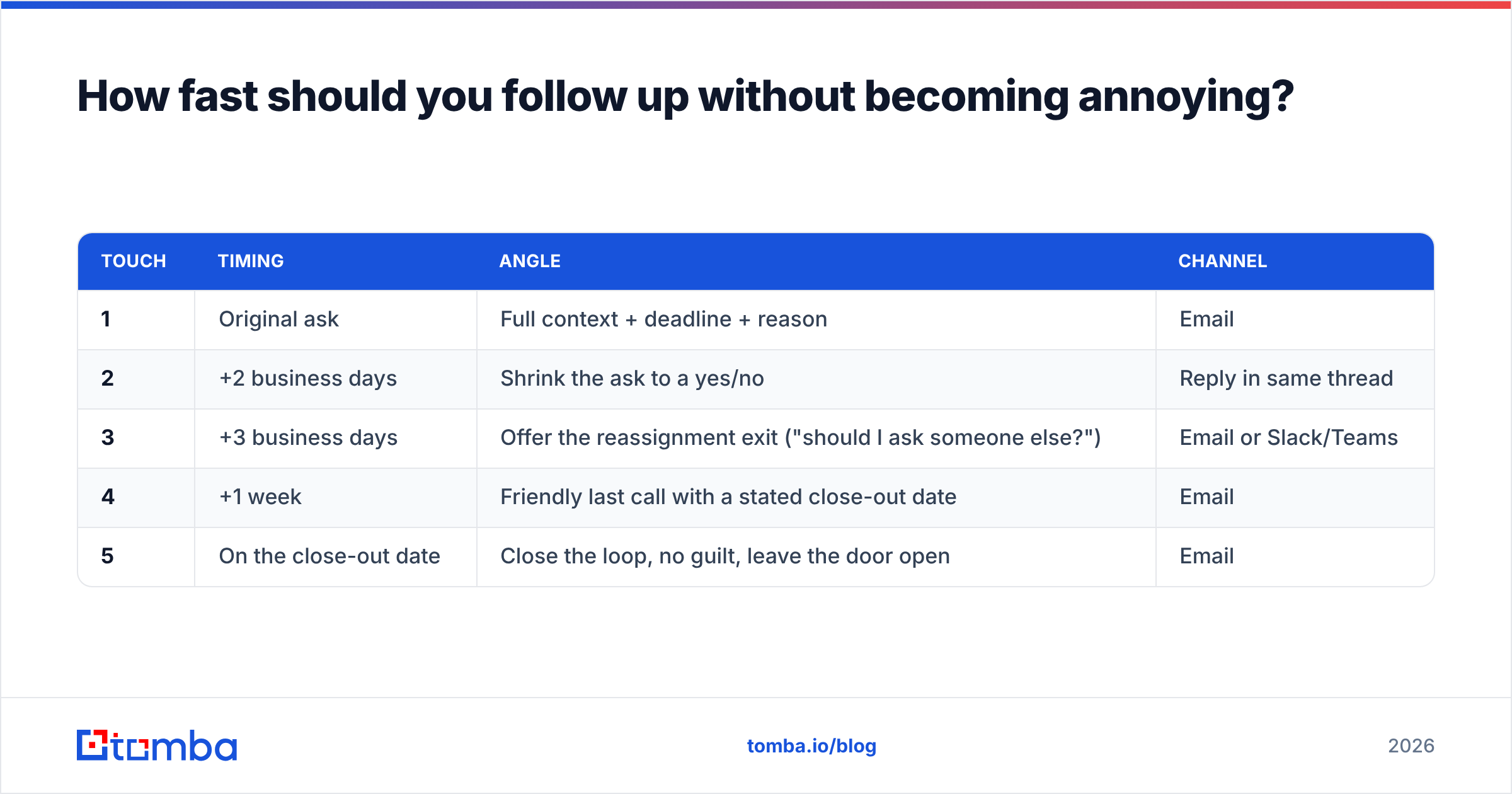
Cadence is where most people either give up too early or grind too long. A workable default for a genuinely time-sensitive request:
| Touch | Timing | Angle | Channel |
|---|---|---|---|
| 1 | Original ask | Full context + deadline + reason | |
| 2 | +2 business days | Shrink the ask to a yes/no | Reply in same thread |
| 3 | +3 business days | Offer the reassignment exit ("should I ask someone else?") | Email or Slack/Teams |
| 4 | +1 week | Friendly last call with a stated close-out date | |
| 5 | On the close-out date | Close the loop, no guilt, leave the door open |
Two rules keep this from tipping into harassment. First, every touch must add new information — a changed date, a shrunk ask, a new option, an exit. A bump with no new content is a bump you shouldn't have sent. Second, reply in the same thread for touches 2 and 3, then start a fresh thread with a new subject for touch 4. Threads collapse in crowded inboxes; a new subject line resurfaces the request without pretending nothing happened.
If the request is genuinely urgent and email touch 2 goes unanswered, switch channels rather than escalating tone. A 40-second phone call is more polite than a fourth email with bolded text. HubSpot's sales team has published this pattern for years, and it holds: channel variety beats message volume. Improving your response rate is usually a timing and channel problem before it's a copywriting problem.
What if they never replied because they never received it?#
This is the scenario nobody checks, and it's more common than you'd guess on external threads.
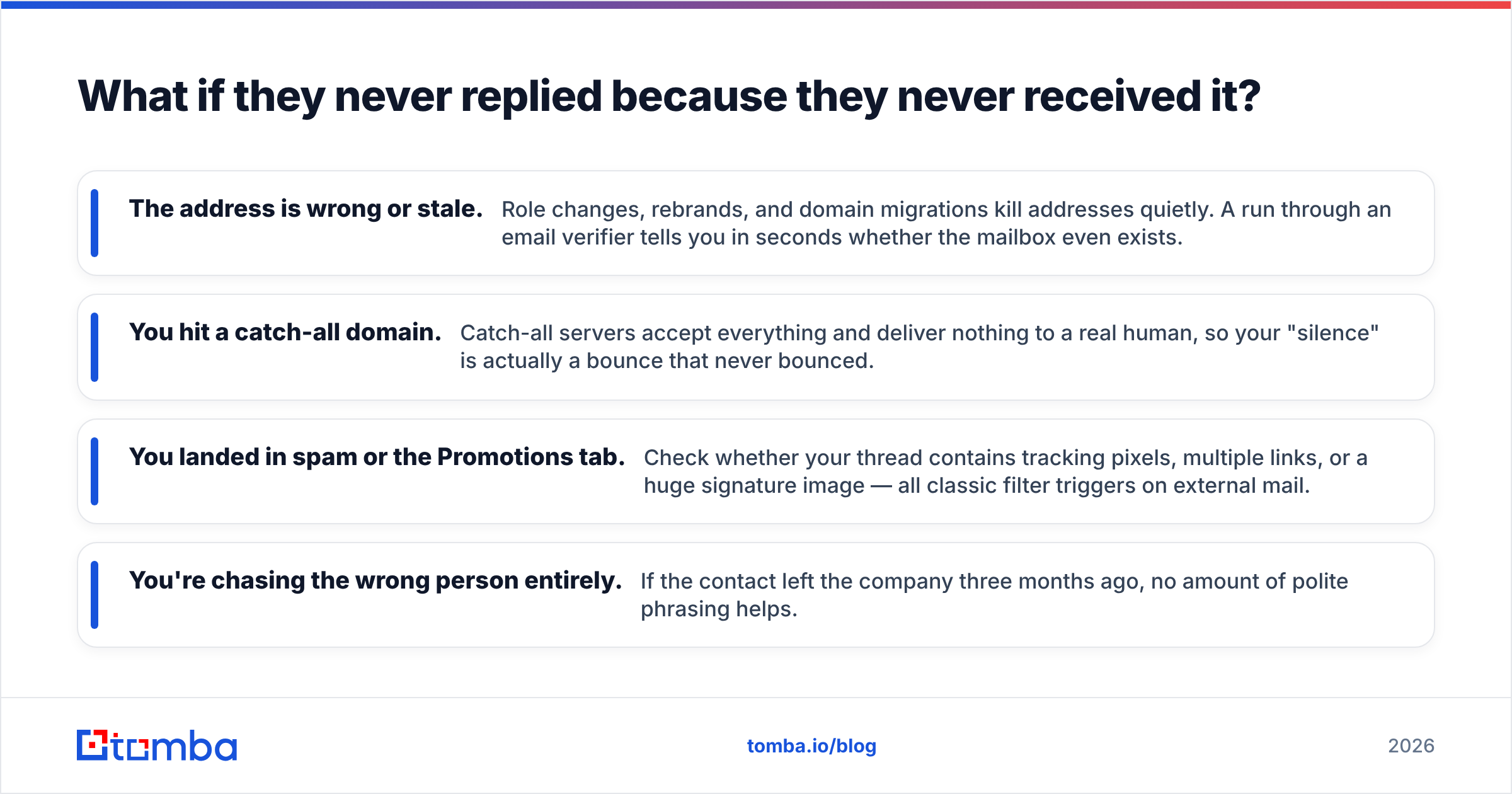
Before you send a fourth increasingly tense follow-up to a prospect, partner, or new contact, rule out the boring explanations:
- The address is wrong or stale. Role changes, rebrands, and domain migrations kill addresses quietly. A run through an email verifier tells you in seconds whether the mailbox even exists.
- You hit a catch-all domain. Catch-all servers accept everything and deliver nothing to a real human, so your "silence" is actually a bounce that never bounced.
- You landed in spam or the Promotions tab. Check whether your thread contains tracking pixels, multiple links, or a huge signature image — all classic filter triggers on external mail.
- You're chasing the wrong person entirely. If the contact left the company three months ago, no amount of polite phrasing helps.
Fixing a bad address is a five-second job that removes an entire category of imagined rudeness. Chasing a dead mailbox for two weeks, on the other hand, makes you look disorganised when the real owner eventually surfaces. If you build outreach lists at any volume, keep verification in the workflow rather than treating it as a cleanup task, and use ready-made cold email templates as a base so your first touch is strong enough that you need fewer chases.
What mistakes should you avoid when rushing someone politely?#
Bolding, red text, and multiple exclamation marks. Visual shouting reads as loss of composure. If the content is urgent, the formatting doesn't have to be.
Adding "!!" or "URGENT" to the subject line. Executives filter these on sight, and spam classifiers on external mail do the same.
CC'ing someone's manager on touch two. This is the nuclear option. It works exactly once, then permanently changes how that person treats your emails. Save it for genuine escalations, and tell the person you're doing it before you do it.
Apologizing more than once. One brief acknowledgement of the imposition is courteous. Three is a request to be reassured, which costs the reader emotional labour on top of the task.
Rushing without checking your own timeline. If your deadline exists because you sat on the request for a week, say so plainly and offer a revised date. People forgive honesty about internal delays far more readily than manufactured urgency.
Sending the rush email on Friday at 4pm. You've guaranteed either a rushed low-quality answer or a weekend of resentment. Tuesday to Thursday mornings in the recipient's timezone are the sweet spot for anything with a deadline attached.
What's the fastest way to make follow-ups unnecessary?#
Reduce the number of threads that need chasing in the first place.
Most of the chasing pain in B2B comes from two sources: asks that were too vague to answer quickly, and outreach that went to the wrong contact. The first is a writing problem — every request should contain a date, a reason, and a minimum viable answer. The second is a data problem, and it's the cheaper one to fix.
When your first email reaches the right person at a verified address, with a subject line that states the deadline and a body that fits in a preview pane, the polite-rush email often becomes unnecessary. That's the real goal: not a better nudge, but fewer nudges.
If you're chasing external contacts and half your threads are silence, start by confirming you're emailing real, current people. The Tomba Email Finder locates verified professional addresses by name, company, or domain, so your first touch lands in a live inbox instead of a void — and your follow-ups can focus on the decision rather than on whether anyone is reading. The free tier includes 25 searches a month, and paid plans start at $49/mo on Tomba pricing if you're working through larger lists. Fix the address, sharpen the ask, set a real date — and you'll rarely have to write a rush email at all.
Related guides#
// get started
Find, verify and enrich your first contacts today
Start on the free plan with 25 searches a month, then scale when your team is ready.
Free plan · No credit card required · GDPR & CCPA
// about the author