How To Say Just Checking In Professionally: 12 Better Lines
"Just checking in" tells your prospect nothing and asks for nothing. Here are 12 replacement lines, a decision table for picking one, and the follow-up cadence that actually gets replies.
TL;DR
- "Just checking in" fails because it puts the work on the recipient: it carries no new information and makes no specific ask.
- Replace it with one of three patterns — new information, specific question, or clean close — and pick based on how long the thread has been quiet.
- The single highest-leverage swap: end every follow-up with one question that can be answered in under ten words.
- Cadence matters as much as wording. Four to six touches across 18–21 days, each one carrying a different reason to reply.
- None of it works if the address is wrong. Verify before you send; a bounced follow-up looks identical to being ignored.
Why does "just checking in" fail so consistently?#
Because it's a status request disguised as a courtesy. You're asking someone to do unpaid work — reconstruct the context, decide what you want, and write a reply — in exchange for nothing.
Think of it like knocking on a neighbor's door and saying "hi." They now have to figure out why you're there. Compare that to "your package got delivered to my porch." Same knock, but the second one hands them something.
Three concrete failures:
- No new information. The recipient knows the thread exists. Reminding them it exists adds zero.
- No specific ask. "Any thoughts?" is unanswerable in a hurry. "Is Q1 or Q2 the realistic window?" takes four seconds.
- No stated stakes. Nothing happens if they ignore you, so ignoring you is the cheapest option available.
- It signals low priority. Buyers read filler as "this rep has nothing to say," and they file you accordingly.
HubSpot's sales research has repeatedly found that follow-ups with a concrete next step outperform open-ended nudges — the mechanism is simple: you reduced the cost of replying.
What should you say instead of "just checking in"?#
Pick from three patterns. Every good follow-up line is one of them.
Pattern 1 — Deliver new information. You earned the right to email again because you have something they didn't have before.
- "Your competitor just published their Q3 numbers — page 14 has the churn figure we talked about."
- "We shipped the SSO feature you flagged as a blocker. Two-minute demo link if useful."
- "Found the benchmark for your industry: median CAC payback is 14 months. You mentioned you were at 22."
Pattern 2 — Ask one narrow, answerable question. The reply should be typeable with a thumb.
- "Is this still on the roadmap for this quarter, or has it slipped?"
- "Who owns this decision now that Priya moved teams?"
- "Should I send the security review docs, or is that not needed at your stage?"
Pattern 3 — Close the loop cleanly. The permission-to-close email, used correctly, gets a surprising number of replies precisely because it removes pressure.
- "I'll assume the timing isn't right and stop following up. If that's wrong, just say 'still interested' and I'll pick it back up."
- "Closing this out on my end — happy to reopen whenever it's relevant."
Pattern 4 — Reference a trigger event. Funding round, new hire, product launch, regulatory change. The event is your reason for writing, not your desire for an answer.
- "Saw you posted a Head of RevOps role — usually means the reporting stack is under review. Worth a 15-minute conversation?"
Which replacement should you use, and when?#
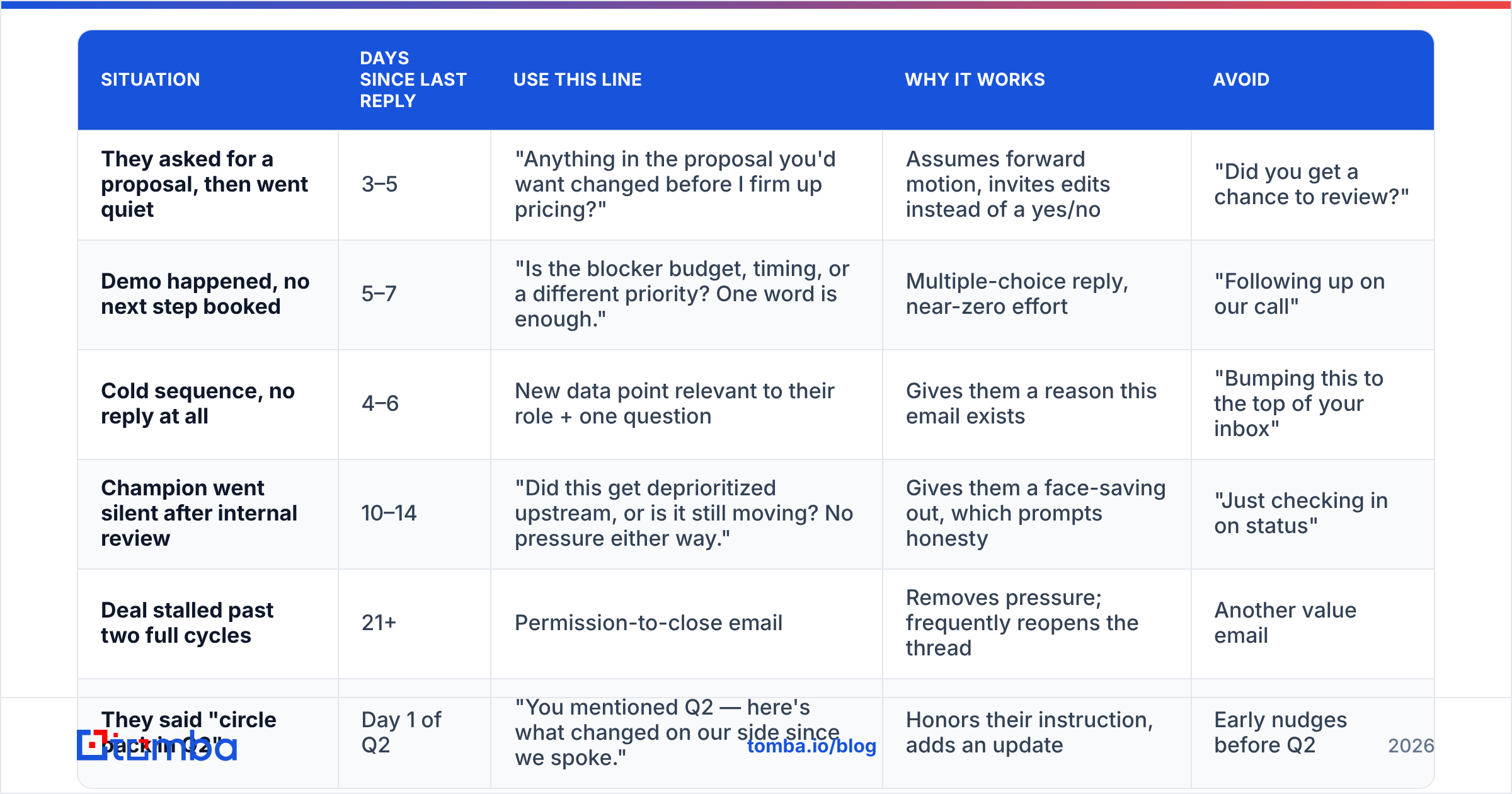
The right line depends on thread age, what you know, and where they stand. Use this to decide fast.
| Situation | Days since last reply | Use this line | Why it works | Avoid |
|---|---|---|---|---|
| They asked for a proposal, then went quiet | 3–5 | "Anything in the proposal you'd want changed before I firm up pricing?" | Assumes forward motion, invites edits instead of a yes/no | "Did you get a chance to review?" |
| Demo happened, no next step booked | 5–7 | "Is the blocker budget, timing, or a different priority? One word is enough." | Multiple-choice reply, near-zero effort | "Following up on our call" |
| Cold sequence, no reply at all | 4–6 | New data point relevant to their role + one question | Gives them a reason this email exists | "Bumping this to the top of your inbox" |
| Champion went silent after internal review | 10–14 | "Did this get deprioritized upstream, or is it still moving? No pressure either way." | Gives them a face-saving out, which prompts honesty | "Just checking in on status" |
| Deal stalled past two full cycles | 21+ | Permission-to-close email | Removes pressure; frequently reopens the thread | Another value email |
| They said "circle back in Q2" | Day 1 of Q2 | "You mentioned Q2 — here's what changed on our side since we spoke." | Honors their instruction, adds an update | Early nudges before Q2 |

How do you rewrite a bad follow-up line by line?#
Here's the same email before and after. The edits are mechanical — you can run this on any draft in two minutes.
Before:
Subject: Checking in
Hi Marco,
Just checking in to see if you had a chance to look at my last email. Let me know if you have any questions or if you'd like to hop on a quick call.
Best,
Dana
Everything in there is about Dana. Marco has no reason to move.
After:
Subject: The 14-month CAC number from Tuesday
Hi Marco,
You mentioned payback was sitting around 22 months. I pulled the benchmark for mid-market fintech — median is 14. The gap usually comes from one of two places: SDR ramp or list quality.
Which one is it on your side?
Dana
Four mechanical changes:
- Subject line carries content, not process. "Checking in" tells the recipient to skip it.
- First sentence references their words, so context reconstruction costs nothing.
- The body adds one fact they didn't have.
- The close is a single question with a two-option answer.
The subject line tester is useful here — process-y subjects ("Following up," "Touching base," "Checking in") score badly for a reason, and swapping in the specific noun from the thread usually lifts open rates on its own.
What phrases should you delete from every follow-up?#
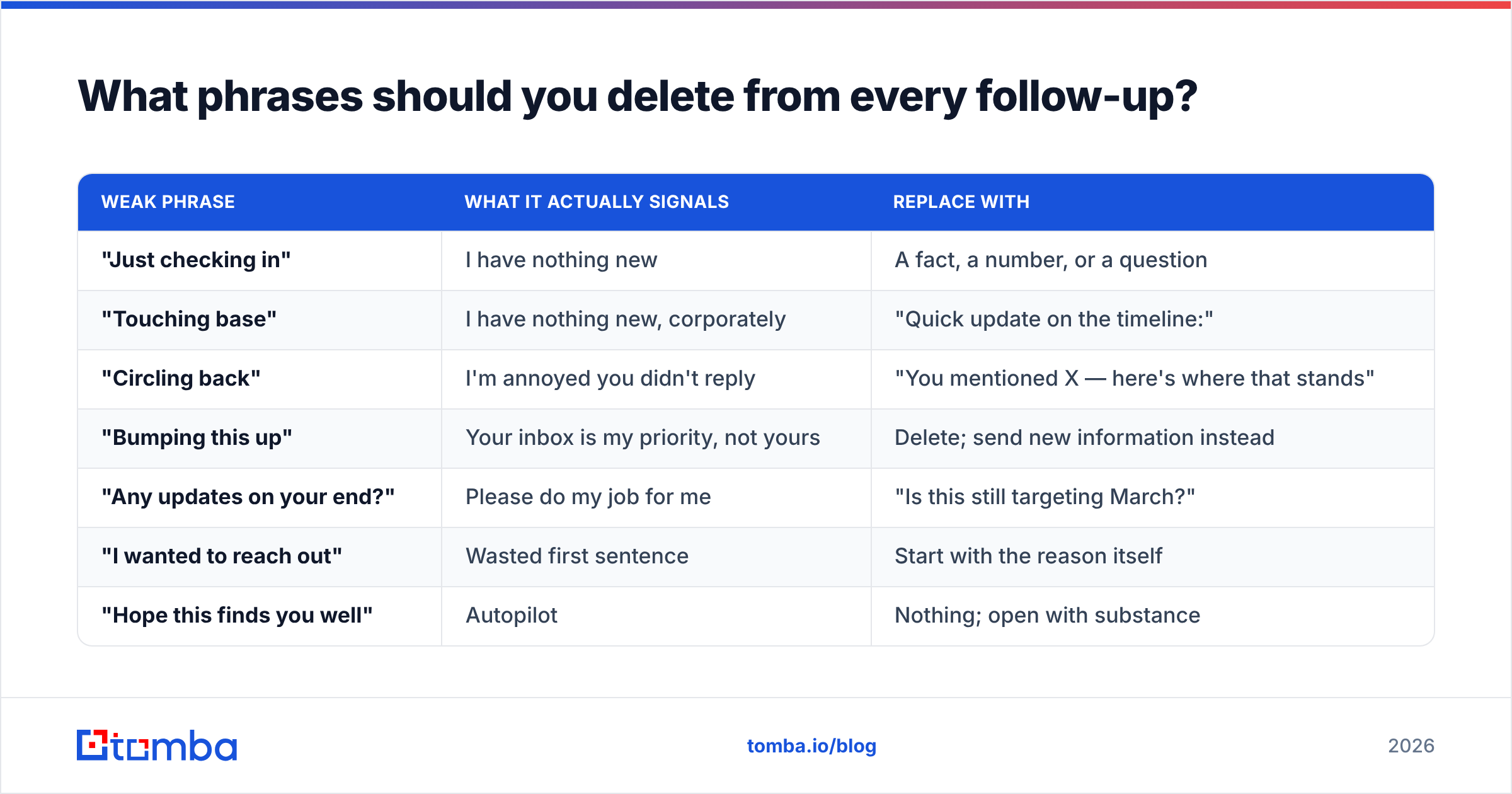
Some of these are technically polite. All of them are filler that trains recipients to skim past you.
| Weak phrase | What it actually signals | Replace with |
|---|---|---|
| "Just checking in" | I have nothing new | A fact, a number, or a question |
| "Touching base" | I have nothing new, corporately | "Quick update on the timeline:" |
| "Circling back" | I'm annoyed you didn't reply | "You mentioned X — here's where that stands" |
| "Bumping this up" | Your inbox is my priority, not yours | Delete; send new information instead |
| "Any updates on your end?" | Please do my job for me | "Is this still targeting March?" |
| "I wanted to reach out" | Wasted first sentence | Start with the reason itself |
| "Hope this finds you well" | Autopilot | Nothing; open with substance |
| "Per my last email" | Passive aggression | "Reattaching the doc so it's easy to find" |
One more habit worth breaking: never apologize for following up. "Sorry to bother you again" frames your email as a nuisance before they've decided whether it is one.
How many follow-ups should you send, and how far apart?#
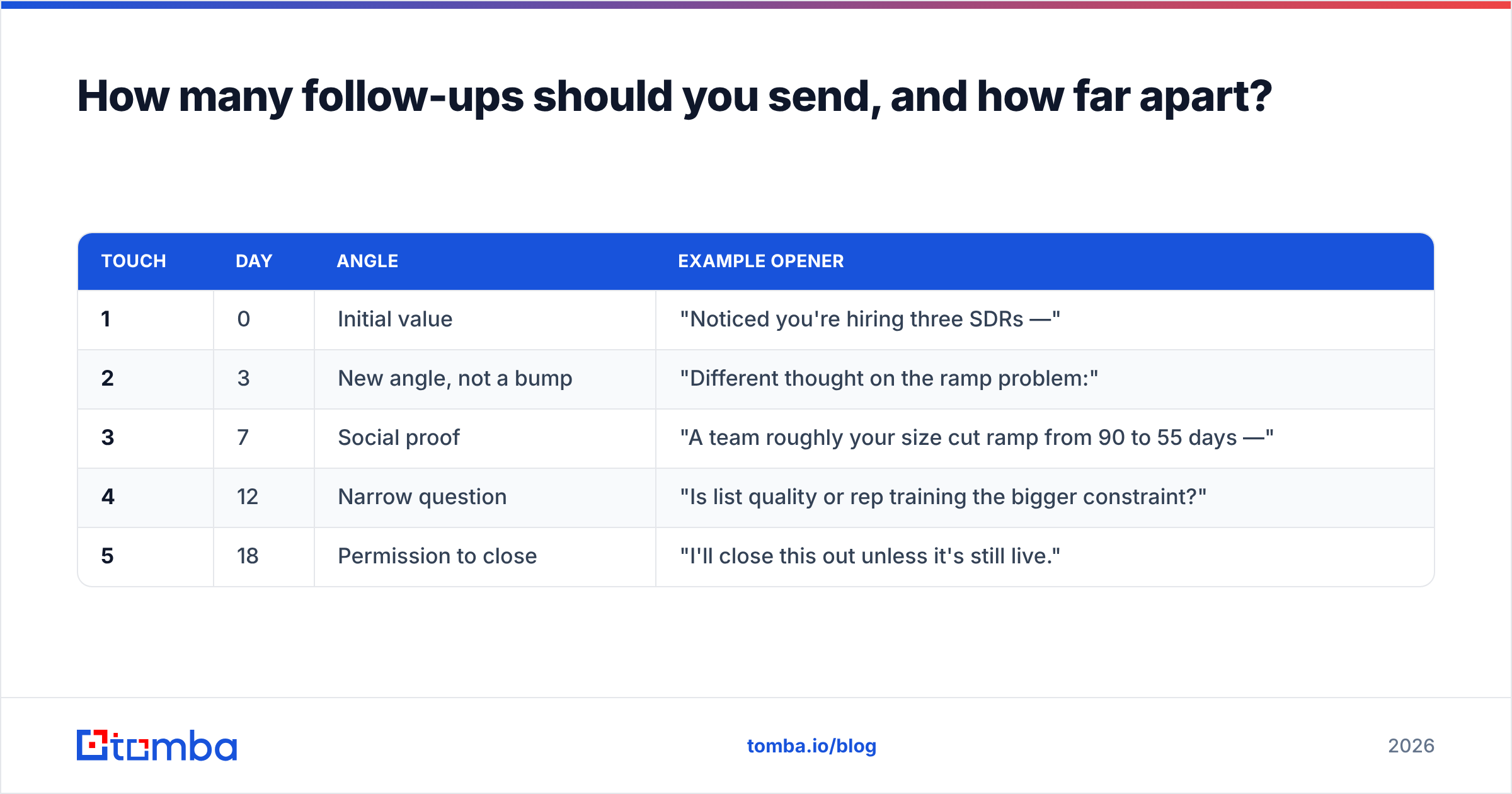
Four to six touches over roughly three weeks, and no two touches should be the same kind of email.
| Touch | Day | Angle | Example opener |
|---|---|---|---|
| 1 | 0 | Initial value | "Noticed you're hiring three SDRs —" |
| 2 | 3 | New angle, not a bump | "Different thought on the ramp problem:" |
| 3 | 7 | Social proof | "A team roughly your size cut ramp from 90 to 55 days —" |
| 4 | 12 | Narrow question | "Is list quality or rep training the bigger constraint?" |
| 5 | 18 | Permission to close | "I'll close this out unless it's still live." |
Two rules that matter more than the exact spacing:
- Change the angle every time. Five versions of the same pitch is spam. Five different reasons to care is a sequence.
- Reply in the same thread for touches 2–4, then start a fresh thread for the close. Long threads collapse in Gmail and your close gets buried.
Keeping volume sane also protects email deliverability. Sending eight follow-ups to a cold, unverified list is how you end up in spam folders, at which point the wording of your follow-up is irrelevant — nobody sees it. Run a spam checker on the sequence before you launch it.
Does the wording matter if the email address is wrong?#
No. And this is the failure mode most people never diagnose.
A follow-up sent to a stale or guessed address produces the same outward signal as being ignored: silence. Reps then blame their copy, rewrite it five times, and keep emailing an address that stopped existing when the person changed jobs.
Business email addresses decay fast — industry consensus puts B2B contact data decay in the 25–30% per year range, and role changes cluster in Q1. A prospect who was first.last@company.com in January may be gone by June, and the bounce lands in a folder you never check.
Three checks before you send follow-up number two:
- Verify the address is deliverable. An email verifier confirms the mailbox exists without sending anything.
- Confirm they still work there. Data enrichment on the address surfaces current title and company, so you know whether you're chasing a ghost.
- Find the new owner if they left. Domain search returns the current people in that function at the account, so the thread continues with whoever inherited the project.
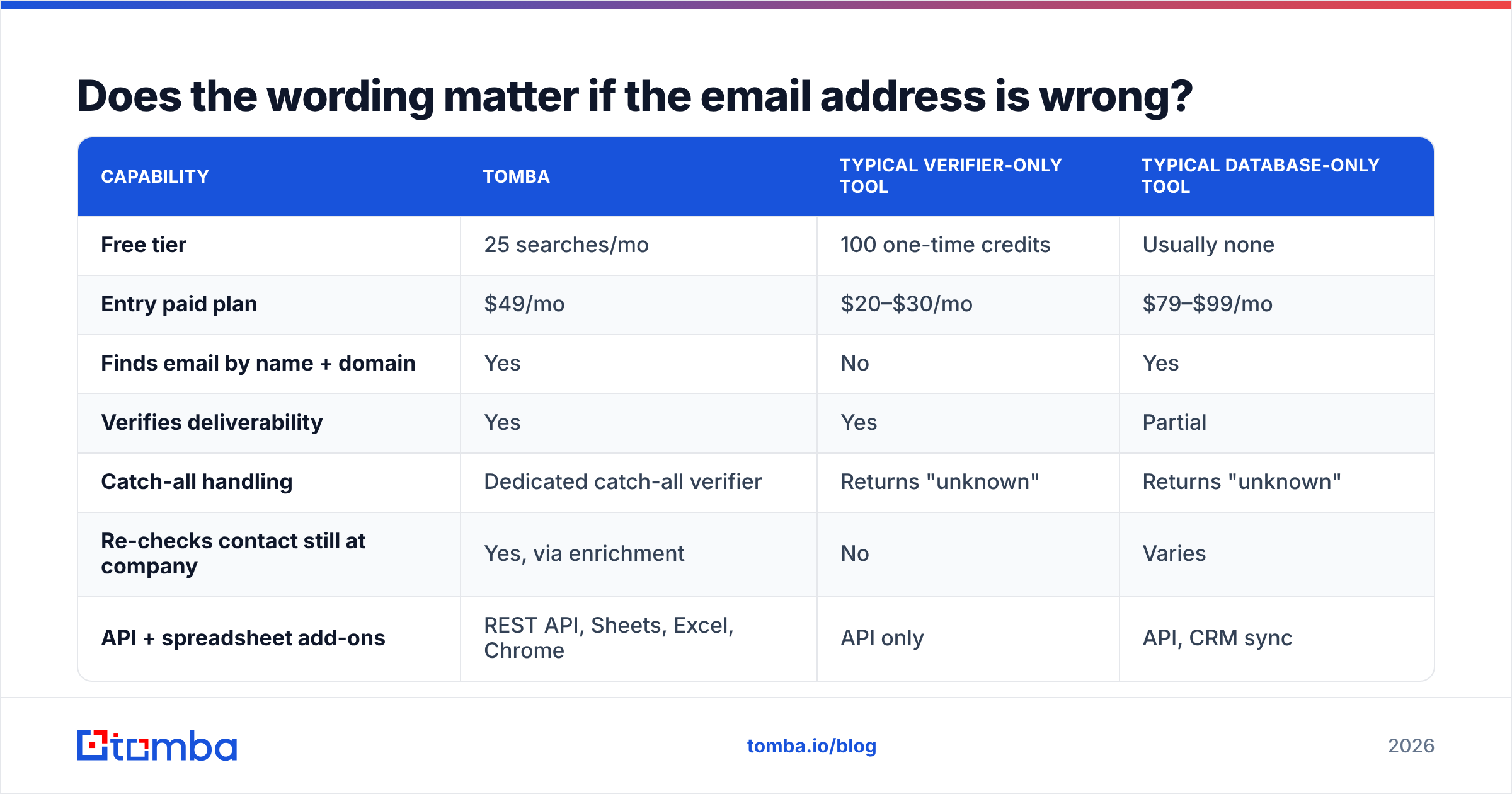
Tools worth comparing on this dimension:
| Capability | Tomba | Typical verifier-only tool | Typical database-only tool |
|---|---|---|---|
| Free tier | 25 searches/mo | 100 one-time credits | Usually none |
| Entry paid plan | $49/mo | $20–$30/mo | $79–$99/mo |
| Finds email by name + domain | Yes | No | Yes |
| Verifies deliverability | Yes | Yes | Partial |
| Catch-all handling | Dedicated catch-all verifier | Returns "unknown" | Returns "unknown" |
| Re-checks contact still at company | Yes, via enrichment | No | Varies |
| API + spreadsheet add-ons | REST API, Sheets, Excel, Chrome | API only | API, CRM sync |
Peers like BookYourData approach the same problem from the prebuilt-list side, which suits teams that want to buy a targeted list outright rather than resolve contacts one at a time. Both approaches solve the same underlying issue: your follow-up copy can only be judged once you know it reached a real inbox. Full Tomba pricing is public if you want to run the math against your own volume.
How do you write follow-ups that sound human, not automated?#
Five habits, in order of impact:
- Reference something only you would know. A line from their reply, a detail from the demo, a comment they made on LinkedIn. Merge tags can't fake this.
- Write shorter than feels comfortable. Sixty to ninety words. If it needs scrolling on a phone, it needs cutting.
- Use one question mark, at the end. Two questions halves your reply rate because it doubles the decision cost.
- Drop the pleasantry stack. "Hope you're doing well, I know things are busy, no rush at all" — three sentences signaling that ignoring you is fine.
- Match their register. If they write two-line replies with no greeting, do the same. Formality mismatch reads as a script.
For B2B outbound specifically, Gartner's research on buyer behavior has consistently found that buyers spend the majority of the purchase cycle doing independent research rather than talking to sellers. Your follow-ups compete with that research, so the winning move is to be a useful input to it — a benchmark, a comparison, a checklist — rather than a request for their attention.
Ratings sites like G2 are also worth mining before a follow-up: reading the review your prospect's category is arguing about gives you a concrete, specific opener that no template generates.
What does a good follow-up look like at each stage?#
Copy these and swap the specifics.
After a cold email with no reply (day 3):
Subject: The 55-day ramp number
Different angle on my last note. The teams that fix rep ramp usually fix list quality first — bad lists make good reps look slow.
Is ramp actually the constraint on your side, or is it pipeline volume?
After a demo with no next step (day 5):
Subject: Security review or budget?
You said you'd loop in Ravi this week. Two things usually stall here: security review or budget timing.
Which one is it? I can send the SOC 2 pack today if it's the first.
After the champion goes quiet (day 12):
Subject: Did this get deprioritized?
No pressure either way — I'd just rather know than keep guessing. Did this slip behind something else, or is it still live for this quarter?
The close (day 18):
Subject: Closing this out
I'll stop following up here. If the timing changes, reply "reopen" and I'll pick it up with everything we already covered.
That last one gets replies at a rate that surprises people. Removing the ask is itself an ask.
Stop guessing at addresses, then guessing at copy#
Rewriting "just checking in" fixes half the problem. The other half is making sure the rewritten email lands in a real, current inbox belonging to the person who can actually say yes.
Tomba Email Finder resolves names and domains into verified business addresses, flags the ones that have gone stale, and surfaces the current owner when your contact moves on. The free tier gives you 25 searches a month to test it against a list you already have; paid plans start at $49/mo when you're ready to run full sequences. Find the right person first — then the twelve better lines above will actually get read.
Related guides#
// get started
Find, verify and enrich your first contacts today
Start on the free plan with 25 searches a month, then scale when your team is ready.
Free plan · No credit card required · GDPR & CCPA
Get the Tomba newsletter
Product and data updates
// about the author