How to Secure a Meeting on a Cold Call: 2026 Playbook
Most cold calls die in the first 12 seconds. Here is the exact opener, objection-handling script, and close that turns a stranger's 'not interested' into a booked meeting on your calendar.
TL;DR
- The meeting is won or lost in the first 12 seconds. Ask for permission, name the reason you called, then earn the next 30 seconds.
- Never pitch the product on a cold call. Pitch the meeting — a specific, short, low-risk block of time with a clear agenda.
- Handle "not interested" once, not three times. One reframe, one alternative, then a graceful exit that keeps the door open.
- Close with an assumptive two-option ask ("Tuesday 10:15 or Thursday 2:30?") and confirm by email before you hang up.
- Bad phone data kills more meetings than bad scripts. Verify direct dials and matching work emails before you build the list.
Why do most cold calls never turn into meetings?#
Because the rep is trying to sell the product when the only thing on the table is 90 seconds of a stranger's attention.
Think of it like a street vendor. Nobody buys a $40,000 watch from a folding table on a sidewalk. But plenty of people will accept a business card and agree to visit the shop on Thursday. The cold call is the sidewalk. The meeting is the shop. Every sentence you say should be moving the prospect toward the shop, not closing the watch.
Three things reliably break that movement:
- No permission. You launch into a pitch before the prospect has agreed to listen. Their brain is still processing "who is this?" while you're on your third value prop.
- Vague relevance. "We help companies like yours improve efficiency" tells them nothing. If your reason for calling could apply to 40,000 companies, it applies to none.
- No specific ask. "Would you be open to learning more sometime?" gets a polite "send me info," which is the phone equivalent of the trash folder.
The fix is structural, not motivational. You need a repeatable seven-part call frame, and you need to run it enough times that the numbers work. Industry benchmarks put cold-call connect rates in the low single digits to low teens depending on data quality — HubSpot's sales research has tracked this decline for years. The lever you actually control is what happens after someone picks up.

What is the 7-step structure for securing a meeting on a cold call?#
Here is the full frame. Every step has one job and hands off to the next.
- The pattern interrupt (0–5 sec). State your first name and company, then stop. "Hi Maria, this is Sam from Northbeam." Silence for a beat. This is not a pause for drama — it's a signal that you're a human, not a dialer bot.
- The permission ask (5–12 sec). "I know I'm an interrupt. Can I have 27 seconds to tell you why I called, and then you can tell me to go away?" The oddly specific number works because it proves you've thought about their time. Roughly 7 in 10 people say yes to this framing.
- The reason (12–40 sec). One sentence of trigger-based relevance. "I saw you posted three SDR roles in the last month — usually that means the team is ramping and pipeline coverage is the pressure point." Name the trigger, name the likely problem. Do not name your feature set.
- The permission-to-question (40–50 sec). "Am I close, or is that not what's happening over there?" You're handing them control. This is where a monologue becomes a conversation.
- The two-question discovery (50–90 sec). Ask no more than two questions. One about current state, one about impact. "How are you covering pipeline today?" then "What happens if Q2 comes in under coverage?" Anything more and you're doing the meeting on the phone for free.
- The meeting pitch (90–110 sec). Pitch the meeting, not the product. "Here's what I'd suggest — 20 minutes next week. I'll show you what three companies in your segment did about exactly this, and if it's not relevant you'll know inside five minutes."
- The assumptive close (110–120 sec). Two options, both specific, both odd-numbered. "Tuesday at 10:15 or Thursday at 2:30 — which is less painful?"
Two minutes, start to finish. Anything longer and you've stopped selling the meeting and started giving it away.
How should you open a cold call to earn the next 30 seconds?#
Lead with the interrupt acknowledgement — it defuses the reflex hang-up faster than any charm offensive.
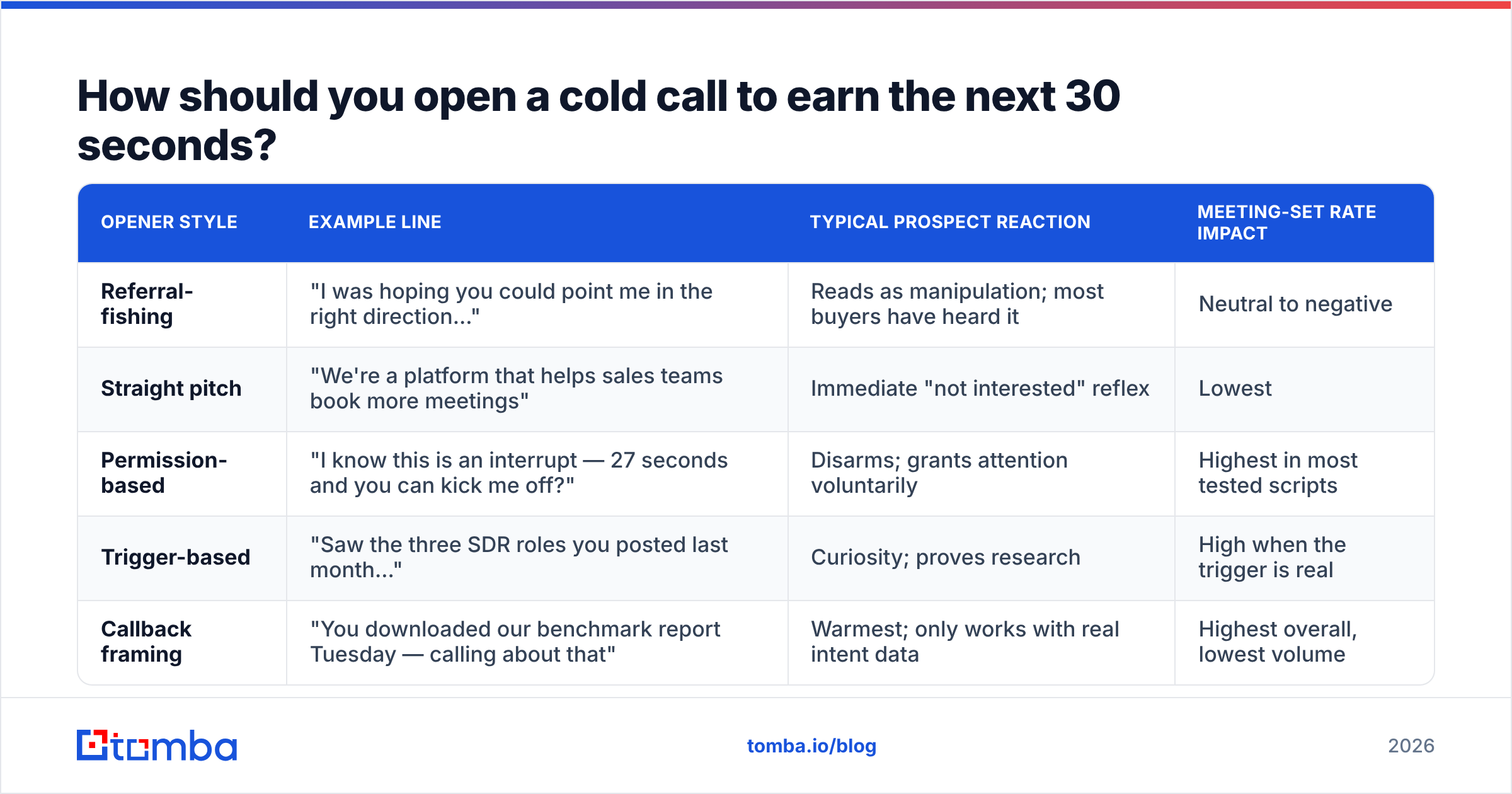
Compare the two most common openers against the permission-based version:
| Opener style | Example line | Typical prospect reaction | Meeting-set rate impact |
|---|---|---|---|
| Referral-fishing | "I was hoping you could point me in the right direction..." | Reads as manipulation; most buyers have heard it | Neutral to negative |
| Straight pitch | "We're a platform that helps sales teams book more meetings" | Immediate "not interested" reflex | Lowest |
| Permission-based | "I know this is an interrupt — 27 seconds and you can kick me off?" | Disarms; grants attention voluntarily | Highest in most tested scripts |
| Trigger-based | "Saw the three SDR roles you posted last month..." | Curiosity; proves research | High when the trigger is real |
| Callback framing | "You downloaded our benchmark report Tuesday — calling about that" | Warmest; only works with real intent data | Highest overall, lowest volume |
The permission-based and trigger-based openers stack well. Permission gets you the airtime; trigger justifies why you spent it on this specific person. If you can only fix one thing about your call today, fix the first 12 seconds.
One more mechanical detail: your tone should drop at the end of sentences, not rise. Upward inflection signals uncertainty and invites the brush-off. Speak like you already belong on their calendar.
What do you say when they push back?#
Handle the objection once, offer one alternative, then exit cleanly. Repeated pushing converts a "no" into a "never."
"I'm not interested."
"Totally fair — you don't know me yet. Most people I call say that before they hear the reason. Thirty seconds and if it's still a no, I'll never call again."
"Send me some information."
"Happy to. So I don't spam you with the wrong thing — is the priority pipeline coverage or rep ramp time? Whichever you say, I'll send that one page and grab 15 minutes to walk you through it."
"We already use [competitor]."
"Good — that means you've already solved the obvious part. The teams I talk to who use them usually still hit a wall on data accuracy. Is that the case for you, or have you got that dialed in?"
"I don't have budget."
"Not asking for budget. Asking for 20 minutes so that when budget opens, we're not starting from zero. Does that seem reasonable?"
"Now is a bad time."
"Understood. I'll be quick then — are mornings or afternoons generally better for you? I'll put 15 minutes on Thursday and you can move it if the week goes sideways."
Notice what none of these do: argue. Each one accepts the objection as valid, reframes it, and then re-asks for the meeting with a smaller commitment. That's the whole game — shrink the ask until saying yes costs less than saying no.
For a broader look at how phone outreach fits with email sequencing, our writeup on response rate benchmarks shows why multi-channel follow-up beats phone-only cadences by a wide margin.
How do you actually close the calendar slot?#
Assume the meeting, offer two specific slots, and confirm in writing before you hang up.
The failure mode here is the open-ended ask. "When would be a good time for you?" hands the prospect a blank page and a reason to defer. Two odd-numbered options ("10:15 or 2:45") do three things: they signal a real, busy calendar; they make the decision binary; and they're memorable enough that the prospect actually writes them down.
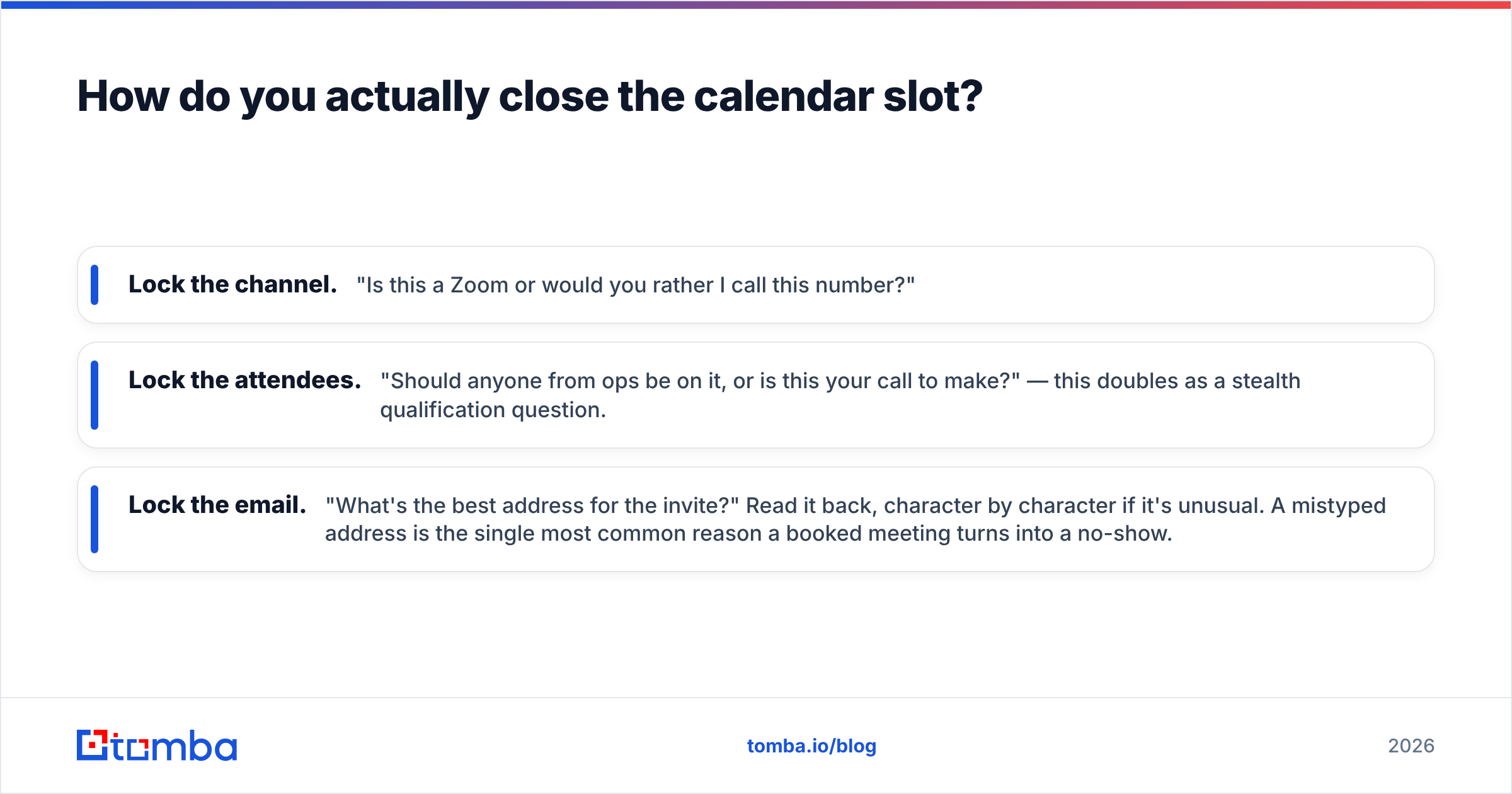
Then run this three-part confirmation before you end the call:
- Lock the channel. "Is this a Zoom or would you rather I call this number?"
- Lock the attendees. "Should anyone from ops be on it, or is this your call to make?" — this doubles as a stealth qualification question.
- Lock the email. "What's the best address for the invite?" Read it back, character by character if it's unusual. A mistyped address is the single most common reason a booked meeting turns into a no-show.
Send the invite while you're still on the line. Say so out loud: "Sending it now — you should see it in about ten seconds." The prospect confirming receipt on the call converts a soft commitment into a hard one.

Does your data matter more than your script?#
Yes — and it's not close.
A perfect script delivered to a wrong number books nothing. Reps routinely burn 60–70% of a dialing block on disconnected lines, gatekeepers, and job-changers who left 14 months ago. That's not a talent problem, it's a list problem. G2's category reviews for sales intelligence tools show data accuracy as the single most-cited differentiator in buyer feedback, ahead of price and UI.
Three data hygiene habits that raise your meeting rate without touching your script:
- Verify the direct dial before the block. A phone validator check strips disconnected and invalid numbers so your connect rate reflects real conversations, not dead air.
- Pair every dial with a verified email. You need the address for the calendar invite and the follow-up. Running the list through an email verifier before you dial means you're not asking "what's your email?" and getting a mumbled generic inbox.
- Re-verify quarterly. B2B contact data decays roughly 2–3% per month through job changes alone. A list built last January is meaningfully wrong by summer.
Here's how the common approaches to sourcing dial lists compare:
| Approach | Typical cost | Direct-dial accuracy | Time to build 500 contacts | Best for |
|---|---|---|---|---|
| Manual LinkedIn research | Rep time only | Low — mostly switchboards | 15–20 hours | Very small ABM lists |
| Scraped lists / marketplaces | $0–$200 one-off | Low; heavy decay | 1 hour | Never, honestly |
| Bundled sales-engagement suite | $99–$199/user/mo | Medium to high | 1–2 hours | Teams already on the suite |
| Curated B2B database (e.g. BookYourData) | Per-record pricing | High, human-checked segments | 1–2 hours | Niche verticals, one-off campaigns |
| Verification-first finder (Tomba) | Free tier, then $49/mo Starter | High on verified records | Under 1 hour with bulk | Teams that dial and email the same list |
Whichever route you pick, the principle holds: verify before you dial. A bulk email finder run over your target account list takes minutes and removes the two worst outcomes of a cold call — reaching nobody, and reaching someone whose invite bounces.
How do you measure whether your cold calling is working?#
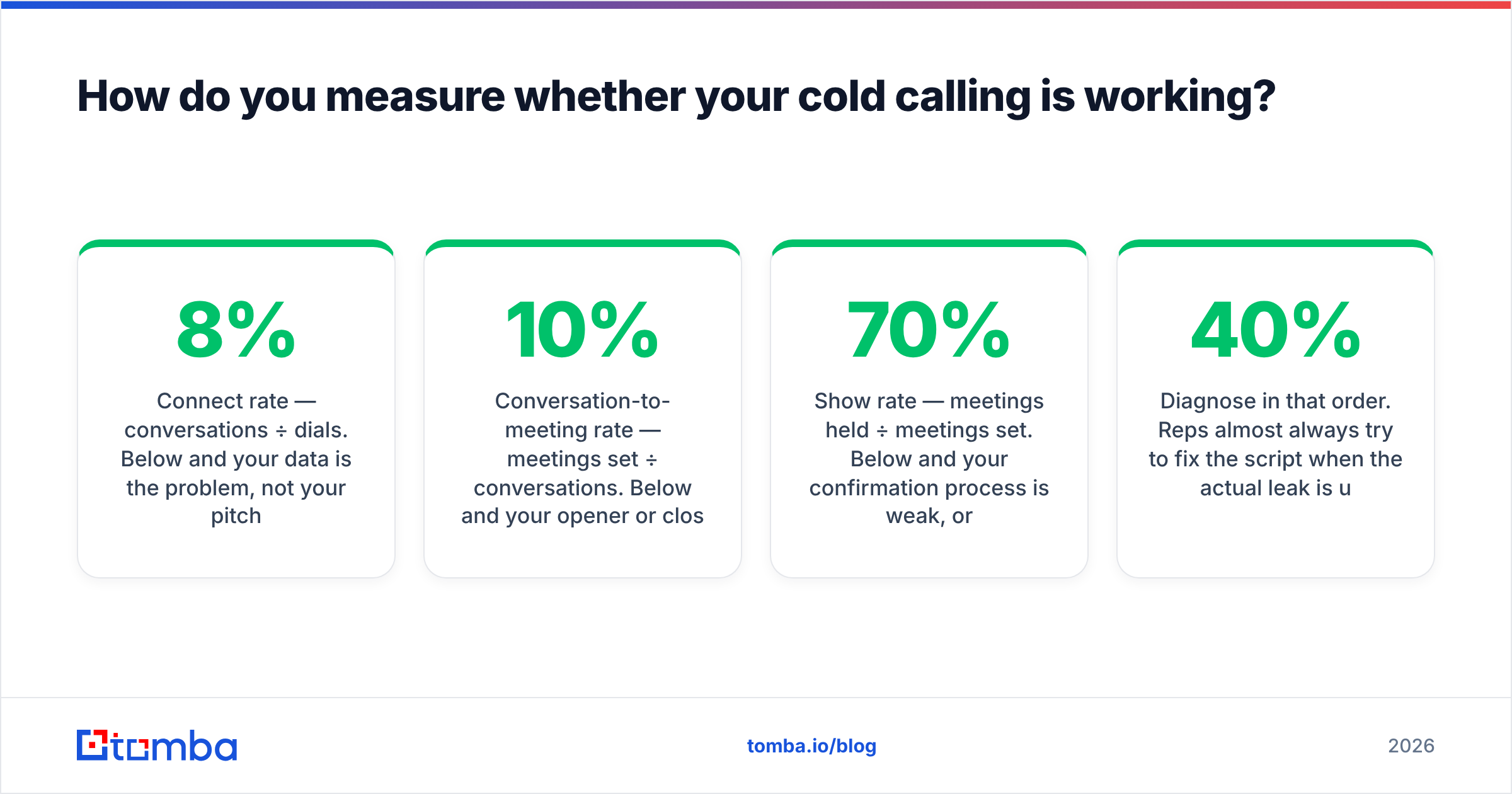
Track four numbers weekly and ignore everything else.
- Connect rate — conversations ÷ dials. Below 8% and your data is the problem, not your pitch.
- Conversation-to-meeting rate — meetings set ÷ conversations. Below 10% and your opener or close is the problem. Record calls and audit the first 12 seconds.
- Show rate — meetings held ÷ meetings set. Below 70% and your confirmation process is weak, or you're booking too far out. Anything beyond 8 days decays badly.
- Meeting-to-opportunity rate — this tells you whether you're booking the right people or just booking anyone who'll say yes.
Diagnose in that order. Reps almost always try to fix the script when the actual leak is upstream in the list or downstream in the confirmation. If connect rate is fine and conversation-to-meeting is fine but show rate is 40%, no amount of objection-handling practice will help you.
Log everything in your CRM the same day. A cold-call program you can't measure is a cold-call program you can't improve.
What does a full call look like end to end?#
Rep: "Hi Maria, Sam from Northbeam." (pause)
Prospect: "...Okay?"
Rep: "I know I'm an interrupt. Can I have 27 seconds to tell you why I called, and then you tell me to get lost?"
Prospect: "Go ahead."
Rep: "You posted three SDR roles in the last month. Usually when I see that, the team is ramping fast and pipeline coverage is the thing keeping someone up at night. Am I close?"
Prospect: "Closer than most people who call here."
Rep: "How are you covering the gap while the new folks ramp?"
Prospect: "Honestly, the existing team is just dialing more."
Rep: "That's what most teams do, and it holds for about a quarter. Here's what I'd suggest — 20 minutes next week. I'll show you what two other teams in your segment did instead of adding dials, and if it's not relevant you'll know in five minutes. Tuesday at 10:15, or Thursday at 2:30?"
Prospect: "Thursday works."
Rep: "Done. Best email for the invite? ... Sending it now, you'll see it in ten seconds. Anyone from ops need to be on it?"
Under two minutes. No product demo, no feature list, no discount. Just relevance, permission, and a specific ask.
Where should you start tomorrow?#
Pick 50 accounts. Verify the contact data before you touch the phone. Write the trigger sentence for each one — the actual reason you're calling that specific person — and run the seven-step frame exactly as written for a full week before you change anything. Then look at your four numbers and fix the weakest one.
The script is learnable in an afternoon. The list is what separates a rep who books eight meetings a week from one who books one.
Build that list properly with the Tomba Email Finder — find and verify the decision-maker's work email in seconds, pair it with a validated direct dial, and start every dialing block knowing the person on the other end actually exists and actually still works there. The free tier gives you 25 searches a month to test it against your current list; see Tomba pricing when you're ready to scale past that.
Related guides#
// get started
Find, verify and enrich your first contacts today
Start on the free plan with 25 searches a month, then scale when your team is ready.
Free plan · No credit card required · GDPR & CCPA
// about the author