How To Sell Anything To Anybody: The 2026 Playbook
The old "sell ice to an Eskimo" myth is dead. Here's the modern, research-backed process for selling anything to anybody — qualification, diagnosis, framing, and the follow-up most reps skip.
TL;DR
- "How to sell anything to anybody" is a bad literal goal and a great mental model. You cannot sell to anybody — you can build a repeatable process that works on anyone who has the problem you solve.
- The 7-step process below replaces closing tricks with diagnosis: research, reach the right person, open with a hypothesis, qualify honestly, frame value in their numbers, handle objections as data, and follow up on a schedule.
- Most deals die before the pitch. Bad contact data, wrong-level buyers, and a two-touch follow-up habit kill more revenue than weak wording ever does.
- Disqualifying fast is a selling skill. Reps who walk away from bad fits close more of the good ones and keep their calendar full of real pipeline.
- The one non-negotiable input: a clean, verified list. You cannot run a great process on emails that bounce.
What Does "Sell Anything To Anybody" Actually Mean?#
It means having a process that doesn't depend on the product, the vertical, or the mood of the person on the other end.
The phrase comes from a sales culture built on charisma — the mythical rep who could sell a second phone to someone holding one. That rep is mostly a story. What actually travels between products and industries is a sequence: find people with a problem, prove you understand the problem better than they've articulated it, quantify the cost of leaving it alone, and make buying the lowest-friction next step.
Here is the honest version of the promise: you can learn to sell anything to anybody who has the problem, the budget, and the authority to act on it. Strip out any one of those three and no amount of technique saves the deal. That's not a limitation of your skill — it's the definition of the job.
The modern buyer makes this even clearer. Research from Gartner has consistently shown that B2B buyers spend the majority of their purchase journey doing independent research, with only a slice of that time spent with any sales rep at all. You are not the source of information anymore. You are the source of judgment — the person who tells them which of the twelve tabs they have open actually matters for their situation.

Why Do Old-School Closing Tactics Stop Working?#
Because the information asymmetry that made them work is gone.
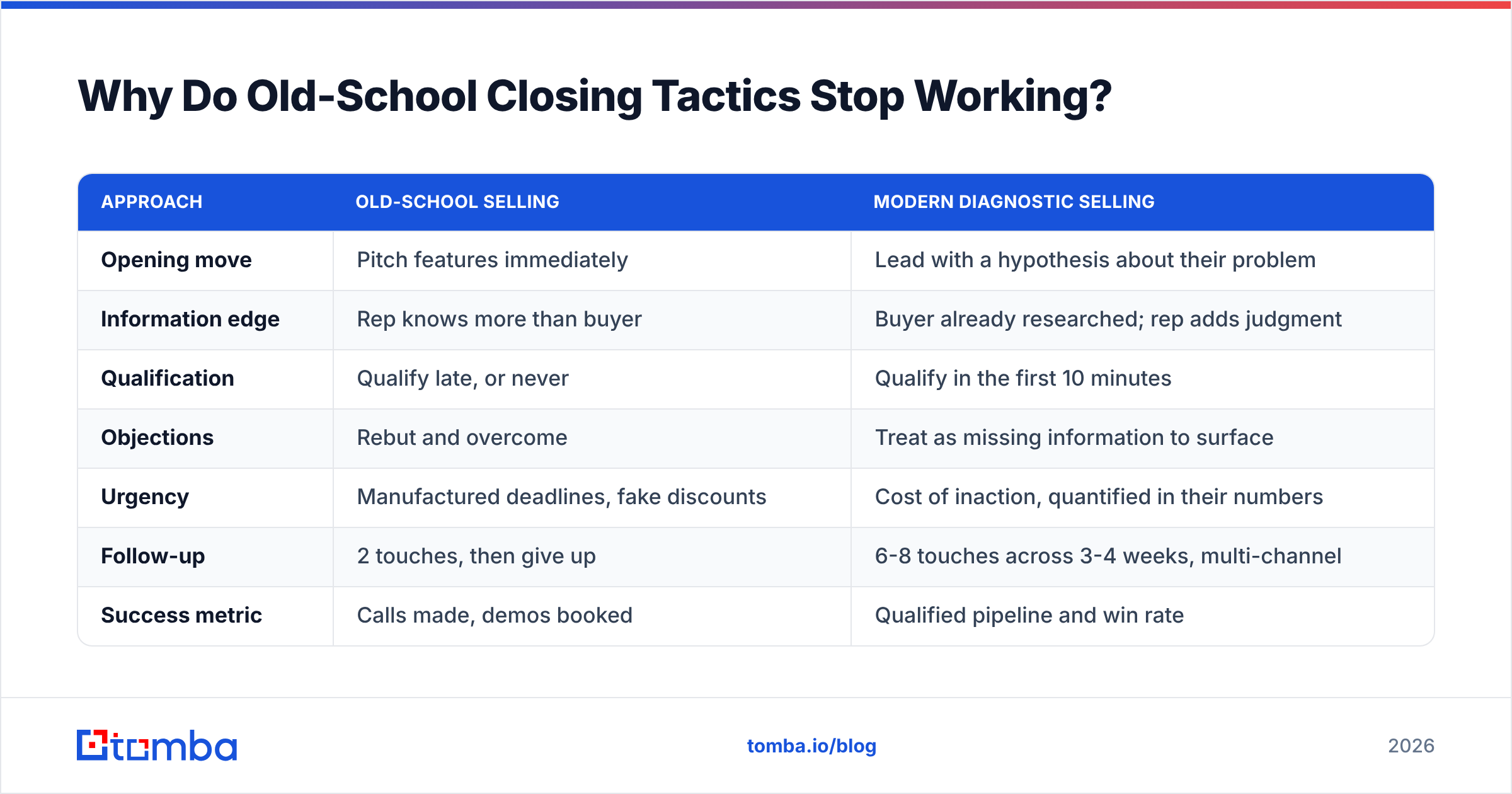
"Always Be Closing" was written for a world where the rep knew the price list and the buyer didn't. In 2026, your prospect can find your pricing page, your G2 reviews, three comparison blog posts, and a Reddit thread about your churn — before your first email lands. Pressure tactics against an informed buyer read as either desperation or incompetence.
| Approach | Old-school selling | Modern diagnostic selling |
|---|---|---|
| Opening move | Pitch features immediately | Lead with a hypothesis about their problem |
| Information edge | Rep knows more than buyer | Buyer already researched; rep adds judgment |
| Qualification | Qualify late, or never | Qualify in the first 10 minutes |
| Objections | Rebut and overcome | Treat as missing information to surface |
| Urgency | Manufactured deadlines, fake discounts | Cost of inaction, quantified in their numbers |
| Follow-up | 2 touches, then give up | 6-8 touches across 3-4 weeks, multi-channel |
| Success metric | Calls made, demos booked | Qualified pipeline and win rate |
The right column isn't softer. It's harder to fake. You have to actually understand the business you're calling into, which is why it works across products — the skill transfers even when the SKU doesn't.
What Are The 7 Steps To Sell Anything To Anybody?#
This is the sequence. Run it in order; skipping steps is where deals leak.
Research before you touch the keyboard. Fifteen minutes per account, not two hours. What does the company do, who did they just hire, what changed in the last quarter, and what does that change imply about the problem you solve? A single specific detail beats a paragraph of flattery.
Reach the right human with the right data. The best pitch sent to a bounced address is worth exactly zero. Use a verified email finder to get to the individual — job-title-based guessing at
info@addresses is why most outbound never gets read. Run every list through an email verifier before it enters a sequence.Open with a hypothesis, not a question. "I noticed you just opened a second EU office — teams at that stage usually hit a wall with regional lead routing. Is that showing up for you yet?" This gives them something to correct, which is far easier than answering "what are your biggest challenges?"
Qualify honestly and early. Confirm the problem is real, painful enough to fund, and that the person you're talking to can move it forward. If two of three fail, say so and leave the door open. You just bought back six hours.
Frame value in their units. Not "we improve efficiency" — "you're paying four SDRs to spend roughly a day a week on list cleanup; that's about $60K a year of salary going to manual data work." Use their numbers, gathered in step 4. If you don't have their numbers, you haven't earned the right to quantify anything.
Treat objections as missing information. "Too expensive" almost never means the price is wrong. It means the value case hasn't been made in a currency they care about, or the wrong person is evaluating it. Ask which one it is before you discount.
Follow up on a written schedule. Most reps stop at two touches. Most replies come after that. Build a 6-8 touch cadence over 3-4 weeks, vary the channel, and make every touch add something — a benchmark, a customer story, a relevant article — rather than "just bumping this up."
Steps 1-2 decide whether the other five matter. That's the part reps most want to skip and least can afford to.
How Do You Qualify Without Killing The Deal?#
Ask disqualifying questions early, and mean them.
There's a fear that qualifying hard scares people off. In practice it does the opposite — buyers are relieved to talk to someone who might tell them "this isn't for you." Frameworks like MEDDIC or the classic BANT are useful scaffolding, but the underlying test is simpler. Three questions:
- Is the problem real and currently costing them something? If they can't name a cost, there's no budget behind it.
- Is there a reason to act this quarter? A problem with no deadline is a problem that stays unsolved forever.
- Can this person get a decision made, or introduce you to someone who can? Champions are great. Champions without access are a slow no.
If you get three yeses, invest heavily. Two, keep it warm and cheap. One or zero, disqualify and say why — that honesty is worth more in referrals than the deal was worth in commission.

What Separates Reps Who Close From Reps Who Chase?#
Process discipline in the boring parts, mostly.
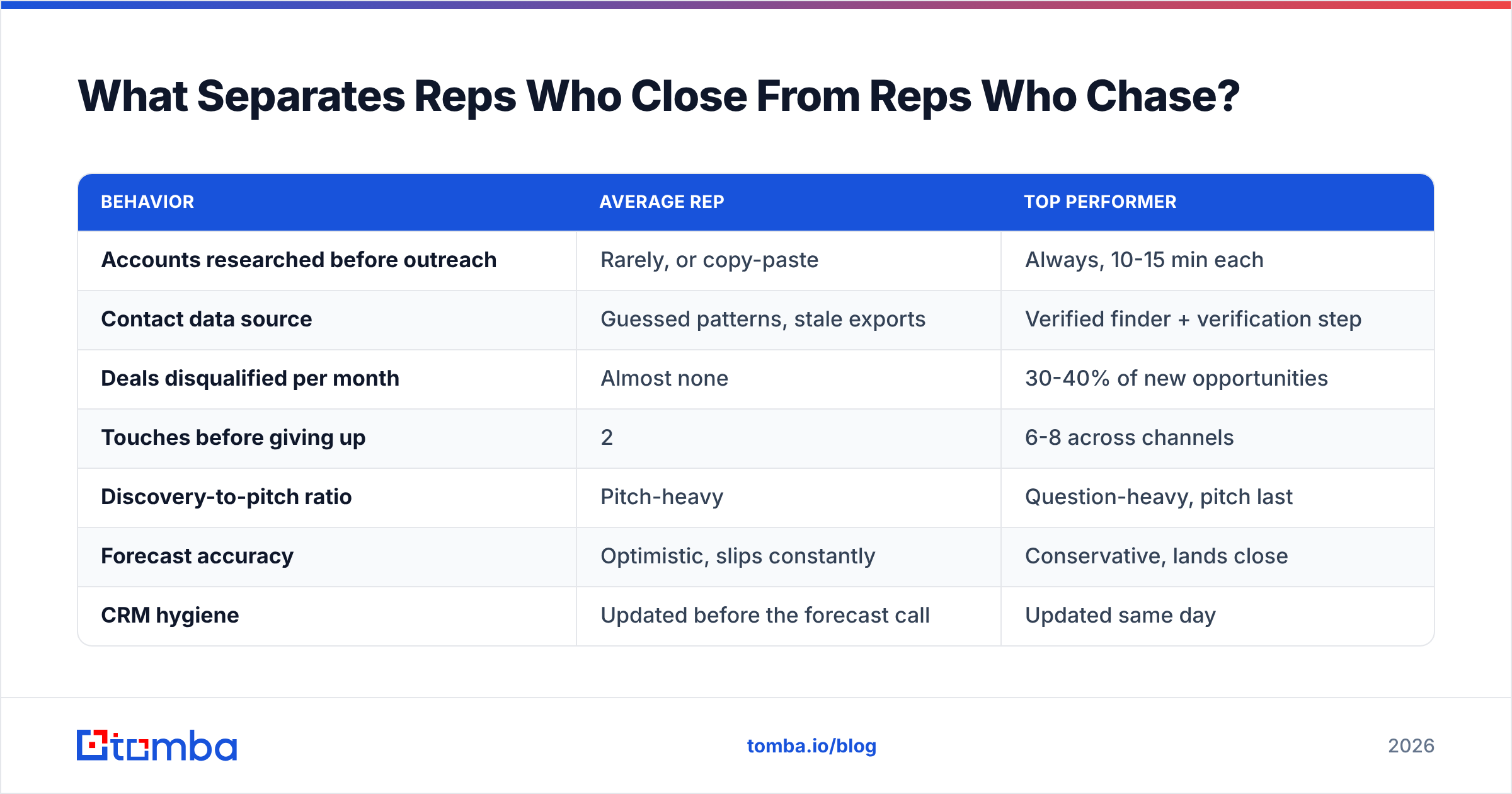
Look at the difference in behavior between top and average performers and it's rarely charisma. It's that the top rep's pipeline is smaller and cleaner, their contact data is right, and their follow-up happens whether or not they feel like it.
| Behavior | Average rep | Top performer |
|---|---|---|
| Accounts researched before outreach | Rarely, or copy-paste | Always, 10-15 min each |
| Contact data source | Guessed patterns, stale exports | Verified finder + verification step |
| Deals disqualified per month | Almost none | 30-40% of new opportunities |
| Touches before giving up | 2 | 6-8 across channels |
| Discovery-to-pitch ratio | Pitch-heavy | Question-heavy, pitch last |
| Forecast accuracy | Optimistic, slips constantly | Conservative, lands close |
| CRM hygiene | Updated before the forecast call | Updated same day |
The uncomfortable read on that table: almost every row is a habit, not a talent. That's good news. Habits are teachable, and they're what makes "sell anything to anybody" a training problem instead of a personality lottery.
How Does Data Quality Change Your Close Rate?#
More than your script does.
Run the arithmetic on a typical outbound month. Send 1,000 emails with a 25% bad-address rate and you've got 750 real deliveries. Bounce rates that high also damage your sender reputation, which quietly drops your inbox placement on the good addresses too. Now the same effort produces maybe 600 real impressions. Fix the data and you get 950+ — a ~58% increase in actual conversations from zero change to your messaging.
That's why the data layer sits underneath every step of this playbook:
- Finding the person — a domain search returns the verified addresses at a target company, so you're picking a person rather than guessing a format.
- Verifying before send — catching invalid and risky addresses protects deliverability and stops you from burning a domain on a list you never checked.
- Enriching for context — data enrichment fills in title, seniority, company size and tech stack, which is what makes step 3's hypothesis specific instead of generic.
- Scaling without decay — bulk email finder workflows keep list quality constant as volume goes up, instead of degrading the moment you scale.
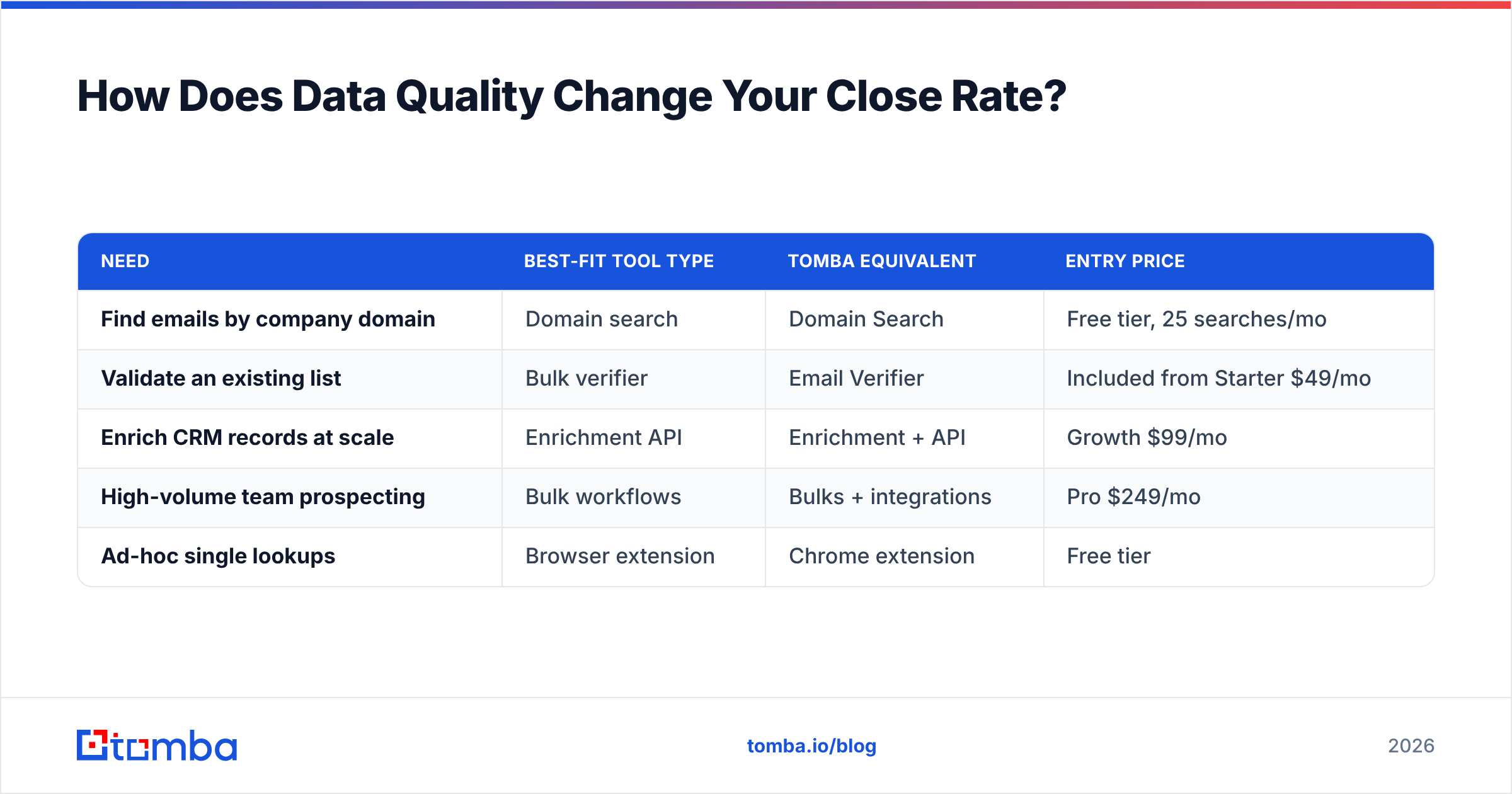
For teams evaluating tooling here, the practical spread is wide. Pure verifiers like ZeroBounce or Debounce clean lists but don't find contacts. All-in-one platforms like Apollo bundle a database with sequencing but charge for seats you may not need. Contact-data specialists — Tomba, Findymail, and BookYourData, which is strong if you want prepaid, pay-as-you-go B2B lists rather than a subscription — focus on the accuracy of the record itself. Match the tool to the bottleneck you actually have.
| Need | Best-fit tool type | Tomba equivalent | Entry price |
|---|---|---|---|
| Find emails by company domain | Domain search | Domain Search | Free tier, 25 searches/mo |
| Validate an existing list | Bulk verifier | Email Verifier | Included from Starter $49/mo |
| Enrich CRM records at scale | Enrichment API | Enrichment + API | Growth $99/mo |
| High-volume team prospecting | Bulk workflows | Bulks + integrations | Pro $249/mo |
| Ad-hoc single lookups | Browser extension | Chrome extension | Free tier |
Full Tomba pricing sits in the same range as most single-purpose verifiers, which is worth noting when you're deciding whether to buy a database seat you'll use twice a week.
How Do You Handle The Four Objections You'll Always Hear?#
Every product, every industry, same four objections wearing different clothes.
"It's too expensive." Translation: the value case is smaller than the price in their head. Don't discount. Go back to their numbers from discovery and rebuild the math, or find out whether you're talking to someone who owns the budget line at all.
"We're already using [competitor]." Good — that means the problem is validated and funded. Ask what they'd change about the current setup if they could. Don't attack the incumbent; ask about the gap. Most switches happen at renewal, so find the renewal date and set your calendar.
"Send me some information." Usually a polite exit. Test it: "Happy to — so I send the right thing, is the priority the pricing model or the integration side?" A real answer means real interest. A vague one means you can stop spending time here.
"Not right now." Ask what changes between now and then. If they can name the trigger, you have a real follow-up date and a reason to call. If they can't, this is a no in a friendlier costume, and you should treat it accordingly.
Notice that none of these responses are clever. They're all just refusing to accept the surface statement and asking one more question. That's the entire objection-handling skill.
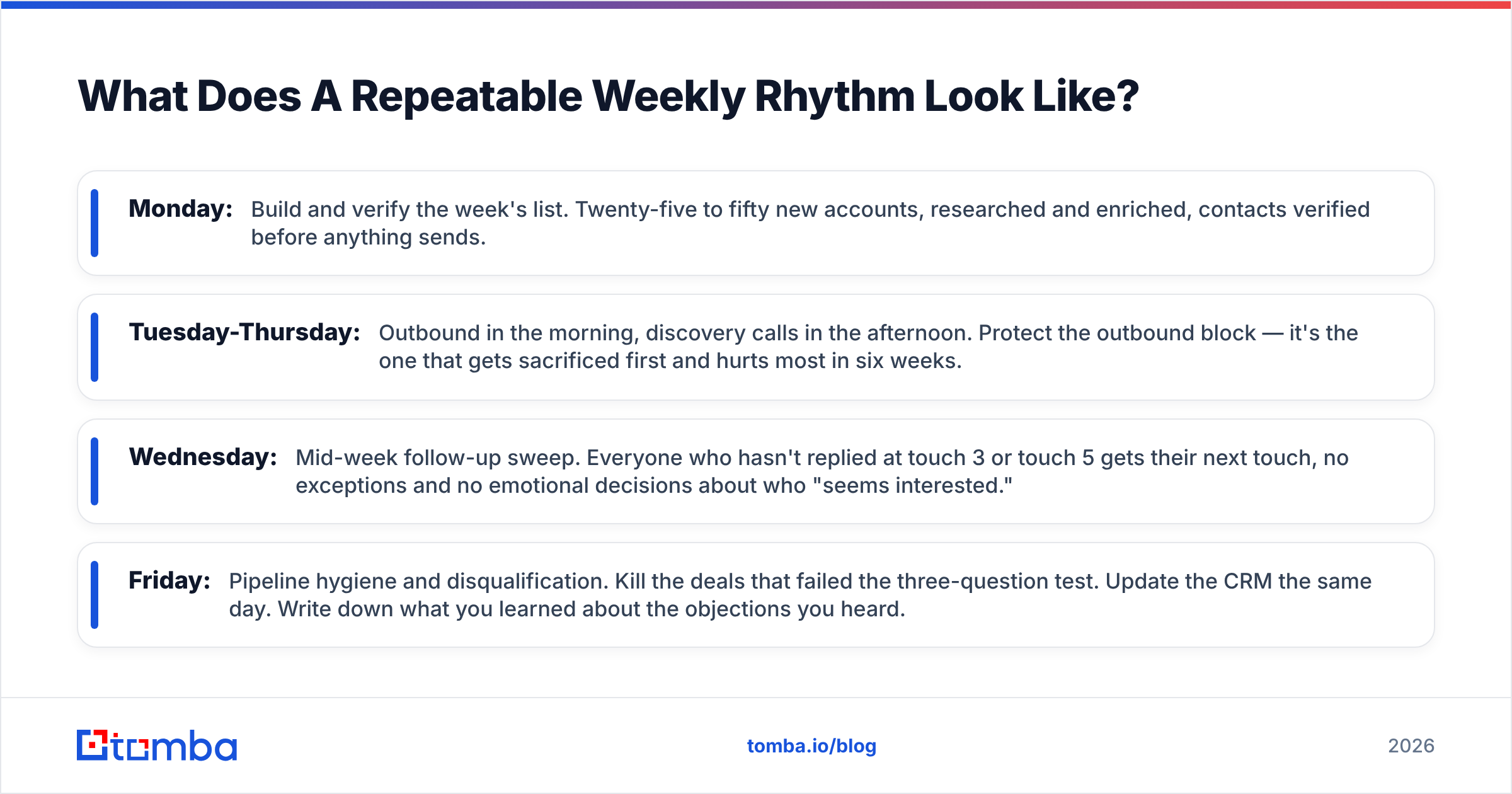
What Does A Repeatable Weekly Rhythm Look Like?#
A cadence you can run on your worst week, not your best one.
- Monday: Build and verify the week's list. Twenty-five to fifty new accounts, researched and enriched, contacts verified before anything sends.
- Tuesday-Thursday: Outbound in the morning, discovery calls in the afternoon. Protect the outbound block — it's the one that gets sacrificed first and hurts most in six weeks.
- Wednesday: Mid-week follow-up sweep. Everyone who hasn't replied at touch 3 or touch 5 gets their next touch, no exceptions and no emotional decisions about who "seems interested."
- Friday: Pipeline hygiene and disqualification. Kill the deals that failed the three-question test. Update the CRM the same day. Write down what you learned about the objections you heard.
The rhythm matters more than any individual element. Selling anything to anybody is a volume-plus-quality game, and volume only compounds if it's consistent. A rep who does four good hours every day beats a rep who does twelve heroic hours once a fortnight, every quarter, without exception.
One more thing worth internalizing: track your win rate by lead source, not just in aggregate. Most reps discover that one channel produces 60% of their closes and 20% of their effort — and they'd never have seen it without segmenting the number.
Start With The Part You Control#
You can't control whether a prospect has budget this quarter. You can control whether your list is accurate, whether your research is specific, and whether you follow up seven times instead of two.
Start with the data layer, because it's the cheapest fix with the largest effect. Tomba Email Finder gets you verified, deliverable contacts at your target accounts — by name, by domain, or in bulk — so the process above runs on real addresses instead of guesses. The free tier gives you 25 searches a month to test it against a list you already have; if the accuracy holds up on accounts you know, scale from there. Fix the input first, then work on the pitch.
Related guides#
// get started
Find, verify and enrich your first contacts today
Start on the free plan with 25 searches a month, then scale when your team is ready.
Free plan · No credit card required · GDPR & CCPA
// about the author