How to Sell Benefits Not Features: A 2026 Playbook
Feature lists lose deals. Learn the translation method that turns specs into buyer outcomes, with scripts, a comparison table, and the mistakes that kill reply rates.
TL;DR
- A feature is what your product has. A benefit is what the buyer gets. Buyers only pay for the second one.
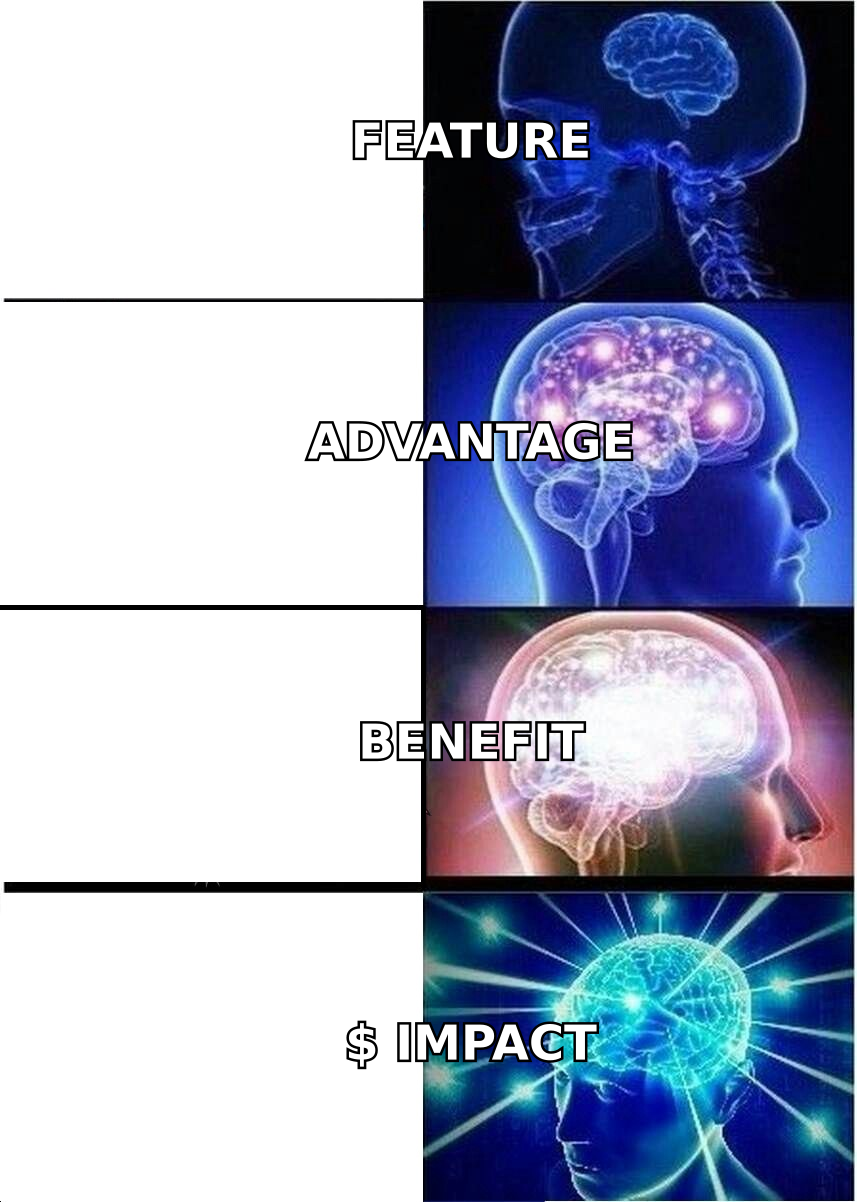
- The fastest translation tool is the "so what?" ladder: feature → advantage → benefit → quantified business impact. Stop at level four, not level one.
- Benefit claims only work when they're specific to a role. A CFO's benefit and an SDR manager's benefit from the same feature are different sentences.
- Personalized benefit statements need accurate contact and company data — a benefit aimed at the wrong title reads like spam.
- Test it: if your competitor could paste your sentence onto their site unchanged, it's not a benefit. It's a category description.
What is the actual difference between a feature and a benefit?#
A feature is a fact about your product. A benefit is a change in your buyer's life.
Think of a drill. The feature is a 20-volt brushless motor. The benefit is that you hang the shelf before your in-laws arrive. Nobody wakes up wanting a motor. They want the shelf on the wall and the argument avoided.
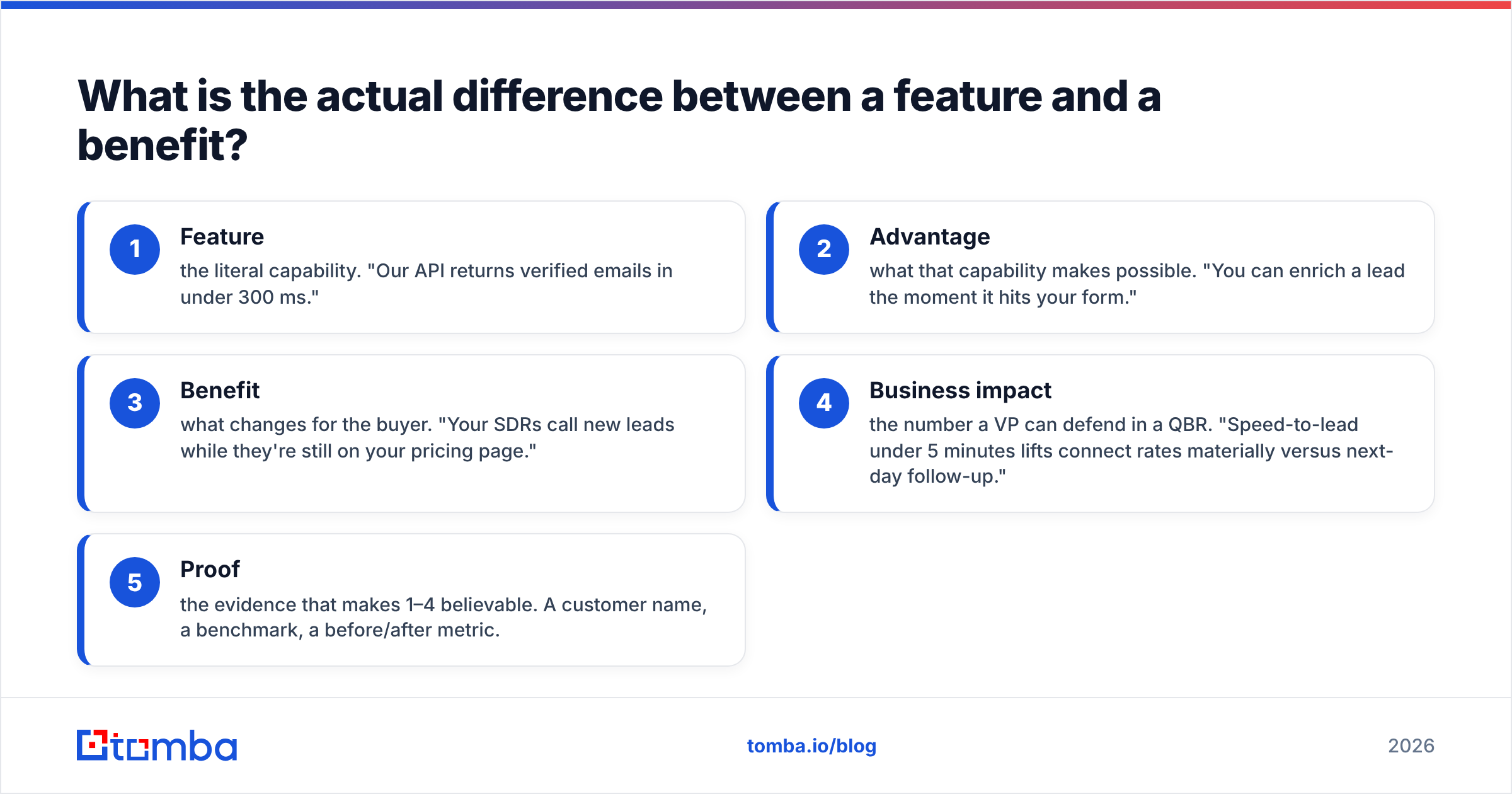
In B2B this gets muddier because the "shelf" is a business outcome that's two or three steps removed from the product. That distance is exactly where most reps give up and just list specs. Here's the ladder that closes the gap:
- Feature — the literal capability. "Our API returns verified emails in under 300 ms."
- Advantage — what that capability makes possible. "You can enrich a lead the moment it hits your form."
- Benefit — what changes for the buyer. "Your SDRs call new leads while they're still on your pricing page."
- Business impact — the number a VP can defend in a QBR. "Speed-to-lead under 5 minutes lifts connect rates materially versus next-day follow-up."
- Proof — the evidence that makes 1–4 believable. A customer name, a benchmark, a before/after metric.
Most sales copy stops at step one or two and hopes the buyer does the rest of the work. They won't. Harvard Business Review's research on the B2B buying process found that buyers are already drowning in information; the vendor who does the interpretation wins.
Why do features still dominate most sales conversations?#
Because features are easy and safe. You can read them off a spec sheet without knowing anything about the buyer. Benefits require you to know what the buyer is actually measured on — and that's homework.
There are four structural reasons feature-dumping persists:
- Product marketing writes the deck. Internal teams are proud of what they built, so the deck reflects engineering effort rather than buyer payoff.
- Reps fear being wrong. A feature is objectively true. A benefit is a claim, and claims can be challenged. Feature lists feel low-risk.
- Competitive pressure. When a competitor publishes a 40-row feature matrix, the instinct is to publish a 45-row one.
- No discovery data. You can't personalize a benefit for someone whose role, team size, or tech stack you never bothered to learn.
That last point is the practical bottleneck. A benefit statement is only as good as your understanding of the person receiving it. If you're emailing "Head of Growth" when the actual buyer is a RevOps lead, your beautifully crafted benefit lands on the wrong scoreboard.
How do you convert any feature into a benefit in under 60 seconds?#
Run the feature through four questions. Write the answers down — mental drafts don't count.
- What does this let the buyer do that they couldn't do before? This gets you the advantage.
- Who specifically cares? Name a title, not a department. "VP Sales" and "Sales Ops Manager" want different things.
- What does it save or make? Convert to hours, dollars, headcount, or risk avoided. If you can't, you have a nice-to-have, not a benefit.
- What breaks if they don't have it? The cost of inaction is the strongest version of a benefit, because loss aversion outperforms gain framing in nearly every study of buyer psychology.
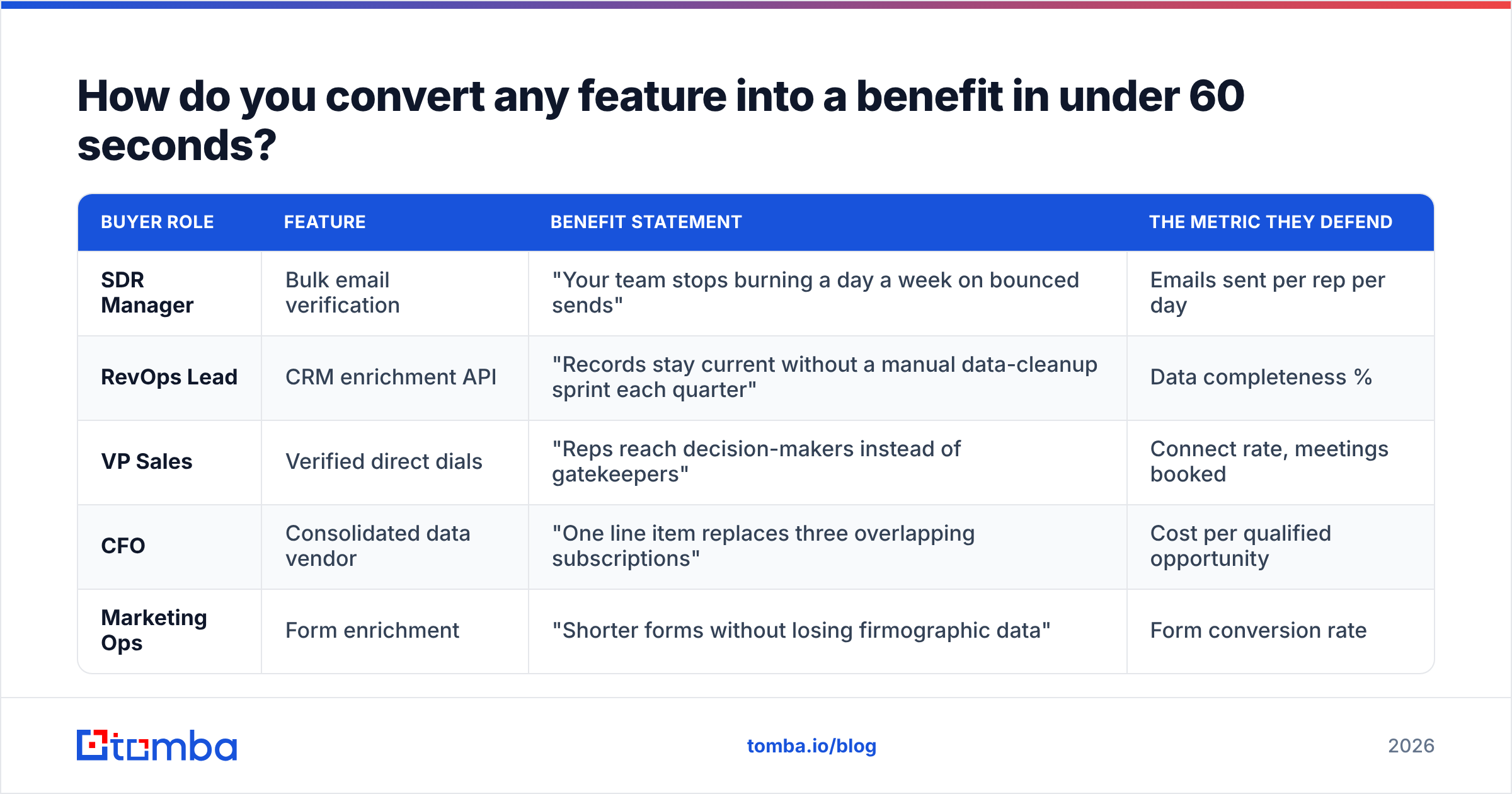
Here's the same feature run through the ladder for three different buyers:
| Buyer role | Feature | Benefit statement | The metric they defend |
|---|---|---|---|
| SDR Manager | Bulk email verification | "Your team stops burning a day a week on bounced sends" | Emails sent per rep per day |
| RevOps Lead | CRM enrichment API | "Records stay current without a manual data-cleanup sprint each quarter" | Data completeness % |
| VP Sales | Verified direct dials | "Reps reach decision-makers instead of gatekeepers" | Connect rate, meetings booked |
| CFO | Consolidated data vendor | "One line item replaces three overlapping subscriptions" | Cost per qualified opportunity |
| Marketing Ops | Form enrichment | "Shorter forms without losing firmographic data" | Form conversion rate |
Notice that the feature column barely changes. The benefit column changes completely. That's the entire discipline.
What does a benefit-led email actually look like?#
Below is a before/after on a real pattern you'll recognize immediately.
Before (feature-led):
Hi Sarah — Tomba is an email finding platform with domain search, catch-all verification, a REST API, Chrome extension, and Google Sheets integration. We have 15+ integrations and support bulk lookups. Would you be open to a 15-minute demo?
Everything there is true and nothing there is about Sarah.
After (benefit-led):
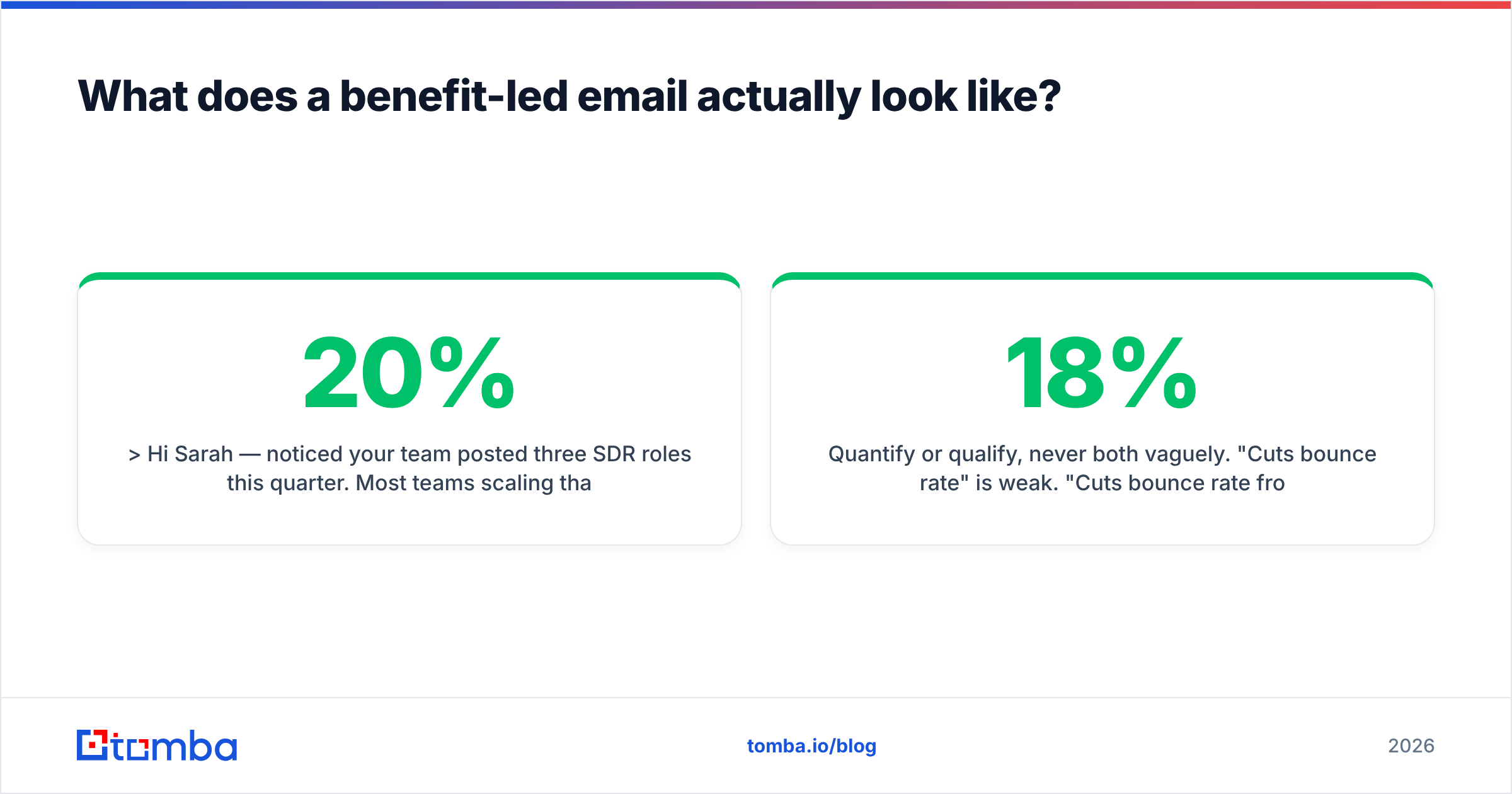
Hi Sarah — noticed your team posted three SDR roles this quarter. Most teams scaling that fast hit the same wall: new reps burn their first two weeks on lists that bounce at 15–20%.
We fix the list quality problem upstream, so a new rep's first sequence lands instead of bouncing. Worth 10 minutes to see whether your current bounce rate justifies it?
The second version names a trigger, names a cost, and names an outcome. It also earns the right to be specific because it's built on real data about her company — the kind of signal you get from a proper B2B database rather than a guess.
A few structural rules for benefit-led copy:
- Lead with their situation, not your product. The product should not appear in sentence one.
- One benefit per email. Three benefits read as zero benefits.
- Quantify or qualify, never both vaguely. "Cuts bounce rate" is weak. "Cuts bounce rate from 18% to under 3%" is a claim you can defend.
- End with a low-friction ask. The benefit earns attention; a heavy CTA spends it all at once.
If you want a starting point, the cold email templates library is a decent structural reference — but replace the benefit lines with your own, because generic benefits are just features wearing a hat.
How do you find the benefits your buyers actually care about?#
Stop guessing and go to four sources:
- Won-deal call recordings. Search for the moment the buyer said "oh, that's useful." That sentence is your benefit statement, in their words.
- Churned-customer exit notes. What they stopped getting is the clearest statement of what they were paying for.
- Public review sites. G2 and Capterra reviews are full of buyers explaining, unprompted, what problem your category solved for them. Mine the "What do you like best?" field.
- Job descriptions of your buyer's role. A job posting is a public list of what someone is measured on. If "reduce cost per lead" is bullet three, that's your benefit.
Source four is underrated and it scales. When you're prospecting, pairing role signals with verified contact data lets you write a benefit line that's right for that specific title. Tools that combine identification with verification — an email finder plus email verification in one workflow — remove the excuse of "I didn't know enough to personalize."
Where does benefit selling go wrong?#
Four failure modes, in order of how often they show up in real pipelines.
1. The generic benefit. "Save time and increase revenue." Every vendor in every category says this. Apply the swap test: if your closest competitor could put the sentence on their homepage without editing it, delete it.
2. The unearned number. "Increase conversions by 340%." Unsourced numbers now trigger skepticism rather than interest. A modest, sourced number outperforms a spectacular, unsourced one. If the figure came from one outlier customer, say so.
3. The wrong-altitude benefit. Pitching cost savings to a champion who's measured on speed. Pitching speed to a CFO who's measured on cost. Same product, wrong scoreboard — and this is almost always a data problem, not a copy problem. You didn't know the person's actual role.
4. Skipping the feature entirely. The overcorrection. Technical evaluators need the feature; they're the ones who have to confirm it's real. The fix is sequencing: benefit first, feature as the proof underneath it. "Reps reach decision-makers instead of gatekeepers — because we return verified direct dials, not switchboard numbers."
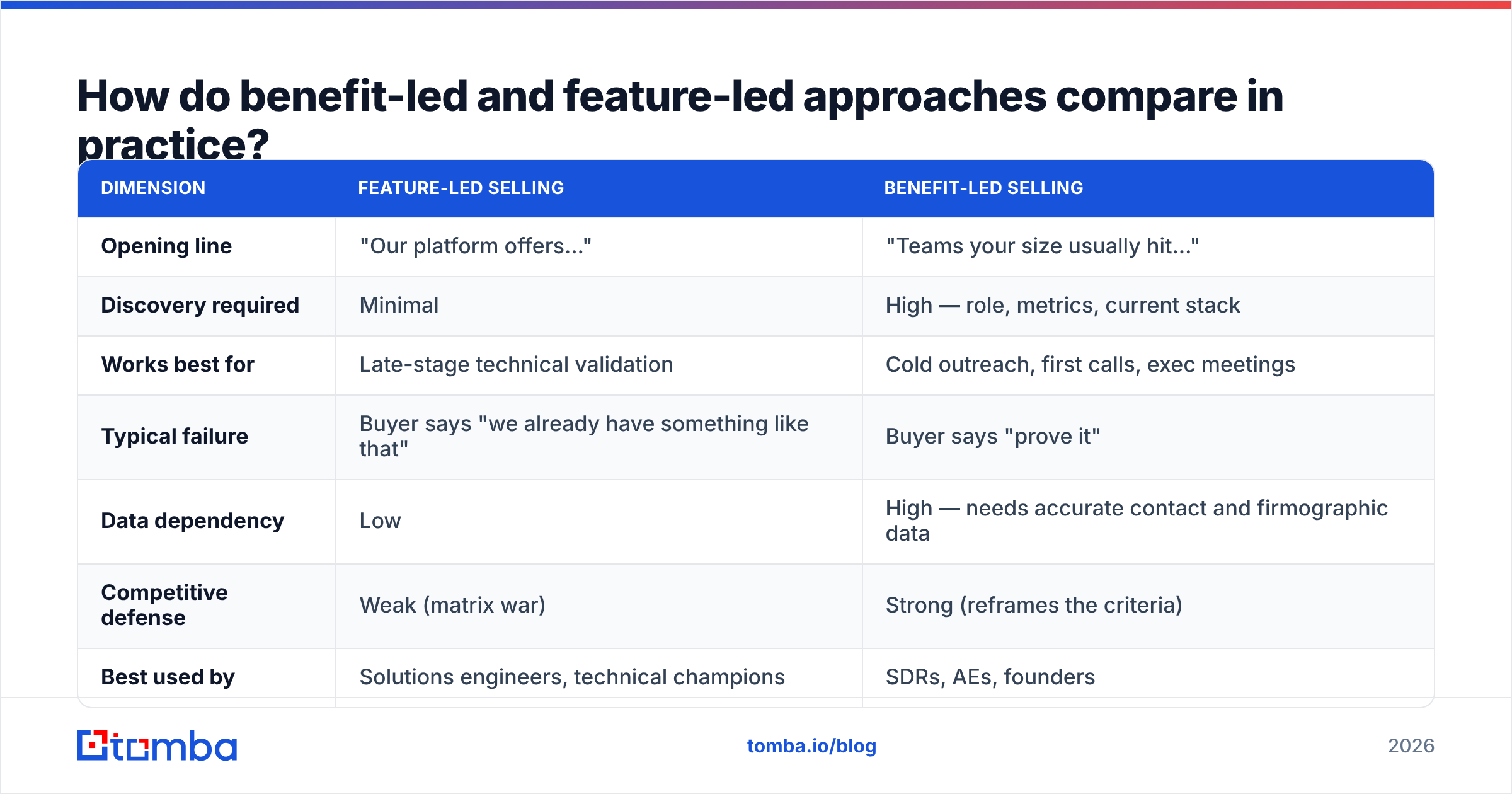
How do benefit-led and feature-led approaches compare in practice?#
| Dimension | Feature-led selling | Benefit-led selling |
|---|---|---|
| Opening line | "Our platform offers…" | "Teams your size usually hit…" |
| Discovery required | Minimal | High — role, metrics, current stack |
| Works best for | Late-stage technical validation | Cold outreach, first calls, exec meetings |
| Typical failure | Buyer says "we already have something like that" | Buyer says "prove it" |
| Data dependency | Low | High — needs accurate contact and firmographic data |
| Competitive defense | Weak (matrix war) | Strong (reframes the criteria) |
| Best used by | Solutions engineers, technical champions | SDRs, AEs, founders |
| Effort per message | Low | Medium (but templatable by persona) |
The honest read: you need both. Feature-led material belongs in documentation, comparison pages, and security reviews. Benefit-led material belongs in every message where you're competing for attention rather than for a checkbox.
How do you scale benefit-led messaging across a team?#
Personalization at one-to-one depth doesn't scale past about 20 emails a day per rep. The workaround is persona-level templating with a variable slot for the trigger.
Build a benefit matrix: rows are your top five features, columns are your top four buyer personas. Fill each cell with one benefit statement and one proof point. That's 20 pre-written, role-accurate benefit lines. Reps then pick the cell and add a single company-specific trigger — a funding round, a job posting, a new tool in their stack.
To make that work operationally you need three things:
- Accurate role data, so the persona column is right. Enrichment beats guessing from a LinkedIn headline.
- Verified deliverability, because a perfect benefit statement in a bounced email is worth nothing. Check your sender reputation before scaling volume.
- A trigger source — hiring pages, funding announcements, tech-stack changes.
Peers in the data space, including BookYourData, take a similar view: message quality and data quality are the same problem viewed from two ends. The best-written benefit line still fails if it reaches a stale contact at a company that no longer matches your ICP.
Track two metrics as you roll this out. Reply rate tells you whether the benefit resonated. Meeting-held rate tells you whether the benefit was true. A high reply rate with a low held rate means you wrote a promise the product doesn't keep — fix the claim, not the sequence.
What should you do in the next week?#
Concrete sequence, in order:
- Audit ten sent emails. Highlight every sentence about your product in one color and every sentence about the buyer in another. Count the ratio. Most teams find 80/20 the wrong way.
- Run your top three features through the five-step ladder. Write the output down. If step four has no number, go find one from a customer.
- Build the persona × feature matrix. Twenty cells, one afternoon.
- Clean the list you're sending to. A benefit-led rewrite on a bad list will underperform a feature dump on a good one.
- Ship and measure. Two-week window, reply rate and meeting-held rate side by side.
Step four is where most rewrites quietly fail. You can write the sharpest benefit statement in your category and still see flat results because a third of your list bounced or reached the wrong title. Before you rewrite anything, confirm that the people receiving it are real and correctly identified.
That's what Tomba Email Finder is for — finding verified professional email addresses by domain, name, or company so your benefit-led message reaches the person who actually owns the metric you're promising to move. The free tier gives you 25 searches a month to test the workflow, and paid plans start at $49/mo on Starter with Growth at $99/mo; full Tomba pricing is public. Fix the data, then fix the copy. In that order.
Related guides#
// get started
Find, verify and enrich your first contacts today
Start on the free plan with 25 searches a month, then scale when your team is ready.
Free plan · No credit card required · GDPR & CCPA
// about the author