How To Sell Consulting Services in 2026: A Practical Playbook
Most consultants lose deals before the first call — not during it. Here is the pipeline math, the outreach sequence, and the pricing model that actually convert consulting buyers in 2026.
TL;DR
- Consulting is sold on diagnosis, not deliverables. Buyers pay for a named problem with a number attached, not for "strategy support."
- Your pipeline math is brutal: at a 3% reply rate and a 25% close rate, you need roughly 400 verified contacts per closed $25K engagement. Data quality is the lever, not effort.
- Value-based pricing beats hourly on every axis except one — cash-flow predictability. A hybrid retainer plus outcome fee solves that.
- The highest-converting outreach for consulting is a 5-touch, 14-day sequence built on one specific observation about the prospect's business.
- Referrals still close fastest (40-60% win rates), but they don't scale. Build outbound as the floor and referrals as the ceiling.
Why is selling consulting services harder than selling software?#
Because you're selling a promise with no demo.
A SaaS buyer can start a trial, click around, and decide in 20 minutes. A consulting buyer is being asked to spend $25,000 to $250,000 on an outcome that doesn't exist yet, delivered by a person they met three weeks ago. The risk sits entirely on their side of the table, and it's career risk, not just budget risk.
That changes what "selling" means. In software you reduce friction. In consulting you reduce perceived risk. Every part of the sales process — your outreach, your discovery call, your proposal, your pricing — is either lowering that risk or raising it.
Three structural differences drive everything else:
- The buying committee is smaller but more senior. Most consulting deals under $100K are decided by one to three people, usually a VP or C-level owner of the problem. There's no procurement gauntlet on small engagements, which means one person's confidence is the whole sale.
- The sales cycle is front-loaded. By the time you send a proposal, the decision is largely made. Roughly 70% of the outcome is determined in discovery.
- You are the product. Buyers evaluate your judgment in the first ten minutes of conversation. Generic questions ("So, tell me about your goals") signal you've done no homework and instantly reprice you as a commodity.
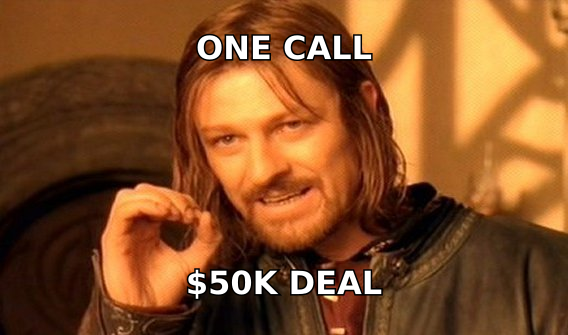
What does a consulting sales pipeline actually look like?#
Work backwards from revenue, not forwards from activity.
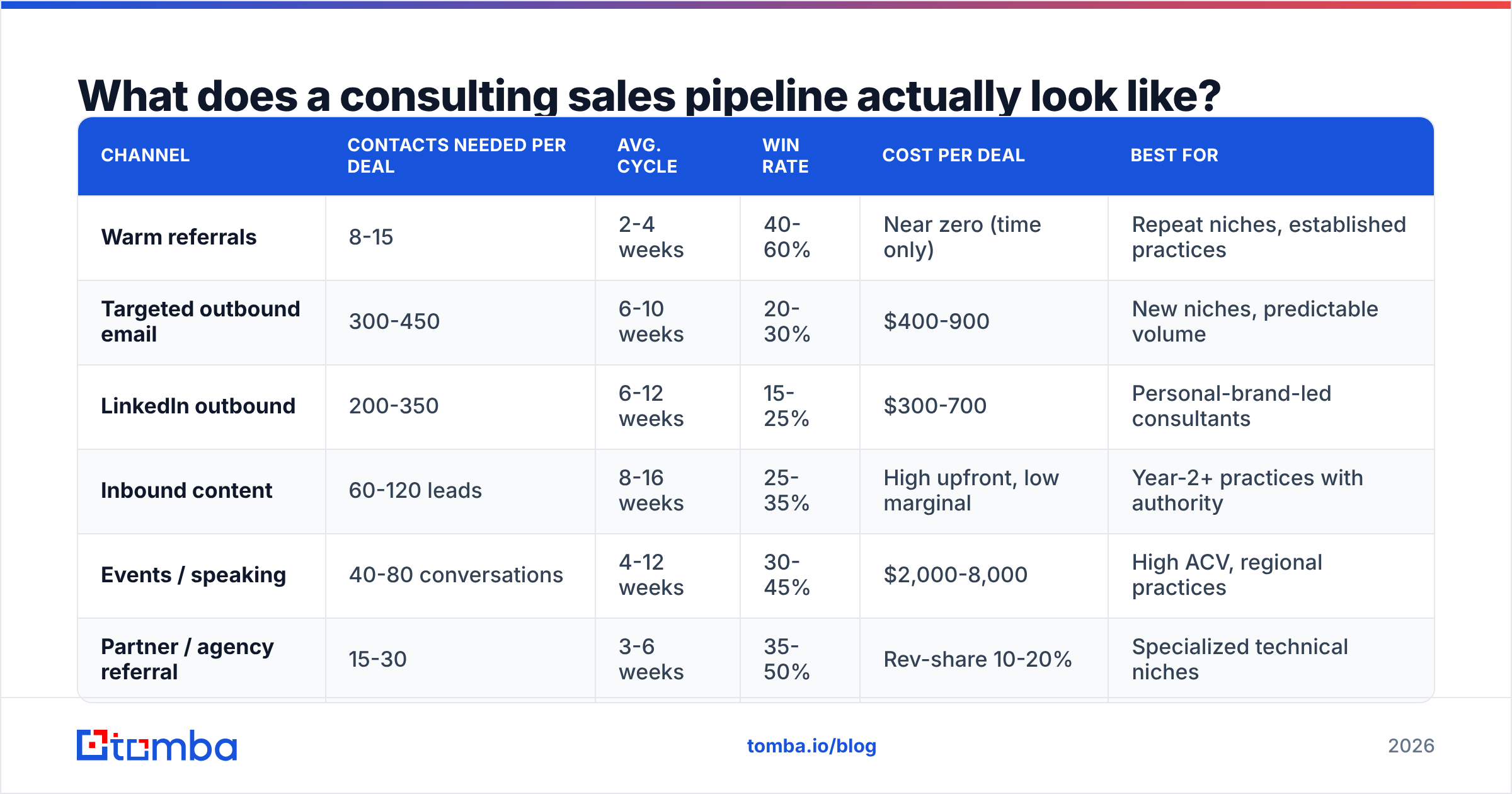
Say your target is $300,000 in new engagements this year, with an average deal size of $25,000. That's 12 engagements. Now apply realistic conversion rates by channel:
| Channel | Contacts needed per deal | Avg. cycle | Win rate | Cost per deal | Best for |
|---|---|---|---|---|---|
| Warm referrals | 8-15 | 2-4 weeks | 40-60% | Near zero (time only) | Repeat niches, established practices |
| Targeted outbound email | 300-450 | 6-10 weeks | 20-30% | $400-900 | New niches, predictable volume |
| LinkedIn outbound | 200-350 | 6-12 weeks | 15-25% | $300-700 | Personal-brand-led consultants |
| Inbound content | 60-120 leads | 8-16 weeks | 25-35% | High upfront, low marginal | Year-2+ practices with authority |
| Events / speaking | 40-80 conversations | 4-12 weeks | 30-45% | $2,000-8,000 | High ACV, regional practices |
| Partner / agency referral | 15-30 | 3-6 weeks | 35-50% | Rev-share 10-20% | Specialized technical niches |
The number that surprises most consultants is the outbound one. If you need 300-450 contacts to land one engagement, and you want 6 engagements from outbound, you need roughly 2,400 accurate contacts a year — about 200 a month. That is not a "send a few emails when things are slow" volume. It's a system.
And the word accurate is doing heavy lifting. A 25% bounce rate on that list doesn't just waste 25% of your sends — it damages your sending domain, which quietly suppresses the other 75%. Run every list through an email verifier before the first send, and check your sender reputation monthly.
How do you find and qualify the right consulting prospects?#
Narrow the definition until it hurts, then build the list.
The most common consulting sales failure is a target market defined as "B2B companies that need help with operations." That's not a market, it's a mood. A workable target definition has four locked variables:
- Industry vertical — "Series B fintech" not "financial services"
- Company size band — "80-400 employees" not "SMB to mid-market"
- Trigger event — new VP of Sales hired, funding round closed, expansion into a new region, a compliance deadline, a public earnings miss
- Named role — the person who owns the P&L for the problem, not the person who'd manage the project
The trigger event is what separates a prospect list from a phone book. A newly hired VP of Revenue Operations has 90 days to show a plan, a budget nobody has spent yet, and every incentive to bring in outside help. A VP who's been in seat for four years has a working system and no urgency.
Once you have the criteria, sourcing is mechanical. Pull target companies from a funding database or a hiring-signal feed, identify the named role, and resolve contact details. A domain search returns the email patterns and known contacts for a company in one query, which is far faster than guessing first.last@ and hoping. For LinkedIn-sourced lists, a LinkedIn finder closes the gap between a profile and a real inbox.
Then qualify hard before you spend a call. The BANT framework is dated; use this instead:
- Problem clarity — Can they name the problem in one sentence, with a number? If not, you're selling a diagnostic, not an engagement.
- Owned budget — Does your contact control discretionary spend at your price point, or do they need three signatures?
- Consequence of inaction — What happens if they do nothing for six months? If the answer is "nothing much," there's no deal.
- Prior consulting experience — Firms that have hired consultants before buy 2-3x faster. First-timers need an education cycle you should price for.
- Timeline anchor — Is there a board meeting, launch, audit, or fiscal deadline forcing a decision?
What is the highest-converting outreach sequence for consultants?#
Five touches over 14 days, each carrying one new piece of value.
The mistake is treating outreach as a persistence contest. Sending the same "just following up" message five times doesn't build credibility; it builds an unsubscribe. Each touch should give the prospect something they didn't have before.
Here's the structure that works for consulting-sized deals:
| Touch | Day | Channel | Content | Goal |
|---|---|---|---|---|
| 1 | Day 0 | One specific observation about their business + one question | Prove you did homework | |
| 2 | Day 3 | Connection request, no pitch, referencing the same observation | Face-to-name recognition | |
| 3 | Day 5 | A relevant result: "We took a similar team from X to Y in 90 days" | Establish proof | |
| 4 | Day 9 | A genuinely useful asset — a teardown, benchmark, or 1-page framework | Reciprocity | |
| 5 | Day 14 | Permission-to-close: "Should I stop reaching out?" | Force a binary reply |
Touch 5 is the highest-reply message in almost every sequence ever measured, and it's the one most consultants skip because it feels like giving up. It isn't. It converts silence into information.
On the first email specifically: the observation must be something a competitor couldn't have written. "I noticed you're hiring three enterprise AEs while your careers page still lists an SDR-led model" is an observation. "I noticed you're growing fast" is a mail merge. Twenty minutes of research per account is expensive at 200 accounts a month — which is exactly why you narrow the target list first, so the research compounds across near-identical companies.
Keep the mechanics clean: separate sending domain, warmed inbox, plain text, no tracking pixels on the first send, and a hard cap of about 30-40 sends per mailbox per day. If your email deliverability slips, none of the copy matters.

How should you run the discovery call?#
Diagnose out loud, and let them hear you think.
The single biggest lever in consulting sales is running discovery like a doctor, not a vendor. A doctor doesn't open with a list of procedures they offer. They ask targeted questions, narrow the possibilities, and name what they think is happening — before quoting anything.
A working 45-minute structure:
- Minutes 0-5 — Frame. "I've got 45 minutes. I want to understand what's actually happening, and by the end I'll tell you whether I think I can help or not. Both answers are fine."
- Minutes 5-25 — Diagnose. Ask about the current state, what they've already tried, and what broke. The most valuable question in consulting sales: "What have you already tried, and why didn't it stick?" The answer tells you the real constraint, which is almost never the stated problem.
- Minutes 25-35 — Quantify. Convert the problem into money. "If your sales cycle is 94 days and industry median for your segment is 61, what's the carrying cost of those 33 days across 40 deals?" Let them do the arithmetic out loud. It's their number now, not yours.
- Minutes 35-42 — Hypothesize. Say what you think is happening and how you'd approach it, at a high level. Yes, you're giving away thinking for free. That's the demo.
- Minutes 42-45 — Next step. Never end on "I'll send over a proposal." End on a scheduled 20-minute call to walk through the proposal together. Emailed proposals get compared; walked-through proposals get closed.
If the diagnosis reveals you're not the right fit, say so and refer them out. That single act generates more inbound than most content strategies.
Should you price hourly, fixed-fee, or value-based?#
Fixed-fee scoped to an outcome, with a hybrid retainer for anything ongoing.
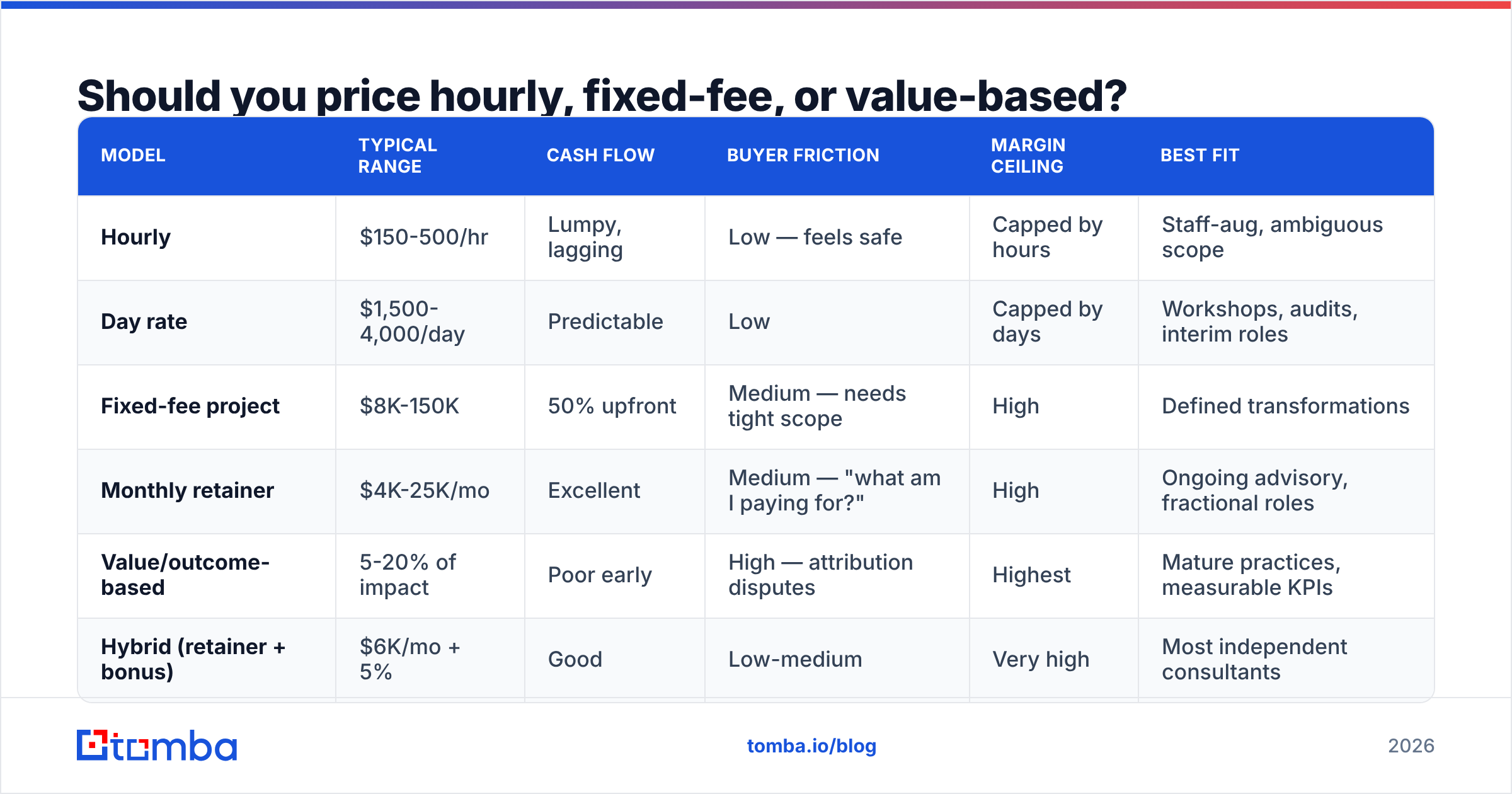
Hourly billing caps your income at your calendar and punishes you for getting faster. Worse, it invites the buyer to audit your time instead of your results. But pure value-based pricing ("10% of incremental revenue") introduces attribution fights and cash-flow gaps that kill small practices.
| Model | Typical range | Cash flow | Buyer friction | Margin ceiling | Best fit |
|---|---|---|---|---|---|
| Hourly | $150-500/hr | Lumpy, lagging | Low — feels safe | Capped by hours | Staff-aug, ambiguous scope |
| Day rate | $1,500-4,000/day | Predictable | Low | Capped by days | Workshops, audits, interim roles |
| Fixed-fee project | $8K-150K | 50% upfront | Medium — needs tight scope | High | Defined transformations |
| Monthly retainer | $4K-25K/mo | Excellent | Medium — "what am I paying for?" | High | Ongoing advisory, fractional roles |
| Value/outcome-based | 5-20% of impact | Poor early | High — attribution disputes | Highest | Mature practices, measurable KPIs |
| Hybrid (retainer + bonus) | $6K/mo + 5% | Good | Low-medium | Very high | Most independent consultants |
Three pricing mechanics that materially change close rates:
- Always present three options. A single price is a yes/no decision. Three options turns it into a "which one" decision. Anchor high: the top tier should feel slightly out of reach, the middle tier is what you expect to sell, and the bottom tier makes the middle look reasonable.
- Price the problem, not the hours. Open the proposal with the cost of the status quo you quantified in discovery. A $40,000 fee against a $600,000 problem is a rounding error; the same fee against an unnamed problem is an outrage.
- Never discount the price without cutting the scope. A discount signals the original number was fiction. Remove a deliverable instead.
What tools and stack do you actually need?#
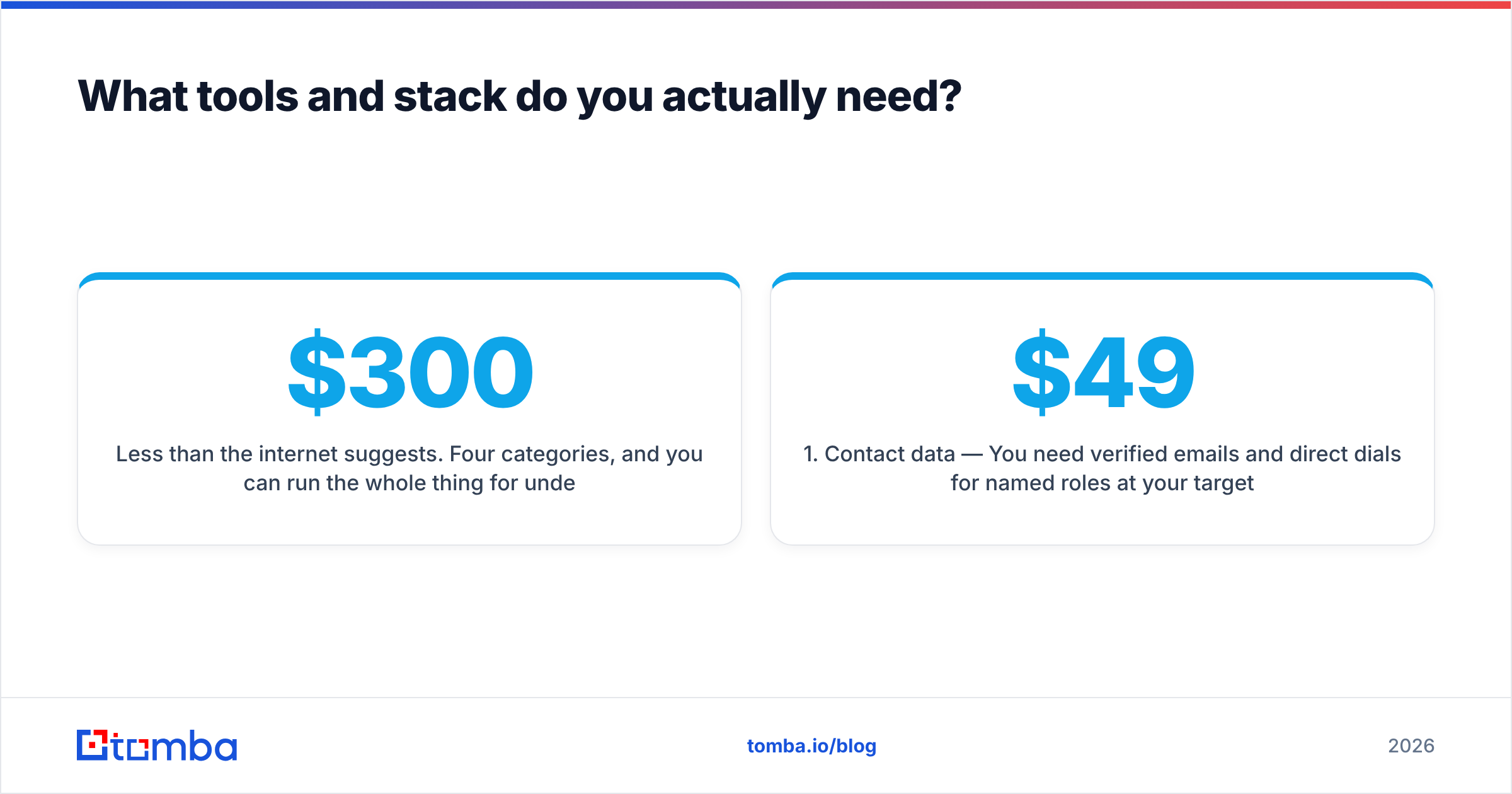
Less than the internet suggests. Four categories, and you can run the whole thing for under $300 a month.
- Contact data — You need verified emails and direct dials for named roles at your target accounts. This is the input to everything downstream; a bad list makes good copy irrelevant. Tomba's email finder starts free at 25 searches a month, with paid plans from $49/mo — see Tomba pricing for the Growth ($99/mo) and Pro ($249/mo) tiers if you're running higher volume.
- Sending infrastructure — A secondary domain, warmed mailboxes, and a sequencer. Keep daily volume low and personalization high; consulting outreach is a scalpel, not a firehose.
- CRM — Anything that tracks stage, next action, and date. HubSpot's free CRM is more than sufficient for a solo or small practice. What matters is that every open opportunity has a scheduled next step; deals die from neglect, not rejection.
- Proposal and e-signature — Reduce the gap between "yes" and "signed." Every day between verbal agreement and signature is a day for priorities to shift.
Skip, for now: intent-data platforms, ABM orchestration suites, AI SDR agents, and anything with a five-figure annual minimum. At consulting volumes, the ROI isn't there — a review of buyer feedback on G2's sales intelligence category shows the same pattern repeatedly: small teams over-buy platform and under-invest in list quality.
If you're enriching an existing list of companies or LinkedIn exports, bulk email finder workflows will process a spreadsheet in one pass rather than one lookup at a time.
How do you turn one engagement into three?#
Design the exit before you start.
Roughly 60-70% of a healthy consulting practice's revenue should come from existing and past clients. That doesn't happen by accident at the end of a project — it's engineered from week one.
- Scope a phase, not a project. "Phase 1: diagnostic and roadmap, 6 weeks" naturally implies Phase 2. "Complete sales transformation" implies an ending.
- Deliver a written artifact that outlives you. A playbook, a dashboard, an operating cadence document. It keeps your name in the room after you leave.
- Schedule the 90-day check-in inside the contract. Not as a sales call — as a service commitment. Half of them become renewals.
- Ask for the referral at peak value, not at the end. The moment a client says "this is exactly what we needed" is the moment to ask who else needs it. Waiting until the final invoice loses the emotional peak.
- Publish the anonymized result. "How a 200-person logistics firm cut quote turnaround from 6 days to 9 hours" is the single most effective marketing asset a consultant can produce, and it costs one afternoon.
One more thing worth measuring: your win rate by lead source. Most consultants discover that one channel produces 70% of closed revenue and 20% of their effort, and that they've been allocating time in exactly the wrong ratio. Track it for two quarters and reallocate.
Where should you start this week?#
Pick a single vertical, build a list of 100 companies inside it, identify one named decision-maker per company, verify the contact data, and run the 5-touch sequence. That's a two-week project that will teach you more about your market than six months of positioning debates.
The constraint most consultants hit isn't messaging — it's that they run out of qualified people to message. Fix the input first. Tomba's Email Finder resolves verified professional emails by name, company, or domain, starts free at 25 searches a month, and moves to $49/mo when you're ready to run the full 200-contacts-a-month cadence. Build the list, verify it, then go have the conversations that actually close.
Related guides#
// get started
Find, verify and enrich your first contacts today
Start on the free plan with 25 searches a month, then scale when your team is ready.
Free plan · No credit card required · GDPR & CCPA
// about the author