How to Sell CRM Software in 2026: A Rep's Playbook
Selling CRM software means selling change, not features. Here's the discovery, demo, pricing, and objection-handling playbook that actually closes CRM deals in 2026.
TL;DR
- CRM deals are won on migration risk and adoption, not feature checklists. The buyer's real fear is a $40k system nobody logs into.
- Run discovery against the current workflow, not the wish list. Ask where data goes today, who re-types it, and what breaks at month-end.
- The demo should show their pipeline stage names, not your generic sandbox. Ten minutes of setup doubles your close rate.
- Multi-threading is mandatory: CRM buys involve RevOps, a sales leader, IT/security, and finance. Single-threaded CRM deals stall at legal.
- Prospecting for CRM buyers is a data problem first — find the RevOps and sales-ops titles at companies showing switch signals, then verify before you send.
Selling CRM software is harder than selling almost any other SaaS category, and the reason is simple: you're not asking someone to add a tool. You're asking them to move their company's revenue memory from one place to another. Every rep who lost a CRM deal in the last quarter lost it to "we'll revisit next year," not to a competitor.
This is the playbook — prospecting, discovery, demo, pricing, objections, and close — for selling CRM software in 2026, when the market is mature, budget scrutiny is high, and your prospect has already used two CRMs they didn't like.
Why is CRM software so hard to sell?#
Because you're selling against inertia, and inertia is free.
A prospect on a bad CRM still has their contacts in it. Their reports run. Their reps have muscle memory. Switching means data migration, retraining, integration rework, and a two-month period where forecasting gets worse before it gets better. Your product has to be better than the incumbent plus the cost of that transition.
Three structural problems make CRM selling distinct:
- The buyer is not the user. A VP of Sales or RevOps lead signs the contract. Twenty account executives have to live in the thing daily. If the users hate it, the deal churns at renewal and your logo becomes a cautionary tale.
- The category is saturated and commoditized on paper. Salesforce, HubSpot, Pipedrive, Zoho, Close, Attio, and forty others all show contact records, pipelines, and dashboards on their feature pages. Nobody wins a spec sheet comparison.
- The switching cost is real, not imagined. Migration is genuinely painful. Pretending otherwise destroys your credibility in the first call.
The reps who consistently close CRM deals stop selling the CRM and start selling the transition. That reframe changes discovery, demo, and pricing all at once.

How do you find companies actually ready to switch CRMs?#
Look for the four switch signals, then build a targeted list rather than blasting every company with a sales team.
The signals that predict a CRM evaluation:
- New revenue leadership. A CRO, VP Sales, or Head of RevOps hired in the last 90 days will audit the stack. This is the single highest-converting trigger in the category.
- Funding round or a merger. New capital means headcount, and headcount means the spreadsheet-plus-Pipedrive setup breaks. Mergers mean two CRMs that must become one.
- Job postings mentioning a specific CRM. A company hiring a "Salesforce Administrator" is committed. A company hiring a "RevOps Manager — CRM migration experience preferred" is in market right now.
- Renewal timing. Annual CRM contracts renew on predictable anniversaries. If you know when they signed, you know when to be in the conversation — roughly 90 days before.
Once you have the account list, you need the humans. CRM decisions cluster in a narrow set of titles: Head of RevOps, VP Sales, Sales Operations Manager, CTO or Head of IT for security review, and a finance approver above a certain contract value. Use a domain search to pull the addresses at a target company, then run an email verifier pass before anything hits the sequence — bounce rates in the RevOps title band are high because these people change jobs often.
A practical note on data hygiene: CRM vendors bounce more than average because their prospects are the people who churn tools and titles. Verify at send time, not at list-build time. A contact scraped six weeks ago is materially less accurate than one checked this morning.
What should you ask in a CRM discovery call?#
Ask about the current workflow in concrete nouns, not about pain in abstract adjectives. "What are your biggest challenges?" gets you a rehearsed answer. "Walk me through what happens after a demo is booked" gets you the truth.
Here's the discovery structure that surfaces the real deal:
- Map the data path. Where does a lead enter today? Which system holds it? Who moves it to the next system, and by hand or by automation? Every manual hop is a line item in your business case.
- Find the shadow spreadsheet. Almost every company running a CRM they dislike has an off-system spreadsheet where the real forecast lives. Ask who maintains it and how long it takes each week. That number is your ROI anchor.
- Quantify the reporting gap. Ask what question their leadership asks that they can't answer in under an hour. Pipeline coverage by segment, win rate by source, stage conversion trends — the gap is usually one of these.
- Identify the adoption history. "What did reps say about the last rollout?" Their answer tells you whether you're selling into an organization that will train and enforce, or one that will buy and abandon.
- Get the migration inventory. How many contacts, how many custom fields, how many years of activity history, which integrations. Vague answers here mean the deal will slip; specific answers mean someone has already thought about leaving.
- Surface the political map. Who else has an opinion? Who blocked the last tool purchase? Who owns the budget line? If you can't name four people by the end of call one, you're single-threaded and the deal is fragile.
The mistake reps make is treating discovery as qualification only — checking BANT boxes and moving on. In CRM, discovery is the demo prep. Everything you learn here becomes the configuration you show in call two.
How do you demo CRM software without a feature dump?#
Configure the demo environment with their data before the call. This is the highest-leverage thirty minutes in the entire cycle and most reps skip it.
Concretely, before the demo you should have:
- Their actual pipeline stage names, not "Qualified / Proposal / Closed Won"
- Three to five real company names from their target market in the account list
- Their two or three custom fields that came up in discovery
- One report that answers the specific question they said they couldn't answer
Then structure the demo as a narrative, not a tour:
Open with the outcome. Show the report or dashboard that solves their stated gap. First ninety seconds. Not the login screen, not the nav bar, not "let me give you a quick overview of the platform."
Work backwards to the input. Once they want the output, show what has to go in to produce it — and show how little manual work that is. This is where automation and enrichment earn their keep. If your CRM auto-fills company data on record creation, that's the moment to show it.
Address the rep experience explicitly. Say out loud: "Here's what your AE sees on a Tuesday morning." Then show it. The economic buyer is quietly worried about adoption and will not raise it as an objection until it's too late to handle.
End on migration, not pricing. Close the demo by walking through how their data gets from the old system to yours, with a timeline. This preempts the objection that kills more CRM deals than cost.
Which CRM sales approach fits which deal size?#
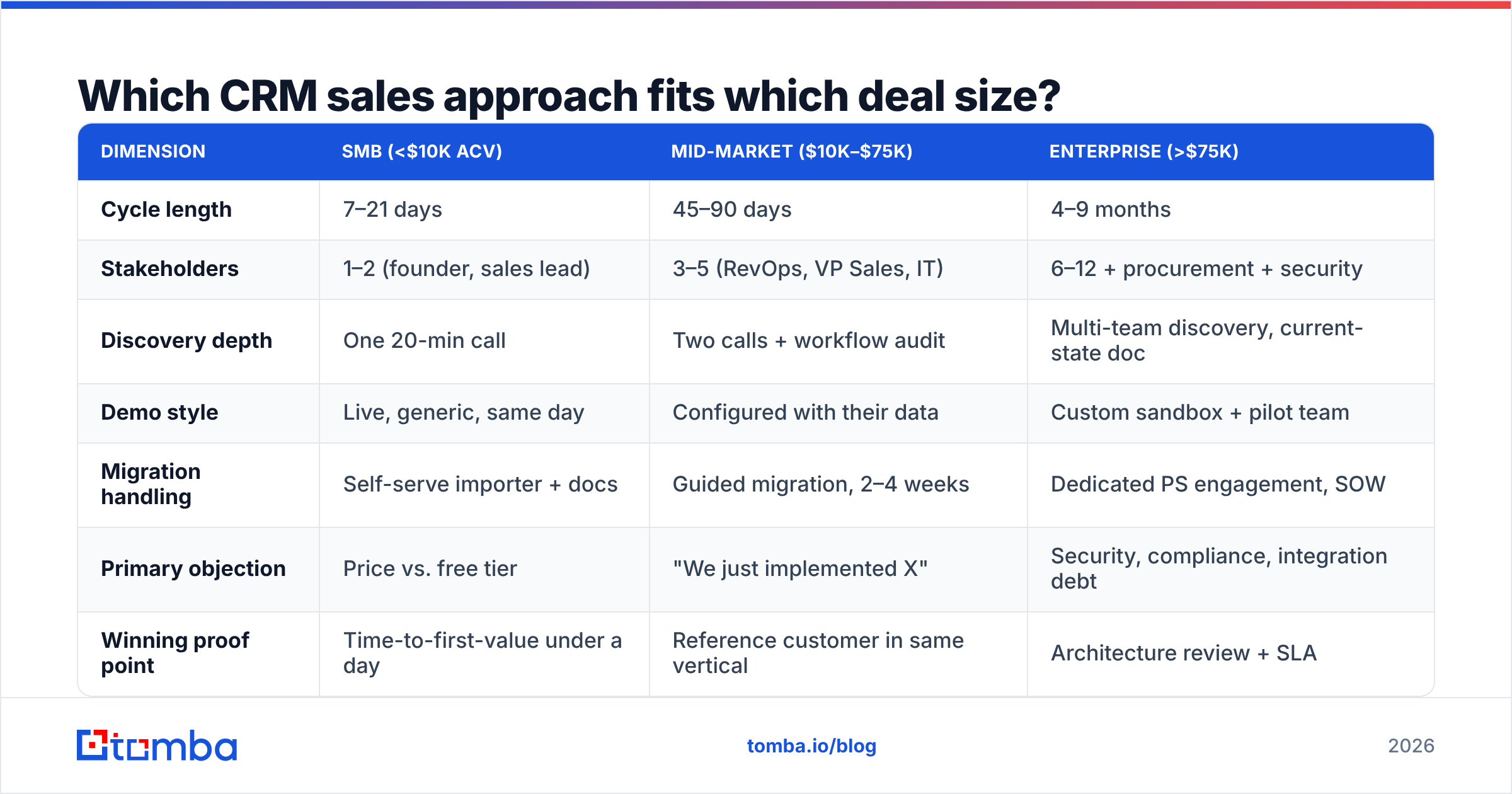
The motion has to match the contract value. Running an enterprise playbook on a $6k deal burns margin; running a self-serve motion on a $200k deal loses to a competitor who showed up in person.
| Dimension | SMB (<$10k ACV) | Mid-market ($10k–$75k) | Enterprise (>$75k) |
|---|---|---|---|
| Cycle length | 7–21 days | 45–90 days | 4–9 months |
| Stakeholders | 1–2 (founder, sales lead) | 3–5 (RevOps, VP Sales, IT) | 6–12 + procurement + security |
| Discovery depth | One 20-min call | Two calls + workflow audit | Multi-team discovery, current-state doc |
| Demo style | Live, generic, same day | Configured with their data | Custom sandbox + pilot team |
| Migration handling | Self-serve importer + docs | Guided migration, 2–4 weeks | Dedicated PS engagement, SOW |
| Primary objection | Price vs. free tier | "We just implemented X" | Security, compliance, integration debt |
| Winning proof point | Time-to-first-value under a day | Reference customer in same vertical | Architecture review + SLA |
| Who kills the deal | The founder's calendar | The IT admin nobody looped in | Procurement, at the last stage |
Read the table as a diagnostic. If you're running a 90-day cycle on a $9k deal, you've over-engineered the motion. If you're on call three of an enterprise deal and still haven't spoken to IT, you're going to lose in security review.
How do you handle the five objections that kill CRM deals?#
Every CRM objection is one of five things wearing a different hat. Handle them by naming the underlying fear, not by rebutting the surface statement.
"We just implemented [incumbent] eighteen months ago." The fear is sunk cost and career risk — someone championed that purchase. Don't attack the incumbent. Ask what they'd keep if they were rebuilding today, and what they'd change. If the "change" list is long, you have a deal. If it's short, you have a nurture contact and should say so honestly.
"Migration is going to be a nightmare." The fear is a six-week blackout in reporting. Answer with specifics: number of days, who does what, what runs in parallel, what the rollback looks like. A written migration plan attached to the proposal converts skeptics better than any discount.
"Our reps won't use it." The fear is a repeat of the last failed rollout. Offer a pilot with one team and a defined success metric — logged activities per rep per week, or pipeline data completeness. A four-week pilot on ten seats de-risks a hundred-seat decision.
"It's too expensive compared to [cheaper option]." The fear is overpaying for capacity they won't use. Reframe onto total cost: seats plus admin time plus the integrations they'd have to buy separately plus the data-quality tooling. Many "cheaper" CRMs cost more once you add the connectors.
"Send me some information and I'll circulate it internally." This is not an objection, it's a stall that means you haven't found the real decision-maker. Respond by offering to present to the group yourself. If they refuse, you're not in a deal.

How should you price and package a CRM deal?#
Anchor on the business outcome, present three tiers, and never lead with per-seat cost.
Per-seat pricing invites a headcount negotiation you cannot win — the buyer will always try to license fewer seats than they need, then complain about adoption. Instead:
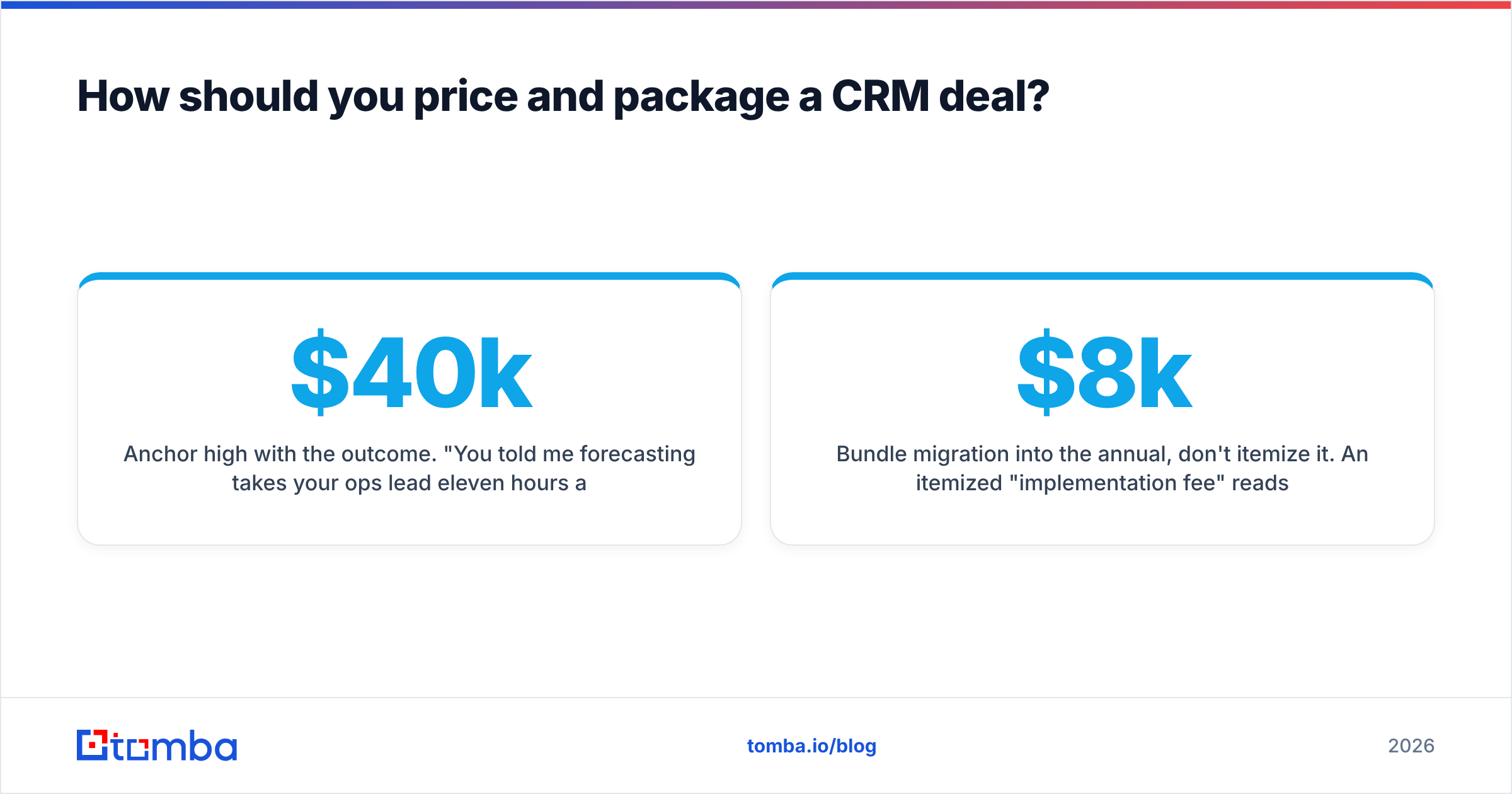
- Anchor high with the outcome. "You told me forecasting takes your ops lead eleven hours a week. At loaded cost that's roughly $40k a year of labor sitting inside a spreadsheet." Now your $30k contract is a saving.
- Present three tiers, recommend the middle. Classic, still effective. The top tier exists to make the middle look reasonable and to capture the occasional buyer who wants everything.
- Bundle migration into the annual, don't itemize it. An itemized $8k "implementation fee" reads as a penalty. The same money inside a first-year rate reads as a rate.
- Trade discount for commitment, always. Multi-year, case study rights, a reference call, or a faster close date. Free discounts train the buyer to negotiate at every renewal.
- Give procurement something to win. Enterprise procurement teams are measured on concessions extracted. Hold back one small, pre-planned item — payment terms, an extra sandbox, added training hours — to concede at the end.
For benchmarking how mature vendors structure tiers, HubSpot's public pricing page and Salesforce's editions comparison are worth studying — both use the three-tier anchor structure and both bury per-seat detail below the outcome messaging. Peer review signals on G2's CRM category will also tell you which objections your competitors are getting hit with in the wild.
What does a repeatable CRM sales process look like?#
Below is the stage model that holds up across most CRM vendors. Each stage has an exit criterion — a fact you must have, not a feeling.
| Stage | Exit criterion | Typical duration | Common failure |
|---|---|---|---|
| 1. Target & reach | Verified contact at RevOps or VP Sales title responds | Ongoing | Sending to unverified, stale addresses |
| 2. Discovery | Current-state workflow documented + 4 stakeholders named | 1–2 calls | Asking about pain instead of process |
| 3. Configured demo | Prospect confirms the shown report answers their gap | 1 call | Generic sandbox tour |
| 4. Technical validation | IT/security sign-off on integrations and data residency | 1–3 weeks | Looping IT in too late |
| 5. Business case | Written ROI doc circulated internally by the champion | 1–2 weeks | Champion has no internal document to forward |
| 6. Proposal & pricing | Three tiers presented, migration plan attached | 3–7 days | Itemized implementation fee |
| 7. Procurement & close | Signed order form, kickoff date booked | 1–6 weeks | No pre-planned concession to trade |
Track your win rate by stage-entered, not by stage-exited, and you'll find the leak fast. In most CRM sales teams the leak is between stage 3 and stage 4 — the demo went well, everyone was excited, and then IT asked a question nobody had prepared for.
How do you keep the pipeline full while running long CRM cycles?#
Long cycles mean you need consistent top-of-funnel volume, and volume in this category depends entirely on contact data quality.
Practical mechanics that work for CRM vendors specifically:
- Build lists from job-change and hiring signals, not static firmographics. A company that hired a RevOps lead last month is worth ten companies that merely match your ICP size band.
- Multi-thread from the first touch. Reach the RevOps lead and the VP Sales in the same week with different angles. CRM buying committees talk to each other; parallel outreach reads as thoroughness, not spam.
- Verify before every send. Titles in this space churn fast. Running the list through an email verifier before each wave protects your sender reputation and your email deliverability.
- Enrich the accounts you already have. If your own CRM has stale records, data enrichment will resurface contacts who have moved into buying roles at new companies — often your warmest available prospects.
- Batch it. For a quarterly list refresh, a bulk email finder run against your target account list is faster than manual lookups and produces a cleaner starting file.
One honest caveat: no amount of prospecting tooling fixes a weak business case. If your CRM genuinely isn't differentiated for the segment you're targeting, better data just gets you to "no" faster. Use the volume to test messaging and segment fit, then double down where the reply rate is real.
Where should you start this week?#
Pick your ten highest-signal accounts — new revenue leadership, recent funding, or a CRM-specific job posting — and build a complete contact map for each: RevOps, VP Sales, IT, finance. Verify every address. Then write one message per persona, not one message for all four.
That's the whole thing. CRM software sells when you find companies already feeling the pain, talk to enough people that the deal survives one person's vacation, show them their own data in your product, and make the migration feel boring instead of terrifying.
To build the contact map without spending your morning on LinkedIn, start with the Tomba Email Finder — search by domain or by name to pull verified professional addresses for the RevOps and sales-leadership titles that decide CRM purchases. The free tier gives you 25 searches a month to test the workflow, and paid plans start at $49/mo on the Starter tier if you want to run a full quarterly prospecting cycle. Check Tomba pricing for the Growth ($99/mo) and Pro ($249/mo) tiers if you're running list builds for a whole team.
Related guides#
// get started
Find, verify and enrich your first contacts today
Start on the free plan with 25 searches a month, then scale when your team is ready.
Free plan · No credit card required · GDPR & CCPA
// about the author