How To Sell High Ticket Products: A 2026 Playbook
High-ticket deals are not small deals with a bigger number on the invoice. Here is the outreach, qualification, and proof sequence that actually closes $25K+ contracts in 2026.
TL;DR
- High-ticket selling fails on targeting and access, not on closing technique. Fix the top of the funnel before you touch your objection scripts.
- A $25K+ deal averages 6–10 stakeholders. If you're single-threaded into one champion, your forecast is fiction.
- Cut your prospect list by 80%. Twenty accounts researched properly beat 500 accounts blasted with the same template.
- Price on outcome, not effort. Anchor to the cost of the problem, then present three tiers so the buyer chooses how much, not whether.
- Proof beats persuasion: security docs, reference calls, and a pilot with exit criteria are what move procurement.
What Counts As A High Ticket Product?#
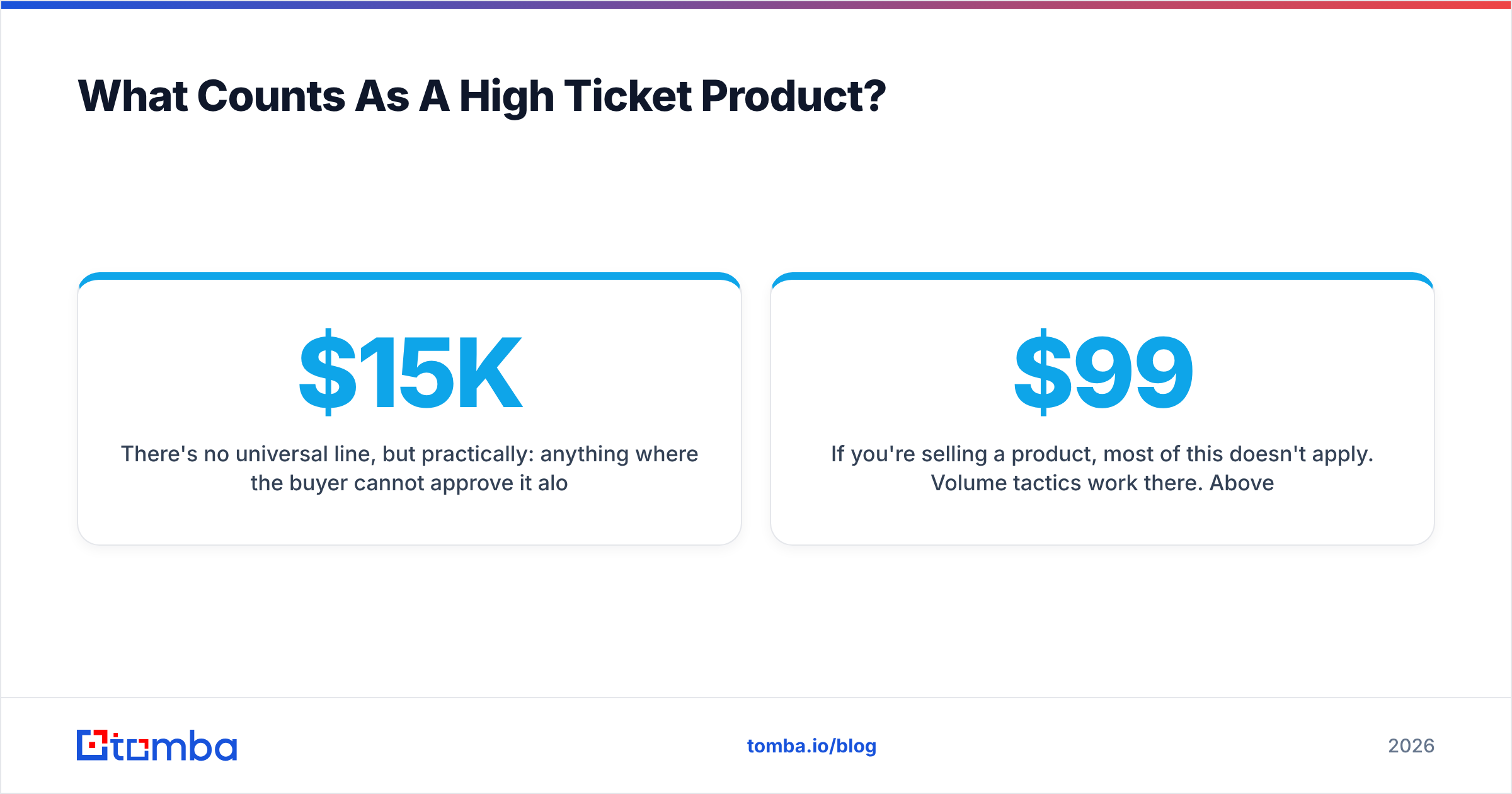
There's no universal line, but practically: anything where the buyer cannot approve it alone. In B2B software that's usually $15K–$25K annual contract value and up. In services it's often $10K+ per engagement. In equipment or consulting it can be six figures.
The dollar amount matters less than the consequence. Once a purchase requires a second signature, four things change at once:
- The buying committee expands. Gartner's research on B2B buying consistently finds 6–10 decision-makers involved in complex purchases, each with their own information sources. You are now selling to a group that never meets together.
- The timeline stretches. Three-to-nine month cycles are normal. Deals die from stalled momentum far more often than from a competitor.
- Risk becomes the real objection. Nobody gets fired for not buying. They get fired for buying wrong. Your job shifts from proving value to de-risking a decision.
- Procurement and security enter late and hard. A SOC 2 questionnaire arriving in week ten can add six weeks if you weren't ready.
If you're selling a $99/month product, most of this doesn't apply. Volume tactics work there. Above the approval threshold, volume tactics actively hurt you — a generic sequence signals you didn't do the work, and a buyer spending $60K notices immediately.
Why Do High Ticket Deals Actually Fail?#
Reps blame pricing. The data rarely agrees. Most lost high-ticket deals trace back to one of these:
- Wrong account, right pitch. The company doesn't have the budget cycle, the headcount, or the pain at the scale your product solves. No amount of follow-up fixes a bad fit.
- Single-threaded. Your champion left, got reassigned, or was never as senior as their title suggested. The deal evaporates with them.
- No quantified problem. "It'll make you more efficient" doesn't survive a CFO review. "You're losing $340K a year in rep ramp time" does.
- Momentum decay. Two weeks between touches on a 90-day cycle means the buyer forgets the pain you surfaced.
- Bad contact data. You had the right account and pitched the wrong person, or your email bounced and you never knew.
That last one is unglamorous and enormous. If your outreach to a VP bounces, you don't get a signal — you get silence that looks identical to disinterest. Running your target list through an email verifier before a high-ticket sequence is a five-minute step that protects the other ninety days of work.
How Do You Build A High Ticket Target List?#
Start narrow and go deep. The instinct to widen the net is the single most expensive mistake in high-ticket outbound.
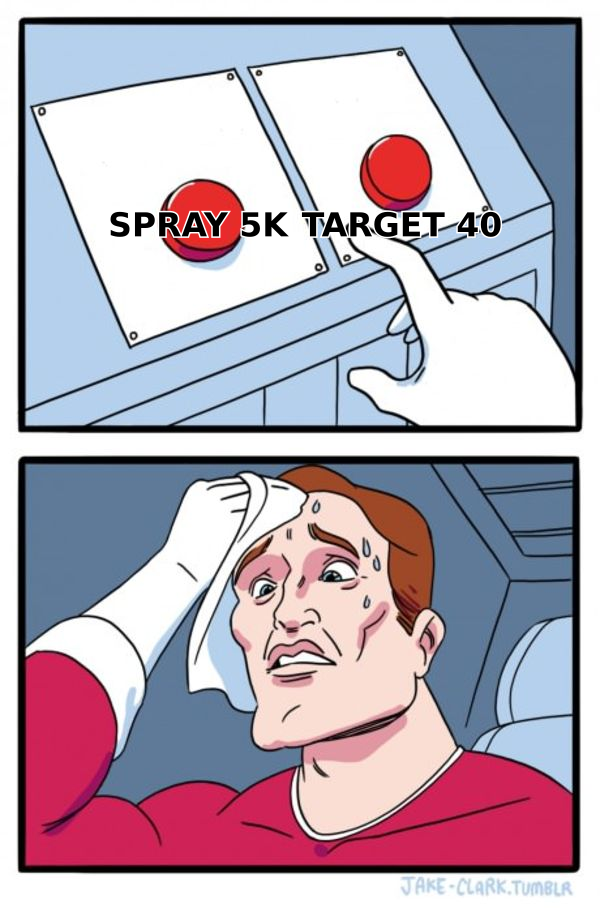
The 40-account rule. One rep working $25K+ deals can meaningfully research and multi-thread roughly 30–50 accounts per quarter. Anything beyond that becomes template spraying, which converts at rates that make the whole motion unprofitable.
Build your list in this order:
- Define the trigger, not the persona. "VP Sales at 200–500 employee SaaS" is a persona. "VP Sales who just posted three SDR roles and switched CRMs in the last 90 days" is a trigger. Triggers convert 3–5x better because they carry timing.
- Score against your closed-won profile. Pull your last 20 wins. What did they share — industry, headcount band, tech stack, funding stage, geography? That's your ICP, not the one in the deck from 2023.
- Map the committee before you write anything. For each account, identify the economic buyer, the technical evaluator, the end-user champion, and the likely blocker (usually security, legal, or a competing internal project).
- Source contacts for all four roles. Not just the champion. You'll need the others by week six anyway. A domain search pulls every discoverable address at a company at once, which is faster than hunting one title at a time.
- Verify before you send. A 4% bounce rate on a 40-account list is only two contacts — but at $25K each, those two contacts are $50K of pipeline you never knew existed.
- Enrich with context. Recent funding, leadership changes, job postings, product launches, earnings-call language. This is what makes the first email land as research rather than a mail merge.
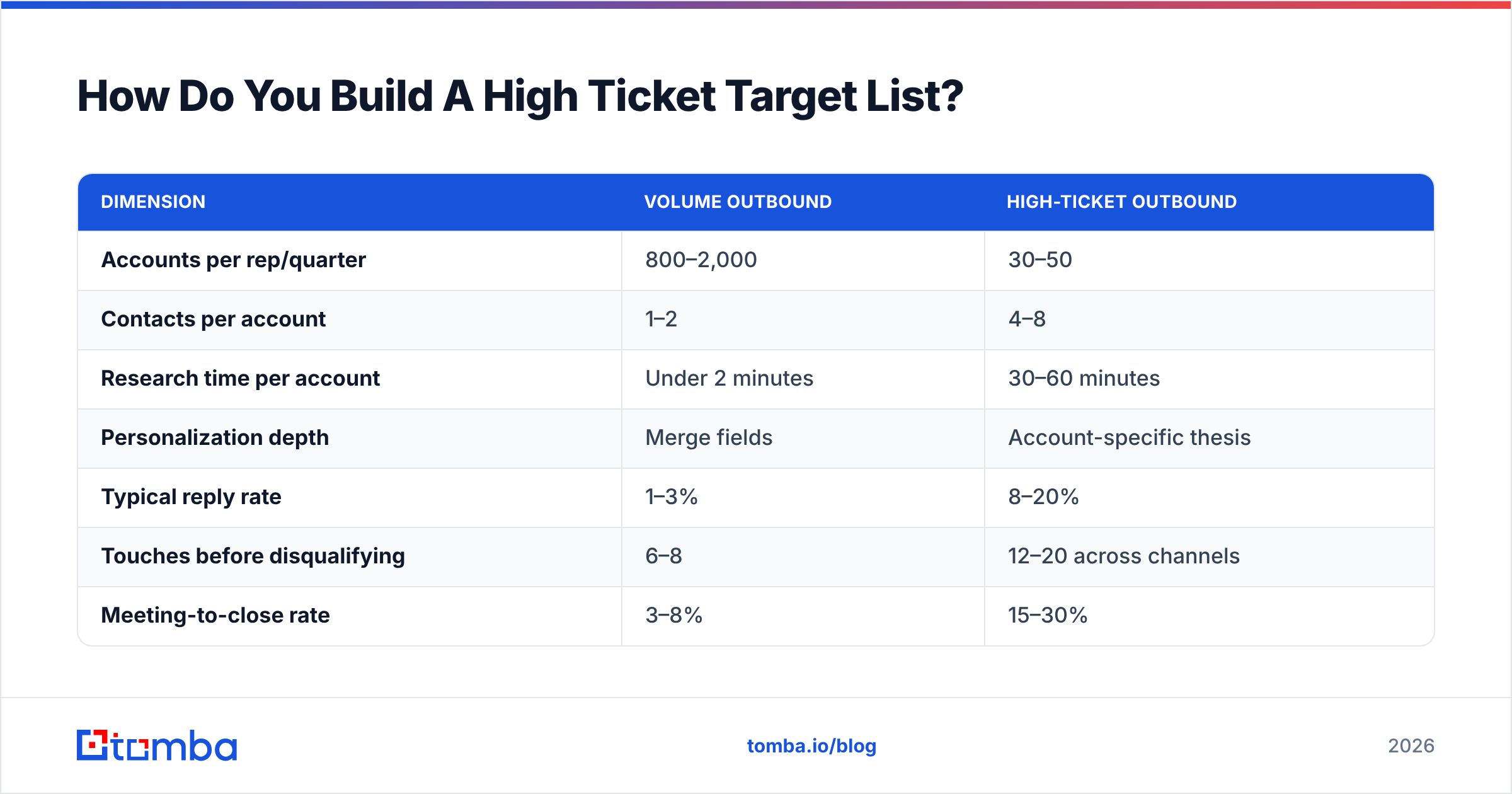
Here's how the two motions compare in practice:
| Dimension | Volume Outbound | High-Ticket Outbound |
|---|---|---|
| Accounts per rep/quarter | 800–2,000 | 30–50 |
| Contacts per account | 1–2 | 4–8 |
| Research time per account | Under 2 minutes | 30–60 minutes |
| Personalization depth | Merge fields | Account-specific thesis |
| Typical reply rate | 1–3% | 8–20% |
| Touches before disqualifying | 6–8 | 12–20 across channels |
| Meeting-to-close rate | 3–8% | 15–30% |
| Data accuracy requirement | Tolerable at 80% | Must exceed 95% |
The right column costs more per contact and returns dramatically more per account. That trade only works if the account selection is right, which is why step one is not optional.
What Should The First Touch Actually Say?#
Three sentences, one idea, no pitch.
The structure that works on senior buyers:
Observation → Implication → Ask. You noticed something specific and verifiable about their business. You state what it likely costs them, framed as a hypothesis rather than a claim. You ask a low-commitment question.
Bad: "Hi {{FirstName}}, I wanted to reach out about how our platform helps sales teams increase productivity by 40%."
Better: "Saw you opened three enterprise AE roles in Chicago last month. Teams that scale enterprise headcount that fast usually hit a ramp problem around month four — new reps can't source their own pipeline yet. Is that on your radar for Q1, or already handled?"
The second version does three things: it proves research, it names a specific failure mode the buyer recognizes, and it gives them an easy out. Senior buyers respond to being understood far more than to being impressed.
A few rules that hold up at this deal size:
- No calendar links in email one. It signals you value your time over theirs.
- Under 90 words. Executives read on phones between meetings.
- One question, not three. Multiple questions produce zero answers.
- Never attach a deck. It's a request for 20 minutes of unpaid work.
- Sequence across channels. Email, LinkedIn, and phone together beat any one channel by roughly 2x. Real phone numbers matter here — a phone finder that returns direct dials rather than switchboard numbers is the difference between a conversation and a voicemail maze.
Vary the angle across touches rather than repeating the same message louder. Touch one: the trigger. Touch three: a customer story from their industry. Touch five: a piece of research or benchmark data with no ask attached. Touch eight: a genuine breakup note, which converts surprisingly often.
How Do You Qualify Without Killing The Deal?#
Qualification at this deal size is not a checklist you run in discovery call one. It's continuous, and the buyer should never feel interrogated.
Four things you must establish before you build a proposal:
- Quantified pain. Not "we struggle with X" but "X costs us roughly $Y per quarter." Get the buyer to say the number. If they can't, help them build it — but the number must be theirs, or it won't survive the CFO.
- Funding path. Not "do you have budget" (they'll say no reflexively) but "when something like this gets approved here, who signs and what does the process look like?" This question is factual, easy to answer, and tells you everything.
- Decision timeline with a forcing event. A contract renewal, a compliance deadline, a board commitment, a product launch. Deals without a forcing event slip indefinitely regardless of enthusiasm.
- Committee map with named humans. You should be able to name every person who touches this decision by the end of call two, and have spoken to at least two of them by call four.
If any of those four are missing after three conversations, you have an interested contact, not a deal. Treat it accordingly in your forecast — inflated pipeline at high ACV distorts everything downstream in your revenue operations reporting.
How Do You Multi-Thread Without Going Behind Your Champion's Back?#
Ask permission and make it their idea.
The line that works: "For a decision this size, I've found the projects that go smoothly are the ones where the security and finance folks see it early rather than in week ten. Who should I be looping in, and would it help if I sent you something you could forward?"
You've done three things — flagged a real risk, positioned yourself as experienced, and handed your champion something useful. Champions want to look good internally. Give them the material to do it.
Practical multi-threading moves:
- Send forwardable assets. A one-page business case your champion can paste into an internal thread beats a 40-slide deck they'll never share.
- Get the security questionnaire early. Ask for it in week two, not week ten. If you have a SOC 2 report and a standard DPA ready, say so unprompted — it removes a common stall.
- Offer a reference call, don't wait to be asked. Match the reference by role, not just industry. Your champion's CFO wants to talk to a CFO.
- Meet the blocker directly. The skeptical technical lead who tears your product apart is the most valuable person in the deal. Win them and the deal is nearly closed. Ignore them and they'll kill it after you've left the room.
Track this systematically. Most CRMs let you record contact roles on an opportunity; if yours does and nobody fills it in, that's a process problem, not a tooling problem. Connect your enrichment directly — a HubSpot integration that populates new committee contacts automatically means the map stays current without manual data entry.
How Should You Price And Present A High Ticket Offer?#
Anchor to the cost of the problem, then give them a choice of three.
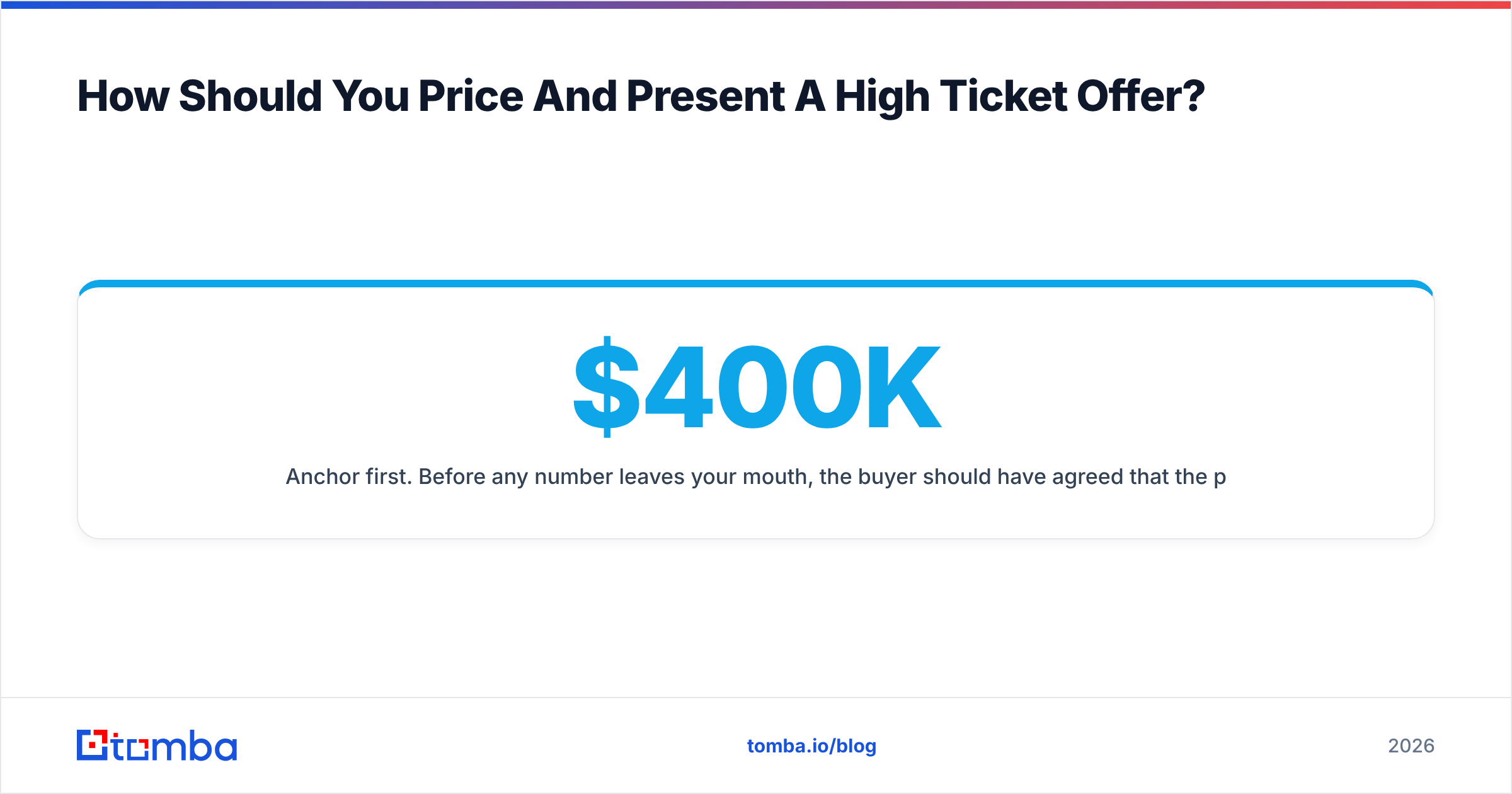
Anchor first. Before any number leaves your mouth, the buyer should have agreed that the problem costs them a specific amount. If inefficient prospecting costs them $400K a year in wasted rep time, a $60K solution is an obvious trade. Present the same $60K without the anchor and it's just an expense.
Three tiers, always. Buyers presented with a single price evaluate yes-or-no. Buyers presented with three options evaluate which-one. Make the middle tier the one you want them to pick, price the top tier high enough to make the middle look reasonable, and make the bottom tier genuinely viable but visibly limited.
Never discount without a trade. Every unearned discount teaches the buyer your prices are fiction and invites another round. If you must move on price, take something in exchange: a longer term, a case study, an upfront payment, a reference commitment, a faster close date.
Handle "it's too expensive" by finding out which one it is. That sentence means one of three things: (a) I don't see the value, (b) I don't have the authority, or (c) I'm comparing you to something cheaper. Each needs a different response, and guessing wrong loses the deal. Ask: "Is it expensive relative to the problem, or relative to another option you're considering?"
Offer a paid pilot with written exit criteria. For genuinely large deals, a 60-to-90-day paid pilot with an agreed success metric converts far better than a free trial. Free trials signal low confidence; a paid pilot with defined outcomes signals you expect to win. Write the exit criteria down and make expansion automatic if they're met.
What Tools Do You Actually Need?#
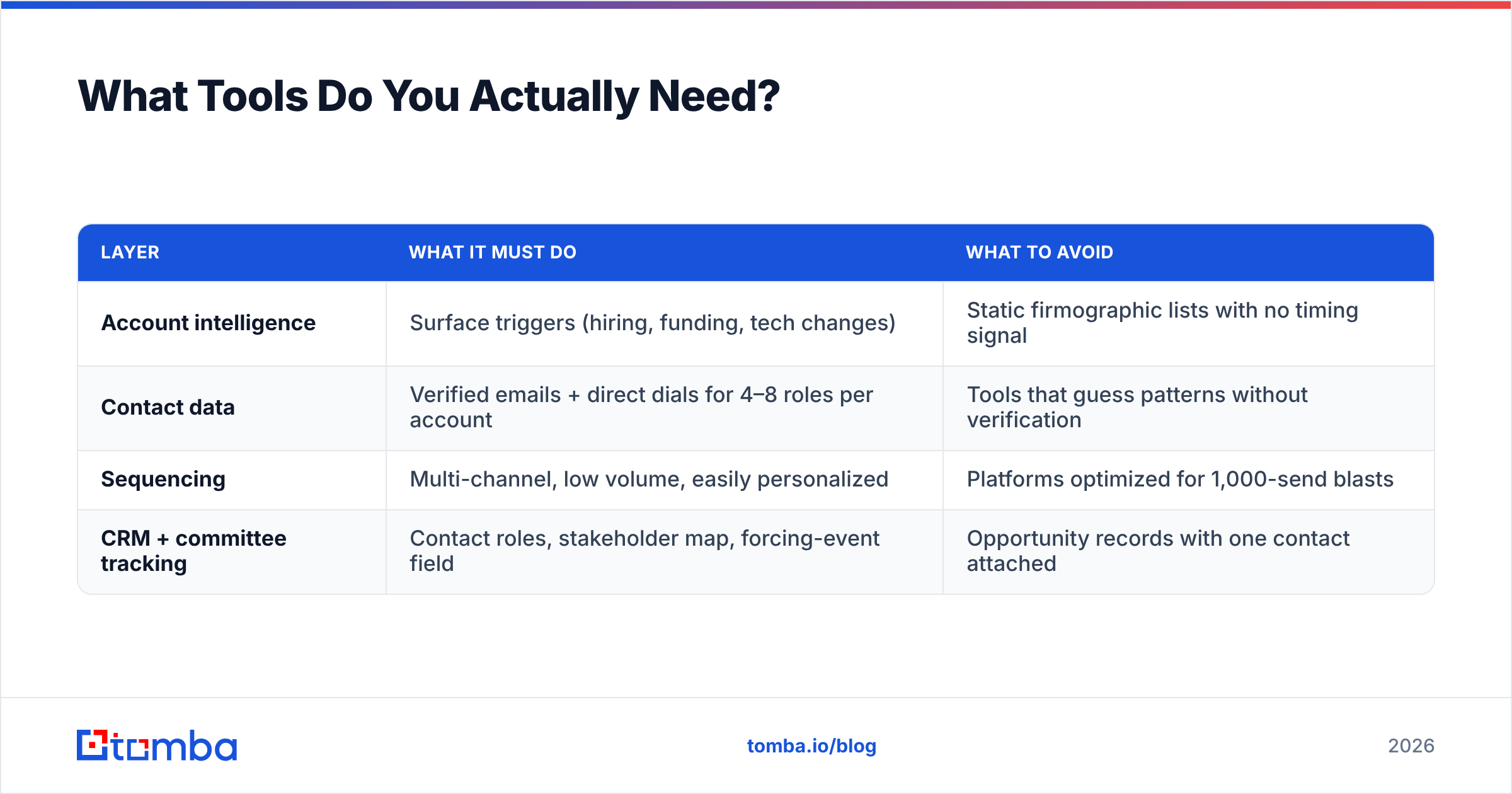
Fewer than vendors want you to believe. The stack for high-ticket outbound has four jobs: find the right accounts, get accurate contact data for the whole committee, sequence multi-channel touches, and track the committee in your CRM.
| Layer | What it must do | What to avoid |
|---|---|---|
| Account intelligence | Surface triggers (hiring, funding, tech changes) | Static firmographic lists with no timing signal |
| Contact data | Verified emails + direct dials for 4–8 roles per account | Tools that guess patterns without verification |
| Sequencing | Multi-channel, low volume, easily personalized | Platforms optimized for 1,000-send blasts |
| CRM + committee tracking | Contact roles, stakeholder map, forcing-event field | Opportunity records with one contact attached |
On the contact-data layer specifically, accuracy is the whole game at this deal size. Sending 40 emails where two bounce is a 5% loss on a list where each contact is worth thousands. Tools like Tomba, Hunter, and BookYourData all approach this differently — Tomba and Hunter build from crawled and verified public sources with per-lookup verification, while BookYourData sells pre-verified list access with a bounce guarantee, which suits teams who want the list handed to them rather than sourced query by query. Both models work; pick based on whether your motion is account-by-account research or bulk list acquisition.
Check Tomba pricing against your actual volume before committing. High-ticket teams typically need far fewer credits than volume teams — the Starter plan at $49/mo covers most single-rep high-ticket motions, and the free tier's 25 searches per month is enough to test data quality on your real accounts before paying anything. Compare against G2 reviews for the category rather than trusting any vendor's own comparison page, including this one.
What Does A Realistic 90-Day Plan Look Like?#
Days 1–15: Build the foundation. Pull your last 20 closed-won deals and extract the real ICP. Define three triggers. Build a 40-account list. Map four committee roles per account. Source and verify contacts for all of them.
Days 16–45: Run the sequence. Twelve to fifteen touches per account across email, LinkedIn, and phone, varied by angle. Target eight to twelve discovery conversations. Expect to disqualify half of them fast — that's the system working, not failing.
Days 46–75: Deepen and multi->thread. For every live opportunity, get to three or more stakeholders. Send the security questionnaire proactively. Line up references. Build the business case with the buyer's own numbers, not yours.
Days 76–90: Propose and close. Three-tier proposal anchored to quantified pain. Mutual action plan with dates and owners. Procurement engaged early. Forecast only the deals with a named economic buyer, a documented forcing event, and three-plus engaged stakeholders.
At 40 accounts, a 20% meeting rate, and a 20% close rate, that's roughly 1.6 closed deals per quarter per rep. At $40K ACV that's $64K in new revenue from 40 accounts. Run the same rep at 1,500 accounts on generic outreach and the math almost never gets there, because the deals that do close at that volume are smaller ones.
Where Should You Start?#
Pick your 40 accounts this week, map four stakeholders in each, and verify every contact before your first send. That's the unglamorous part that determines whether the next 80 days produce revenue or activity.
The data layer is where most high-ticket motions quietly break — the outreach is fine, the pitch is fine, but a third of it went to addresses that never existed. Start with the Tomba Email Finder to source and verify your committee contacts, test it free on 25 real accounts from your list, and see how many of the addresses you were about to email were wrong. Then build the sequence on top of data you can trust.
Related guides#
// get started
Find, verify and enrich your first contacts today
Start on the free plan with 25 searches a month, then scale when your team is ready.
Free plan · No credit card required · GDPR & CCPA
// about the author