How to Sell Managed Services: A 2026 MSP Sales Playbook
Most MSPs still sell break-fix in a managed-services wrapper. Here is the pricing, packaging, and outbound sequence that actually converts SMB and mid-market buyers in 2026.
TL;DR
- Selling managed services fails when you lead with tools and tickets. Lead with a business outcome the buyer already worries about — downtime cost, cyber insurance renewal, audit deadlines.
- Package into three tiers with per-user pricing. Flat per-device pricing punishes you as clients add laptops; per-user scales with the value you deliver.
- Your first meeting is a risk assessment, not a demo. Findings sell the contract; slides do not.
- Outbound still works in 2026, but only with verified contact data. A 20%+ bounce rate kills your domain before your offer is ever read.
- The average MSP win comes from 5-9 touches across email, phone, and LinkedIn over 3-4 weeks — not one blast.
What does it actually mean to "sell managed services"?#
Selling managed services means selling a subscription to an outcome, not a subscription to your labor. The buyer is not purchasing 40 hours of engineer time per month. They are purchasing "my company keeps operating, my data stays out of the news, and my IT bill stops surprising me."
That distinction changes every part of the sales motion. Break-fix sales are transactional: something is broken, you quote a fix, you win or lose on price. Managed services sales are consultative and recurring: you are asking a business owner to replace an unpredictable cost center with a fixed monthly line item and to trust you with the keys.
Think of it like the difference between selling someone a fire extinguisher and selling them a fire-safety contract. The extinguisher is a product they compare on price. The contract is a relationship they compare on trust, response time, and whether the building burns down.
Here is the practical consequence: your pitch has to be built around what breaks their business, not what your RMM platform does. Nobody signs a $6,000/month agreement because you mentioned "24/7 monitoring."
Why do most MSP sales pitches fall flat?#
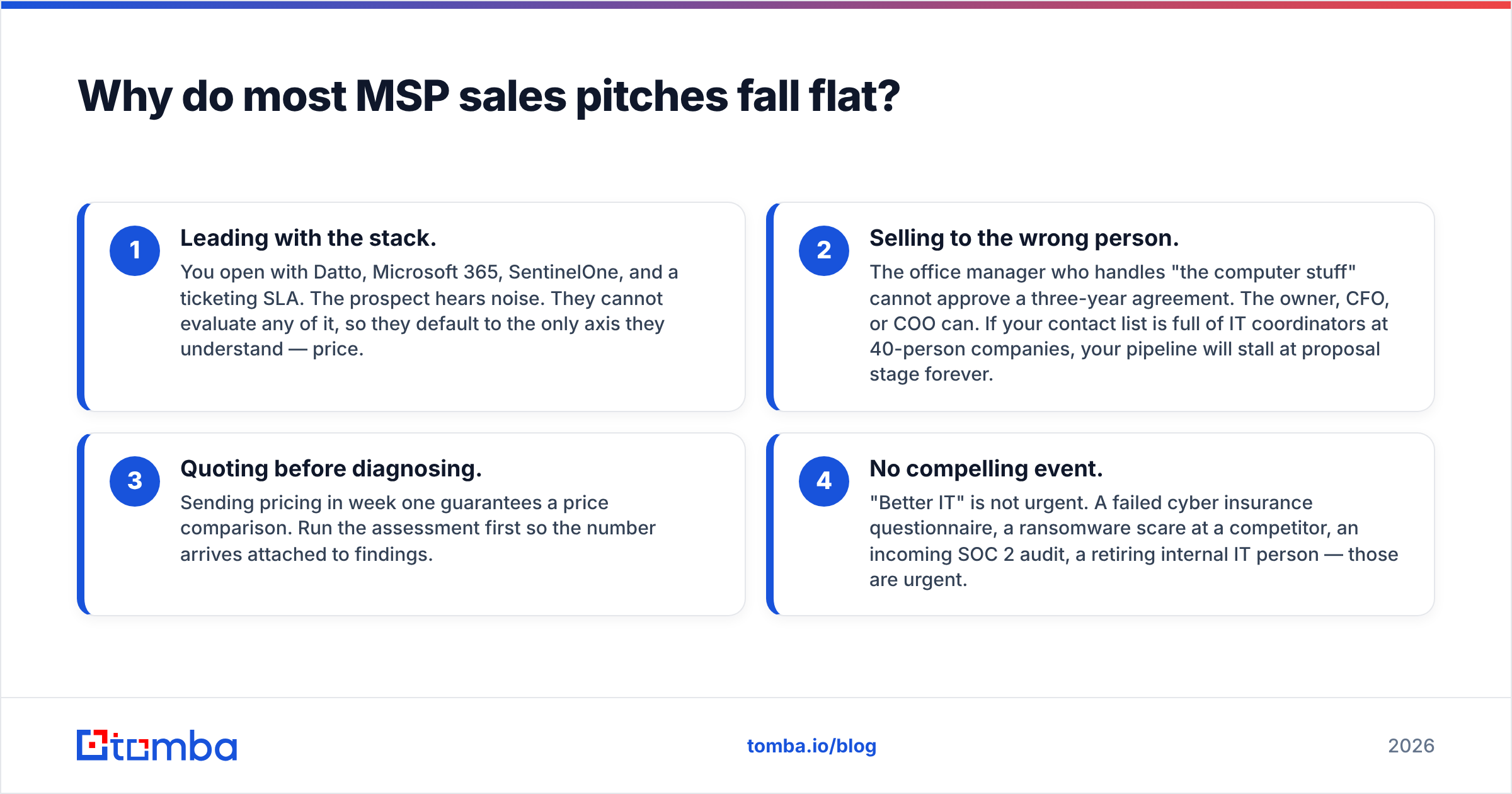
Four failure modes account for the majority of lost deals.
- Leading with the stack. You open with Datto, Microsoft 365, SentinelOne, and a ticketing SLA. The prospect hears noise. They cannot evaluate any of it, so they default to the only axis they understand — price.
- Selling to the wrong person. The office manager who handles "the computer stuff" cannot approve a three-year agreement. The owner, CFO, or COO can. If your contact list is full of IT coordinators at 40-person companies, your pipeline will stall at proposal stage forever.
- Quoting before diagnosing. Sending pricing in week one guarantees a price comparison. Run the assessment first so the number arrives attached to findings.
- No compelling event. "Better IT" is not urgent. A failed cyber insurance questionnaire, a ransomware scare at a competitor, an incoming SOC 2 audit, a retiring internal IT person — those are urgent.
Fix the compelling-event problem and the rest gets easier. Every good MSP outbound message is built on a trigger, not on a feature.
What are the core steps in a managed services sale?#
Here is the sequence that works across SMB and lower mid-market. Each step has one job: earn the right to the next one.
- Define your ideal client profile. Not "any business with 10-200 employees." Pick a vertical (dental practices, manufacturing, professional services, regional healthcare) and a compliance driver (HIPAA, CMMC, PCI, SOC 2). Vertical specialization is the single biggest lever on close rate because you can name their exact problems in the first 30 seconds.
- Build a verified contact list. Owner, CFO, or COO — with a real, deliverable email address and a direct phone number. This is where most MSP outbound quietly dies.
- Open with a trigger, not a pitch. Reference the compliance deadline, the acquisition, the new office, the job posting for an internal IT hire.
- Run a paid or free risk assessment. Scan the environment. Document what you find: unpatched endpoints, no MFA, backups that have not restored successfully in 18 months, local admin rights everywhere.
- Present findings, then price. Walk the decision-maker through the risk register in business terms — dollars of downtime, insurance non-compliance, audit exposure. Price lands as the remedy, not as a quote.
- Offer three tiers, recommend one. Anchoring works. Most buyers take the middle.
- Close with a start date and an onboarding plan, not with a discount.
How should you price and package managed services in 2026?#
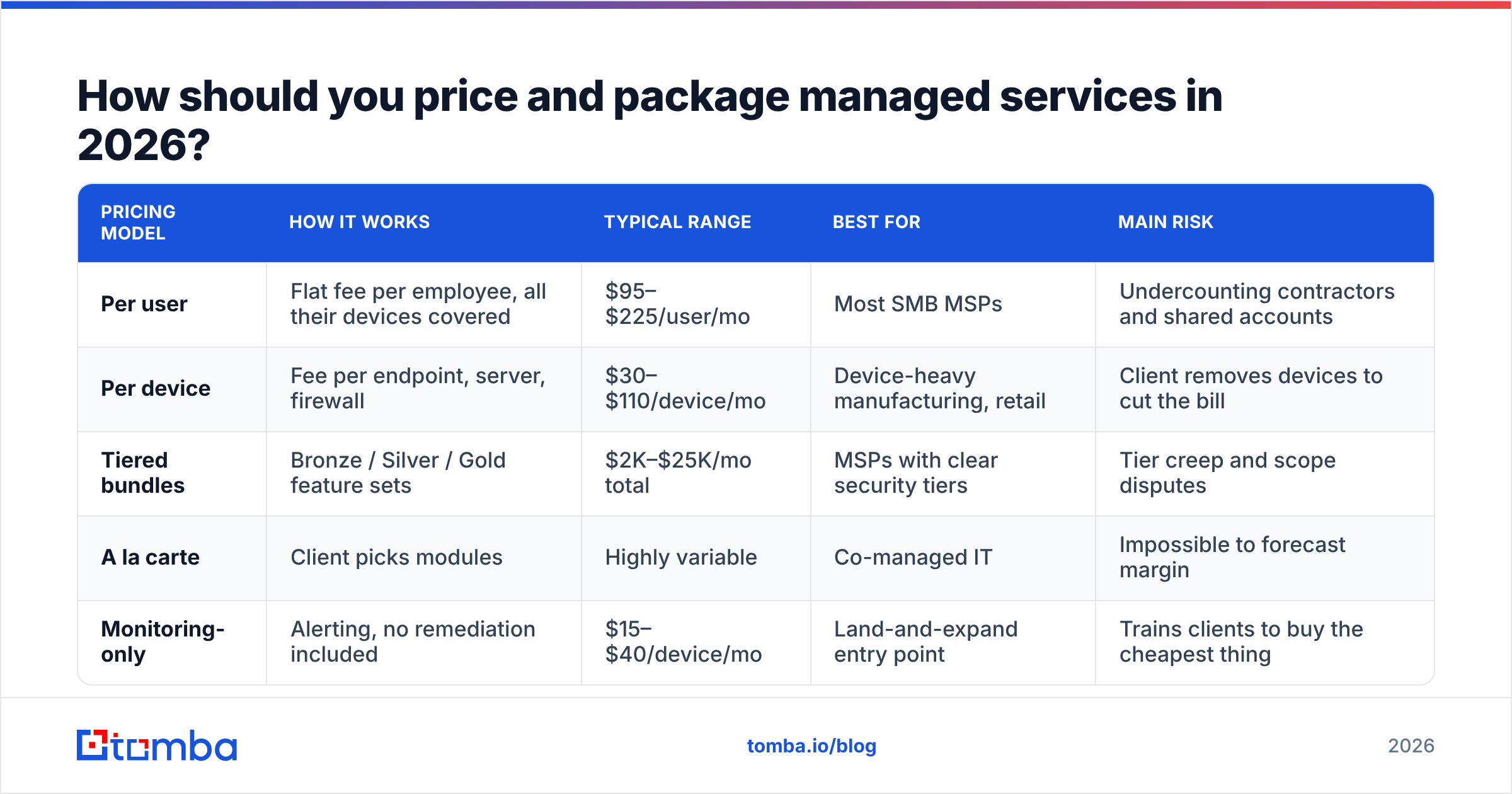
Pricing is packaging. Three tiers, per-user, with a clearly named "recommended" middle option. Here is how the common models compare:
| Pricing model | How it works | Typical range | Best for | Main risk |
|---|---|---|---|---|
| Per user | Flat fee per employee, all their devices covered | $95–$225/user/mo | Most SMB MSPs | Undercounting contractors and shared accounts |
| Per device | Fee per endpoint, server, firewall | $30–$110/device/mo | Device-heavy manufacturing, retail | Client removes devices to cut the bill |
| Tiered bundles | Bronze / Silver / Gold feature sets | $2K–$25K/mo total | MSPs with clear security tiers | Tier creep and scope disputes |
| A la carte | Client picks modules | Highly variable | Co-managed IT | Impossible to forecast margin |
| Monitoring-only | Alerting, no remediation included | $15–$40/device/mo | Land-and-expand entry point | Trains clients to buy the cheapest thing |
Per-user pricing wins for most MSPs because it aligns your revenue with headcount growth — the thing your client is actually trying to do — and it stops the "can we drop these five old laptops off the contract" conversation.
A workable 2026 tier structure:
- Essential — patching, RMM, helpdesk during business hours, managed backup, MFA enforcement. Roughly $95–$125/user/mo.
- Secure (recommend this one) — everything above plus EDR/MDR, email security, security awareness training, quarterly vCIO review. Roughly $145–$185/user/mo.
- Compliance — everything above plus SIEM/log retention, policy documentation, audit support, annual penetration test. $200+/user/mo.
Put an onboarding fee on every tier. Free onboarding signals that your implementation work is worthless, and it destroys first-quarter margin on new logos.
How do you find and reach the right decision-makers?#
You need three data points per target account: the right person, a deliverable email, and a direct phone number. Miss any one and the sequence collapses.
Start from a defined list rather than a purchased CSV. Build the account list from local business registries, chamber-of-commerce directories, association member lists in your vertical, and job boards (a company posting for "IT Support Specialist" is a company with an IT problem right now). Then enrich.
Use a domain search to pull every published address at a target company and identify the email pattern — first.last@, flast@, first@. Once you know the pattern, a email finder resolves the specific owner or CFO you actually want. For accounts where you only have a LinkedIn profile, a LinkedIn finder closes the gap.
Then verify. Every list decays — people change jobs, companies get acquired, aliases get retired. Running your list through an email verifier before a send is not optional in 2026. Google and Yahoo bulk-sender requirements have made spam-complaint and bounce thresholds hard limits rather than guidelines; you can read the current expectations directly in Google's sender guidelines. Cross a 0.3% complaint rate or a high bounce rate and your entire domain's email deliverability degrades — including the invoices and ticket notifications you send to existing clients.
For MSPs, phone still outperforms email on connect rate with owner-operators. Pair every email touch with a call attempt using a phone finder to get direct dials rather than the front-desk number.

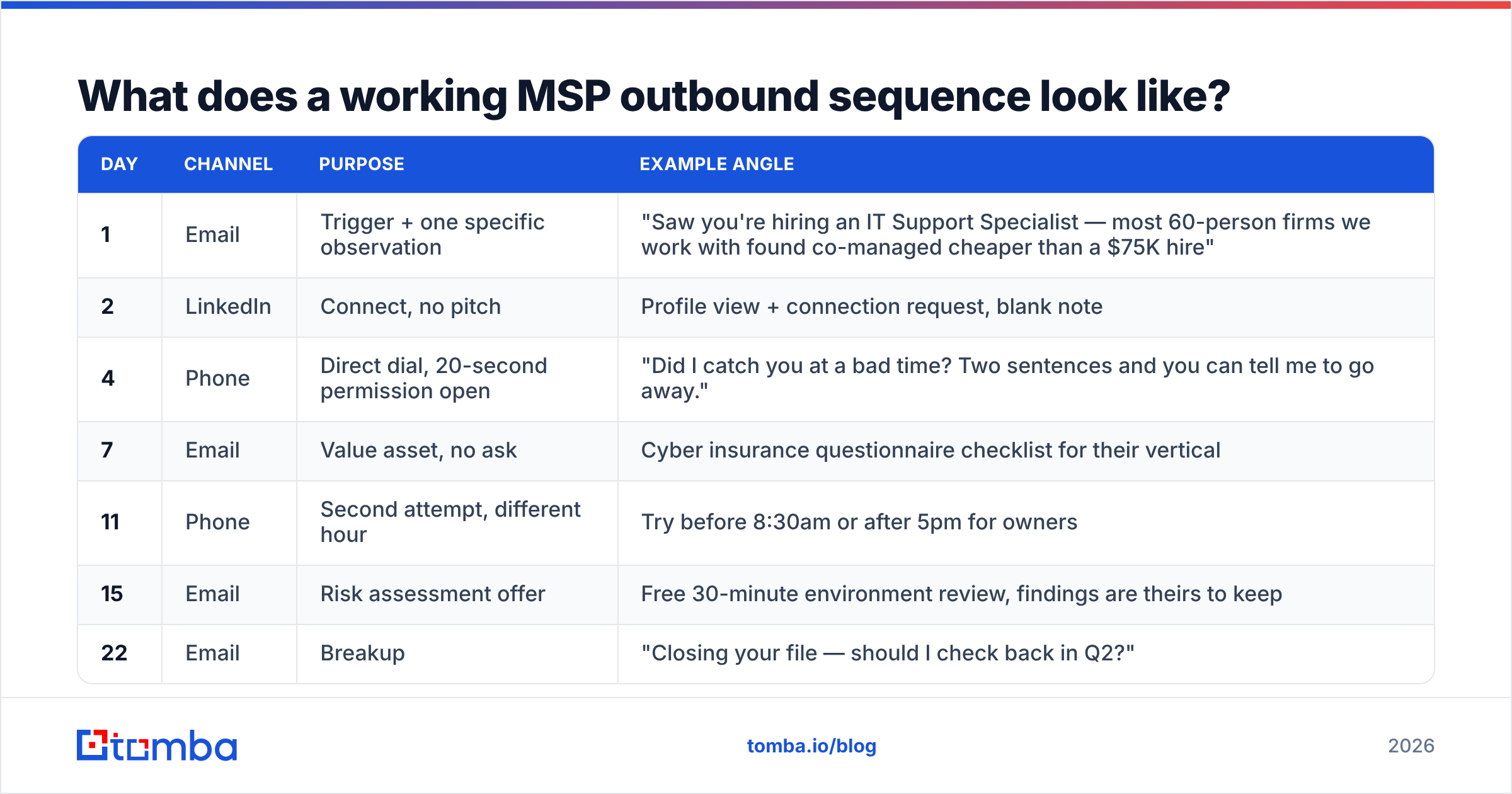
What does a working MSP outbound sequence look like?#
Five to nine touches over 21-28 days, mixing channels. Here is a template you can run as-is:
| Day | Channel | Purpose | Example angle |
|---|---|---|---|
| 1 | Trigger + one specific observation | "Saw you're hiring an IT Support Specialist — most 60-person firms we work with found co-managed cheaper than a $75K hire" | |
| 2 | Connect, no pitch | Profile view + connection request, blank note | |
| 4 | Phone | Direct dial, 20-second permission open | "Did I catch you at a bad time? Two sentences and you can tell me to go away." |
| 7 | Value asset, no ask | Cyber insurance questionnaire checklist for their vertical | |
| 11 | Phone | Second attempt, different hour | Try before 8:30am or after 5pm for owners |
| 15 | Risk assessment offer | Free 30-minute environment review, findings are theirs to keep | |
| 22 | Breakup | "Closing your file — should I check back in Q2?" |
Two rules make this work. First, every email is under 90 words and asks for one thing. Second, the value asset in touch four must be genuinely useful without you — a checklist, a benchmark, a one-page policy template. If it is a brochure, it burns the sequence.
Track your response rate by vertical, not in aggregate. Dental practices and manufacturing firms respond to completely different framing, and a blended number hides which one is working.
How do you run the risk assessment that closes the deal?#
The assessment is the sale. Everything before it exists to book it; everything after it is paperwork.
Scope it to 60-90 minutes on site or remote, and structure the output as a one-page risk register with three columns: finding, business impact, remediation. Business impact must be in the buyer's language.
- Backup — "Your last successful restore test was never. A ransomware event means 3-6 weeks of reconstruction from paper records."
- Identity — "MFA is off for 34 of 41 accounts. Your cyber insurance renewal asks about this in question 7."
- Endpoint — "19 machines are 200+ days behind on patches, including the workstation that runs your accounting package."
- Access — "Three former employees still have active credentials."
- Vendor risk — "Nobody owns the relationship with your line-of-business software vendor, so outages have no escalation path."
Present findings to the decision-maker in person or on video, never as an emailed PDF. The PDF becomes a shopping list they take to a cheaper MSP. Reference frameworks that carry outside authority — the NIST Cybersecurity Framework gives your register a structure buyers' insurers and auditors already recognize, and it moves the conversation from "your opinion" to "the standard."
Then price the remediation as part of the monthly agreement rather than as a separate project. Bundling the fix into the recurring fee removes the biggest objection — a large upfront number — and locks in the multi-year contract.
How do you handle the three objections you will always hear?#
"We already have an IT guy." Do not attack him. Position co-managed IT: you take patching, backup, security monitoring, and after-hours; he keeps the applications and the internal relationships. Most internal IT people are drowning, and framing yourself as their reinforcement converts a blocker into a champion.
"That's more than we spend now." Correct — and incomplete. Compare against total current cost: break-fix invoices for the last 12 months, downtime hours at loaded labor cost, the failed backup nobody found, the insurance premium difference. Most SMBs have never added it up. When they do, managed services frequently comes in flat or cheaper.
"Send me a proposal." This usually means no. Answer with a question: "Happy to — what would need to be in it for you to sign it this month?" Either you get the real criteria, or you learn there is no deal and you free up your pipeline.
Push objection handling into your sales process documentation so every rep answers the same way. Consistency here moves close rates more than any script rewrite. If you want outside benchmarks on what buyers report about MSP vendors, G2's managed service provider category is a reasonable place to sanity-check your positioning claims against real reviews.
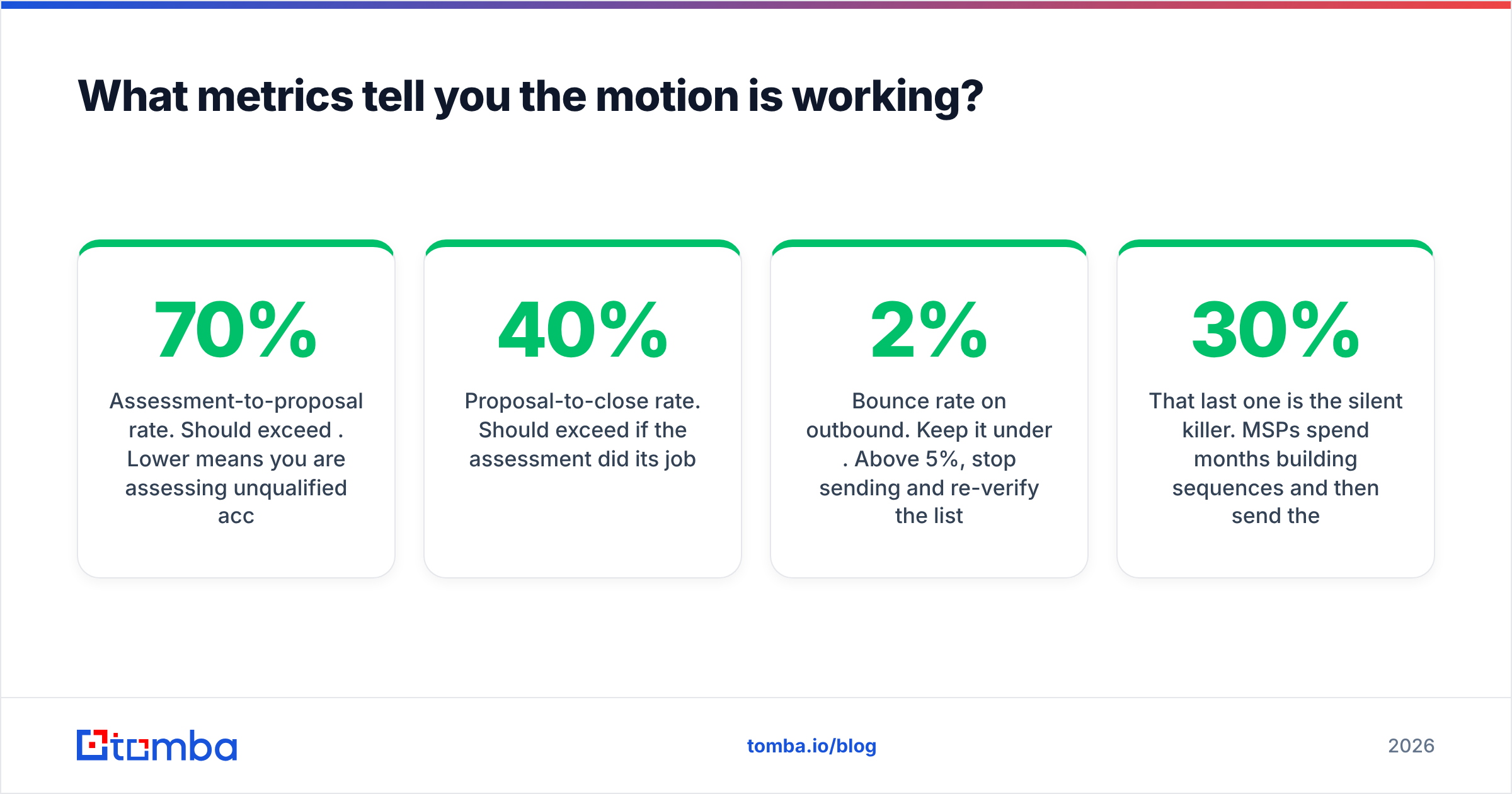
What metrics tell you the motion is working?#
Track five numbers monthly:
- Meetings booked per 100 verified contacts. Below 2 means your list or your trigger is wrong, not your copy.
- Assessment-to-proposal rate. Should exceed 70%. Lower means you are assessing unqualified accounts.
- Proposal-to-close rate. Should exceed 40% if the assessment did its job.
- Average MRR per new logo. If it is falling, your reps are discounting to close.
- Bounce rate on outbound. Keep it under 2%. Above 5%, stop sending and re-verify the list.
That last one is the silent killer. MSPs spend months building sequences and then send them to lists that are 30% stale. Clean data is not a nice-to-have in this motion; it is the input that determines whether any of the other four numbers can improve.
Get the contact data your MSP pipeline depends on#
Everything in this playbook — the trigger-based opener, the multichannel sequence, the assessment offer — assumes your message reaches an actual decision-maker's inbox. Most MSP outbound fails at that first step, not at the pitch.
Start with the Tomba Email Finder to locate owners, CFOs, and operations leads at your target accounts by name and domain, then verify before you send. The free tier includes 25 searches per month so you can test your ideal client profile before committing; paid plans start at $49/month for Starter and $99/month for Growth. Full Tomba pricing is public, and the Tomba API lets you push verified contacts straight into your CRM as accounts hit your trigger criteria.
Build the list right, and the rest of the playbook actually gets a chance to work.
Related guides#
Ready to find emails that actually work?
Join 150,000+ professionals who stopped guessing and started sending. Free credits on signup — no credit card required.
Get the Tomba newsletter
Practical outbound tactics and product updates — once every two weeks.
About the author