How to Sell on the Phone in 2026: A Rep's Field Guide
Phone selling still closes deals faster than any other channel — if your list is clean and your first 15 seconds earn the next 45. Here is the exact framework, script structure, and stack that works in 2026.
TL;DR
- Phone selling fails on the list before it fails on the script. Bad numbers and wrong-fit contacts kill connect rates before a rep says a word.
- Your first 15 seconds decide the call. Use a permission-based opener, name the reason you called, and stop talking.
- Discovery beats pitching. Reps who ask 11–14 questions per call consistently outperform reps who present features.
- Objections are information, not rejection. Label them, isolate them, then confirm before you handle them.
- Build a repeatable stack: verified contact data, a dialer, a call recorder, and a CRM that logs outcomes automatically.
Why does phone selling still work in 2026?#
Because it is the only outbound channel where you get a real-time, two-way conversation with a decision-maker inside 90 seconds. Email is asynchronous. LinkedIn is a queue. A phone call is a conversation happening now, and conversations move deals.
The catch: connect rates have collapsed for anyone dialing bad data. Mobile carriers now aggressively label unknown numbers as spam, buyers screen ruthlessly, and the average B2B contact record decays roughly 25–30% per year as people change jobs. If your list is 18 months old, a quarter of it is already dead weight.
So the honest version of "how to sell on the phone" in 2026 has two halves:
- Get the right number for the right person — a data problem.
- Earn 45 more seconds in the first 15 — a skill problem.
Most training content only covers the second half. That is why most reps plateau.
What actually determines whether a phone sale happens?#
Five variables, roughly in order of impact:
- List quality — Is this person a plausible buyer, and is this number actually theirs? A 40% connect rate on a tight list beats a 6% connect rate on 5,000 scraped numbers.
- Timing — Calls placed within five minutes of an inbound signal (demo request, pricing page visit, content download) convert dramatically better than cold-from-zero dials.
- Opener — The first 15 seconds. Pattern-interrupt or permission-based, never "How are you today?"
- Discovery depth — Questions asked before any product talk. This is the single biggest separator between quota-crushers and everyone else.
- Next-step specificity — "I'll send some info" is a dead call. "Thursday at 2, 20 minutes, I'll bring the two workflows you mentioned" is a pipeline.
Notice that only two of the five are about talking. The rest are preparation and process.
How do you build a call list that actually connects?#
Start from a defined ICP, then enrich. Do not start from a purchased CSV and hope.
A working sequence:
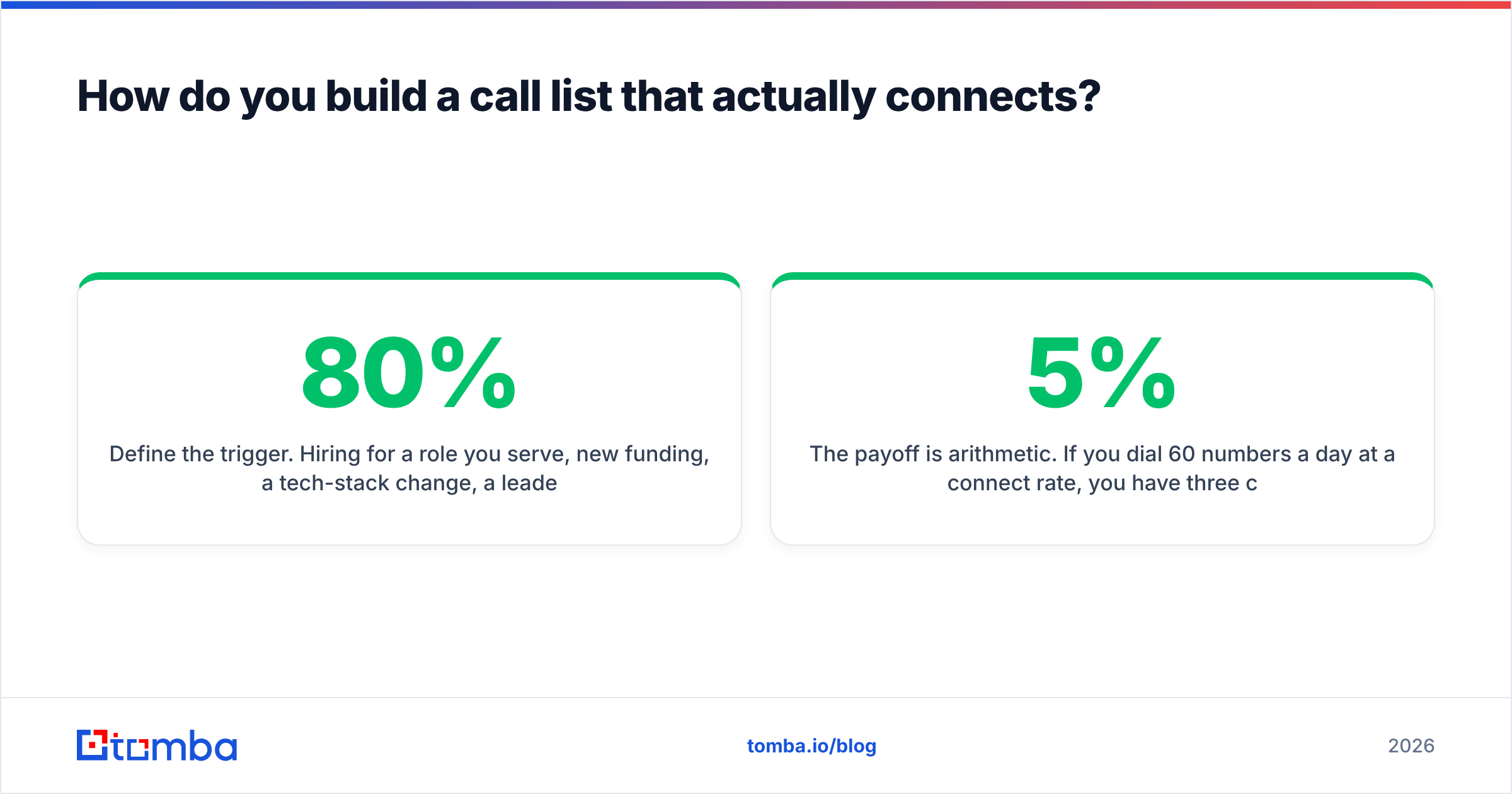
- Define the trigger. Hiring for a role you serve, new funding, a tech-stack change, a leadership hire. A trigger gives you a legitimate reason to call, which is 80% of your opener.
- Find the company set. Use a B2B data source or your own research to build a list of 100–300 accounts matching the trigger, not 10,000.
- Find the human. Titles, then names. Use a domain search to pull the contacts at each company, then narrow to the two or three people who own the problem.
- Get the direct line. Switchboards waste calls. A phone finder that returns direct dials and mobiles will roughly double your conversations per hour versus main-line dialing.
- Validate before you dial. Run numbers through a phone validator so you are not burning your dialer's reputation on disconnected lines.
- Enrich for context. Pull role, seniority, company size, and recent news so your opener has something specific in it. Data enrichment turns a name and a number into a reason to call.
The payoff is arithmetic. If you dial 60 numbers a day at a 5% connect rate, you have three conversations. At 20% you have twelve. Same effort, four times the pipeline.
What should the first 15 seconds sound like?#
Three structures work. Pick one and drill it until it is boring to you.
The permission opener
"Hi Sarah, it's Dan from Tomba. I know I've caught you unannounced — can I have 30 seconds to tell you why I called, and you can tell me to get lost?"
Why it works: it acknowledges the interruption, which disarms the reflex hang-up, and it sets a tiny, easy-to-grant commitment.
The trigger opener
"Hi Sarah, Dan from Tomba. I saw you're hiring three SDRs this quarter — I called because that usually creates a data problem about six weeks in. Is that on your radar or am I way off?"
Why it works: specific, researched, and ends in a question that is genuinely easy to answer either way.
The straight-line opener
"Sarah, this is a cold call. Want to hang up, or give me 20 seconds?"
Why it works: radical honesty is a pattern interrupt. Roughly a third of prospects laugh and say "go ahead." It also filters fast, which matters if you are volume-dialing.
What never works: "How are you doing today?", "Did I catch you at a bad time?" (you just handed them the exit), and any opener where you talk for more than 20 uninterrupted seconds.
How do you run discovery without sounding like an interrogation?#
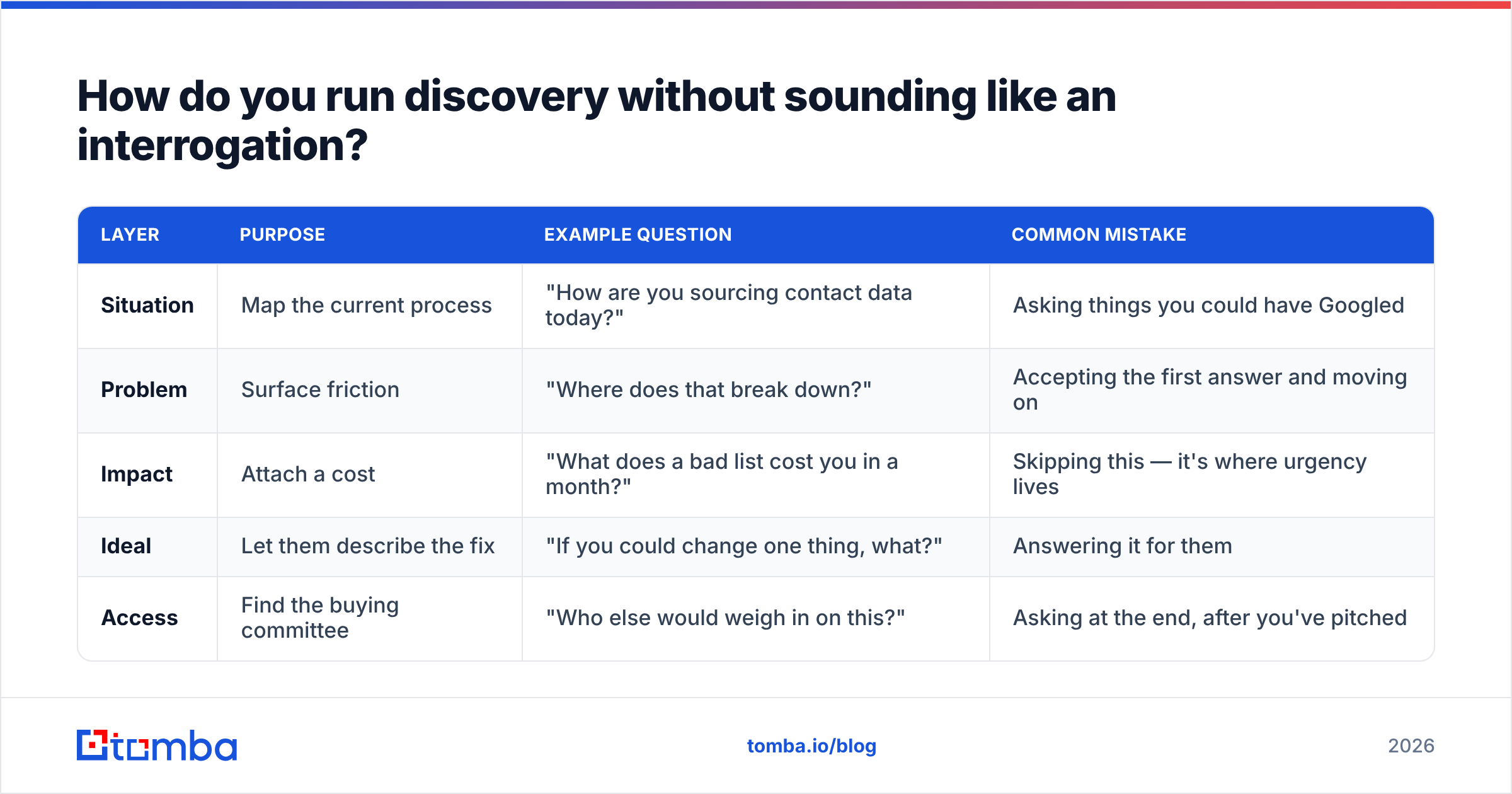
Layer your questions. Go broad, then narrow, then quantify.
| Layer | Purpose | Example question | Common mistake |
|---|---|---|---|
| Situation | Map the current process | "How are you sourcing contact data today?" | Asking things you could have Googled |
| Problem | Surface friction | "Where does that break down?" | Accepting the first answer and moving on |
| Impact | Attach a cost | "What does a bad list cost you in a month?" | Skipping this — it's where urgency lives |
| Ideal | Let them describe the fix | "If you could change one thing, what?" | Answering it for them |
| Access | Find the buying committee | "Who else would weigh in on this?" | Asking at the end, after you've pitched |
Two rules make this feel like a conversation rather than a form:
- Mirror before you ask again. Repeat their last two or three words as a question. "Hard to keep clean?" Silence after that does more work than any follow-up question you could write.
- Ask permission to go deeper. "Can I ask a slightly nosy question about that?" Almost nobody says no, and it reframes the interrogation as collaboration.
Aim for a talk-to-listen ratio around 40:60 in your favor — that is, you talk less than half the time. Call recording tools like Gong surface this metric automatically, and it is one of the few call analytics numbers that correlates cleanly with close rate.
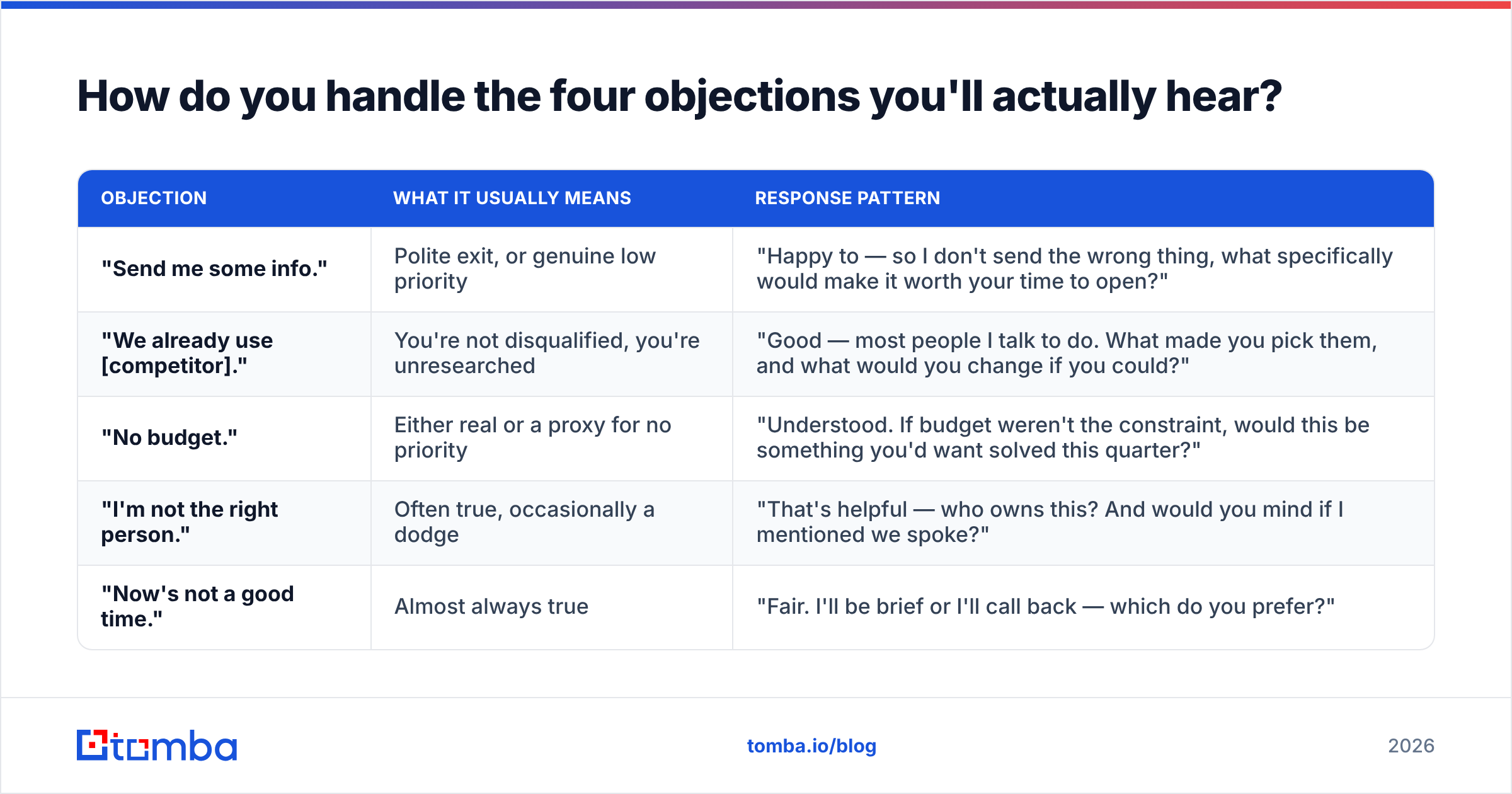
How do you handle the four objections you'll actually hear?#
Handle them in the same order every time: acknowledge → isolate → confirm → address. Skipping straight to "address" is what makes reps sound defensive.
| Objection | What it usually means | Response pattern |
|---|---|---|
| "Send me some info." | Polite exit, or genuine low priority | "Happy to — so I don't send the wrong thing, what specifically would make it worth your time to open?" |
| "We already use [competitor]." | You're not disqualified, you're unresearched | "Good — most people I talk to do. What made you pick them, and what would you change if you could?" |
| "No budget." | Either real or a proxy for no priority | "Understood. If budget weren't the constraint, would this be something you'd want solved this quarter?" |
| "I'm not the right person." | Often true, occasionally a dodge | "That's helpful — who owns this? And would you mind if I mentioned we spoke?" |
| "Now's not a good time." | Almost always true | "Fair. I'll be brief or I'll call back — which do you prefer?" |
The rule underneath all of these: never handle an objection you haven't confirmed. If someone says "too expensive," ask "compared to what?" before you defend price. Half the time the real objection is something else entirely and you just argued against a phantom.
What does a good phone sales stack look like?#
You need four categories. Anything beyond this is optimization, not foundation.
| Layer | Job | Representative options | What to look for |
|---|---|---|---|
| Contact data | Find the person and the direct dial | Tomba, BookYourData, Apollo, Cognism | Verification rate, direct-dial coverage, refund policy on bad records |
| Dialer | Remove manual dialing friction | Orum, Nooks, Aircall, Kixie | Parallel dialing, spam-label monitoring, local presence |
| Conversation intelligence | Coach from actual calls | Gong, Chorus, Clari Copilot | Talk-ratio, question-count, and objection tagging |
| CRM + sequencing | Log outcomes, drive follow-up | HubSpot, Salesforce, Pipedrive | Auto-logging of call disposition, no manual data entry |
On cost, here is the realistic entry-level picture for a small team:
| Layer | Typical entry price | Free tier? | Notes |
|---|---|---|---|
| Contact data (Tomba) | $49/mo Starter, $99/mo Growth | Yes — 25 searches/mo | Email, phone, and enrichment in one account; see Tomba pricing |
| Contact data (BookYourData) | Pay-as-you-go credits | Limited trial | Strong for pre-built, filterable lists you buy outright |
| Dialer | $80–$150/user/mo | Rare | Parallel dialers price higher; worth it above ~80 dials/day |
| Conversation intelligence | $100+/user/mo | No | Skip until you have 3+ reps to coach |
| CRM | $0–$100/user/mo | HubSpot free tier | Don't over-buy early |
The mistake teams make is buying the dialer first. A fast dialer pointed at a bad list just fails faster. Fix data, then add speed.
For a broader view of how contact-data vendors stack up on price and coverage, G2's sales intelligence category is a reasonable neutral starting point.
How many calls should you actually make per day?#
Depends on your motion, but here are defensible benchmarks for 2026:
- High-velocity SMB SDR: 80–120 dials/day, 8–15 conversations, 2–4 meetings booked.
- Mid-market AE prospecting: 25–40 dials/day, 4–8 conversations, deeply researched.
- Enterprise: 10–20 dials/day, every one preceded by 15+ minutes of account research.
Track conversations, not dials. Dials are an input you can fake; conversations are the thing that predicts pipeline. If your dial count is up and your conversation count is flat, the problem is your list or your caller ID reputation — not your effort.
A few operational habits that reliably lift numbers:
- Block time. Two 90-minute call blocks beat eight scattered 20-minute attempts. Momentum on the phone is real.
- Call the same account 6–8 times across 3 weeks, varying time of day. Most reps quit at two attempts; most connects happen after four.
- Leave voicemails that reference the next touch. "I'll follow up by email in an hour with the two things I mentioned" — then actually do it. The voicemail's job is to make your email get opened, not to get a callback.
- Pair every call with an email. Multichannel sequences outperform phone-only by a wide margin, and your email response rate climbs when the prospect has already heard your name.
- Review two recorded calls a week. Not ten. Two, closely, with one specific thing to change.
How do you close on the phone without being pushy?#
You close by making the next step obviously easier than not taking it.
The structure that works:
- Summarize their words back. "So if I heard you right: three reps, list churn is eating a day a week, and the CRM data is stale by the time it's imported."
- Confirm. "Did I miss anything?" Wait for the yes.
- Propose one specific next step. Not options. One. "Let's do Thursday at 2 — 20 minutes, I'll walk through exactly how the enrichment side would fit your CRM."
- Handle the calendar in real time. Never "I'll send some times." Book it while you're both on the line.
- Confirm the commitment out loud. "You'll block 20 minutes Thursday at 2 — anything that would cause that to move?"
That last question feels awkward the first ten times. It also cuts no-show rates meaningfully, because it forces the prospect to either commit or tell you the truth.
And if the answer is no? Ask one disqualifying question before you hang up: "Totally fine — is this a not-now or a not-ever, so I know whether to check back?" Both answers are valuable. Only one wastes your time.
What are the most common phone selling mistakes?#
- Pitching before diagnosing. If you name a feature before minute four, you're guessing.
- Filling silence. After you ask a real question, count to five. The prospect's second sentence is usually the honest one.
- Reading the script verbatim. Scripts are for structure and for the five sentences that must land word-perfect. Everything else should be yours.
- Dialing unverified numbers. Wrong-number rates above ~10% get your caller ID flagged as spam, and once that happens every subsequent call is harder.
- Treating the CRM as optional. If it's not logged, it didn't happen, and your next-quarter list rebuild starts from zero.
- No pre-call research. Thirty seconds on the company's homepage and the prospect's LinkedIn is enough to make your opener specific. Skipping it costs you more than it saves.
Where should you start this week?#
Pick one account list, twenty-five contacts deep, tied to a single trigger. Verify every number and email. Write one opener and one discovery sequence. Call all twenty-five over three days, record every call, and review two of them.
You will learn more from that than from another month of unscored volume dialing.
The data layer is where most reps lose before they start. If your dials are landing on disconnected lines and gatekeepers, no script rescues that. Tomba's Email Finder gives you verified professional contact details — email, direct dial, and enrichment context — from a company domain or a name, so every dial you place is aimed at a real, current, right-fit human. Start on the free tier at 25 searches a month, or move to Starter at $49/mo when your call blocks outgrow it. Fix the list first; the conversations follow.
Related guides#
Ready to find emails that actually work?
Join 150,000+ professionals who stopped guessing and started sending. Free credits on signup — no credit card required.
Get the Tomba newsletter
Practical outbound tactics and product updates — once every two weeks.
About the author