How to Sell Remotely in 2026: A Practical Playbook
Remote selling isn't in-person selling over Zoom. Here's the stack, the cadence, and the metrics that separate reps closing six figures from home from reps burning their pipeline.
TL;DR
- Remote selling fails at the data layer first, not the charisma layer. Bad contact data kills more remote deals than bad pitches do.
- Build a repeatable weekly rhythm: 40% prospecting, 30% live calls, 20% follow-up, 10% pipeline hygiene. Without a calendar structure, remote reps drift.
- Multi-thread every deal. Remote buyers ghost more easily, so three contacts per account is the minimum insurance policy.
- Video calls need a different script than in-person meetings — shorter openings, screen-shared agendas, and a scheduled next step before you hang up.
- Track reply rate, meeting-held rate, and multi-thread depth. Activity counts alone will lie to you when nobody can see you working.
What Does "Selling Remotely" Actually Mean in 2026?#
Remote selling means running the entire deal cycle — sourcing, qualification, demo, negotiation, close — without ever sitting in the same room as your buyer. That's now the default for most B2B software, services, and mid-market deals, not an exception.
The mistake most reps make is treating it as field selling with a webcam bolted on. It isn't. Three things structurally change:
- Trust has to be manufactured, not absorbed. In a room, a firm handshake and a shared coffee do quiet work. On a call, you replace that with preparation, specificity, and speed of response.
- Your inputs are entirely digital. No trade show badge scans, no receptionist who tells you the CFO's name. Every contact comes from a database, a scrape, a referral, or a signal — which means data quality becomes the ceiling on your performance.
- Attention is contested every second. Your buyer has Slack, email, and two other tabs open during your demo. A 45-minute monologue that survives in person dies remotely.
Once you accept those three, the playbook writes itself.
How Do You Build a Remote Sales Stack That Doesn't Leak?#
You need four layers, and most struggling remote teams are missing exactly one of them.
| Layer | Job | Typical tools | What breaks without it |
|---|---|---|---|
| Data | Find and verify who to contact | Tomba, Apollo, BookYourData, Clearbit | Bounces, spam folder, wasted sequences |
| Outreach | Deliver messages at volume | Instantly, Smartlead, Lemlist | No pipeline, manual copy-paste |
| Conversation | Run the actual meeting | Zoom, Google Meet, Gong | Deals stall after first call |
| Record | Track and forecast | HubSpot, Salesforce, Pipedrive | Forecast fiction, lost follow-ups |
The layer that most often leaks is the first one. A rep with a mediocre script and clean data outperforms a rep with a brilliant script and 30% invalid addresses — because the second rep's messages never arrive. Before you optimize copy, run your list through an email verifier and see what survives.

Note on tooling budget: you do not need all four layers at enterprise tier. A solo remote seller can run data at $49/mo, outreach at around $37/mo, free video, and a free CRM tier, and compete fine. Overspending on the record layer while starving the data layer is the most common misallocation on small remote teams.
Which Comes First — Data, Message, or Cadence?#
Data. Always data. Here's the order of operations that actually works, and why each step depends on the one before it:
- Define the account list. 100–300 named accounts, not "anyone in SaaS." Remote selling rewards depth over spray.
- Find the humans. Titles, then names, then contact points. Use domain search to pull every published address at a target company in one pass rather than guessing patterns one person at a time.
- Verify before you send. Anything above a 3% bounce rate starts damaging your sending domain. Verification is cheaper than a burned domain.
- Write the message per segment, not per person. Full personalization at scale is a myth. Segment into 5–8 buckets, write a strong core message per bucket, personalize the first line only.
- Set the cadence. 5–7 touches over 18–21 days, mixing email, LinkedIn, and one phone attempt. Stop at the end; don't nag forever.
- Instrument the funnel. Reply rate by segment, meeting-booked rate by segment. Kill the bottom two segments every month.
That sequence matters because each step's output is the next step's input. Reps who start at step four — writing clever copy before they have a clean list — are optimizing the cheapest part of the chain.
How Do You Run a Remote Sales Call That Doesn't Die?#
The remote call has its own physics. Adapt these five habits:
- Open in 60 seconds. Name the agenda, name the time box, name the desired outcome. "I've got three things to cover, we'll be done by :25, and by the end you'll know if this is worth a technical review."
- Share your screen with a written agenda. Buyers who can see structure stay engaged. Buyers staring at a talking head go check Slack.
- Ask, then shut up. Aim for a talk ratio near 45/55 in your buyer's favor on discovery calls. Recording tools measure this — Gong's own research on sales conversations has made talk-ratio benchmarking common practice.
- Confirm the next step live. Never end with "I'll send times." Open the calendar on screen and book it. Meeting-held rates collapse when the next step is an email away.
- Send the recap within one hour. Short, three bullets, one clear ask. This is where remote deals are actually won.
One more thing that separates good remote reps: they multi-thread deliberately. If your only contact goes on vacation, a remote deal has no hallway conversation to keep it alive. Find the two adjacent stakeholders — the budget holder and the implementer — before your second call. A quick reverse email lookup on a forwarded thread often surfaces the person who's actually deciding.
Is Remote Selling Better or Worse Than Field Sales?#
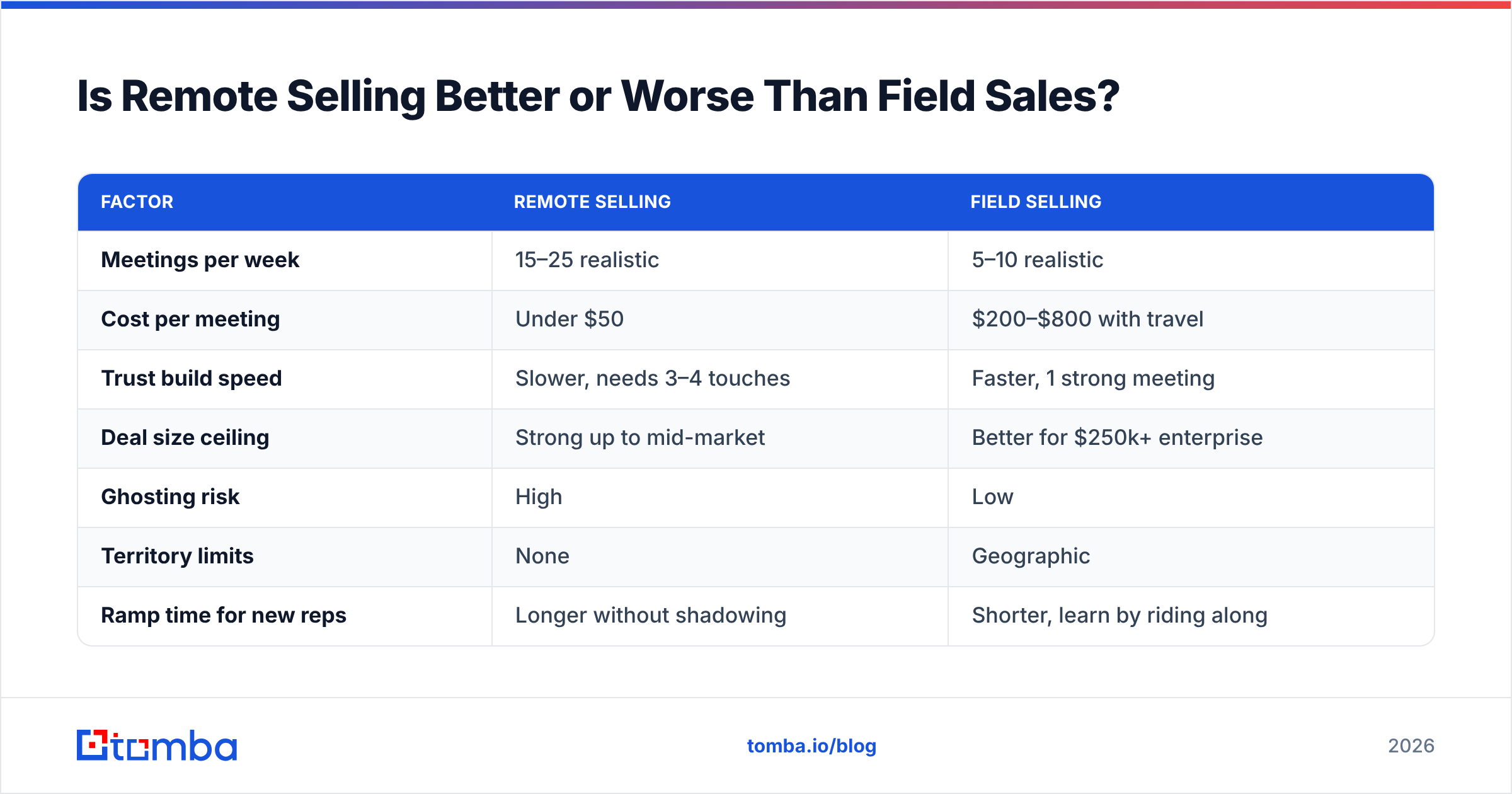
Neither, but the trade-offs are concrete. Here's the honest comparison:
| Factor | Remote selling | Field selling |
|---|---|---|
| Meetings per week | 15–25 realistic | 5–10 realistic |
| Cost per meeting | Under $50 | $200–$800 with travel |
| Trust build speed | Slower, needs 3–4 touches | Faster, 1 strong meeting |
| Deal size ceiling | Strong up to mid-market | Better for $250k+ enterprise |
| Ghosting risk | High | Low |
| Territory limits | None | Geographic |
| Ramp time for new reps | Longer without shadowing | Shorter, learn by riding along |
The pattern across most B2B orgs: remote wins on volume and cost, field wins on complex enterprise trust-building. Hybrid teams typically run remote through discovery and demo, then fly out once for the executive alignment meeting on large deals. Analyst coverage from firms like Gartner has consistently pointed toward buyer preference for digital-first interactions in early stages, with in-person reserved for late-cycle validation.
If you're selling under $50k ACV, there is almost no case for field sales in 2026. The math doesn't work.
What Metrics Should a Remote Seller Actually Watch?#
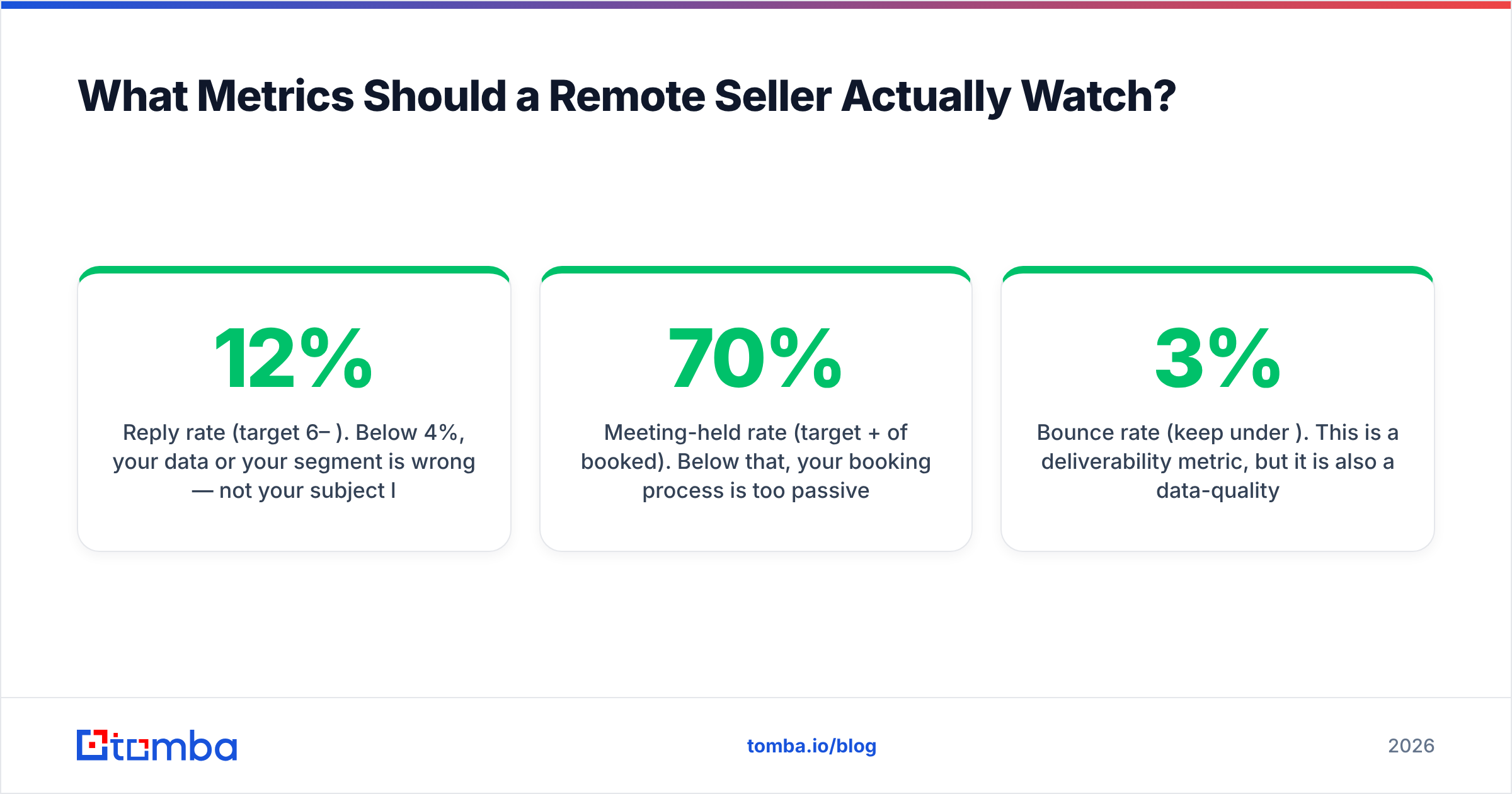
Activity metrics lie when you work from home, because nobody sees the difference between 60 focused calls and 60 voicemails. Watch outcome-weighted numbers instead:
- Reply rate (target 6–12%). Below 4%, your data or your segment is wrong — not your subject line.
- Meeting-held rate (target 70%+ of booked). Below that, your booking process is too passive.
- Multi-thread depth (target 3+ contacts per open opp). The single strongest predictor of remote deals closing.
- Response latency (target under 2 hours in business hours). Remote buyers reward speed disproportionately.
- Bounce rate (keep under 3%). This is a deliverability metric, but it is also a data-quality metric, and it silently caps everything above it.
Two of those five — reply rate and bounce rate — are downstream of your contact data, not your talent. Which is why the data layer keeps coming back.

How Do You Stay Productive Selling From Home?#
The uncomfortable truth is that remote sales performance is mostly a calendar-design problem. Reps don't fail because they lack talent; they fail because their week has no shape.
A structure that holds up across most remote teams:
- Block prospecting before email. First 90 minutes, no inbox. Prospecting is the only activity that compounds, and it's the first thing that gets displaced.
- Batch your calls. Two blocks per day, not scattered. Context switching between deep research and live conversation costs more than people think.
- Protect one admin block. 45 minutes daily for CRM hygiene, recaps, and list building. If it isn't scheduled, your pipeline data rots.
- Set a hard stop. Remote reps burn out from creep, not intensity. A 6pm shutdown enforced for a quarter beats heroics for a month.
- Weekly pipeline review with yourself. Every open opp: what's the next step, who's the second thread, what's the close date. Anything without answers is not a real opportunity.
For teams, add one asynchronous ritual: a shared Loom or written deal review twice a week. It replaces the bullpen learning that remote reps otherwise never get.
What Tools Are Worth Paying For First?#
Order of purchase, if you're building from zero:
| Priority | Category | Budget range | Why this order |
|---|---|---|---|
| 1 | Contact data + verification | $49–$99/mo | Nothing works without valid contacts |
| 2 | Sending / sequencing tool | $30–$100/mo | Volume without manual labor |
| 3 | CRM | Free–$99/mo | Free tiers are genuinely fine at first |
| 4 | Call recording | $0–$150/mo | Coaching value scales with team size |
| 5 | Scheduling link | Free–$15/mo | Small tool, outsized effect on held rate |
Note the CRM sits third. Plenty of remote teams buy Salesforce before they have 50 verified contacts, then wonder why the pipeline is empty. Buyer reviews on G2 show the same pattern in category adoption: data tools have the highest satisfaction-to-spend ratio for small teams, precisely because they unblock everything downstream.
For the data layer specifically, compare on three things: match rate on your actual ICP domains, verification quality (does it distinguish catch-all from valid?), and price per verified contact — not price per credit. A tool that returns 100 addresses where 40 bounce is more expensive than one returning 60 that all land. Check Tomba pricing against per-verified-contact math rather than headline credit counts; the Free tier at 25 searches/mo is enough to run that test yourself before committing.
What's the Fastest Way to Start Selling Remotely This Week?#
Five days, concretely:
- Monday: Build your 150-account list. Company name, domain, why they'd care.
- Tuesday: Find and verify contacts. Two per account minimum, three preferred.
- Wednesday: Write four segment messages. 90 words each, one clear ask, no attachments.
- Thursday: Load sequences, set the 6-touch cadence, send the first batch.
- Friday: Book your call blocks for next week and write your recap template.
You'll have a functioning remote sales motion by the following Monday. Everything after that is iteration on reply rate and segment quality — which, again, is mostly a data question.
Remote selling rewards the boring parts: clean lists, fast follow-up, disciplined calendars, and three threads per deal. The charisma matters less than it did in a conference room, and the inputs matter far more.
If your reply rates are stuck and you suspect the list rather than the copy, start there. The Tomba Email Finder pulls verified professional addresses by name, domain, or company, so the messages you spend Wednesday writing actually reach a human on Thursday. Run your next 25 target accounts through the free tier, measure the bounce rate against your current list, and let the numbers make the decision for you.
Related guides#
// get started
Find, verify and enrich your first contacts today
Start on the free plan with 25 searches a month, then scale when your team is ready.
Free plan · No credit card required · GDPR & CCPA
// about the author