How to Sell to Buyers in 2026: A 7-Step B2B Playbook
B2B buyers finish most of their research before they ever talk to a rep. Here is a concrete 7-step playbook for selling to modern buying groups — plus the data hygiene that keeps your outreach landing.
TL;DR
- Buyers do most of their evaluation without you. Your job is not to control the process — it's to be useful inside a process you don't own.
- You are never selling to one person. A typical B2B purchase involves a buying group of roughly 6–10 people with different jobs, fears, and success metrics.
- The seven steps below map to how buyers actually move: trigger → research → shortlist → internal consensus → risk review → decision → onboarding.
- Most "outreach doesn't work" problems are data problems. Wrong contact, wrong role, dead mailbox — the message never gets a fair test.
- Measure buying-group coverage and multi-threading depth, not just activity counts. Coverage predicts win rate better than dials do.
What has actually changed about how buyers buy?#
The purchase decision now happens mostly in rooms you are not in.
Buyers arrive at a first call already carrying a shortlist, a rough price expectation, and at least one internal skeptic. They have read the docs, watched a teardown video, asked a peer in a Slack community, and skimmed reviews on G2. By the time your calendar link gets clicked, the discovery you planned to run has largely already happened — badly, without you, using competitor framing.
That is the real shift. Not "buyers are more informed" (they always claimed to be), but that the sequence inverted. Selling used to be: you educate, they evaluate, they decide. Now it's: they educate themselves, they evaluate, and they invite you in to help them de-risk a decision they have half-made.
Two consequences follow, and both are uncomfortable:
- Your early-stage content is your first sales call. Whatever a buyer reads before contacting you is doing the qualification work your SDR used to do.
- Late-stage selling is mostly internal enablement. Your champion has to sell you to procurement, security, finance, and a skeptical peer team. If you don't arm them, they lose that argument alone.
Gartner's sales research has been consistent on the core point for years: buying groups are larger, more cautious, and more likely to end in "no decision" than in a loss to a competitor. Your actual enemy is inertia, not the vendor on the other side of the bake-off.
Who is "the buyer" in a B2B deal?#
There is no buyer. There is a buying group, and its members want different things.
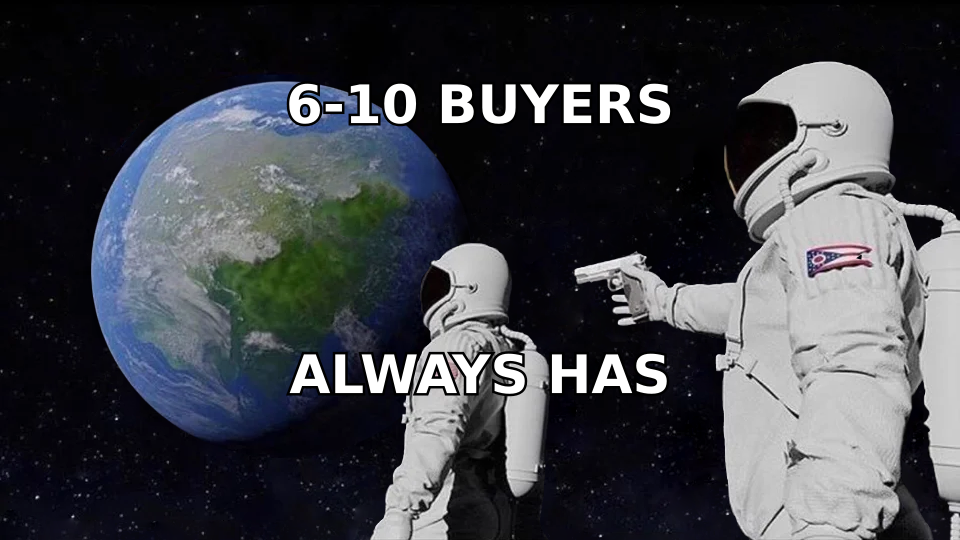
Selling to buyers means selling to a committee that never meets in one room. Map it like this:
- The initiator — feels the pain daily. Fast to say yes, has no budget, and gets overruled constantly. Great source of truth, terrible sole champion.
- The economic buyer — owns the number. Cares about payback period and whether this line item survives the next budget review. Wants two sentences, not a demo.
- The technical evaluator — decides whether it works and whether it breaks something else. Cares about API limits, data provenance, rate limits, and export paths.
- The security and compliance reviewer — has veto power and no upside. Their default answer is "no" until the questionnaire is clean.
- The blocker — usually someone whose current tool, process, or headcount your product implicitly criticizes. Ignore them and they'll kill the deal quietly, in a meeting you weren't invited to.
- The end users — the people who will actually log in. If adoption fails at day 30, renewal fails at day 365.
If your CRM shows one contact on a $40k opportunity, that deal is not real yet. It's a conversation. The practical work of learning how to sell to buyers is really the work of finding, reaching, and equipping five more people around your first contact.
Is seller-led or buyer-led selling better in 2026?#
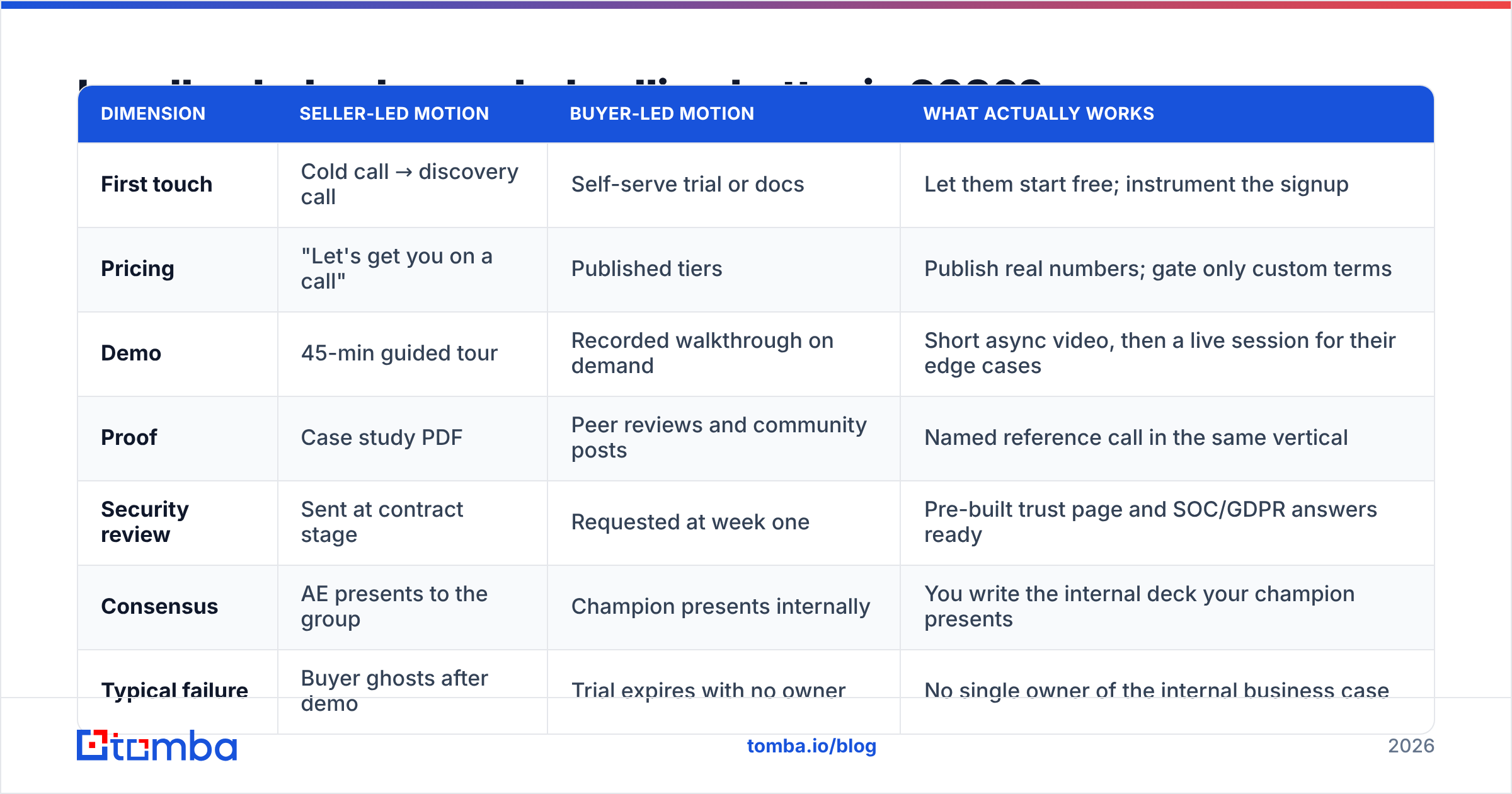
Neither wins on its own. What kills deals is running a seller-led process against a buyer-led purchase — pushing a demo-then-proposal sequence at someone who wanted a sandbox and a security doc.
| Dimension | Seller-led motion | Buyer-led motion | What actually works |
|---|---|---|---|
| First touch | Cold call → discovery call | Self-serve trial or docs | Let them start free; instrument the signup |
| Pricing | "Let's get you on a call" | Published tiers | Publish real numbers; gate only custom terms |
| Demo | 45-min guided tour | Recorded walkthrough on demand | Short async video, then a live session for their edge cases |
| Proof | Case study PDF | Peer reviews and community posts | Named reference call in the same vertical |
| Security review | Sent at contract stage | Requested at week one | Pre-built trust page and SOC/GDPR answers ready |
| Consensus | AE presents to the group | Champion presents internally | You write the internal deck your champion presents |
| Typical failure | Buyer ghosts after demo | Trial expires with no owner | No single owner of the internal business case |
The pattern in the right-hand column is the same every row: reduce the number of things a buyer must ask you for before they can move. Every required interaction is a place where the deal can stall for two weeks because someone went on holiday.
How do you sell to buyers, step by step?#
Here is the seven-step version. It maps to the buyer's sequence, not yours.
Step 1 — Start from a trigger, not a title list. Titles tell you who might care. Triggers tell you who cares now: a funding round, a new VP of Sales, a job posting for a role your product supports, a tech-stack change, a competitor's price increase. A message that references a real trigger reads as observation. A message that references a title reads as a mail merge.
Step 2 — Build the buying group before you send anything. Pick your entry point (usually the initiator or the economic buyer's direct report), then map two levels up and one across. Use domain search to pull the addressable contacts at the account, filter by department, and note which roles you're missing. Missing roles are your research to-do list, not a reason to start emailing.
Step 3 — Verify before you send. This is the least glamorous step and the highest-leverage one. Sending to stale addresses inflates bounce rates, damages sender reputation, and eventually routes even your good messages to spam. Run the list through an email verifier and drop or quarantine anything that isn't deliverable.
Step 4 — Lead with a diagnosis, not a pitch. The opening line should state something true and specific about their situation that they'd nod at. "You're running outbound on two SDRs and no data QA step" beats "I wanted to reach out about our platform." If you can't say something specific, you haven't done step 1.
Step 5 — Multi-thread deliberately and transparently. Contact three to five people in the group, and tell each one you're doing it. Secret multi-threading feels like going around your champion; announced multi-threading feels like professionalism. Phrase it as: "I've also reached out to Dana in Security so we don't lose two weeks later."
Step 6 — Build the internal business case for your champion. One page: problem, current cost, proposed change, expected payback, risks and mitigations, implementation timeline. Send it as an editable doc so they can put their own name on it. Champions who have to write this themselves usually don't.
Step 7 — Sell the first 30 days, not the product. Close on an onboarding plan with named owners and a checkpoint date. Buyers fear the post-signature vacuum more than they fear the price. Removing that fear is often the last mile of the deal.
Why does most outreach fail before the message matters?#
Because the message never arrived, or arrived at the wrong person.

Run this diagnostic before you rewrite another sequence:
- Bounce rate above 3%? That's a data problem, not a copy problem. Fix the list first.
- Open rate under 25% on verified addresses? Deliverability and subject lines, in that order. Check authentication records before you A/B test wording.
- Opens fine, replies near zero? Now it's the message. Your first line is probably about you.
- Replies fine, no meetings? Your ask is too big. Trade the 30-minute call for a two-question reply or a five-minute async video.
- Meetings fine, no deals? You're single-threaded. Go back to step 2.
Contact data decays fast — people change jobs, companies rebrand, mailboxes get retired. Whatever source you use, treat freshness as a first-class requirement. Providers differ in approach: some, like BookYourData, focus on curated pre-built B2B lists you can filter and export; others, like Tomba's email finder, resolve contacts on demand from a domain and a name so you're pulling data at the moment of use rather than from a snapshot. Both models are legitimate — the failure mode is using either one without a verification step in front of your sender.
For accounts where email is saturated, layer in a phone finder and treat the call as a follow-up to a message they've already seen, not a cold interruption. Sequences that mix channels around the same narrative outperform single-channel blasts, and the HubSpot sales blog has published a decade of data pointing the same direction.
What should you actually say to each stakeholder?#
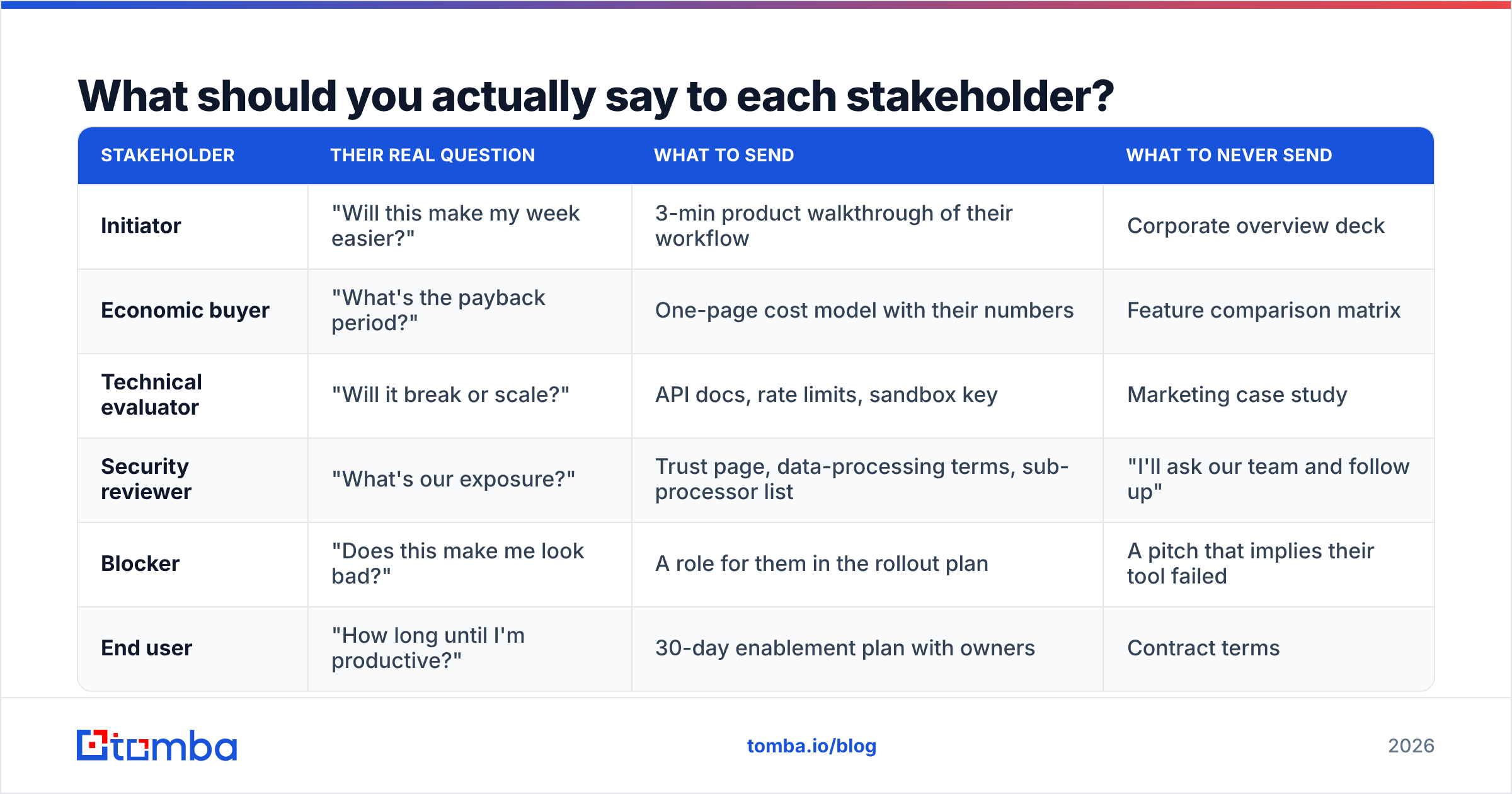
Same story, different proof. Rewriting the narrative per persona confuses your champion when the group compares notes.
| Stakeholder | Their real question | What to send | What to never send |
|---|---|---|---|
| Initiator | "Will this make my week easier?" | 3-min product walkthrough of their workflow | Corporate overview deck |
| Economic buyer | "What's the payback period?" | One-page cost model with their numbers | Feature comparison matrix |
| Technical evaluator | "Will it break or scale?" | API docs, rate limits, sandbox key | Marketing case study |
| Security reviewer | "What's our exposure?" | Trust page, data-processing terms, sub-processor list | "I'll ask our team and follow up" |
| Blocker | "Does this make me look bad?" | A role for them in the rollout plan | A pitch that implies their tool failed |
| End user | "How long until I'm productive?" | 30-day enablement plan with owners | Contract terms |
Two rules make this work. First, never send a stakeholder something written for a different stakeholder — economic buyers can smell a repurposed technical doc instantly. Second, keep one consistent claim across all six. If your ROI story changes between the CFO and the RevOps lead, the deal dies in the comparison.
How do you know it's working?#
Activity metrics lie at this stage of the market. Track these instead:
- Buying-group coverage. Contacts engaged ÷ estimated group size. Under 3 engaged contacts, forecast the deal at half whatever your rep says.
- Multi-thread depth by stage. Deals with 4+ engaged contacts at proposal stage close at materially higher rates than single-threaded ones — and, more importantly, stall far less often.
- Time-to-second-stakeholder. How many days from first reply to a second person joining the thread. Shorter is a leading indicator of a real deal.
- Data health. Bounce rate, catch-all share, and percentage of CRM records enriched in the last 90 days. Pair a catch-all verifier with routine data enrichment so records don't silently rot between quarters.
- No-decision rate. Losses to competitors teach you positioning. Losses to inertia teach you that your champion couldn't build a case. The second number is usually bigger and almost never tracked.
Analyst firms including Forrester have argued for years that pipeline quality metrics beat volume metrics for forecasting accuracy. In practice, the simplest useful change is adding one required field to your opportunity record: number of engaged stakeholders. It will embarrass your forecast for a quarter and then improve it permanently.
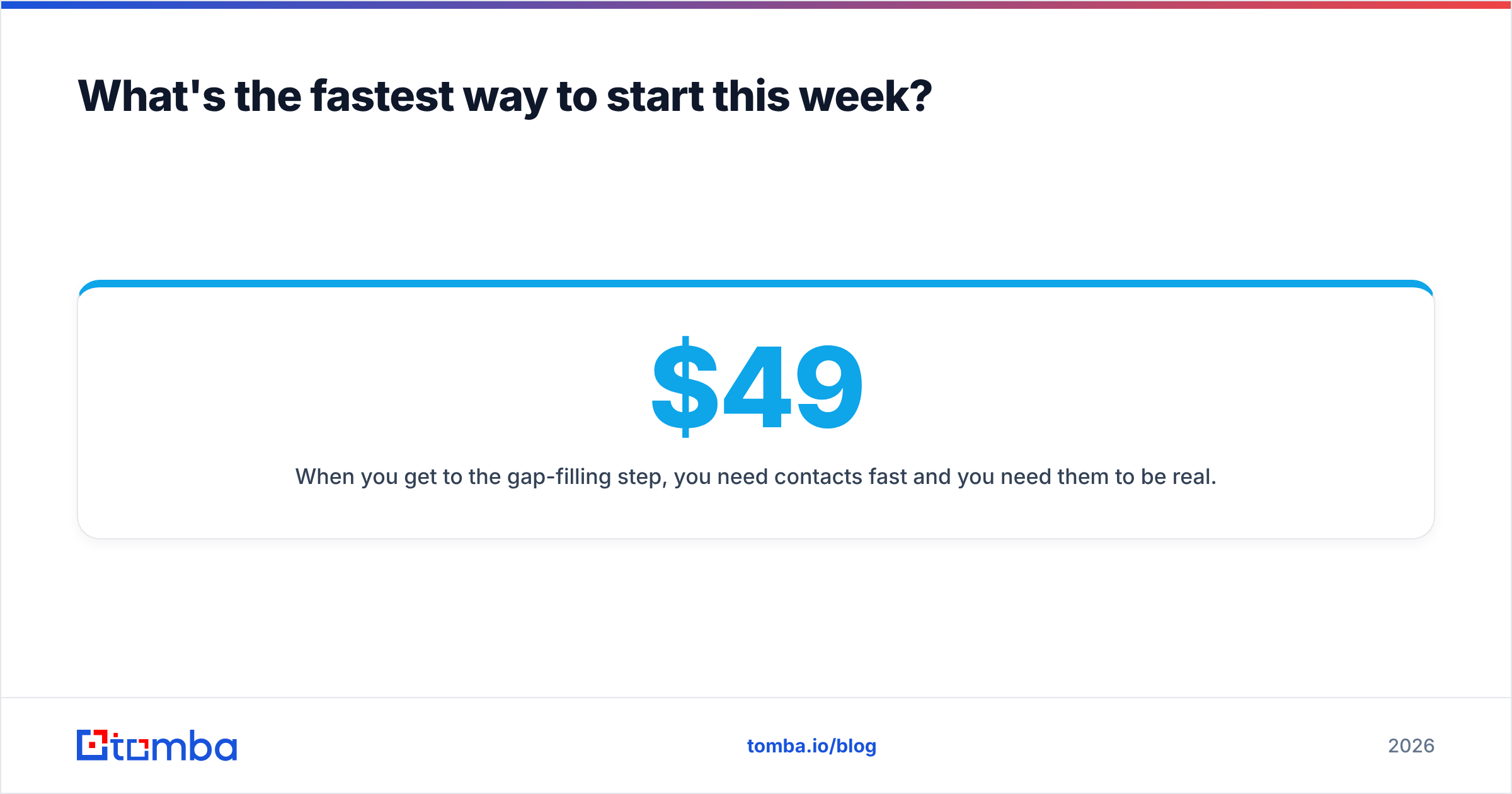
What's the fastest way to start this week?#
Pick your ten most valuable open opportunities. For each, list the six roles from the buying-group section and mark which ones you have a verified contact for. You will almost certainly find that half your pipeline is single-threaded. Fill the gaps, verify the addresses, send each new contact a message written for their question — not your product — and re-forecast in two weeks.
That exercise costs an afternoon and typically surfaces more revenue than a month of new prospecting.
When you get to the gap-filling step, you need contacts fast and you need them to be real. Tomba's Email Finder resolves professional addresses from a domain and a name, returns a confidence score with the sources behind it, and runs verification in the same workflow — so the contacts you add to a live deal actually receive what you send. Start on the free tier at 25 searches a month, or move to Starter at $49/mo when you're mapping buying groups across a full territory; full Tomba pricing is public, including Growth at $99/mo and Pro at $249/mo. Map the group, verify the addresses, then go write something worth reading.
Related guides#
Ready to find emails that actually work?
Join 150,000+ professionals who stopped guessing and started sending. Free credits on signup — no credit card required.
Get the Tomba newsletter
Practical outbound tactics and product updates — once every two weeks.
About the author