How to Sell to CFO Buyers in 2026: Complete Playbook
CFOs kill more deals than any other buyer — and they rarely tell you why. Here's how to build a business case, price your pitch, and get finance to say yes.
Knowing how to sell to CFO buyers is less about your product and more about capital allocation. This playbook breaks the finance conversation into seven moves: payback math, risk framing, and the one-page business case that gets budget approved.
TL;DR
- CFOs do not buy products. They buy a defensible allocation of capital they can explain to the CEO and the board.
- The single biggest reason deals die in finance review is not price — it's an unquantified payback period. If you can't state months-to-payback, you're a "maybe next quarter."
- Lead with the cost of inaction, not the feature list. Finance leaders anchor on downside risk before upside.
- Bring three numbers to every CFO conversation: total cost of ownership, expected annual benefit, and the confidence interval around that benefit.
- Get to the CFO early through your champion, with a one-page business case they can forward without editing.
Why do CFOs kill deals your champion already loved?#
Because your champion sells on capability and the CFO buys on capital allocation. Those are different currencies.
Your VP of Sales champion sees a tool that removes friction from her week. The CFO sees a line item that competes with a headcount req, a security audit, and a warehouse migration. When your deal reaches finance, the comparison changes. It is no longer measured against "doing nothing." It is measured against every other request in the queue. Most reps never adjust the pitch for that switch.
Think of it like a family budget. Your teenager wants a new laptop and can list twelve reasons it's better than the old one. The parent paying for it is asking a different question: what breaks if we wait six months, and what else does this $1,800 not buy? Neither party is wrong. They're evaluating on different axes.
Finance leaders in 2026 face more scrutiny than they did in the ZIRP era. Gartner's finance research tracks a steady shift toward cost discipline. Teams are cutting overlapping software. So your deal is not just up against rival tools. It is up against the CFO's standing project to shrink the vendor list.
What does a CFO actually care about?#
Five things, roughly in this order:
- Payback period. How many months until the cumulative benefit exceeds the cumulative cost? Under 12 months is easy to approve. Over 24 months needs a strategic story attached.
- Cash flow timing. Annual prepay hits this quarter's cash. Monthly billing spreads it. A CFO will sometimes pay 15% more in total to avoid a lumpy cash outflow — and sometimes the exact opposite, if there's budget to burn before year-end.
- Risk of the status quo. What is currently leaking? Missed quota, compliance exposure, churn, manual hours. Quantified, not implied.
- Downside if it fails. Contract length, exit terms, data portability, switching cost. A 12-month lock-in with no out clause raises the bar on everything else.
- Who owns the outcome. Finance wants a named internal person accountable for the promised result. If nobody owns it, the number is fiction.
Notice what isn't on the list: your feature roadmap, your funding round, your G2 badge count. Those matter to your champion. They're noise to finance unless you translate them into one of the five items above.
How do you build a business case a CFO will actually forward?#
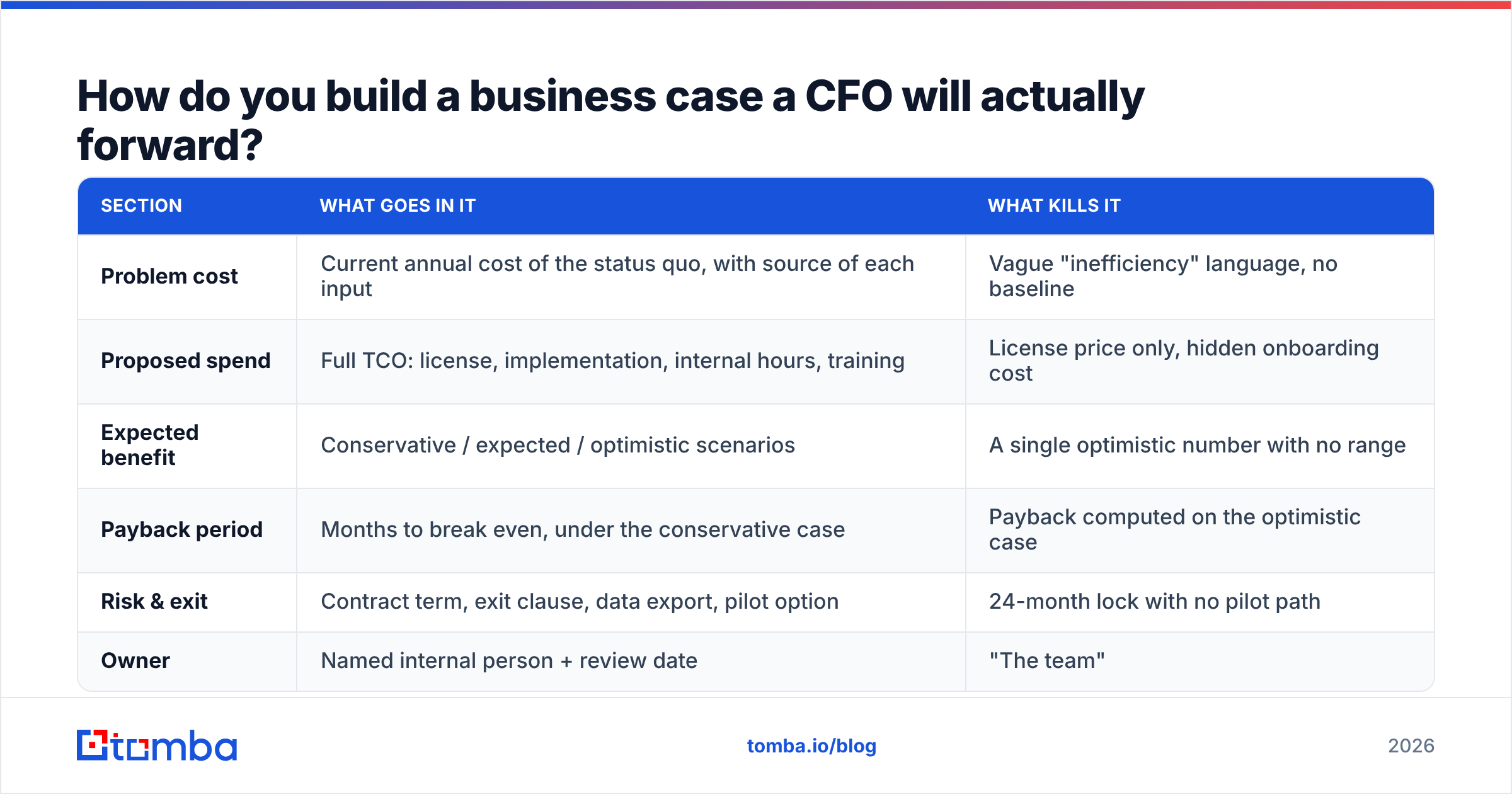
One page. Three numbers. Assumptions stated in plain English so finance can argue with them.
Most sellers build a slick ROI calculator that spits out one giant number — "$1.4M in annual value!" — with no visible assumptions. A CFO sees an unexplained number and divides it by three. Show your work instead. Let them adjust the inputs themselves. A business case the CFO can edit is one the CFO now co-owns.
Here's the structure that survives finance review:
| Section | What goes in it | What kills it |
|---|---|---|
| Problem cost | Current annual cost of the status quo, with source of each input | Vague "inefficiency" language, no baseline |
| Proposed spend | Full TCO: license, implementation, internal hours, training | License price only, hidden onboarding cost |
| Expected benefit | Conservative / expected / optimistic scenarios | A single optimistic number with no range |
| Payback period | Months to break even, under the conservative case | Payback computed on the optimistic case |
| Risk & exit | Contract term, exit clause, data export, pilot option | 24-month lock with no pilot path |
| Owner | Named internal person + review date | "The team" |
Use the conservative case as your headline. If your conservative case still shows a sub-12-month payback, you've removed the CFO's most reliable objection before it's raised. If it doesn't, you now know your deal needs either a smaller starting footprint or a longer strategic argument.
What are the real numbers behind a sales-tech business case?#
Take a concrete example, because abstractions don't get approved.
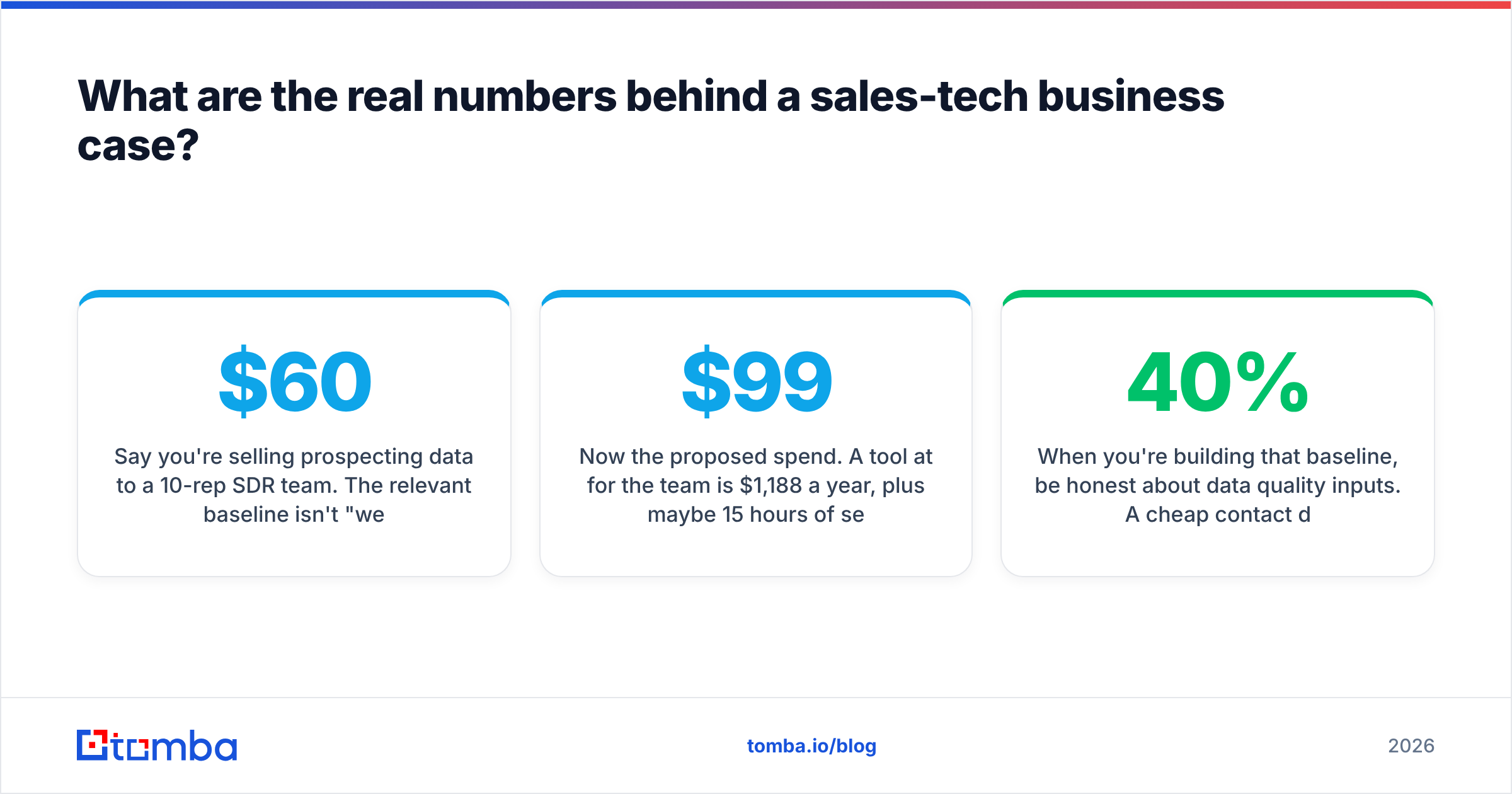
Say you're selling prospecting data to a 10-rep SDR team. The relevant baseline isn't "we need better data" — it's the hours those reps spend building lists and the bounce rate they're absorbing. If each rep spends six hours a week on manual research at a $60/hour fully loaded cost, that's $187,200 a year in research labor. If 22% of sends bounce, you also burn sender reputation. That quietly drags down every conversion rate after it.
Now the proposed spend. A tool at $99/month for the team is $1,188 a year, plus maybe 15 hours of setup. Against $187,200 of research labor, the payback math isn't close — it's under a week. That's the shape of business case a CFO approves without a meeting.
This works because you priced the problem first. Most reps price the solution first and then scramble to justify it. Flip the order and the conversation changes character. You're not asking for budget. You're pointing out an existing leak and offering a cheaper patch.
When you build that baseline, be honest about data quality inputs. A cheap contact database that returns 40% invalid addresses costs more than a good one. The waste shows up in three places: wasted send volume, damaged domains, and rep time chasing dead leads. Run your list through an email verifier before a campaign. Finance grasps that line item at once, because it maps to a measurable cut in wasted spend.
How should you compare vendors when finance is in the room?#
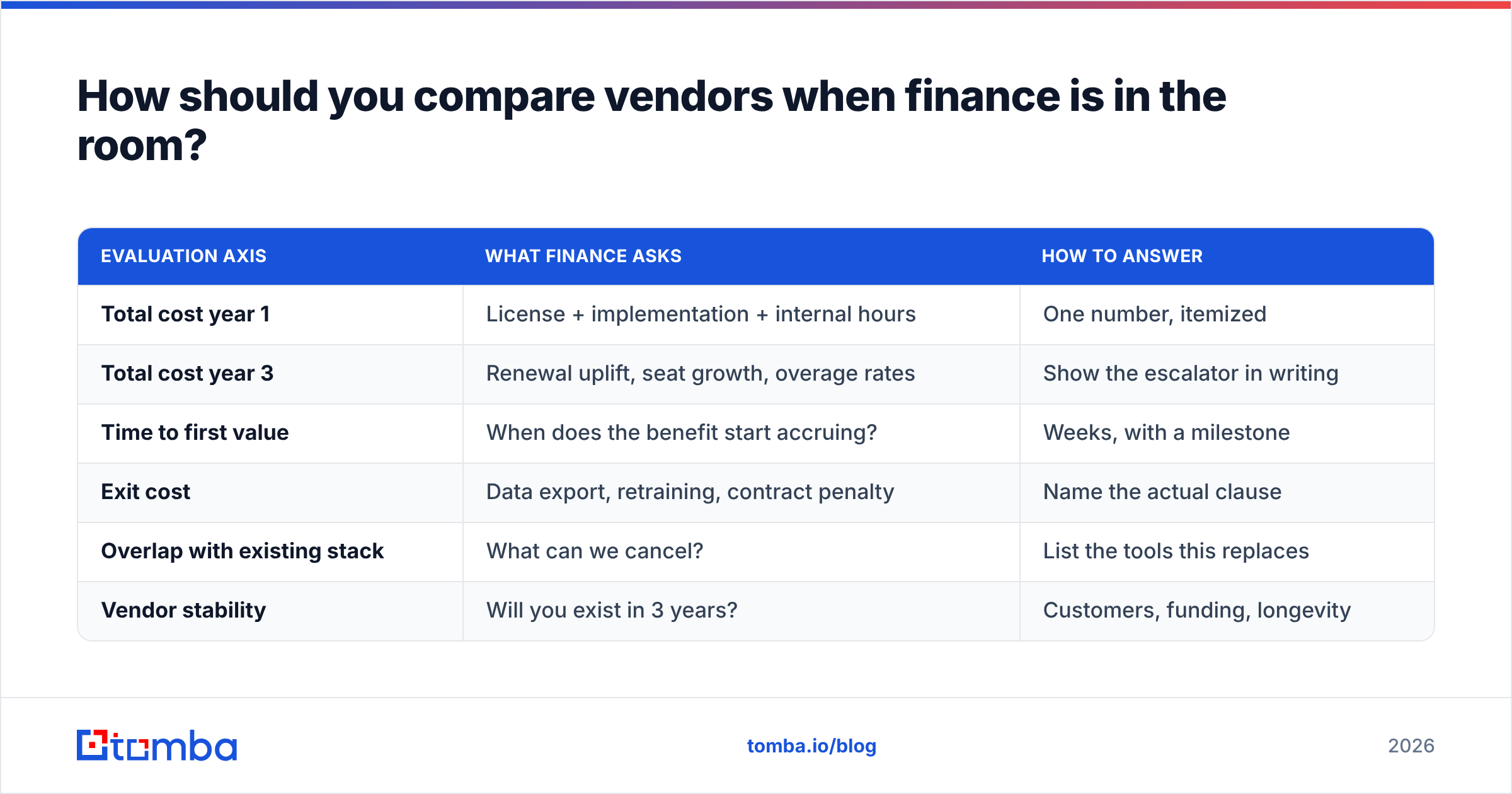
Give the CFO the comparison they'd otherwise build themselves — including your competitors. This feels counterintuitive and it is the fastest trust-builder available to you.
| Evaluation axis | What finance asks | How to answer |
|---|---|---|
| Total cost year 1 | License + implementation + internal hours | One number, itemized |
| Total cost year 3 | Renewal uplift, seat growth, overage rates | Show the escalator in writing |
| Time to first value | When does the benefit start accruing? | Weeks, with a milestone |
| Exit cost | Data export, retraining, contract penalty | Name the actual clause |
| Overlap with existing stack | What can we cancel? | List the tools this replaces |
| Vendor stability | Will you exist in 3 years? | Customers, funding, longevity |
That last row on overlap is the one that wins deals in 2026. A CFO approving $12,000 of new spend is a hard sell. A CFO approving $12,000 of new spend that lets them cancel $19,000 of existing licenses is a hero. Do the stack audit for them. Ask your champion what else sits in the tooling budget and find honest overlap. If there is none, say so. The trust you bank is worth more than a made-up saving.
Independent sources carry weight here that your deck never will. Point them to G2's category grids or peer review data rather than asking them to trust your comparison. A CFO who verifies one of your claims independently will trust the other nine.
How to sell to CFO buyers: when do you bring finance in?#
Earlier than feels comfortable. Not at the end, when you need a signature.
The standard motion — build consensus with the user, get the VP on board, then "loop in finance for approval" — treats the CFO as an obstacle to route around. Finance knows when it is being routed around. The response is predictable: more questions, longer timelines, deeper discounts.
The better sequence:
- Discovery with the practitioner. Understand the workflow and quantify the current cost. Get real numbers, not estimates.
- Validate with the economic buyer's proxy. Ask your champion: "When this goes to finance, what will they push back on?" Champions almost always know.
- Co-build the business case with your champion. Their numbers, your template. They present it, not you.
- Offer a finance-specific conversation. Fifteen minutes, one page, focused on payback and exit terms. Not a demo.
- Give them a smaller first step. A pilot with a defined success metric de-risks the whole decision and shortens the approval chain.
Step three is where most deals are won. A business case the champion built is one the champion will defend in a meeting you are not invited to. That meeting is where the real decision happens.

What language should you use — and avoid?#
Swap capability words for capital words. It's a near-mechanical translation.
| Don't say | Say instead |
|---|---|
| "Our platform is AI-powered" | "This removes 6 hours/rep/week of manual work" |
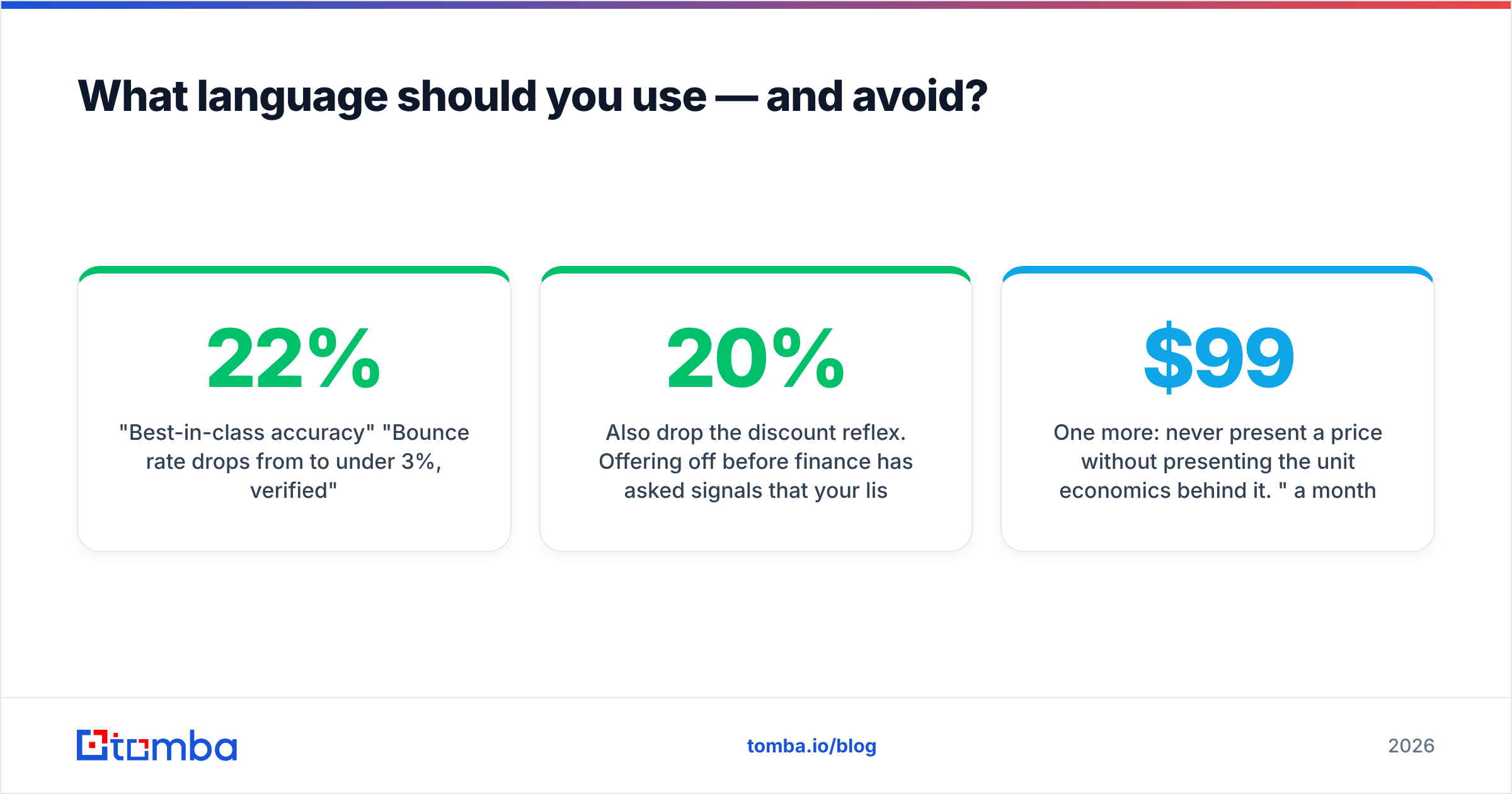
| "Best-in-class accuracy" | "Bounce rate drops from 22% to under 3%, verified" |
| "Enterprise-grade" | "SOC 2 Type II, DPA available, EU data residency" |
| "Great ROI" | "Payback in 4.2 months on the conservative case" |
| "Flexible pricing" | "Monthly billing available; no seat minimum until month 6" |
| "Trusted by 5,000 companies" | "Three references in your industry, same headcount band" |
Also drop the discount reflex. Offering 20% off before finance asks signals that your list price was fiction. That invites a deeper cut and weakens every number in your business case. If you must concede, trade. A longer term for a better rate. A case study for a pilot discount. Annual prepay for a locked renewal rate. Concessions that cost the buyer something protect your pricing.
One more rule. Never present a price without the unit economics behind it. "$99 a month" invites comparison to the cheapest thing in the category. "$99 a month, which is $0.06 per verified contact against a $60/hour research cost" reframes the number as a rate. Rates are what finance compares.
How do you handle the four objections finance always raises?#
"We don't have budget this year." Usually true and usually not final. Ask which budget line the spend would come from, and whether there's an existing line it could displace. Mid-year, the answer is often a renewal that's already underperforming. Offer to time the start date to that renewal.
"Can we do this with what we already have?" Sometimes yes — say so if it's true. When it's not, be specific about the gap rather than dismissive. "You can export from your CRM, but it won't tell you which of those 4,000 records are still valid, and re-verifying manually is the six hours we measured."
"What happens if it doesn't work?" This is the exit-terms question in disguise. Have a real answer: a pilot period, a defined success metric, a documented exit path, data export in a standard format. Vague reassurance reads as evasion.
"Why now?" The cost-of-delay question. Compute it. If the annual benefit is $180,000, every month of delay costs $15,000. That framing turns a deferral into an active decision with a price tag, which is much harder to sign off on than a passive "let's revisit next quarter."
What tooling actually supports a finance-friendly sales motion?#
The connective tissue is measurement. If you can't show finance what changed, you can't renew on outcomes. You renew on goodwill, and goodwill doesn't survive a budget cut.
In practice, instrument three things before the pilot starts: baseline hours, baseline data quality, and baseline conversion. Capture them in a shared doc your champion owns. When the renewal conversation comes, you're not arguing about value. You're reading a scoreboard both sides agreed to.
On the data side, this is where the accuracy of your contact sourcing shows up in a CFO's numbers. You may pull contacts via domain search for target-account lists, or enrich inbound records. Either way, the verification step is what turns "we bought a data tool" into a defensible cut in wasted send volume. Peers like BookYourData have built solid businesses on exactly this premise: verified, delivery-tested data is a finance-grade input, not a nice-to-have. Compare Tomba pricing against your current per-contact cost and the business case usually writes itself.
The point isn't the tool. A measurable input produces a measurable output, and measurable outputs are the only thing a CFO can defend to a board. That is the core of how to sell to CFO buyers.
Ready to build the numbers?#
If your CFO conversation stalls on data quality — bounce rates, invalid records, hours lost to manual research — start by fixing the input. The Tomba Email Finder gives you verified professional email addresses by domain, name, or company. The free tier includes 25 searches a month, so you can benchmark accuracy against your current source before you spend anything. Run 200 contacts through it, measure the bounce delta, and put that number in your business case. That is the kind of evidence finance signs off on, and it is the shortest path to how to sell to CFO buyers on their own terms.
Related guides#
// get started
Find, verify and enrich your first contacts today
Start on the free plan with 25 searches a month, then scale when your team is ready.
Free plan · No credit card required · GDPR & CCPA
// about the author