How To Sell Value Not Price: The 2026 B2B Framework
Discounting is a symptom, not a strategy. Here is a step-by-step framework for selling value instead of price — discovery questions, ROI math, and the exact language to use when a buyer asks what your best offer is.
TL;DR
- Price objections are usually value-communication failures, not pricing failures. If the buyer cannot repeat your business case back to you, they will negotiate on the only number they understand.
- Value selling runs on arithmetic: cost of the current state, cost of inaction, and expected return — all in the buyer's own numbers, not your marketing claims.
- The highest-leverage moment is discovery, not the close. You cannot quantify value you never asked about.
- Build a one-page value model per deal (metric, baseline, target, dollar impact, timeline). Deals with a written model discount less and churn less.
- When the discount ask comes, trade instead of concede: shorter term, faster payment, case study, multi-seat commitment. Never give price away for free.
What does "sell value not price" actually mean?#
It means you move the conversation from what your product costs to what the buyer's problem costs them. Those are two different numbers, and the second one is almost always bigger.
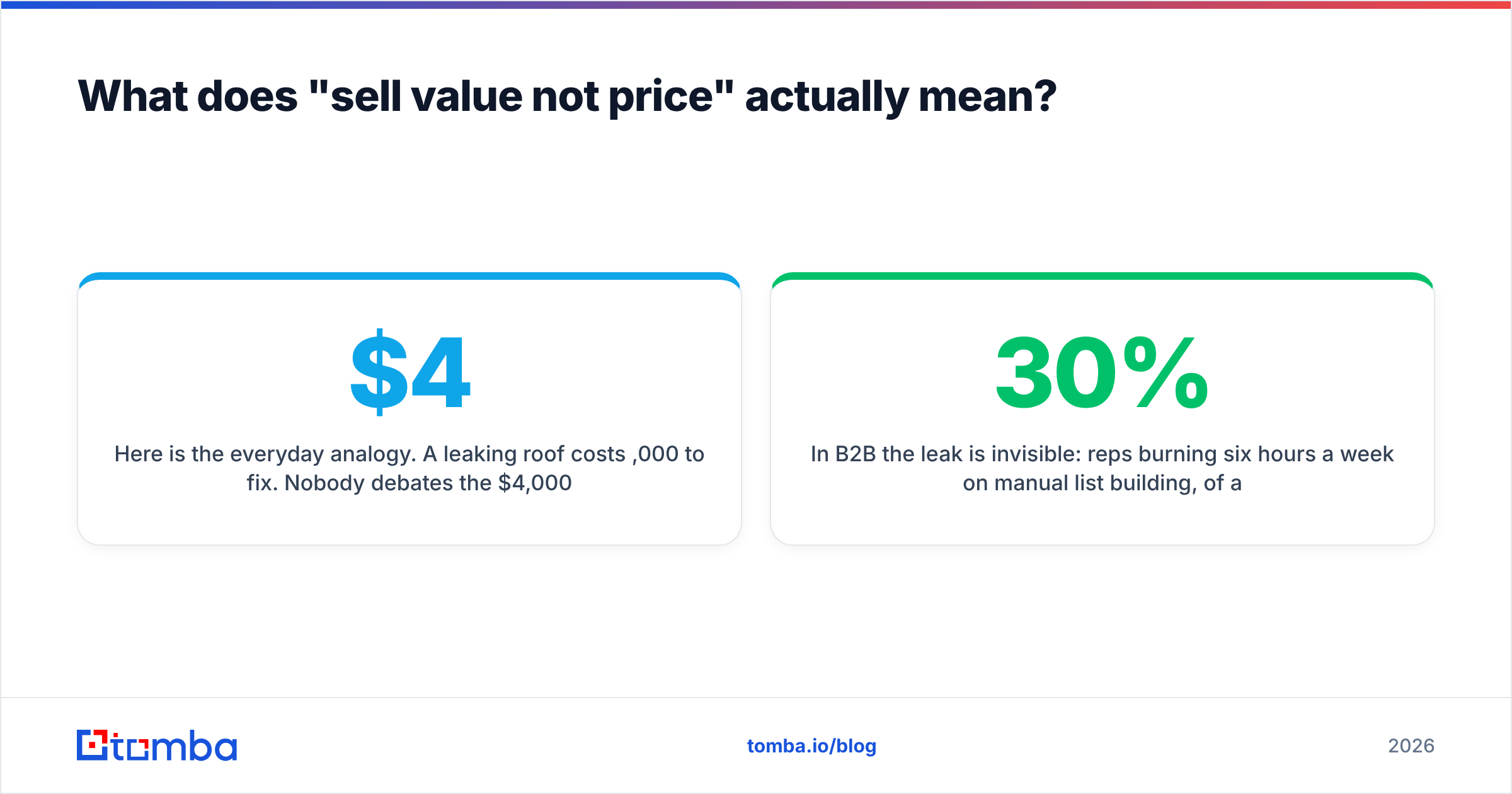
Here is the everyday analogy. A leaking roof costs $4,000 to fix. Nobody debates the $4,000 in isolation — they debate it against the $40,000 of water damage that arrives next winter. The roofer who leads with "$4,000, but I can do $3,600" is negotiating against himself. The roofer who leads with photos of the joists, a damage estimate, and a timeline is selling value. Same roof, same price, completely different conversation.
In B2B the leak is invisible: reps burning six hours a week on manual list building, 30% of a sequence bouncing because contact data is stale, an SDR team hitting 1.2% reply rates because they are emailing people who left the company in 2024. None of that shows up on a P&L line called "waste," so nobody prices it — until you do it for them.
Value selling is not a personality trait or a closing trick. It is a repeatable sequence:
- Find the metric that matters — the number the buyer's boss asks about in QBRs. Pipeline created, cost per meeting, gross margin, ramp time, churn rate.
- Establish the baseline — where that number sits today, stated by the buyer, in writing.
- Quantify the gap — what the number would be if the problem disappeared, and what that delta is worth in dollars per quarter.
- Attach cost of inaction — what the gap costs for every month the decision slips.
- Map your capability to the gap — one line per capability, tied to the specific number it moves.
- Agree on proof — the pilot, the reference call, or the trial that makes the model believable.
Notice that steps 1 through 4 contain zero product talk. That is the point. Gartner's B2B buying research has been saying the same thing for years: buyers spend the majority of the purchase cycle not talking to you, and the vendors who win are the ones who help them make sense of their own problem rather than the ones who pitch hardest.
Why do buyers push back on price in the first place?#
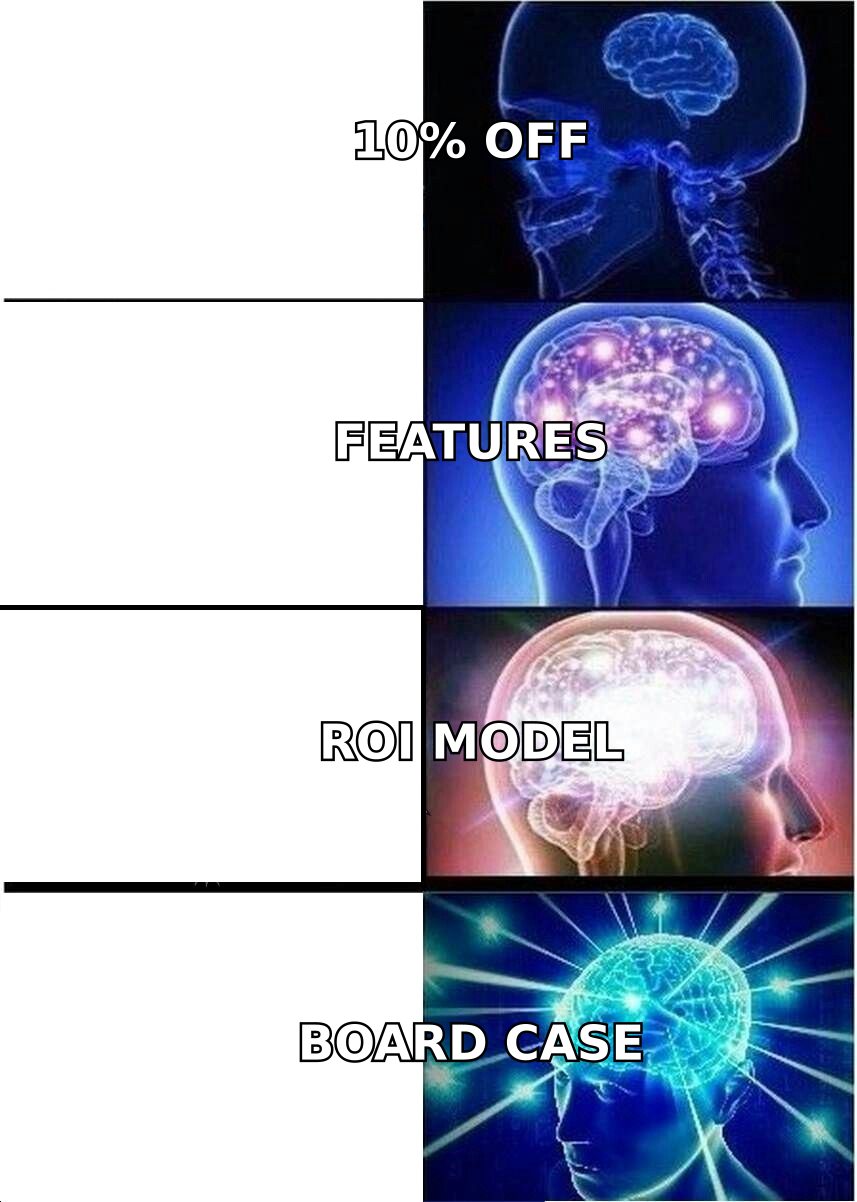
Because price is the only variable they can evaluate without expertise. If two vendors both say "AI-powered," "best-in-class accuracy," and "seamless integration," the buyer has no basis for comparison except the number at the bottom of the quote. You made price the deciding factor by failing to make anything else measurable.
There are four common root causes behind a price objection, and each has a different fix:
- No quantified problem. The buyer likes the demo but cannot articulate what it saves. Fix: go back to discovery, even at proposal stage.
- Wrong stakeholder. You quantified value for a user, not for the person who owns the budget. A rep cares about time saved; a VP cares about pipeline per rep. Fix: rebuild the model in the economic buyer's units.
- Genuine budget ceiling. The value is understood and the money does not exist this quarter. Fix: restructure — smaller scope, phased rollout, different start date.
- Procurement theater. The discount ask is a job function, not a signal. Fix: trade, don't concede.
Only the third is actually about price. The other three are about clarity, and discounting will not fix any of them — it will just teach the buyer that your list price was fiction.
How do you build a value model in one page?#
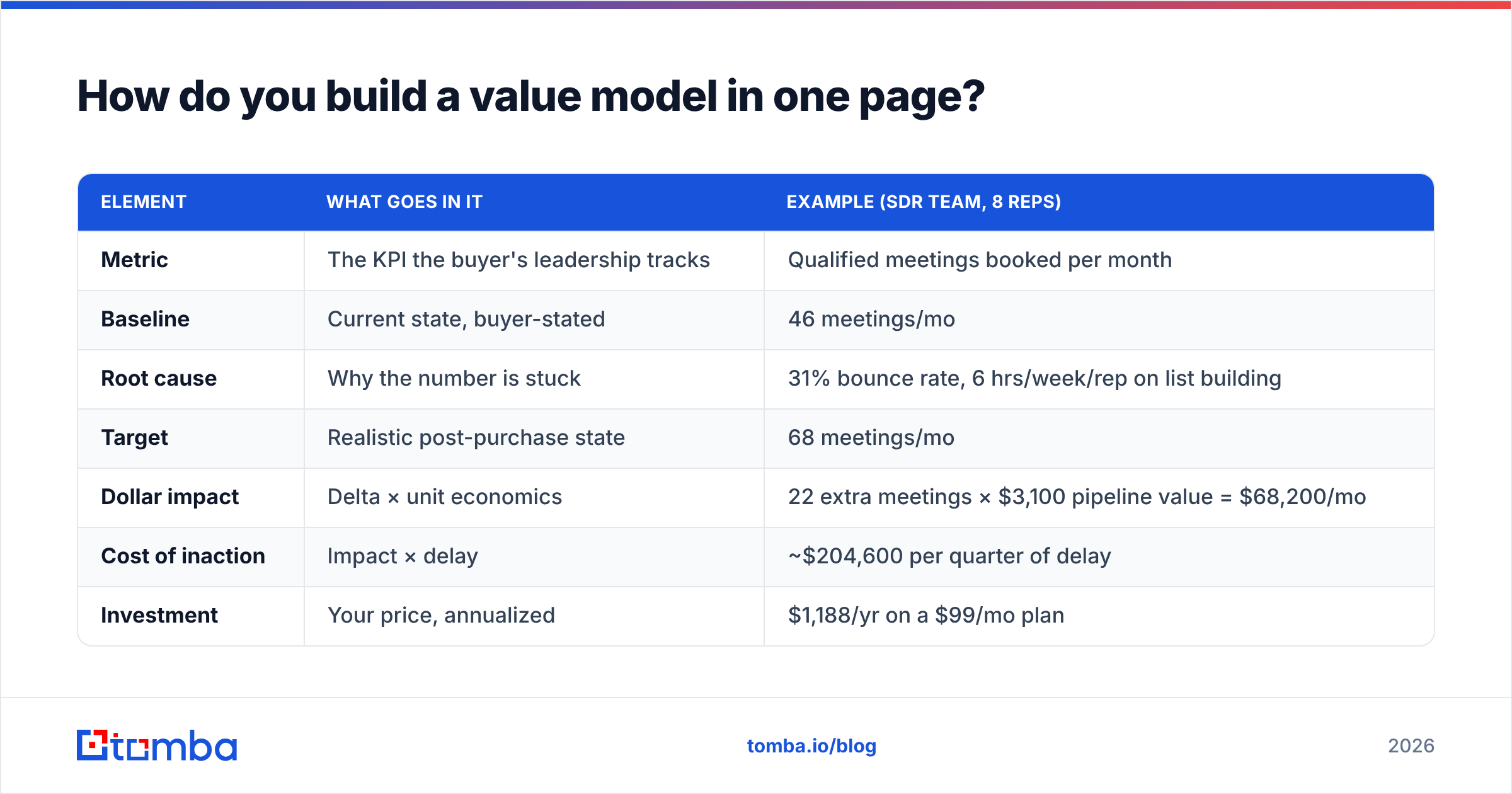
The one-page value model is the core artifact of this whole approach. It is not a slide deck. It is a table you build with the buyer on a call, then send back as the meeting summary.
| Element | What goes in it | Example (SDR team, 8 reps) |
|---|---|---|
| Metric | The KPI the buyer's leadership tracks | Qualified meetings booked per month |
| Baseline | Current state, buyer-stated | 46 meetings/mo |
| Root cause | Why the number is stuck | 31% bounce rate, 6 hrs/week/rep on list building |
| Target | Realistic post-purchase state | 68 meetings/mo |
| Dollar impact | Delta × unit economics | 22 extra meetings × $3,100 pipeline value = $68,200/mo |
| Cost of inaction | Impact × delay | ~$204,600 per quarter of delay |
| Investment | Your price, annualized | $1,188/yr on a $99/mo plan |
| Proof step | What makes it believable | 14-day pilot on one territory |
Three rules make this table work.
Every number comes from the buyer. If you supply the baseline, it is your claim. If they supply it, it is their commitment. Ask: "What's your current bounce rate on outbound?" and then shut up.
Round conservatively. A model that promises a 12x return gets dismissed. A model that promises 3.4x and shows its arithmetic survives the CFO. Under-promise inside the model itself.
Include the cost of inaction line. This is the single most underused row in B2B selling. Most deals do not die to a competitor; they die to "let's revisit next quarter." Putting a monthly dollar figure on delay reframes the decision from "should we buy" to "how long can we afford to wait."
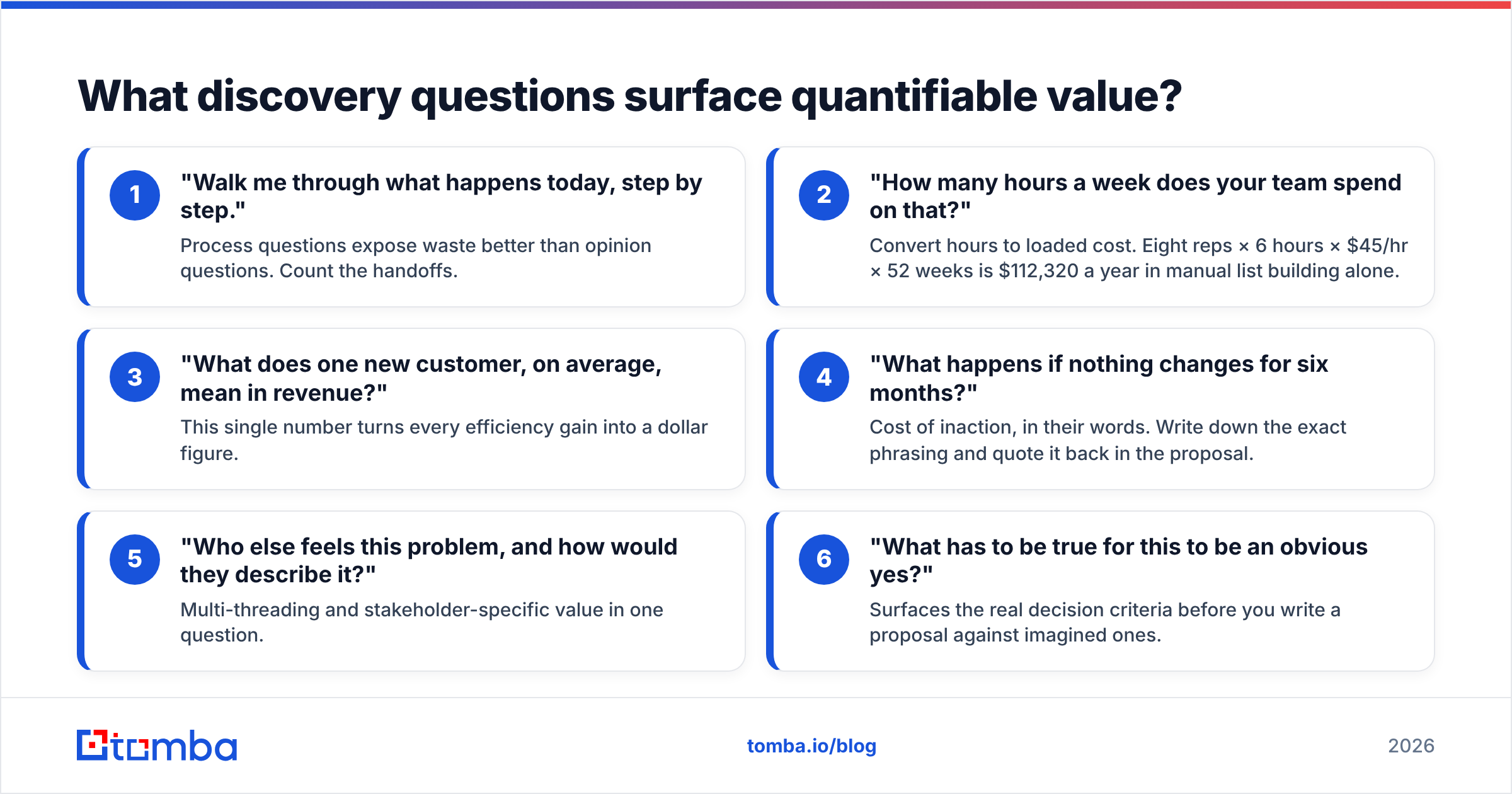
What discovery questions surface quantifiable value?#
You cannot build the table above from a generic discovery call. These questions are engineered to produce numbers rather than adjectives.
- "Walk me through what happens today, step by step." Process questions expose waste better than opinion questions. Count the handoffs.
- "How many hours a week does your team spend on that?" Convert hours to loaded cost. Eight reps × 6 hours × $45/hr × 52 weeks is $112,320 a year in manual list building alone.
- "What does one new customer, on average, mean in revenue?" This single number turns every efficiency gain into a dollar figure.
- "What happens if nothing changes for six months?" Cost of inaction, in their words. Write down the exact phrasing and quote it back in the proposal.
- "Who else feels this problem, and how would they describe it?" Multi-threading and stakeholder-specific value in one question.
- "What has to be true for this to be an obvious yes?" Surfaces the real decision criteria before you write a proposal against imagined ones.
The follow-up matters as much as the question. When a buyer says "it's a big time sink," the correct response is not sympathy — it is "how big?" Push politely until you have an integer. A strong discovery process is where deal margin is actually created; the negotiation at the end just reveals whether you did the work.
Is value selling better than price competing?#
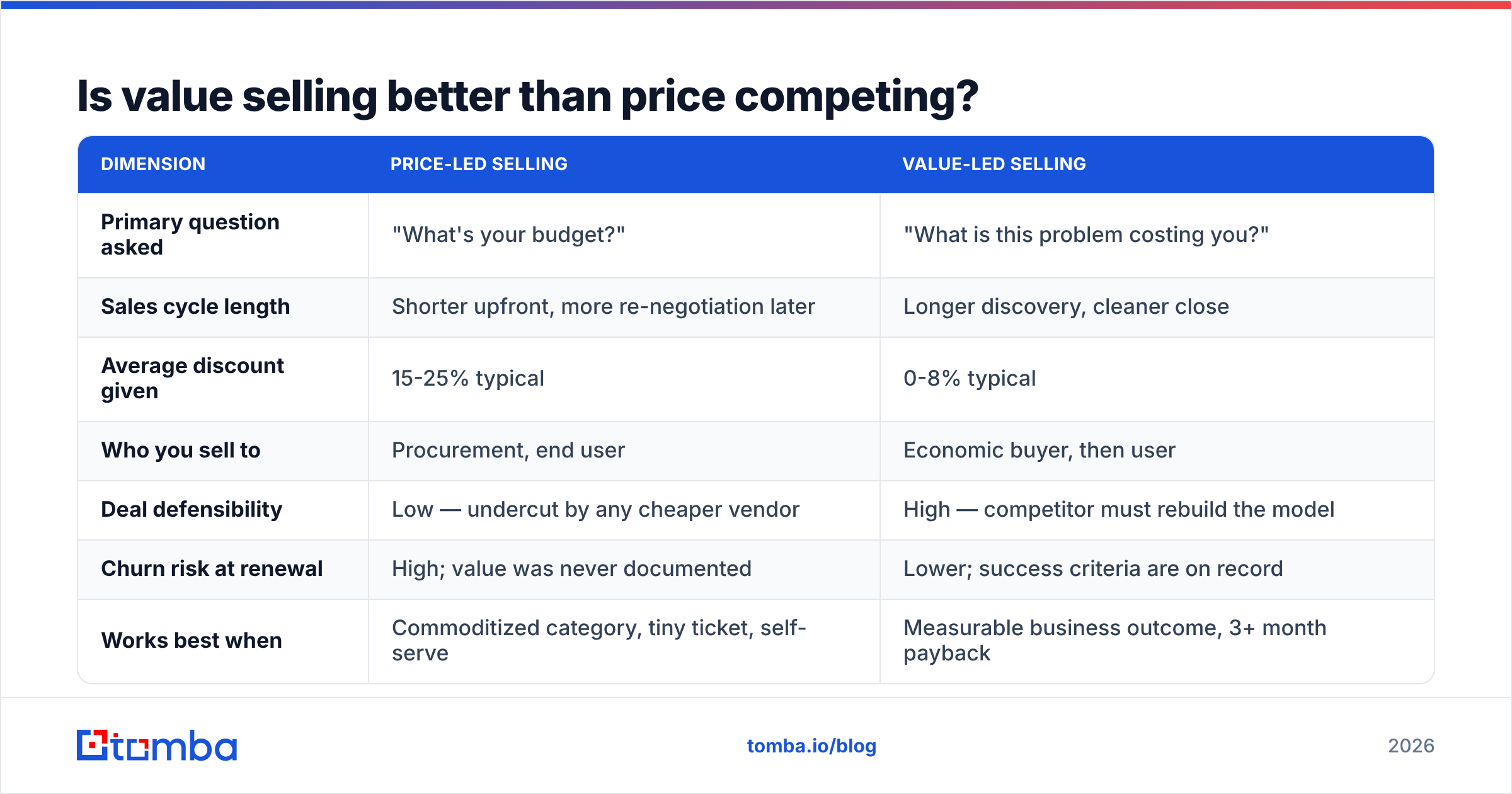
For most B2B products, yes — but the honest answer is that it depends on your category's maturity and your data quality. Here is a side-by-side.
| Dimension | Price-led selling | Value-led selling |
|---|---|---|
| Primary question asked | "What's your budget?" | "What is this problem costing you?" |
| Sales cycle length | Shorter upfront, more re-negotiation later | Longer discovery, cleaner close |
| Average discount given | 15-25% typical | 0-8% typical |
| Who you sell to | Procurement, end user | Economic buyer, then user |
| Deal defensibility | Low — undercut by any cheaper vendor | High — competitor must rebuild the model |
| Churn risk at renewal | High; value was never documented | Lower; success criteria are on record |
| Works best when | Commoditized category, tiny ticket, self-serve | Measurable business outcome, 3+ month payback |
| Fails when | Buyer has genuine hard budget cap | You have no access to real usage or outcome data |
Value selling is not free. It costs you discovery time and it requires that you actually know your customers' unit economics. If your product genuinely is a commodity with no measurable outcome, forcing a value model will read as theater. Be honest about which of the two you are in, and note that the same rep can run both motions across different segments.
What do you say when they ask for a discount?#
Trade, don't concede. Every concession needs a counterparty concession, stated in the same sentence. Some patterns that hold up under pressure:
- The reciprocity trade. "I can get you to that number on a 24-month term instead of 12. Does the longer commitment work on your side?"
- The scope trade. "I can hit your budget — we'd drop from the Pro tier to Growth, which means bulk enrichment moves to manual. Is that trade worth $150 a month to you?"
- The proof redirect. "Before we talk about price, can we agree the model is right? If 22 extra meetings a month is the real number, we're arguing about 0.6% of the return."
- The timing trade. "Annual prepay instead of monthly gets you there. Can finance approve that this quarter?"
- The honest no. "I don't have room at this volume. What I can do is start you on the smaller tier and expand at renewal once the numbers are proven."
What you never say: "Let me see what I can do." That phrase tells the buyer the price was negotiable all along, and it invites a second ask. Once you discount without a trade, your model loses credibility retroactively — if the price was soft, maybe the ROI figures were too.
How does data quality underpin the whole approach?#
This is the part most value-selling advice skips. Every number in your model traces back to data you can actually observe. If you cannot see the buyer's bounce rate, reply rate, or reachable contact coverage, your model is guesswork dressed up in a table.
Three practical implications for outbound teams:
- Bad contact data corrupts the baseline. If 30% of a prospect list is undeliverable, every efficiency claim you make downstream is off by 30%. Running the list through an email verifier before you quote a reply-rate improvement keeps the model honest.
- Coverage determines addressable value. A model that assumes 500 reachable accounts falls apart if only 180 have findable decision-maker contacts. Running a domain search against the target account list gives you a real denominator before you promise anything.
- Enrichment turns a claim into evidence. Showing a prospect their own account list with titles, verified emails, and direct numbers filled in is more persuasive than any slide. Contact enrichment makes the before-and-after visible rather than theoretical.
The same discipline applies to your own forecast. Teams that track win rate by segment know which value models hold up and which ones are wishful. Review your closed-lost deals against the value model you built: where the model was specific and buyer-sourced, you will see a higher hit rate. Where it was generic, you will see discounting.
Peer-review sites like G2's sales-intelligence category are also worth mining for language — the phrases real buyers use to describe outcomes are better than anything in your own positioning doc, and they make your value model sound like the buyer wrote it.
What does a 30-day rollout look like?#
- Week 1 — Pick one metric per segment. Do not build twelve models. Pick the single KPI that your best three customers improved, and get the real numbers from them.
- Week 2 — Rewrite discovery. Replace two rapport questions with two quantification questions. Record calls and check whether reps are leaving with integers.
- Week 3 — Ship the one-pager template. One table, one page, sent as the recap after every discovery call. Make it a required field on the opportunity in your CRM.
- Week 4 — Run a discount audit. Pull every deal closed last quarter, tag which had a written value model, and compare average discount. That comparison is what gets the rest of the team to adopt it.
Then hold the line. The first two weeks after a team switches to value-led discovery are uncomfortable — cycles look longer and reps feel like they are stalling. Judge the change on discount percentage and win rate at 90 days, not on activity metrics at 14.
Where should you start?#
Start with the baseline you can actually measure this week: your list quality. Value models built on unverified contact data collapse the moment a prospect checks your math, and outbound efficiency claims are the easiest to verify or debunk. Get the denominator right first.
The Tomba Email Finder is a straightforward place to do that — find and verify decision-maker addresses by domain, name, or company so your reachable-account math is real rather than assumed. The free tier gives you 25 searches a month to sanity-check a target list before you commit to any number in a proposal, and paid plans start at $49/mo with Growth at $99/mo when you need volume; full Tomba pricing is public, so you can build your own ROI line against it. Build the model on numbers you can defend, and the price conversation stops being the hard part.
Related guides#
// get started
Find, verify and enrich your first contacts today
Start on the free plan with 25 searches a month, then scale when your team is ready.
Free plan · No credit card required · GDPR & CCPA
// about the author