How To Send A Follow Up Email That Actually Gets Replies
Most deals die in the gap between the first email and the second. Here is the exact timing, structure, and sequence length that turns silence into replies — plus the mistakes that get you ignored.
TL;DR
- Most replies to cold outreach come from message two through five, not message one. If you send once and stop, you are throwing away the majority of your pipeline.
- The best-performing cadence is 3–5 touches spread over 12–21 days, with gaps that widen (2 days, 3 days, 5 days, 7 days) rather than a fixed daily drip.
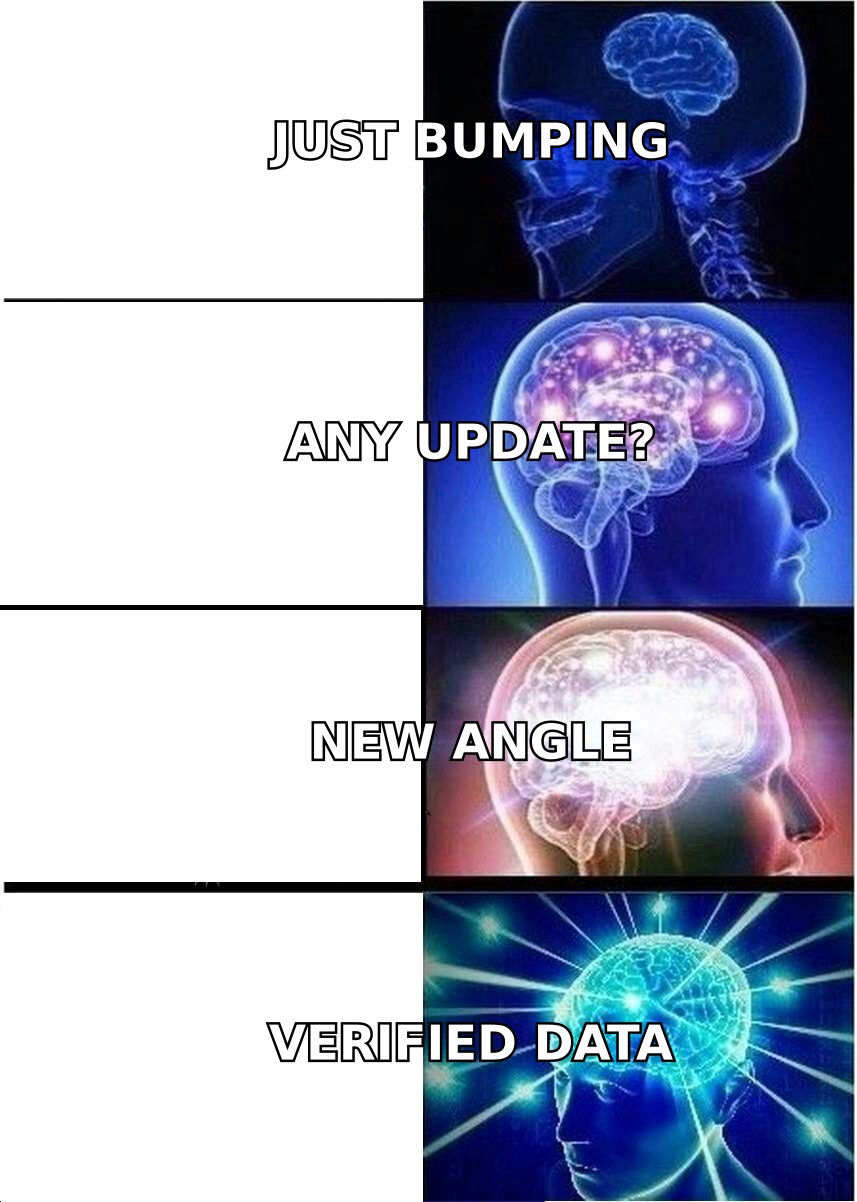
- A follow-up should never say "just bumping this." Every touch must add one new thing: a proof point, a resource, a different angle, or an explicit close.
- Deliverability kills more follow-up sequences than copy does. Bad addresses in the list spike your bounce rate, and the whole domain gets throttled before your second touch lands.
- Keep the thread. Reply in the same chain so the recipient sees context, and stop the sequence the moment they reply or open a support ticket about it.
Why do follow-up emails matter more than the first email?#
Because the first email almost never lands at the right moment. Your prospect is in a meeting, on a plane, mid-quarter-close, or triaging 180 unread messages. The first email is a coin flip on timing. The follow-up is where you buy more coin flips.
Sales teams consistently find that a large share of closed-won conversations began after the second or third contact — the exact percentage varies by industry and dataset, but the direction is never in question. HubSpot's sales research has documented this pattern across thousands of teams for years: persistence, done politely, compounds.
The uncomfortable part is that most reps quit early. They send one email, get nothing, and mentally file the prospect under "not interested." That prospect was never uninterested. They were busy.
What does a good follow-up email actually look like?#
Four lines. That's the target.
- Context line — one sentence tying back to the original message so they don't have to scroll. "Following my note about your Q3 hiring page."
- New information — a customer result, a benchmark, a relevant article, a question you didn't ask before. This is the only mandatory element, and it's the one most people skip.
- Single ask — one clear next step. "Worth 15 minutes Thursday?" Not "let me know your thoughts, or feel free to forward this, or check out our site."
- Easy exit — a line that lets them say no without friction. "If this isn't a priority, tell me and I'll close the loop."
That fourth line does more work than it looks like. It lowers the social cost of replying, and a "no" reply is worth more than silence — it frees your pipeline and protects your sender reputation from repeatedly hitting a disengaged address.
What to cut:
- "Just following up" — signals you have nothing new to say.
- "Did you see my last email?" — makes them feel guilty and gives them nothing.
- A recap of your entire pitch — they didn't read it the first time; length is not the fix.
- Fake urgency — "closing this out today" when you'll email again next week trains them to ignore you.
- Multiple CTAs — every extra option reduces the odds any one of them gets picked.
How long should you wait before following up?#
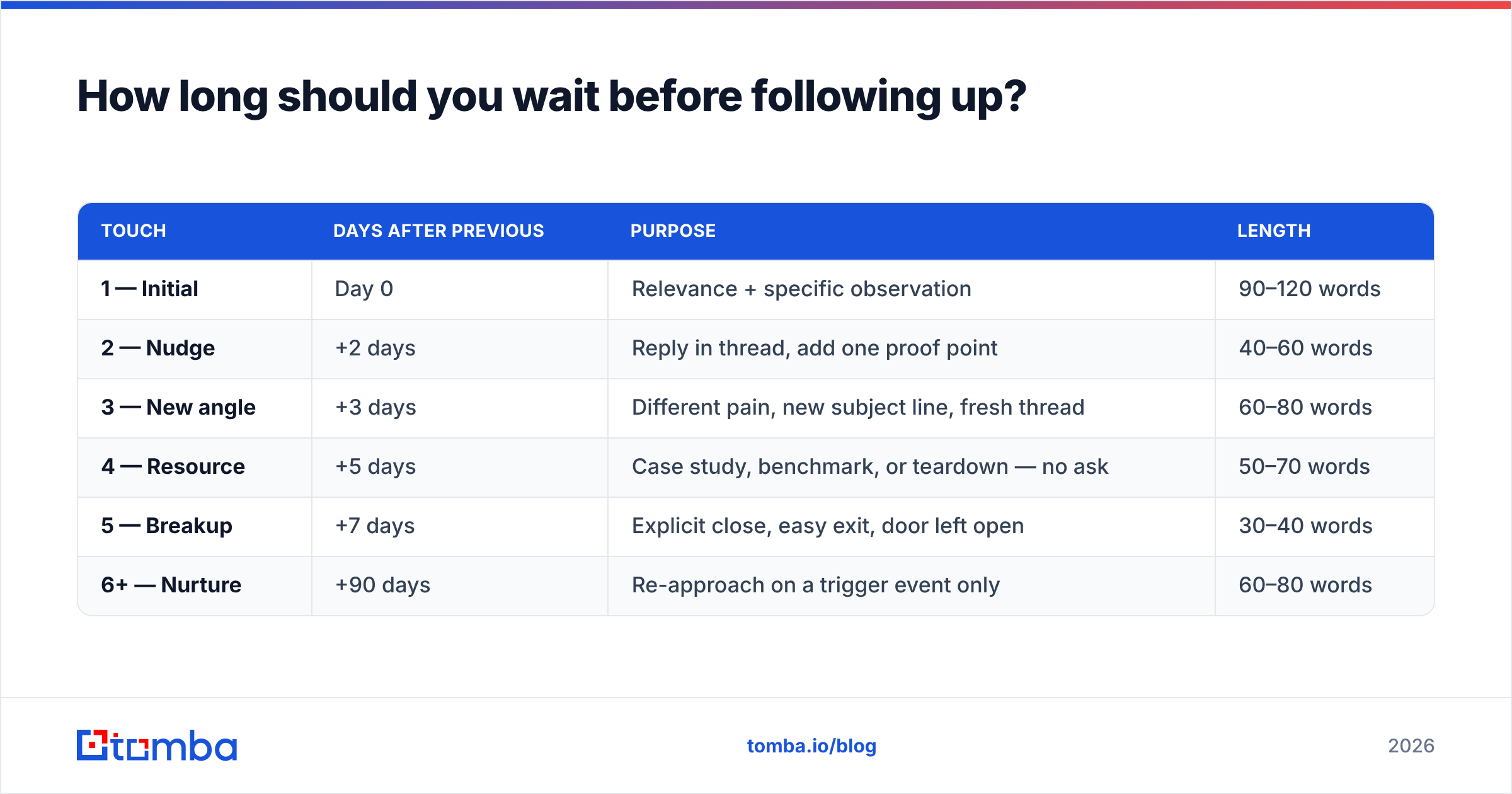
Widen the gaps as the sequence progresses. A tight, fixed cadence reads as automated; a widening one reads as a human who is genuinely still interested.
| Touch | Days after previous | Purpose | Length |
|---|---|---|---|
| 1 — Initial | Day 0 | Relevance + specific observation | 90–120 words |
| 2 — Nudge | +2 days | Reply in thread, add one proof point | 40–60 words |
| 3 — New angle | +3 days | Different pain, new subject line, fresh thread | 60–80 words |
| 4 — Resource | +5 days | Case study, benchmark, or teardown — no ask | 50–70 words |
| 5 — Breakup | +7 days | Explicit close, easy exit, door left open | 30–40 words |
| 6+ — Nurture | +90 days | Re-approach on a trigger event only | 60–80 words |
Total elapsed time: roughly 17 days for five touches. That is long enough to survive a vacation and short enough to stay attached to your original context.
Two adjustments worth making. First, if the prospect opened your email five times without replying, tighten the next gap — interest is live. Second, if you're emailing a European contact in August or a US contact between December 20 and January 3, pause the sequence entirely rather than burning touches into an empty inbox.
Should you follow up in the same thread or start a new one?#
Same thread for touches 2 and 4. New thread for touch 3 and the breakup.
Threading keeps context visible, which raises the odds of a fast "oh right, that." But a thread that grows to five messages deep with no reply starts to look like a wall of your own voice, and it also concentrates all your risk in one subject line. If that subject line didn't work the first time, sending three more replies under it won't fix it.
Breaking to a new thread on touch 3 gives you a genuinely new subject line and a fresh preview snippet — the two things that actually determine whether the message gets opened at all.
How many follow-ups is too many?#
Five is the practical ceiling for cold outreach. After the breakup email, further touches produce diminishing replies and rising spam complaints — and complaints are the single fastest way to damage a sending domain.
Warm follow-ups behave differently. If someone booked a demo and went quiet, or a champion went dark mid-deal, seven to nine touches over six weeks is normal and expected. The relationship absorbs the persistence; a cold list does not.
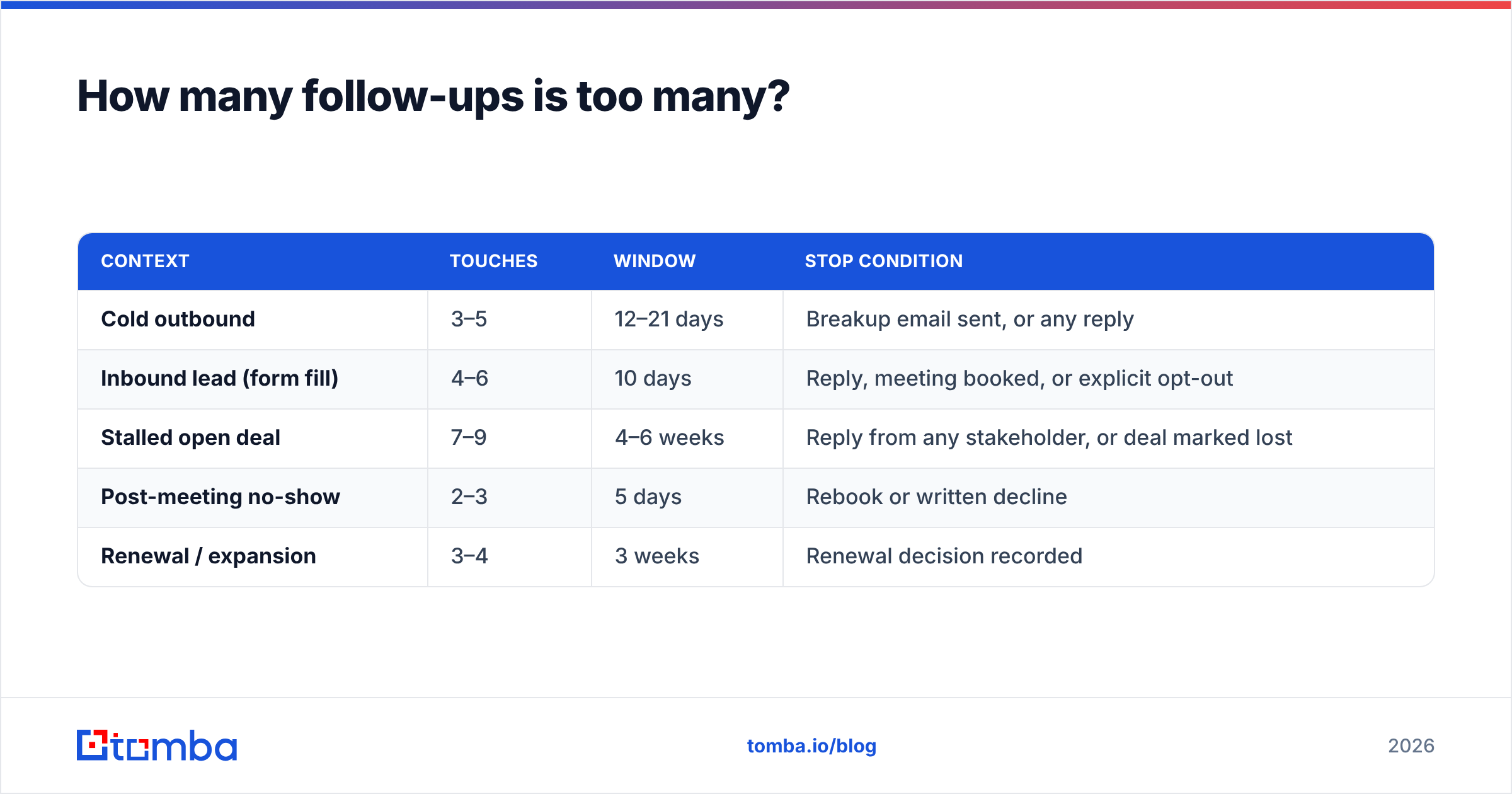
Here's how the three contexts differ:
| Context | Touches | Window | Stop condition |
|---|---|---|---|
| Cold outbound | 3–5 | 12–21 days | Breakup email sent, or any reply |
| Inbound lead (form fill) | 4–6 | 10 days | Reply, meeting booked, or explicit opt-out |
| Stalled open deal | 7–9 | 4–6 weeks | Reply from any stakeholder, or deal marked lost |
| Post-meeting no-show | 2–3 | 5 days | Rebook or written decline |
| Renewal / expansion | 3–4 | 3 weeks | Renewal decision recorded |
The stop condition matters more than the count. Sequences that keep firing after a reply are the most common cause of the "please remove me" response — and it's almost always a CRM sync problem, not a copywriting problem.
Why do follow-up emails land in spam?#
Because the list was bad before the copy was ever written.
Every email you send to a dead address is a hard bounce. Mailbox providers treat a rising bounce rate as evidence that you bought a list or scraped one carelessly, and they throttle you accordingly. The cruel timing is that touch one goes out fine, bounces accumulate over the next 24 hours, and touch two — the one that would have gotten the reply — lands in spam.
Three things fix this, in order of impact:
- Verify before you send, not after. Run every address through an email verifier and drop anything that isn't deliverable. Aim to keep your bounce rate under 2%; under 1% is the real target.
- Handle catch-all domains separately. Catch-all servers accept everything, which means a standard verification returns "unknown." Segment those into their own low-volume sequence and use a catch-all verifier to score them rather than blasting them alongside verified contacts.
- Authenticate the domain. SPF, DKIM, and DMARC are table stakes since Google and Yahoo tightened bulk-sender requirements. A missing SPF record will sink a technically perfect sequence.
Warm the sending domain before volume ramps, keep daily send counts per mailbox modest, and monitor email deliverability as a first-class metric rather than something you check after replies drop.
What should you write in each follow-up? (Templates)#
Touch 2 — the nudge (same thread)
Quick addition to my note below: [Similar Company] cut their onboarding time from 6 weeks to 11 days using the same approach. Thought the number might be more useful than my original pitch.
Worth 15 minutes Thursday?
Touch 3 — the new angle (new thread)
Subject: your [specific page / job posting / launch]
Saw you're hiring three more SDRs this quarter. Usually that means the current team is buried in list-building rather than conversations.
We handle that part. Two questions: is that the bottleneck, and are you already solving it?
Touch 4 — the resource (same thread as touch 3)
No ask on this one — I put together a teardown of how three companies in [industry] structure their outbound data workflow. It's here: [link].
If the third one is close to what you're doing, happy to talk. If not, ignore me.
Touch 5 — the breakup
I've sent a few notes and haven't heard back, which usually means one of three things: wrong timing, wrong person, or wrong problem.
I'll stop here. If any of those change, reply to this and I'll pick it back up.
Notice that none of them mention the previous email's silence. That's deliberate. Referencing the non-reply puts the recipient on the defensive; ignoring it lets them re-enter the conversation without an apology.
How do you scale follow-ups without sounding automated?#
Personalize the first line and the trigger; templatize everything else.
The line that determines whether a follow-up reads as human is the one referencing something specific about them — a hiring page, a funding round, a product change, a conference talk. Everything after that can be a template, because the recipient stops evaluating authenticity once the opening proves you looked.
That means the scaling problem is really a data problem. You need accurate contact records and enough firmographic context to write a specific first line at volume. A few practical mechanics:
- Build the list from the domain outward. Start with target companies, then use domain search to pull the relevant roles rather than buying a static list that decays 25–30% per year.
- Enrich before sequencing. Attach job title, company size, and tech stack via data enrichment so your trigger lines write themselves.
- Sync reply state to the CRM in real time. A reply in one inbox has to stop the sequence in every other channel. This is where most "please stop emailing me" complaints come from.
- Cap sends per mailbox. 30–50 per day per inbox keeps you inside normal human behavior; rotating across several mailboxes scales volume without scaling risk.
- Review the sequence monthly. Kill any touch whose reply rate falls below a third of touch one's — it's costing you sender reputation for nothing.
If you're comparing tools for this, G2's sales engagement category is a reasonable neutral starting point, and most vendors' own docs will tell you their per-mailbox sending limits before you hit them the hard way.
What metrics tell you your follow-ups are working?#
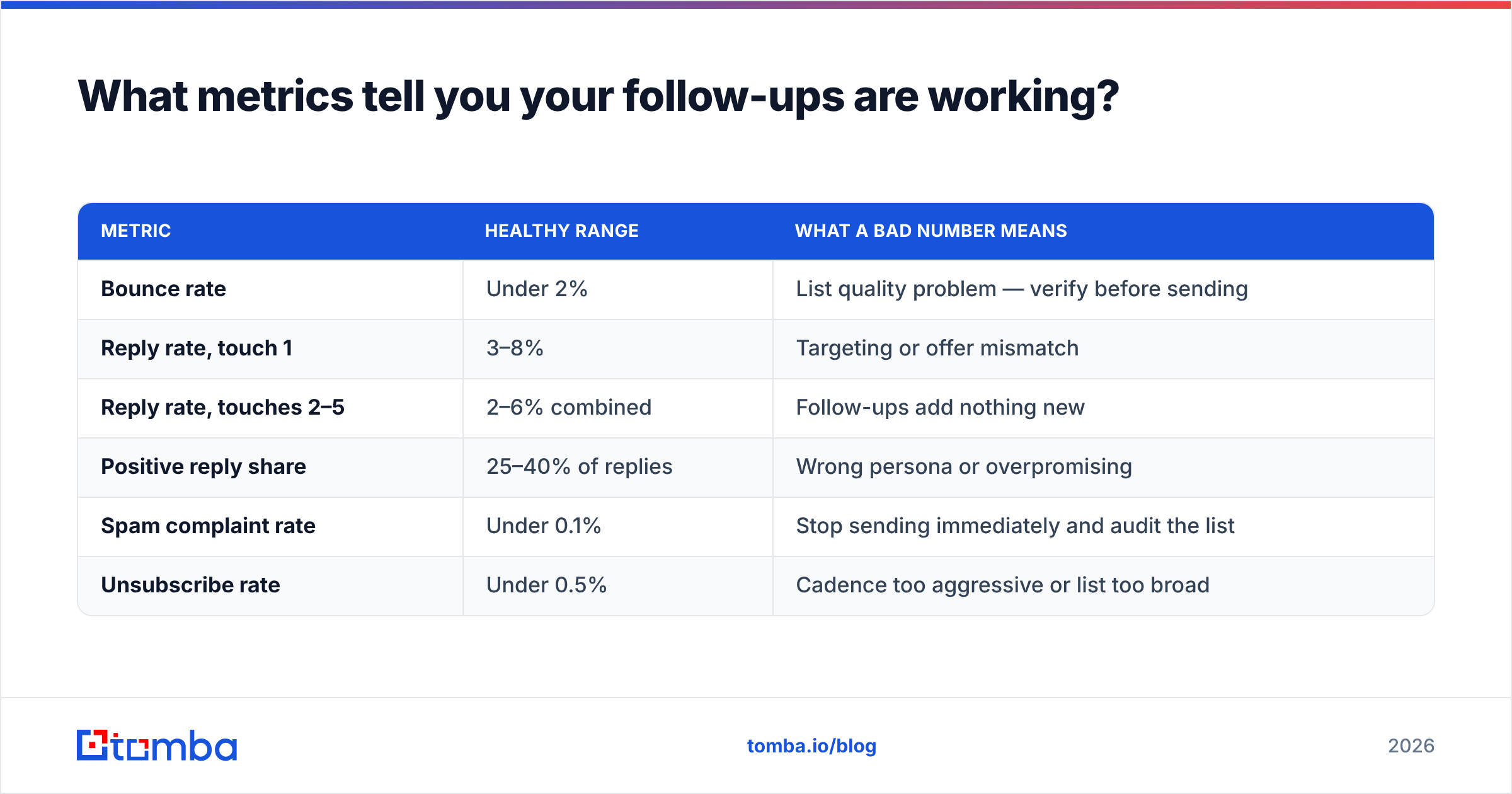
Track reply rate per touch, not aggregate open rate. Opens have been unreliable since Apple's Mail Privacy Protection started pre-fetching images, and aggregate numbers hide the touch that's actually carrying the sequence.
| Metric | Healthy range | What a bad number means |
|---|---|---|
| Bounce rate | Under 2% | List quality problem — verify before sending |
| Reply rate, touch 1 | 3–8% | Targeting or offer mismatch |
| Reply rate, touches 2–5 | 2–6% combined | Follow-ups add nothing new |
| Positive reply share | 25–40% of replies | Wrong persona or overpromising |
| Spam complaint rate | Under 0.1% | Stop sending immediately and audit the list |
| Unsubscribe rate | Under 0.5% | Cadence too aggressive or list too broad |
If your touch-1 reply rate is healthy but touches 2–5 flatline, the problem is copy: your follow-ups are bumping instead of adding. If touch 1 is weak too, the problem is upstream — wrong list, wrong offer, or wrong role.
Watch response rate trends over 30-day windows rather than reacting to a single bad week. Cold outbound is noisy at small sample sizes, and reps who rewrite their sequence every Monday never learn anything from it.
Where should you start?#
Fix the list first, then the cadence, then the copy. That order is not negotiable — the best-written five-touch sequence in the world is worthless if 18% of the addresses bounce and your domain gets throttled before touch two.
Pull verified, current contacts for the companies you actually want to talk to, then build the 3–5 touch cadence above around them. Start with the Tomba Email Finder to source accurate addresses by domain, name, or company, and verify the whole list before your first send. The free tier gives you 25 searches a month to test the workflow; the Starter plan runs $49/mo when you're ready to scale, with full Tomba pricing laid out per volume tier.
Send fewer emails to better addresses, and follow up like someone who actually wants the answer.
Related guides#
// get started
Find, verify and enrich your first contacts today
Start on the free plan with 25 searches a month, then scale when your team is ready.
Free plan · No credit card required · GDPR & CCPA
// about the author