How to Send a Networking Email That Actually Gets a Reply
Most networking emails die because they ask for time before they earn attention. Here is the 6-part structure, the timing rules, and the tooling that gets a busy stranger to reply within 48 hours.
TL;DR
- A networking email is not a cold sales email. It asks for attention, not budget — so the structure, the ask, and the length are all different.
- The six-part structure that works: verified address → specific subject line → proof you did the homework → a reason you exist to them → one small ask → an easy exit.
- Keep it under 150 words. Replies drop sharply once a stranger has to scroll.
- Send Tuesday–Thursday, 7–9am in the recipient's timezone. Follow up exactly once, 4–6 days later, then stop.
- Getting the right address is half the battle. A bounced networking email doesn't just fail — it damages the sending domain you'll use for every future email.
What is a networking email, and how is it different from cold outreach?#
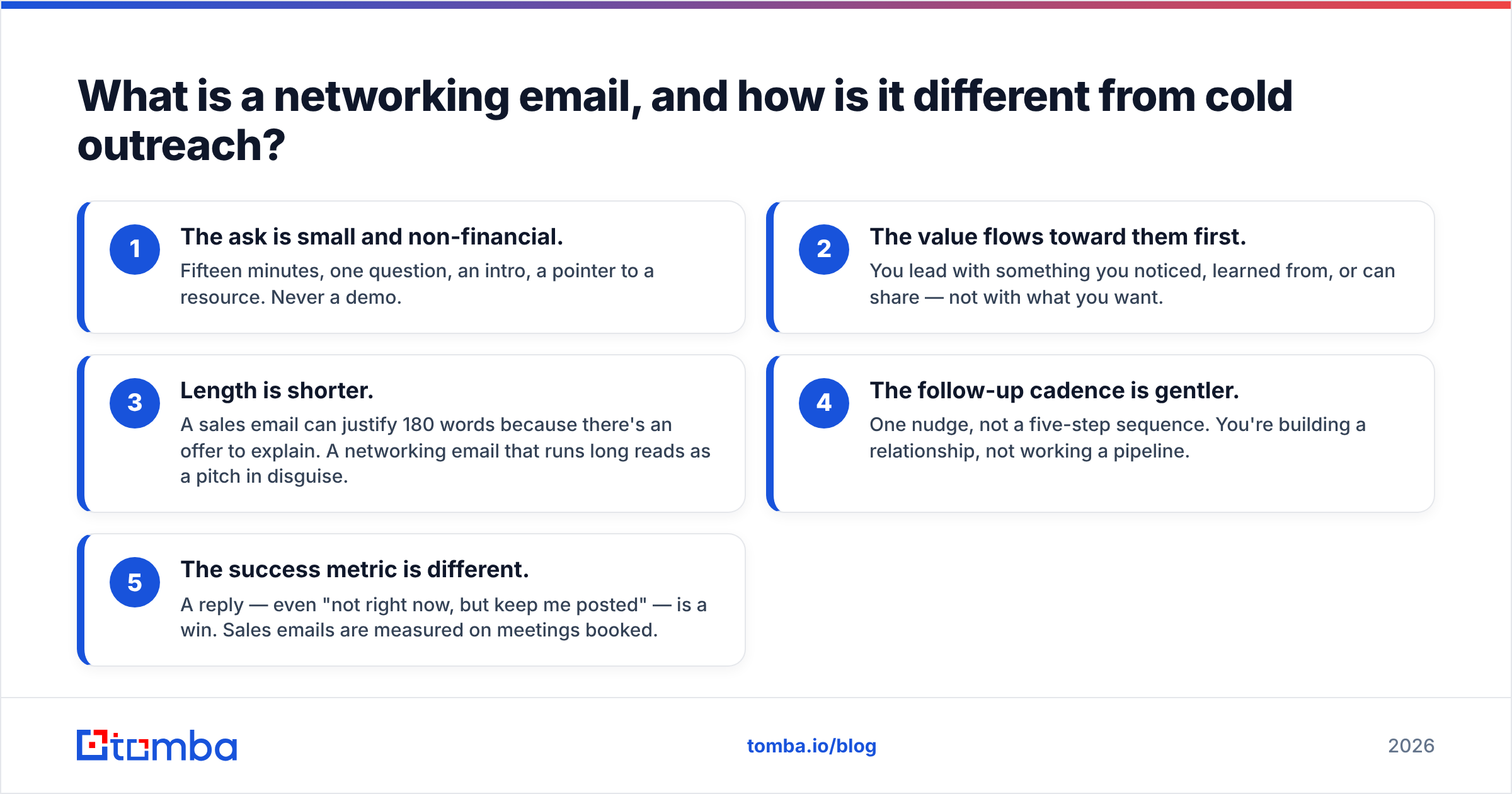
A networking email asks a stranger for their attention. A cold sales email asks for their money. That single difference changes everything downstream.
Think of it like knocking on a neighbour's door. A salesperson knocks to sell you solar panels — you know the script, you brace for it. A new neighbour knocks to introduce themselves and ask which bin day is which. Same door, same knuckles, completely different reception. The networking email is the second knock, and people are far more willing to open it if you don't smuggle a pitch inside.
Practically, that means:
- The ask is small and non-financial. Fifteen minutes, one question, an intro, a pointer to a resource. Never a demo.
- The value flows toward them first. You lead with something you noticed, learned from, or can share — not with what you want.
- Length is shorter. A sales email can justify 180 words because there's an offer to explain. A networking email that runs long reads as a pitch in disguise.
- The follow-up cadence is gentler. One nudge, not a five-step sequence. You're building a relationship, not working a pipeline.
- The success metric is different. A reply — even "not right now, but keep me posted" — is a win. Sales emails are measured on meetings booked.
Mixing the two is the single most common failure. The moment a networking email includes a calendar link and a pricing hint, the recipient reclassifies it as spam and the relationship is dead before it starts.
How do you send a networking email in 6 steps?#
Here is the structure. Every element earns its place; delete any one of them and reply rates fall.
Step 1 — Verify the address before you write a word.
Writing a beautiful email to firstname@company.com when the company uses f.lastname@company.com wastes the whole effort. Worse, hard bounces damage your sender reputation, which quietly degrades every email you send afterward — including the ones to people who do want to hear from you. Use a domain search to confirm the company's pattern, then run the specific address through an email verifier before sending.
Step 2 — Write a subject line that describes the email, not the outcome. "Question about your Q3 pricing-page rewrite" beats "Quick question" and destroys "Connecting!". Specificity signals that a human wrote it. Aim for 4–7 words, no title case, no exclamation marks.
Step 3 — Open with proof you did the homework. One sentence, one specific detail. A talk they gave, a post they wrote, a decision their team announced. Not "I love what you're building" — anyone can write that. "Your point about pricing pages being read bottom-up changed how we structured ours" can only come from someone who read it.
Step 4 — Say who you are in one line. Role, company, and the reason those two facts matter to them. "I run demand gen at a 40-person B2B SaaS" is enough context for them to calibrate whether they can help.
Step 5 — Make one small, specific ask. "Would you be open to a 15-minute call in the next two weeks?" or, better for very senior people, "Would you mind sending me the one resource you'd give someone in my position?" The second one costs them 30 seconds and gets answered far more often.
Step 6 — Give them an easy exit. "Completely fine if the timing's bad — I'll keep following your work either way." This removes the social cost of saying no, which paradoxically increases the number of yeses. People avoid replying when "no" feels rude.
What does a good networking email actually look like?#
Subject: your point on bottom-up pricing pages
Hi Dana,
Your talk at SaaStr on reading pricing pages bottom-up changed how we restructured ours last quarter — the FAQ-first version outperformed the old layout by a wide margin.
I run demand gen at Northsun, a 40-person B2B SaaS in the same space you were describing.
Would you be open to 15 minutes in the next couple of weeks? I'd want to ask about how you decided which objections to answer above the fold.
Totally fine if timing's bad — I'll keep following your work either way.
Best,
Marco
That's 96 words. It names a specific artifact, establishes standing, makes one ask, and offers an exit. Nothing in it is generic enough to have been sent to a hundred people.
Networking email vs. cold sales email vs. LinkedIn DM: which should you use?#
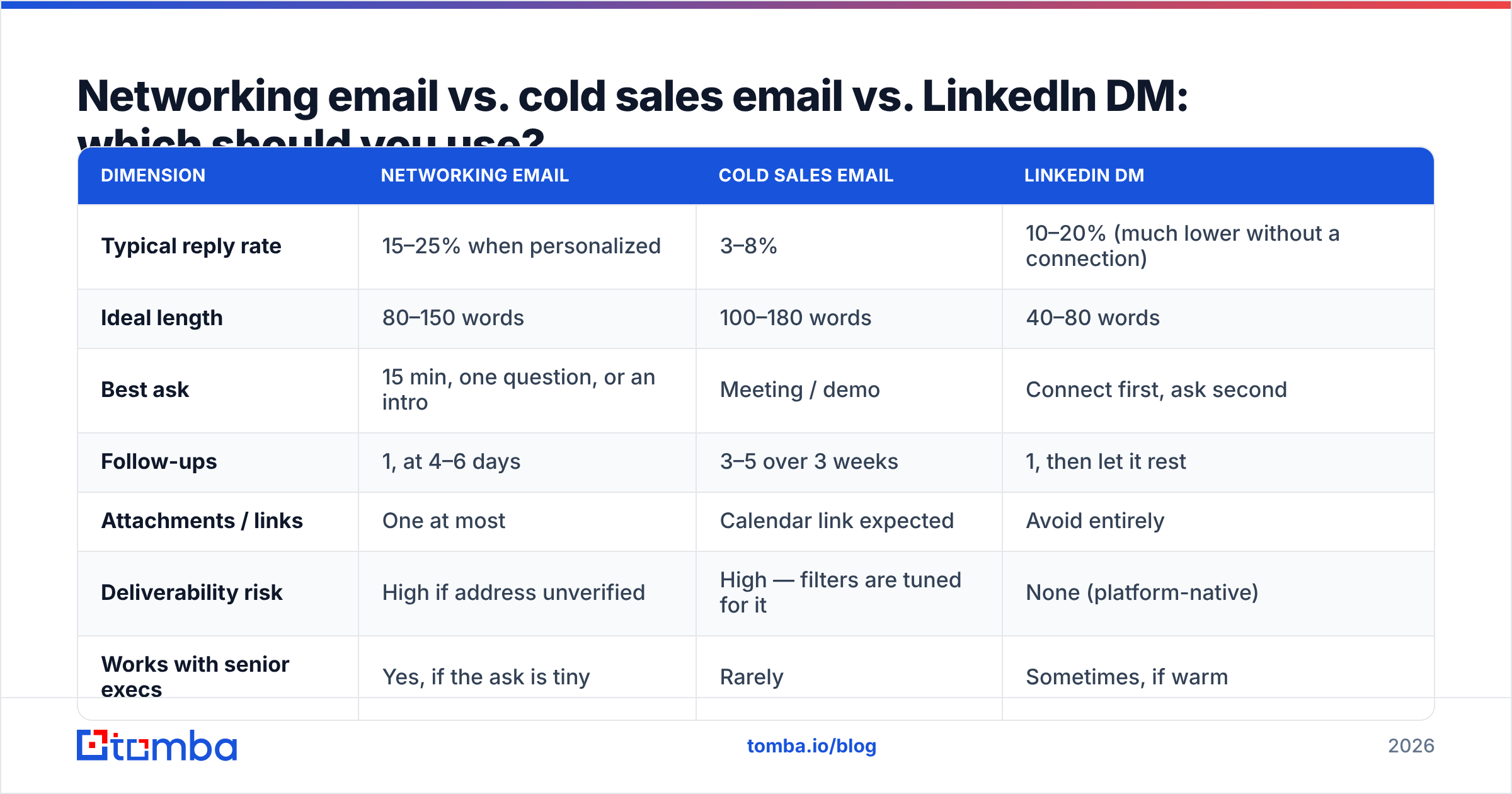
Channel choice matters as much as copy. Here's how the three compare on the dimensions that actually drive replies.
| Dimension | Networking email | Cold sales email | LinkedIn DM |
|---|---|---|---|
| Typical reply rate | 15–25% when personalized | 3–8% | 10–20% (much lower without a connection) |
| Ideal length | 80–150 words | 100–180 words | 40–80 words |
| Best ask | 15 min, one question, or an intro | Meeting / demo | Connect first, ask second |
| Follow-ups | 1, at 4–6 days | 3–5 over 3 weeks | 1, then let it rest |
| Attachments / links | One at most | Calendar link expected | Avoid entirely |
| Deliverability risk | High if address unverified | High — filters are tuned for it | None (platform-native) |
| Works with senior execs | Yes, if the ask is tiny | Rarely | Sometimes, if warm |
| Scales past 50/week | Poorly, by design | Yes | No (platform limits) |
The pattern is clear: email gives you reach and permanence, LinkedIn gives you social proof and lower friction. The strongest play is sequential — engage genuinely on LinkedIn for a week or two, then send the email referencing that interaction. It converts a cold email into a lukewarm one, and lukewarm is where reply rates jump. If LinkedIn is your primary discovery channel, a LinkedIn finder bridges the gap by turning a profile into a verified work address.
How do you find someone's email address for networking?#
Four methods, ranked by reliability:
- Their own footprint. Personal site, GitHub profile, conference bio, newsletter footer, academic paper. If they published it, using it is fair game and reply rates are highest here — they expected to be contacted.
- Company pattern inference. Determine the org's format (
first.last@,flast@,first@) from any known employee, then apply it. An email finder automates this and returns a confidence score rather than a guess. - Article and author bylines. For writers, editors, and analysts, an author finder resolves a byline URL straight to a contact address.
- Mutual introduction. Slowest, highest-converting. If a shared connection will forward your email, do that instead — a forwarded email carries borrowed trust that no subject line can manufacture.
Whatever route you take, verify before you send. Roughly a quarter of B2B contact data decays every year as people change jobs, so an address that was correct eighteen months ago is a coin flip today. Verification takes a second and protects the domain you'll be sending from for years.
When should you send a networking email?#
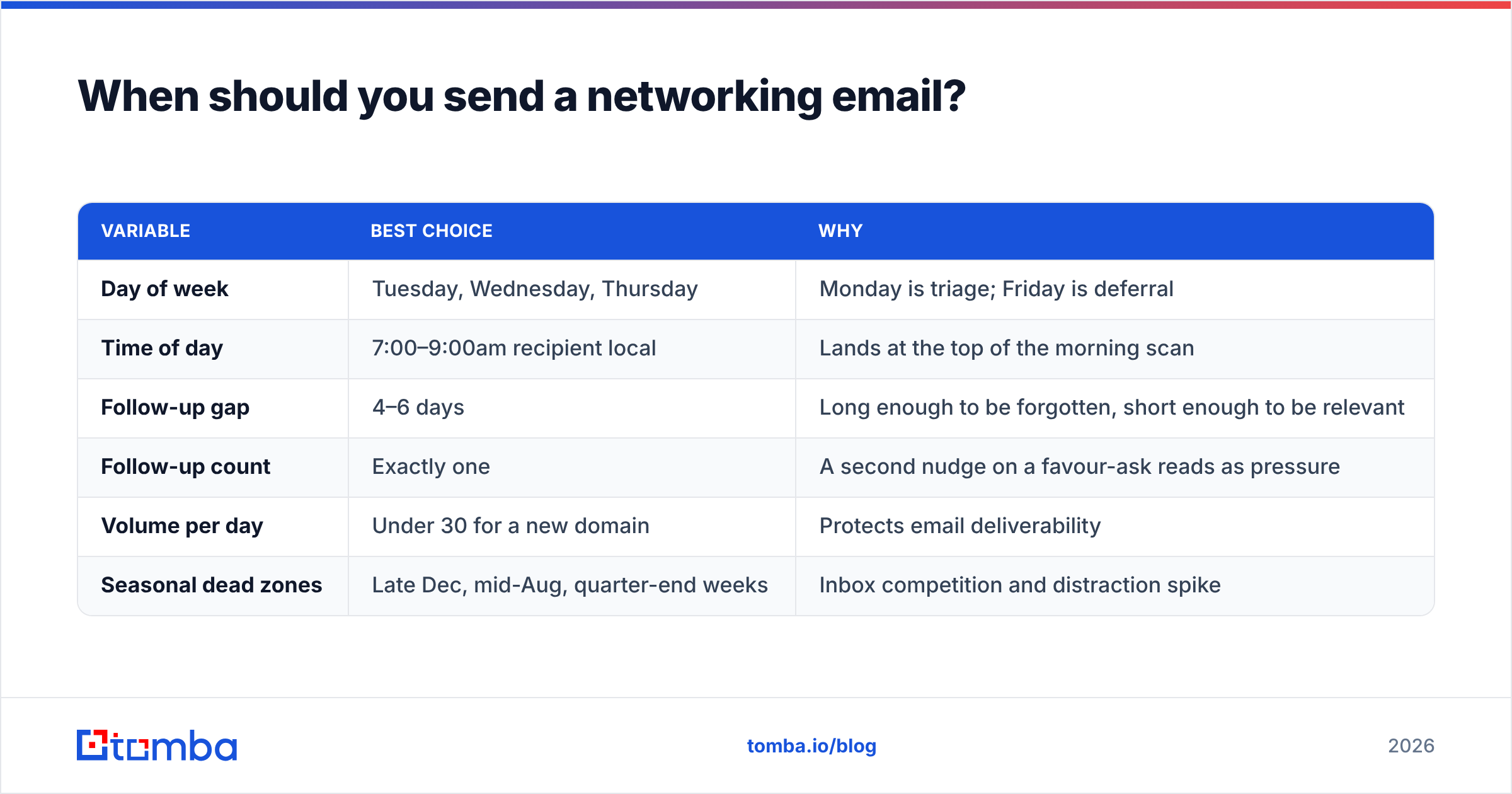
Timing won't rescue a bad email, but it meaningfully lifts a good one.
| Variable | Best choice | Why |
|---|---|---|
| Day of week | Tuesday, Wednesday, Thursday | Monday is triage; Friday is deferral |
| Time of day | 7:00–9:00am recipient local | Lands at the top of the morning scan |
| Follow-up gap | 4–6 days | Long enough to be forgotten, short enough to be relevant |
| Follow-up count | Exactly one | A second nudge on a favour-ask reads as pressure |
| Volume per day | Under 30 for a new domain | Protects email deliverability |
| Seasonal dead zones | Late Dec, mid-Aug, quarter-end weeks | Inbox competition and distraction spike |
One nuance on the follow-up: don't send "just bumping this up." Add something. A relevant article, a note that you implemented their advice, an update on the thing you mentioned. The follow-up should be a second gift, not a second invoice.
What kills networking emails before they're read?#
Six failure modes, in rough order of how much damage they do:
- Unverified addresses. A hard bounce is a permanent zero, and enough of them push your domain toward the spam folder. Check your SPF record and authentication setup too — Google's bulk sender requirements are enforced, not advisory.
- The invisible ask. "Would love to connect and explore synergies" gives the recipient nothing to say yes to. If they can't picture the next 15 minutes, they won't book them.
- Flattery without evidence. "Huge fan of your work" is the networking equivalent of "Dear Sir/Madam." Name the specific thing.
- The hidden pitch. A demo link, a pricing mention, or a "we help companies like yours" clause converts your networking email into a sales email in the reader's mind. All the trust you built evaporates in one clause.
- Length. Past roughly 150 words, a stranger stops reading and starts skimming for the ask. If they can't find it fast, they close the tab.
- Wrong person entirely. Senior enough to be worth contacting, but so senior they've delegated the topic away. Aim one level below where you think the decision sits — those people reply more and often have more direct knowledge.
Independent reviews of outreach tooling on G2 consistently show the same theme in user feedback: the limiting factor is rarely the copywriting, it's the data quality underneath it. A brilliant email to a dead address performs exactly as well as no email at all.
How do you scale networking outreach without ruining it?#
There's a hard ceiling, and it's lower than most people want to hear: roughly 20–30 genuinely researched networking emails a week, per person. Beyond that, the research thins out, the personalization becomes templated, and reply rates collapse toward cold-sales numbers.
What you can automate is everything that isn't the thinking:
- Address discovery and verification. Run the whole target list through a bulk email finder once, rather than looking people up one at a time.
- List hygiene. Deduplicate, drop role addresses (
info@,contact@) and re-verify anything older than 90 days. - Context gathering. Pull job title, company size, and recent role changes with data enrichment so the "who you are and why it matters to them" line writes itself.
- CRM logging. Push sends and replies into your CRM automatically so you never send the same person the same introduction twice.
What you should never automate: the specific observation in the first sentence. That line is the entire email. Templating it is how a networking campaign becomes spam — and how reputable teams like HubSpot end up recommending templates as scaffolding rather than as scripts to send verbatim.
Frequently asked questions#
How long should I wait before following up? Four to six days. Sooner reads as impatient on a favour-ask; later and the original email has fallen out of memory entirely.
Should I attach my resume or a deck? No. Attachments in a first email from a stranger increase spam filtering and signal a transaction. Link to your LinkedIn profile in the signature instead, and send materials only when asked.
Is it acceptable to email someone I've never interacted with at all? Yes, provided you've done real research and your ask is genuinely small. The rudeness isn't in emailing a stranger — it's in emailing them lazily.
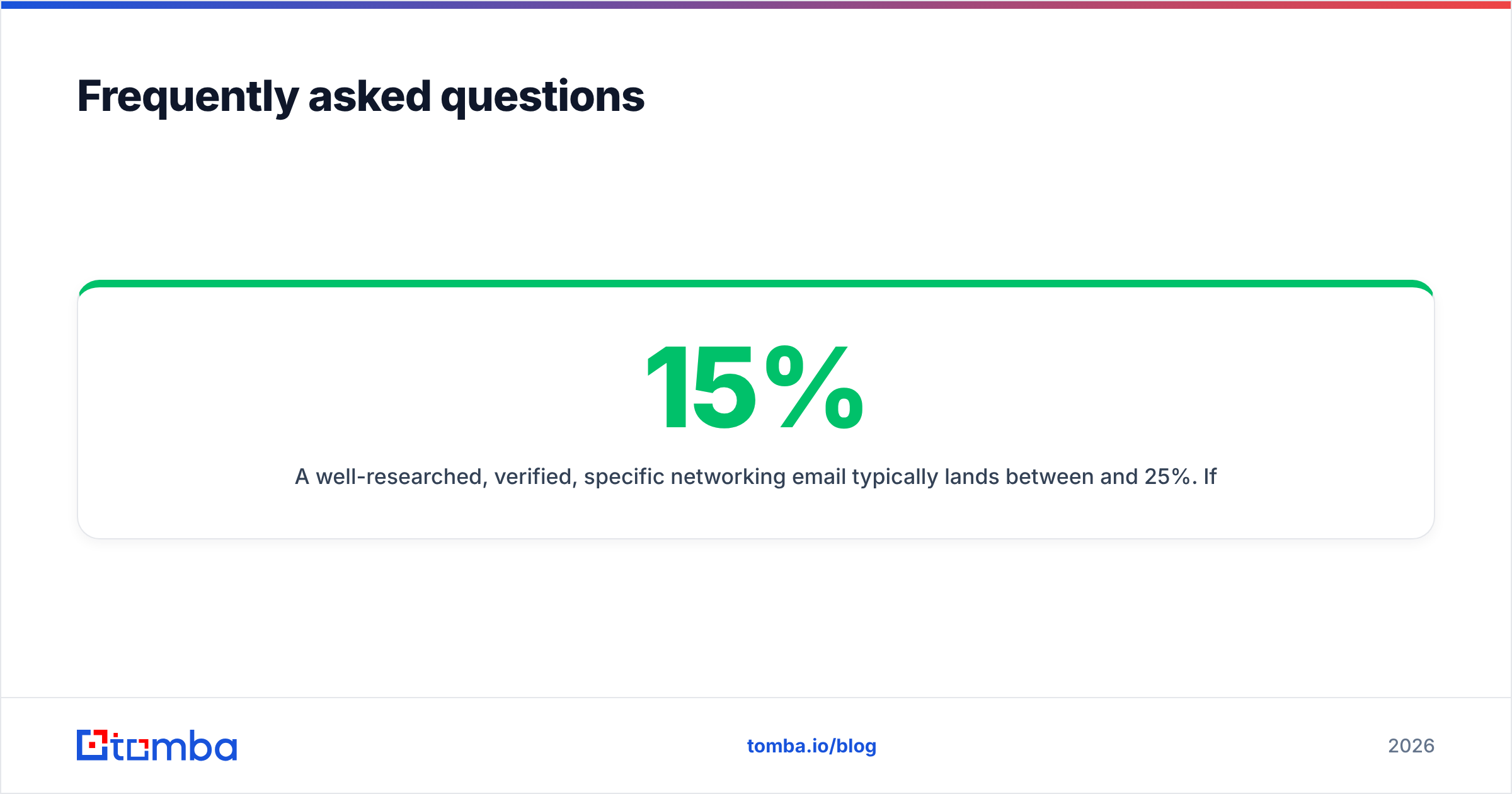
What reply rate should I expect? A well-researched, verified, specific networking email typically lands between 15% and 25%. If you're under 10%, the problem is almost always the address quality or the specificity of the opening line — in that order.
Does the sender domain matter? Substantially. A company domain outperforms a Gmail address for professional outreach, but only if that domain is properly authenticated and hasn't been burned by prior bulk sending.
Start with an address that actually works#
Every tactic here — the specific opener, the tiny ask, the graceful exit — is worthless if the email lands in a void. Address quality is the foundation the rest of it sits on, and it's the one part you can fix in a minute rather than a quarter.
Tomba's Email Finder resolves a name and a company domain into a verified professional address with a confidence score, so you know before you hit send whether that email will arrive. The free tier gives you 25 searches a month — enough to test the entire approach on your top targets. If it works and you scale up, Tomba pricing starts at $49/mo for Starter and $99/mo for Growth. Find the address first. Then write the email that deserves a reply.
Related guides#
// get started
Find, verify and enrich your first contacts today
Start on the free plan with 25 searches a month, then scale when your team is ready.
Free plan · No credit card required · GDPR & CCPA
Get the Tomba newsletter
Product and data updates
// about the author