How to Set Sales Quotas That Reps Actually Hit in 2026
Most quotas are built backwards — a revenue target divided by headcount. Here is the capacity-based method, the math behind attainment rates, and the 6 steps to set sales quotas your team can actually hit.
TL;DR
- Stop dividing the board's revenue target by headcount. That is a budget allocation, not a quota — and it is why 40-60% of your reps miss.
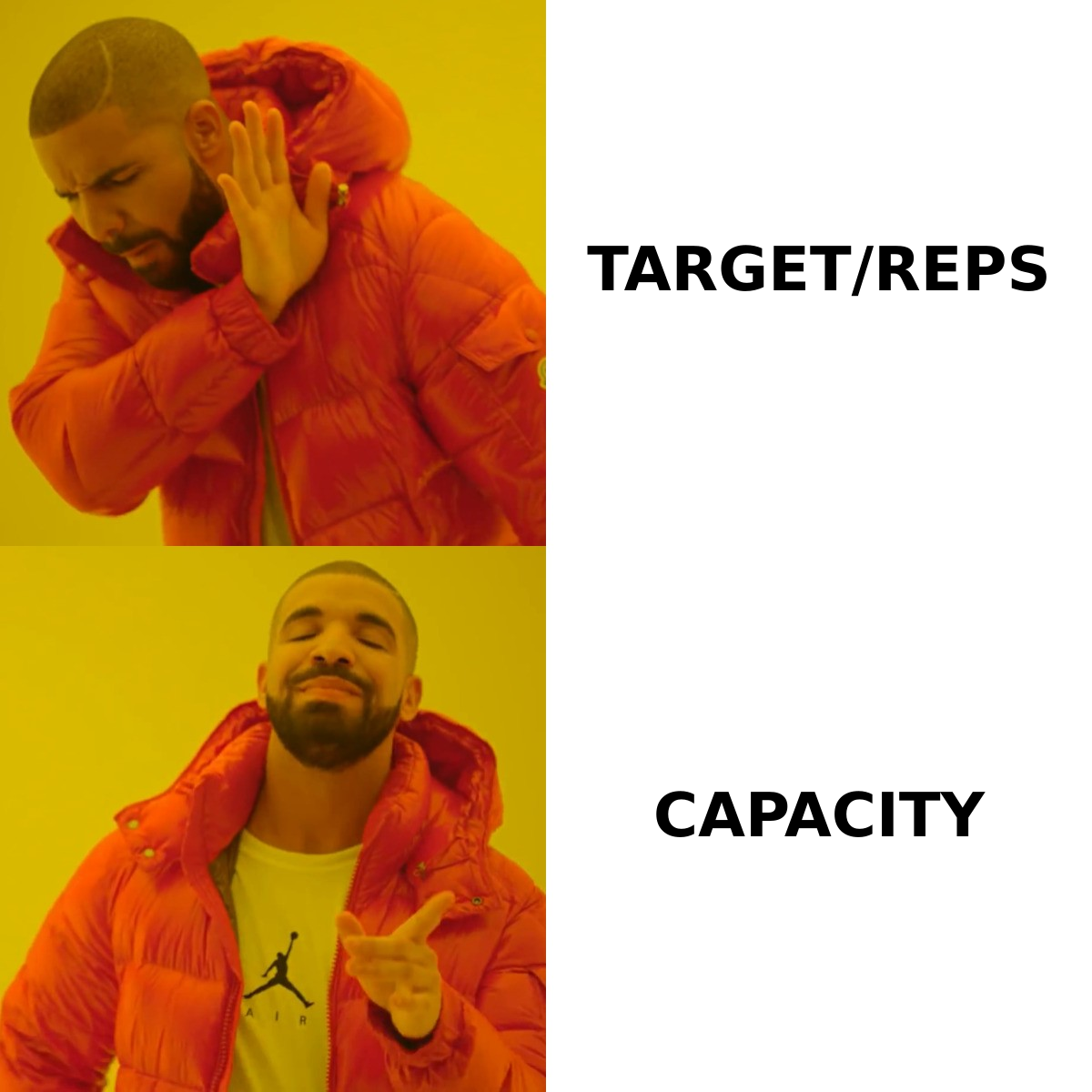
- Build quotas bottom-up from capacity: activity volume × conversion rate × average deal size × ramp factor, then stress-test against the top-down number.
- Healthy attainment looks like 60-70% of reps at or above quota. If 90% hit, the number is too low. If 25% hit, you have a churn problem forming.
- Quota only works if pipeline coverage works. A 5x-coverage quota with 2x pipeline is a math error you will pay for in Q4.
- Set quotas annually, review them quarterly, and never reset mid-cycle without a written trigger everyone agreed to in advance.
What is a sales quota, actually?#
A sales quota is a rep's individual performance target over a defined period — usually revenue, but sometimes units, new logos, or gross margin. That is the textbook definition. The useful definition is different: a quota is a bet that a specific rep, with a specific territory and a specific amount of pipeline, can close a specific number in a specific window.
Think of it like a restaurant setting covers-per-night targets. You do not pick 200 covers because the landlord wants $50k in rent. You count tables, count turns, count how fast the kitchen plates food, and then you find out the room holds 140. If you tell the floor manager to hit 200 anyway, you do not get 200 — you get burned-out servers and a manager who quits in March.
Most sales orgs skip the table count. Finance hands down a number, RevOps divides by headcount, and everyone acts surprised when attainment lands at 38%.
The four quota types you will choose between#
- Revenue quota — closed-won dollars. The default for AEs. Simple, easily gamed with discounting unless you pair it with margin floors.
- Volume quota — units, seats, or logos closed. Good for PLG-adjacent motions and low-ACV, high-velocity teams where dollar variance is noise.
- Activity quota — calls, meetings booked, demos delivered. The right primary metric for SDRs and for AEs in their first 90 days, when outcome data does not exist yet.
- Profit quota — gross margin contributed. Use it when reps control pricing and you have seen discounting destroy a quarter.
- Combination quota — a weighted blend, e.g. 70% revenue + 30% new-logo count. Prevents reps from farming renewals and calling it new business.
- Forecast/pipeline quota — coverage a rep must generate, not close. Usually a secondary target that protects next quarter.
Pick one primary. Every quota beyond the first dilutes focus; by the third, nobody can tell you what they are optimizing for.
Why do top-down quotas fail so often?#
Because top-down quotas encode a wish, not a capacity.
The standard failure sequence: the board approves a 40% growth plan. Finance converts it to a bookings number. The CRO divides that by the number of AEs on the roster — including two who start in April and one who is on a PIP. Every rep gets the same number. Nobody checked whether the territories can produce it.
Then the second-order damage starts. Reps who see an unreachable number early stop trying to hit it and start sandbagging deals into next quarter. Your forecast accuracy collapses, which means the revenue operations team loses the ability to plan hiring. Then the good reps — the ones with options — leave first, because they can read a comp plan.
Research from Gartner has consistently pointed at quota-setting as one of the top drivers of seller attrition, and the mechanism is not mysterious: people quit targets they were never given the resources to hit.
How to set sales quotas step by step?#
Here is the method. Run it bottom-up first, then reconcile against the top-down number — never the reverse.
Step 1 — Establish the capacity baseline. For each rep segment, pull the last 4 quarters: average deals closed per rep per quarter, average deal size, average sales cycle length, and win rate from qualified opportunity. If you have fewer than 8 closed-won deals per rep, your averages are noise — use segment medians instead.
Step 2 — Model the throughput. The core equation:
Quarterly quota = (Qualified opps worked per quarter × Win rate × Average deal size) × Ramp factor
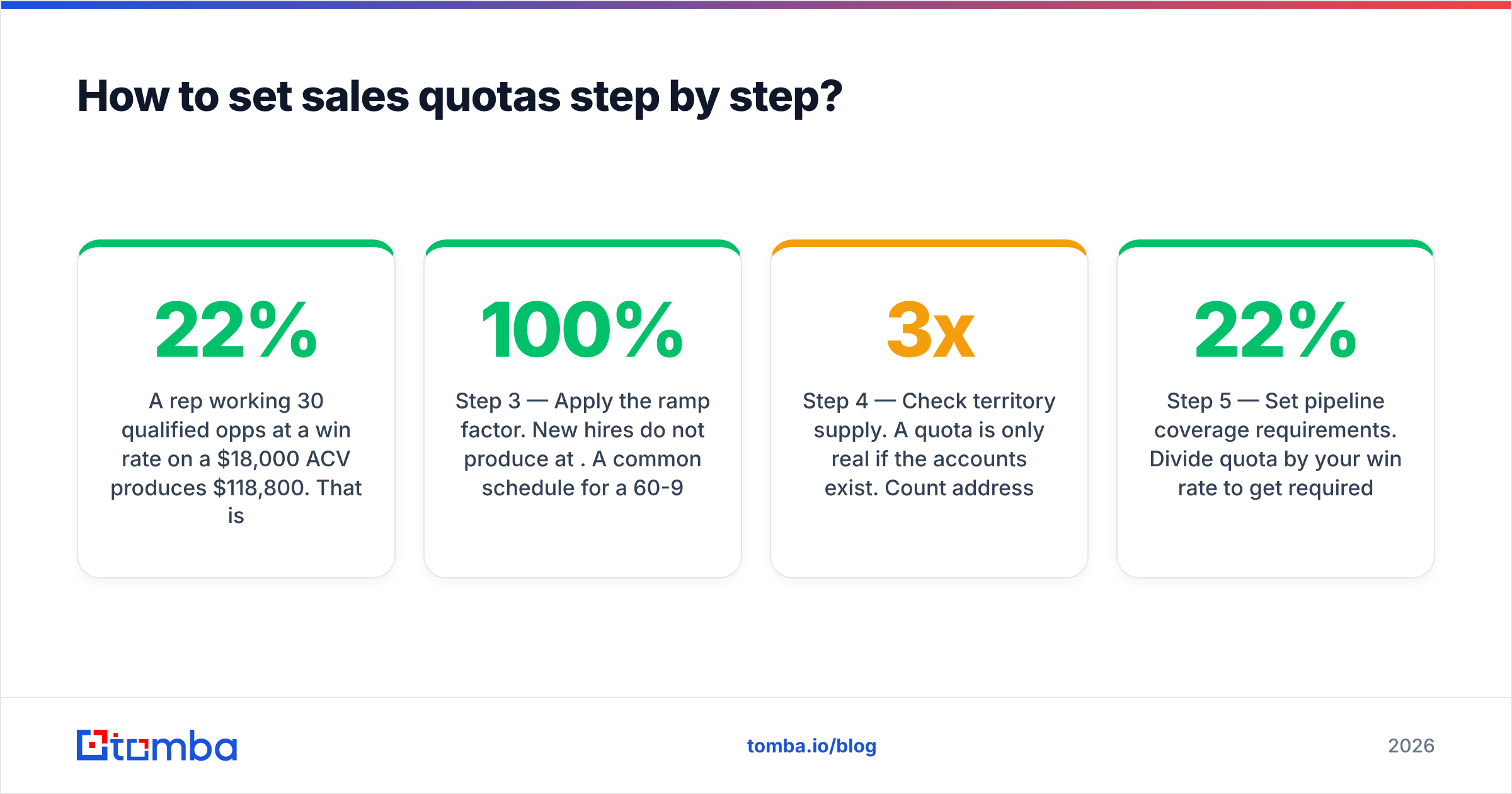
A rep working 30 qualified opps at a 22% win rate on a $18,000 ACV produces $118,800. That is the honest ceiling, not $200,000 because finance needs it.
Step 3 — Apply the ramp factor. New hires do not produce at 100%. A common schedule for a 60-90 day cycle: month 1-2 at 0%, month 3 at 25%, month 4 at 50%, month 5 at 75%, month 6+ at 100%. Multiply each rep's annual number by their blended ramp coefficient. Skipping this single step is the most common reason team-level attainment misses by 15+ points.
Step 4 — Check territory supply. A quota is only real if the accounts exist. Count addressable accounts per territory, multiply by realistic penetration rate, and confirm the resulting TAM supports at least 3x the quota. If a rep needs $500k from a patch containing 40 accounts with a $20k ACV ceiling, the territory caps out at $800k of lifetime value — you are asking them to burn their patch in 18 months.
Step 5 — Set pipeline coverage requirements. Divide quota by your win rate to get required pipeline. At a 22% win rate, a $500k quota needs roughly $2.3M in qualified pipeline. Then ask the uncomfortable question: who is building it? If the answer is "the reps, on top of closing," your capacity model in Step 2 is already wrong, because prospecting hours are not selling hours.
Step 6 — Reconcile and distribute the gap. Sum the bottom-up numbers. Compare to the top-down target. If bottom-up says $8.2M and the board wants $11M, you have a $2.8M gap and exactly four honest levers: hire more reps, raise conversion (enablement), raise ACV (packaging/pricing), or lower the target. Loading the gap onto existing quotas is not a fifth lever — it is a decision to miss with extra steps.
How much should you add on top of the target?#
Add a quota buffer — the amount by which the sum of individual quotas exceeds the company target — of 10-20%.
The logic: not every rep hits. If your company target is $10M and you assign exactly $10M across the team, you need 100% attainment to make plan. Assign $11.5M and you make plan at 87% aggregate attainment, which is realistic.
Above 20% buffer, reps notice. They compare notes, work out that the numbers sum to something absurd relative to the funding announcement, and lose trust in the plan. That is a comp-plan credibility problem you cannot fix mid-year.
What does a healthy quota attainment rate look like?#
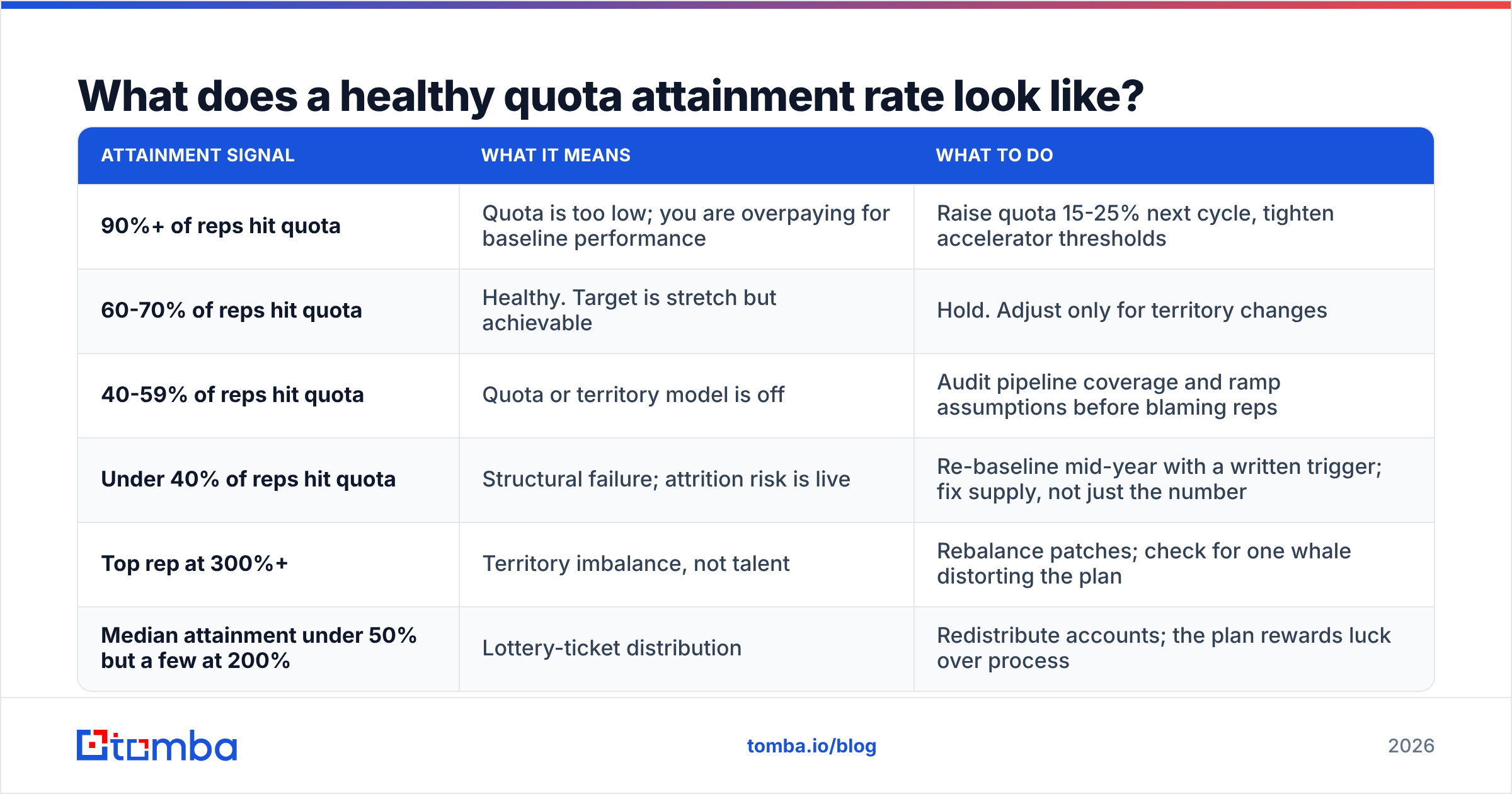
| Attainment signal | What it means | What to do |
|---|---|---|
| 90%+ of reps hit quota | Quota is too low; you are overpaying for baseline performance | Raise quota 15-25% next cycle, tighten accelerator thresholds |
| 60-70% of reps hit quota | Healthy. Target is stretch but achievable | Hold. Adjust only for territory changes |
| 40-59% of reps hit quota | Quota or territory model is off | Audit pipeline coverage and ramp assumptions before blaming reps |
| Under 40% of reps hit quota | Structural failure; attrition risk is live | Re-baseline mid-year with a written trigger; fix supply, not just the number |
| Top rep at 300%+ | Territory imbalance, not talent | Rebalance patches; check for one whale distorting the plan |
| Median attainment under 50% but a few at 200% | Lottery-ticket distribution | Redistribute accounts; the plan rewards luck over process |
The number to watch is not average attainment — one rep at 400% hides four reps at 30%. Watch the median and the percentage of reps at or above 100%. Those two figures tell you whether the plan is a plan or a lottery.
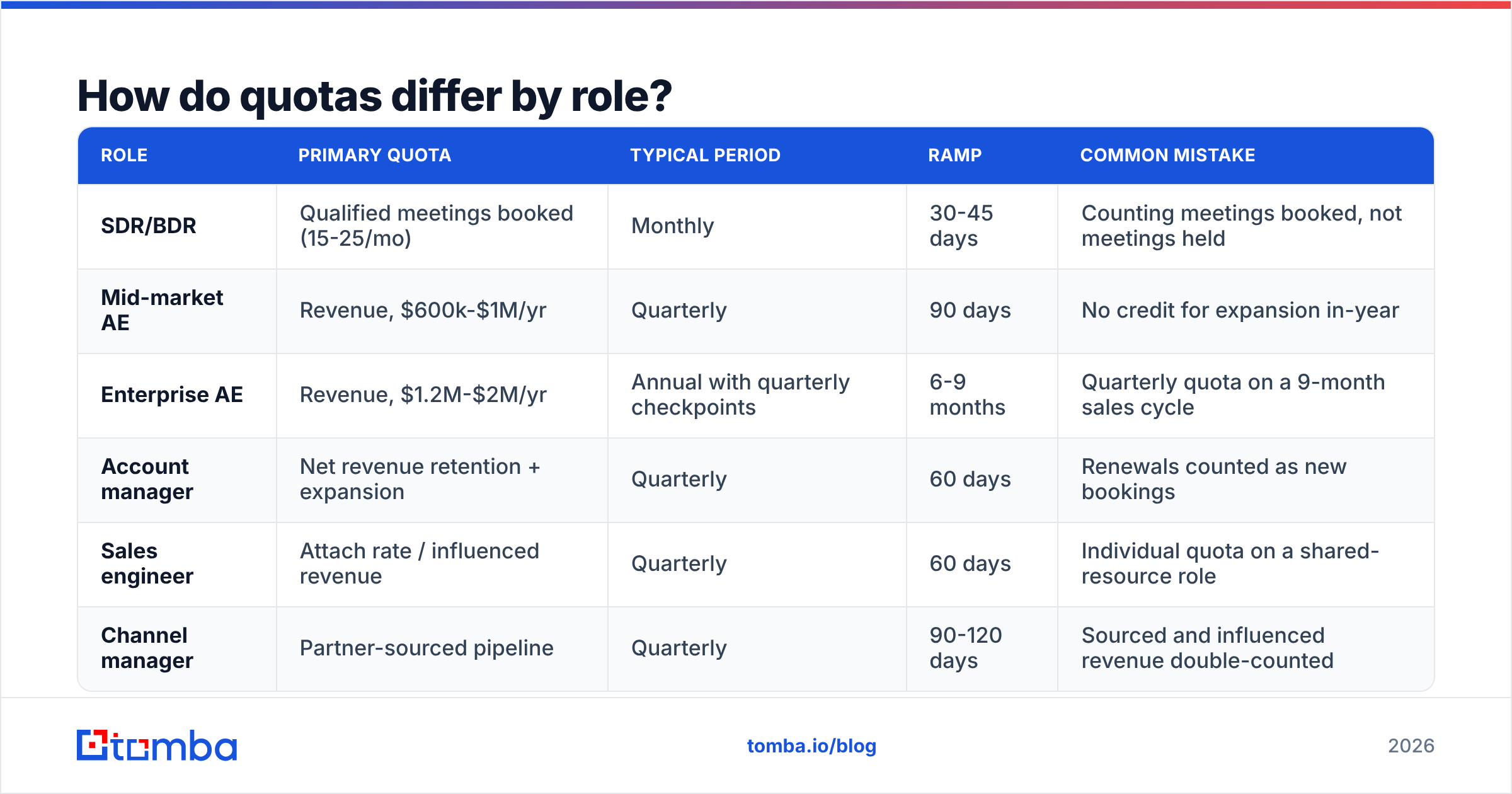
How do quotas differ by role?#
| Role | Primary quota | Typical period | Ramp | Common mistake |
|---|---|---|---|---|
| SDR/BDR | Qualified meetings booked (15-25/mo) | Monthly | 30-45 days | Counting meetings booked, not meetings held |
| Mid-market AE | Revenue, $600k-$1M/yr | Quarterly | 90 days | No credit for expansion in-year |
| Enterprise AE | Revenue, $1.2M-$2M/yr | Annual with quarterly checkpoints | 6-9 months | Quarterly quota on a 9-month sales cycle |
| Account manager | Net revenue retention + expansion | Quarterly | 60 days | Renewals counted as new bookings |
| Sales engineer | Attach rate / influenced revenue | Quarterly | 60 days | Individual quota on a shared-resource role |
| Channel manager | Partner-sourced pipeline | Quarterly | 90-120 days | Sourced and influenced revenue double-counted |
The enterprise row is where most teams break. If your average cycle is 7 months and you assign quarterly quotas, Q1 is structurally unhittable for anyone who started in November. Match the quota period to the sales cycle, or use annual quotas with quarterly pipeline checkpoints instead.
When should you adjust a quota mid-cycle?#
Almost never — and only against triggers you wrote down before the cycle started.
Legitimate mid-cycle triggers:
- Territory change. A rep loses or gains named accounts. Pro-rate immediately; this is not a favor, it is arithmetic.
- Product change. You sunset a SKU that made up 30% of a segment's bookings.
- Headcount change. A teammate leaves and their patch is absorbed. The absorber gets time and quota relief, or you get two misses instead of one.
- Documented market shock. A regulatory change or a category-wide freeze that hits every rep equally.
Illegitimate triggers: "we are behind plan, so everyone's number goes up," or the quiet mid-year reset that arrives with the Q3 comp plan. Both convert your quota from a target into a moving goalpost, and reps respond by discounting the whole system.
Write the trigger list into the comp plan document. HubSpot's sales compensation resources make the same point from a different angle: predictability in the plan is worth more to seller behavior than optimality in the number.

How does pipeline data change the quota math?#
Your quota is downstream of one number you rarely control directly: how many qualified conversations a rep can actually start.
Run the math backwards. If a rep needs 30 qualified opportunities per quarter and converts 8% of contacted prospects into a qualified opp, they need 375 real contacts per quarter — about 6 per working day, every day, on top of closing. Now apply the tax nobody models: if 25% of your contact data is stale, bounced, or wrong-person, those 375 contacts require 500 records. That is a 33% overhead you just charged to your rep's selling hours.
This is why data quality shows up in quota attainment even though it never appears in a comp plan. Two teams with identical quotas, identical win rates, and identical headcount will diverge by 15-20 points of attainment purely on how much of their outbound lands on a real, current inbox.
Three things worth auditing before you finalize next year's quotas:
- Bounce rate on outbound. Above 3% and you are burning sender reputation alongside rep hours. Run lists through an email verifier before they hit the sequencer.
- Contact coverage per target account. If reps average 1.2 contacts per enterprise account in a 6-person buying committee, your win rate is capped by access, not skill. A domain search across target accounts closes that gap faster than any objection-handling workshop.
- Time-to-first-contact. Measure how long a rep spends between "I want to reach this company" and "the email is sent." If it is more than two minutes, tooling is your bottleneck.
Fixing data quality does not let you raise quotas arbitrarily — but it does move the honest ceiling in Step 2, which is the only legitimate way to raise a number.
What tooling do you need to run quotas properly?#
| Capability | Why it matters for quota | Where it usually lives |
|---|---|---|
| Historical win rate by segment | Input to the capacity equation | CRM reporting (Salesforce, HubSpot) |
| Ramp tracking per hire | Prevents 15-point team-level miss | Sales ops spreadsheet or enablement platform |
| Pipeline coverage by rep | Early warning 2 quarters out | CRM dashboard, refreshed weekly |
| Territory account counts | Confirms the quota is physically possible | CRM + B2B database |
| Verified contact supply | Determines real activity ceiling | Email finder + verifier |
| Attainment distribution | Tells you if the plan is fair | Comp tool or BI layer |
You do not need a dedicated quota-management platform under 50 reps. A well-maintained CRM plus a disciplined spreadsheet beats an expensive tool nobody updates. Above 50 reps, territory and comp complexity justifies dedicated software. Check current category reviews on G2 before committing to a contract.
What are the most common quota-setting mistakes?#
- Same quota for every rep regardless of territory. Feels fair, is not. A rep in a mature patch and a rep in a greenfield patch face different physics.
- No ramp adjustment for new hires. The single most predictable cause of a team-level miss.
- Quarterly quotas on annual sales cycles. Forces reps to pull deals forward with discounts, destroying margin.
- Quota set once and never reviewed. Markets move. Review quarterly, adjust annually, and only against pre-written triggers.
- Ignoring the pipeline generation cost. If reps build their own pipeline, the hours must come out of the capacity model, not out of their evenings.
- Confusing quota with forecast. Quota is the target you set; forecast is what you actually expect. When leadership merges them, forecast accuracy dies and so does planning.
How do you roll quotas out without losing the room?#
Show your work. Reps do not resent hard numbers — they resent numbers that appear from nowhere.
Give every rep a one-page document: their quota, the assumptions behind it (opps, win rate, ACV, ramp), the territory account count, and the required pipeline coverage. When a rep can see that their $480k number came from 28 opps × 24% × $71k, the conversation changes from "this is unfair" to "my win rate assumption is wrong, here is why." That is a productive argument. The other kind is not.
Then hold a calibration session with frontline managers before the numbers go out. Managers know which territories are hollow. If they sign off on the model, they defend it in 1:1s. If they see it for the first time on rollout day, they quietly tell their reps the number is fake — and it becomes fake.
Build the pipeline your quotas assume#
Every quota model in this post rests on one assumption: your reps can reliably reach the people who can buy. If a quarter of your contact data is wrong, no amount of comp-plan engineering fixes the gap — you have just asked reps to hit a number with a third of their selling hours taxed away.
The Tomba Email Finder closes that gap directly: find verified professional email addresses by name, domain, or company, so the activity volume in your capacity model is the activity volume your reps actually get. Start on the free tier with 25 searches a month, or check Tomba pricing — Starter runs $49/mo, Growth $99/mo, and Pro $249/mo with bulk and API access for teams that need to enrich a full territory before quota season.
Set the number from capacity. Then give the team the data to hit it.
Related guides#
// get started
Find, verify and enrich your first contacts today
Start on the free plan with 25 searches a month, then scale when your team is ready.
Free plan · No credit card required · GDPR & CCPA
// about the author