How to Start a Cold Call: Openers That Actually Work in 2026
The first 8 seconds of a cold call decide everything. Here are the openers that beat the permission-based script, the ones that get hung up on, and the data behind each.
TL;DR
- The opener is the only part of a cold call you fully control. Everything after it depends on what the prospect says back.
- The strongest opening pattern in 2026 is a pattern interrupt + reason for the call + permission ask, delivered in under 12 seconds.
- "How are you today?" and "Did I catch you at a bad time?" both underperform. One triggers the auto-brush-off; the other invites a no.
- Your opener fails before you speak if the number is wrong, the name is misspelled, or the person changed jobs. Data quality is upstream of script quality.
- Record 20 calls, count how many get past 30 seconds, and iterate on the first line only. Change one variable at a time.
Why does the first 8 seconds decide the whole cold call?#
Because that is roughly how long a prospect takes to sort you into one of two buckets: "person with a reason" or "telemarketer." Once you land in bucket two, no amount of value-prop skill pulls you back out. The brush-off ("not interested," "send me an email") is reflexive, not considered — it fires before your prospect has processed a single word about your product.
Think of it like a bouncer at a door. The bouncer isn't evaluating your personality. They're checking two things fast: do you look like you belong, and do you have a reason to be here. Your opener is the ID you hand over.
That framing changes what you optimize. Most reps spend their prep time polishing the pitch — the part of the call they may never reach. The reps with 8-12% meeting rates spend their prep on the first three sentences and on knowing exactly who they're calling.
What are the core building blocks of a cold call opener?#
Every opener that works is assembled from the same five parts. Skip one and the call gets shakier; skip two and you're a telemarketer.
- The name. Say their first name, correctly, in the first two seconds. It buys attention and signals you're not a dialer bot. Mispronouncing it costs more than skipping it.
- The self-identification. Your name and company, once, plainly. "This is Marcus from Tomba." No title, no department, no "I'm reaching out on behalf of."
- The pattern interrupt. A line that breaks the script the prospect expects. The most durable version is a candid admission: "This is a cold call — want to give me 30 seconds and then decide?"
- The reason for the call. One sentence, specific to them, not to their industry. "I saw you're hiring three SDRs this quarter" beats "we work with a lot of SaaS companies."
- The permission ask or the micro-question. A closed question that costs them almost nothing to answer and moves the call forward.
Assemble those in order and you have a 12-second opener. Anything longer and you're monologuing at someone who did not agree to listen.
Which cold call opener actually performs best?#
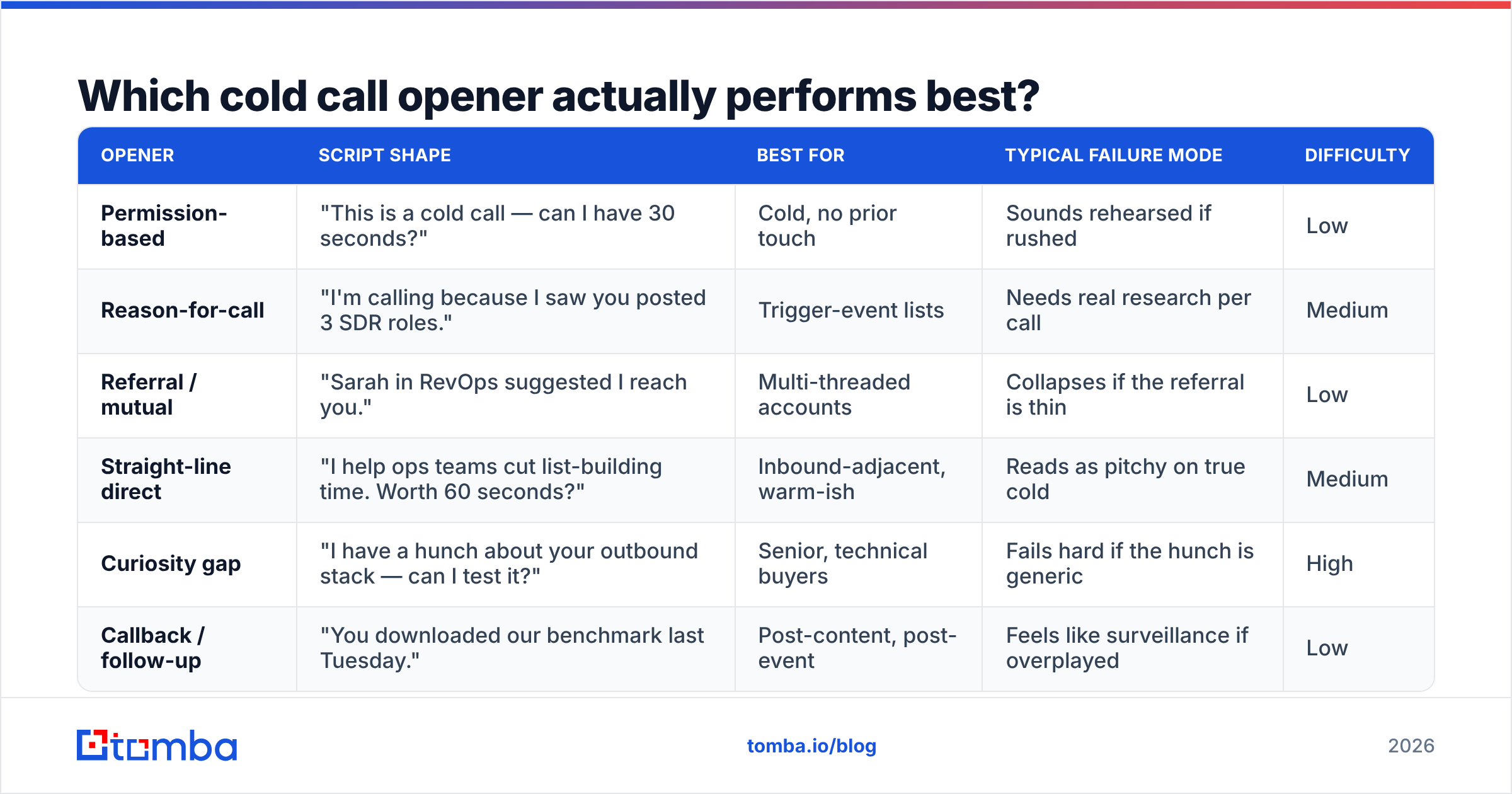
There is no universal winner, but there is a clear ranking by intent and prospect type. Here's how the six most common openers compare on real-world usage.
| Opener | Script shape | Best for | Typical failure mode | Difficulty |
|---|---|---|---|---|
| Permission-based | "This is a cold call — can I have 30 seconds?" | Cold, no prior touch | Sounds rehearsed if rushed | Low |
| Reason-for-call | "I'm calling because I saw you posted 3 SDR roles." | Trigger-event lists | Needs real research per call | Medium |
| Referral / mutual | "Sarah in RevOps suggested I reach you." | Multi-threaded accounts | Collapses if the referral is thin | Low |
| Straight-line direct | "I help ops teams cut list-building time. Worth 60 seconds?" | Inbound-adjacent, warm-ish | Reads as pitchy on true cold | Medium |
| Curiosity gap | "I have a hunch about your outbound stack — can I test it?" | Senior, technical buyers | Fails hard if the hunch is generic | High |
| Callback / follow-up | "You downloaded our benchmark last Tuesday." | Post-content, post-event | Feels like surveillance if overplayed | Low |
The permission-based opener is the safest default because it does something the others don't: it names the awkwardness out loud. Chris Voss's negotiation work at the Black Swan Group calls this an accusation audit — you say the objection before your counterpart does, and it loses its charge. In a cold call, the unspoken objection is always "why are you interrupting me?" Answer it in the first line and you defuse it.
The reason-for-call opener outperforms permission-based when — and only when — your reason is genuinely specific. "I saw your team grew from 4 to 11 reps since January" is a reason. "I noticed you're in the fintech space" is filler wearing a reason's clothes.
What should you actually say? Six scripts you can steal#
1. The permission-based opener (default)
"Hi Dana, this is Marcus at Tomba. I'll be honest — this is a cold call. Want to hang up, or give me 30 seconds and then decide?"
Then stop talking. The pause is doing work. Roughly two-thirds of prospects will say some version of "go ahead," mostly because the candor is unexpected.
2. The trigger-event opener
"Hi Dana, Marcus from Tomba. I'm calling because I saw you opened three SDR roles this month. When teams scale that fast, list-building usually becomes the bottleneck before the reps do. Is that landing anywhere close?"
3. The referral opener
"Hi Dana — Marcus at Tomba. Sarah on your RevOps team mentioned you own the data-quality side. She said you'd be the person to ask about bounce rates. Did she steer me right?"
4. The straight-line opener
"Dana, Marcus from Tomba. I'll be direct: we cut list-building time for outbound teams by about half. That may or may not be a problem you have. Sixty seconds to find out?"
5. The curiosity-gap opener
"Hi Dana, this is Marcus. Strange question to open with — how much of your outbound list are you actually able to verify before it goes out? I ask because I looked at your domain and I have a guess."
6. The callback opener
"Dana, Marcus at Tomba. You pulled our deliverability benchmark last Tuesday — I'm not calling to sell you anything about it, I'm calling because most people who download it are fighting the same specific problem. Can I check if that's you?"
Notice the shared structure: every one of them ends with a question, and every question is short enough to answer in one breath.
What should you never say in the first ten seconds?#
Three lines do measurable damage, and reps use all three constantly.
- "How are you today?" — It signals script. Your prospect has heard this exact phrase from every dialer that ever called them. It triggers the brush-off reflex before you get to your reason.
- "Did I catch you at a bad time?" — You are handing them a scripted exit. Yes, some trainers defend it as a negotiation-style no-oriented question, but in practice the "yes, it is" rate is brutally high on true cold lists. The permission ask does the same job without pre-loading the escape hatch.
- "I'm reaching out because I wanted to see if..." — Twelve words of throat-clearing. Cut the wind-up and lead with the reason itself.
Also avoid stacking your title, your company's funding round, and your product category into one sentence. Each additional clause before your first question drops your odds of getting to a second question.
Does your data matter more than your script?#
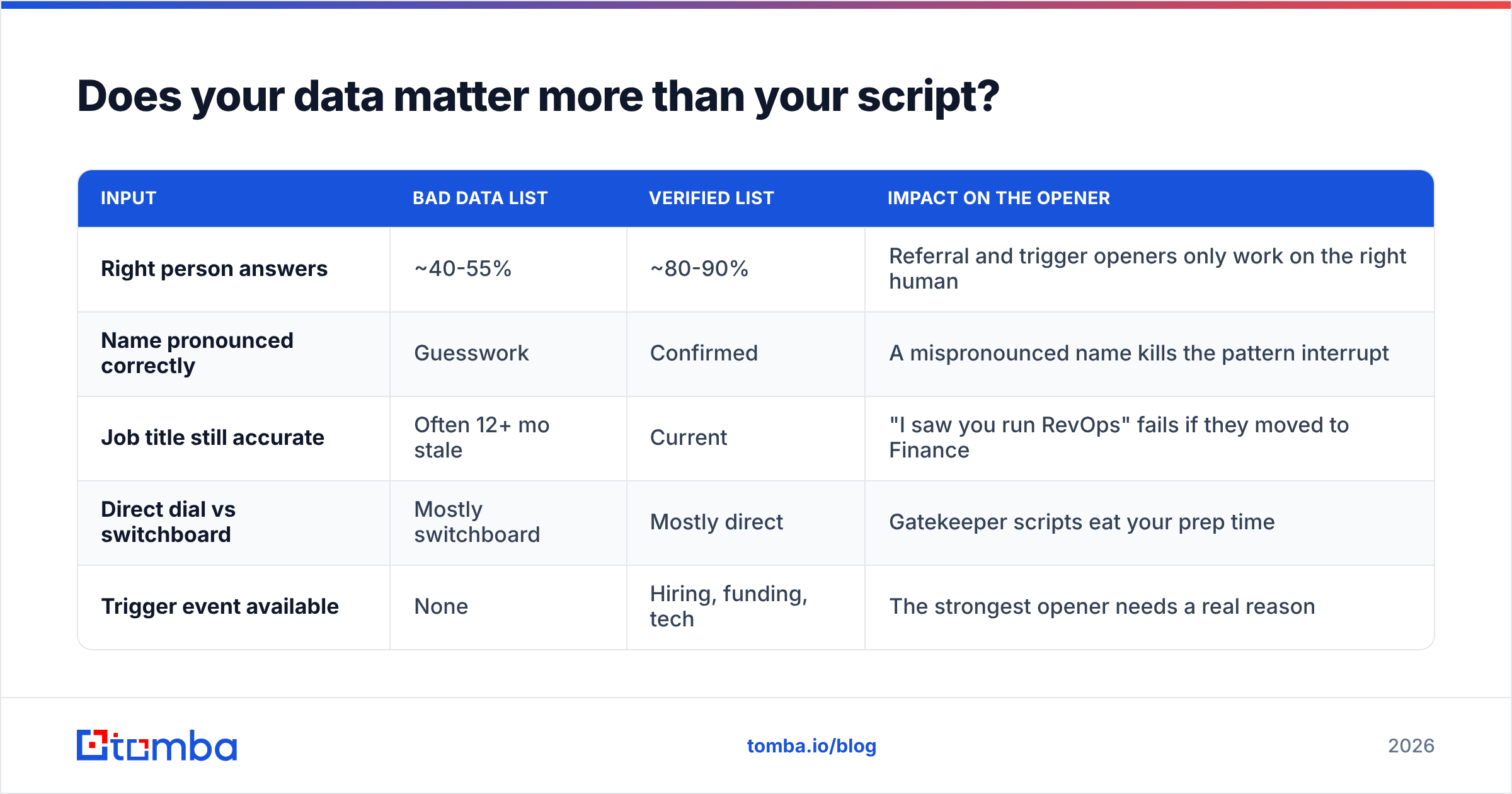
Yes — and it's not close. Here is the uncomfortable arithmetic: if 30% of your numbers are wrong or stale, your best possible opener runs on 70% of your dials. A merely decent opener on a clean list beats a brilliant opener on a rotten one, every time.
| Input | Bad data list | Verified list | Impact on the opener |
|---|---|---|---|
| Right person answers | ~40-55% | ~80-90% | Referral and trigger openers only work on the right human |
| Name pronounced correctly | Guesswork | Confirmed | A mispronounced name kills the pattern interrupt |
| Job title still accurate | Often 12+ mo stale | Current | "I saw you run RevOps" fails if they moved to Finance |
| Direct dial vs switchboard | Mostly switchboard | Mostly direct | Gatekeeper scripts eat your prep time |
| Trigger event available | None | Hiring, funding, tech | The strongest opener needs a real reason |
This is where prep pays off before you touch a phone. Before a call block, run your target accounts through domain search to confirm who actually sits in the function you're targeting, pull direct numbers with a phone finder, and validate the numbers with a phone validator so you're not burning dials on disconnected lines. Then use data enrichment to attach the trigger — headcount change, new tooling, recent funding — that becomes your reason-for-call sentence.
If your workflow is email-first with calling as the follow-up, verifying the address with an email verifier first tells you whether the contact record is alive at all before you spend a dial on it.

How do you handle the first objection after your opener?#
Assume it's coming. The opener's job isn't to prevent objections — it's to earn you the right to answer one.
The three you'll hear most, and what to do:
- "Not interested." Almost always reflexive, fired before they heard you. Respond calmly: "Totally fair — you don't know what this is yet. One sentence and then I'll let you go." Then deliver your single most specific line and stop.
- "Send me an email." Take the win, but qualify it: "Happy to. So I don't send you something useless — is list quality actually a live problem, or is this a 'get me off the phone' email?" Said warmly, this gets a real answer surprisingly often.
- "How did you get my number?" Answer directly and without apology: "Public sources plus a data provider — nothing shady. Want me to explain why I picked you specifically?" Defensiveness here reads as guilt.
The pattern in all three: acknowledge, compress, ask again. Never argue, never re-pitch louder.
How do you practice and measure your opener?#
Treat it like a single-variable experiment, because that's what it is.
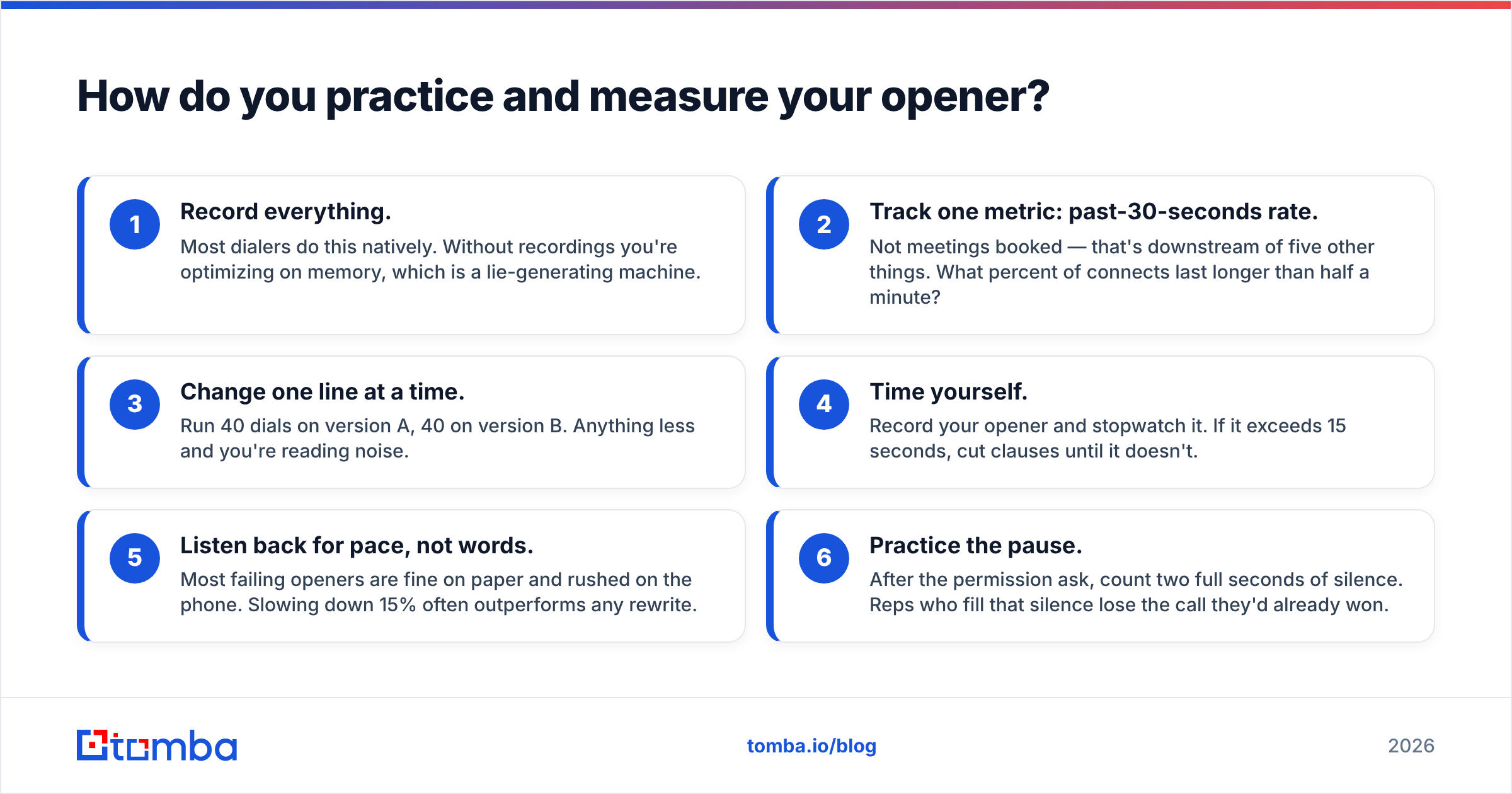
- Record everything. Most dialers do this natively. Without recordings you're optimizing on memory, which is a lie-generating machine.
- Track one metric: past-30-seconds rate. Not meetings booked — that's downstream of five other things. What percent of connects last longer than half a minute?
- Change one line at a time. Run 40 dials on version A, 40 on version B. Anything less and you're reading noise.
- Time yourself. Record your opener and stopwatch it. If it exceeds 15 seconds, cut clauses until it doesn't.
- Listen back for pace, not words. Most failing openers are fine on paper and rushed on the phone. Slowing down 15% often outperforms any rewrite.
- Practice the pause. After the permission ask, count two full seconds of silence. Reps who fill that silence lose the call they'd already won.
For the broader picture on how call activity feeds your funnel, G2's sales software category is a reasonable place to compare dialers and engagement platforms against what your team already runs. And if you want the underlying communication research rather than sales-blog folklore, the Wikipedia entry on cold calling is a decent neutral starting point on the practice's history and regulatory constraints.
Do openers change by seniority and industry?#
They do, in a predictable direction: the more senior the buyer, the shorter and blunter the opener should be.
| Buyer level | Opener length | Best fit | Tone |
|---|---|---|---|
| SDR / IC | 12-15 sec | Permission-based | Friendly, casual |
| Manager | 10-12 sec | Trigger-event | Peer-to-peer |
| Director / VP | 8-10 sec | Straight-line | Direct, no warm-up |
| C-level | 6-8 sec | Referral or curiosity | Terse, respectful of time |
Industry matters less than people claim, with two exceptions. Regulated sectors — finance, healthcare, government — respond better to openers that name compliance or process early. And technical buyers (engineering, IT, security) reward specificity brutally: a generic curiosity opener that would charm a CMO reads as a wasted question to a head of infrastructure.
What does a full opening sequence look like end to end?#
Here's the whole first 45 seconds, assembled:
You: "Hi Dana, this is Marcus at Tomba. I'll be honest — this is a cold call. Want to hang up, or give me 30 seconds and then decide?"
Dana: "...Go ahead."
You: "Appreciate it. I'm calling because I saw your team went from four reps to eleven since January. Every ops lead I talk to at that stage tells me the same thing — the reps ramp faster than the list does, so people end up calling stale numbers. Is that anywhere near what's happening on your side?"
Dana: "Somewhat, yeah."
You: "Where does it hurt more — finding the contacts, or trusting the ones you already have?"
That last question is the pivot from opener to discovery. You've spent under 45 seconds, made two claims, asked three questions, and pitched nothing. That's the shape of a call that gets a second one.
Ready to make your openers land?#
Your script can only be as good as the record you're calling. Confirm the person still holds the role, get the direct number instead of the switchboard, and walk in with a real reason for the call — that's what turns a generic opener into a specific one. Tomba Email Finder gives you verified contact records and the enrichment context that fuels your reason-for-call line, and the free tier includes 25 searches a month so you can test it against a real call block before committing. Check Tomba pricing when you're ready to scale past that — Starter runs $49/mo.
Fix the data, then fix the first eight seconds. In that order.
Related guides#
// get started
Find, verify and enrich your first contacts today
Start on the free plan with 25 searches a month, then scale when your team is ready.
Free plan · No credit card required · GDPR & CCPA
// about the author