How To Start A Cold Calling Business In 2026: Full Playbook
A step-by-step breakdown of what it actually costs to launch a cold calling agency in 2026 — pricing models, dialer stack, data sourcing, compliance, and the margins nobody publishes.
TL;DR
- A cold calling business is sellable in 2026 because most B2B teams have abandoned the phone — connect rates are low, but competition on the channel is lower still.
- Realistic startup cost: $600–$2,400 for month one (dialer, numbers, data, CRM, LLC). You do not need an office, a team, or a call center.
- Pricing model matters more than call volume. Pay-per-appointment burns cash; a retainer plus performance bonus is where agencies survive past month six.
- Your data layer is the whole business. Bad phone numbers mean 4% connect rates and churned clients — verify contacts before they hit the dialer.
- Compliance (TCPA, DNC, state calling windows, STIR/SHAKEN) is not optional. One FCC complaint pattern can get your numbers flagged as "Scam Likely" permanently.
What Is A Cold Calling Business, Exactly?#
A cold calling business sells outbound phone conversations as a service. You take a client's ideal customer profile, build or buy a contact list, dial it, qualify the prospects, and hand back booked meetings or qualified opportunities. The client's account executives close.
That's the whole model. It is deliberately narrow — you are not doing full-funnel marketing, you are not writing their email sequences (though many agencies bolt that on later), and you are not closing deals.
Three variants exist in the market:
- Appointment setting — you book calendar slots. Most common, easiest to sell, hardest to price profitably.
- SDR-as-a-service — you place dedicated reps on a client account, often 20–40 hours/week. Higher retainers, higher operational burden.
- List qualification / data verification calling — you call to confirm decision-maker identity, tech stack, budget cycle, or intent. Lower glamour, absurdly good margins, and almost nobody markets it.
The third one is underrated. A client with 12,000 stale CRM records will pay $2–$4 per record for confirmed contact data, and each call takes 90 seconds because you're not selling anything.
Why Start A Cold Calling Business In 2026?#
Because everyone else quit. Email inboxes hit saturation somewhere around 2023, and by 2026 the average B2B buyer receives dozens of automated sequences a week while receiving almost no phone calls that aren't robocalls.
The numbers that matter:
- Connect rates on verified mobile numbers run roughly 3–8x higher than on switchboard landlines.
- Multi-touch sequences that include a call step consistently outperform email-only sequences on meeting-booked rate — HubSpot's sales research has tracked this pattern for years.
- Client acquisition cost for you is low: your own service is the demo. You cold call to win cold calling clients.
That last point is the real unlock. You can start with zero marketing spend, because your prospecting activity is your portfolio. Book 10 meetings for yourself and you have a case study.
The counterargument you'll hear: "Nobody answers the phone anymore." Partly true. Landline pickup is dismal. Mobile pickup for a number that isn't flagged, called during the prospect's local business hours, from an area code they recognize, is a completely different statistic. The channel didn't die — the lazy version of it did.
What Does It Actually Cost To Start?#
Here is the honest month-one budget. No office, no employees, solo operator.
| Line item | Budget option | Serious option | Notes |
|---|---|---|---|
| Business entity (LLC) | $50–$300 | $500 (with registered agent) | Required before you sign client contracts |
| Dialer / VoIP | $25/mo (JustCall solo) | $150/mo (Orum, Nooks parallel dialer) | Parallel dialers 3-5x your talk time |
| Phone numbers | $2–$5/number/mo | $60/mo (10-15 rotating numbers) | Number rotation prevents spam flagging |
| Contact data | $49/mo | $99–$249/mo | See data section below |
| CRM | $0 (HubSpot free) | $25–$99/mo (Pipedrive, Close) | Close.com is built for callers |
| Call recording + coaching | $0 | $80/mo (Gong-lite tools) | Skip until you have 2+ reps |
| E&O / general liability | $0 | $45/mo | Enterprise clients will ask |
| Month-one total | ~$600 | ~$2,400 | Excludes your own time |
Notice what isn't there: an office, a website redesign, a logo, paid ads. You need a functioning phone, a clean list, and a calendar link. Everything else is procrastination with a receipt.
The one line I'd never cut is data. A $49/mo data subscription that gives you accurate direct contacts beats a free scraped list that burns 200 dials on disconnected numbers. Your cost per conversation is the metric that decides whether this business works.
How Do You Get Contact Data That Actually Connects?#
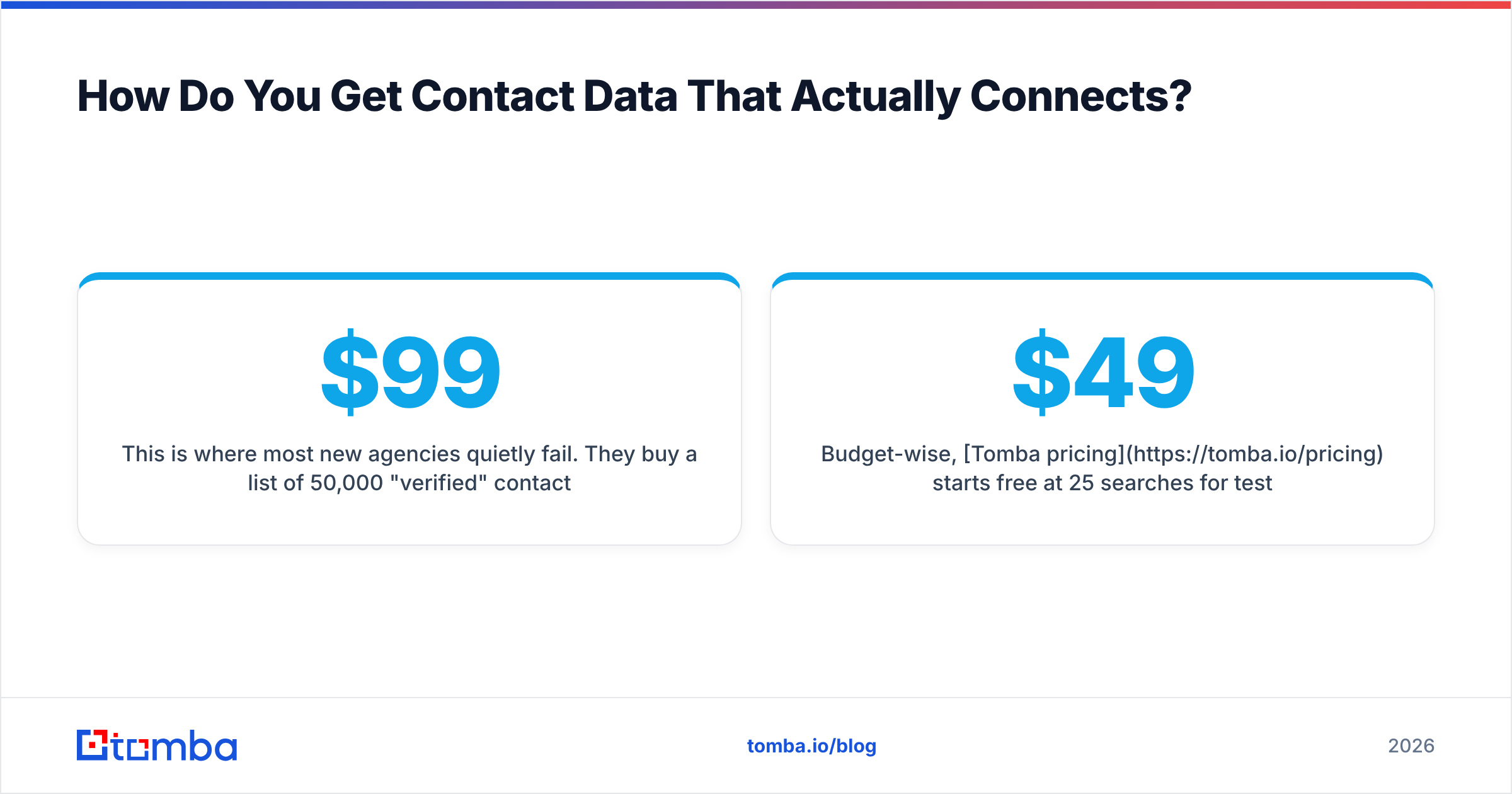
This is where most new agencies quietly fail. They buy a $99 list of 50,000 "verified" contacts, load it into a dialer, and discover that 40% of the numbers are main switchboards, 20% are disconnected, and a chunk of the emails bounce when they try to follow up.
Build your data layer in three steps:
- Define the account list first, not the contact list. Pull companies by firmographics — industry, headcount, tech stack, funding stage, hiring signals. A 400-company list you understand beats a 40,000-company list you don't.
- Find the right people at those companies. Use a domain search to pull every discoverable contact at a target domain, then filter to the two or three titles who actually own the problem you're calling about.
- Verify before you dial. Run contacts through an email verifier for the follow-up channel and a phone validator to confirm the number is live and correctly typed as mobile vs. landline. Mobile-vs-landline classification alone will swing your connect rate more than any script change.
A practical workflow for an agency serving multiple clients: keep one enrichment stack and reuse it across accounts. Pull the account list, enrich with contact enrichment to fill in titles, LinkedIn URLs, and company size, then push clean records into the dialer. Charging clients a small data pass-through fee on top of your retainer is standard and defensible — you're doing real work.
Budget-wise, Tomba pricing starts free at 25 searches/month for testing, then $49/mo Starter, $99/mo Growth, and $249/mo Pro. For a solo agency running 1,500–3,000 dials a month, the Growth tier is usually the right fit. Data providers like BookYourData are also a solid option when you want pay-as-you-go list purchasing rather than a subscription — plenty of agencies run both, using a subscription tool for targeted lookups and a bulk provider for volume campaigns.
How Should You Price A Cold Calling Service?#
Pricing kills more of these businesses than bad calling does. Here's the comparison every founder should run before quoting anyone.
| Model | Typical rate | Cash flow | Risk to you | Best for |
|---|---|---|---|---|
| Pay per appointment | $80–$250 per booked meeting | Lumpy, back-loaded | High — you absorb list and dialer cost | Proven niche, tight ICP, high show rates |
| Monthly retainer | $2,000–$6,000/mo per client | Predictable | Low | Everyone, especially months 1–12 |
| Retainer + bonus | $1,500 base + $75/meeting | Predictable with upside | Medium | The sweet spot for most agencies |
| Hourly / per-dial | $25–$45/hr or $0.60–$1.20 per dial | Very predictable | Very low | Data verification calling, enterprise pilots |
| Revenue share | 5–15% of closed deal | Terrible early | Extreme | Only with clients you've worked with for a year+ |
Start with retainer plus a small performance bonus. Pure pay-per-appointment sounds attractive to clients because it feels risk-free, but it puts every variable outside your control — their offer, their calendar, their sales rep's follow-up — onto your P&L. If their AE no-shows the meeting you booked, you still ate the dial cost.
One clause to write into every contract: a definition of a qualified meeting. Company size range, title, confirmed pain, confirmed calendar acceptance. Without it, you will spend month three arguing about whether a meeting counted.
What Does The Operating Stack Look Like?#
Four layers, in order of how much they affect results:
- Data layer — sourcing, enrichment, verification. Tomba, ZoomInfo, BookYourData, Apollo. This decides your connect rate.
- Dial layer — the dialer, the numbers, the local presence rotation. Orum, Nooks, JustCall, Kixie. This decides your conversations per hour.
- Record layer — CRM plus call logging. Close, HubSpot, Pipedrive. This decides whether you can prove your value at renewal.
- Follow-up layer — email and LinkedIn after the call. This is where 60% of your booked meetings actually get confirmed.
That last one surprises people. The call opens the door; the follow-up email that lands 90 seconds after you hang up is what gets the calendar invite accepted. Have a cold email template library ready and send from a warmed domain — a call-to-email handoff that lands in spam wastes the entire dial.
For parallel dialing specifically: a parallel dialer calls 3–5 numbers simultaneously and drops you into whichever one answers. It roughly triples talk time per hour. It also triples the rate at which you burn through a list, which is exactly why the data layer has to be right first. Feeding garbage into a parallel dialer just means you reach the bottom of your bad list faster.
What Compliance Rules Will Bite You?#
Assume you will get this wrong at least once. Learn the four that carry real consequences.
TCPA (US). Governs automated dialing and prerecorded messages. B2B calls to business lines have more latitude than B2C, but the distinction blurs when the "business line" is a personal mobile — which, in 2026, most of them are. The FCC's consumer guidance on unwanted calls is the primary source; read it rather than a blog summary.
Do Not Call registries. National DNC plus state-level lists. Scrub before every campaign, not once at onboarding. Keep the scrub logs — they're your defense.
Calling windows. 8am–9pm in the prospect's local time zone, and some states are stricter. Your dialer should enforce this automatically. If it doesn't, replace it.
STIR/SHAKEN and number reputation. Carriers now score your outbound numbers. High call volume with low answer rates and short durations gets you tagged "Scam Likely," which is effectively a death sentence for that number. Mitigations: rotate 10–15 numbers, keep per-number daily volume under about 80 dials, register your numbers with the Free Caller Registry, and — most importantly — call better-targeted lists so your answer rate stays healthy.
Outside the US, GDPR governs EU calling and requires a legitimate-interest assessment plus a documented opt-out path. Canada has CASL. Do not assume a US-legal campaign is legal in Berlin.
How Do You Get Your First Five Clients?#
Use the service on yourself. That's not a cute line — it's the highest-conversion path available, and it doubles as proof.
The sequence that works:
- Pick a vertical you can speak fluently. Not "B2B SaaS." Something like "MSPs in the Midwest with 15–60 employees" or "commercial roofing contractors." Narrow enough that your script references things only an insider knows.
- Build a 300-account target list in that vertical. Use find email addresses and a LinkedIn finder to map decision-makers — usually the founder, VP Sales, or head of growth.
- Call them with a specific, provable offer. "I book meetings for MSPs. I'll run 200 dials into your ICP this week at no charge and you keep whatever books." A free pilot converts far better than a pitch deck.
- Convert pilots to retainers with data, not vibes. Show dials, connects, conversations, meetings, and cost-per-meeting. Clients renew on a spreadsheet, not on enthusiasm.
- Ask every happy client for one referral into their peer network. In tight verticals, referral is a shorter path than any cold channel — including your own.
Expect a pilot-to-paid conversion around 25–40% if your targeting is tight. Expect roughly 15% if you're calling "any company that might need more leads."
What Are The Realistic Margins?#
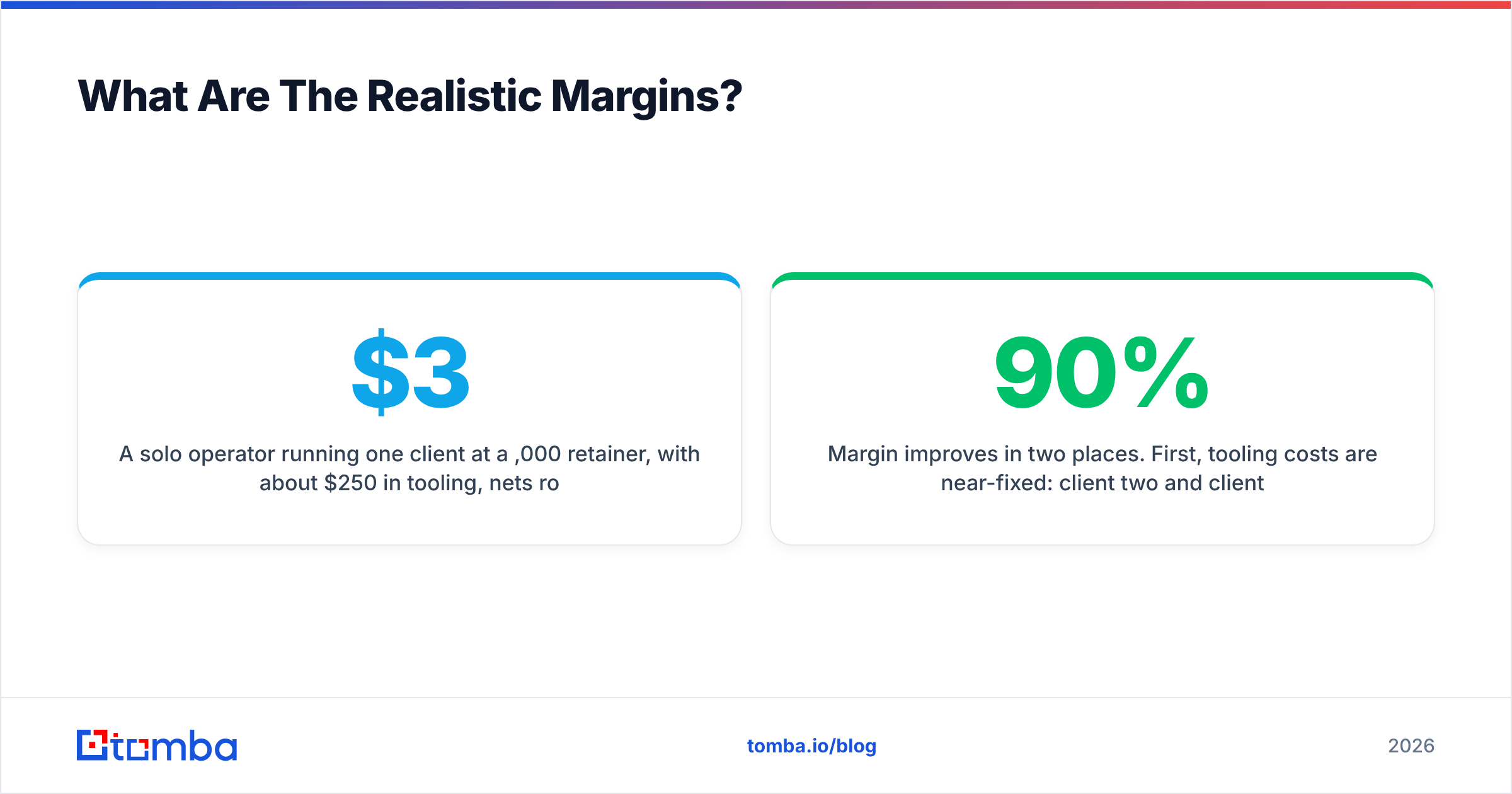
A solo operator running one client at a $3,000/mo retainer, with about $250/mo in tooling, nets roughly $2,750 before taxes — for maybe 60 hours of work. That's $45/hour, and it's the floor.
Margin improves in two places. First, tooling costs are near-fixed: client two and client three ride the same dialer and mostly the same data subscription, so incremental margin approaches 90%. Second, when you hire, a trained rep on $18–$25/hour handling 2 clients at $3,000 each generates roughly $6,000 in revenue against about $3,200 in fully-loaded cost.
The trap is hiring before your process is documented. If your scripts, objection handling, list-building steps, and QA rubric live only in your head, your first hire will underperform and you'll conclude that "good callers are impossible to find." They aren't. Undocumented processes are impossible to transfer.
Track four numbers weekly per client: dials, connect rate, conversation-to-meeting rate, and cost per meeting booked. If connect rate drops, fix the data. If conversation-to-meeting drops, fix the script or the offer. Those two diagnoses cover almost everything that goes wrong.
Where Should You Start This Week?#
Register the entity, pick the vertical, and build a 300-account list before you buy a single tool. The list will tell you whether the vertical is reachable — if you can't find direct contacts for the decision-makers you need, the campaign is dead before the first dial and you've spent nothing finding out.
That's the sequencing that separates agencies that survive from agencies that spend $2,000 on a dialer they cancel in week six.
Start with the data. Tomba's Email Finder gives you verified professional contacts by domain, name, or company, with a free tier at 25 searches a month so you can validate your target vertical before committing a dollar. Pair it with the domain search to map entire org charts, and you'll walk into your first client pilot with a list that actually connects — which is, in the end, the only thing you're really selling.
Related guides#
Ready to find emails that actually work?
Join 150,000+ professionals who stopped guessing and started sending. Free credits on signup — no credit card required.
Get the Tomba newsletter
Practical outbound tactics and product updates — once every two weeks.
About the author